Amazon FBA Removal, Disposal and Liquidation Fees 2026
R
RenéFreelance Amazon Editor
|
15 min read
Last updated: Nov 08, 2026
Aged-inventory surcharges (Amazon's current name for what used to be called long-term storage fees) are building on a batch of slow-moving inventory, and the Recommended Removal report is nudging you toward a decision: ship it back, destroy it, or liquidate it. The three options have genuinely different fees attached, a 2026 rate change already shifted one of them, and the right call depends on numbers most sellers never actually run. This guide lays out the exact 2026 fee tables for removal, disposal and liquidation orders, how a liquidation payout is really calculated, and a worked comparison on the same batch of inventory so you can see which option actually nets the most money.
An Amazon FBA removal order ships inventory back to you, has it donated or recycled, or liquidates it through Amazon's FBA Liquidations program, and each option has a different fee. As of January 15, 2026, the smallest standard-size removal and disposal fee tier (0 to 0.5 lb) is $0.84 per unit, down from $1.04; larger tiers are unchanged. Liquidation charges a 15% referral fee on the gross recovery value plus a separate per-unit processing fee, and the gross recovery value itself is typically only 5% to 10% of the item's worth, so liquidation returns a small net amount rather than a full refund of your cost.
The three removal order outcomes, and what each one actually does
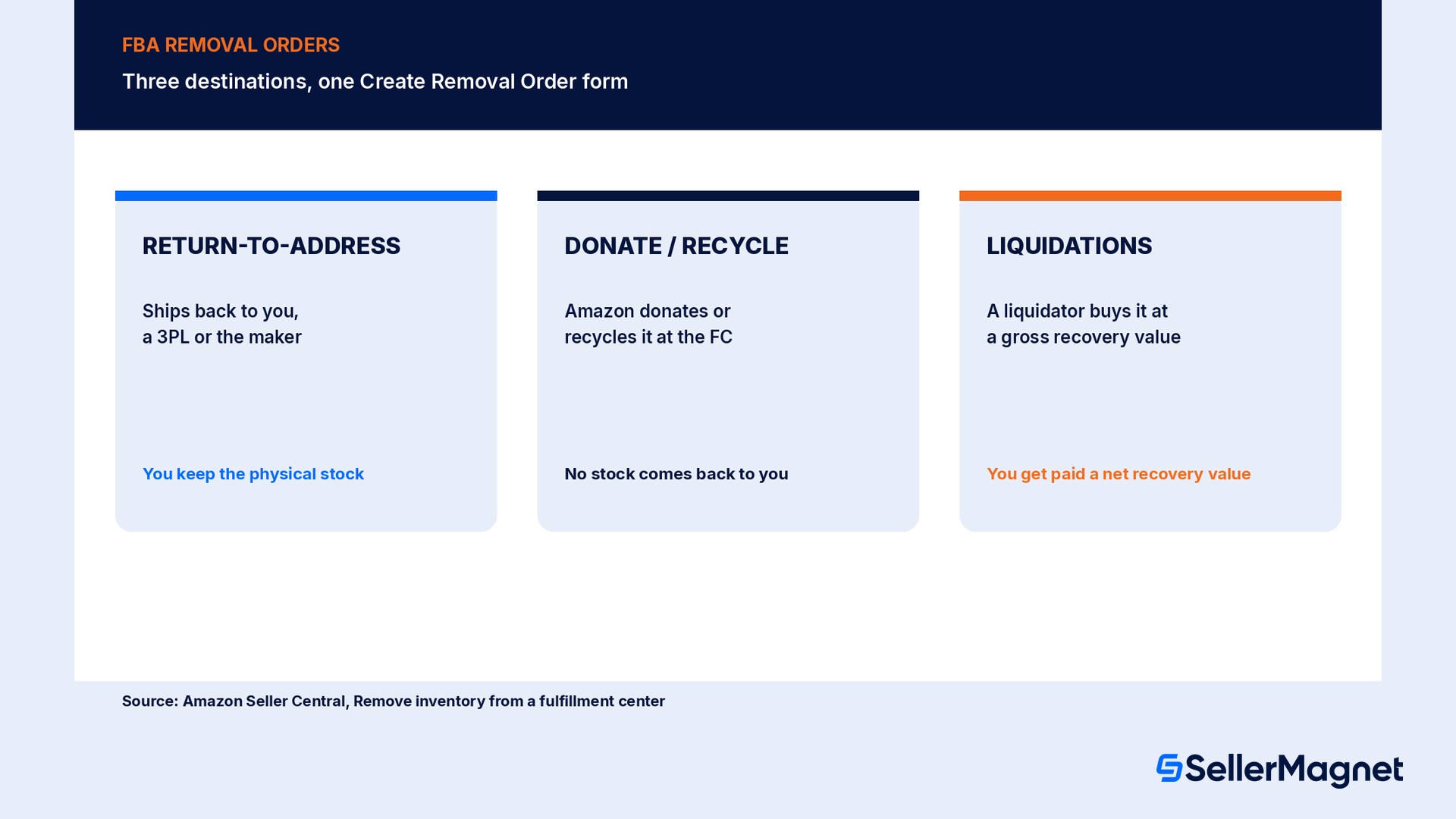
Every removal order starts the same way, from an inventory planning page or the Recommended Removal report, by selecting units and choosing Create removal order. What differs is the destination you pick inside that one form.
Option
What happens
When it fits
Return-to-address
Inventory ships back to an address you specify (your own warehouse, a 3PL, the manufacturer, or a recycling center you've arranged)
You want the physical stock back, or plan to resell, repackage or dispose of it yourself
Donate/Recycle
Amazon donates or recycles the inventory at the fulfillment center; no inventory comes back to you
Low-value stock not worth shipping back or liquidating; avoids disposal logistics entirely
Liquidations
A contracted liquidator buys the inventory at a gross recovery value, Amazon deducts two fees, and pays you the net recovery value
Stock still has resale value but is not moving on your own listing; recovers some cash instead of none
Source: Remove inventory from a fulfillment center, an official Amazon Seller Central help page. One detail that affects timing decisions: once a removal order is successfully created, Amazon does not charge storage fees on those units during the processing period until the order completes, so submitting the order promptly (rather than deciding and then waiting) stops the storage-fee clock sooner.
The 2026 removal and disposal fee table
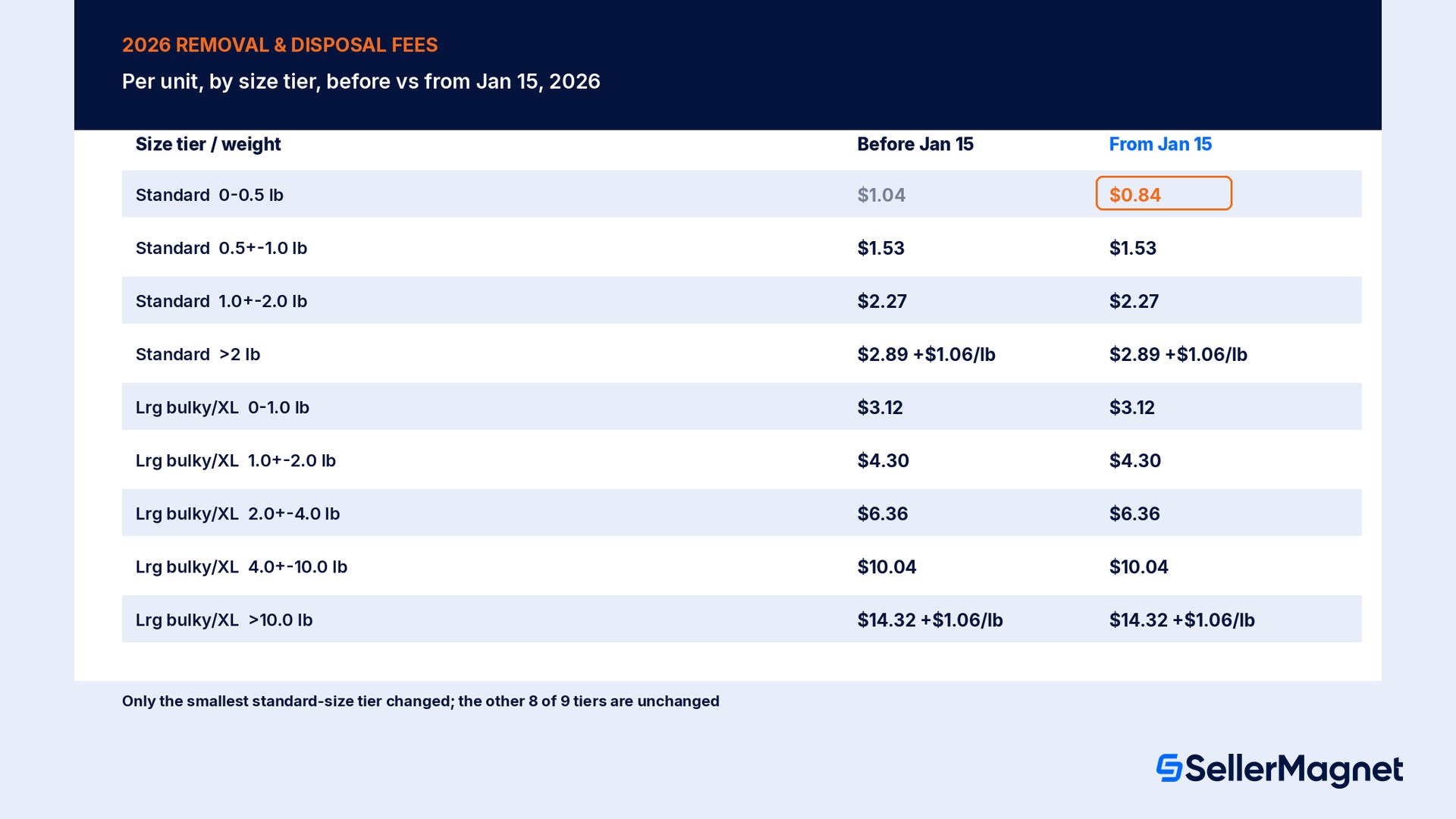
Removal and disposal fees are calculated at the moment the order is placed and charged when the shipment actually leaves the fulfillment center. If you place the order before January 15, 2026, the pre-2026 fee applies even if the shipment itself completes after that date; place it on or after January 15, 2026, and the new rate applies.
Size tier
Shipping weight
Before Jan 15, 2026
From Jan 15, 2026
Standard-size
0 to 0.5 lb
$1.04
$0.84
Standard-size
0.5+ to 1.0 lb
$1.53
$1.53
Standard-size
1.0+ to 2.0 lb
$2.27
$2.27
Standard-size
More than 2 lb
$2.89 + $1.06/lb over 2 lb
$2.89 + $1.06/lb over 2 lb
Large bulky, extra-large, special handling*
0 to 1.0 lb
$3.12
$3.12
Large bulky, extra-large, special handling*
1.0+ to 2.0 lb
$4.30
$4.30
Large bulky, extra-large, special handling*
2.0+ to 4.0 lb
$6.36
$6.36
Large bulky, extra-large, special handling*
4.0+ to 10.0 lb
$10.04
$10.04
Large bulky, extra-large, special handling*
More than 10.0 lb
$14.32 + $1.06/lb over 10 lb
$14.32 + $1.06/lb over 10 lb
*Large bulky and extra-large tiers were previously called Oversize. Special handling items can include apparel, shoes, watches, jewelry and dangerous goods. The same per-unit fee applies whether the order is a removal (return-to-address) or a disposal (donate/recycle); the fee is identical, only the destination differs. Source: 2026 FBA removal, disposal and liquidation order fee changes, an official Amazon Seller Central help page.
Only one tier actually changed in 2026
It is easy to assume a named "2026 fee change" update touches every row of the table. In this case, eight of the nine listed tiers kept their exact prior rate; only the smallest standard-size tier (0 to 0.5 lb) dropped, from $1.04 to $0.84 per unit. Check your own products' actual size tier before assuming the update changes your cost either way.
Worked example: removal/disposal cost on a real batch
Take 500 units in the smallest standard-size tier (0 to 0.5 lb), the one tier the 2026 update actually touched. Before January 15, 2026, removing or disposing of that batch cost $520.00 at the old $1.04-per-unit rate. At the new $0.84-per-unit rate, the identical batch costs $420.00, a difference of $100.00 on this one batch alone. The saving scales directly with volume: a seller regularly removing or disposing of several thousand units a month in this exact tier sees the $0.20-per-unit cut add up meaningfully, even though it looks small per unit.
Batch
Rate
Cost on 500 units
Before Jan 15, 2026
$1.04/unit
$520.00
From Jan 15, 2026
$0.84/unit
$420.00
Difference
$0.20/unit
$100.00
How FBA Liquidations fees actually work
Liquidations is designed to recover some value from inventory you would otherwise remove, dispose of, or let sit under storage fees, but it is worth being precise about how little of the original product value actually comes back, since "liquidation" sounds closer to a markdown sale than it is.
Amazon values the inventory using your sales history and the average FBA selling price (ASP) on Amazon for that ASIN, then a contracted liquidator buys it at a gross recovery value set under Amazon's rates with that liquidator, typically about 5% to 10% of that product value.
Amazon deducts a liquidations referral fee, 15% of that gross recovery value.
Amazon deducts a liquidations processing fee, a flat per-unit amount based on item size and weight (the same size-tier structure as the removal table above, but with its own, lower rates).
You receive the net recovery value, the gross recovery value minus both fees, which should appear in your account within 90 days of submitting the order.
Size tier
Shipping weight
Liquidation processing fee per unit
Standard-size
0 to 0.5 lb
$0.25
Standard-size
0.5+ to 1.0 lb
$0.30
Standard-size
1.0+ to 2.0 lb
$0.35
Standard-size
More than 2 lb
$0.40 + $0.20/lb over 2 lb
Large bulky, extra-large, special handling*
0 to 1.0 lb
$0.60
Large bulky, extra-large, special handling*
1.0+ to 2.0 lb
$0.70
Large bulky, extra-large, special handling*
2.0+ to 4.0 lb
$0.90
Large bulky, extra-large, special handling*
4.0+ to 10.0 lb
$1.45
Large bulky, extra-large, special handling*
More than 10.0 lb
$1.90 + $0.20/lb over 10 lb
Source: FBA Liquidations, an official Amazon Seller Central help page. These liquidation fees are unaffected by the January 2026 removal/disposal fee change; the two fee schedules are separate and move independently.
Worked example: liquidation net recovery on the same 500 units
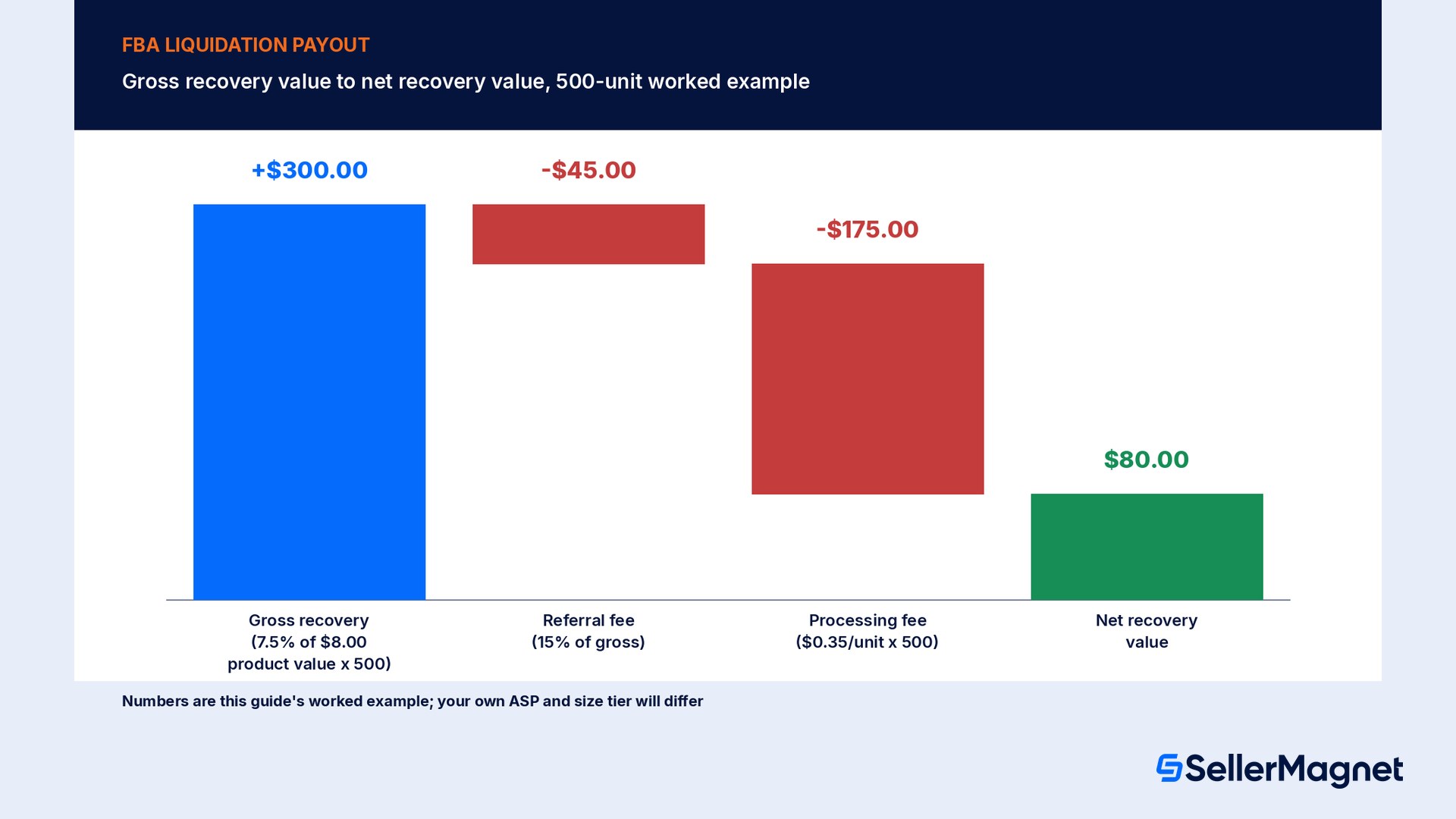
Take the same 500-unit batch, now in the standard-size 1.0-to-2.0-lb tier, with an assumed product value of $8.00 per unit (the value Amazon assigns for this purpose, based on your sales history and average selling price on Amazon, not necessarily your landed cost; use your own ASP). At the midpoint of Amazon's stated 5% to 10% gross recovery range (7.5%), the gross recovery value is $0.60 per unit, or $300.00 total. Amazon then deducts the 15% liquidations referral fee ($45.00) and the $0.35-per-unit liquidations processing fee for this tier ($175.00 total), leaving a net recovery value of $80.00 on a batch Amazon valued at roughly $4,000.
Step
Calculation
Amount
Gross recovery value (7.5% of $8.00 product value x 500 units)
$0.60/unit x 500
$300.00
Liquidations referral fee (15% of gross)
$300.00 x 15%
-$45.00
Liquidations processing fee (1.0-2.0 lb tier)
$0.35 x 500
-$175.00
Net recovery value
Gross minus both fees
$80.00
Liquidation recovers cash, not your product's full value
On this worked batch, liquidation returns about 2% of the $4,000 product value Amazon assigned to it, after fees. That is still better than zero from continued storage fees and an eventual forced disposal, but it is nowhere close to a discounted resale, and sellers who expect liquidation to meaningfully offset a bad buying decision are usually disappointed by the actual deposit.
Removal vs. liquidation: which nets more on the same batch?
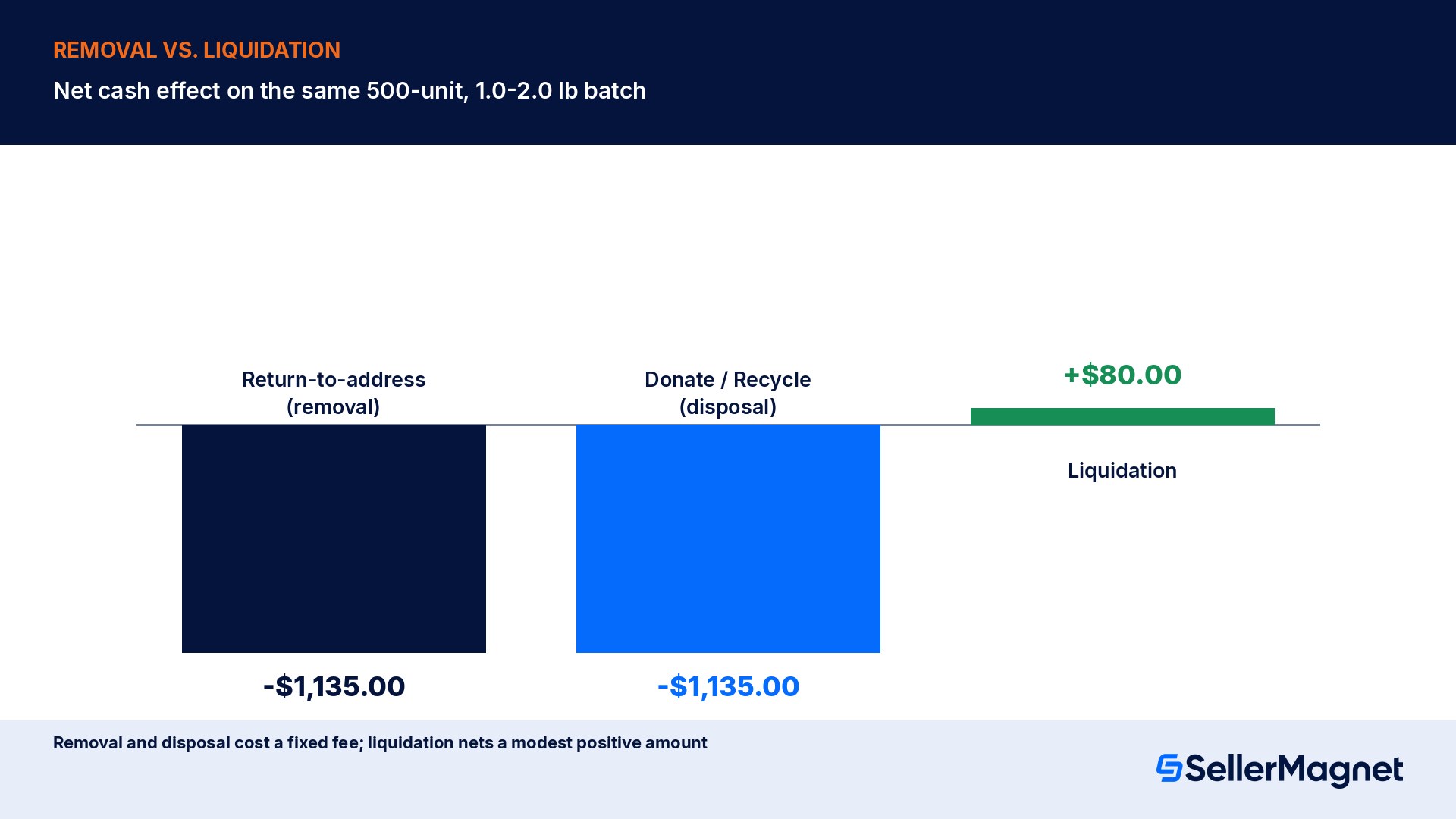
Put the three outcomes side by side on a comparable 500-unit, standard-size 1.0-to-2.0-lb batch. Removal and disposal cost the same $2.27-per-unit fee in 2026 (this tier was not touched by the January update); liquidation costs fees but also pays something back.
Outcome
Net cash effect on 500 units
Return-to-address (removal)
-$1,135.00 (fee only; you keep the physical stock)
Donate/Recycle (disposal)
-$1,135.00 (same fee; no stock returned)
Liquidation
+$80.00 net (at the worked example's 7.5% gross recovery rate and $8.00 product value)
Liquidation wins on pure cash flow in this comparison, but the decision is not only about the fee: Return-to-address is the right call when you genuinely plan to resell the stock elsewhere, repackage it, or the product has a reuse value beyond what a liquidator will pay. Donate/Recycle fits low-value stock where shipping cost would exceed any resale value, or where the units would not qualify for Liquidations in the first place (the program excludes Expired, Defective and Warehouse Damaged inventory). Liquidation is the default better option specifically when the stock still has resale value but is not moving on your own listing and you have no reuse plan for it.
Automating recurring removal decisions
Not every removal decision needs a manual Create Removal Order click. Seller Central lets you set up automatic removals so recurring unsellable inventory is handled on a schedule instead of case by case, and FBA Liquidations specifically supports automated liquidations removals for both fulfillable and unfulfillable inventory, so eligible stock can be routed into the program without a manual order each time.
The usual storage and removal fees still apply under automation; what changes is that a return or a failed inspection no longer sits as unfulfillable inventory accumulating storage fees while someone remembers to submit a manual removal order for it. For a seller processing returns at any real volume, that manual-review gap is usually where avoidable storage-fee cost actually comes from, more than from picking the wrong removal option on any single batch.
A second worked example: a bulkier, heavier batch
The standard-size numbers above understate the gap for bulkier products, since large bulky and extra-large items pay a noticeably higher removal fee than standard-size units at a comparable weight. Take 200 units in the Large bulky, extra-large or special handling tier at 2.0-plus to 4.0 lb, with an assumed product value of $25.00 per unit (again Amazon's assigned value for the liquidation side, not necessarily your landed cost).
Outcome
Fee basis
Total on 200 units
Return-to-address or Donate/Recycle
$6.36/unit removal or disposal fee (unchanged by the 2026 update)
-$1,272.00
Liquidation (gross recovery at 7.5% of $25.00 product value)
$1.875/unit gross, minus 15% referral ($56.25 total) and $0.90/unit processing fee ($180.00 total)
+$138.75 net
The absolute numbers are larger on a bulkier batch, but the relative pattern holds: removal and disposal are a fixed, guaranteed cost with no cash returned, while liquidation nets a modest positive amount after both fees, as long as the product category and condition qualify for the program. The one variable worth checking before assuming liquidation applies is eligibility: Amazon's Liquidations program has its own condition and category restrictions, so confirm a specific SKU is eligible on the Recommended Removal report or the Create Removal Order form before counting on the liquidation payout in your planning.
When this decision is worth auditing across your whole catalog, not just one batch
A single removal decision on one batch is a few hundred or a few thousand dollars either way. The bigger cost most sellers never quantify is the cumulative effect of running this decision badly, or not at all, across dozens of SKUs over a year. Aged-inventory surcharges accrue every month that a slow-moving batch sits unresolved, on top of whatever removal or disposal fee eventually applies, so the real cost of indecision compounds the longer a removal decision is deferred.
Pull the Recommended Removal report at least monthly, not only when a long-term storage fee notice arrives; the report flags candidates before the surcharge actually hits.
Group candidate SKUs by size tier before deciding, since the fee gap between standard-size and large bulky tiers is large enough to change which outcome wins on otherwise similar inventory.
Keep a rough per-SKU average selling price (even a spreadsheet estimate) on hand, alongside your landed cost, so the liquidation net-recovery math in this guide, which runs on product value rather than cost, can be checked in minutes instead of guessed at.
Re-run the comparison whenever Amazon publishes a fee change notice; this guide's January 2026 example shows even a single-tier, $0.20-per-unit change is worth re-checking against your own SKU mix.
Track the real numbers this decision runs on.Profit Analytics shows net profit per order and product after Amazon fees, COGS, shipping, VAT and refunds, with COGS entered per purchase batch (FIFO) or a simple flat cost per unit, so the landed-cost side of a removal-vs-liquidation decision is a real number, not a guess. The Inventory Forecast (included from the Growth tier) flags days of stock left and expected stockout dates from your real sales velocity, the same report that should surface a slow mover early, before storage fees pile up.
Common mistakes that cost more than the removal fee itself
Canceling a removal order expecting the fee pause to continue. It does not: canceled units are not removed from inventory, so they resume accruing monthly aged-inventory surcharges immediately.
Expecting a removal shipment to arrive as a single delivery. Amazon's removal terms require the designated recipient to receive every unit in the order all at once, even when Amazon itself ships the order from several fulfillment centers; if a unit does not arrive with the rest, Amazon may instruct the carrier to dispose of it, with the disposal cost billed to you and no reimbursement.
Comparing only the headline removal fee against the headline liquidation fee. The real comparison is removal's flat per-unit cost against liquidation's net recovery value after both liquidation fees, which the worked examples above show land in very different ranges depending on your product's value and size tier, not your landed cost alone.
Waiting to decide while storage fees keep accruing. Since no storage fee is charged once a removal order is successfully created and processing, the cost of indecision is the ongoing storage fee itself, not the removal fee, which does not change while you wait.
Not setting up automatic removals for recurring unsellable inventory. Amazon's automatic removal settings, including automated liquidations removals for unfulfillable inventory, remove the need to manually create a removal order every time a return comes back damaged, at the usual storage and removal fees.
Decide before storage fees pile up, not after.Lost & Found scans up to two years of your Seller Central data for lost, damaged and unreturned inventory and fee issues, and prepares each reimbursement claim with a template and evidence, so money Amazon owes you on inventory that never cleanly reached a removal decision gets claimed instead of written off. For the restock-timing side of the same inventory, see our Amazon Inventory Forecasting guide, and for the fee that triggers when stock runs too lean instead of too heavy, our Amazon IPI Score guide.
Did Amazon's FBA removal fees go up or down in 2026?
Only the smallest standard-size tier (0 to 0.5 lb) changed, dropping from $1.04 to $0.84 per unit effective January 15, 2026. Every other size tier's removal and disposal fee is unchanged.
Are liquidation fees different from removal fees?
Yes, they are a separate fee schedule. Liquidation charges a 15% referral fee on the gross recovery value plus a lower per-unit processing fee (from $0.25 for the smallest standard-size tier up to $0.40 plus $0.20 per lb over 2 lb for larger standard-size items), while removal and disposal charge a single, higher flat per-unit fee by size tier.
How much money do I actually get back from liquidation?
Amazon states the gross recovery value is typically about 5% to 10% of the product's value (based on your sales history and average selling price, not your cost), and both liquidation fees are then deducted from that gross figure before you receive the net recovery value, so the real payout is a small fraction of the product's value.
Can I cancel a removal order after submitting it?
Only while it is still in Planning status, which usually lasts just a few hours before the order moves to Processing; once it is Processing, it cannot be canceled, and a required removal cannot be canceled at all. Clicking cancel does not guarantee the cancellation went through, so confirm the order's status afterward. Canceled units are not removed from your inventory and would start incurring storage fees again.
Does placing a removal order stop storage fees immediately?
Once a removal order is successfully created, Amazon does not charge storage fees on those units during the processing period until the order is completed, so storage fees effectively pause from the moment the order is placed.
What happens if my removal shipment is not delivered all at once?
By submitting a removal order you agree to receive every unit in that order all at once upon delivery. If the designated recipient does not receive all units together, Amazon may instruct the carrier to dispose of them, and you would pay the disposal cost without any reimbursement.
Should I remove or liquidate slow-moving inventory?
Run both numbers using your own size tier: removal costs a flat per-unit fee and keeps the physical stock for resale or reuse, while liquidation's gross recovery runs on your product's value (not your landed cost) minus both liquidation fees. Liquidation tends to win on pure cash flow when the stock has no reuse plan but still has resale value to a liquidator; removal wins when you have a genuine use for the returned stock.
Stop Juggling Tools. SellerMagnet Combines Everything You Need.