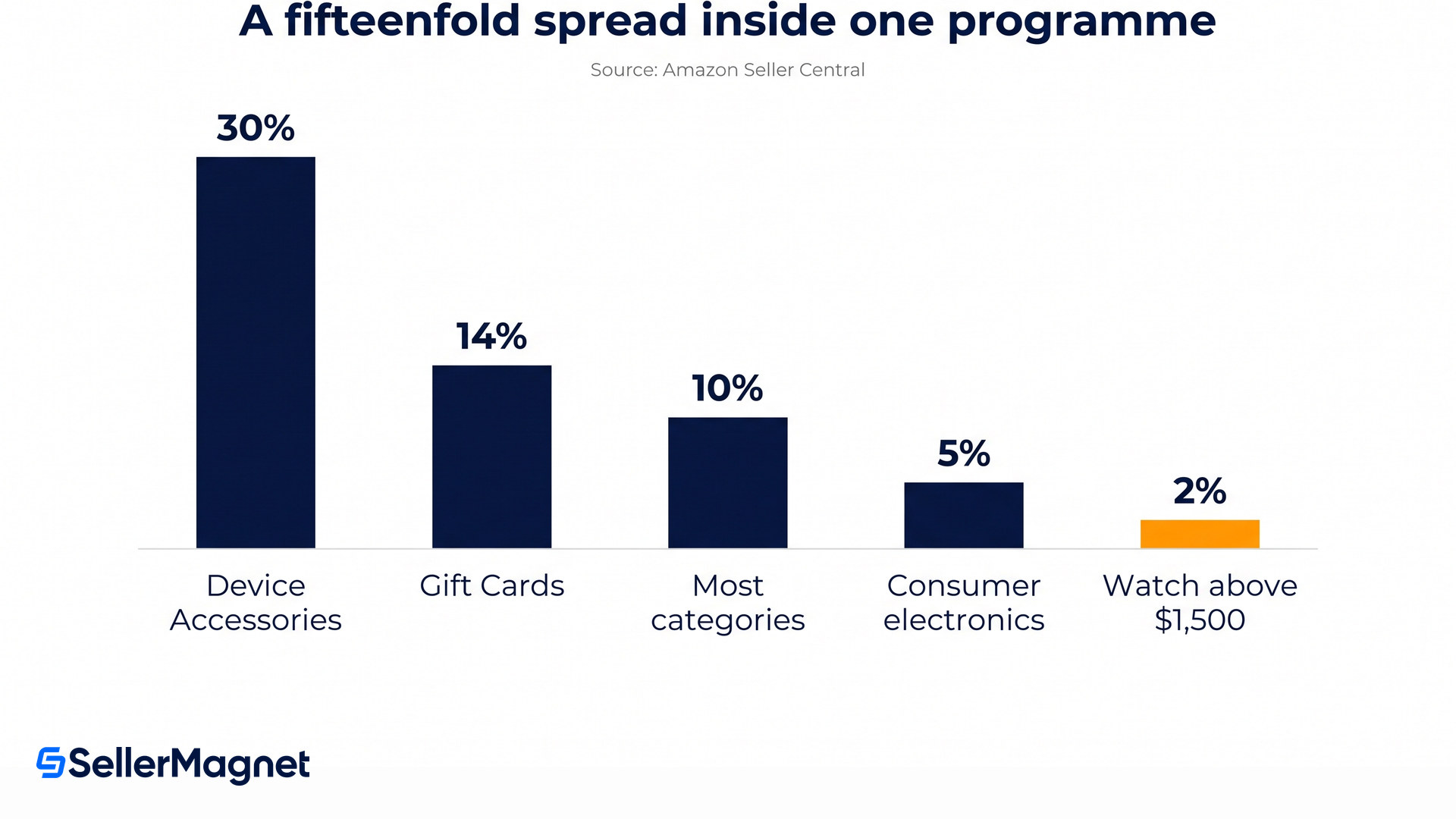
Every guide to the Brand Referral Bonus repeats the same number: an average of 10%. Amazon publishes the actual table, and it runs from 2% to 30% depending on what you sell and how much it costs. Amazon Device Accessories earn 30%. Consumer electronics earn 5%. A watch earns 11% on the first $1,500 and 2% on everything above it. If you have been modelling external traffic on a flat tenth, you have been modelling the wrong business.
The Amazon Brand Referral Bonus credits brand owners roughly ten per cent of sales they drive to Amazon from outside marketing, but the published rate depends on the category and the price. It ranges from two per cent to thirty per cent. The bonus is applied as a credit against referral fees about two months after the sale, and it requires Brand Registry plus an Amazon Attribution tag on the traffic.
What does the bonus actually pay?
The rate depends on your category, and Amazon publishes the whole table. The Brand Referral Bonus help page describes the programme as one that "credits Brands an average of 10% of sales from traffic you have driven to Amazon", then prints a category list where 10% is simply the most common row rather than the rule.
Category
Published rate
What that means
Amazon Device Accessories
30%
Three times the figure everyone quotes
Amazon Explore
20%
The second-highest published row
Gift Cards; Entertainment Collectibles; Fine Art; Jewelry
14%
Jewelry drops to 3% above $250
Clothing & Accessories; Watches
11%
Watches drop to 2% above $1,500
Home & Garden, Kitchen, Toys & Games, Pet Supplies, Everything Else
10%
The row the average comes from
Industrial & Scientific; 3D Printed Products
8%
Base equipment power tools at 8%
Consumer electronics, Personal Computers, Cameras, Cell Phones
5%
Half the headline
Two categories fall off a cliff above a threshold
Several rows are not flat percentages but breakpoints, and two of them fall off a cliff. Jewelry is "14% for the portion of the total sales price up to $250.00, and, 3% for any portion of the total sales price greater than $250.00". Watches are "11% for the portion of the total sales price up to $1,500.00, and, 2% for any portion of the total sales price greater than $1,500.00". Jewelry is where that bites hardest. A $1,000 piece earns 14% on the first $250 and 3% on the rest, which blends to 5.75% against a 14% headline. The watch tier is gentler: a $2,000 watch blends to 8.75%. Work out your own blended rate at your actual average order value before you plan a campaign on the headline figure.
There is also a hedge in Amazon's own wording that deserves attention. The instruction is to "multiply your qualifying sales by the minimum bonus rate in the corresponding product category", and the column is headed "Estimated Bonus Rate". The footnote adds that "Your actual bonus rate can vary based on inputs such as additional shipping and gift wrapping charges". So the table is a floor for estimating rather than a contracted rate, and the real number only appears afterwards, in the weekly report.
When does the bonus actually reach you?
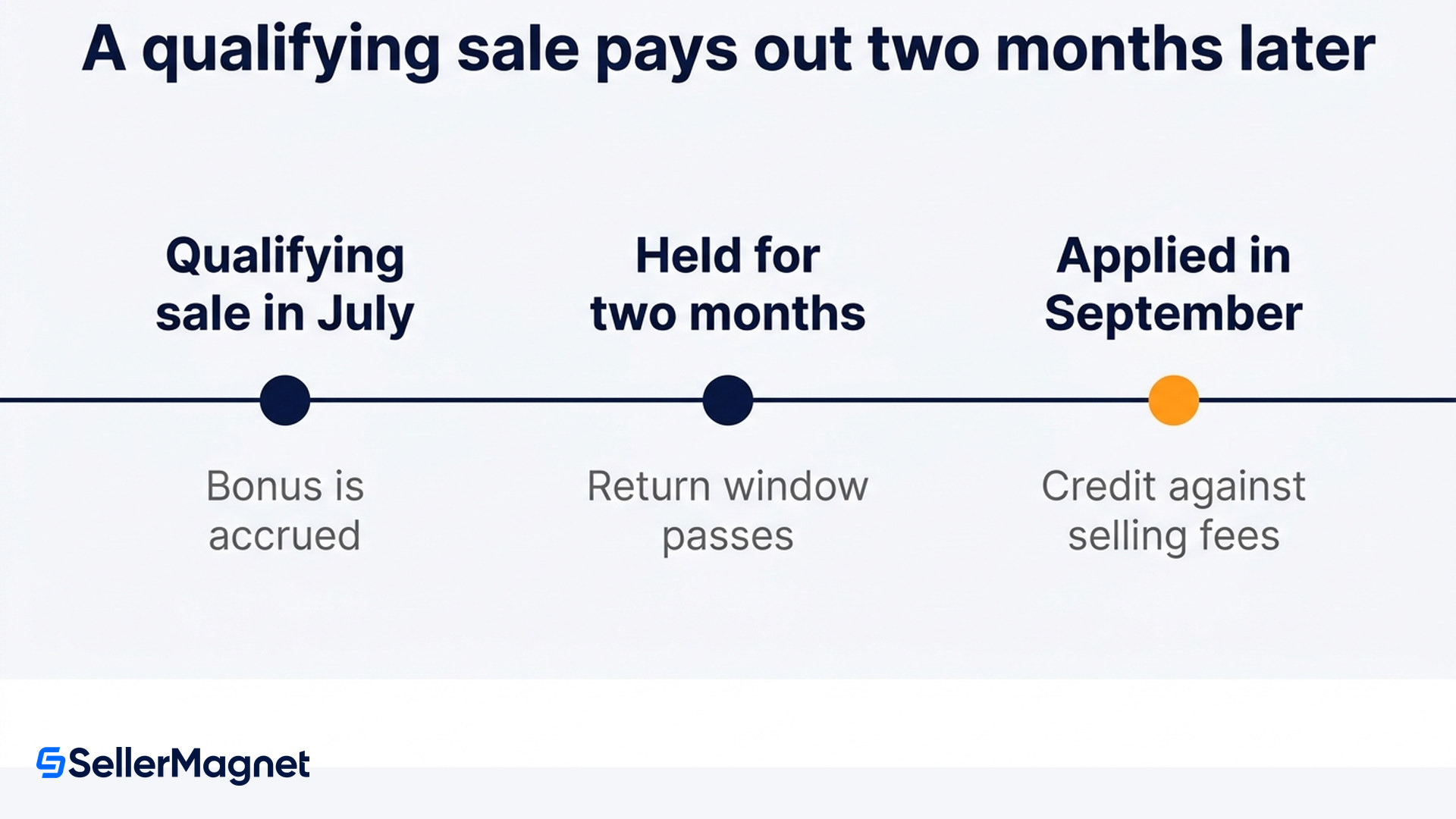
Two months later, and it is not money. Amazon is direct about the delay: "There is a wait time (two months) before the bonus is credited to your account to accommodate order cancellation and customer returns. For example, if a qualified sale occurred in July, the bonus will be credited to your account in September." What lands is a credit, not a payment: "The bonus will be used to deduct the referral fees in transactions for September and going forward, until the bonus gets exhausted."
The two-month lag changes what the bonus is worth to a business with a tight cash cycle. A campaign that runs in July is paid for in July, and its offset shows up against September's referral fees. It also means the bonus can be invisible in your transaction view. Amazon describes two cases: where there is tax on the fee, "bonus payments will show up in the discount on referral fee line"; where the bonus covers the whole fee and there is no tax, "the bonus will be applied in the background and the Referral Fee section will not be shown in the transaction".
Earned bonus is credited on the 10th of each month, visible in the Amazon Attribution dashboard in the Advertising console.
Reports generate every Friday, covering activity up to the preceding Friday, so the newest week is always missing.
No qualified sales in 90 days means no report is generated at all, which reads like a broken tool rather than an empty one.
Reporting only goes back 365 days. Amazon says it does not currently support downloading reporting data older than a year, so annual comparisons need you to archive your own copies.
What counts as qualifying traffic?
Tagged, non-Amazon traffic, and then rather more than you might expect. The rule is that "The bonus applies to brand-owned products with an Amazon Attribution tag that originates from a non-Amazon marketing effort", and the generous part follows: "This includes promoted products and additional products purchased from the same brand up to 14 days after clicking on the ad."
That second clause is the part worth building a campaign around. A click on an advertised mug that leads to a purchase of two other items from your brand within a fortnight earns the bonus on all of it. It rewards brands with a coherent catalogue far more than brands with one hero product, and it makes the bonus most valuable exactly where external traffic is usually hardest to justify: introducing a new customer to a range rather than closing a single sale.
No tag, no bonus, and the clock starts at enrolment
Amazon is unambiguous that "All traffic must have an Amazon Attribution tag in order to qualify for the bonus", so untagged traffic from the same campaign earns nothing. If you already use Attribution, the existing tags do count, but only forward: "We will calculate your bonus from all qualifying sales attributed by Amazon Attribution starting the day you enroll for Brand Referral Bonus." Enrolling is therefore the cheapest thing on this list and the one most worth doing today rather than at the start of the next campaign.
Who is quietly ineligible?
Two groups, and neither is obvious from the marketing. The first is resellers, and the exclusion is total. The programme is built on Brand Registry roles, and Amazon puts it plainly: "The Brand Referral Bonus is only available for Brand Representatives. If you are a Reseller, you can join the Amazon Associates program to earn commissions from sales you generate." If you drive external traffic to products you resell rather than own, this programme is not for you, and the Associates route pays differently.
The second is a tax condition that can disqualify a seller who has done everything else right. Amazon states: "If you are a non-US person (for US federal tax purposes) participating in the Brand Referral Bonus program, you are eligible to receive the bonus only if you perform all services under the Agreement outside the United States, as designated through the tax information interview." And the consequence: "If you are a non-US person and performing the services within the United States, you are not eligible to receive the bonus."
An unanswered tax interview destroys the bonus in six months
Providing tax information is not optional: "Yes, providing tax information is required to receive the Brand Referral Bonus. We may request tax information from you time to time. If we request tax information from you and you do not provide it, your earned bonuses will expire 6 months from the earned date." So a bonus can be earned, reported, visible in the dashboard, and then quietly expire because nobody answered a form. US sellers should also expect the amount on an IRS Form 1099-NEC, since Amazon reports it "to both you and the IRS on an annual basis... if reporting thresholds are exceeded". Put the tax interview on the enrolment checklist, not on the someday list.
How to set the bonus up properly
Confirm you are a Brand Representative, not a reseller - Eligibility runs to "All selling partners with a Brand Representative role assigned to a registered brand in Brand Registry selling in Amazon's US store", and that explicitly includes "sellers based outside of the US with an eligible US selling account". If the brand is not registered yet, Amazon points to Brand Benefit Eligibility and the Brand Self Service Identification program.
Register for the programme, then enrol in Amazon Attribution - These are two separate enrolments and the order matters, because the bonus is calculated from the day you enrol in Brand Referral Bonus rather than from the day your tags were created. Doing it before the next campaign launches costs nothing and avoids a month of unqualified traffic.
Complete the tax interview immediately - This is the step that silently voids earnings. Complete it at enrolment rather than when a banner appears, and if you are a non-US person, answer the services-location question accurately, because indicating work performed inside the United States makes you ineligible.
Tag every external channel, not just the paid ones - Untagged traffic earns nothing, so newsletters, social bios, influencer links and affiliate placements all need Attribution tags if you want them counted. Amazon points to its Attribution campaign creation guidance for per-channel implementation.
Grant reporting access to whoever runs the numbers - Secondary users cannot see or enrol by default. A primary user grants it under Settings, then User Permissions, then Manage Permissions, where Brand Referral Bonus sits in the Performance section: View for reports, View and Edit to enrol.
The number that decides whether external traffic pays
Take your true category rate from the table, not the 10%, and apply it to your actual average order value including the tier breakpoints. Multiply by the share of external clicks you can realistically tag. Then compare that against your cost per click on the channel you are considering. For a $9 pet supply at 10%, the bonus is 90 cents a sale and it meaningfully changes a paid-social calculation. For a $1,000 piece of jewellery, 14% on the first $250 and 3% above it comes to $57.50, a blended 5.75%, and a campaign planned on 14% is planning on more than twice what arrives. The bonus is a discount on referral fees, not a marketing budget, and it should move a decision that was already close rather than justify one that was not.
Because the bonus lands as a referral-fee credit two months later, it is easy to lose track of whether a campaign actually paid for itself. Tracking fees and margin per ASIN in one place is what lets you see the offset arrive against the right products, and a seller analytics dashboard that holds fee data per ASIN answers that faster than reconciling reports by hand. If you are weighing external traffic against on-Amazon advertising, our guide to Amazon's fee structure covers the referral fees the bonus is credited against.
Is the Brand Referral Bonus really 10%?
10% is the average, not the rule. The category decides: Amazon Device Accessories pays 30%, consumer electronics 5%, and several rows change rate above a price threshold.
Is the bonus paid in cash?
No. It is credited to your account and used to deduct referral fees on subsequent transactions until it is exhausted, so it reduces fees rather than adding a payment.
How long until I see it?
About two months. Amazon holds the bonus to absorb cancellations and returns, so a July sale is credited in September, and earned bonus reaches the account on the 10th of the month.
Can a reseller join?
No. The programme is only open to Brand Representatives of a registered brand. Amazon points resellers to the Amazon Associates program instead.
Does a click only earn on the advertised product?
No. The bonus covers the promoted product and additional products bought from the same brand for up to 14 days after the click, which favours brands with a full catalogue.
What happens if I ignore the tax interview?
Earned bonuses expire six months from the earned date if Amazon requests tax information and you do not provide it, so the balance can disappear without anything else going wrong.
Stop Juggling Tools. SellerMagnet Combines Everything You Need.