Eleven A-to-z Claims Amazon Grants Without Investigating
R
RenéFreelance Amazon Editor
|
11 min read
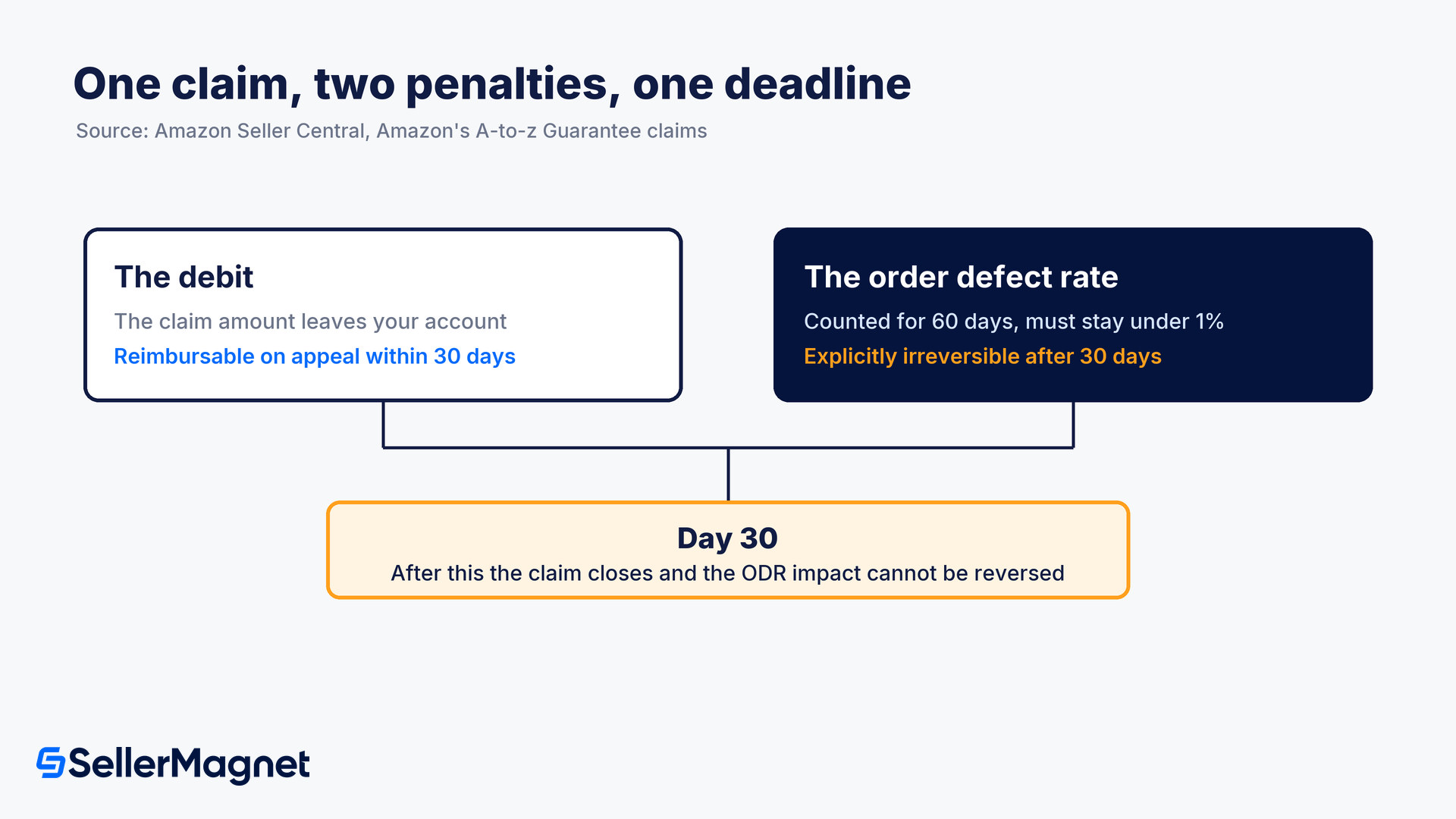
Almost everything written about the A-to-z Guarantee is advice on writing a persuasive appeal. Read Amazon's own page and a different picture emerges: in eleven enumerated situations the claim is granted automatically, with no investigation and no appeal to write until after the money has already left your account. And the refund is often the smaller of the two penalties. The claim also lands on your order defect rate, and Amazon is explicit that after 30 calendar days that part cannot be undone.
An Amazon A-to-z Guarantee claim is a buyer protection on orders you fulfil yourself, covering late or undelivered items and items that do not match their description. If Amazon grants the claim it refunds the buyer, debits your account and counts the claim against your order defect rate, which must stay below one per cent. Many claims are granted automatically when a seller misses a response deadline, and sellers have 30 calendar days to appeal.
What has to happen before a customer can file?
Contact, then a wait, and then only if you have not resolved it in time. Amazon's A-to-z Guarantee claims page sets the guarantee's scope first: it "is provided for orders directly fulfilled by you and covers both the timely delivery and the condition of items once received". Customers "must first contact you and give you an opportunity to resolve their issue" before they become eligible, and for delivery problems there is a second lock: "the customer must also wait 3 days past the maximum estimated delivery date (EDD) before they are eligible to file a claim".
Your side of that window is 48 hours, and it is measured from the customer's first message rather than from when you read it. For a delivery issue you "must respond to their message in Buyer-Seller Messages and attempt to resolve the issue to the customer's satisfaction within 48 hours of when the customer's first message was sent". For a condition issue you "must authorize or respond to that request within 48 hours with a valid domestic return address, a prepaid return label, or a returnless resolution", and Amazon adds that "it's best practice to respond within 24 hours". Resolving it there is not just good manners: Amazon states that "resolving issues directly with the customer, before a claim is filed, protects your order defect rate".
Which claims are decided without an investigation?
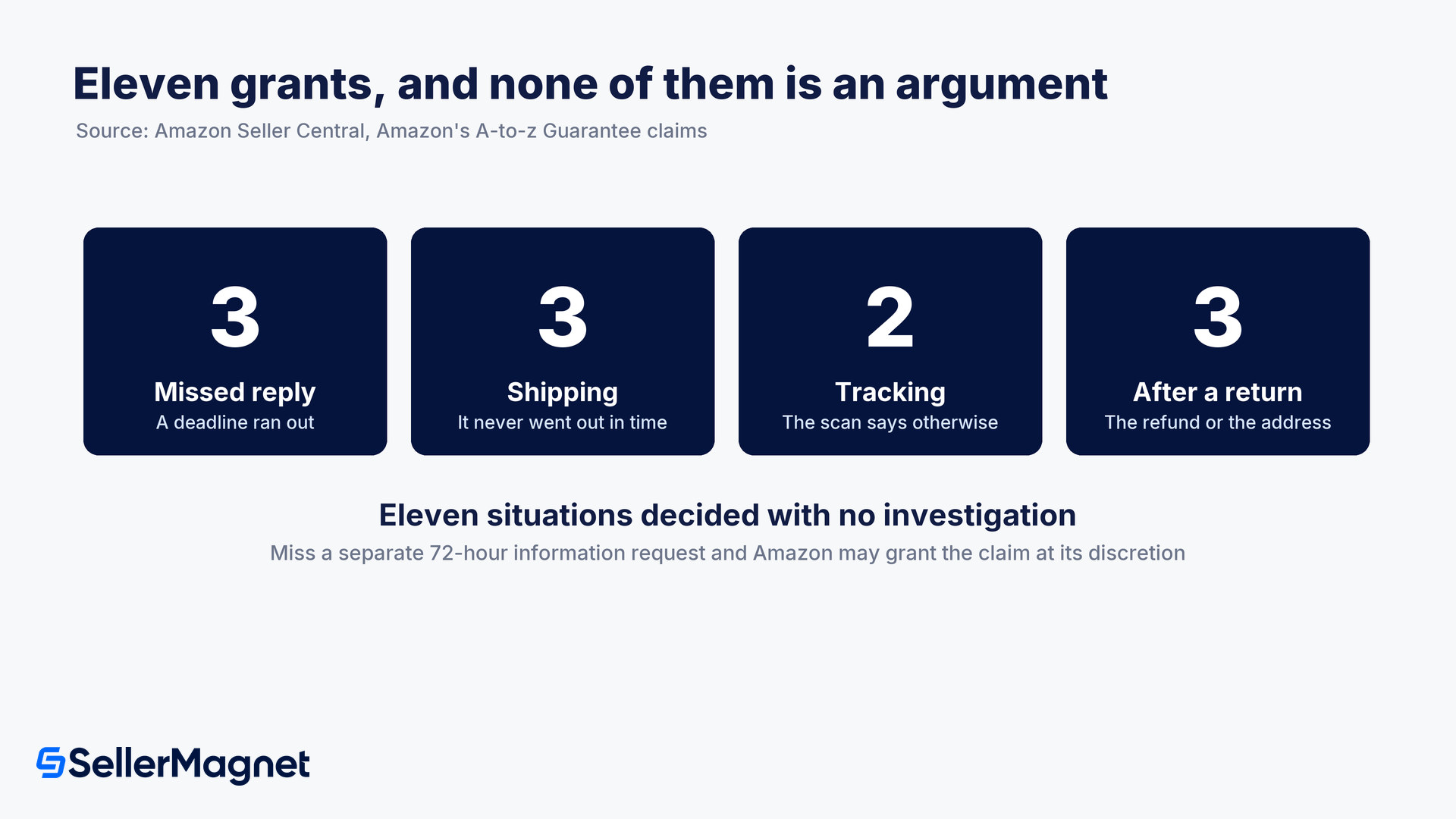
Eleven of them, and they are mostly clocks rather than arguments. Amazon introduces the list with "Amazon will automatically grant the claim and debit the claim amount from your account in the following circumstances", and what follows contains no language about weighing evidence. Grouping them makes the pattern obvious: three are missed response deadlines, three are shipping failures, two are tracking outcomes, and three concern what happens after a prepaid return label is used.
Group
What triggers the automatic grant
The clock
Missed reply
No response to a delivery issue in Buyer-Seller Messages
48 hours from the customer's first message
Missed reply
No authorisation or response to a return request
48 hours from the return request
Missed reply
International return address with no prepaid label and no returnless refund
2 days from receiving the return request
Shipping
Order not shipped by the expected ship date
The expected ship date
Shipping
No trackable method and no valid tracking ID in Manage Orders
When the order was placed
Shipping
Not delivered by the maximum estimated delivery date
The maximum EDD
Tracking
Tracking shows the order is undeliverable
On the tracking event
Tracking
Not delivered to the address the customer provided
On the tracking event
After a return
Return received on a prepaid label but not refunded
5 days from receiving the return
After a return
Return lost in transit after a prepaid label was used
On the tracking event
After a return
Return undeliverable or going back to sender because your return address was wrong or out of date
On the tracking event
One more deadline sits just outside that list, and it bites during an investigation rather than before one. Amazon warns that "if you do not respond to our information request within 72 hours, Amazon may grant the claim in favor of the customer, which will impact your order defect rate". Note the softer verb: in the eleven above Amazon says it will automatically grant, here it says it may. That is the difference between a rule and a discretion, and it is the one place in the process where silence is not automatically fatal.
Two instant refunds, and only one of them touches your ODR
Amazon can also refund without the customer contacting you at all, and the consequences are not identical. Where "tracking shows that the item was undeliverable to the customer or refused" and the package is coming back, Amazon refunds and debits you, then says plainly: "It does not impact your account health or order defect rate (ODR)." Where tracking shows you had not shipped when the claim was filed, Amazon refunds, debits you and states the opposite: "This will impact your account health and order defect rate (ODR)." Same refund, different mark on your record.
What does a granted claim actually cost?
Two things, and only one of them is money. The refund is debited from your account. The claim is then also counted in your order defect rate, which Amazon defines on its order defect rate page as "the percentage of orders with one or more of the following indicators of poor customer service during a given 60-day period", listing negative feedback, A-to-z Guarantee claims and credit card chargebacks. The policy is stated as a hard requirement: "We require sellers to maintain their ODR less than 1% to sell in the Amazon store", and breaching it "may result in suspension of your Fulfilled by Merchant selling privileges or deactivation of your seller-fulfilled offers".
ODR runs on a 60-day window, so a bad fortnight is visible for two months rather than until the end of the month.
It "only applies to seller-fulfilled orders", which is why the metric belongs to FBM, Seller Fulfilled Prime and Customer Service by Amazon sellers rather than to FBA.
Refunding voluntarily does not protect you once a claim exists. Amazon lists issuing a full refund as one of the four outcomes and notes: "This will impact your order defect rate."
A withdrawal does protect you. If "the customer withdraws the claim and the claim is closed", there is "no impact to your order defect rate".
You cannot reverse a refund on your own. Amazon "cannot reverse a customer refund for seller-fulfilled orders, without the customer's affirmative consent", so the customer has to initiate it.
After 30 days the claim closes and the ODR cannot be reversed
Amazon gives one deadline for appeals and it applies whether the claim was investigated or granted automatically: "you have 30 calendar days to appeal, provide new information, and request further investigation". A successful appeal may reverse the decision "in whole or in part (this may include reversing impact to your ODR or reimbursing you for the refund amount)", so the two penalties can be undone separately. The closing sentence is the one to diary: "If you do not appeal within 30 calendar days, the claim will be closed and any negative impact to your ODR cannot be reversed."
Can you make a claim not count at all?
For one claim type, yes, and Amazon documents the conditions exactly. The Buy Shipping protections page describes two separate protections, Claims Protection and OTDR Protection. Claims Protection applies "against 'Package didn't arrive' claims" and only when every one of a short list of conditions is true: the buyer was reimbursed by Amazon for not receiving the package, the label was bought through Amazon Buy Shipping on a service carrying the Claims Protected badge, and the order "was shipped on time, which will be considered at the moment of the carrier's first scan, not when you confirm shipment". Meet all of them and "Amazon will fund the buyer reimbursement and the customer-reported claim will not be counted against your order defect rate".
That last condition is the one most write-ups omit, and it changes what a warehouse has to do. Confirming shipment in Seller Central at 17:00 proves nothing; the protection turns on when the carrier first scans the parcel. A label bought on time, printed on time and collected the next morning can still fall outside it. Amazon also flags the badge you must avoid: "'Late Delivery Risk' labels are ineligible for protections", and it defines those as services that, on Amazon's own estimated delivery date, "have a lower chance of being delivered on-time for the specific order". Via the Buy Shipping APIs those labels "will be filtered out" unless you deliberately opt in.
Which claims process you land in is decided by who answers the customer
Amazon splits the route by support model rather than by fulfilment method: "For orders where you manage the customer support, the A-to-z claim process will be followed", while "for cases where Amazon manages the customer support, through the Customer Service by Amazon (CSBA) or Seller Fulfilled Prime (SFP) programs, the SAFE-T claim process will be followed." Sellers in SFP or CSBA therefore read a different rulebook for the same undelivered parcel, and our guide to SAFE-T claims covers that side.
How to cut your A-to-z claim rate
Put a 48-hour alarm on Buyer-Seller Messages and return requests - Three of the eleven automatic grants are nothing but a missed reply, and both windows run from the customer's action rather than yours. A weekend is 48 hours. Treat the 24-hour target Amazon calls best practice as the working deadline so that a bank holiday does not cost you a claim and an ODR point.
Buy labels with the Claims Protected badge, and watch the first scan - Claims Protection removes package-not-arrived claims from your ODR entirely, but only on a Claims Protected service shipped on time as measured at the carrier's first scan. Avoid Late Delivery Risk services; Amazon states they are ineligible for protections. If you buy labels by API, they are filtered out by default, which is the safer setting.
Fix your return address before it costs you three ways - An out-of-date return address is one of Amazon’s eleven on its own, and that single item covers both an undeliverable return and one going back to sender. Add the two neighbouring rows, a return lost in transit and a refund not issued within five days of receiving a return, and a stale address plus a slow refund desk accounts for three of the eleven triggers.
Answer information requests inside 72 hours - During an investigation Amazon may request more detail and may grant the claim if you do not answer within 72 hours. This is the stage where evidence still changes the outcome, so send the tracking, the messages and the photographs rather than a summary. Amazon asks you to "recount your version of events" and says it is important to provide as much relevant and compelling information as possible.
Diary every granted claim for appeal within 30 days - Claims are listed on the Manage A-to-z claims page under the Performance menu, and Amazon states that "you are responsible for monitoring and resolving your claims". Because an appeal can reverse the decision in whole or in part, it is worth filing even when the refund itself is small: the ODR reversal may be the more valuable half, and Amazon is explicit that once the 30 days pass the claim closes and that impact cannot be undone.
The number that tells you whether claims are a problem yet
Count your seller-fulfilled orders over the last 60 days and divide by 100. That is roughly how many defects, of any kind, take you to the 1% line, because ODR pools A-to-z claims with negative feedback and chargebacks in the same window. At 400 seller-fulfilled orders inside that 60-day window that is a margin of four, shared across three separate failure modes, which is why a single week of missed replies can move the metric more than months of ordinary order volume.
Claims are cheap to lose track of because each one is small and they arrive on different days. The useful view is not the claim itself but the pattern behind it: which SKUs, which carriers and which dispatch days keep producing them. Tracking orders, returns and fees per SKU in one place is what turns eleven separate deadlines into one list you work through each morning. SellerMagnet's order and returns tracking keeps that history against the product rather than the case.
How long do I have to appeal an A-to-z claim?
30 calendar days from the claim being granted, whether it was investigated or granted automatically. After that Amazon states the claim is closed and any negative impact to your ODR cannot be reversed.
Does an A-to-z claim always hurt my ODR?
No. A claim withdrawn by the customer has no ODR impact, and an instant refund triggered by a package returning to you is debited but explicitly does not affect account health or ODR.
Does refunding the customer myself avoid the defect?
Not once a claim exists. Amazon lists a voluntary full refund as an outcome and notes that it will impact your order defect rate. Resolving the issue before a claim is filed is what protects the metric.
What is the ODR threshold?
Amazon requires sellers to keep ODR below 1% over a rolling 60-day period. Above that it may suspend Fulfilled by Merchant selling privileges or deactivate seller-fulfilled offers.
Do A-to-z claims apply to FBA orders?
The guarantee covers orders you fulfil directly, and Amazon states that ODR only applies to seller-fulfilled orders. Sellers in SFP or Customer Service by Amazon follow the SAFE-T process instead.
Can I reverse a refund if the parcel turns up?
Only with the customer's agreement. Amazon cannot reverse a refund on a seller-fulfilled order without the customer's affirmative consent, so you have to ask them to start the reversal.
Stop Juggling Tools. SellerMagnet Combines Everything You Need.