Amazon tightened its seller-fulfilled reimbursement programme at both ends in early 2026: you now get four calendar days to decide what to do with a return, and 30 days rather than 60 to file the claim. The part worth knowing before you rely on any of it is that Amazon has described these rules three times, in three places, and the three descriptions do not agree.
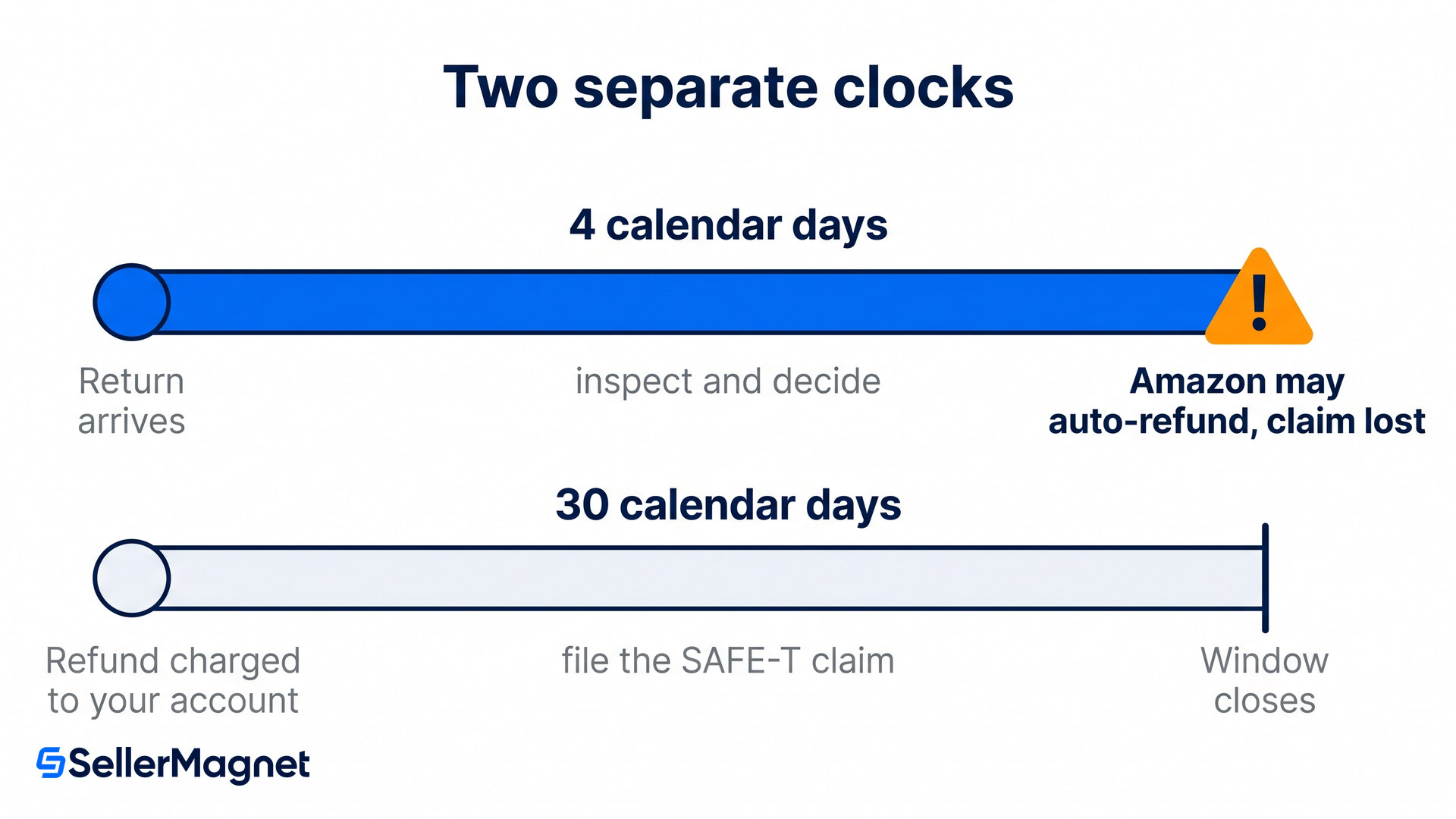
A SAFE-T claim is how a seller-fulfilled Amazon seller asks to be reimbursed after Amazon refunds a buyer for a return that was not the seller's fault. Since 2026 you have four calendar days to inspect the return and decide, and 30 calendar days to file the claim, down from sixty.
What is a SAFE-T claim?
A SAFE-T claim is the route to getting money back after Amazon has already refunded your buyer. Amazon's policy page defines it as a programme that "allows sellers in the seller-fulfilled network to request compensation from Amazon after a refund is deducted from the seller account and issued to the buyer for a buyer return", adding that "This policy also provides coverage for replacements."
Two limits sit in that definition and both matter. The refund has to have been issued by Amazon on your behalf, because the page states plainly that "You are not eligible for reimbursement if the refund was issued by you." And the outcome is discretionary: reimbursement happens "At Amazon's sole discretion" where Amazon "determines that you were not at fault". This is not an appeal against a refund. It is a request for compensation after one.
It is a seller-fulfilled programme only
SAFE-T covers the merchant-fulfilled network, including Seller Fulfilled Prime, and it is a US programme: the policy page says so in passing when it keys the four-day rule to "receiving a US domestic return". Amazon's policy page is blunt that "FBA orders are not covered by this policy" and points those elsewhere. If your returns come back to an Amazon fulfilment centre, this article is not your route and the FBA returns policy is.
What changed on 26 January 2026?
The window to act on a return roughly doubled, and the penalty for missing it hardened. Amazon's announcement said the processing window "will extend from two business days to four calendar days before Automated Refund triggers", framing it as giving sellers "more time to assess returns".
That framing is fair as far as it goes. Two business days spanning a weekend could be a very short clock, and four calendar days is usually longer. What the announcement put in the following paragraph is the part that changed the economics: "If you don't process a refund within four calendar days of receiving a returned item, we may issue an automatic refund. In these cases, you won't be eligible for Seller Assurance for e-Commerce Transactions (SAFE-T) claim reimbursement".
So the deadline is not a filing deadline. It is a decision deadline, and letting it lapse converts a claimable order into an unclaimable one. Amazon's recommended route through it is the Guided Refund Workflow, which it describes as letting you "grade returned items, apply appropriate restocking fees, and upload evidence when items are returned in a different condition than shipped".
What changed on 16 February 2026?
The filing window halved. Amazon's moderator post on the 2026 rules states it directly: "Effective February 16, 2026, the window to file a SAFE-T claim was reduced from 60 days to 30 days", and adds "Miss that window and your claim will be denied, no exceptions." The live policy page carries the new number in its guidelines.
Where the two sources part company is on what starts the clock, and the difference is not academic. The forum post says the 30 days run "from the return delivery scan at your warehouse or the refund date, whichever comes later". The policy page says claims "must be submitted in Seller Central within 30 calendar days of a refund being charged to your account or receipt of the returned item in the case of a free replacement".
Count from the refund, not from the parcel
On the policy page's wording the trigger for an ordinary return is the refund hitting your account, with receipt of the item mattering only for free replacements. The forum version, which takes the later of the scan and the refund, can imply a more generous deadline than the policy allows. Where a page and a post disagree, diary the earlier date.
Which exceptions actually survive the four-day rule?
The exceptions are where Amazon's three accounts diverge most sharply, and the difference decides real claims. The announcement said eligibility survives "except for specific situations such as when returned items are lost in transit or delivery confirmation was incorrect through no fault of your own". The 2026 moderator post narrowed that to "one exception for items lost in transit".
The policy page lists something different again, and it is the version that governs. It states that automated refunds issued after the four days "are not eligible for SAFE-T claims, with the following exceptions: You did not receive the return (no return delivery confirmed). You believe the buyer used an inaccurate return reason code. In this case, you may file a claim for reimbursement of return shipping costs."
Where Amazon says it
Exceptions to the four-day rule
Use it for
December announcement
"such as" lost in transit, or incorrect delivery confirmation
Context. The open-ended "such as" is not a list.
2026 moderator post
One exception, items lost in transit
The narrowest reading. Assume nothing more.
Policy page G202188810
No return delivery confirmed, or an inaccurate return reason code (shipping costs only)
The operative version. File against this.
Read together, the reliable core is the same in all three: if the return reached you and you left it unopened, the value of that order is gone. Two things survive, and both are narrow. One is the claim where the return never arrived at all, which every version of Amazon's wording keeps. The other is the policy page's reason-code exception, which does apply when the item came back, but buys you a claim for the return shipping cost rather than for the value of the goods.
How long do you have to answer an investigator?
Three business days according to the forum, seven days according to the policy. The moderator post lists among the common denial reasons that "Additional information was requested by the investigator and the seller didn't respond within 3 business days". The policy page says: "You must reply to information requests from Amazon investigators. Failure to provide sufficient information within seven days will result in denial of your claim."
Both cannot be right, and the gap between them is where claims quietly die. Treating three business days as the deadline costs nothing, and it is the rule to use whenever these sources disagree on timing: work to the earlier date, whichever page it came from. It is also worth knowing you get one attempt per order: the policy page states that "You can file only one claim per Order ID."
Which orders were never claimable?
A longer list than most sellers expect, and working through it before you file saves the effort. Amazon publishes a non-exhaustive list of ineligible orders, and several entries catch people who did nothing wrong.
Anything damaged or lost on the way back. Amazon states these "are not eligible for reimbursement from SAFE-T including the Amazon fees or send shipping label costs", because "Contractually, you are the shipper of record and may file a claim with the carrier to recover any loss."
Returnless refunds you configured. If you set returnless refunds in your return settings and one was issued automatically, "you are not eligible for reimbursement."
Offers shown as Free Returns. No reimbursement of return shipping cost where "the offer is indicated as 'Free Returns' on the customer store-front".
Orders with an A-to-z claim, which run down their own appeal route instead, and chargebacks, which the policy does not cover at all.
Late delivery where you bought the wrong label. A "Late Delivery Risk" label voids a late-delivery claim outright, and a "Claims Protected" label voids it too if you missed the ship-by date.
Refunds not yet debited. An order "is not eligible if the refund hasn't been debited from your seller's account yet", so an early filing is a wasted filing.
The fifteen-day wait that contradicts the thirty-day clock
Amazon tells you to wait before filing in one specific case: where it has refunded the buyer and the order has a valid return authorisation, "wait for at least 15 days or until you receive the item, before filing a claim". Against a 30-day window counted from the refund, that instruction spends half your time. If an RMA exists and nothing has arrived, put day 15 and day 30 in the diary on the day the refund lands, because the gap between them is the whole of your opportunity.
How much can you actually get back?
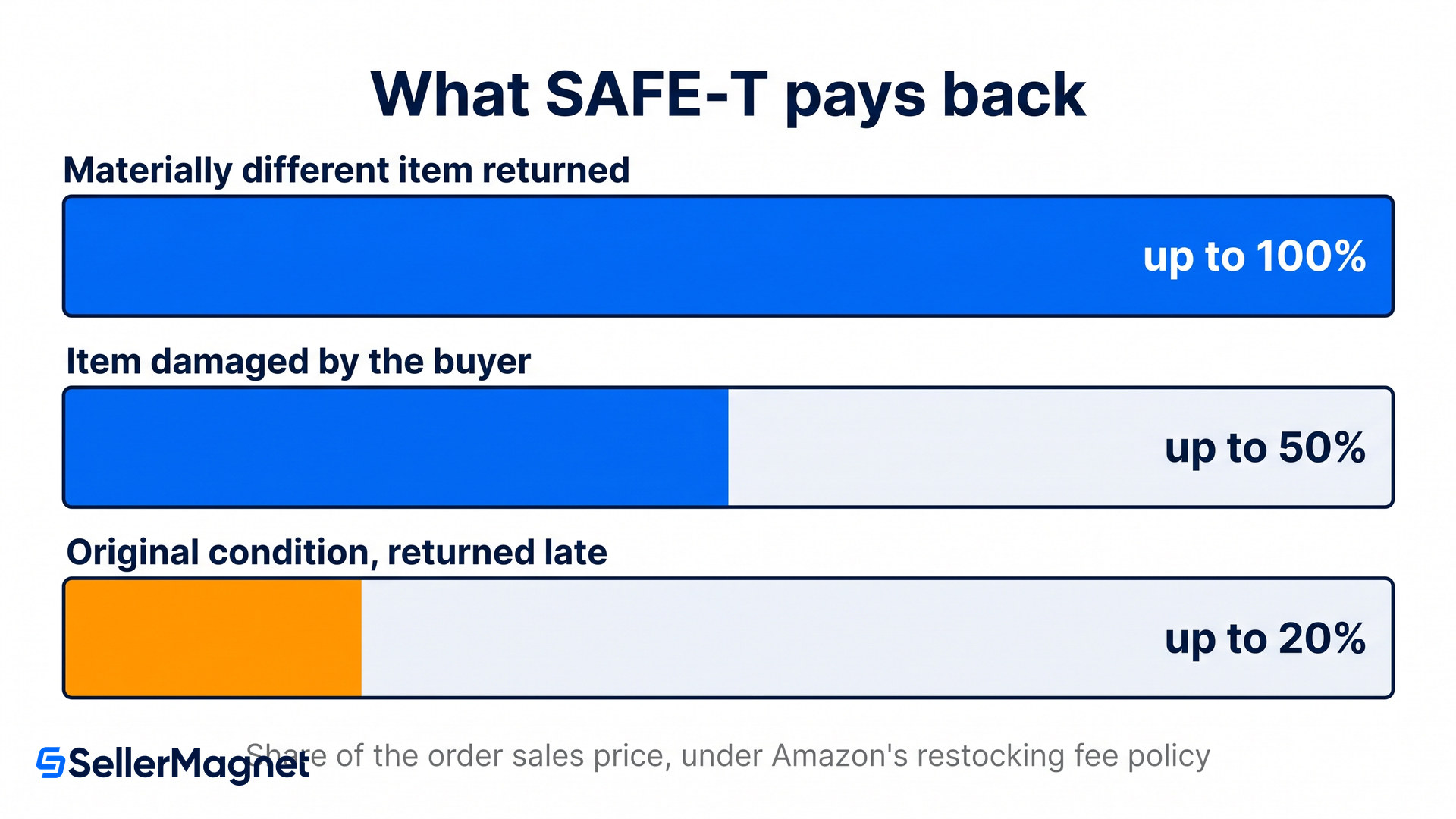
Less than the order value in most cases. The policy page attaches the same note to each eligible case, "As per Amazon's restocking fee policy", and sets three ceilings. Buyer damage pays "up to 50% of the order sales price of the product depending on the extent of damage as assessed by Amazon". A materially different item coming back pays "up to 100% of the order sales price". An item returned in original condition more than 15 days past the return window pays "up to 20%".
For the late-delivery case the bar is evidentiary rather than proportional. You need either a "Claims Protected" label bought through Amazon Buy Shipping with tracking confirming the order "was shipped on time and met the Maximum Estimated Delivery Date", or signature confirmation to the buyer's address with the same tracking standard. Without one of those two, proof of delivery on its own does not get you there.
Two things that reimburse without a claim
Goodwill concessions issued under Customer Service by Amazon come back automatically: Amazon says they "will be automatically refunded to your account within 48 hours of refund date" and that "You will not need to file SAFE-T claims" for them. And on a free replacement where the buyer never sends the original back within 30 days of the replacement shipping, "you will be eligible for an auto-reimbursement", allowing seven business days for it to appear.
How to keep a seller-fulfilled return claimable
Check returns daily, not weekly - The decision window is four calendar days from receiving the item, and it includes weekends. A Friday arrival can expire on Tuesday. A weekly returns routine is no longer compatible with the programme, which is the change of habit the 2026 rules really demand.
Decide inside the Guided Refund Workflow - Open the return, photograph its condition against what you shipped, and record the decision through the workflow rather than issuing a refund by hand. Amazon built it to capture grading, restocking fees and evidence, and a refund you issue yourself is explicitly outside the programme.
Photograph before you decide, not after - Capture the item, the damage or discrepancy, and the return package with its label and tracking ID visible. Evidence gathered after a refund has gone out is evidence about an order you can no longer claim on, so the photography has to sit inside the four days.
Diary the refund date, not the delivery date - The policy page counts the 30 days from the refund being charged to your account. Log that date when it appears in your payments, because it is the one the guidelines name and it is usually later than the scan you were watching.
Wait out the fifteen days only where an RMA exists - If Amazon refunded the buyer and a valid return authorisation is open with nothing delivered, Amazon asks you to wait 15 days or until the item arrives. Outside that case the instruction does not apply, and waiting simply burns window.
Answer investigators within three business days - Amazon's two statements of this deadline are three business days and seven days. Work to the shorter one. Check that the person who files is on the account's Registered Users list, because the policy states a claim will not be processed otherwise.
The one report to run this week
Pull your seller-fulfilled returns from the last 30 days and mark every one where Amazon issued the refund rather than you. Those are the only orders SAFE-T was ever available on. Then count how many of them sat more than four days between arrival and decision. That number is what the January change costs you per month, and it is usually a scheduling problem rather than a policy problem.
Returns are where seller-fulfilled margin goes quietly, and the 2026 changes make the cost of a slow week larger than it used to be. Knowing which SKUs generate the returns worth inspecting, and what each one nets after the refund and the shipping, turns a daily chore into a sorting problem. A seller analytics dashboard that shows returns and margin per ASIN puts the two in one view, and our guide to FBM return reason codes covers the codes that decide who pays for the return leg.
How long do I have to file a SAFE-T claim in 2026?
Thirty calendar days, reduced from sixty on 16 February 2026. Amazon's policy page counts them from the refund being charged to your account, or from receipt of the returned item in the case of a free replacement.
What happens if I miss the four-day decision window?
Amazon may issue an automatic refund, and automated refunds issued for that reason are not eligible for SAFE-T. The exceptions on the policy page are where no return delivery was confirmed, or where you believe the buyer used an inaccurate return reason code.
Can I file a SAFE-T claim on an FBA order?
No. Amazon states that FBA orders are not covered by this policy and directs sellers to the FBA buyer returns policy instead. SAFE-T covers the merchant-fulfilled network, including Seller Fulfilled Prime.
Why was my claim denied when the item came back damaged?
The common causes are filing after the 30 days, an automatic refund that followed a missed four-day window, insufficient photographic evidence, or not answering an investigator in time. Damage in return transit is also excluded, because you are the shipper of record.
How much does SAFE-T reimburse?
Up to 50% of the order sales price for buyer damage, up to 100% where a materially different item was returned, and up to 20% for an item returned in original condition more than 15 days past the return window. Applicable fees are deducted.
Does Refund at First Scan still qualify?
Yes. Amazon's moderator post states that a refund issued through Refund at First Scan remains eligible regardless of the four-day window, because the refund happens before you have the item to assess.
Stop Juggling Tools. SellerMagnet Combines Everything You Need.