Most FBM sellers find out what they are paying for shipping one invoice at a time, after the label is already bought. Amazon's own Buy Shipping tool sits inside Manage Orders and quotes a pre-negotiated rate from Amazon Shipping, FedEx, UPS, USPS, DHL Express International or China Post before you commit to a carrier, and Amazon states those rates run over 31% lower on average than retail ground rates. This guide covers what Buy Shipping actually includes, the real zone-based rate card behind it, a worked monthly cost comparison against retail pricing, when linking your own carrier account beats it, the declared value and address limits that catch sellers out, and a checklist to run before your next shipment.
Amazon Buy Shipping is a tool inside Seller Central's Manage Orders page that lets FBM sellers purchase shipping labels at Amazon's negotiated carrier rates, which Amazon states run over 31% lower on average than retail ground rates. It covers Amazon Shipping, FedEx, Ontrac, UPS, USPS, DHL Express International and China Post, automatically confirms shipment and tracking, and gives the order Amazon's account health protection for delivery issues. Sellers can also link their own carrier account to use a personally negotiated rate instead of Amazon's.
What is Amazon Buy Shipping?
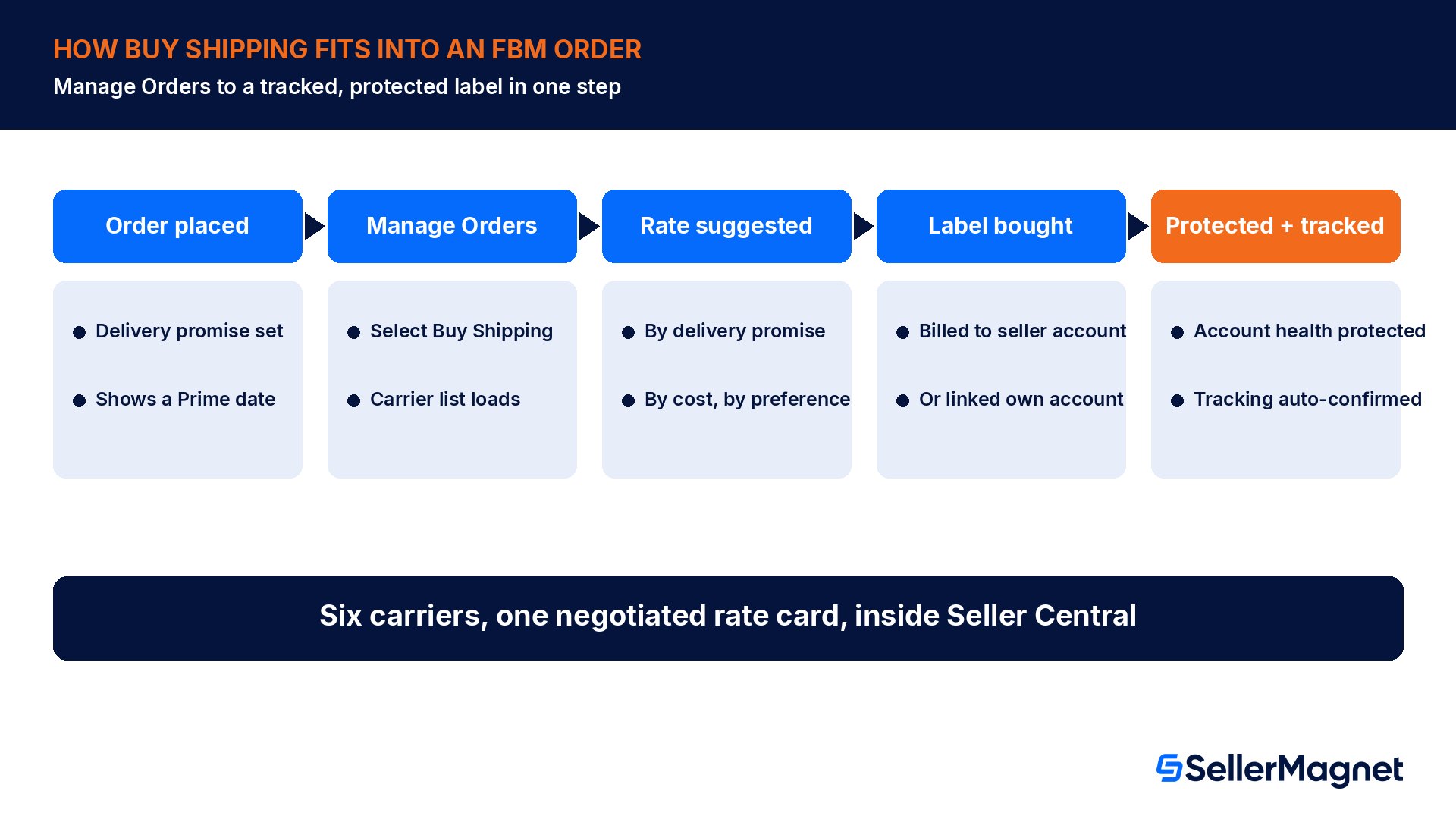
Buy Shipping is Amazon's own label-buying layer for merchant-fulfilled orders. Instead of leaving Seller Central to log into a separate carrier account, you select Buy Shipping on the Manage Orders page and the tool suggests a shipping service based on the delivery promise shown to the customer, your own carrier preference, and the lowest available cost. You can buy labels one at a time or in bulk for domestic orders, and the same rates are available through the Shipping API for sellers who print labels from their own systems or a multi-channel integrator.
The carriers available through Buy Shipping are Amazon Shipping, FedEx, Ontrac, UPS, USPS, DHL Express International and China Post, and all domestic USPS labels bought this way are priced at USPS Commercial Plus pricing rather than retail counter pricing. If a shipping method you want is not showing up as eligible, Amazon's help center has a dedicated troubleshooting page for a missing carrier or ship method, which is usually a setting on the order or the account rather than a real unavailability.
Bulk labels do not cover international orders
Buying shipping labels in bulk through Buy Shipping currently works for domestic shipments only. International FBM orders, including DHL Express International and China Post, are bought one label at a time.
What does the discount actually look like?
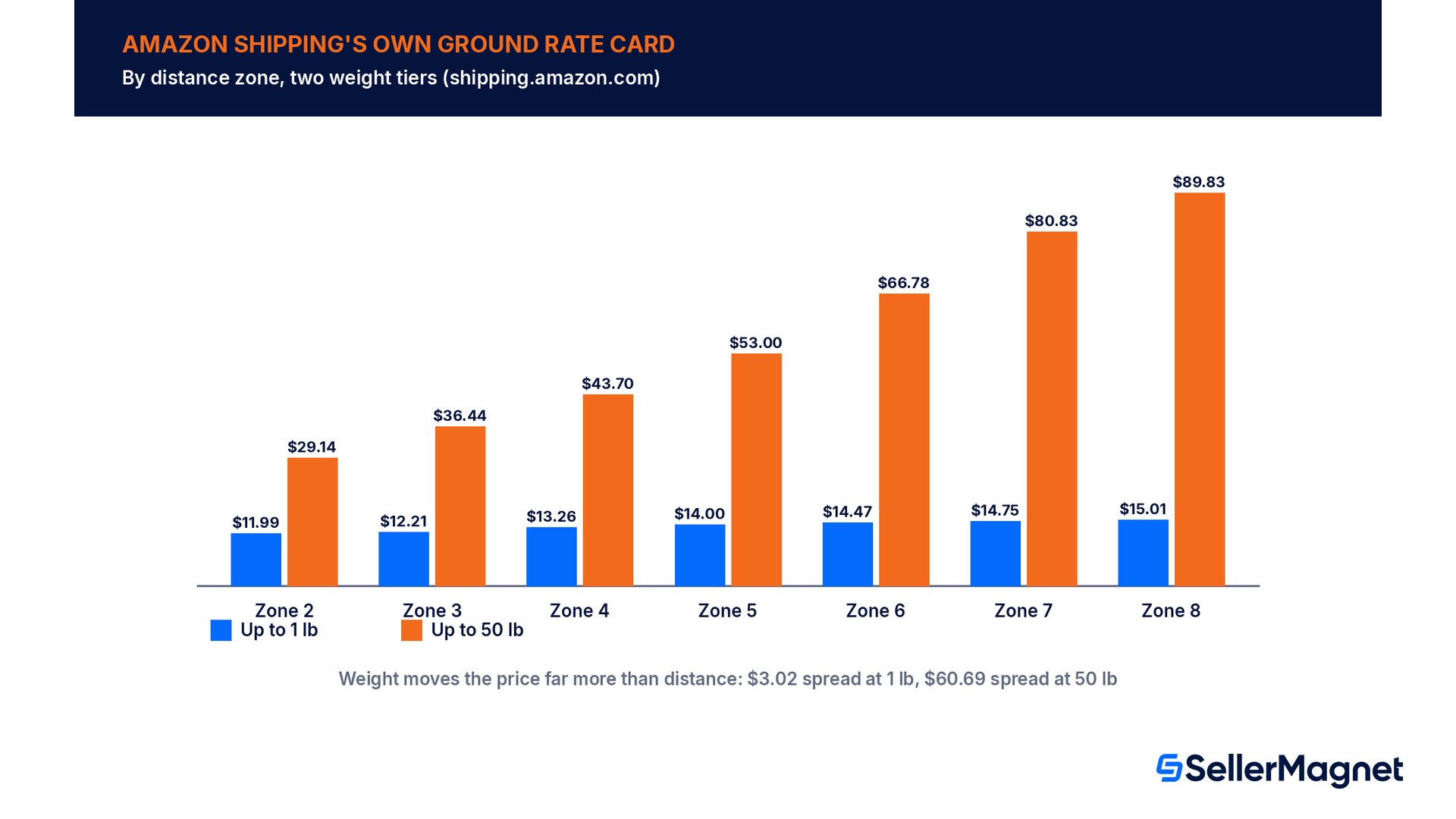
Amazon's own marketing pages for Buy Shipping make a specific claim: rates are over 31% lower on average compared to retail ground rates for UPS, FedEx and USPS, based on Amazon's internal comparison covering November 2022 to October 2023. That average hides a lot of variation. The real driver behind any specific label price is Amazon Shipping's own published rate card, which prices every package by its billable weight and the distance zone between the pickup and delivery address, exactly the same structure every carrier uses.
Distance zone
Rate, up to 1 lb
Rate, up to 50 lb
Zone 2
$11.99
$29.14
Zone 3
$12.21
$36.44
Zone 4
$13.26
$43.70
Zone 5
$14.00
$53.00
Zone 6
$14.47
$66.78
Zone 7
$14.75
$80.83
Zone 8
$15.01
$89.83
Two things stand out in that table. First, weight moves the price far more than distance does: a package under 1 lb costs between $11.99 and $15.01 across every zone in the country, a spread of only $3.02, while a 50 lb package spans $60.69 from the nearest zone to the farthest. Second, Amazon publishes base and earned discounts on top of this card for sellers whose annualized gross shipping spend qualifies, and sellers shipping fewer than 300 packages a day can set up a rate card of their own and save up to 40% more, on Amazon's own figures, which is a separate lever from the Buy Shipping average discount above.
USPS Commercial Plus pricing and why it matters
USPS is the carrier most sellers touch first, because it is the cheapest option for light, small packages and the only one of the group with no PO Box or military address restriction. Buying a USPS label through Buy Shipping prices it at USPS Commercial Plus pricing, the tier USPS normally reserves for shippers with a negotiated volume agreement, rather than the retail counter price anyone can walk in and pay. That distinction is the real source of a large part of the average discount Amazon advertises: a seller with no existing USPS contract gets volume-tier pricing on day one, with no minimum spend and no separate application to USPS.
The practical effect shows up most on the lightest, cheapest packages, where the retail-to-commercial gap is proportionally largest. A seller shipping small, light items through USPS and nothing else will typically see a bigger share of the 31% average discount than a seller whose mix leans toward heavier UPS or FedEx parcels, where Amazon's own negotiated discount off retail tends to be smaller in percentage terms even when it is larger in dollars.
Buy Shipping, Seller Fulfilled Prime and returns
Buy Shipping was originally built around FBM's strictest delivery requirement: Seller Fulfilled Prime, where a late or lost shipment hits your delivery metrics directly. Rates bought through the tool are chosen to meet the delivery promise shown to the Prime customer, and the account health protection that comes with Buy Shipping orders is worth more on an SFP order than on a standard FBM order, because SFP eligibility itself depends on keeping those shipping performance metrics inside Amazon's thresholds. Sellers running Seller Fulfilled Prime outside the US, for example through SFP in Germany, work under the equivalent local Buy Shipping and carrier setup for that marketplace rather than the US carrier list above.
Returns ride the same rail in the other direction. When a customer requests a return on an eligible FBM order through the Online Return Center, Amazon issues a tracked prepaid return label through Buy Shipping on your behalf, using the same negotiated carrier rates, and charges your seller account for it once the buyer ships the item back. That keeps the return label price in line with the outbound rates covered in this guide, rather than a separate, usually higher, retail return rate; it does not change your underlying return volume, which is better addressed by fixing the causes behind it.
Peak season moves the comparison too
The 31% average discount is measured against retail rates at a point in time, and retail and commercial rates both move every year for peak season. USPS finalized temporary peak pricing with the Postal Regulatory Commission for 2026, adding per-piece increases on Priority Mail Express, Priority Mail, USPS Ground Advantage and Parcel Select from 4 October 2026 through 17 January 2027, on top of a separate transportation-related base increase already in effect since 26 April 2026. UPS and FedEx apply their own peak demand surcharges on a similar calendar. None of this changes which carrier Buy Shipping can access, but it does change the dollar figure behind the discount, so a savings estimate run in the summer is not the number you will see on a shipment in December.
Service and zone band
0 to 3 lb
4 to 10 lb
11 to 25 lb
Priority Mail and Ground Advantage, Zones 1 to 4
+$0.40
+$0.65
+$1.05
Ground Advantage, Zones 5 to 9
+$0.55
+$1.05
+$1.75
Priority Mail, Zones 5 to 9
+$0.85
+$1.75
+$3.85
Those figures are the commercial per-piece peak increases USPS filed for the 2026 window, and they apply whether the label is bought through Buy Shipping, a linked account or retail; Buy Shipping does not exempt a shipment from a carrier's own peak surcharge. Rerun your own comparison for the October-to-January window specifically if a meaningful share of your shipping happens during peak, rather than assuming the rest-of-year number holds.
Worked example: 400 orders a month
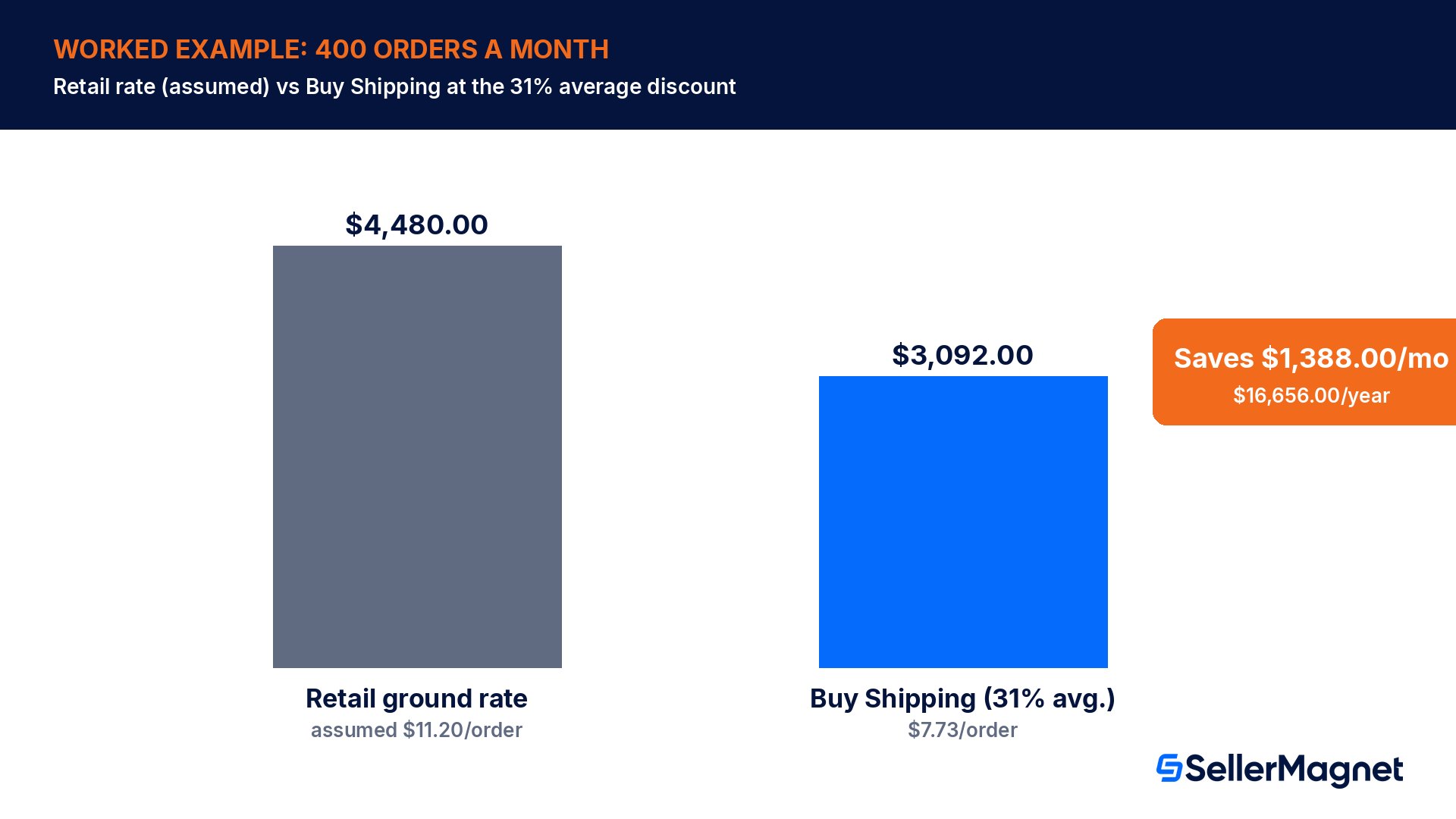
Here is what the headline 31% figure means in dollars for a mid-size FBM seller. The seller ships 400 domestic orders a month, averaging a 2 lb package to a Zone 5 address. The retail rate below is an assumption for this example, a representative counter price you would get buying that same label directly from a carrier's retail service; pull your own number from your last few shipping invoices before you rely on this math for your own numbers.
Retail ground rate
Buy Shipping (31% average discount)
Rate per package
$11.20
$7.73
Monthly cost, 400 orders
$4,480.00
$3,092.00
Monthly savings
n/a
$1,388.00
Savings over a year
n/a
$16,656.00
At the assumed $11.20 retail rate, the Buy Shipping price comes out to $7.73, a per-order saving of $3.47. Multiplied across 400 orders a month, that is $1,388.00 a month, or $16,656.00 over a year, without changing a single carrier relationship or signing anything new. A seller shipping 1200 orders a month at the same rates would see the retail bill of $13,440.00 fall to $9,276.00, a saving of $4,164.00 a month. The saving scales directly with volume, which is exactly why it is worth checking even if your current shipping workflow feels fine as it is.
The retail baseline here is an assumption
The $11.20 retail rate is a stand-in for a 2 lb, Zone 5 ground package, used to make the arithmetic readable. Your real retail rate depends on your carrier, your account-level discounts if any, your package weight and the zones you actually ship to. Pull the number from your own last invoice, not from this example, before deciding whether switching is worth it.
What carriers and limits apply?
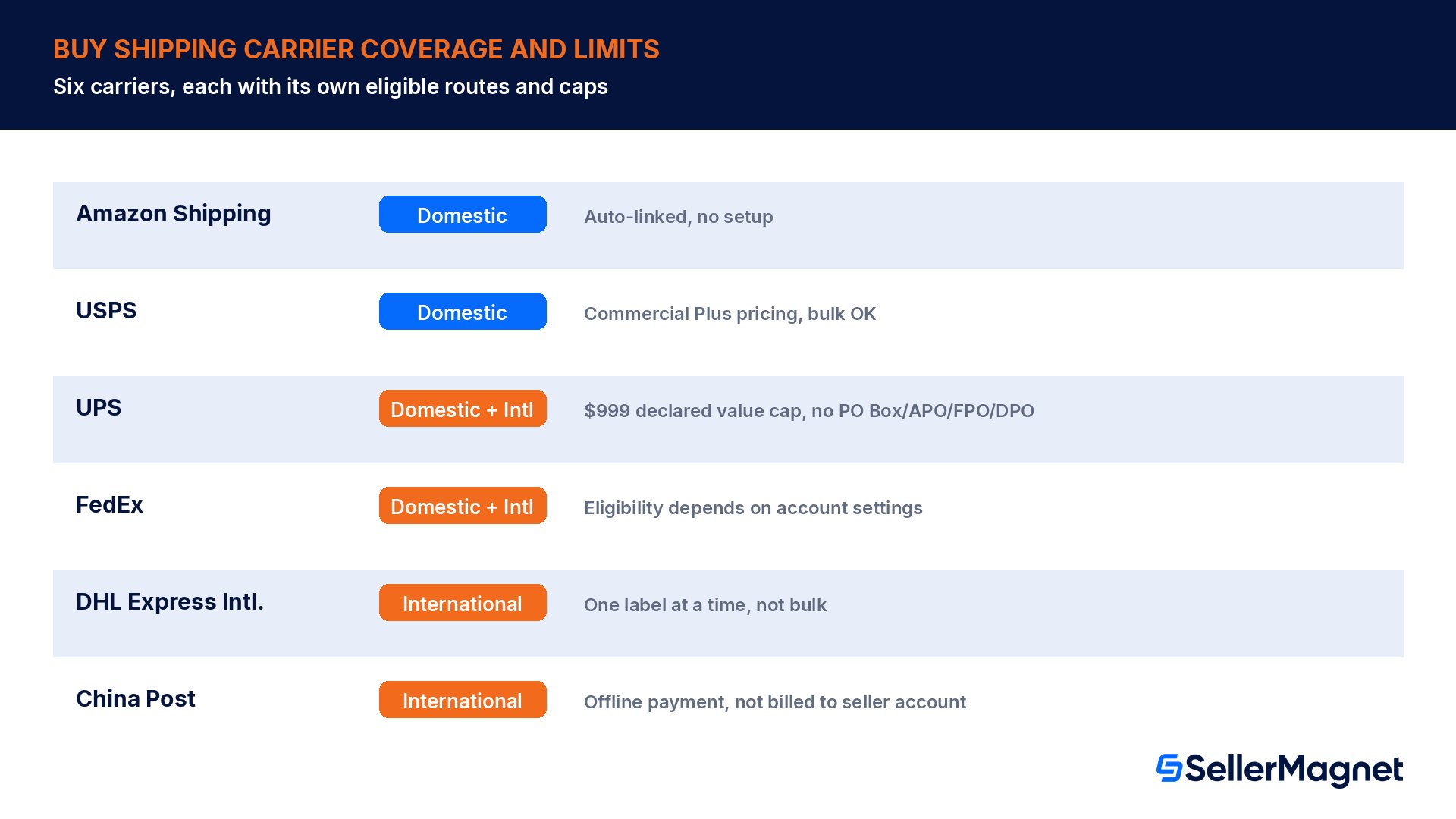
Buy Shipping is not one rate, it is a shopfront in front of several carriers, and each one keeps its own restrictions even when the label is bought through Amazon. The two limits that catch sellers most often are the declared value cap and the delivery address type.
Carrier
Coverage
Key limit through Buy Shipping
Amazon Shipping
Domestic, growing metro and regional coverage
Automatically linked once you sign up for Amazon Shipping, no separate account needed
UPS
Domestic and international
Declared value capped at $999; no PO Box, APO, FPO or DPO delivery addresses
USPS
Domestic, all 50 states
Priced at USPS Commercial Plus rates; bulk labels are domestic only
FedEx
Domestic and international
Eligibility and rates depend on your account's shipping settings
DHL Express International
International only
Bought one label at a time, not in bulk
China Post
China outbound, international
Settled through an offline payment approach, not billed to the seller account directly
For UPS specifically, a package with a declared value over $999 cannot be shipped through Buy Shipping and needs to go directly through UPS or another carrier that allows higher values. The same restriction blocks UPS delivery to a PO Box, APO, FPO or DPO address regardless of declared value, so orders to those address types need a different carrier from the start, not a Buy Shipping workaround.
Buy Shipping's rate versus your own carrier account
Buy Shipping is not the only way to get a discount. You can link your own UPS, FedEx or other carrier account to Seller Central and ship at the rate you negotiated directly with that carrier, charged to your own account instead of your Amazon seller account. Which one wins depends entirely on your numbers, not on the brand name.
Decide between Buy Shipping and your own carrier account
Pull your real volume and weight profile - Take your last full month of FBM shipments and find the average package weight and the distribution of zones you ship to, not just one example order.
Price both options for that profile - Get a current quote from your own carrier account for that same volume, and compare it to the Buy Shipping rate shown in Seller Central for the same packages.
Add in account health protection - Orders shipped through Buy Shipping carry Amazon's account health protection for delivery issues. A cheaper label bought outside the tool does not carry that protection, so price it as part of the comparison, not as a free extra.
Check the restrictions - Confirm the carrier and service you plan to use is actually eligible through Buy Shipping for your package type, destination and declared value before committing volume to either path.
Re-check after any rate renegotiation - If you renegotiate your own carrier contract or your shipping volume changes enough to shift Amazon's earned discount tier, redo the comparison instead of assuming last quarter's answer still holds.
In practice, sellers who already ship enough volume to negotiate strong rates directly with UPS or FedEx sometimes beat Buy Shipping on price alone, especially outside the standard ground zones where Amazon's own card is less competitive. Sellers without that negotiating leverage, or who want the account health protection and the automatic tracking confirmation without managing a separate carrier relationship, are usually better served staying inside Buy Shipping. Either way, the decision is a number you can check, not a default to assume.
Common mistakes sellers make with Buy Shipping
Assuming the 31% average discount applies to every shipment: it is an average across UPS, FedEx and USPS retail ground rates, and your own weight and zone mix can be above or below it.
Trying to ship a high-value item through UPS via Buy Shipping without checking the declared value cap, and having the label rejected at the point of purchase.
Shipping to a PO Box, APO, FPO or DPO address with UPS and finding out only at that point that the carrier does not support it through Buy Shipping.
Buying international labels one at a time without budgeting the extra time that takes compared to domestic bulk buying.
Never comparing Buy Shipping's rate against a directly negotiated carrier rate once volume grows, and assuming the Amazon rate is always the cheapest one.
Treating Buy Shipping and account health protection as separate decisions, when the protection is part of what the rate is paying for.
Not re-pricing the comparison after a carrier contract renewal or a real change in shipping volume.
Buy Shipping checklist before your next shipment
You know which carriers are actually eligible for the order's destination, package type and declared value before you select a service.
For UPS, the declared value is at or under $999 and the address is not a PO Box, APO, FPO or DPO.
You have compared the quoted Buy Shipping rate against your own carrier account's current rate for the same package, not an old quote.
Your Seller Fulfilled Prime orders, if any, are using a carrier and service that meets the delivery promise Amazon is showing the customer.
You track your real shipping spend per order, not just the headline discount percentage, so you catch a rate change early.
International orders are budgeted for one-at-a-time label buying rather than bulk, since Buy Shipping's bulk tool is domestic only.
You revisit the Buy Shipping versus own-account comparison whenever your volume or your carrier contract changes.
How SellerMagnet fits into the decision
Buy Shipping sets the cost of getting an order out the door; what that cost does to your margin is a separate calculation SellerMagnet's Analytics handles for you. Connect your Amazon account and every order's profit, including the shipping label you actually paid for, rolls up by SKU, by day and by marketplace, so a shipping rate change shows up in your real numbers instead of staying buried in a carrier invoice. If you only need a quick, no-login fee check for a single ASIN, the free Fee Calculator compares FBA and FBM costs side by side using Amazon's public fee schedule.
What is Amazon Buy Shipping?
It is a tool inside Seller Central's Manage Orders page, and the Shipping API, that lets merchant-fulfilled sellers buy shipping labels from Amazon Shipping, FedEx, Ontrac, UPS, USPS, DHL Express International and China Post at Amazon's negotiated rates, with automatic shipment confirmation and tracking.
How much cheaper is Buy Shipping than retail rates?
Amazon states its negotiated rates run over 31% lower on average compared to retail ground rates for UPS, FedEx and USPS, based on the company's own internal data from November 2022 to October 2023. Your actual saving depends on your package weight, the zones you ship to and the specific carrier.
Can I use my own UPS or FedEx account instead of Buy Shipping?
Yes. You can link a carrier account you already have to Seller Central and ship at the rate you negotiated directly, billed to that account instead of your Amazon seller account. Which option is cheaper depends on your own negotiated rate versus Amazon's card for your volume.
Is there a value limit on packages shipped through Buy Shipping?
For UPS specifically, Buy Shipping caps declared value at $999 per package, whether the label is charged to your seller account or a linked UPS account. Higher-value UPS shipments or international shipments above that value need to be arranged directly with UPS.
Does Buy Shipping work for international orders?
Yes, through DHL Express International and China Post, plus UPS and FedEx where your account is eligible, but international labels are bought one at a time. Bulk label buying through Buy Shipping currently covers domestic shipments only.
What does account health protection mean for a Buy Shipping order?
Orders shipped using Buy Shipping's negotiated rates or a linked carrier account both get Amazon's account health protection related to delivery issues on that order. A label bought entirely outside Seller Central, with no account link, does not carry that protection.
Can I ship to a PO Box using Buy Shipping?
Not with UPS. UPS shipping options through Buy Shipping are not available for orders with a PO Box, APO, FPO or DPO delivery address, so those orders need a different carrier, most often USPS.
Do I need a separate Amazon Shipping account to use it through Buy Shipping?
No. Once you sign up for Amazon Shipping, it is automatically linked and integrated into Buy Shipping, unlike UPS or FedEx, where you choose between Amazon's rate or linking your own existing carrier account.
Stop Juggling Tools. SellerMagnet Combines Everything You Need.