A Performance Notification lands in the inbox, and within a day the account's selling privileges are gone: no new orders, existing listings down, and a short message pointing at a policy violation that may be days or weeks old. The seller's first instinct is usually to write back and explain what happened. Amazon's own guidance is blunt about why that instinct backfires: an appeal built around an explanation, rather than a Plan of Action with a specific root cause, corrective action already taken, and a preventive measure for the future, gets the same automated reply almost every time, a notice that there is not enough information to reinstate the account, with no list of what exactly is missing. This guide works through what a Plan of Action actually needs to contain to get past that first automated read, where to submit it inside Seller Central, how Amazon's own Account Health Assurance program changes the picture for sellers who already have a strong score, how long reinstatement realistically takes, and the specific, documented mistakes, generic denials, missing evidence, unaddressed root causes, that keep a resubmission stuck in the same loop.
A Plan of Action is Amazon's required format for appealing an account deactivation or listing removal. It needs three specific parts: the root cause of the violation, the corrective action already taken to fix it, and a preventive measure to stop it happening again, each backed by specific evidence (the exact ASIN, the policy, supporting documents). It is submitted through the Account Health dashboard, not a general support case, and a generic or incomplete version is the most common reason Amazon's automated review rejects it with no specific list of what is missing.
What actually triggers a deactivation?
Seller Central's own Account Health page separates two different kinds of problems that both show up as the same red banner once they go far enough: a score problem and a policy problem. The Account Health Rating (AHR), a 0 to 1,000 number covering Order Defect Rate, late shipments, policy violations and a handful of other metrics, is the ongoing early-warning signal; a full breakdown of what moves it, including why it can drop with zero new violations, lives in SellerMagnet's separate Account Health Rating guide, since that score mechanic is its own topic. A deactivation itself is almost always triggered by a specific policy violation, not by the AHR number falling on its own: a Product Policy Compliance issue (intellectual property, restricted product, inauthentic complaints), a Customer Service or Shipping Performance metric breaching Amazon's documented target, or Amazon's own Trust and Safety team flagging suspected fraudulent, deceptive or otherwise harmful activity. Each of those arrives first as a Performance Notification, visible on the Account Health page and sent by email, and most of them give a window to respond or fix the underlying issue before the account itself is deactivated. Ignoring that notification, not the metric dip that caused it, is what actually converts a warning into a deactivation in most cases Amazon's own seller-forum staff describe.
The three parts every Plan of Action needs
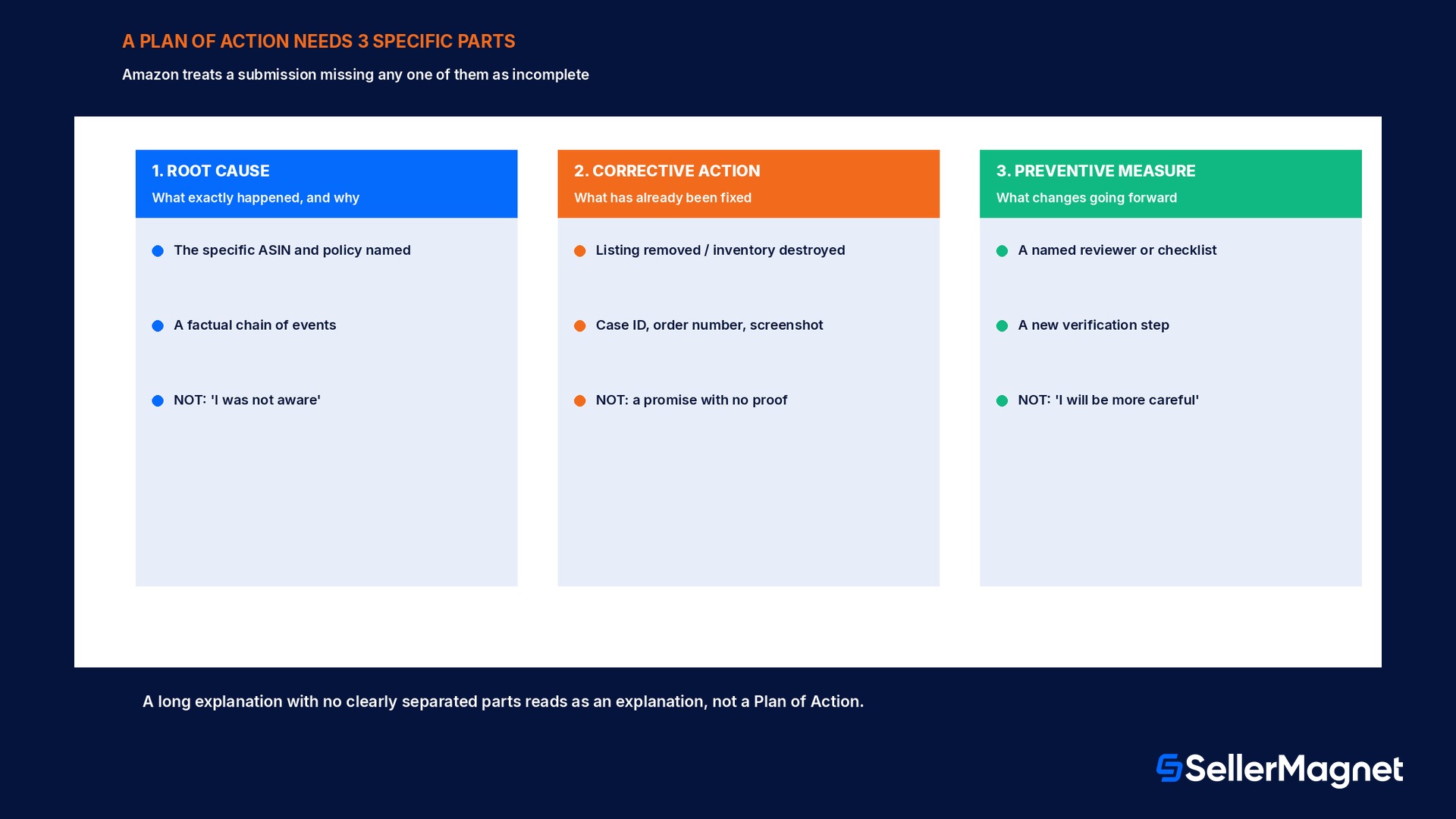
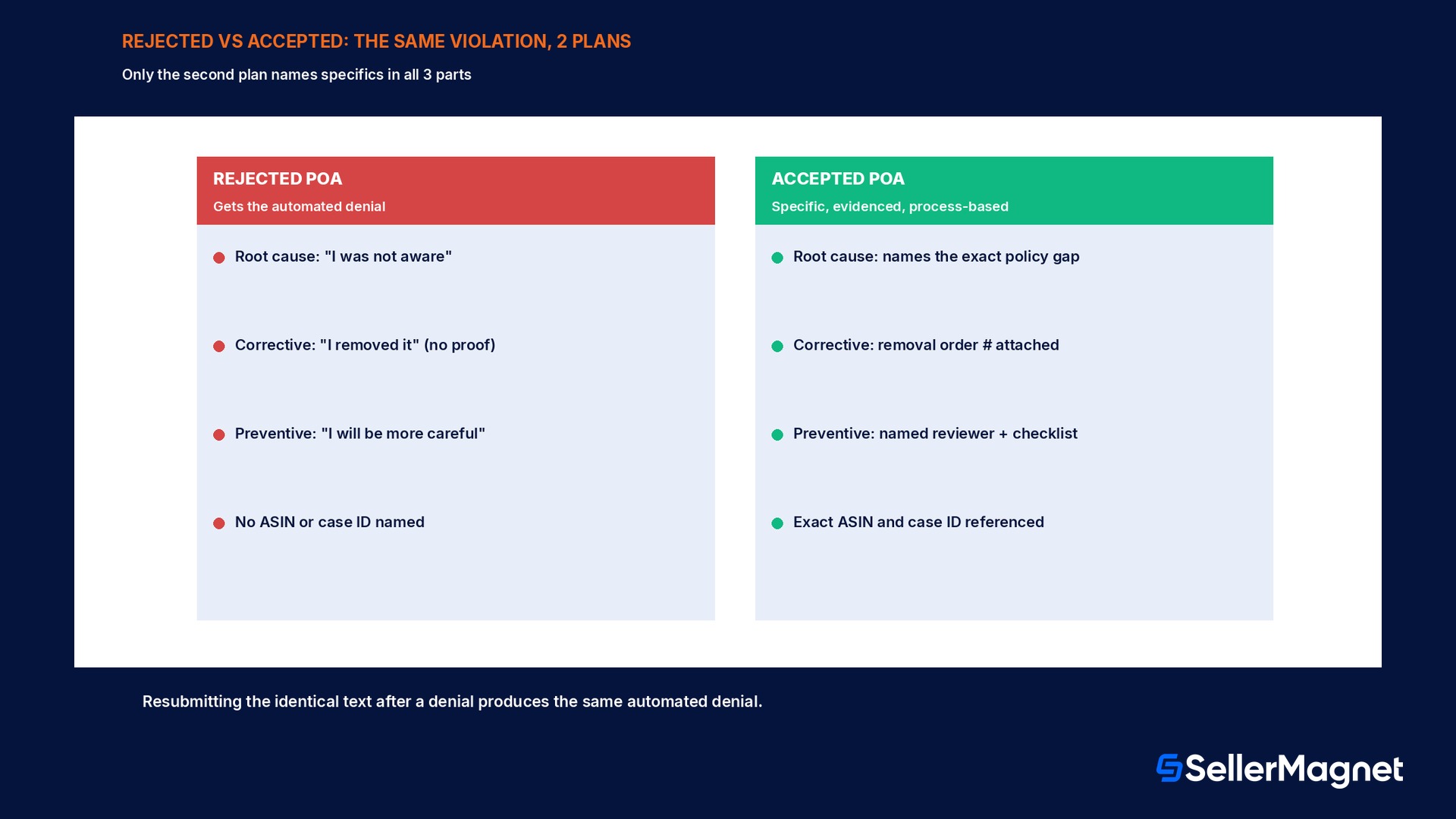
Amazon's own appeal guidance, repeated consistently across its Account Health documentation and forum staff replies, breaks a Plan of Action into exactly three sections, and treats a submission missing any one of them as incomplete rather than merely weak. The root cause has to identify specifically what went wrong and why, not what the seller intended to do; a root cause stated as 'I was not aware of the policy' or 'this was a mistake' is the kind of generic language Amazon's guidance explicitly calls out as unacceptable, because it does not show Amazon what actually happened on the account. The corrective action documents what has already been done, concretely, to resolve the specific instance: removing the flagged ASIN, destroying non-compliant inventory, cancelling the order in question, with the evidence to show it (a screenshot, a removal order number, a case ID). The preventive measure is the only forward-looking piece, and it needs to describe a changed process, not a promise: a second-person review before any new listing goes live, a written compliance checklist, a named person now responsible for checking supplier documentation, rather than 'I will be more careful' or 'I will contact Selling Partner Support before listing next time', both of which Amazon's own guidance lists as explicitly rejected phrasing.
Part
What it must answer
Accepted by Amazon
Rejected by Amazon
Root cause
What exactly happened, and why
The specific ASIN, policy, and factual chain of events
'I was not aware', 'this was a mistake', no specifics named
Corrective action
What has already been fixed, with proof
Listing removed, inventory destroyed, case ID or order number attached
A promise to fix it, with no evidence it already happened
Preventive measure
What changes going forward, as a process
A named reviewer, a written checklist, a new verification step
'I will be more careful', 'I will contact support first'
Where do you actually submit it, and who do you talk to?
A Plan of Action does not go through a general support case, and Amazon's own Account Health team staff replies in the seller forums are explicit that a Contact Us case opened for an appeal gets redirected back, costing a seller the days it sits in the wrong queue. The correct path depends on what triggered the notice: a listing-level Product Policy Compliance issue is appealed from the Product Policy Compliance section of the Account Health dashboard directly, while a full account deactivation is appealed through 'Submit new information' on the same Account Health page. For sellers Amazon has already reached out to about a specific issue, often ahead of an actual deactivation, the 'Call Me Now' button on the Account Health page connects directly to an Account Health Specialist by phone, the same channel Amazon uses to call sellers first when working an issue under Account Health Assurance; a seller can also use that page to submit a written plan instead of taking the call, if a phone conversation is not practical. Whichever path applies, every supporting document, invoices, licensing agreements, letters of authorization, compliance certificates, needs to be current (Amazon's own guidance asks for documents from within the last 365 days where that requirement applies) and the relevant ASIN, supplier name or compliance detail highlighted directly in the document rather than left for a reviewer to find.
The 72-hour window is an Account Health Assurance benefit, not a universal appeal deadline
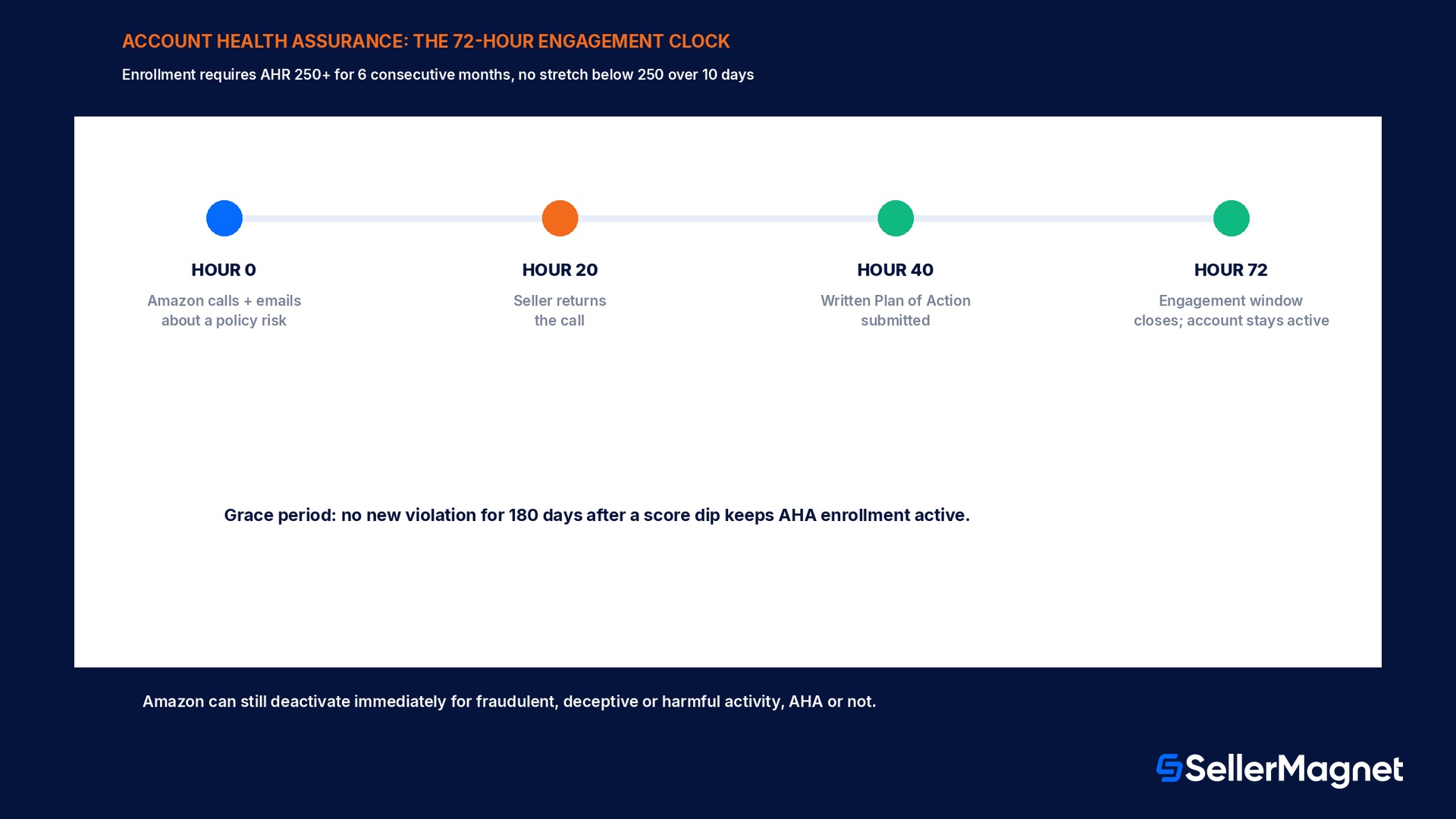
A standard deactivation appeal has no single fixed response-time guarantee published by Amazon; Account Health Assurance specifically commits to working with an enrolled seller before deactivating, provided that seller engages within 72 hours of being contacted. Outside AHA, respond as fast as the evidence can genuinely be gathered: a rushed, generic POA submitted in an hour is weaker than a specific one submitted the next day.
The specific mistakes that keep a Plan of Action rejected
Explaining instead of structuring. A long narrative of what happened, with no clearly separated root cause, corrective action and preventive measure, reads to Amazon's review process as an explanation, not a Plan of Action, even when the same facts are all present somewhere in the text.
Naming the symptom as the root cause. 'My listing was removed' describes what Amazon did, not what the seller did; the root cause has to go one level deeper, to the actual policy gap or process failure that caused the listing to violate the policy in the first place.
Submitting a preventive measure that is a promise, not a process. 'I will be more careful going forward' and 'I will contact Selling Partner Support before listing' are named directly in Amazon's own guidance as statements that will not be accepted as a valid preventive measure.
Leaving out the specific ASIN or case number. A reviewer working a queue of appeals cannot match a generic plan to the specific violation on file; naming the exact ASIN, policy, and case ID ties the POA to the right review.
Attaching stale evidence. A compliance certificate or invoice older than the window Amazon's guidance asks for (365 days, where that requirement applies) can get the whole appeal treated as unsupported, even if every other section is strong.
Resubmitting the identical POA after a rejection. When Amazon's automated reply says there is not enough information with no itemized list of what is missing, resubmitting the same text produces the same automated denial; each resubmission needs to add something concretely new, an additional document, a more specific root cause, a corrective action not mentioned the first time.
Opening a general Contact Us case for an appeal. Account Health staff in the seller forums confirm this gets redirected back to Account Health, which only delays the real appeal.
Treating acknowledgment of the violation as disqualifying. Some sellers hesitate to admit fault in writing; Amazon's guidance in practice expects the opposite, a clear acknowledgment paired with a specific fix is what a root cause section is supposed to contain.
Intellectual property complaints need a different kind of evidence
An intellectual property (IP) complaint, a brand owner reporting a listing as infringing, counterfeit, or using unauthorized images or text, triggers one of Amazon's strictest deactivation paths, and the appeal that works for a shipping-performance or late-delivery violation is not the appeal that works here. Amazon's own guidance for a restricted-product or IP removal asks for the exact ASIN, the specific policy flagged, and documentary proof the listing was compliant or is no longer being sold: an invoice from an authorized supplier, a letter of authorization from the brand owner, a licensing agreement, or a compliance certificate, with the relevant ASIN, supplier name, or compliance detail highlighted or circled directly on the document rather than left for a reviewer to locate. A seller who acknowledges the violation outright, removes every connected ASIN, and audits the rest of the catalogue for the same risk, then documents all of it in the corrective-action section, is following the path Amazon's own forum guidance describes as the one most likely to succeed; a plan that only argues the complaint was mistaken, without addressing what will stop a similar listing going live again, tends to produce the same 'not enough information' response on repeat submissions, since arguing innocence is not the same as supplying a preventive measure. Where the complaint itself seems wrong, the appeal still needs the same three-part structure: the root cause section can state why the seller believes the listing was compliant, but it still has to name the exact policy and ASIN in dispute, not a general objection to the complaint.
A worked example: the timeline under Account Health Assurance
The numbers below walk through Account Health Assurance's own published mechanics, not a real account's case. A professional seller has held an AHR of 250 or higher for 6 consecutive months (roughly 182 days), with no single stretch below 250 lasting more than 10 days, and keeps a verified emergency contact number on file, meeting all four enrollment conditions. On day 1 of a new issue, Amazon's Account Health team identifies a policy risk on the account and places a call plus sends an email; because the seller is AHA-enrolled, this triggers the 72-hour engagement clock instead of an immediate deactivation. By hour 20, the seller returns the call, and by hour 40, a written Plan of Action, root cause, corrective action already completed, and a preventive process change, is submitted through the Account Health page, comfortably inside the 72-hour window. Four months later, a slower sales month plus one short metrics dip pushes the AHR to 240 for 6 days, under the 10-day threshold, so AHA enrollment is unaffected; no new policy violation occurs in that stretch, so even if the score had stayed under 250 longer, the 180-day grace period would have kept the account enrolled. The account never crosses into deactivation at any point in this timeline, which is the entire mechanism AHA is built to provide.
Milestone
AHA mechanic
This example's numbers
Enrollment baseline
AHR 250+ sustained
6 consecutive months, no stretch below 250 over 10 days
Issue flagged
Amazon calls + emails first
Day 1, 72-hour engagement clock starts
Seller responds
Call back, then submit a POA
Hour 20 (call), hour 40 (written POA)
Later score dip
Grace period if no new violation
AHR 240 for 6 days, under the 10-day threshold, still enrolled
How long does reinstatement actually take, and what do you do while waiting?
Amazon does not publish one universal reinstatement timeline, because the real driver is how complete the first Plan of Action is, not a fixed clock that starts at submission. A POA with a specific root cause, documented corrective action and a concrete preventive process is the version most likely to clear on the first or second pass; a generic one triggers the automated 'not enough information' response seen repeatedly in seller-forum threads, and each round of that costs the days it takes to notice the denial, rewrite the plan with something genuinely new in it, and wait for the next review. While an appeal is pending, Amazon's own Account Health Specialist channel, the 'Call Me Now' button, stays open for a seller to ask what specifically is missing rather than guessing at a rewrite; sellers who have used it successfully in the forums describe it as the fastest way to get past a vague denial, though it is guidance, not a guaranteed timeline commitment. Nothing in the appeal process is sped up by opening a second, parallel appeal through a different channel: it adds a second queue to track without changing the review of the first one. A seller waiting on a decision can still keep working the account where Amazon allows it: FBA inventory already in a fulfillment center generally keeps moving through existing customer orders even while new listings are suspended, and gathering stronger evidence for a possible resubmission, additional invoices, a more detailed corrective-action log, a written copy of the new internal process, costs nothing and shortens the next round if the first submission comes back denied.
Checklist before submitting a Plan of Action
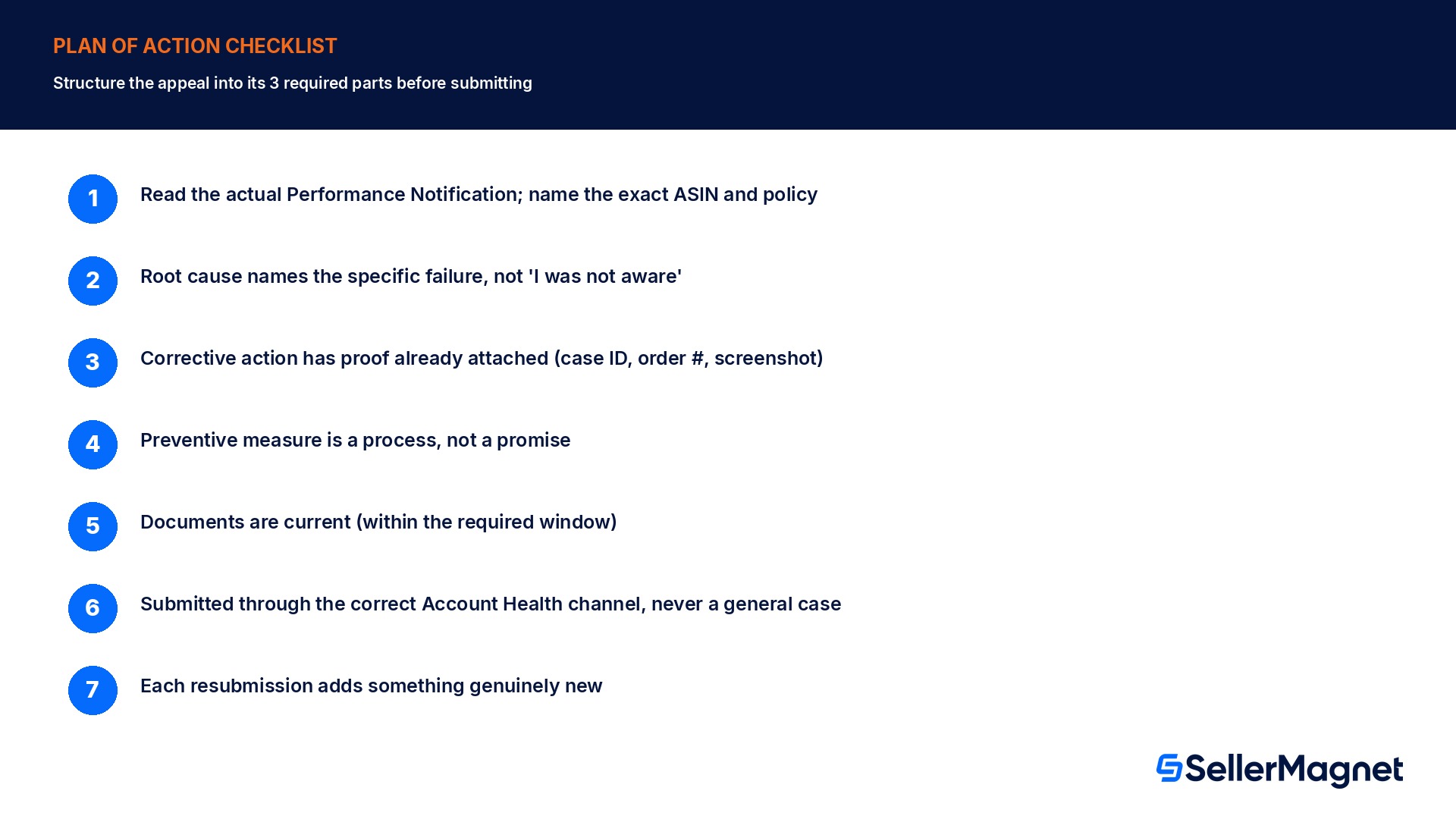
How to write a Plan of Action Amazon is likely to accept
Read the actual Performance Notification before writing anything - Identify the exact ASIN, policy, and metric named, not an assumption about what triggered it.
Write a root cause that names the specific failure - Not 'I was not aware' or 'this was a mistake'; name what actually happened and why.
Document the corrective action with proof already in hand - A removal order number, a case ID, a screenshot of the fixed listing, attached to the submission.
Write a preventive measure as a process, not a promise - A named reviewer, a written checklist, a new verification step; avoid 'I will be more careful'.
Attach documents from within the required window - Invoices, licenses, and compliance certificates current within the period Amazon's guidance asks for.
Submit through the correct Account Health channel - Product Policy Compliance for a listing issue, 'Submit new information' for an account deactivation; never a general Contact Us case.
If rejected, add something genuinely new before resubmitting - An additional document or a more specific root cause, not the same text resubmitted unchanged.
What SellerMagnet can and cannot do about this
Writing and submitting a Plan of Action happens entirely inside Seller Central, directly between a seller and Amazon's Account Health team; no third-party tool, including SellerMagnet, submits an appeal on a seller's behalf or influences how Amazon reviews one. Where Alerts and Offer Watch help is earlier in the same chain: flagging a suppressed listing, a new Buy Box loss, or a catalog change the moment it happens, often well before the underlying issue has escalated into a Performance Notification, so the root cause behind a future POA gets caught and fixed while it is still a small catalog problem, not an account-wide deactivation.
This sits next to the score mechanics covered in the separate Account Health Rating guide: that guide explains what moves the AHR number itself and what Account Health Assurance protects against, while this guide covers what to actually write once a specific violation, not just a falling score, has already produced a Performance Notification or a deactivation.
What are the three parts of a Plan of Action?
Root cause (what specifically went wrong and why), corrective action (what has already been fixed, with evidence), and preventive measure (what process changes going forward). Amazon's guidance treats a submission missing any one of the three as incomplete.
Where do I actually submit a Plan of Action?
Through the Account Health dashboard: the Product Policy Compliance section for a listing-level issue, or 'Submit new information' for a full account deactivation. A general Contact Us case gets redirected back to Account Health.
Why did my Plan of Action get rejected with 'not enough information' and no details?
This is Amazon's documented automated response to an incomplete or generic POA. It most often means the root cause or preventive measure used generic language ('I was not aware', 'I will be more careful') instead of specific, evidenced statements.
What is Account Health Assurance, and how is it different from appealing a POA?
Account Health Assurance (AHA) is a protection, not an appeal process: Amazon works with an enrolled seller (AHR 250+ for 6 consecutive months, valid emergency contact) before deactivating, as long as the seller engages within 72 hours of being contacted. A Plan of Action is what any seller, enrolled or not, submits after a violation or deactivation already occurred.
Can my account still be deactivated if I am enrolled in Account Health Assurance?
Yes. Amazon can remove a seller from AHA and deactivate immediately, bypassing its protections, if it believes the account engaged in fraudulent, deceptive, illegal, or otherwise harmful activity.
What happens if my Account Health Rating drops below 250 after I am enrolled in AHA?
If there are no new policy violations, the account stays enrolled in AHA for another 180 days even with an AHR below 250. A new violation during that grace period must be appealed and resolved within 10 days, or AHA access is lost.
How long does Amazon take to review a resubmitted Plan of Action?
Amazon does not publish one fixed timeline; a complete, specific POA is far more likely to clear on the first or second review than a generic one, which tends to repeat the same automated denial cycle.
My account was deactivated for an intellectual property complaint. Does the same Plan of Action format apply?
Yes, the same three-part structure applies, but the evidence differs: an IP appeal needs the exact ASIN and policy named, plus documentary proof such as an invoice, a letter of authorization, or a licensing agreement, with the relevant detail highlighted directly on the document.
Stop Juggling Tools. SellerMagnet Combines Everything You Need.