Amazon Canada Returns 2026: The New CAD 25 Cross-Border Default
R
RenéFreelance Amazon Editor
|
12 min read
Starting 23 November 2026, Amazon Seller Central changes two separate things about how a return is resolved on an order shipped into Canada, and the two are easy to conflate even though only one of them needs any action from most sellers. The first is a new self-serve returnless resolution rule builder in Return settings: any seller can define rules that auto-trigger a refund without the item coming back, by price range, product category, or return reason, and nothing changes unless a seller creates a rule. The second is a default Amazon now applies automatically, with no seller rule required: if a seller fulfils orders into Canada from outside Canada and has not set a default Canadian return address, any eligible return valued at CAD 25 or less is refunded automatically, without the item being returned, full stop. For returns above that CAD 25 line, Amazon's own guidance recommends offering a pre-paid return label within 48 hours of the request, or a returnless refund, but does not force either. This guide works from Amazon's own Returnless Resolutions help page and the matching seller forums announcement to walk through exactly who the automatic default hits, a worked comparison of what it costs versus setting a Canadian return address, and the mistakes the CAD 25 line makes easy to fall into.
From 23 November 2026, if you fulfil orders into Canada from outside Canada without a default Canadian return address on file, Amazon automatically refunds eligible returns valued at CAD 25 or less with no item returned. For returns above CAD 25, Amazon recommends a pre-paid return label within 48 hours or a returnless refund. Separately, any seller can now build custom returnless resolution rules by price, category, or reason in Return settings.
Two changes on 23 November 2026, not one
Amazon's seller forums announcement bundles two mechanics into a single post, and the fact that they share a launch date is the main reason sellers conflate them. The first is a tool: a returnless resolution rule builder, reachable from Settings, Return settings, the Resolutions tab, then Create a returnless resolution rule, where a seller names a rule and sets a price range and criteria before saving it. This applies to any seller-fulfilled return anywhere, not just Canada, and nothing about an existing account changes unless a seller actually builds a rule. The second is a default: Amazon's Returnless Resolutions help page states that if a seller fulfils customer orders in Canada from outside Canada and does not provide a default Canadian return address, Amazon will automatically issue the buyer a refund for eligible returns valued at or under CAD 25, without requiring the item be returned. That second mechanic needs zero setup to apply; it is already live for any account that matches its two conditions, cross-border fulfilment into Canada and no Canadian return address on file, the moment the 23 November date arrives.
Condition
Returns CAD 25 or under
Returns over CAD 25
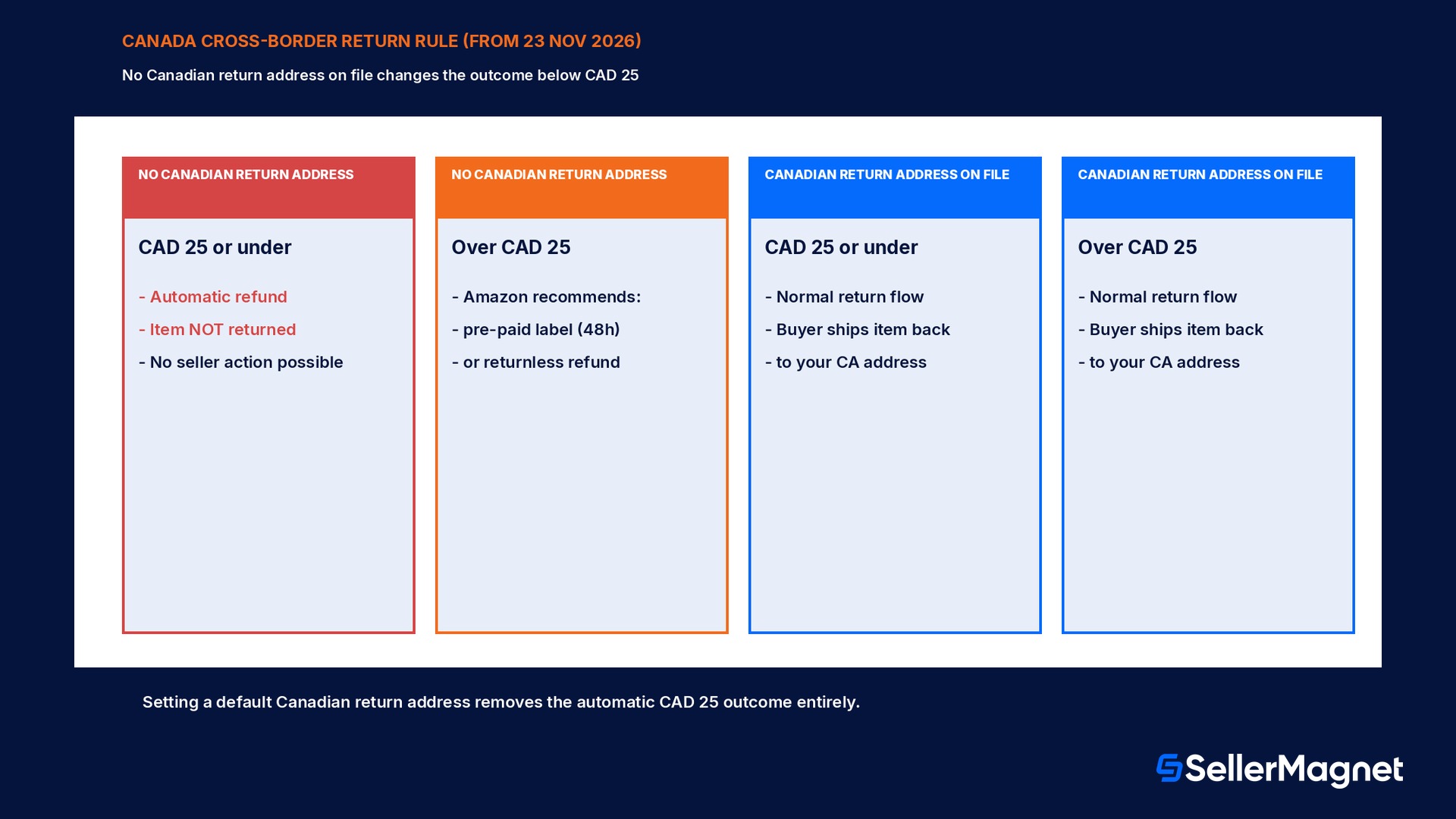
You fulfil into Canada from outside Canada, no Canadian return address on file
Automatic refund, item not returned (no seller action needed or possible)
Amazon recommends a pre-paid return label within 48 hours, or a returnless refund (not forced)
You have a default Canadian return address on file
Normal return flow applies: buyer ships the item back to your Canadian address
Normal return flow applies: buyer ships the item back to your Canadian address
The part every seller can use: the returnless resolution rule builder
The self-serve half of the 23 November change is not Canada-specific and is not automatic. A seller opens Settings, clicks Return settings, selects the Resolutions tab, and clicks Create a returnless resolution rule. From there, a rule gets a name, a price range, and a set of criteria such as product category or return reason, and is saved. Once saved, the rule applies going forward to orders that match it: Amazon issues the refund automatically and the buyer keeps the item, the definition of a returnless resolution. This is the same mechanic Amazon already supported for individual SKUs through an uploaded returnless resolution template; the 23 November change adds the rule-based version, so a seller no longer has to tag every SKU by hand to get the same automatic behaviour across a whole price band or category.
The part that needs no seller action: the Canada CAD 25 default
The automatic default is scoped narrowly and on purpose. It applies only to orders fulfilled in Canada from outside Canada, the cross-border FBM scenario, and only when the seller has not set a default Canadian return address in Return settings. Under that exact combination, Amazon's help page states plainly that eligible returns valued at or under CAD 25 are refunded automatically, with no requirement that the item be returned at all; the seller has no rule to configure and no opt-out for that specific band. Above CAD 25, the same page states Amazon recommends offering a pre-paid return label within 48 hours of the return request, or offering a returnless refund instead, worded as a recommendation rather than an automatic action, which leaves the seller a real choice the sub-CAD-25 band does not.
The one setting that removes the automatic default entirely
Amazon's customer-facing return policy lists a Canadian return address as one of three options a cross-border seller can offer (a Canadian return address, a pre-paid label, or a full refund). Setting a default Canadian return address in Return settings takes an account out of the automatic CAD 25 scenario completely, since that default only triggers when no such address is on file; it does not remove the new rule builder, which stays available either way.
A worked comparison: what the CAD 25 default actually costs without a Canadian address
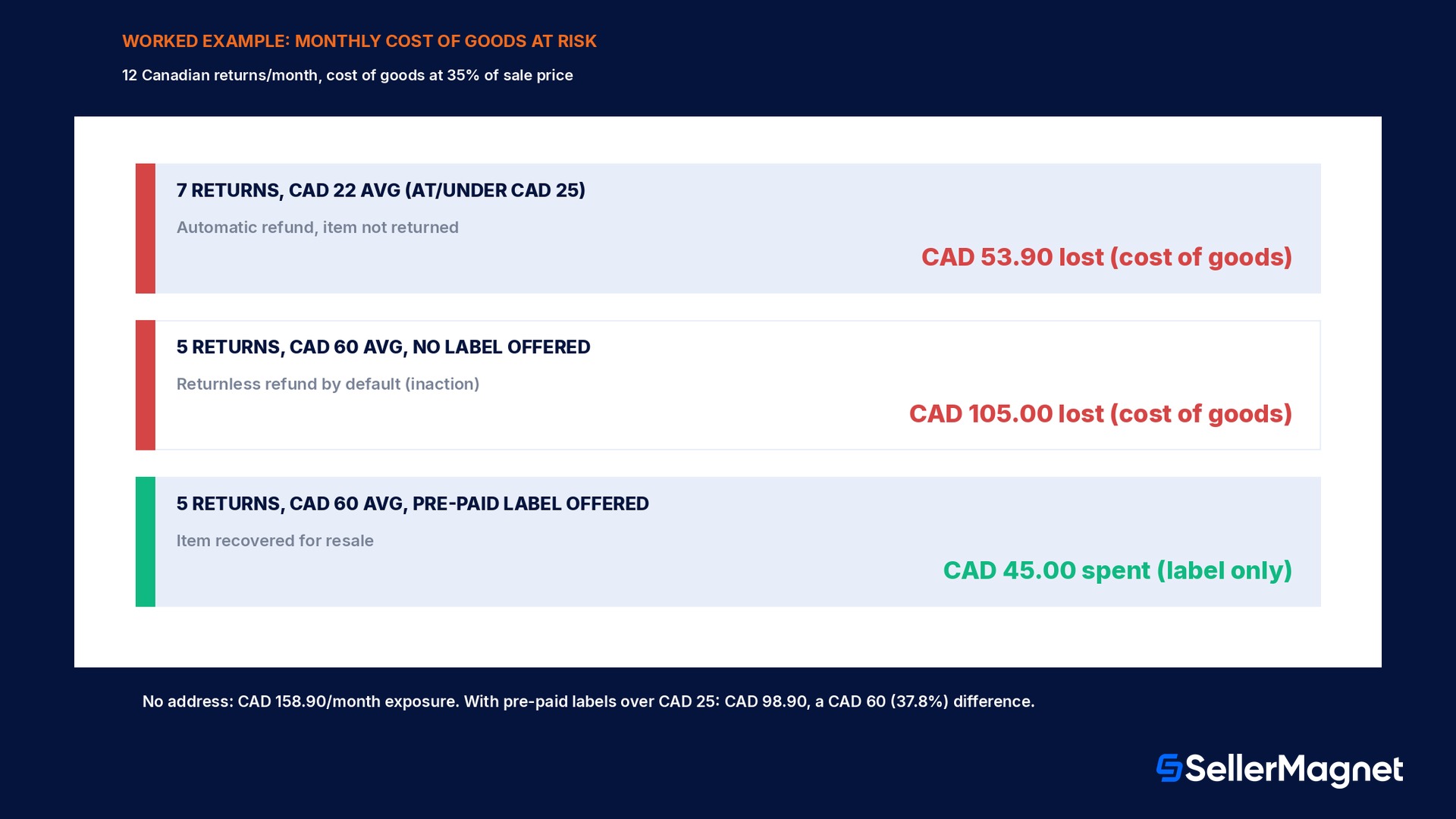
Take a cross-border FBM seller shipping into Canada from outside it, averaging 12 Canadian returns a month, split 7 valued at roughly CAD 22 each (at or under the CAD 25 line) and 5 valued at roughly CAD 60 each (above the line), with cost of goods running 35% of sale price. Without a Canadian return address on file, every one of the 7 smaller returns is refunded automatically with the item never coming back, an unrecovered cost of goods of CAD 53.90 that no seller action could have prevented once the order fell under the automatic default. If the seller also does nothing proactive on the 5 larger returns, each above the CAD 25 recommendation threshold, and simply lets them run as returnless refunds too, the cost of goods lost on those rises to CAD 105.00, for a combined monthly exposure of CAD 158.90. Choosing instead to offer a pre-paid return label, at a typical CAD 9 per label, on the 5 larger returns recovers the physical item for resale and drops that half of the cost to CAD 45.00 in label spend, for a combined monthly exposure of CAD 98.90, a CAD 60 (37.8%) improvement from one operational choice on the half of the returns Amazon leaves to the seller's judgement.
Return band
Count/month
Avg value
Strategy
Monthly cost
CAD 25 or under (automatic, no choice)
7
CAD 22
Automatic refund, item not returned
CAD 53.90 (cost of goods, unrecovered)
Over CAD 25, no pre-paid label offered
5
CAD 60
Returnless refund by default (seller's own inaction)
CAD 105.00 (cost of goods, unrecovered)
Over CAD 25, pre-paid label offered
5
CAD 60
Pre-paid label within 48 hours
CAD 45.00 (label cost, item recovered)
How this sits next to the other 2026 Amazon Canada and return changes
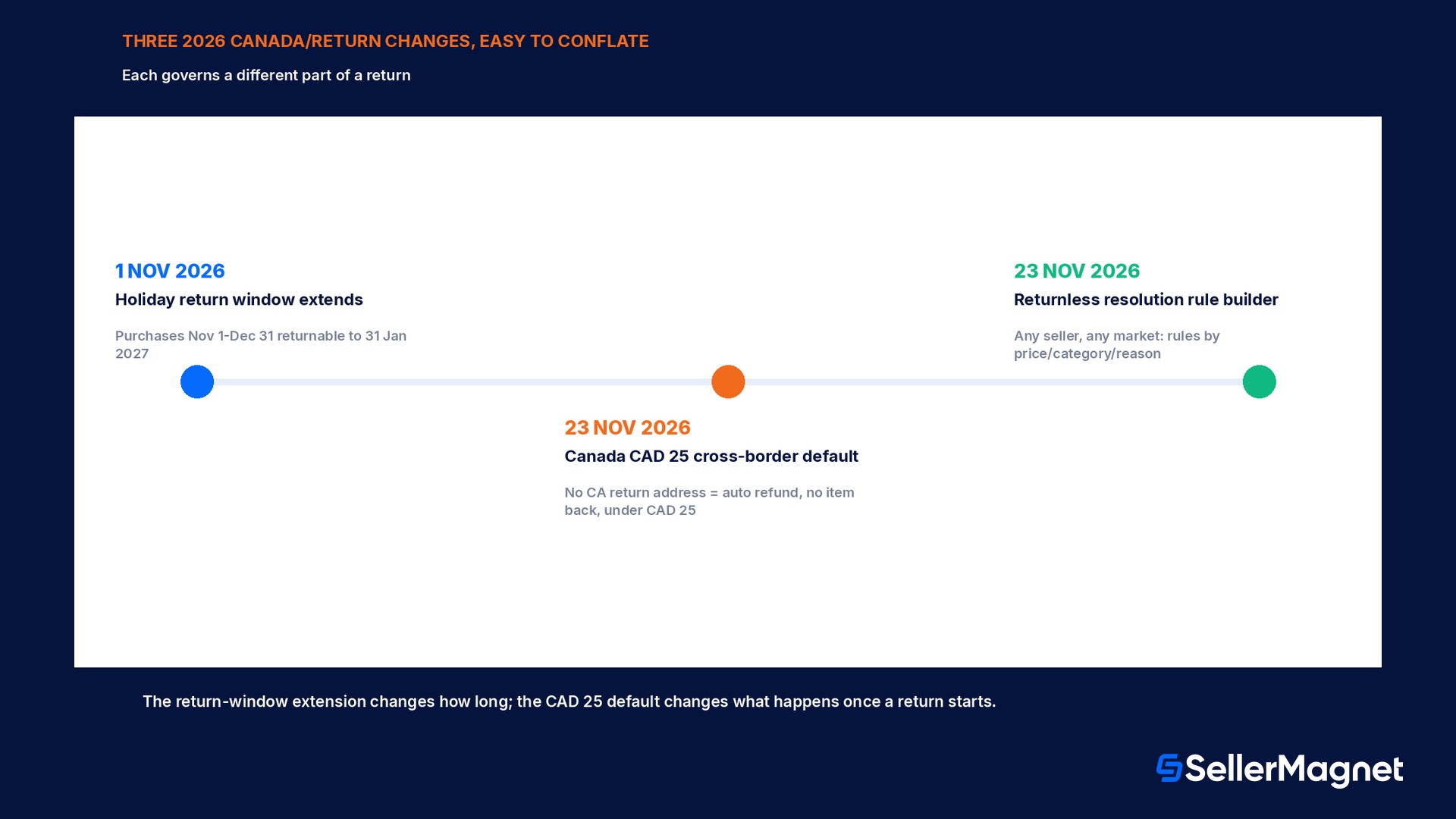
Sellers who already track the 2026 holiday return-window extension (purchases made 1 November through 31 December 2026 stay returnable through 31 January 2027, 15 January 2027 for Apple products) have a reason to assume this is the same announcement; it is not. That extension changes how long a Canadian customer can request a return; it does not change what happens once that return is requested. The 23 November 2026 change covered in this guide governs the resolution mechanics of a return already in motion: whether the item has to come back, and under what value it does not, specifically for orders fulfilled into Canada from outside it. It is also distinct from the existing US-market FBA returnless-resolutions mechanics, which cover a different fulfilment method (FBA, not FBM) and a different store (the US, not Canada) with its own separate rules.
Who this change actually hits
The automatic CAD 25 default is scoped to one specific combination, and most sellers selling into Canada will fall outside it the moment they check one setting.
FBM sellers fulfilling Canadian orders from outside Canada with no Canadian return address set. Every eligible return at or under CAD 25 is now refunded automatically with the item never coming back, with no way to opt out of that specific band.
FBM sellers fulfilling Canadian orders from outside Canada who sell mostly low-value items. A catalogue clustered under CAD 25 turns this from an edge case into the default resolution path for most returns.
Sellers who already set a default Canadian return address. This group is unaffected by the automatic default; the buyer ships the item back to that address as before.
FBA sellers fulfilling Canadian orders from Canadian fulfilment centres. This default is scoped to cross-border FBM; standard FBA return mechanics are not the ones changing here.
Any seller who wants rule-based returnless resolutions by price band or category. The new Resolutions-tab rule builder is available account-wide, not limited to Canada, and is worth checking independently of the Canada default.
What SellerMagnet can and cannot do about this
Whether a return is resolved with the item coming back or not is decided entirely inside Amazon's own Return settings and the default described above; no third-party dashboard, including SellerMagnet, changes that resolution. Where a tool like SellerMagnet's Analytics genuinely helps is on the side the resolution mechanics do not touch: tracking how much cost of goods a Canadian-return pattern is actually costing per month once returns stop coming back physically, so the real margin impact shows up in a dashboard instead of surfacing only at month-end reconciliation.
A quick pass through the Fee Calculator is worth running on any Canada-bound catalogue clustered near the CAD 25 line specifically, not as a general habit; it will not flag the returnless default for you automatically, since that is a Return settings mechanic rather than an Amazon fee, but it is still the fastest way to confirm whether a given SKU's margin can absorb an unrecovered-cost-of-goods return before deciding whether to add a Canadian return address or lean on pre-paid labels instead.
Mistakes the CAD 25 default makes easy to fall into
Assuming the CAD 25 default only matters if you build a rule. It applies automatically with zero rule-building, purely from the combination of cross-border fulfilment into Canada and no Canadian return address on file.
Confusing the rule builder with the automatic default. The Resolutions-tab rule builder is opt-in and account-wide; the CAD 25 Canada default is automatic and narrowly scoped. Building a rule does not change the automatic default, and ignoring the rule builder does not avoid it either.
Treating the over-CAD-25 guidance as mandatory. Amazon's own wording recommends a pre-paid label or returnless refund above CAD 25; it does not force either, which is exactly where a seller's own policy still decides the outcome.
Confusing this with the 2026 holiday return-window extension. That extension changes how long a customer can request a return; it does not touch whether the item has to come back once they do.
Assuming this is the same as the US FBA returnless-resolutions mechanics. This default is Canada-specific and keyed to cross-border FBM fulfilment, a different scope from the US FBA rules.
Not checking whether a Canadian return address is actually on file. The single setting that removes the automatic default from an account is one most sellers have never visited.
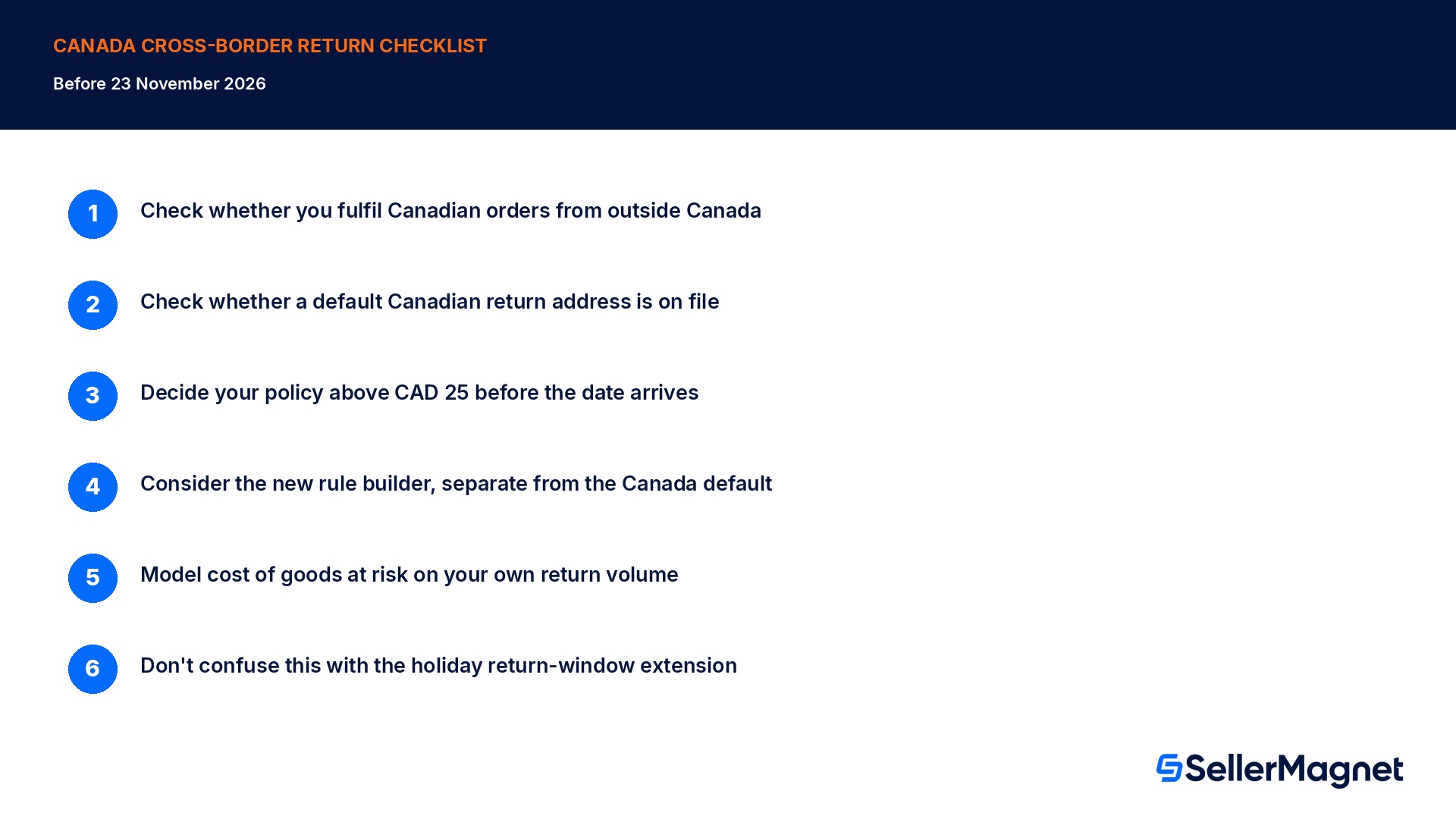
Checklist for the 23 November 2026 Canada return changes
How to prepare for Amazon's Canada cross-border return default
Check whether you fulfil Canadian orders from outside Canada - The automatic default only applies to this specific cross-border FBM scenario; FBA from a Canadian fulfilment centre is not in scope.
Check whether a default Canadian return address is on file - Go to Settings, Return settings; if no Canadian address is set, eligible returns at or under CAD 25 are refunded automatically with no item returned, starting 23 November 2026.
Decide your policy above CAD 25 before the date arrives - Amazon recommends a pre-paid return label within 48 hours or a returnless refund; neither is forced, so decide which fits your margin per SKU.
Consider the new rule builder independently of the Canada default - Settings, Return settings, Resolutions tab, Create a returnless resolution rule; useful account-wide, not limited to Canada.
Model the cost of goods at risk on your own Canadian return volume - Multiply average monthly Canadian returns under CAD 25 by their cost of goods; that figure is unrecovered regardless of any rule you build.
Do not confuse this with the holiday return-window extension - That extension changes how long a customer can request a return; this change governs whether the item comes back once they do.
Does the CAD 25 automatic refund apply to every Canadian return?
No. It applies only when you fulfil the order into Canada from outside Canada and have no default Canadian return address on file. Sellers with a Canadian return address on file are not affected.
Is the CAD 25 threshold the same as the new returnless resolution rule builder?
No. The rule builder is an opt-in tool any seller can use account-wide, for any price range or category. The CAD 25 Canada default is automatic, needs no rule, and applies only to cross-border FBM orders into Canada with no Canadian return address on file.
What happens to returns above CAD 25 for cross-border Canada orders?
Amazon recommends offering a pre-paid return label within 48 hours of the return request, or a returnless refund instead, but does not mandate either; the seller's own policy still decides.
How do I stop the automatic CAD 25 refund from applying to my account?
Set a default Canadian return address in Return settings. The automatic default only triggers when no such address is on file.
Does this apply to FBA orders fulfilled from a Canadian fulfilment centre?
No. The automatic default is scoped to cross-border FBM fulfilment, orders shipped into Canada from outside Canada, not standard FBA from within Canada.
Is this the same change as the 2026 holiday return-window extension?
No. The holiday extension changes how long a customer can request a return. This change governs what happens once a return is requested, specifically for cross-border Canada orders.
Stop Juggling Tools. SellerMagnet Combines Everything You Need.