Amazon Dangerous Goods 2026: The New Listing Questions From October 26
R
RenéFreelance Amazon Editor
|
17 min read
Since October 26, 2026, Amazon has added required dangerous goods questions to the listing workflow for 4 product groups: refrigerators, air conditioners, freezers and similar appliances; shock absorbers and suspension lift supports; markers and writing instruments; and pool and spa water treatment chemicals. If you sell any of them, the next listing you create or edit after that date will ask about refrigerant, shock-absorbing material, ink or chemical composition before it goes through. The questions look simple. The risk is answering them from memory: Amazon's help page says products with incomplete, inaccurate or conflicting dangerous goods information may be blocked for sale through FBA. Below is exactly what Amazon will ask, where each answer comes from, how long a review takes and what a dangerous goods classification costs you in storage this peak season.
From October 26, 2026, Amazon requires new dangerous goods compliance answers when you create or edit listings for refrigerators, air conditioners and freezers, shock absorbers and suspension lift supports, markers and writing instruments, and pool and spa chemicals. Existing listings get the questions at their next edit. Answer from the nameplate, the safety data sheet and the manufacturer's specifications, because incomplete or conflicting answers can block the product for sale through FBA.
What changes on October 26, 2026?
Amazon announced the change on its Seller Forums in September 2026. The US announcement reads: starting October 26, 2026, if you create new listings or edit existing listings for select categories, you will be required to answer new compliance questions "to help us identify dangerous goods, enable more ship methods, and reduce unnecessary disposal costs and fees." The UK version is worded almost identically, with "delivery methods" instead of "ship methods".
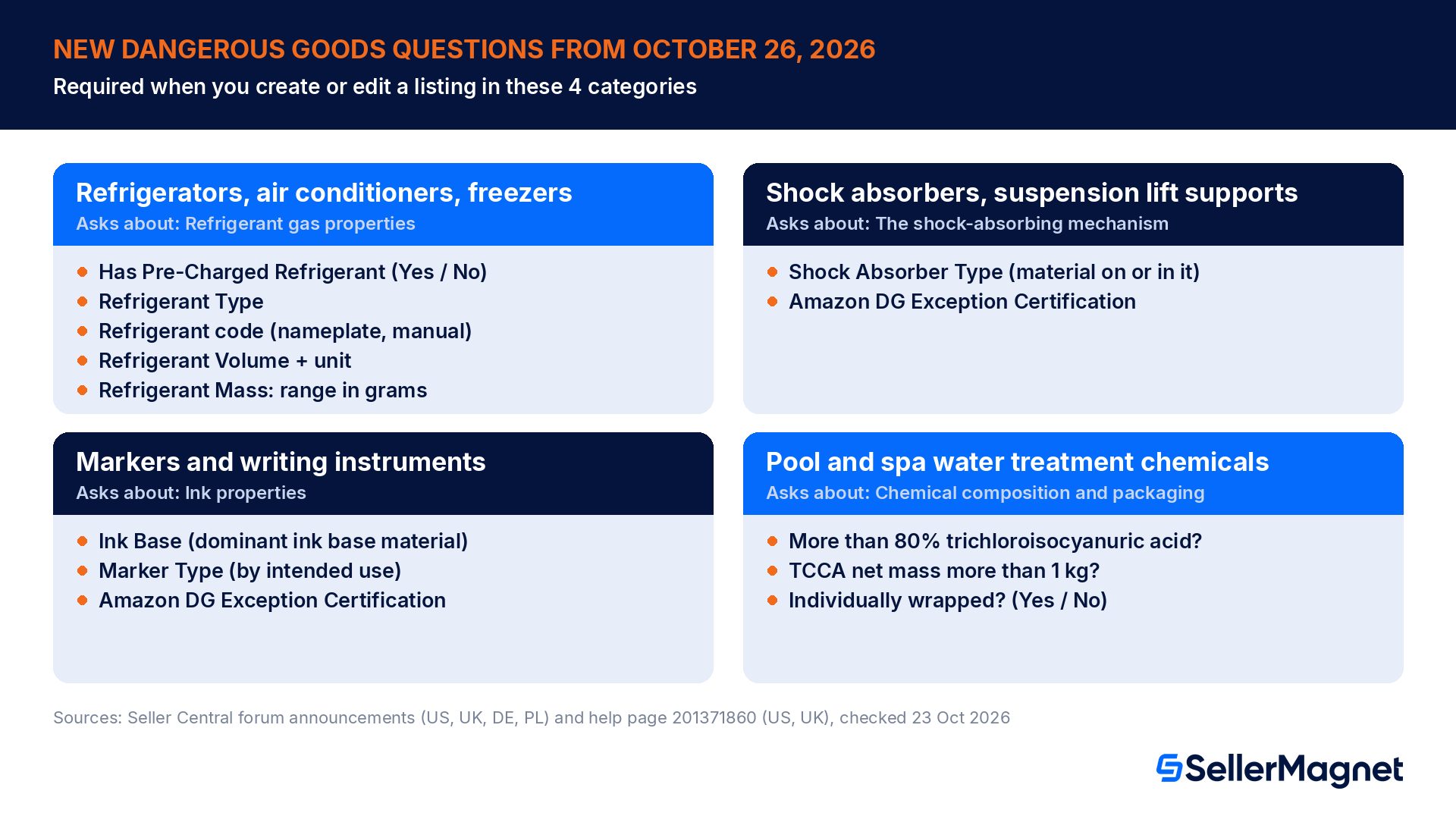
That stated reason tells you how your answers will be used. They feed Amazon's dangerous goods classification, which decides whether and how an ASIN can be stored and shipped through FBA. Precise, documented answers give the reviewer what it needs to classify the product correctly. Vague or contradictory answers are exactly what the help page names as a reason to block a product. The table shows the 4 categories, what Amazon wants to know and the fields you will see, with the field names as Amazon's help page writes them (its versions in other languages use translated names).
Category
What Amazon asks about
Fields in the listing workflow
Refrigerators, air conditioners, freezers and similar products
Refrigerant gas properties
Has Pre-Charged Refrigerant, Refrigerant Type, Refrigerant (the code), Refrigerant Volume (with unit), Refrigerant Mass (a range in grams)
Pool and spa water treatment products (pool chemicals)
Chemical composition and packaging
Contains more than 80% Trichloroisocyanuric Acid, TCCA Net Mass more than 1 kg, Individually Wrapped
Which marketplaces this covers
We read 4 copies of the announcement: amazon.com (US), amazon.co.uk (UK), amazon.de (Germany) and amazon.pl (Poland). All 4 give October 26, 2026 and the same 4 categories. The help page that lists the fields, the review times and the 14-business-day rule says the same in its US, UK, German, French, Italian, Spanish, Polish and Swedish versions (checked October 23, 2026). If you sell in another Amazon store, check that store's Seller Forums news before you rely on the date. The storage fees later in this article are US rates.
Did existing listings need action before October 26?
The English announcements contain one confusing sentence. The US post says: "If you have existing listings in any of these categories, you don't need to take action before August 31, 2026." The UK post says the same with "31 August 2026". That date had already passed when Amazon published the update, and the German and Polish versions of the same announcement say instead that existing listings need no action before October 26, 2026.
The sentence that follows says the same in all 4 versions, and it is the one that matters in practice: "These required questions will appear the next time you create or edit a listing." Nothing happens to a live listing on October 26 by itself. The questions are triggered when you next create or edit a listing in one of the 4 categories, so the real deadline is your own next edit, not a date in the calendar.
That turns the change into a planning question for the fourth quarter. If you intend to refresh images, titles or bullet points on these products before Black Friday, collect the answers first. Otherwise a 5-minute content update waits on a spec sheet from your supplier, in the weeks when a blocked listing costs you the most.
Refrigerators, air conditioners and freezers: the refrigerant questions
For refrigerating machines, Amazon's help page Dangerous goods (hazmat) required information and documentation lists 5 fields. Has Pre-Charged Refrigerant: select Yes if the product comes with refrigerant pre-filled and ready for immediate use. Refrigerant Type: the type of refrigerant the product comes pre-charged with, chosen from Amazon's list. Refrigerant: the refrigerant code, which Amazon says can sometimes be found on a plate on the back, bottom or inside a panel of the appliance, or in the manual or spec sheet. Refrigerant Volume: the total volume of refrigerant with its unit of measurement. Refrigerant Mass: the total mass range of the refrigerant, in grams.
The mass field is where answers go wrong. Many nameplates and spec sheets state the charge in ounces, while Amazon asks you to select a range in grams. Convert before you open the form: 1 ounce is 28.35 grams. A rough guess can put the product in the wrong range, and a range that contradicts your safety data sheet is the kind of conflicting information that can get a listing blocked.
Charge on the nameplate (illustrative)
In grams
What you select
0.85 oz
24.1 g
The mass range that contains 24.1 g
3.5 oz
99.2 g
The mass range that contains 99.2 g
14.1 oz
399.7 g
The mass range that contains 399.7 g
One email to your supplier answers all 5 fields
Ask for a photo of the nameplate and the current spec sheet in the same request, and save both in the product's compliance folder. Together they give you the refrigerant code, the type, the volume and the charge, and they are the evidence you need if a reviewer later asks how you answered.
Shock absorbers and suspension lift supports
This category gets 2 fields. Shock Absorber Type asks you to select the type of shock-absorbing material found on or in the product. Amazon DG Exception Certification asks you to certify that your product meets an applicable dangerous goods (hazmat) regulation exemption or exception. The announcement describes the purpose as questions about the shock-absorbing mechanism, so the answer belongs to whoever knows what is inside the part: the manufacturer.
Treat the certification as a formal statement, not a checkbox that unlocks the listing. Only certify an exemption or exception when your supplier's documents support it, and keep those documents next to the ASIN. If a reviewer finds that your certification conflicts with the safety data sheet, you are back to the rule that incomplete, inaccurate or conflicting information may get the product blocked for sale through FBA.
Markers and writing instruments
Markers and writing instruments get 3 fields. Ink Base: select the dominant base material of the product's ink. Marker Type: based on the intended use of the marker, select the type that matches your product. Amazon DG Exception Certification: the same certification as for shock absorbers. The announcement frames all 3 as questions about ink properties.
Sellers of multipacks and mixed sets should take extra care. If a set contains different marker types or inks, answer for what the product actually contains according to the manufacturer, and make sure the listing's title, bullet points and images tell the same story. A title that says one ink base while the dangerous goods answer says another is a textbook case of conflicting information.
Pool and spa chemicals: the TCCA questions
Pool and spa water treatment products get the most specific questions, all about trichloroisocyanuric acid, which Amazon also lists as TCCA, symclosene, trichlorocyanuric acid or trichloro-s-triazinetrione. Contains more than 80% Trichloroisocyanuric Acid: answer whether the product's TCCA concentration is above 80%. TCCA Net Mass more than 1 kg: answer whether the product has a net mass of more than 1 kg. Individually Wrapped: select Yes if each unit is sold individually wrapped in packaging, No if the units are unwrapped.
All 3 answers come from documents you should already have: the concentration from the label and the safety data sheet, the net mass from the label, and the wrapping from your packaging specification. If the label shows several weights (gross, net, per tablet), use the net figure, and keep a photo of the label with your records so that your answer can be checked against it.
How long does a dangerous goods review take?
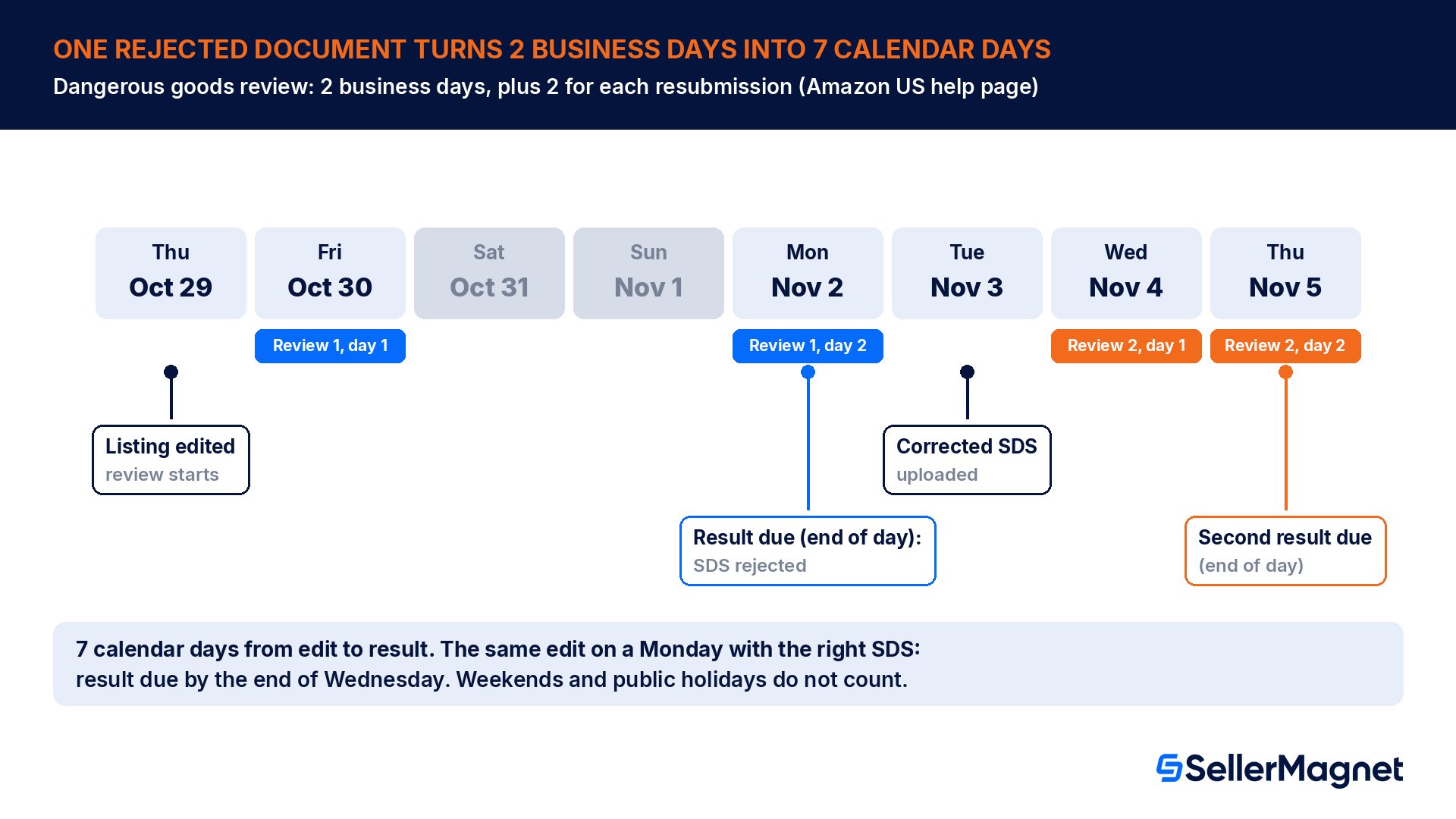
Amazon's help page states (in all 8 store versions we checked) that once a listing is created or converted to FBA, the dangerous goods review takes 2 business days, Monday to Friday excluding public holidays. Rejected documents, or a request for more information, add another 2 business days for each resubmission. If the required information is missing altogether, the listing cannot be created or converted to FBA at all. Amazon's own service-level table shows how the 2 business days fall on the calendar:
You submit on
Review due by
Monday
End of day Wednesday
Thursday
End of day Monday (next week)
Saturday or Sunday
End of Wednesday (the clock starts on Monday)
Thursday before a Friday public holiday
End of day Tuesday (following week)
Monday that is a public holiday
End of day Thursday (the clock starts on Tuesday)
Worked example (illustrative): say you edit a shock absorber listing on Thursday, October 29, 2026, and the edit sends the ASIN into a dangerous goods review. The result is due by the end of Monday, November 2. If the reviewer rejects your safety data sheet and you upload a corrected one on Tuesday, November 3, the new due date is the end of Thursday, November 5. One rejected document has turned a 2-business-day wait into 7 calendar days, in the middle of the run-up to Black Friday. The same edit made on a Monday, with the documents ready, would have been through by Wednesday.
What if Amazon flags stock already in a fulfillment center?
The review does not only happen when you list. Amazon says it regularly reviews products in its fulfillment centers that may be regulated as dangerous goods. If your product is identified as a possible dangerous good while inventory is already in a fulfillment center, the help page says you are notified by email and have 14 business days to provide the requested documentation. If you do not provide it in that period, Amazon states that the inventory will be disposed of, at your expense. All 8 store versions of the page we checked carry the same 14-business-day rule.
Read dangerous goods emails the day they arrive
14 business days is less than 3 calendar weeks when no public holiday falls in between. Route Amazon's dangerous goods notifications to an inbox someone checks daily, and keep a safety data sheet for every product in the 4 categories ready to upload, so you can send it on the first day instead of the last.
What does a dangerous goods classification cost in storage?
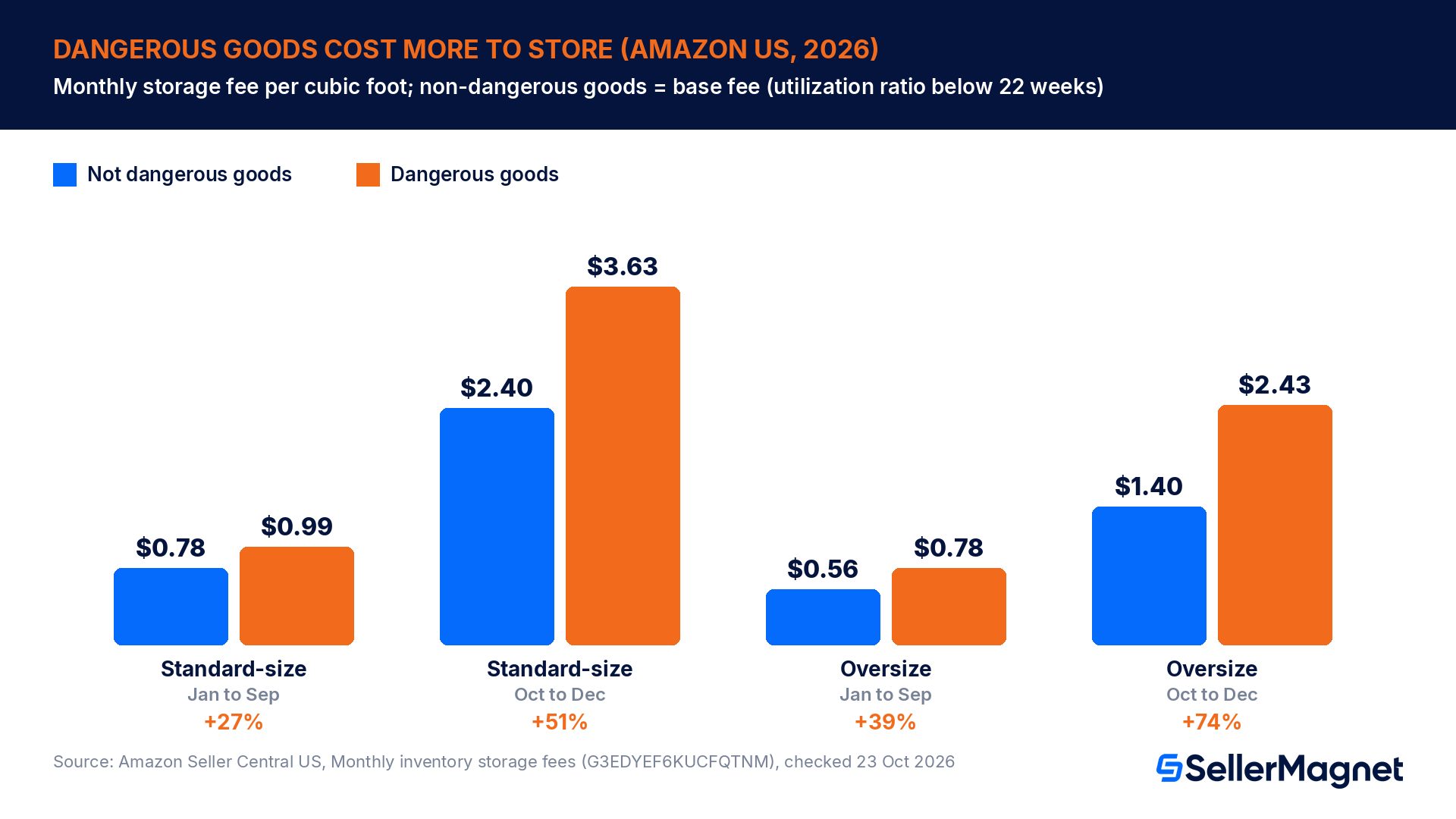
Amazon's US monthly storage fee page says that inventory classified as dangerous goods is charged at different rates, and the gap is widest right now. From October to December, standard-size dangerous goods cost $3.63 per cubic foot per month, against $2.40 for non-dangerous goods: 51% more. Oversize items go from $1.40 to $2.43, 74% more. Off-peak, from January to September, the gaps are smaller: $0.99 against $0.78 for standard-size and $0.78 against $0.56 for oversize.
US monthly storage fee per cubic foot (2026)
Non-dangerous goods
Dangerous goods
Dangerous goods cost
Standard-size, January to September
$0.78
$0.99
+27%
Standard-size, October to December
$2.40
$3.63
+51%
Oversize, January to September
$0.56
$0.78
+39%
Oversize, October to December
$1.40
$2.43
+74%
The non-dangerous goods figures are the base monthly fees, which are the full rate when your storage utilization ratio is below 22 weeks; sellers above that ratio who meet Amazon's criteria pay a storage utilization surcharge on top. Our guide to Amazon FBA storage fees in 2026 explains the surcharge in detail.
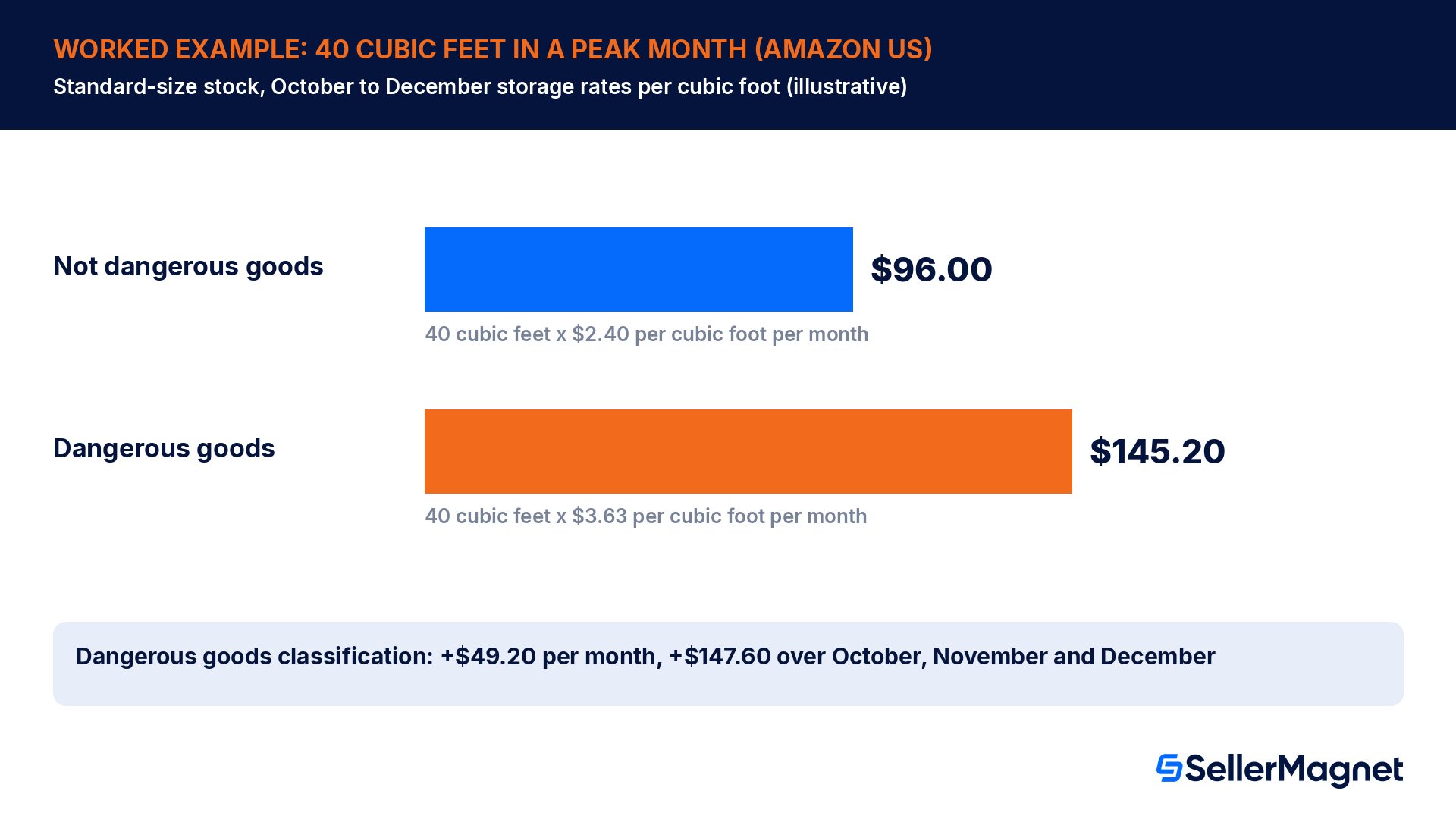
Worked example: you hold 40 cubic feet of standard-size stock in a peak month. Stored as non-dangerous goods it costs $96.00 for the month; classified as dangerous goods it costs $145.20. That is $49.20 more per month, or $147.60 across October, November and December, for one modest shelf of inventory. The classification follows the product's real properties, and you cannot answer your way out of a genuine dangerous good. What you control is that a product which is not a dangerous good is not classified as one because of a missing, guessed or contradictory answer.
SDS or exemption sheet: which document fits?
Answers in the listing workflow are often not the end of it. Amazon may ask for a safety data sheet (SDS) or an exemption sheet after the listing is created, and the 2 are not interchangeable.
Document
When it fits
How Amazon handles it
Safety data sheet (SDS)
Products that are or may be regulated as dangerous goods; prepared by the manufacturer or importer, 16 sections
Upload in Manage dangerous goods classification; reviewed within 2 business days
Exemption sheet for batteries and battery-powered products
Batteries and battery-powered products that do not require an SDS
Download the template, fill in every red cell, upload as an Excel file
Exemption sheet for products without harmful chemicals
Products without harmful chemicals (for example alcohol, acid or sodium) when you cannot get an SDS
Excel file only; rejected for any product outside these 2 categories
For pool chemicals and for appliances that come pre-filled with refrigerant, plan on getting a full safety data sheet from the manufacturer. An exemption sheet for a product that does not fit one of the 2 categories is rejected, and every rejection adds another 2 business days to the review clock above.
How to get your listings ready for the new questions
List the affected ASINs. - Filter your catalogue for refrigerating appliances, shock absorbers and lift supports, markers and writing instruments, and pool and spa chemicals, in every store you sell in.
Check the current classification. - Check each FBA ASIN with Amazon's Look up an ASIN tool, linked from the dangerous goods help pages, and note its classification status.
Collect the source documents. - Nameplate photo and spec sheet for appliances, ink and marker specification, shock absorber specification, and label plus safety data sheet for pool chemicals.
Write the answers down before you edit. - Refrigerant code, type, volume with unit and mass in grams; ink base and marker type; shock absorber type; TCCA concentration, net mass and wrapping.
Decide on any DG Exception Certification with evidence. - Only certify an exemption or exception when the supplier's documents support it, and file that evidence with the ASIN.
Time the edit. - Edit early in the week so that a 2-business-day review and one possible resubmission are done before your stock runs low or a promotion starts.
Common mistakes that get listings blocked
Typing the ounce figure from the nameplate into the gram-based field, or guessing the range. The field asks for the total mass range in grams, and it should match the safety data sheet.
Certifying a dangerous goods exception because it seems to unlock the listing. The certification is your statement, and inaccurate information can get the product blocked for sale through FBA.
Answering differently in different stores or on different variations of the same product. Conflicting information is one of the reasons Amazon names for blocking a product.
Uploading an exemption sheet for a chemical product. Amazon accepts exemption sheets only for batteries and battery-powered products and for products without harmful chemicals, and rejects the rest.
Uploading the exemption sheet as a PDF or a scan. Amazon requires the downloaded template saved and uploaded as an Excel file.
Ignoring a dangerous goods email about stock already in a fulfillment center. After 14 business days without documents, the inventory is disposed of at your expense.
Planning a large listing refresh for the week before Black Friday. Every edit in these 4 categories can now trigger the questions and a review.
The pre-edit checklist
Every ASIN in the 4 categories is listed, per store.
Each one has a safety data sheet (16 sections) or the correct exemption sheet on file.
Refrigerant code, type, volume and mass in grams are written down for every appliance.
Ink base and marker type are confirmed by the supplier for every marker.
Shock absorber type is confirmed, and any DG exception certification is backed by a document.
TCCA concentration, net mass and wrapping are checked against the label for every pool chemical.
Amazon's dangerous goods emails go to an inbox someone reads daily.
Edits are scheduled early in the week, never in the last days before a promotion.
Where SellerMagnet fits
The answers themselves have to come from your documents; no tool can know what is inside your product. What SellerMagnet can do is make the knock-on effects visible. Offer Watch checks your whole connected catalogue automatically for new sellers, Buy Box losses, price undercuts and suppressed listings, once a day as standard, so a listing that drops out after an edit shows up in your next check instead of in next month's sales report. It does not read Amazon's dangerous goods status, so keep using the Look up an ASIN tool for that.
The inventory forecast shows days of stock left, the expected stockout date and the units to send, based on your real sales velocity (included from the Growth tier). That tells you how much buffer you have if a review or a resubmitted document holds up a listing edit or an inbound shipment during peak season.
What changes for Amazon dangerous goods listings on October 26, 2026?
From October 26, 2026, Amazon requires new compliance answers when you create or edit a listing for refrigerators, air conditioners and freezers, shock absorbers and suspension lift supports, markers and writing instruments, or pool and spa chemicals. Amazon says the answers help it identify dangerous goods, enable more shipping methods and reduce unnecessary disposal costs and fees.
Did I have to update my existing listings before October 26, 2026?
No action is needed on the day itself. Amazon says the required questions appear the next time you create or edit a listing in these categories. The English announcements mention August 31, 2026 for existing listings, while the German and Polish versions say October 26, 2026. Either way, prepare the answers before your next edit.
Which marketplaces have announced the new dangerous goods questions?
We checked the announcement on the US, UK, German and Polish Seller Central forums: all 4 give October 26, 2026 and the same 4 categories. The help page with the fields matches in its US, UK, German, French, Italian, Spanish, Polish and Swedish versions. Elsewhere, check your own store's Seller Forums news before relying on the date.
What does Amazon ask about refrigerants?
For refrigerating machines, Amazon asks whether the product is pre-charged with refrigerant, the refrigerant type, the refrigerant code, the total refrigerant volume with its unit, and the total mass range in grams. The code and charge are usually on the appliance's nameplate or spec sheet. Convert ounces to grams first: 1 ounce is 28.35 grams.
What is the Amazon DG Exception Certification?
It is a field for markers and for shock absorbers in which you certify that your product meets an applicable dangerous goods regulation exemption or exception. Only certify it when your supplier's documents support the exemption, and keep that evidence with the ASIN, because inaccurate or conflicting information can block the product for sale through FBA.
How long does Amazon's dangerous goods review take?
In all 8 store versions of Amazon's help page we checked, the review takes 2 business days, Monday to Friday excluding public holidays. A rejected document or a request for more information adds 2 more per resubmission. Something submitted on a Thursday is due by the end of the following Monday, so early-week edits finish sooner.
What happens if Amazon flags inventory already in a fulfillment center?
According to Amazon's help page (all 8 store versions we checked), you are notified by email and get 14 business days to provide the requested documentation, for example a safety data sheet. If you do not provide it in that period, the inventory will be disposed of at your expense. Have the documents ready before an email arrives.
Do dangerous goods cost more to store on Amazon?
Yes. In the US, standard-size dangerous goods cost $3.63 per cubic foot per month from October to December, against $2.40 for non-dangerous goods, which is 51% more. Oversize dangerous goods cost $2.43 against $1.40. From January to September the standard-size rates are $0.99 and $0.78, so peak-season classification errors cost the most.
Stop Juggling Tools. SellerMagnet Combines Everything You Need.