FREEASIN Converter, Fee Calculator and more free tools, no signup required
What Is Amazon Listing Hijacking? (And How to Protect)
FBA FBM Amazon Basics

What Is Amazon Listing Hijacking? (And How to Protect)

|
9 min read
Last updated: Oct 24, 2026

What Is Amazon Listing Hijacking? (And How to Protect Your Listings)

Selling products on Amazon can be a lucrative business, but it's not without its challenges. One particularly frustrating issue many sellers face is Amazon listing hijacking. Understanding this threat and knowing how to defend yourself is crucial to maintaining your success on the platform.

What Exactly Is Amazon Listing Hijacking?

Amazon listing hijacking occurs when another seller starts offering counterfeit or unauthorized versions of your branded product on your Amazon listing. Essentially, hijackers exploit your hard-earned product rankings, reviews, and visibility to make sales for themselves. Imagine this scenario: you've built a successful listing for a private-label product, with hundreds of positive reviews and steady sales. Suddenly, another seller appears on your listing, selling a similar (often inferior) product at a lower price. Customers buy from this unauthorized seller, believing they’re getting your genuine product. In the end, your brand reputation suffers, and you lose revenue.

How Does Listing Hijacking Affect Your Amazon Business?

Hijacking can have several negative effects:
  • Loss of Buy Box: Hijackers frequently undercut prices to temporarily win the Buy Box, stealing sales directly from you.
  • Damage to Brand Reputation: When customers receive poor-quality or counterfeit goods, they'll likely leave negative reviews, damaging your brand image.
  • Reduced Profit Margins: Battling hijackers often requires lowering your own prices, leading to a cut in profit margins.

Real-Life Examples of Amazon Hijacking

One notable example involved a private-label seller who built a six-figure business with branded kitchen utensils. Overnight, their sales plummeted. They discovered multiple unauthorized sellers offering counterfeit versions of their product at lower prices. Negative reviews flooded in, drastically affecting their ratings. It took months and substantial resources to restore their listings and brand reputation. Another example involved a clothing brand whose listings were hijacked. Customers complained about inferior materials from unauthorized sellers, causing a 20% revenue drop until the situation was resolved.

How to Identify an Amazon Hijacker

It's critical to detect hijackers early. Look for signs such as:
  • Sudden price drops from unknown sellers.
  • A spike in customer complaints about authenticity or quality.
  • Unexpected changes to your Buy Box status.
Automated software can monitor your listings and alert you when unauthorized sellers appear, facilitating swift action.

Steps to Protect Your Amazon Listings from Hijackers

1. Register Your Brand

Participating in Amazon Brand Registry provides vital protective measures, including:
  • Increased control over your product listings.
  • Simplified procedures for reporting counterfeit items.
  • Access to Amazon’s enhanced brand-protection programs.

2. Use Amazon’s Transparency Program

Amazon’s Transparency Program requires using distinct 2D barcodes on your products. Each unit is verified by Amazon before shipment, significantly reducing the chance that counterfeit goods can be sold under your listing.
2. Use Amazon’s Transparency Program

3. Amazon Project Zero
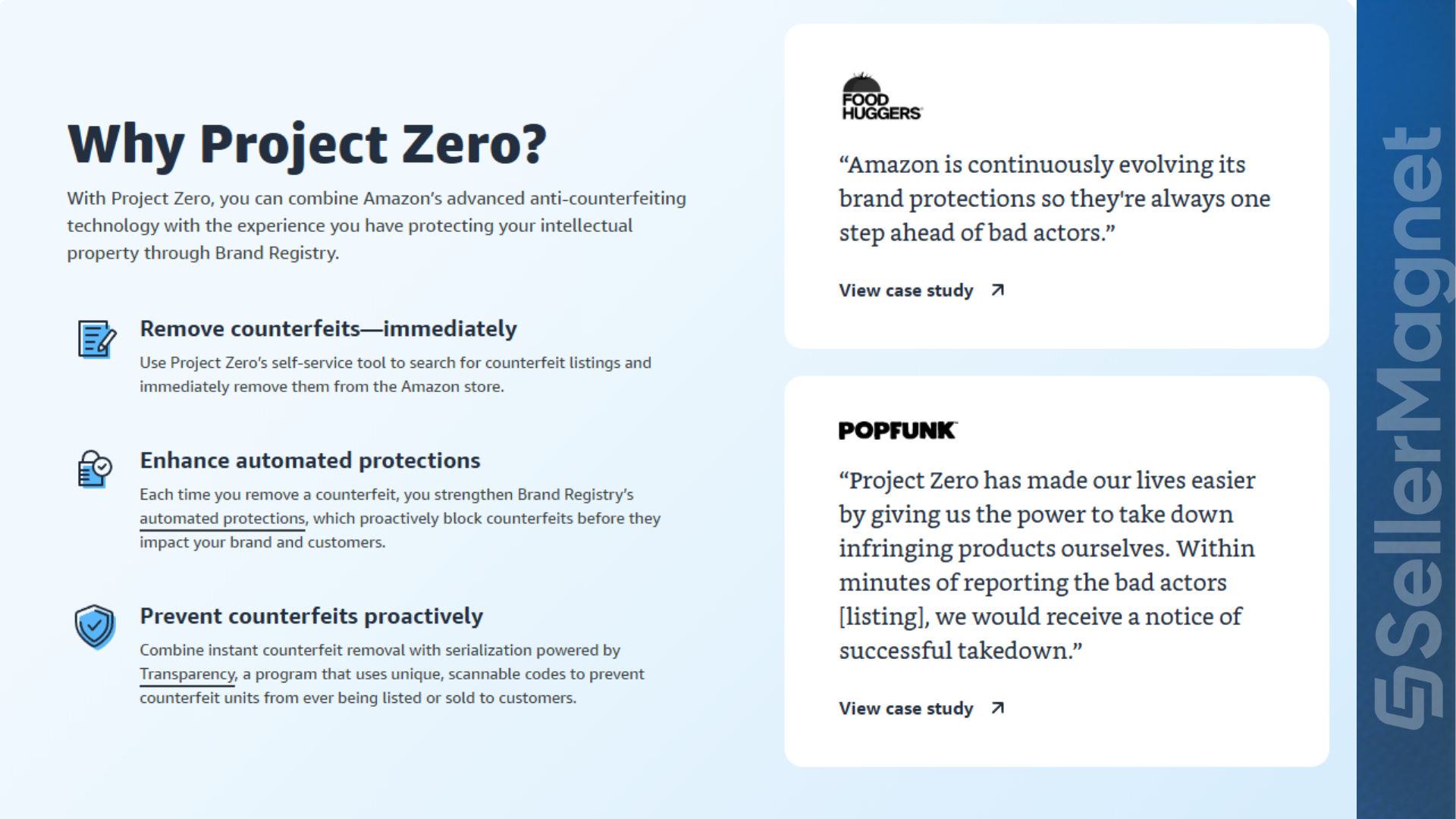
Project Zero advances protection further by allowing registered brands to remove counterfeit listings directly. This proactive tool is very effective in promptly eliminating hijackers.
3. Amazon Project Zero

4. Monitor Listings Regularly

Stay vigilant and periodically check your listings. Automated monitoring services can send you real-time alerts about suspicious activity, enabling immediate action to limit damage.

5. File Infringement Reports

If a hijacker is using your brand’s name and logo, submit an Amazon Report Infringement form. If the hijacker is listing a different brand on your product listing, use Amazon’s Violation form to report the issue.
Sometimes, a cease-and-desist letter backed by legal grounds can deter hijackers. Clearly state possible legal consequences if they continue selling unauthorized items.

Case Study: The Impact of Amazon Project Zero

A well-known skincare brand implemented Amazon Project Zero to handle chronic hijacking issues. Within weeks of activation, they managed to eradicate nearly 90% of counterfeit listings and saw a substantial boost in customer satisfaction and revenue.

Preventive Measures to Avoid Future Hijacking

  • Upgrade your packaging with unique branding, making it more difficult for counterfeiters to replicate.
  • Clearly communicate brand guidelines to authorized distributors, reducing the risk of internal leaks.
  • Stay in touch with customers, encouraging them to buy directly from your listings and educating them on identifying authentic merchandise.

Final Thoughts

Hijacking on Amazon can seriously affect your revenue, reputation, and customer relationships. A proactive strategy, enrolling in Brand Registry, using Amazon’s Transparency and Project Zero programs, consistently monitoring, and swiftly addressing unauthorized sellers, offers your strongest defense. By taking these steps, you can secure your listings, protect your brand, and maintain the success you’ve worked hard to achieve. Keep vigilant, leverage the available tools, and guard the integrity of your business on Amazon.

Stop Juggling Tools. SellerMagnet Combines Everything You Need.

Join a smarter way to manage your Amazon store.

Recommended Articles
Amazon Buy Shipping 2026: Rates and Limits Guide
FBM SellerMagnet Tools

Amazon Buy Shipping 2026: Rates and Limits Guide

How Amazon Buy Shipping's discounted carrier rates work, the real zone-based rate card, a worked monthly savings example, and when linking your own carrier account beats it.
Read more
Amazon EUDR 2026: Dates, Due Diligence and DDI
Amazon Basics Amazon Updates

Amazon EUDR 2026: Dates, Due Diligence and DDI

The EU Deforestation Regulation's 7 covered commodities, the real 30 December 2026 / 30 June 2027 dates, Amazon's Due Diligence Information requirement for Invoice by Amazon, and a worked lot-level example.
Read more
Amazon FBA Capacity Manager 2026: How Bidding for Extra Fulfillment Center Space Really Works
FBA Inventory Management

Amazon FBA Capacity Manager 2026: How Bidding for Extra Fulfillment Center Space Really Works

Capacity Manager lets you bid a reservation fee for extra FBA storage beyond your limit. How the 3-4 day grant cycle, the lowest-fee rule and the $0.15-per-dollar performance credit actually work, with a worked example.
Read more
Amazon Multipack Listings 2026: IPQ and UPC Rules
Amazon Basics Product Research

Amazon Multipack Listings 2026: IPQ and UPC Rules

Item Package Quantity versus Number of Items, the UPC rules for a valid multipack, and the imaging mistakes that get a multipack listing suppressed.
Read more
EU Customs Handling Fee 2026: The New 2 Euro Charge
Amazon Updates FBM

EU Customs Handling Fee 2026: The New 2 Euro Charge

From 1 Nov 2026 the EU charges a 2 euro customs handling fee per item on every import, on top of the 3 euro duty. What stacks, who pays it on FBM vs FBA, and a worked example.
Read more
Amazon DAC7 EU Tax Reporting 2026 Guide
Amazon Basics Amazon Updates

Amazon DAC7 EU Tax Reporting 2026 Guide

What DAC7 actually requires Amazon to report, who is in scope (the 30-transaction/2,000-euro threshold), the 60-day deadline, and how the reported consideration amount is calculated.

Read more

Ready to grow your Amazon business?

Used on nearly 800 Amazon projects to automate pricing, track profits and scale faster.

14-day free trial • Cancel anytime