How to Dropship on Amazon in 2025
Index
- What is Dropshipping and how does it work on Amazon
- Amazon's Dropshipping requirements and policies
- Advantages and disadvantages of Dropshipping
- How to start Dropshipping on Amazon
- Choosing suppliers and products to sell
- Strategies for effective product selection
- Inventory management and performance monitoring
- Pricing and positioning optimization
- Comparison: Amazon Dropshipping vs Amazon FBA
- Common Dropshipping mistakes to avoid
- Conclusions and final recommendations
What is Dropshipping and how does it work on Amazon
Amazon's Dropshipping requirements and policies
- It is clearly indicated that the seller is responsible for the sale.
- Third-party supplier contact information is not used in shipments.
- Amazon's guidelines are strictly followed.
Advantages and disadvantages of Dropshipping
| Advantages | Disadvantages |
|---|---|
| Low upfront investment | Limited control over product and shipping |
| Easy logistics management | Often thinner profit margins |
| Reduced financial risk | High competition |
How to start Dropshipping on Amazon
- Choose between the Individual or Professional seller plan.
- Open a seller account on Amazon.
- Find reliable suppliers using this Amazon guide.
- Select suitable and profitable products to offer.
Choosing suppliers and products to sell
- Check any restrictions on selected products using this ungating guide.
- Ensure the reliability of chosen suppliers.
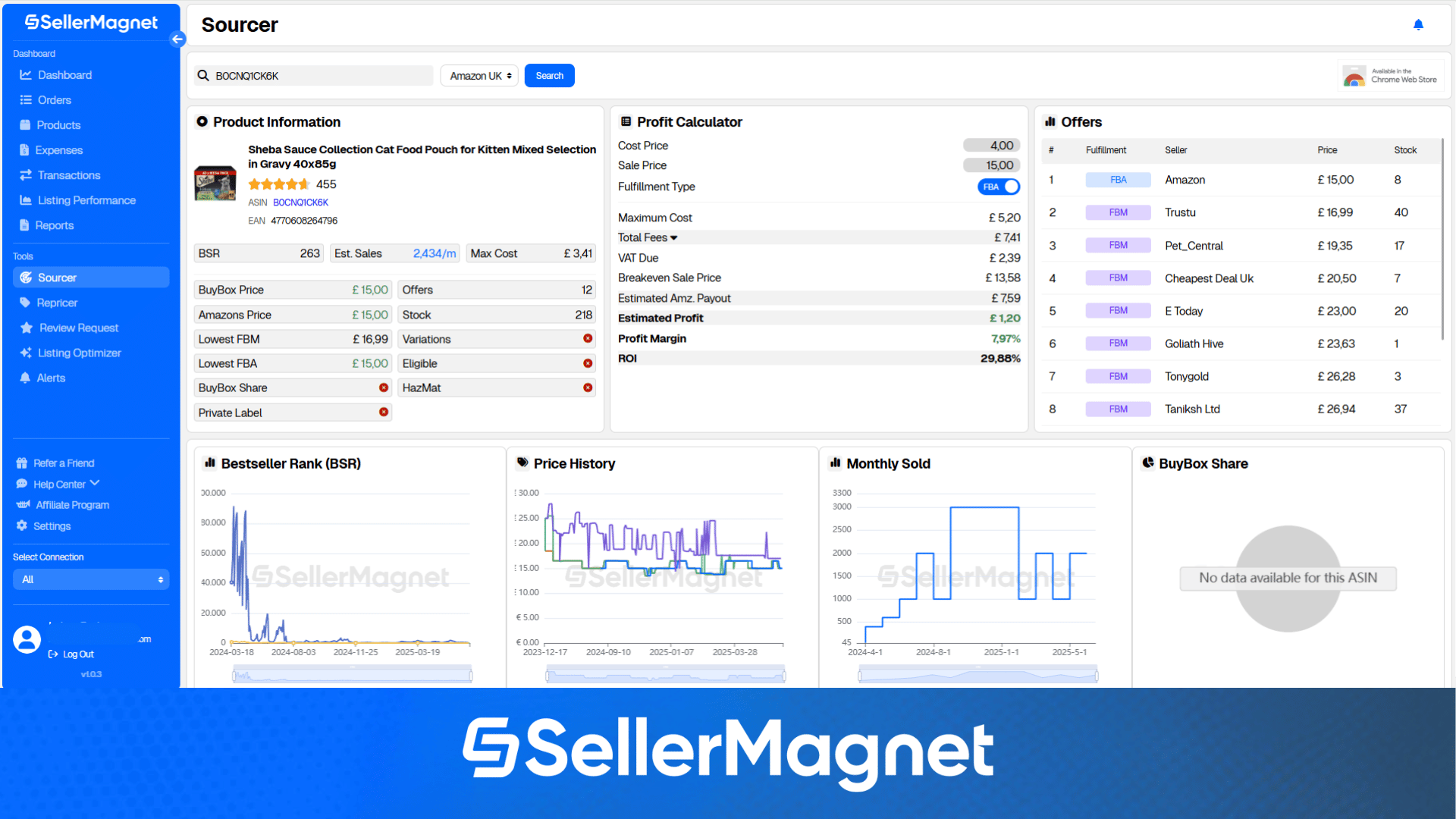
- Use advanced tools like the Amazon Sourcer by SellerMagnet available for free in the analytics dashboard to assess profitability, competitiveness, and market opportunities.
Strategies for effective product selection
- Favor products with steady demand.
- Avoid overly saturated markets.
- Monitor emerging and seasonal trends.
- Carefully evaluate profit margins and potential sales volume.
Inventory management and performance monitoring
- Monitoring tools integrated into the SellerMagnet Analytics Dashboard.
- Continuous performance analysis to quickly identify any issues.
Pricing and positioning optimization
- Set a competitive pricing strategy based on competitor analysis.
- Continuously monitor and adjust prices to maximize profits.
- Work on product SEO to improve visibility.
Comparison: Amazon Dropshipping vs Amazon FBA
| Feature | Amazon Dropshipping | Amazon FBA |
|---|---|---|
| Inventory management | Not required | Required |
| Shipping | Handled by suppliers | Handled by Amazon |
| Quality control | Limited | Very high |
| Upfront costs | Low | Moderate to high |
| Profit margin | Variable | Generally higher |
| Scalability | High | Very high |
Common Dropshipping mistakes to avoid
- Not testing suppliers before purchasing.
- Ignoring negative customer feedback.
- Overlooking competitor analysis.
- Underestimating performance management and monitoring.
Conclusions and final recommendations
Stop Juggling Tools. SellerMagnet Combines Everything You Need.
Join a smarter way to manage your Amazon store.

Recommended Articles
Amazon Brand Registry 2026: Requirements and Cost
Amazon Brand Registry requirements, real trademark cost in USD and EUR, the enrollment steps, what changes once you are in, and a worked example of the payback.
Alibaba Suppliers: Factory or Trading Company? A Pre-Deposit Checklist
How to tell an Alibaba factory from a trading company before you pay a deposit: 6 signals, a 5-step video-call checklist, and what a wrong guess actually costs.
Stranded Inventory on Amazon: Why It Happens and How to Fix It Fast
Amazon's own help pages on what strands FBA inventory, the 48-hour fix window, the 30-day unsellable deadline, and a worked cost example at 2, 7 and 30 days.
No Featured Offers Available: Why and How to Fix It
Why a listing shows "no featured offers available" in 2026, the real causes now that Amazon removed the seller-eligibility gate, and the exact fix for each one.
Amazon High Pricing Error: Why Listings Deactivate
Why Amazon deactivates a listing with a "Potential high pricing error," exactly what triggers it in 2026, and how to set Minimum/Maximum Price so it stops happening.
AWD vs FBA in 2026: Real Costs and When AWD Actually Pays
Amazon's 2026 AWD and FBA storage rates compared line by line, the Smart Storage and Amazon Managed discount rules, and a worked four month example showing exactly when AWD saves money and when it does not.