Best Amazon Repricer 2026: A Fair Comparison
What actually separates one Amazon repricer from another?
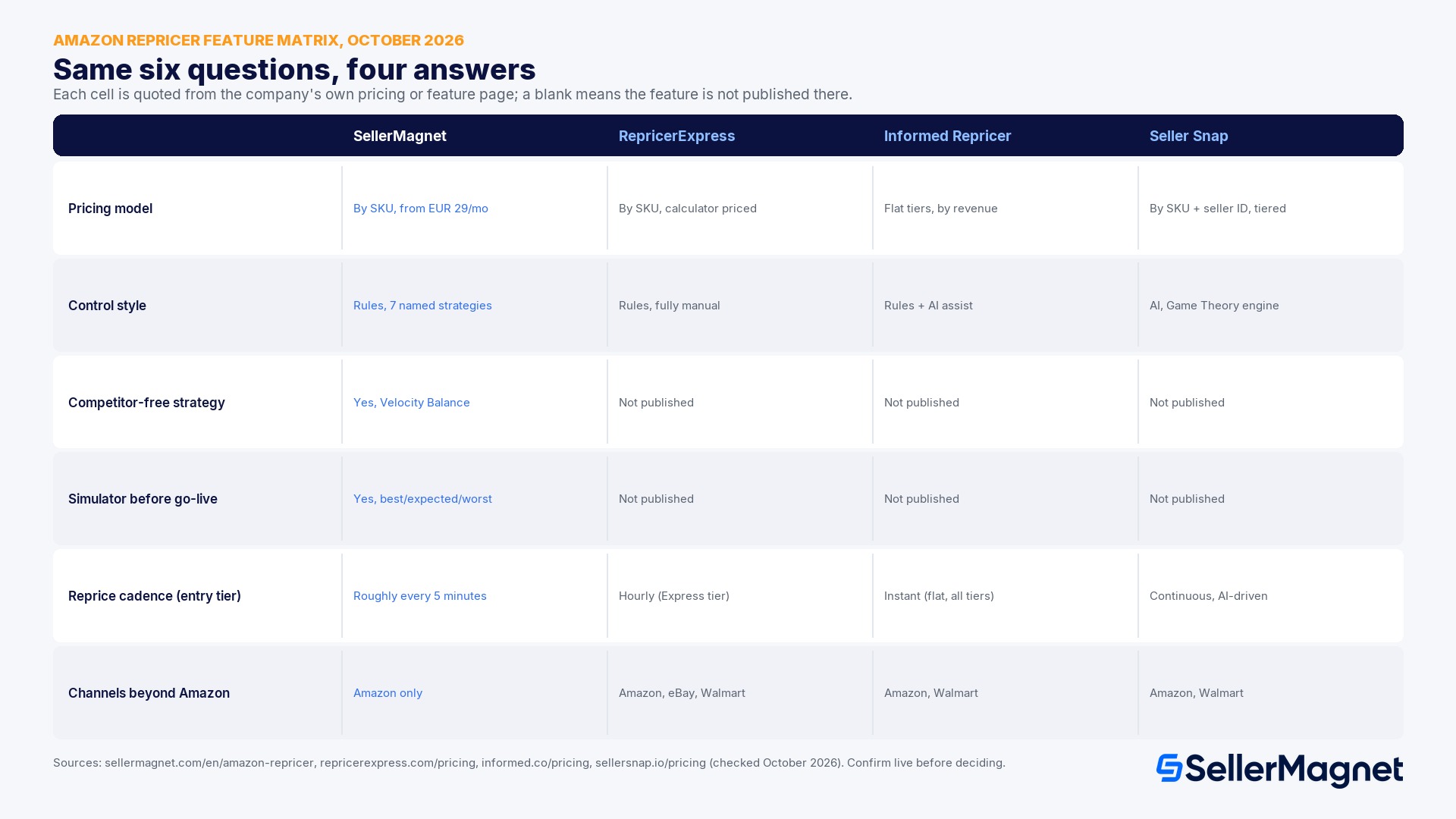
- Pricing model. Is the plan priced by SKU count, by monthly revenue, by seller ID and marketplace, or some mix of these. This decides whether growing your catalog or growing your revenue is what pushes you into the next tier.
- Strategy depth. How many named strategies exist, and do any of them need no competing offer at all (useful for private label ASINs with few or no competitors). A tool with only Featured Offer matching has nothing to do on a listing with no competition.
- Simulator. Can you preview a rule against a best, expected and worst case scenario before it changes a live price, or do you only find out from the price history afterward. The difference matters most the first time you launch a new strategy on a high-volume SKU.
- Reprice speed and tiering. Is the fastest cadence included at the entry price, or sold as a separate add-on tier. A 'hourly' entry tier and a 'sub-15-second' add-on describe the same company's product at very different prices.
- Marketplace coverage. Amazon only, or also eBay and Walmart, and how many Amazon regional marketplaces from one dashboard. If you only sell on Amazon, extra marketplace support is a feature you are paying for and not using.
- Bulk and API tooling. CSV import inside the rule editor versus a flat file upload versus an open API. This decides how long it takes to set floors and ceilings for a few hundred SKUs at once instead of one at a time.
Why these six, and not a feature checklist with 30 rows
The 4 tools compared
- SellerMagnet Repricer runs 7 named strategies: 4 for resellers (Lowest Price, Buy Box, Position, Same Price) and 3 for brand owners (BrandGuard, Competitor ASIN-BuyBox Sync, Velocity Balance, which prices from your own sales rate with no competitor needed). Plans start from EUR 29/month excl. VAT for 25 SKUs on one marketplace, rules re-evaluate roughly every 5 minutes, and a simulator runs any rule against best, expected and worst case competitor scenarios before it touches a live price. Works for FBA and FBM, min and max enforced on every price change, CSV bulk import built into the rule editor, and every price change is logged with its reason.
- RepricerExpress is a rules based repricer covering Amazon across 21 regional marketplaces, plus eBay and Walmart, from one dashboard. Pricing is calculated by SKU count through a calculator on its pricing page rather than published as one flat number; its own tier comparison lists Express (up to 1,000 SKUs, hourly updates), Plus (up to 15,000 SKUs, 10 minute or instant updates) and Expert (up to 50,000 SKUs, instant updates), with a Buy Box Predictor available on higher tiers. It includes free managed setup, net margin floor protection and a 14-day free trial, and its own feature page lists filtering competitors by fulfilment method, feedback rating and stock status.
- Informed Repricer sells a flat monthly price based on monthly revenue rather than SKU count, not by rule depth: a Foundation tier at $99/month for sellers under $5k monthly gross revenue, and a main tier above that threshold. The main tier's exact price moved between live checks in October 2026 (seen between roughly $147 and $199/month, likely an active promotional test), so treat the $99 entry figure as the reliable number and confirm the main tier's current price on the live pricing page before comparing. It advertises instant, AI assisted repricing and a 'raise the Buy Box price' positioning rather than only racing to the bottom, plus advanced analytics covering orders, sales, profit and Buy Box wins at a glance. Optional add-ons seen on the live page include Additional Stores ($49/month), Amazon Business repricing ($149/month) and Priority Support ($49/month), though these also varied slightly between checks.
- Seller Snap is an AI and Game Theory repricing engine, not a manual rules editor: its own marketing describes predicting competitor moves and pricing for profit rather than only Buy Box share, including a Dynamic Max Price tool that calculates a ceiling automatically so sellers do not have to set one by hand. Plans start at $100/month (Starter, 1,000 SKUs, 1 marketplace, 1 user, up to $15k/month revenue), rising to $250/month (Accelerator, adds Walmart and Amazon Business B2B repricing) and $500/month (Standard, 15,000 SKUs, no revenue cap), per its public pricing page, also listed from $250/month on the Amazon Selling Partner Appstore, which adds automated replenishment guidance from sales velocity and lead time alongside the repricing engine.
How to evaluate a repricer yourself in 10 minutes
How to evaluate an Amazon repricer before you subscribe
- Open the live pricing page, not a review site - Marketing copy and third party reviews go stale faster than a company's own pricing page. Screenshot the entry tier, its SKU or revenue limit, and the reprice cadence it includes before reading anything else.
- Find the real limit on the entry tier - Check whether the plan is capped by SKU count, by monthly revenue, or by seller ID and marketplace count, and convert your own catalog into that unit so you are comparing like for like.
- Search the feature page for 'simulator', 'preview' or 'test' - If no page mentions testing a rule before it goes live, assume there is none; most repricers that have one state it clearly as a selling point.
- Check whether the fastest speed is included or an add-on - Look for a second tier table, calculator or add-on list; the entry price and the fastest published speed often live on different rows.
- Confirm min/max enforcement in writing - Every repricer compared here enforces a floor and ceiling you set, but confirm the company states this explicitly rather than assuming it from a 'profit protection' headline.
- Start the free trial on your 5 highest-volume SKUs only - Most repricers, including every one in this guide, offer a 14 or 15 day free trial. Running it on a small, representative slice first limits the blast radius of a misconfigured rule while you learn the tool.
What to do once the trial starts
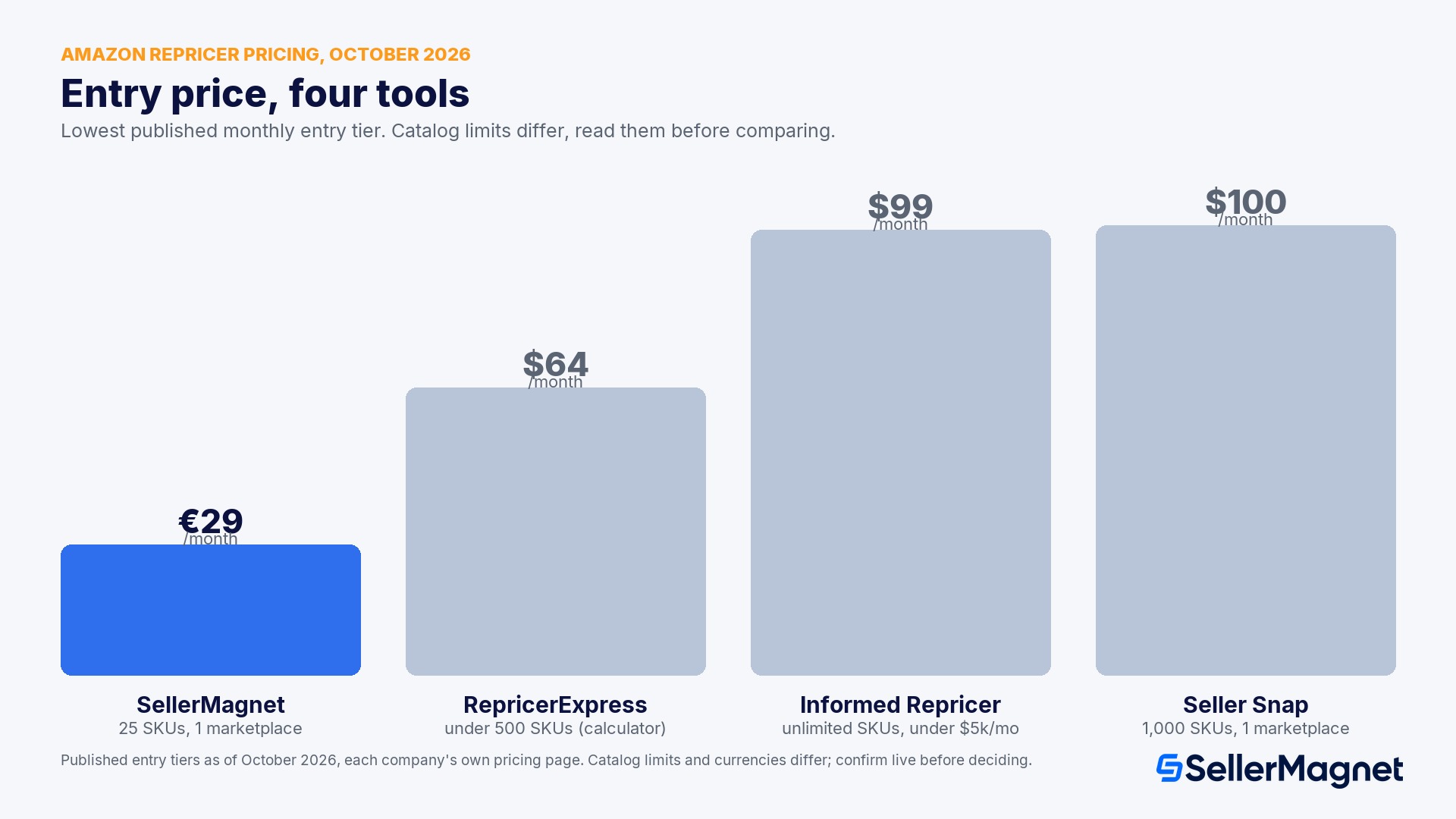
Side-by-side: entry pricing
| Tool | Entry price (Oct 2026) | Entry tier limit | Marketplaces | Simulator |
|---|---|---|---|---|
| SellerMagnet | EUR 29/month | 25 SKUs, 1 marketplace | Amazon | Yes |
| RepricerExpress | $64/month | under 500 SKUs | Amazon, eBay, Walmart | Not published |
| Informed Repricer | $99/month | unlimited SKUs, under $5k/mo revenue (main tier higher, price varies) | Amazon, Walmart | Not published |
| Seller Snap | $100/month | 1,000 SKUs, 1 marketplace | Amazon, Walmart | Not published |
Side-by-side: features and strategy depth
Worked example: the same 2,000-SKU catalog, three pricing models
- SKU-tiered (RepricerExpress): 2,000 SKUs falls in the 1,500 to 5,000 SKU band, listed at $319/month on its own tier table, regardless of the $40k revenue figure.
- Flat fee by revenue (Informed Repricer): $40k monthly revenue is well above the $5k Foundation threshold, so the seller is on the main tier, seen between roughly $147 and $199/month across live checks in October 2026 (an apparent promotional price test), with no SKU limit at all either way, so the catalog size does not change the bill.
- SKU and seller-ID tiered, AI engine (Seller Snap): 2,000 SKUs exceeds the Starter tier's 1,000 SKU cap, so the seller needs at least the Accelerator plan at $250/month (1,000 SKU cap listed on its own pricing page; the 2,000 SKU catalog would actually need to confirm the exact cap for Accelerator versus moving to Standard at $500/month for its 15,000 SKU cap).
- SKU-tiered with a simulator (SellerMagnet): entry tier covers 25 SKUs; a 2,000 SKU, one marketplace catalog needs a higher published tier, check pricing for the exact band.
Which repricer fits which seller?
- Small catalog, wants a simulator and the lowest entry price: SellerMagnet, especially if any ASIN is private label and needs a competitor-free strategy like Velocity Balance. The 25 SKU entry tier and EUR 29/month starting price suit a seller testing a repricer for the first time without committing to a multi-hundred-dollar plan.
- Multi-channel (Amazon plus eBay or Walmart), wants rules you fully control, priced by SKU: RepricerExpress. Its own tier table scales from 500 to 50,000 SKUs with a published reprice cadence at every step, which suits a seller who wants to know exactly which cadence they are buying.
- Large or fast-growing catalog, wants one flat fee with no SKU ceiling to track: Informed Repricer. Pricing by revenue rather than SKU count means a seller adding hundreds of new variations does not need to check a cap before launching them.
- Established, high-volume seller comfortable paying a premium for an AI and game theory engine that manages the logic for you: Seller Snap. Its own pricing page markets replacing manual rule logic with an engine that reads competitor behavior, which costs more at every published tier than the other three tools here.
What none of these four pages actually say
Common mistakes when comparing Amazon repricers?
- Confusing an SKU cap with a revenue cap. RepricerExpress and Seller Snap price by SKU count; Informed Repricer prices by monthly revenue. The same catalog costs a different amount depending on which number the company actually counts.
- Assuming the headline reprice speed is included at every tier. RepricerExpress's hourly, 10-minute and instant speeds are separate published tiers, not one number across the whole product line; check which speed your actual plan includes.
- Trusting a marketing claim over the pricing page. A homepage can say 'instant' or 'AI powered' while the pricing page lists the exact plan that speed or feature actually requires; always confirm on the pricing page linked in this guide.
- Expecting a repricer to fix a hijacker or unauthorized seller problem. Every tool compared here only changes your own price within the minimum and maximum you set; none of them can remove another seller from your listing. That is a Brand Registry enforcement problem, covered in the hijacker detection guide.
- Setting the minimum price from a competitor's price instead of your own cost. Every repricer here enforces whatever floor you type in, but none of them calculates it for you from your actual landed cost and fees; see the minimum and maximum price guide for the math.
- Picking a tool by catalog size alone and ignoring strategy depth. A seller whose entire catalog is private label gets little value from a Featured Offer matching engine, however fast, since there is rarely a competing offer to match; a competitor-free strategy matters more than reprice speed in that case.
- Signing an annual plan before the free trial finishes. Every tool in this comparison offers a 14 or 15 day trial; use the full window on real SKUs before committing to annual billing, which several of these companies discount but also lock in.
- Comparing list price instead of the price at your actual catalog size. A $29 or $64 headline number means nothing once your catalog crosses that tier's SKU or revenue limit; always price out your own catalog on each calculator or tier table before ranking the four tools by sticker price alone.
What is the best Amazon repricer in 2026?
Is a paid repricer better than Amazon's free Automate Pricing?
How much does an Amazon repricer cost?
Do Amazon repricers work for FBM?
What is Game Theory repricing?
Can I switch repricers without losing my price history?
Stop Juggling Tools. SellerMagnet Combines Everything You Need.
Join a smarter way to manage your Amazon store.

Recommended Articles
Best Amazon Repricer 2026: A Fair Comparison
SellerMagnet, RepricerExpress, Informed Repricer and Seller Snap compared on price, strategy depth, speed and simulators, using each company's own pages checked in October 2026.
Amazon FBA Profit Calculator: How to Find True Margin per ASIN
Amazon FBA profit calculator math, step by step: referral fee, FBA fee, storage, PPC and landed cost per unit, with one worked ASIN example.
Amazon FBA Fees 2026: Every Fee in One Table (US and EU)
Every Amazon FBA fee for 2026 in one table: subscription, referral, fulfillment, storage, returns, low-inventory and placement fees for the US and EU, sourced and recalculated.
Does Seller Central Have a Native Repricer?
Yes, Amazon's free Automate Pricing is a native repricer inside Seller Central. What it can do, where it falls short against a third party repricer, and how to choose.

Amazon Hijackers: How to Detect and Remove Them Fast
A hijacker changes your detail page, undercuts your price, or sells counterfeits under your ASIN. How to catch it early and what Report a Violation needs.
Amazon Repricing: How Min and Max Prices Really Work
Amazon repricing only moves your price between the minimum and maximum you set. How to calculate a margin-safe floor, what Amazon checks, and why a ceiling matters.