Amazon gives a registered brand three different self-defense tools against counterfeits, and most sellers only ever learn the names, not the difference: Report a Violation, a manual infringement-report form open to every Brand Registry member; Transparency, a paid, per-unit serialization code that physically stops a counterfeit from ever being listed; and Project Zero, a self-service tool that lets an enrolled brand search for a suspected counterfeit listing and pull it down immediately, without waiting for Amazon's review team. Project Zero is the fastest of the three, and also the one with the highest entry bar and the strictest ongoing requirement: a brand has to already be using Report a Violation successfully for six months before Amazon will even consider an application, and once inside, every brand has to hold a 99% accuracy rate on its own removals or risk losing access to the tool altogether. This guide works from Amazon's own Project Zero and Transparency program pages to lay out the exact eligibility bar, what the enrollment and removal flow actually involves, which 22 countries the tool covers today, and the accuracy math that decides whether a brand keeps its access or gets bumped back to the manual review queue.
Amazon Project Zero is a free, self-service tool for Brand Registry members that lets an enrolled brand search for counterfeit listings and remove them immediately, without filing a report and waiting for Amazon's review. To enroll, a brand needs at least a 90% acceptance rate on Report a Violation submissions over the prior six months, and after enrolling it must keep a 99% accuracy rate on its own removals or risk losing access. Project Zero covers 22 countries and pairs with, but does not replace, Amazon's paid Transparency serialization program.
Three tools, three jobs: Report a Violation, Transparency, and Project Zero
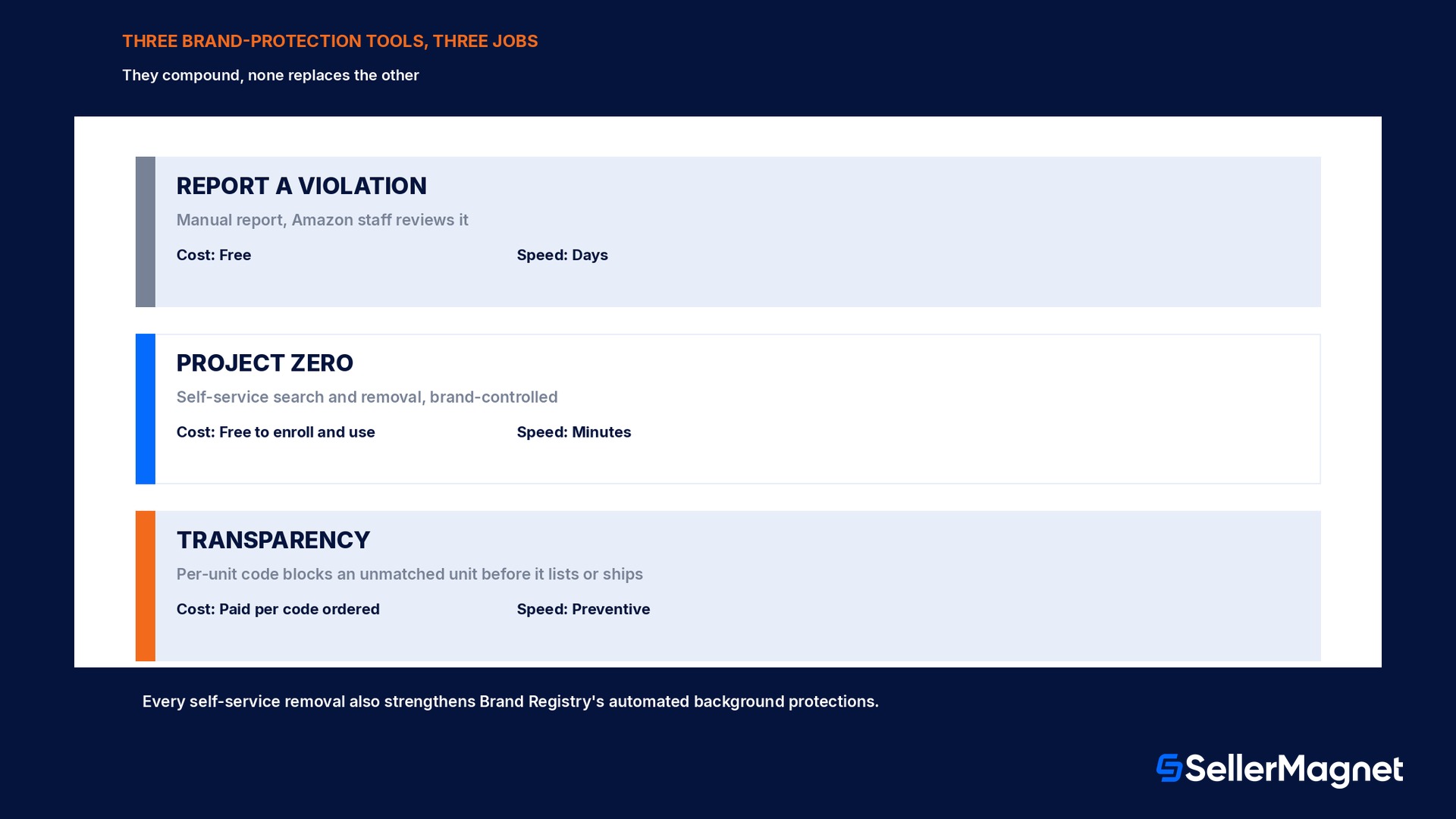
The confusion starts because all three tools live inside the same Brand Registry "Protect" menu and all three exist to fight counterfeits, but each one solves a different part of the problem and none of them is a superset of the others. Report a Violation is the baseline: any Brand Registry member can file an infringement report on a listing they believe violates their intellectual property rights, and an Amazon reviewer decides the outcome, which can take days. Project Zero removes the reviewer from the loop for brands that have earned the trust to self-certify: instead of filing a report and waiting, an enrolled brand searches the catalog itself, confirms a listing is counterfeit, and removes it in minutes through the same tool. Transparency works further upstream, before a listing problem exists at all: it assigns a unique, scannable code to every physical unit a brand manufactures, and Amazon's systems refuse to list or ship a unit in a Transparency-supported store without a valid, matching code, which stops a counterfeit from reaching a customer rather than removing it after the fact. The three are designed to compound rather than compete: Amazon's own guidance says every self-service removal through Project Zero also strengthens Brand Registry's automated background protections for that brand, and brands that combine the removal tool with Transparency serialization see the strongest results of all three options used together.
Tool
What it does
Cost
Speed
Report a Violation
Manual infringement report, reviewed by Amazon staff
Free
Days, reviewer-dependent
Project Zero
Self-service search and immediate removal of counterfeit listings
Free to enroll and use
Minutes, brand-controlled
Transparency
Per-unit serialization code that blocks an unmatched unit from being listed or shipped at all
Paid per code ordered, volume-based pricing
Preventive, before a listing problem exists
The eligibility bar: what a brand needs before applying
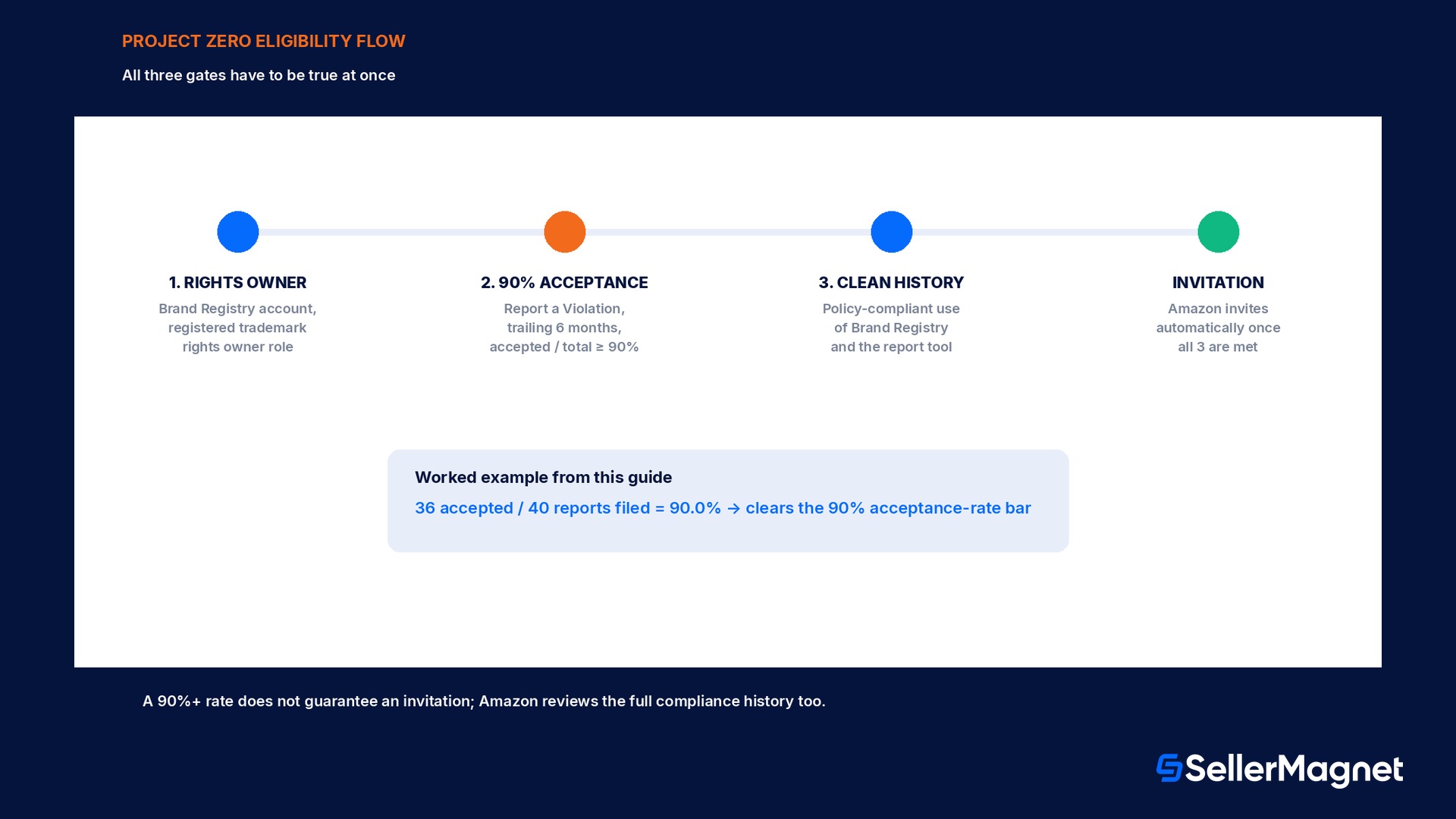
Amazon states the Project Zero eligibility requirements directly on the program's own enrollment page, and all of them have to be true at once; none is a nice-to-have. First, the brand needs an active Brand Registry account where the applicant is specifically registered as the rights owner of a registered trademark, not merely an authorized seller or agency account acting on the brand's behalf. Second, the brand must have used the Report a Violation tool to report suspected trademark infringement within the last six months, and across those reports held at least a 90% acceptance rate, meaning Amazon's reviewers agreed the reported listing really was a violation at least 9 times out of every 10 submissions. Third, Amazon's eligibility language adds a qualitative screen on top of the hard numbers: a documented history of using Brand Registry and the Report a Violation tool in accordance with Amazon's policies, which is Amazon's way of saying a clean compliance record matters alongside the acceptance-rate math; a brand that technically clears 90% through disputed or borderline reports is not guaranteed approval on the number alone. Amazon's own FAQ answers the most common complaint about this bar directly: a brand sitting at a 90% acceptance rate but still rejected has not necessarily failed the primary test; Amazon reviews the acceptance rate alongside these additional criteria to decide whether self-service removal power is being handed to a brand that will use it responsibly, and a brand that is not yet invited is told to keep using Report a Violation, since Amazon states it will automatically extend an invitation once every criterion is met.
A worked example: does a 40-report history clear the 90% bar?
Take a brand that has filed 40 Report a Violation submissions over the last six months, of which Amazon's reviewers accepted 36 as genuine violations and rejected the remaining 4 as not meeting the bar. The acceptance rate is accepted reports divided by total reports: 36 / 40 = 90.0%. Since 90.0% clears Amazon's stated 90% threshold, this brand's report history meets the quantitative half of the entry bar; it would still need the Brand Registry rights-owner status and a clean compliance record (the qualitative half above) before Amazon extends an actual invitation. A brand that instead filed 40 reports and had 34 accepted sits at 34 / 40 = 85.0%, below the 90% line, and is not yet eligible regardless of how clean the rest of its account is; the fix in that case is simply to keep filing well-founded reports until the trailing six-month rate clears 90%, since the rate is a rolling calculation over the reporting window, not a lifetime score.
Reports filed (6 months)
Accepted by Amazon
Acceptance rate
Clears the 90% bar?
40
36
90.0%
Yes
40
34
85.0%
No, 5 points short
Enrolling and using the tool: training, country scope, and the test-buy habit
Once Amazon extends an invitation, enrollment itself is quick: the brand clicks "Get started" on the Project Zero page, completes a 10-minute training module that walks through correct tool use, and at the same step is offered the option to begin enrollment for serialization through Transparency, though that second step is optional and billed separately. Access to the self-service removal tool is granted per country-store, specifically for each country where the brand holds an active, registered trademark that is itself associated with the Brand Registry account; a brand registered only in the United States gets no Project Zero access in, say, the German store, even after full enrollment, until it registers and links a trademark there too. Day to day, the tool sits inside the Brand Registry main menu under "Protect," then "Project Zero." Amazon's own guidance recommends a test buy, an actual purchase of the suspected item, to confirm a listing really is counterfeit before using the tool to remove it, rather than removing on visual suspicion alone from the listing page; this single habit is also the most direct lever a brand controls over its own accuracy rate, covered next. After a removal, the brand can track its status at any time under "Monitor," then "Submission history" in the same Brand Registry menu, and Amazon sends a notice of complaint to every seller whose offer was removed, which is also the point at which a wrongly-removed seller is most likely to push back.
The 99% accuracy bar: what happens if a brand gets it wrong
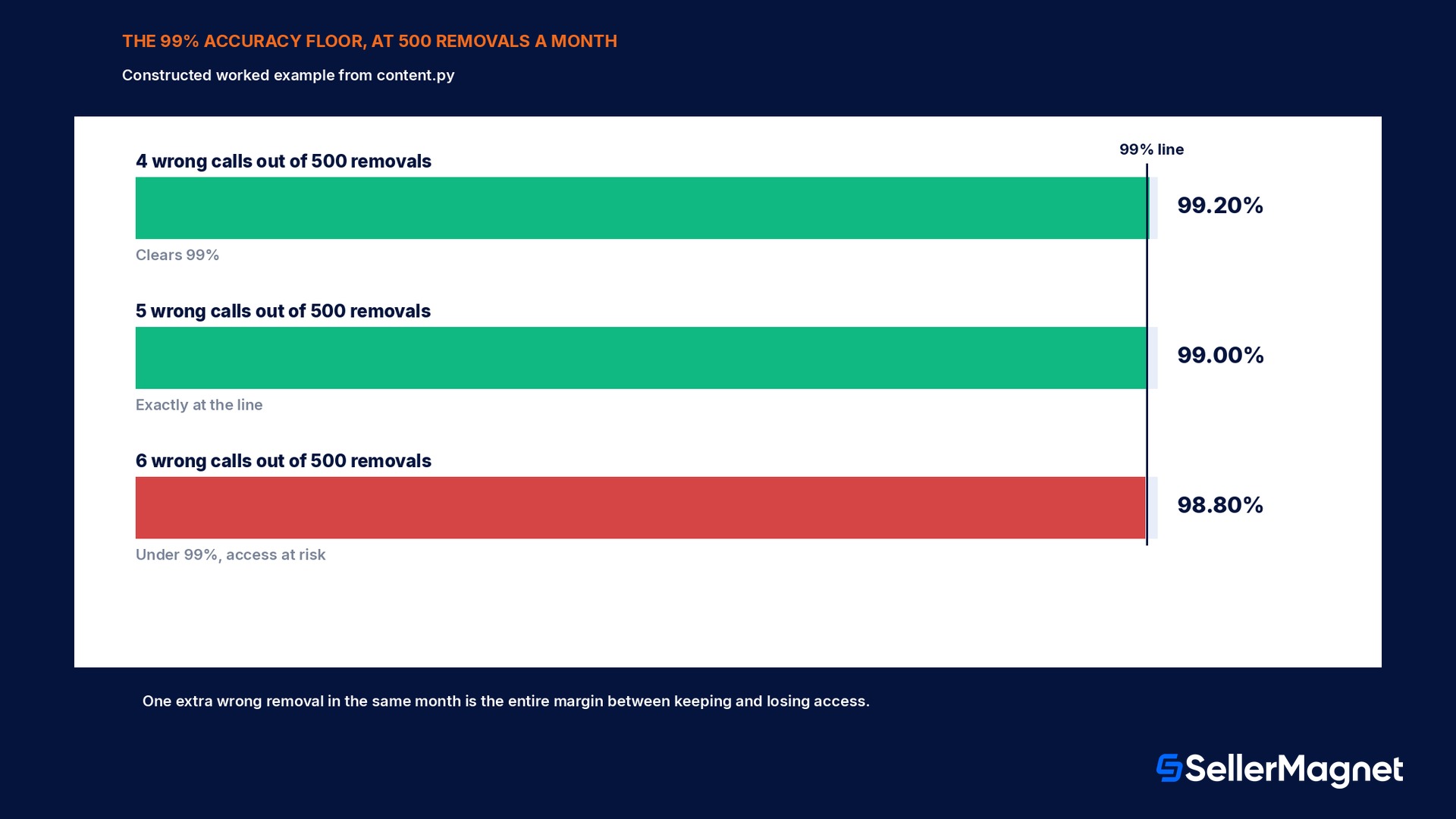
Project Zero hands a brand an unusual amount of trust: the power to pull another seller's listing down immediately, with no Amazon reviewer checking the call first. Amazon's own guidance states the trade for that trust directly, that brands must maintain at least a 99% accuracy rate on their self-service removals to keep access to the tool, backed by required enrollment training and ongoing monitoring Amazon runs to catch misuse. The arithmetic is unforgiving at volume. A brand removing 500 listings in a month through Project Zero can have at most 5 of those removals turn out to be wrong calls (a genuine product mistakenly flagged as counterfeit) and still clear the 99% floor: (500 - 5) / 500 = 99.0%. One additional wrong removal, 6 out of the same 500, drops the rate to 98.8%, under the bar, at the exact same removal volume. At a smaller, more typical volume the margin for error shrinks further still: a brand making 4 wrong calls out of 500 removals sits at 99.2%, comfortably over the line, while 6 wrong calls in that same batch lands at 98.8%, under it; the difference between keeping and losing access to the tool, in this example, is two extra mistaken removals in a single month. Amazon's FAQ is explicit that the tool should only ever be used to remove genuine counterfeits, items carrying an unlawful total or partial reproduction of the brand's registered trademark, and not as a general-purpose way to clear out unwanted resellers, price undercutters, or unauthorized-but-genuine sellers, misuse of that kind is exactly what the accuracy monitoring and required training exist to catch.
Project Zero removes counterfeits, not competitors
Amazon's own definition is narrow: a counterfeit carries an unlawful copy of the registered trademark on the product, packaging, or detail page. An unauthorized reseller of a genuine item, or a seller simply undercutting price, is not a Project Zero case; using the tool on either erodes the brand's accuracy rate and its standing in the program.
Country coverage: 22 stores, scoped to where the trademark lives
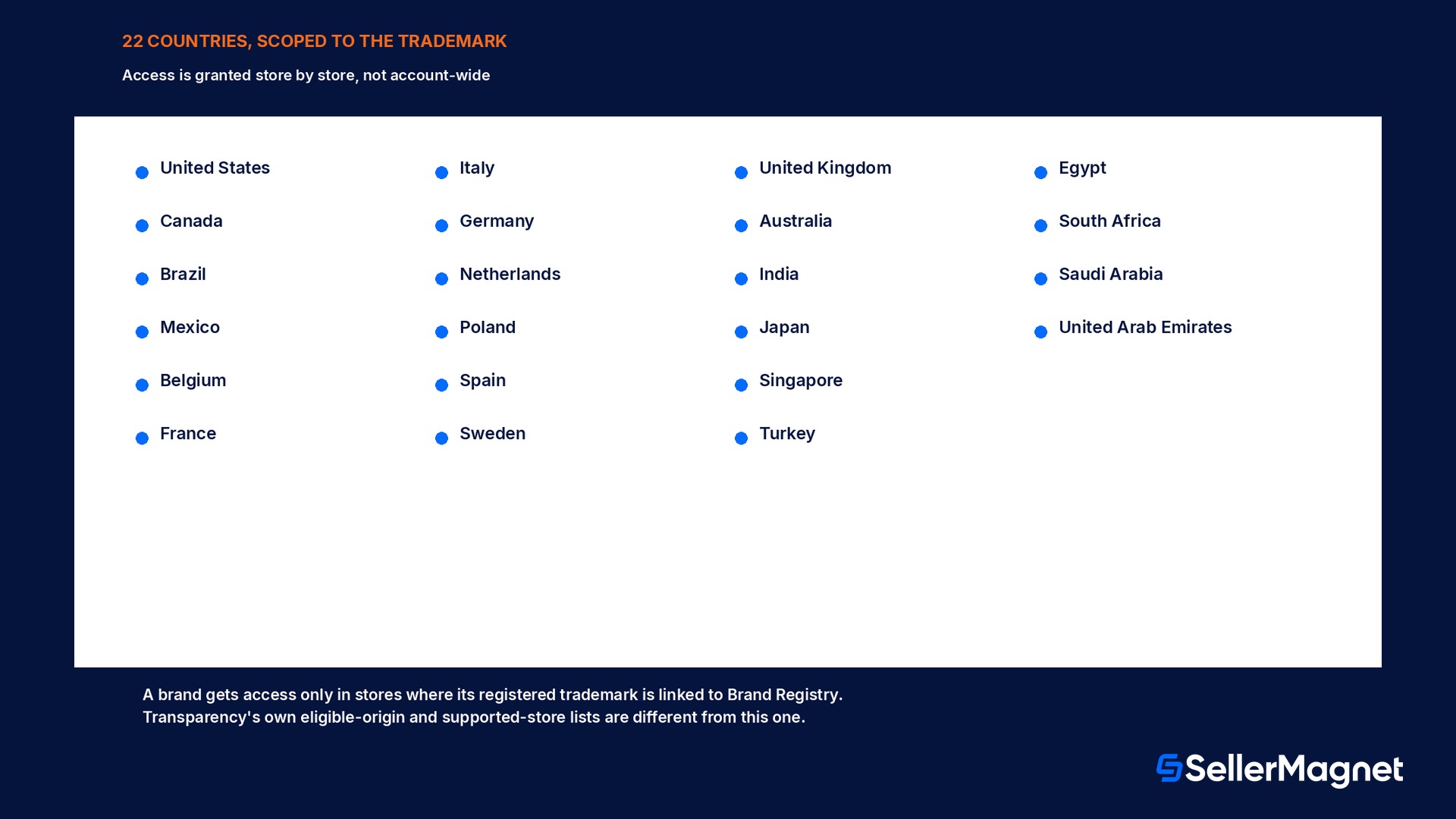
As of this writing, Amazon lists Project Zero as available in 22 countries: the United States, Canada, Brazil, Mexico, Belgium, France, Italy, Germany, the Netherlands, Poland, Spain, Sweden, the United Kingdom, Australia, India, Japan, Singapore, Turkey, Egypt, South Africa, Saudi Arabia, and the United Arab Emirates. Coverage is granted store by store, strictly tied to where the brand's trademark is registered and linked to its Brand Registry account; a brand that enrolls with only a US trademark gets Project Zero access in the US store and nowhere else on this list until it registers and links a trademark in an additional country. This differs from Transparency's own country rules, which separate where a brand is eligible to enroll from (ten origins: the US, Canada, Germany, France, Italy, Spain, the UK, India, Japan, and China) from where its protection is enforced once enrolled (ten supported stores: the US, Canada, Germany, France, Italy, Spain, the UK, Australia, India, and Japan, with Australian-origin brands currently unable to enroll even though Australia is a supported store for everyone else). A brand running both programs across an international catalog should map its own trademark registrations against both lists separately, since neither list is a subset of the other.
Pairing Project Zero with Transparency: what the serialization half actually costs
Amazon's own guidance is explicit that Project Zero alone is not the ceiling: brands that combine instant counterfeit removal with Transparency serialization see the strongest results, because Transparency prevents a counterfeit unit from ever being listed or shipped in the first place rather than removing a listing after it already reached the catalog. Transparency itself has no enrollment fee, no subscription fee, and no minimum order; a brand only pays per serialization code actually ordered, with pricing that varies by order volume and geography, so the cost scales with how many physical units a brand actually wants to protect rather than a flat program fee. Enrollment needs three things a brand already has if it is Project Zero-eligible in the first place: a Brand Registry account with the rights-owner role, an active registered trademark, and a GTIN for every product being enrolled. From there a brand chooses between Amazon-issued codes, which also unlock customer-facing authentication through the Amazon Shopping or Transparency apps and a possible Transparency badge on the detail page, or connecting existing serial codes it already manufactures with (7 to 20 characters, externally scannable in 1D, QR, or 2D format, placed on the same packaging side as the GTIN), which skips the physical-code cost but also skips the customer-facing scanning features. Amazon reports over 90,000 brands enrolled and more than 2.7 billion product units verified as genuine through the program to date, giving a sense of scale for how widely adopted the serialization side already is among brands that also run Project Zero.
Mistakes that cost a brand its Project Zero access
Removing a genuine reseller instead of a counterfeit. Project Zero is scoped to counterfeits only; pulling down an unauthorized but genuine seller's offer to clear price competition is misuse and damages the brand's accuracy rate.
Skipping the test buy on a borderline listing. Amazon's own recommendation is to confirm a suspected counterfeit with a real purchase first; removing on visual suspicion from the listing page alone is the fastest way to rack up wrong calls.
Applying before six months of Report a Violation history exists. The 90% acceptance-rate requirement is calculated over the prior six months; an application submitted earlier has no qualifying history to evaluate.
Treating a 90%+ acceptance rate as an automatic approval. Amazon reviews the number alongside a brand's overall compliance history; a borderline or disputed track record can still delay an invitation even above the stated threshold.
Assuming one trademark covers every store. Access is granted per country where the trademark is actively registered and linked to Brand Registry; a brand expecting coverage in a store it never registered in will find the tool unavailable there.
Ignoring the notice-of-complaint pushback. Every removal sends the affected seller a notice; a brand that cannot defend a removal with real evidence when challenged is building toward the kind of wrong call that erodes the 99% bar.
Running high removal volume without a documented review step. At volumes of several hundred removals a month, even a handful of extra wrong calls is the difference between an accuracy rate comfortably over 99% and one that falls under it.
Checklist before applying for Project Zero
How to qualify for and keep Amazon Project Zero access
Confirm Brand Registry rights-owner status - Project Zero eligibility requires the applicant to be registered as the rights owner of the trademark, not an authorized seller or agency account.
Build at least six months of Report a Violation history - File well-founded reports on real infringement before applying; there is no shortcut around the six-month window.
Track the rolling acceptance rate and stay above 90% - Calculate accepted divided by total reports over the trailing six months; a rate under 90% is not eligible regardless of volume.
Complete the 10-minute enrollment training in full - Enrollment is gated on finishing this module before the removal tool unlocks.
Map trademark registrations against the 22 supported countries - Access is granted store by store; a missing trademark registration in a country means no Project Zero access there even after enrollment.
Test-buy before every borderline removal - Confirm the counterfeit with a real purchase rather than removing on visual suspicion from the listing page alone.
Review removal volume against the 99% accuracy floor monthly - At a few hundred monthly removals, 2 to 3 extra wrong calls is often the entire margin between keeping and losing access.
What SellerMagnet can and cannot do about this
Enrollment, training, and every removal decision inside Project Zero happen entirely inside Seller Central and Brand Registry; no third-party tool, including SellerMagnet, files a Report a Violation or removes a listing on a brand's behalf. Where SellerMagnet's Alerts and offer monitoring genuinely helps is upstream of the decision: flagging a new, unexpected offer on a brand's own ASIN the moment it appears, so a brand can run its own test buy and build the evidence a Project Zero removal (or a Report a Violation filing, for a brand not yet eligible) actually needs, rather than discovering a counterfeit listing weeks later from a customer complaint.
This sits upstream of detecting a listing hijacker, a related but distinct problem (an unauthorized seller riding a brand's existing listing rather than selling a counterfeit copy of it), and of filing a standard counterfeit complaint for brands that have not yet cleared the Project Zero bar. Getting Brand Registry itself set up correctly is the real prerequisite underneath all three: without the rights-owner role and a registered trademark on file, none of Amazon's self-service brand-protection tools are available at all.
What is the difference between Report a Violation and Project Zero?
Report a Violation is a manual form reviewed by Amazon staff, open to every Brand Registry member, that can take days to resolve. Project Zero is a self-service tool, open only to brands that have earned eligibility, that lets the brand itself search for and remove a counterfeit listing in minutes without waiting for an Amazon reviewer.
What acceptance rate do I need on Report a Violation to apply for Project Zero?
At least 90%, calculated over the Report a Violation submissions filed in the prior six months, plus a documented history of using Brand Registry and the tool in line with Amazon's policies.
What accuracy rate do I need to maintain once I am enrolled in Project Zero?
At least 99% on the brand's own self-service removals. Amazon runs ongoing monitoring and requires enrollment training specifically to prevent this rate from slipping.
Does Project Zero cost anything?
No. Enrollment and use of the self-service removal tool are free. Only the separate Transparency serialization program has a cost, charged per code ordered, and is optional.
Which countries is Project Zero available in?
22 as of this writing: the United States, Canada, Brazil, Mexico, Belgium, France, Italy, Germany, the Netherlands, Poland, Spain, Sweden, the United Kingdom, Australia, India, Japan, Singapore, Turkey, Egypt, South Africa, Saudi Arabia, and the United Arab Emirates, each scoped to stores where the brand holds a registered trademark.
Can I use Project Zero to remove a reseller I don't like, not a counterfeit?
No. Amazon's guidance scopes the tool strictly to genuine counterfeits, an unlawful reproduction of the registered trademark on the product, packaging, or detail page. Using it on a genuine but unauthorized reseller is misuse and risks the brand's accuracy rate.
Should I confirm a listing is counterfeit before removing it?
Yes. Amazon's own recommendation is to perform a test buy, an actual purchase of the suspected item, to confirm the violation before using the self-service tool to remove the listing.
Do I need Transparency to use Project Zero, or the other way around?
No, they are independent. Project Zero removes counterfeit listings; Transparency prevents unserialized units from being listed or shipped at all. Amazon states brands get the strongest results combining both, but enrolling in one does not require the other.
Stop Juggling Tools. SellerMagnet Combines Everything You Need.