Amazon Counterfeit Complaints 2026: Report and Appeal
R
RenéFreelance Amazon Editor
|
11 min read
A counterfeit complaint can hit a seller from either side. A rights owner may report that someone else is selling fake versions of their branded product, or a seller may be the one receiving a counterfeit violation on their own account health page, sometimes wrongly. Amazon treats the sale of inauthentic products as a strict-liability policy violation, not a warning-first system: the consequences start with account suspension and can end in civil or criminal penalties for the party found to be selling fakes. This guide works through what Amazon's Anti-Counterfeiting Policy actually says, how to report someone else's counterfeit listing, what happens after a report, and how to appeal a counterfeit violation filed against your own account.
Amazon's Anti-Counterfeiting Policy strictly prohibits selling non-authentic products. To report someone else's counterfeit listing, use Report a Violation with the order ID or ASIN and supporting documentation. If your own account receives a counterfeit violation, appeal it from the Account Health page with invoices or a letter of authorization proving authenticity. Amazon investigates every report but will not disclose the outcome to the person who filed it.
What does Amazon's Anti-Counterfeiting Policy actually say?
Amazon's policy page opens with a blunt line: "Products offered for sale on Amazon must be authentic. The sale of non-authentic products is strictly prohibited. Failure to abide by this policy may result in loss of selling privileges, funds being withheld, and disposal of inventory in our possession." It places the burden squarely on the seller and supplier: "It is each seller's and supplier's responsibility to source, sell, and fulfill only authentic products." Amazon's own list of prohibited products reads: "bootlegs, fakes, or pirated copies of products or content; products that have been illegally replicated, reproduced, or manufactured; and products that infringe another party's intellectual property rights."
Amazon does not pay out on suspected inauthentic sales
The policy states it directly: "we do not pay sellers until we are confident our customers have received the authentic products they ordered. We may withhold payments if we determine that an Amazon account has been used to sell inauthentic goods, commit fraud, or engage in other illegal activity." A frozen payout can precede any formal suspension decision.
Consequence
What Amazon's policy says
Selling privileges
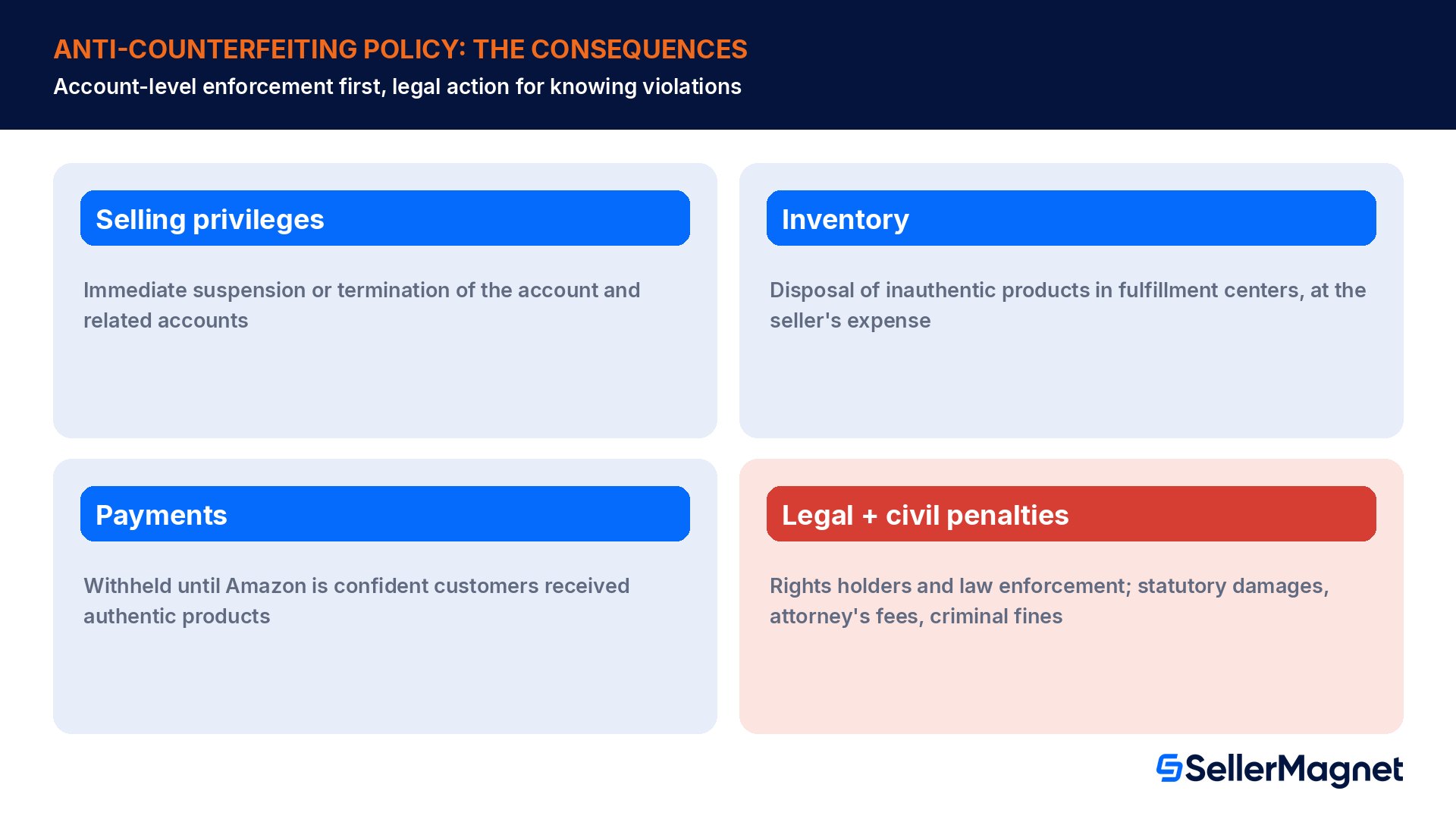
Immediate suspension or termination of the Amazon selling account, and any related accounts
Inventory
Disposal of inauthentic products in Amazon fulfillment centers, at the seller's expense
Payments
Withheld until Amazon is confident customers received authentic products; may be withheld on suspected fraud
Legal action
Amazon works with rights holders and law enforcement worldwide against sellers and suppliers who knowingly violate the policy
Civil penalties
Loss of amounts received from the sale of inauthentic products, damage or harm to rights holders, statutory and other damages, attorney's fees
Criminal penalties
Fines and imprisonment, in addition to civil penalties, for knowing violations
How do I report someone else's counterfeit listing?
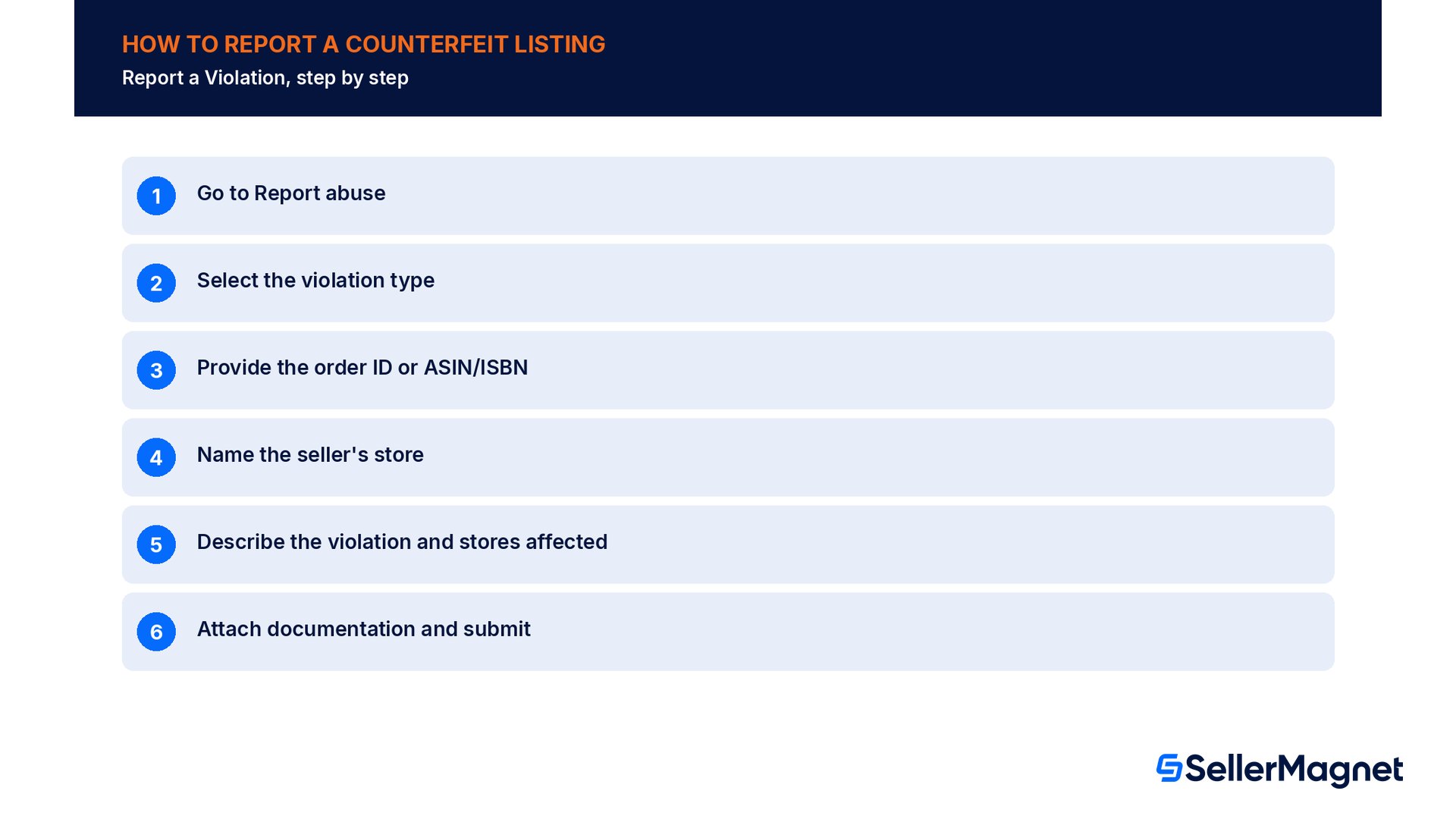
If you believe another seller is selling a counterfeit version of your branded product, or any inauthentic product, Amazon's Report a Violation page gives a specific sequence: "Go to Report abuse. Select the violation type. Provide the concerned order ID or ASIN/ISBN, as applicable." The page is explicit that "All reports are thoroughly investigated by our team," but also sets the privacy expectation up front: "For privacy reasons, the results of our investigations can't be disclosed, but we'll take any disciplinary actions we find appropriate." Filing a report does not guarantee you will be told what happened to the listing or the seller afterward.
Step
What to provide
1. Go to Report abuse
Start the report from the Report abuse tool
2. Select the violation type
Choose the category that matches the counterfeit or policy issue
3. Provide the order ID or ASIN/ISBN
Identifies the exact listing or transaction involved
4. Name the seller
The store or business name of the seller you are reporting
5. Describe the violation
A concise explanation based on the specific policy, plus the stores where it occurred
6. Attach documentation
Order IDs, related Buyer-Seller messages, or receipts that support the claim, then click Submit
Amazon's "describe your issue" field expects several specific details together, not a short note: "The store or business name of the seller that you are reporting. The ASIN or ISBN of the item's detail page and the product title. The stores for which the violation has occurred. A concise explanation of the violation based on the policy. Supporting documentation (for example, order IDs, related messaging, or receipts)." A report missing the ASIN or a clear policy basis is harder for Amazon's team to action quickly.
Reporting a buyer is a different workflow
Report a Violation covers seller and listing abuse. A problem with buyer feedback routes through Feedback Manager instead, and an abusive buyer message goes through Buyer Messages, not Report a Violation.
What happens if a counterfeit violation lands on your own account?
Amazon's policy page addresses this directly: "We stand behind the products sold on our site with our A-to-z Guarantee, and we encourage rights owners who have product authenticity concerns to notify us. We will promptly investigate and take all appropriate actions to protect customers, sellers, and rights holders. You may view counterfeit complaints on the Account health page in Seller Central." If a complaint results in a violation on your account, the policy's own FAQ gives the response path: "To address an intellectual Property violation, go to account health page in account health dashboard (AHD) and select submit appeal next to the violation to provide the requested documentation or information."
What you need to submit depends on the exact violation shown. Amazon's guidance is: "Each violation has a unique experience that will be presented on the account health page. You may refer to account health page for guidance during the appeal and dispute process." For authenticity appeals specifically, the required proof is usually an invoice or a letter of authorization: "When appealing enforcement actions, you are typically required to provide invoices or letters of authorization (LOA) to demonstrate their right to sell the products in question. Amazon will review these documents to verify product authenticity or selling authorization. If the products are confirmed to be genuine, Amazon will remove the enforcement claims from your seller account."
Keep authenticity proof ready before a complaint ever lands. SellerMagnet's Alerts can flag a new violation on your Account Health page the moment it posts, so the appeal clock starts working in your favor immediately instead of being discovered days later. When sourcing new inventory, Sourcer verdicts on a supplier listing help you keep the invoices and authorization paperwork that an authenticity appeal later needs.
How are brand protection, IP violations and counterfeit complaints connected?
Amazon's FAQ ties these together through brand identity: "Amazon considers a brand to be a name that represents a product or set of products. Products from the same brand share a common name, logo, or other identifying mark that appears on the product or packaging and are distinguished from similar products that don't belong to that brand." Brand Registry sits on top of this: "Brand Registry is Amazon's authoritative service for managing and protecting brands. Amazon Brand Registry is global and contains: (A) brand names, (B) brand profile data (for example, trademarks, logos), and (C) accounts that have roles (for example, Rights owner, Brand Representative) for that brand." A brand enrolled in Brand Registry gets more direct reporting tools than Report a Violation alone; see Amazon Brand Registry for the enrollment process.
Amazon's own definition of an IP violation is broader than counterfeits alone: "An intellectual property (IP) violation in e-commerce occurs when protected IP is used without authorization. This includes unauthorized use of copyrighted materials, trademarks, patents, or rights of publicity. Examples range from selling counterfeit goods to using copyrighted images without permission." A counterfeit complaint is the authenticity-specific branch of this wider IP enforcement system, which also covers hijacked listings, unauthorized use of brand images and trademark misuse; see detecting and removing listing hijackers for the listing-takeover side of brand protection.
What documentation actually clears a counterfeit appeal?
Appeal a counterfeit or IP violation on Account Health
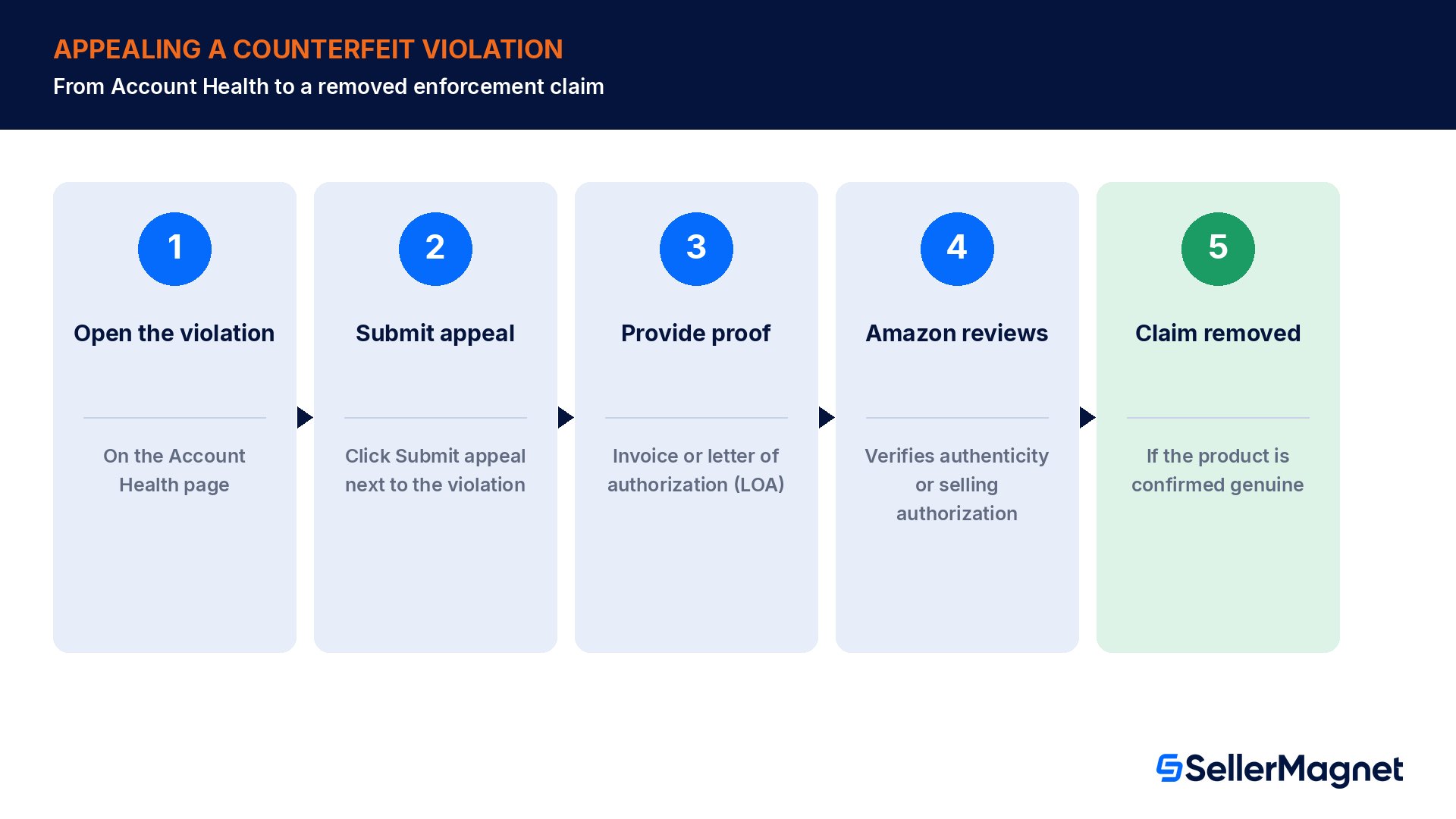
Open the violation on Account Health - Go to the Account Health Dashboard (AHD) and find the specific counterfeit or IP violation listed.
Select Submit appeal - Click Submit appeal next to the violation to open its specific appeal form.
Read the violation's own guidance - Each violation presents its own unique appeal experience on the Account Health page; follow the exact documentation it requests.
Gather authenticity proof - Collect invoices or a letter of authorization (LOA) demonstrating your right to sell the exact products in question.
Submit and wait for review - Amazon reviews the documents to verify authenticity or selling authorization before deciding the appeal.
Confirm the enforcement is removed - If the products are confirmed genuine, Amazon removes the enforcement claim from your seller account; recheck Account Health to confirm the removal.
Worked example: an LOA clears a wrongly flagged authentic listing
A seller sources a branded kitchen product from an authorized regional distributor and lists it on Amazon. A rights owner, unaware of this distribution relationship, files a counterfeit report against the listing through Report a Violation. Amazon investigates and posts a counterfeit violation on the seller's Account Health page. The seller opens the violation, selects Submit appeal, and uploads the distributor's invoice along with a letter of authorization (LOA) from the brand confirming the distributor's right to resell. Amazon reviews the documentation, confirms the products are genuine, and removes the enforcement claim. Throughout this, Amazon never discloses to the original rights owner who filed the report what action, if any, was taken on the seller's account, consistent with its stated privacy policy on investigation outcomes.
Common mistakes with counterfeit complaints
Filing a report without the ASIN, ISBN or order ID, which gives Amazon's investigation team nothing specific to act on.
Expecting Amazon to disclose the outcome of an investigation; results on another account are not shared for privacy reasons.
Appealing a counterfeit violation with generic correspondence instead of an invoice or letter of authorization naming the exact product and brand.
Treating every IP violation as a counterfeit issue, when Amazon's IP violation category also covers copyrighted images, trademarks and rights of publicity with different evidence needs.
Removing pricing information from authenticity documents in a way that edits or misleads the content, which the policy treats as a violation itself.
Waiting to gather supplier invoices until after a violation posts, instead of keeping authenticity paperwork on file from the first order.
Pre-emptive checklist before a counterfeit complaint ever lands
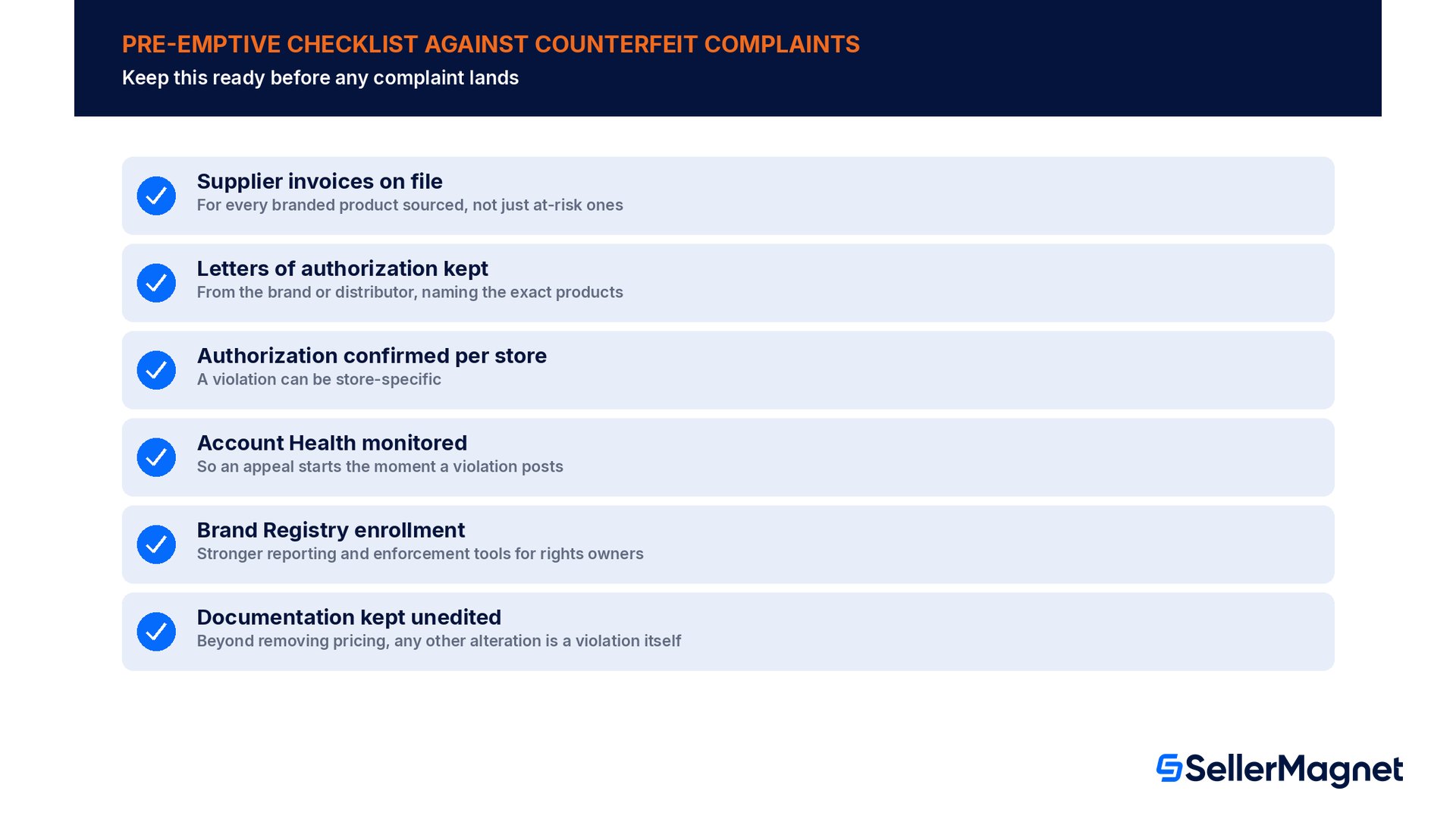
Keep supplier invoices and any letters of authorization (LOA) on file for every branded product you source, not just the ones you expect to be challenged.
Confirm with the brand or distributor which Amazon stores you are authorized to sell in, since a violation can be store-specific.
Monitor your Account Health page for new violations so an appeal starts the moment one posts, not days later.
If you are a rights owner, enroll in Brand Registry for stronger reporting and enforcement tools beyond Report a Violation alone.
Document product authenticity at the point of sourcing (invoices, photos, LOA) so an appeal never starts from zero.
Keep documentation unedited (beyond removing pricing, which Amazon explicitly allows); any other alteration counts as a policy violation on its own.
What is Amazon's Anti-Counterfeiting Policy?
A strict policy requiring every product sold on Amazon to be authentic. Selling bootlegs, fakes, pirated copies or products that infringe intellectual property rights can mean account suspension or termination, inventory disposal at the seller's expense, withheld payments, and legal consequences including civil penalties and criminal fines.
How do I report a counterfeit listing on Amazon?
Go to Report abuse, select the violation type, and provide the order ID or ASIN/ISBN. In the describe-your-issue field, include the seller's store name, the ASIN or ISBN and product title, the stores involved, a concise explanation based on the policy, and supporting documentation such as order IDs or receipts, then click Submit.
Will Amazon tell me what happened after I report a counterfeit?
No. Amazon states that all reports are thoroughly investigated, but for privacy reasons the results of investigations cannot be disclosed to the person who filed the report, even though Amazon will take any disciplinary action it finds appropriate.
How do I appeal a counterfeit violation on my own account?
Go to the Account Health page, find the violation, and select Submit appeal. Provide the documentation that violation specifically requests, typically invoices or a letter of authorization (LOA) proving your right to sell the exact products. If Amazon confirms the products are genuine, it removes the enforcement claim.
What proof clears a counterfeit appeal fastest?
Invoices from an authorized supplier or distributor, or a letter of authorization (LOA) from the brand or manufacturer, naming the exact products in question. Amazon reviews these to verify authenticity or selling authorization before removing the claim.
Can I report a counterfeit against a buyer instead of a seller?
Report a Violation is for seller and listing policy violations. A problem with buyer feedback goes through Feedback Manager, and an abusive buyer message goes through Buyer Messages, not Report a Violation.
Does a counterfeit violation always mean legal action?
Not automatically. Amazon's first response is account-level: suspension, inventory disposal, and withheld payments. Legal action, including civil penalties or criminal fines and imprisonment, applies to sellers and suppliers Amazon and rights holders determine knowingly violated the policy.
Stop Juggling Tools. SellerMagnet Combines Everything You Need.