Amazon Global Certification Reciprocity 2026: One Test, Every Country
R
RenéFreelance Amazon Editor
|
16 min read
Sellers have told Amazon, directly and repeatedly, that compliance is the single biggest reason they do not expand into more countries. Every country sets its own rules for packaging, labeling, safety testing and ingredient restrictions, and sellers have historically had to work all of that out one country at a time, often only after a product was already manufactured. At Accelerate 2026, Amazon announced a fix for that specific problem: a new one-submission compliance process that lets a seller test a product once and have that single test satisfy certification requirements in multiple countries at the same time.
This guide covers exactly what the one-submission process does, which category it covers first, the worked cost and time savings on a real multi-country launch, what is still rolling out, and how it is scoped differently from Amazon's separate cross-border inventory-pooling announcement from the same event.
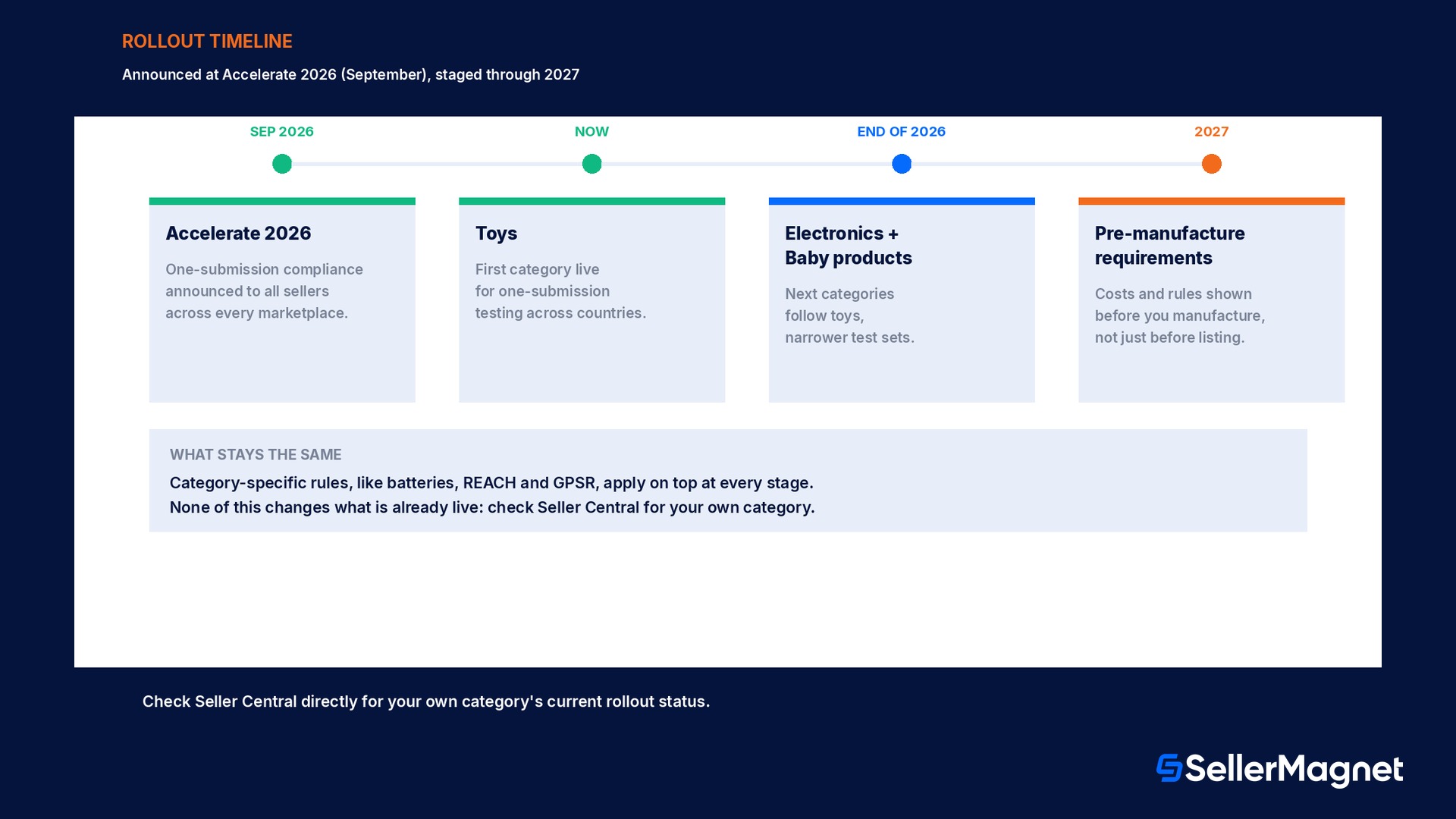
Amazon's one-submission compliance process, announced at Accelerate 2026, lets a seller complete one test submission that satisfies certification requirements in multiple countries at once, instead of testing separately per country. It starts with the toys category, with electronics and baby products following by the end of 2026, and early pilot sellers report savings of up to 60% on compliance costs.
The problem: compliance is the top reason sellers stay in one country
Amazon frames this plainly in its own announcement: sellers consistently say compliance, not logistics, is the single biggest reason they do not sell in more than one country. A product that is perfectly compliant for the US store can still need a different safety test, a different label format, and different packaging language the moment a seller wants to list it in another country. Historically, a seller discovered those requirements late, often after a manufacturing run was already committed, which meant either eating the cost of redoing packaging and testing, or giving up on that market entirely. The one-submission process is Amazon's answer: a single consolidated specification, per category, that tells a seller up front what to test, how to label, and what packaging every destination country requires, so compliance gets checked before manufacturing instead of discovered after.
What the one-submission process actually changes
Under the old model, a seller expanding into several countries ran a separate safety test and certification process for each one, even when the underlying product was identical. Under the one-submission model, a seller completes a single consolidated test, and that one result is checked against every target country's requirements at once. Three things make this different from simply doing the same work faster:
One test submission is evaluated against the requirements of multiple countries at the same time, instead of a separate submission per country.
Certifications a product already holds are recognized by the new process, so a seller is not re-testing or re-submitting paperwork for something already proven elsewhere.
The specification itself is consolidated per category: one document tells a seller what to test, how to label, and what packaging every covered destination country requires, rather than a seller assembling that picture from separate country-specific help pages.
The rollout is by category, not account-wide: a seller's product has to fall into a category Amazon has already enabled for one-submission testing to use it today.
This is a staged rollout, not a single switch
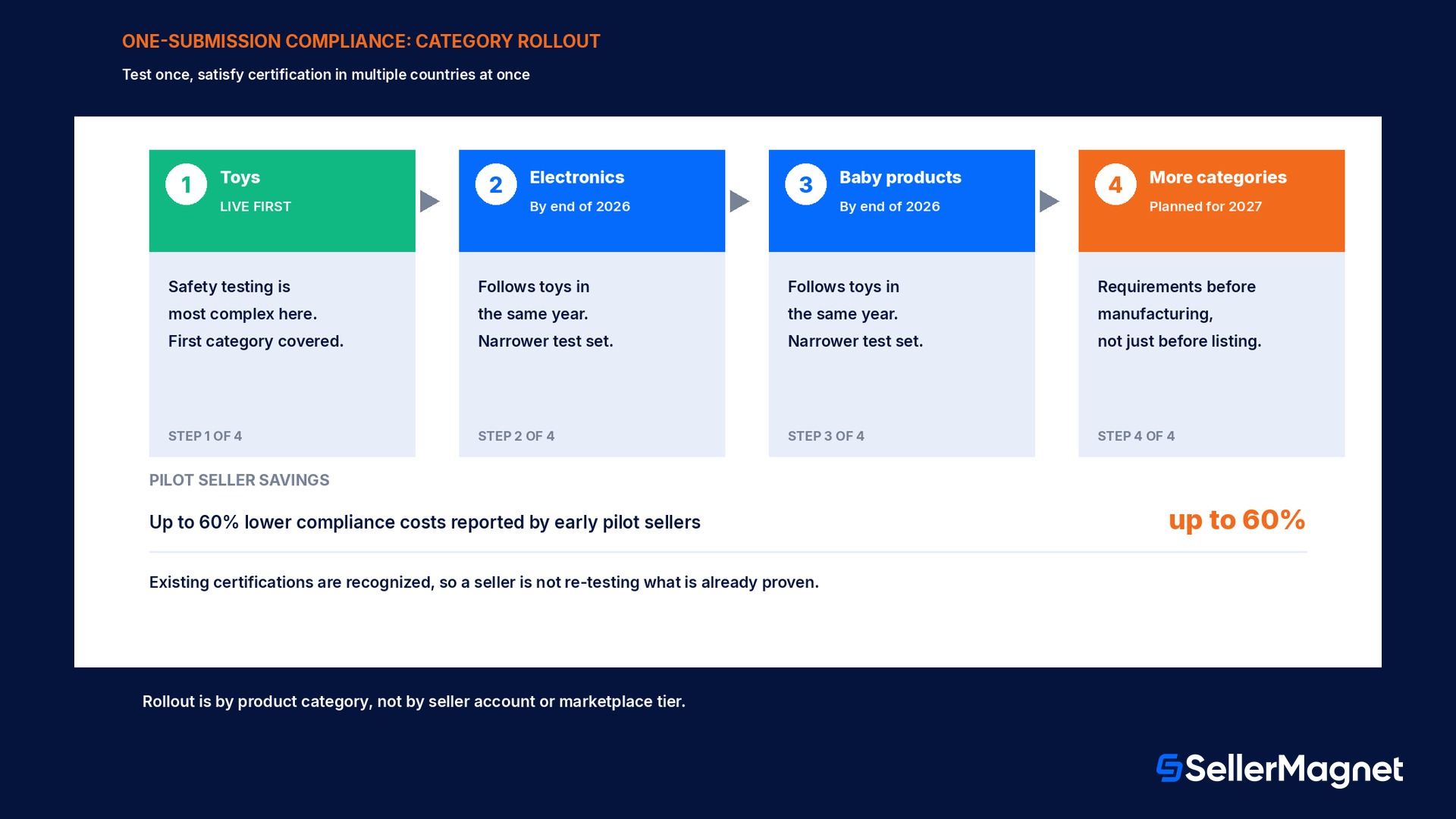
Amazon is explicit that one-submission testing starts with toys because safety testing is most complex there, with electronics and baby products following by the end of 2026 and more categories planned for 2027. A seller in a category that is not covered yet should check Seller Central directly for current availability rather than assuming the whole catalog is covered from this announcement alone.
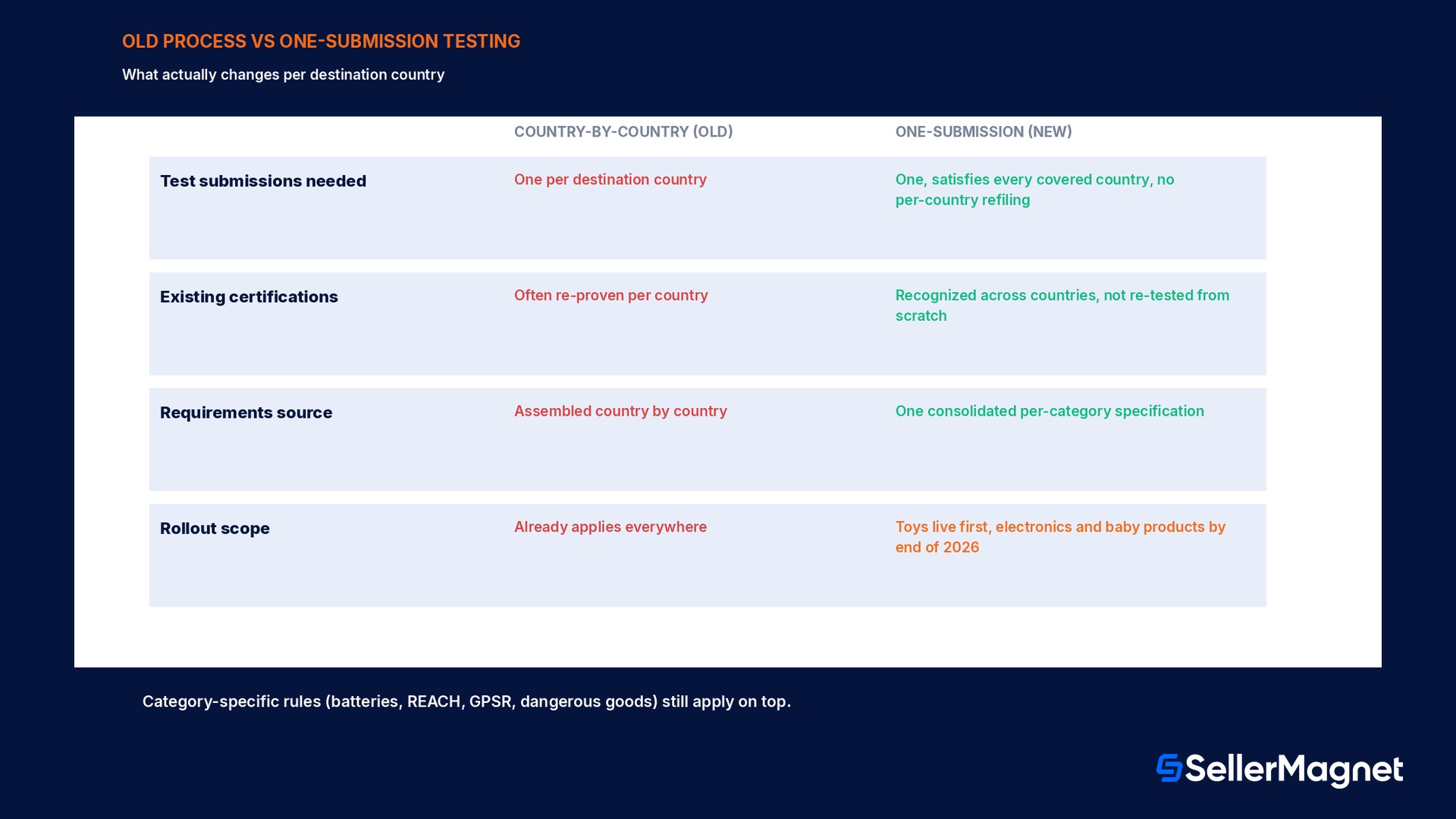
Old process versus one-submission: what actually changes per country
Country-by-country testing (old)
One-submission testing (new)
Test submissions needed
One per destination country
One, satisfies every covered destination country
Existing certifications
Often re-submitted and re-proven per country
Recognized, not re-tested
Where requirements are found
Separate country-specific help pages, assembled by the seller
One consolidated per-category specification
Rollout scope
Already applies everywhere
Toys first, electronics and baby products by the end of 2026
Worked example: certification cost on a five-country toy launch
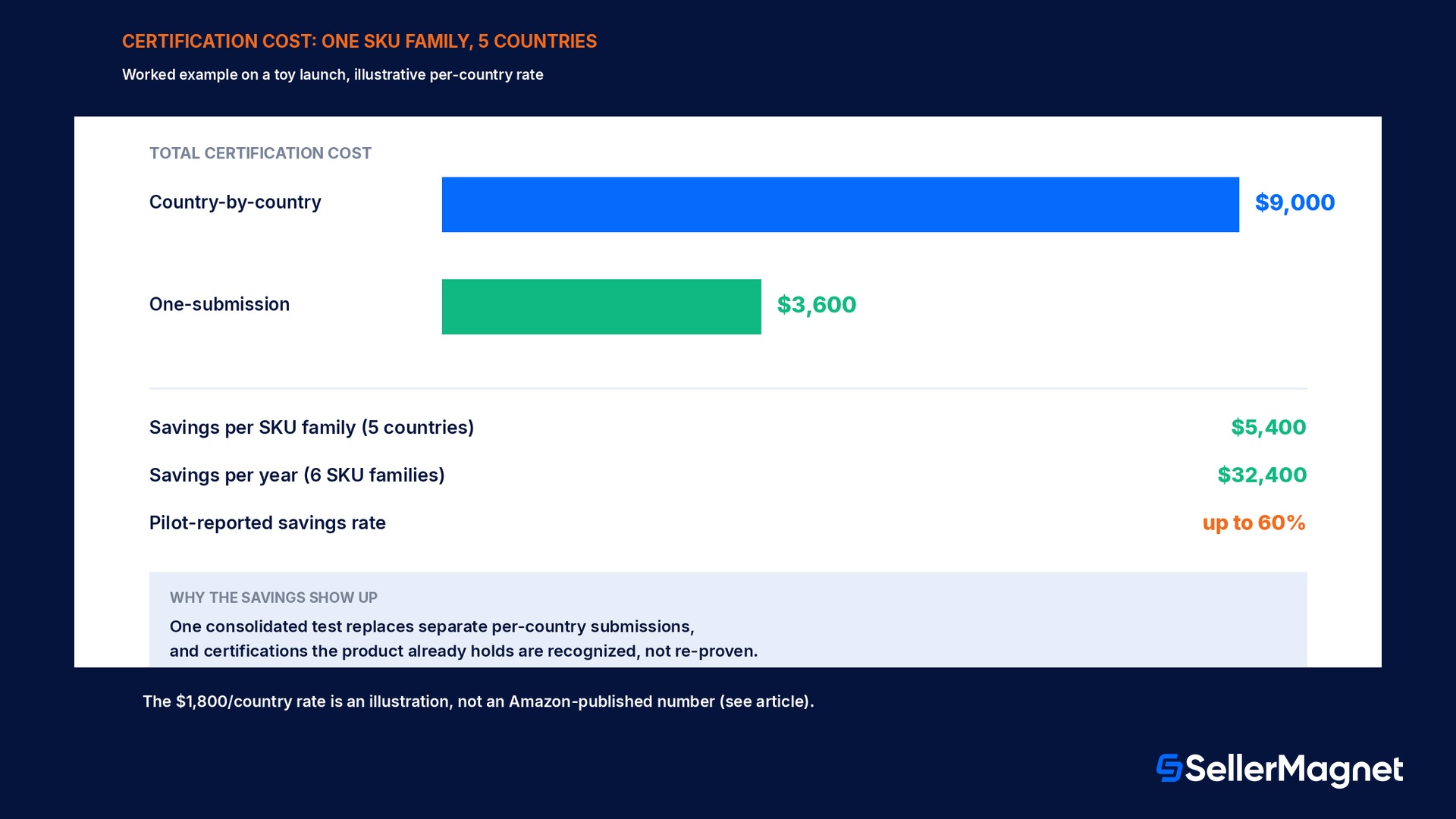
Say a toy seller is launching one SKU family in 5 countries and would otherwise pay an illustrative $1,800 per country for separate safety testing and certification, a total of $9,000. At the up-to-60% savings pilot sellers report from the one-submission process, that same 5-country certification could cost around $3,600 instead, a saving of $5,400 on this SKU family alone, before a single unit ships.
Country-by-country testing
One-submission testing
Countries covered
5
5
Cost per country (illustrative)
$1,800
pooled into one submission
Total cost
$9,000
$3,600
Savings
-
$5,400 (60%)
The per-country rate above is an illustration, not an Amazon-published number
Amazon publishes the percentage savings pilot sellers report (up to 60%), not a flat per-country testing rate; the $1,800 figure here is a worked illustration so you can see the mechanics. Check your own category's actual testing quotes before projecting a savings figure for your catalog.
Worked example: scaling the savings across a year of launches
A seller who runs this same 5-country certification process across 6 different SKU families in a year would pay roughly $54,000 a year under the old country-by-country model. At the same up-to-60% savings, that falls to about $21,600 a year, a difference of $32,400, money that stays available for inventory, advertising or testing one more market instead of paying for duplicate paperwork on products that already passed.
There is also a time dimension worth planning around, though Amazon has not published an exact day count: a sequential country-by-country process, at an illustrative 18 days per country, could stretch to roughly 90 days across 5 countries if run one after another. A single consolidated submission, evaluated once against every covered country, plausibly compresses that closer to 23 days in this illustration, a difference of roughly 67 days before a launch can go live everywhere it is certified for.
The day counts above are an illustration, not an Amazon-published figure
Amazon has not published an exact turnaround time for one-submission testing; the day counts in this section are an illustration of the mechanical difference between sequential per-country testing and one consolidated submission, not a committed timeline. Check your own category's current testing lead time in Seller Central.
How this is scoped versus Amazon's cross-border inventory announcement
The same Accelerate 2026 announcement that introduced one-submission compliance also introduced a separate cross-border inventory-pooling program, built to let a seller ship one manufacturing run to a single facility and have Amazon route units to whichever covered country has real demand. The two programs solve different problems and are easy to conflate because they were announced together: inventory pooling is about where a unit physically ends up once it is manufactured and shipped, while one-submission compliance is about whether that unit is legally allowed to be sold in each target country in the first place, and how much it costs to prove that. A seller can use the compliance change by itself, before ever touching the inventory-pooling program, simply by certifying a product once for every country it plans to sell in.
For sellers whose current blocker is customs duty, freight and landed cost rather than certification paperwork, our guide to expanding from the US into Europe covers the broader go-global decision; this post stays scoped to the compliance/testing piece specifically.
Where compliance already has its own rules today, outside one-submission testing
One-submission testing does not replace every existing compliance requirement a seller already has to meet; it changes how certification testing itself is submitted and recognized across countries. Category-specific rules that already exist, and are not part of the one-submission rollout yet, still apply on top: lithium battery products still need their own air shipment and TIC compliance documentation, products requiring REACH-style chemical safety disclosure still need their own REACH certificates, EU-bound listings still need to satisfy the General Product Safety Regulation, and dangerous-goods categories still carry their own separate compliance requirements. A seller should treat one-submission testing as a reduction in duplicate work within a covered category, not a removal of every other compliance obligation that category already carries.
What Amazon means by "category-level" and why that matters for your product
Amazon scopes one-submission testing by product category, not by seller account, marketplace tier, or how long you have been selling. That distinction matters because it means two sellers in the same account, one selling toys and one selling kitchen tools, can have completely different access to the new process on the exact same day: the toy seller's products may already qualify, while the kitchen-tools seller's products wait for a future category wave with no individual control over the timing. It also means a seller cannot simply ask Amazon to enable the process early for a specific product; the rollout moves by category across the whole marketplace at once, so the fastest path to using it is confirming whether your product's category is already in scope, not escalating a support ticket to get your account prioritized.
The category choice itself is not arbitrary. Amazon states directly that toys lead the rollout because safety testing is most complex there, spanning small-parts choking hazards, flammability, sharp-edge testing, and chemical content limits that already vary meaningfully by country. If a consolidated process can be proven reliable on the hardest case first, it is a reasonable signal that electronics and baby products, which carry their own but generally narrower sets of country-specific tests, are a comparatively lower lift to add next, which lines up with Amazon's own stated order for the rollout.
How to check whether your category is covered today
Because this is a live, moving rollout rather than a fixed feature with a single documentation page, the most reliable way to confirm coverage for your specific product is inside your own Seller Central account rather than from any third-party summary, including this one. A practical process looks like this: open the compliance or product-certification section tied to the category your ASIN sits in, check whether a consolidated multi-country specification is offered for that category, and if one is not yet shown, treat your category as not yet covered rather than assuming partial or hidden access. Because the rollout is explicitly staged, a category that is not covered today may become covered without any announcement reaching you individually, so a seller actively planning international expansion should re-check periodically rather than checking once and concluding the answer is permanent.
Confirm your product's assigned category inside Seller Central, since compliance coverage is scoped to that category, not to your account type or tenure.
Look for a consolidated, multi-country testing specification tied to that category rather than assuming a single country's requirement page implies broader coverage.
If your category is not yet covered, note it and re-check periodically rather than escalating a support request to speed up an account-level rollout that is actually category-level.
If your category is covered, confirm which specific destination countries that consolidated specification applies to, since one-submission coverage can expand by category before it covers every country you personally sell in.
Why this is a bigger deal for new launches than for products already certified
The savings in this guide's worked examples are framed around a seller running a fresh certification process in several countries at once, and that framing is deliberate: one-submission testing has the clearest impact before a product has been tested anywhere, when every country's requirement is still an open task rather than paperwork already filed. A seller whose product is already certified and selling in one country does not get a retroactive discount on work already completed; the benefit shows up the next time that product, or a close variant of it, needs new or renewed certification in an additional country. That makes the timing decision real: a seller about to launch a new SKU in a covered category gets the full benefit by certifying for every planned country from the start, while a seller who already certified country by country in the past realizes the saving only going forward, on the next expansion rather than the last one.
What is still coming in 2027
Amazon frames the current rollout as the first step of a longer plan. In 2027, Amazon says it intends to move compliance a step earlier than certification itself: giving sellers the requirements and costs for every target country before they manufacture a single unit, not just before they list it for sale. That would shift the decision point from "can I legally sell this product where I already manufactured it" to "should I manufacture this product at all, once I know what it will cost to certify everywhere I plan to sell it," a materially earlier and potentially far cheaper place to catch a compliance problem. None of that changes what is live today: one-submission testing for toys, with electronics and baby products following by the end of 2026.
Who should look at this now, and who should wait
This is most useful right now for a seller already selling a product in the toys category who is actively planning to launch, or expand, into several countries at once and has historically absorbed the cost of separate per-country testing. A seller outside the covered categories gets no immediate change to their own testing process yet, but should still check Seller Central periodically as electronics and baby products come online by the end of 2026. A seller still establishing a single-country compliance baseline should finish that groundwork first; one-submission testing reduces duplicate work across countries, it does not remove the need to pass the underlying test in the first place.
Check Seller Central directly for whether your product's category is already covered by one-submission testing.
If you sell toys today, confirm your current certification status before assuming you need to retest from scratch under the new process.
If your category is electronics or baby products, watch for its rollout by the end of 2026 rather than assuming it is live immediately.
Keep category-specific rules (batteries, REACH, GPSR, dangerous goods) in your compliance checklist separately; one-submission testing does not remove those.
Track your own testing invoices before and after any one-submission move so you can measure your real savings against the up-to-60% figure, rather than assuming the headline number applies exactly to your catalog.
Common mistakes sellers make with one-submission compliance
Assuming one-submission testing is already live for every category, when Amazon's own wording scopes the current rollout to toys first.
Confusing this compliance change with Amazon's separate cross-border inventory-pooling announcement from the same event; they solve different problems and can be used independently.
Treating one-submission testing as a replacement for category-specific rules like battery air-shipment documentation, REACH, GPSR or dangerous-goods requirements, which still apply on top.
Projecting the up-to-60% savings figure onto a specific product without checking your own category's current testing cost first.
Re-testing a certification the product already holds instead of confirming with Amazon that it is recognized under the new process.
Waiting for the full 2027 pre-manufacture roadmap to arrive before using the one-submission savings that are already available today in covered categories.
Multi-country certification checklist
You have checked Seller Central directly for whether your product's category is covered by one-submission testing yet.
You know which certifications your product already holds, so you are not re-testing something already proven.
You have listed every country you plan to launch in and confirmed which category-specific rules (batteries, REACH, GPSR, dangerous goods) still apply on top of one-submission testing.
You have a baseline per-country testing cost from your current process to compare against after moving to one-submission testing.
You are tracking certification cost and timeline per launch, not just per product, so the real savings per expansion are visible.
How SellerMagnet fits into a multi-country compliance plan
Certification savings only matter once they show up in your real per-market margin. Fee Calculator lets you check referral and fulfillment fees per marketplace, so a certification budget gets planned against real landed economics in each target country rather than a US-only estimate. Analytics Dashboard tracks sales and margin per marketplace side by side, which matters once a single SKU family is certified and selling in several countries at once and a blended number stops telling you which market actually paid off. See plans and pricing for current rates.
On the listing side, Listing Optimizer helps you adapt copy, keywords and category attributes per marketplace as you add countries, which keeps a newly certified product's listing accurate for each destination's requirements instead of a single US-written listing reused everywhere unchanged.
What is Amazon's one-submission compliance process?
A new process, announced at Accelerate 2026, that lets a seller complete a single test submission which satisfies certification requirements in multiple countries at once, instead of running a separate safety test and certification process for every destination country. It is rolling out by product category, so coverage depends on what you sell.
Which product category does one-submission testing cover first?
It starts with toys, because Amazon describes safety testing there as the most complex to pool across countries, which makes it the clearest proof point for the new process. Amazon says electronics and baby products follow by the end of 2026, with more categories planned for 2027 as the rollout widens.
How much do sellers save with one-submission compliance?
Amazon reports that early pilot sellers in the one-submission testing program saw savings of up to 60% on compliance costs. That is a reported pilot figure, not a guaranteed saving for every product or category, so check your own current testing cost per country before projecting a specific savings number for your own catalog and launch plan.
Do I need to re-test a certification my product already has?
No. Amazon states that existing certifications a product already holds are recognized under the one-submission process, so a seller is not re-testing or re-submitting documentation for something already proven in another country, which is exactly the duplicate work this new process is built to remove for covered categories.
Does one-submission testing replace rules like REACH, GPSR or battery compliance?
No. Category-specific rules such as lithium battery air-shipment documentation, REACH chemical disclosure, the EU's General Product Safety Regulation and dangerous-goods requirements still apply on top of one-submission testing, which only changes how the core certification test itself is submitted and recognized across the countries it currently covers.
Is one-submission testing available to every seller right now?
Only in categories Amazon has already enabled, starting with toys. A seller outside that category should check Seller Central directly for current availability rather than assuming the whole catalog is covered, since electronics and baby products are still rolling out by the end of 2026 and more categories follow in 2027.
How is this different from Amazon's Global Warehousing and Distribution announcement?
Both were announced at Accelerate 2026 but solve different problems. That separate program pools physical inventory across borders from a single shipment. One-submission testing is strictly about certification, whether a product is legally allowed to be sold in each target country, and the cost of proving that.
What is Amazon planning for compliance in 2027?
Amazon says it plans to move compliance a step earlier: giving sellers the requirements and costs for every target country before they manufacture a single unit, not just before they list it for sale, so a compliance problem can be caught before production commits real money rather than discovered only after a run is already made.
Stop Juggling Tools. SellerMagnet Combines Everything You Need.