Amazon Buy for Me 2026: What It Means for Sellers With Their Own Site
R
RenéFreelance Amazon Editor
|
12 min read
A seller who runs their own Shopify or WooCommerce store alongside an Amazon.com listing usually thinks of Amazon as a single relationship: list on Seller Central, pay the referral and FBA fees, done. Buy for Me is a separate relationship entirely, and it works in the other direction. It is Amazon's agentic checkout tool that lets a shopper browsing the Amazon Shopping app complete a purchase on a brand's OWN website, for products Amazon does not sell in its own store, without the shopper ever leaving the familiar Amazon checkout screen. A merchant does not pay Amazon to be found this way, and does not pay a referral fee on the sale either. This guide works through what Buy for Me actually does, how it differs from the wider Shop Direct program it sits inside, who can realistically qualify, and what the real published numbers behind the November 2026 expansion say about how big this already is.
Buy for Me is an Amazon Shopping app feature that lets a customer buy an eligible product directly from a brand's own website without leaving Amazon's checkout screen. The customer confirms delivery address, tax, shipping and payment on Amazon, and Amazon's AI completes the purchase on the merchant's site. It sits inside the wider Shop Direct program, which shows products Amazon does not sell in its own store. Amazon charges no fee to join and takes no referral fee on a Buy for Me sale; the merchant keeps full responsibility for fulfillment, shipping, returns and support.
What Buy for Me actually is, and the program it sits inside
Buy for Me is not its own standalone signup; it is a purchase mechanism that exists inside Shop Direct, Amazon's program for surfacing products from other merchants' websites in Amazon's own search results, the Amazon Shopping app, mobile web, and Alexa for Shopping. When a shopper searches for a brand or product Amazon does not carry in its own store, Shop Direct can surface a matching product from an outside merchant's site, clearly labeled with that merchant's own store name so the shopper always knows who they are buying from. For most Shop Direct products, tapping the listing simply hands the shopper off to the merchant's own website, with a clear notice that they are leaving Amazon, to complete the purchase there using whatever checkout the merchant already runs. Buy for Me is the upgrade available only on a subset of that catalog: for products Amazon marks eligible, the shopper never has to leave Amazon's own interface to finish the purchase. The distinction matters for a merchant evaluating the program, because it is Amazon, not the merchant, that currently decides which individual products get the Buy for Me treatment versus the plain link-out.
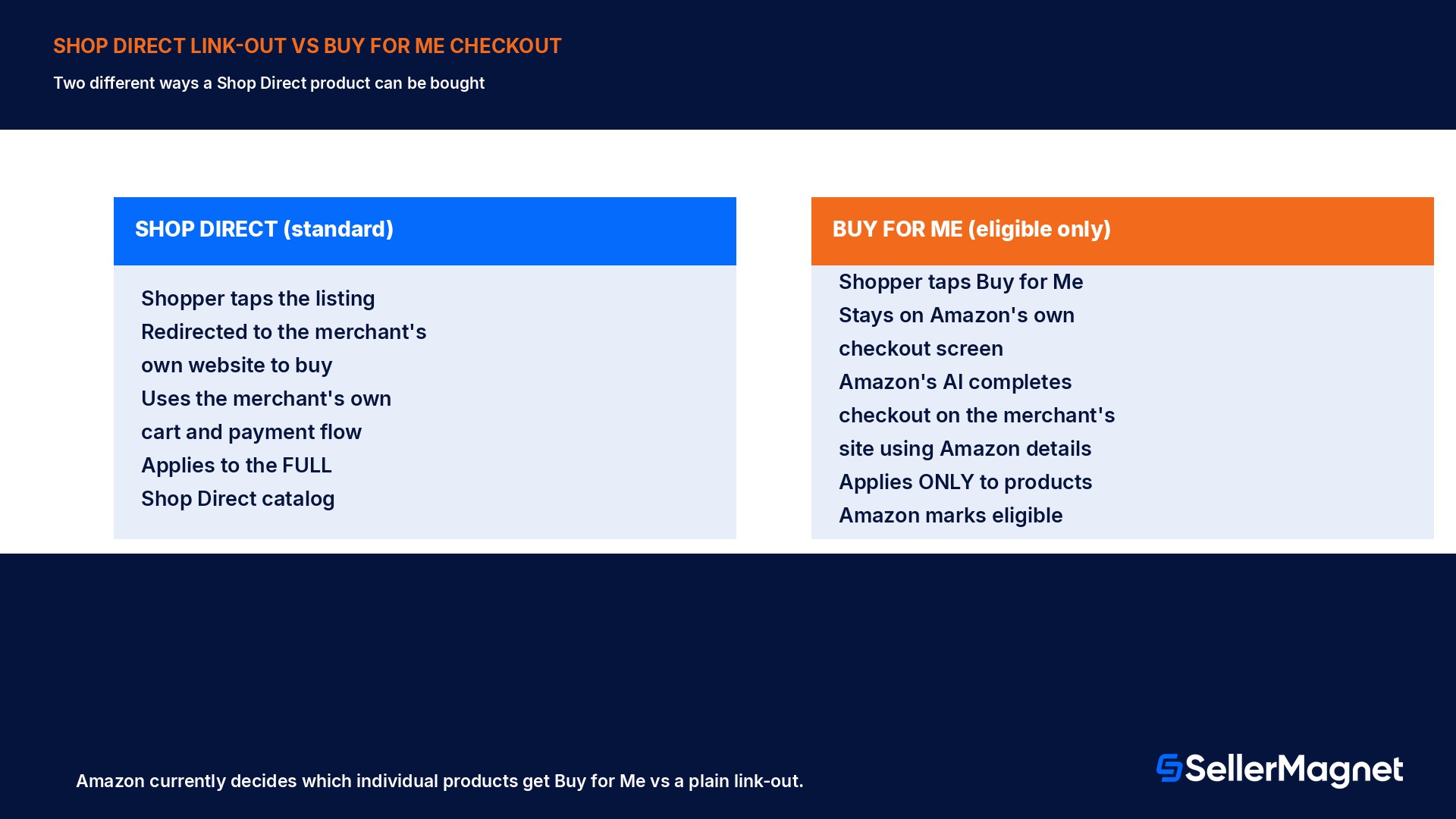
Shop Direct (standard)
Buy for Me (eligible products only)
Shopper taps the listing and is redirected to the merchant's own site
Shopper taps Buy for Me and stays on Amazon's checkout screen
Shopper completes checkout using the merchant's own cart and payment flow
Amazon's AI completes checkout on the merchant's site using the shopper's Amazon address, tax and payment details
Applies to the full Shop Direct catalog
Applies only to products Amazon has marked Buy for Me eligible
Clear notice shown that the shopper is leaving Amazon
Shopper never leaves the Amazon interface during checkout
How a Buy for Me purchase actually runs, step by step
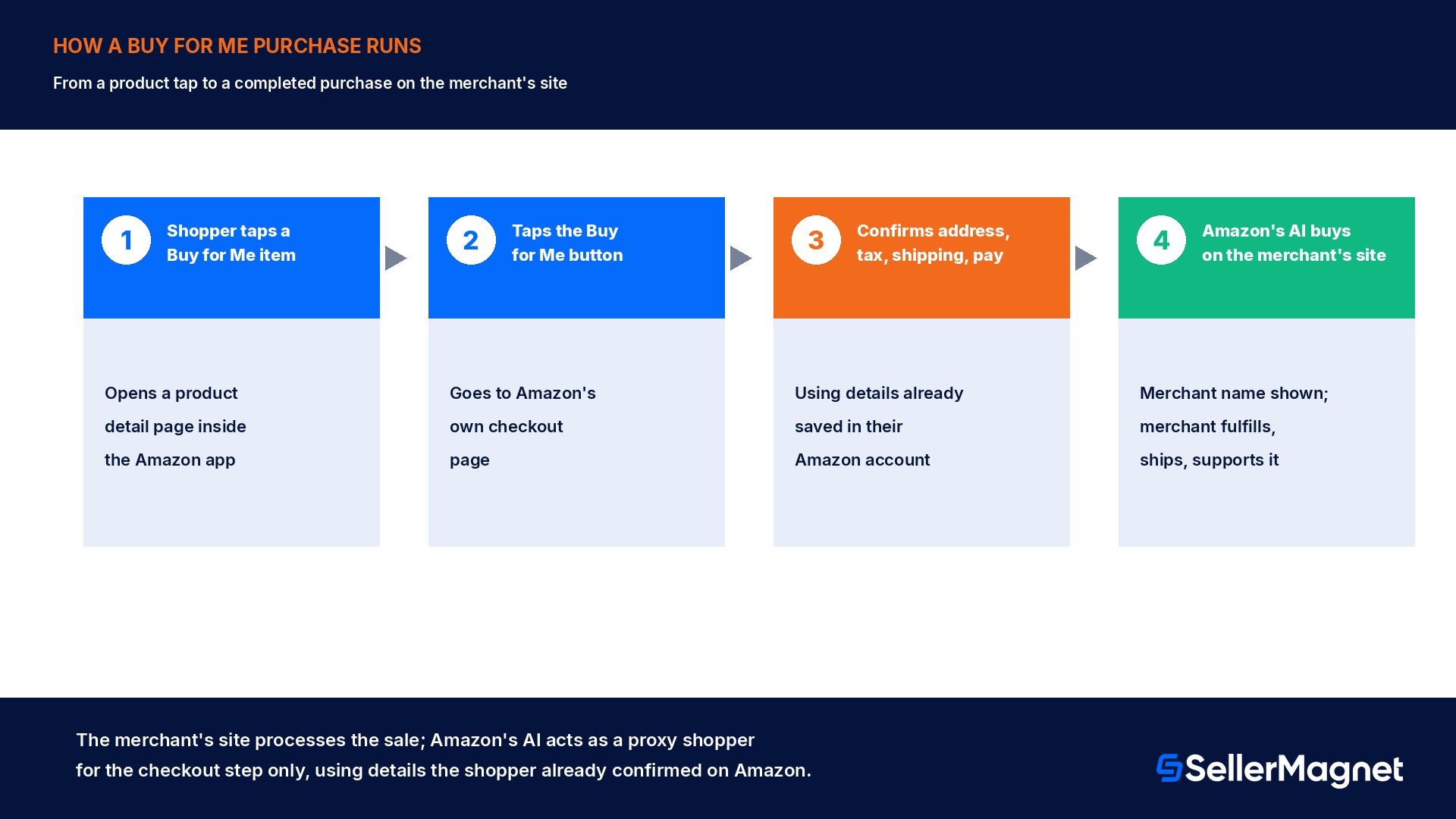
Amazon's own description of the flow breaks into two short steps for the shopper, but it is worth a merchant walking through exactly what each step touches on their side. First, the shopper taps a product in search results labeled for Buy for Me and lands on a product detail page inside the Amazon Shopping app, built to look like the detail pages Amazon uses for items it sells directly, so the shopper can read up on the item before deciding to buy. Second, if the shopper proceeds, they tap the Buy for Me button and are taken to an Amazon checkout page, where they confirm the delivery address, the taxes and shipping fees that apply, and the payment method, all using data already stored in their Amazon account. From there, Amazon's agentic AI, built on Amazon Nova and Anthropic's Claude models, completes the purchase directly on the merchant's own website on the shopper's behalf, without the shopper manually filling out the merchant's checkout form themselves. The merchant's store name stays clearly displayed throughout so the shopper knows whose product they are buying and whose website is actually processing the order behind the scenes.
What stays with the merchant, and what Amazon takes on
Amazon's own program terms are specific about where the line sits: merchants retain full responsibility for inventory, pricing, order fulfillment and customer service, exactly as if the sale had happened through their normal website checkout. Nothing about Buy for Me routes an order into Amazon's own fulfillment network or customer service queue; a return, a shipping delay, or a support question all go back to the merchant through the merchant's own usual channels, the same as any other order placed on their site. What Amazon takes on is narrower and specific to the moment of checkout itself: collecting the shopper's confirmation of address, tax, shipping and payment method on Amazon's own interface, then having its AI complete that specific transaction on the merchant's website using those confirmed details. A merchant joining the program is not outsourcing operations to Amazon; they are letting Amazon's AI act as a proxy shopper for one step of a checkout flow the merchant's own site still ultimately processes.
No fee to join, no referral fee on the sale
Amazon's own Shop Direct program page states plainly that Amazon does not charge merchants a fee to be part of the program and does not take a referral fee on a Buy for Me purchase. This is a materially different economic relationship from a normal Amazon.com marketplace listing, where the referral fee schedule applies to every sale regardless of channel.
Who can actually join Shop Direct and get Buy for Me eligibility
Amazon's own eligibility rule for joining Shop Direct at all is short and specific: a merchant must own an e-commerce website that sells in US dollars and ships products to the United States to participate in the program; eligibility requirements are subject to change, and Amazon reserves the right to determine who actually participates. That bar covers Shop Direct membership itself, not Buy for Me specifically. Amazon's own announcements describe Buy for Me as applying to eligible products within the program rather than to every merchant or every item automatically, and the public announcements do not publish a separate, named checklist for which individual products get promoted from a plain Shop Direct link to a full Buy for Me checkout; that decision currently sits with Amazon. A merchant already selling on Amazon.com is not excluded: Amazon's own Shop Direct Merchant Workspace announcement states that existing sellers may also be eligible to participate, specifically to surface products they do not currently list on Amazon's own store, by reaching out to shopdirect@amazon.com rather than going through the self-service Merchant Workspace signup built for brand-new participants.
How big this already is, in Amazon's own published numbers
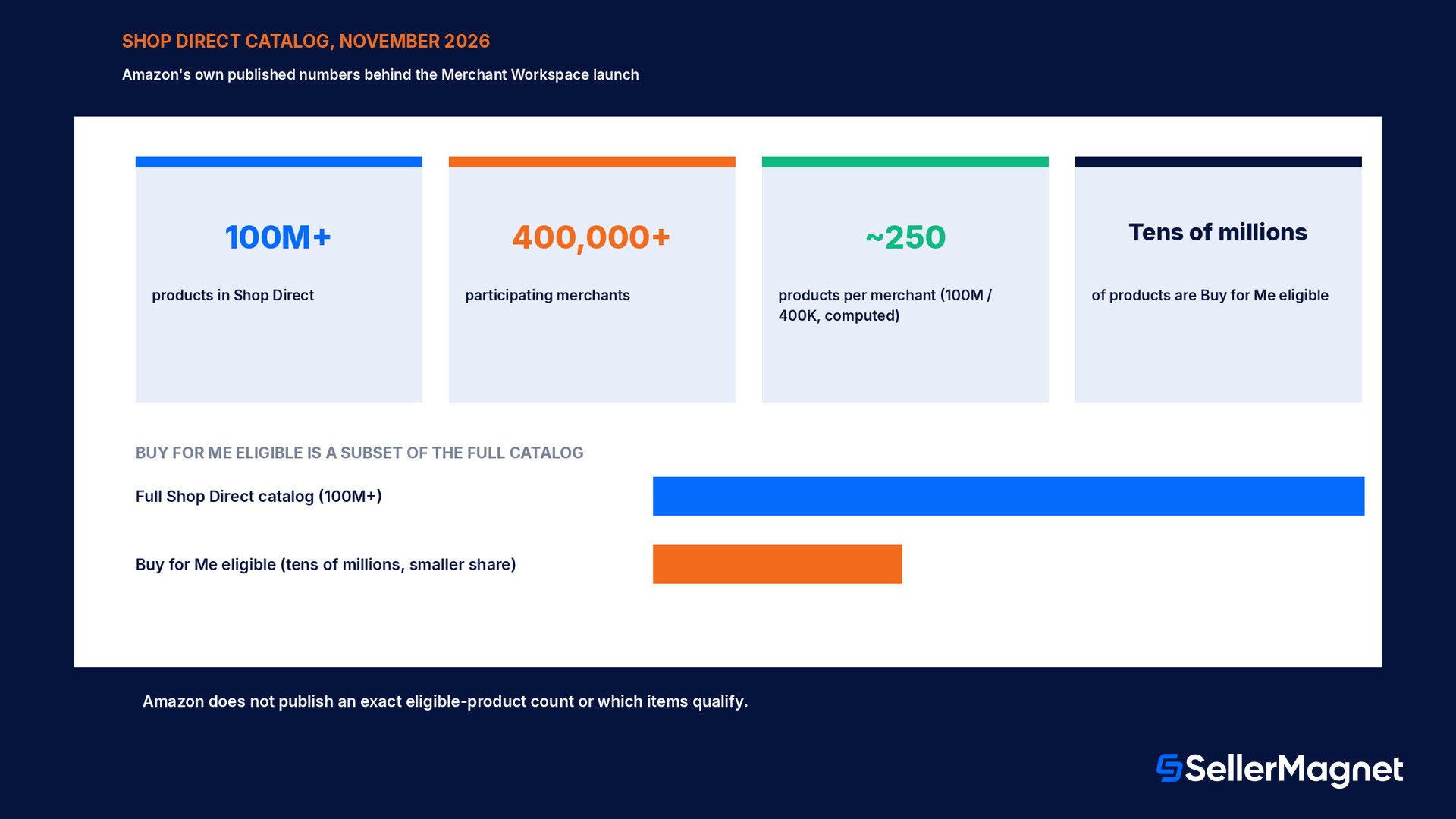
Amazon's own Shop Direct program states that the catalog now carries over 100 million products from more than 400,000 participating merchants, with tens of millions of those products available to purchase through the AI-powered Buy for Me feature specifically, not just linked out to the merchant's own site; Amazon's own November 2026 Merchant Workspace announcement does not restate the exact figure, so these numbers reflect the program's stated scale rather than a November-specific update. Dividing the two headline figures gives a useful benchmark for what a typical participating merchant's catalog footprint looks like inside the program: 100,000,000 products across 400,000 merchants works out to an average of 250 products per merchant, though Amazon does not publish the actual distribution, so an individual merchant's own catalog size relative to that average is not something this guide can state with precision. What the "tens of millions" Buy for Me figure does establish is that Buy for Me eligibility is a meaningful subset of the full Shop Direct catalog, not a rare pilot limited to a handful of brands; it is also, by definition, smaller than the full 100 million-plus product catalog, so a merchant should not assume every Shop Direct listing of theirs will carry the Buy for Me checkout option.
Signing up: the three steps, and where this guide stops
Amazon's own Shop Direct Merchant Workspace, launched in November 2026, runs new signups through three steps: create a Shop Direct merchant account, verify the business website, and share the product catalog either through an established third-party feed provider (Amazon names Feedonomics, Salsify, CEDCommerce and VersaFeed) or by integrating directly against the Selling Partner API to submit and manage the catalog programmatically. This guide is deliberately scoped to the Buy for Me checkout mechanism itself rather than to that signup flow; a merchant evaluating whether to actually register for Shop Direct, verify a website, or choose a feed provider should read the dedicated walkthrough of the Merchant Workspace signup process, since the two topics answer different questions: whether to join the program at all, versus what happens once a product inside it becomes Buy for Me eligible.
How this fits next to Amazon's other own-channel tools for sellers
Buy for Me and Shop Direct are not the only way Amazon is connecting a seller's business to channels outside a single Amazon.com listing. Amazon's own multichannel selling tools inside Seller Central take the opposite direction from Buy for Me: they pull a seller's eBay, Shopify, TikTok and Walmart listings, orders and profitability INTO Seller Central, so an existing Amazon seller manages every channel from one place. Buy for Me instead pulls a merchant's own-site catalog OUT into Amazon's own discovery surfaces, for products that are not on Amazon.com at all. A seller already running both an Amazon.com listing and an independent website can end up touching both programs for genuinely different reasons: multichannel tools to see everything in one dashboard, Shop Direct and Buy for Me to get the non-Amazon catalog discovered by Amazon's own shoppers.
What SellerMagnet does and does not cover here
SellerMagnet connects to a seller's Amazon Seller Central account and does not operate, register for, or manage a seller's participation in Shop Direct or Buy for Me; signing up through the Merchant Workspace, verifying a website, and choosing a feed provider all happen directly between the merchant and Amazon. Where SellerMagnet's Analytics Dashboard is useful is on the Amazon.com side of a seller's business that already exists today: tracking net profit per order, product, and marketplace after Amazon's own referral and FBA fees, which Buy for Me's own reporting (built around a merchant's own off-Amazon website, not Seller Central) does not cover at all. A seller comparing a normal Amazon.com sale against a Buy for Me purchase landing on their own site should expect the second one to carry none of Amazon's marketplace referral fee, since Amazon states explicitly it does not take one on those orders; whatever a seller's own payment processor charges on that off-Amazon sale is a separate cost to track.
A seller who processes payment for orders on their own site through Amazon's own checkout button, a different feature from Buy for Me, should check Amazon Pay's own fee and qualification pages directly; Amazon Pay charges a transaction fee and a referral fee does not apply there either, but it is a separate mechanic from the fee-free Buy for Me checkout covered on this page.
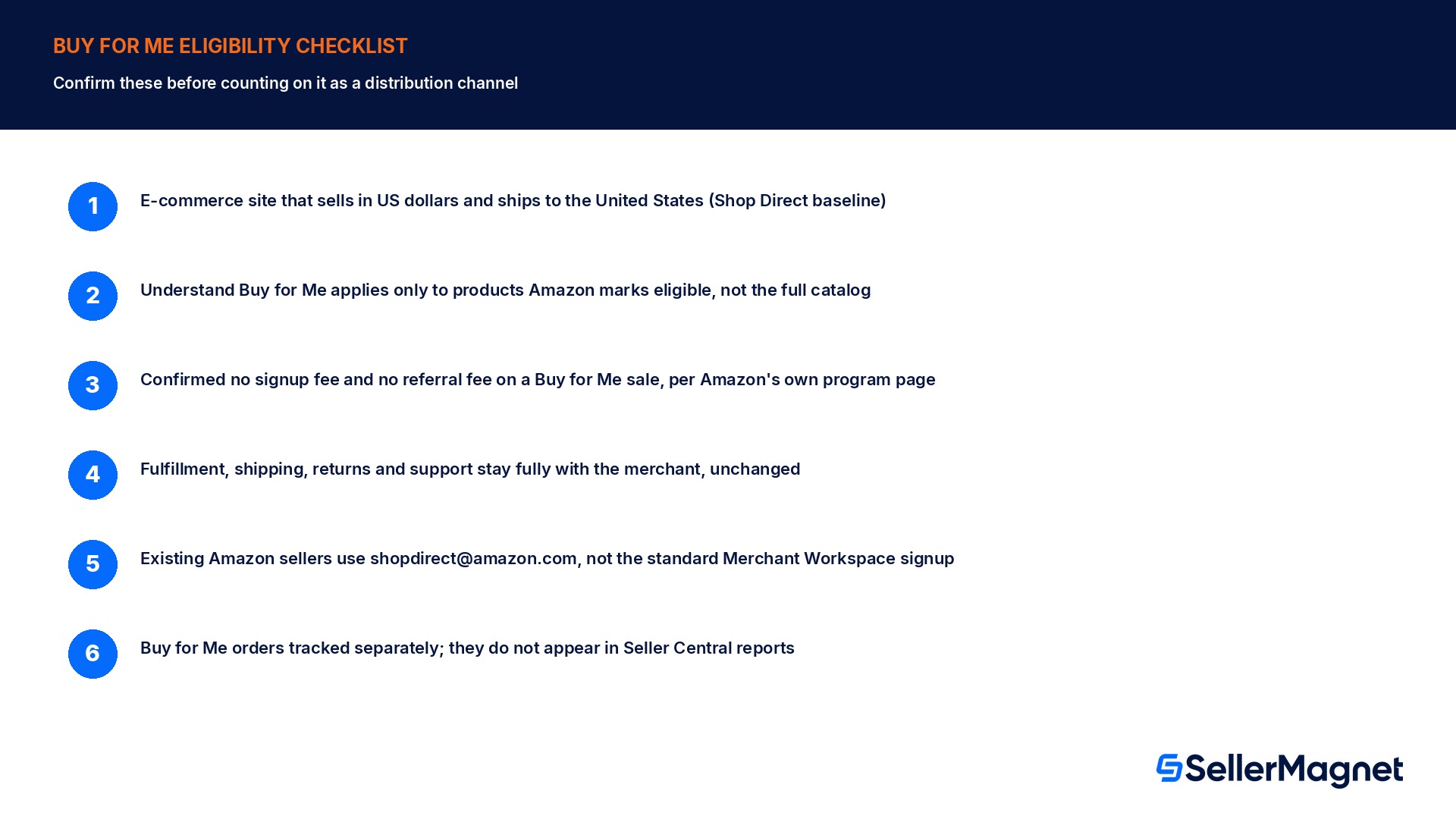
Checklist before treating Buy for Me as a real channel
How to evaluate whether Buy for Me is worth pursuing for a brand's own site
Confirm the e-commerce basics first - A merchant needs an e-commerce website that sells in US dollars and ships to the United States; Amazon decides actual program participation and can change the eligibility bar.
Separate Shop Direct membership from Buy for Me eligibility - Joining Shop Direct does not automatically make every product Buy for Me eligible; Amazon currently decides which individual products get the full in-Amazon checkout versus a plain link-out.
Confirm there is no fee either way - Amazon states it charges no fee to join and takes no referral fee on a Buy for Me sale; verify that stays true on the current program page before relying on it.
Plan for fulfillment to stay exactly as it is today - A Buy for Me order still ships, returns and gets supported through the merchant's own existing processes; nothing about the feature changes operations.
Existing Amazon sellers should use the seller-specific contact path - Reach out to shopdirect@amazon.com to ask about surfacing products not currently sold on Amazon's own store, rather than assuming the self-service signup is the only door in.
Track Buy for Me orders separately from Amazon.com marketplace orders - They are a different revenue stream processed on the merchant's own site; they will not appear inside Seller Central's own order or payments reports.
Is Buy for Me the same thing as Shop Direct?
No. Shop Direct surfaces a merchant's products in Amazon's search results, the Shopping app and Alexa for Shopping. Buy for Me is one checkout option available only for products Amazon marks eligible inside that program; every other Shop Direct product still links the shopper out to the merchant's own site to buy.
Does Amazon charge a fee for Buy for Me purchases?
Amazon's own Shop Direct program page states it does not charge merchants a fee to participate and does not take a referral fee on a Buy for Me purchase. This is a different economic relationship from a normal Amazon.com marketplace listing, which carries Amazon's referral fee schedule regardless of channel.
Who actually qualifies to join Shop Direct?
A merchant needs to own an e-commerce website that sells in US dollars and ships products to the United States. Amazon states eligibility requirements are subject to change and that it reserves the right to determine actual participation, so this is a starting bar rather than a guarantee.
Can an existing Amazon seller also use Shop Direct and Buy for Me?
Yes. Amazon's own announcement states existing sellers may also be eligible, specifically to surface products they do not currently sell on Amazon's own store, and directs interested sellers to contact shopdirect@amazon.com rather than the self-service Merchant Workspace signup built for new participants.
Who handles shipping, returns and customer service on a Buy for Me order?
The merchant does, exactly as with any other order placed on their own website. Amazon's role is limited to the checkout moment itself: collecting the shopper's confirmed address, tax, shipping and payment details on Amazon's interface, then having its AI complete that one purchase on the merchant's site.
How many products are actually eligible for Buy for Me right now?
Amazon's Shop Direct program states the catalog carries over 100 million products from 400,000+ merchants, with tens of millions supporting Buy for Me specifically; the November 2026 Merchant Workspace piece does not restate this figure. It is a meaningful share of the catalog, but smaller than the full catalog by definition, since Amazon does not publish which products qualify.
Stop Juggling Tools. SellerMagnet Combines Everything You Need.