Amazon INFORM Consumers Act 2026: Threshold and Certification
R
RenéFreelance Amazon Editor
|
12 min read
The INFORM Consumers Act is a US federal law that took effect on June 27, 2023, and it places obligations on both Amazon and what the law calls high-volume third-party sellers on Amazon's US store. Amazon's own program page states plainly what the law requires: Amazon must collect, verify, and disclose certain specific information about a high-volume seller's business, that seller must keep the information current and tell Amazon when it changes, and the seller must certify that the information is current at least once a year.
A seller who skips either the required verification or the annual certification can have their account deactivated, which is why the law shows up in Seller Central not as a one-time setup task but as a recurring compliance obligation that keeps coming back every time a seller's account details change or a year passes. This guide works through exactly which sellers the law applies to, what Amazon actually collects and shows customers, a worked example of a seller crossing the threshold mid-year, and what triggers Amazon to ask for re-verification outside the normal annual cycle.
The INFORM Consumers Act requires Amazon to collect, verify, and disclose certain business information for high-volume third-party sellers, defined as sellers with 200 or more transactions and $5,000 or more in gross revenue in any continuous 12-month period during the previous 24 months. Affected sellers must keep that information current, notify Amazon of changes, and certify it at least annually, or risk account deactivation.
What does the INFORM Consumers Act actually require?
Amazon's own help page on the law states that the INFORM Consumers Act took effect on June 27, 2023, and places obligations on Amazon and high-volume third-party sellers who sell products on Amazon's US store. Under the law, a covered seller must do three things on an ongoing basis: provide the specific business information the law requires so Amazon can collect, verify, and disclose it; keep that information current and notify Amazon whenever it changes, which triggers a new round of verification; and certify, at least once a year, that the information on file is still accurate. Amazon's page is explicit that its own internal processes are already more sophisticated than the law's baseline requirements in many respects, but the law still requires Amazon to take certain additional, specific verification steps for every seller the threshold catches, regardless of how established or trusted that seller's account already is. The obligation sits on both sides: Amazon has to collect and verify the data, and the seller has to supply accurate data and keep it that way, with deactivation as the consequence if either side of that fails on the seller's end.
What is the 200-transaction, $5,000 threshold, and how does the rolling window work?
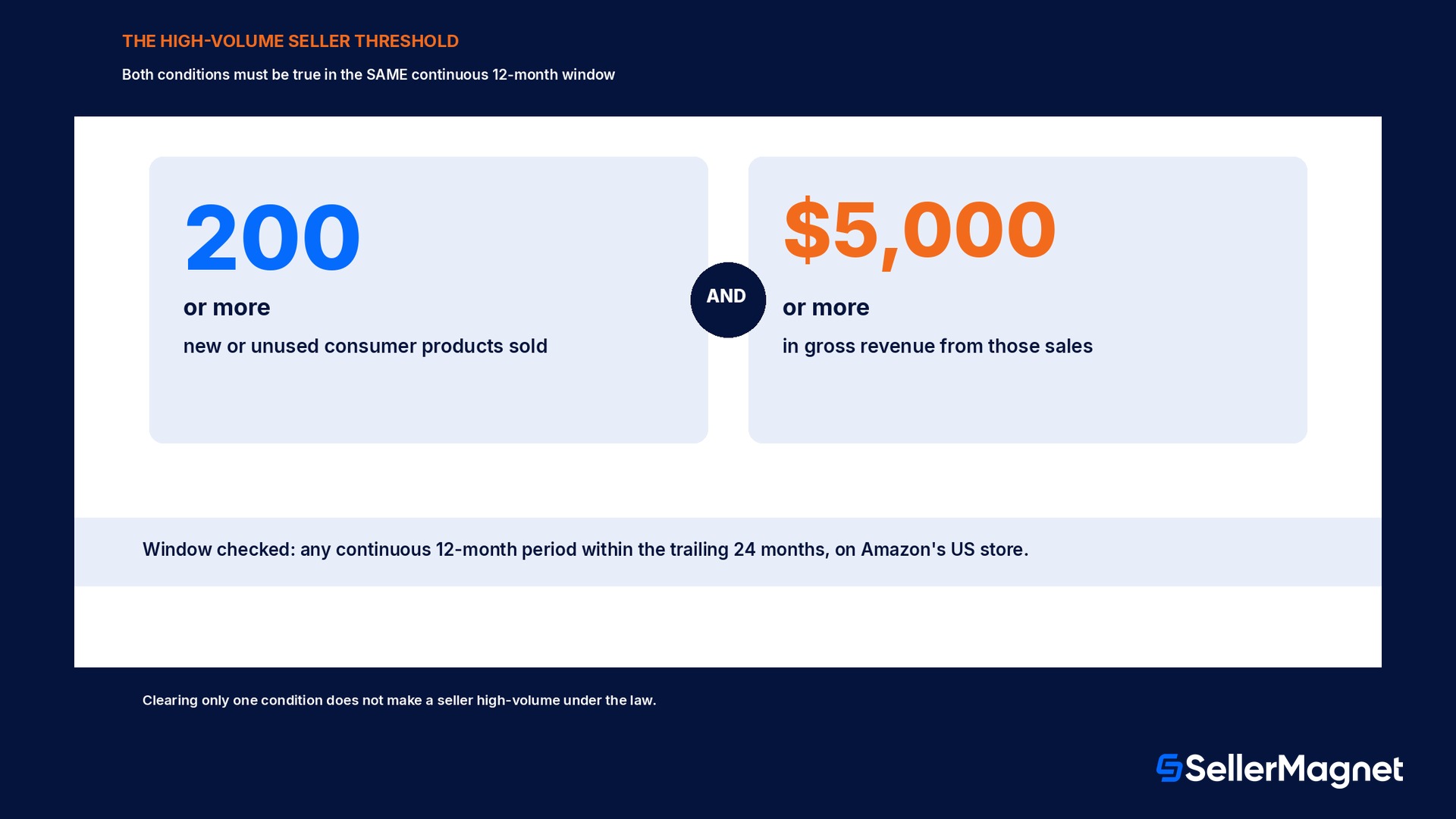
The law does not apply to every third-party seller. Amazon's help page defines the threshold precisely: the law applies to third-party sellers who, in any continuous 12-month period during the previous 24 months, have sold 200 or more new or unused consumer products and have had $5,000 or more in gross revenues from those sales. Both conditions have to be true in the same window; a seller who sold 500 low-value items for $2,000 in gross revenue has crossed the transaction count but not the revenue figure, and the law's own wording ties the two together rather than triggering on either alone. The 24-month lookback matters just as much as the 12-month window itself: Amazon does not only check a seller's most recent rolling year, it checks every possible continuous 12-month span inside the trailing 24 months, so a seller who had one unusually strong 12-month stretch a year ago, followed by a quieter recent year, can still be caught by that earlier stretch. This is why a seller's own sales dashboard matters more than instinct here; crossing the threshold is a function of a full two-year sales history, not just the current month's numbers.
Condition
Threshold
Window checked
New or unused consumer products sold
200 or more
Any continuous 12 months within the trailing 24 months
Gross revenue from those sales
$5,000 or more
The same continuous 12-month window as the transaction count
Marketplace scope
Amazon's US store only
Per Amazon's own INFORM Consumers Act help page
What does Amazon collect, verify, and show customers?
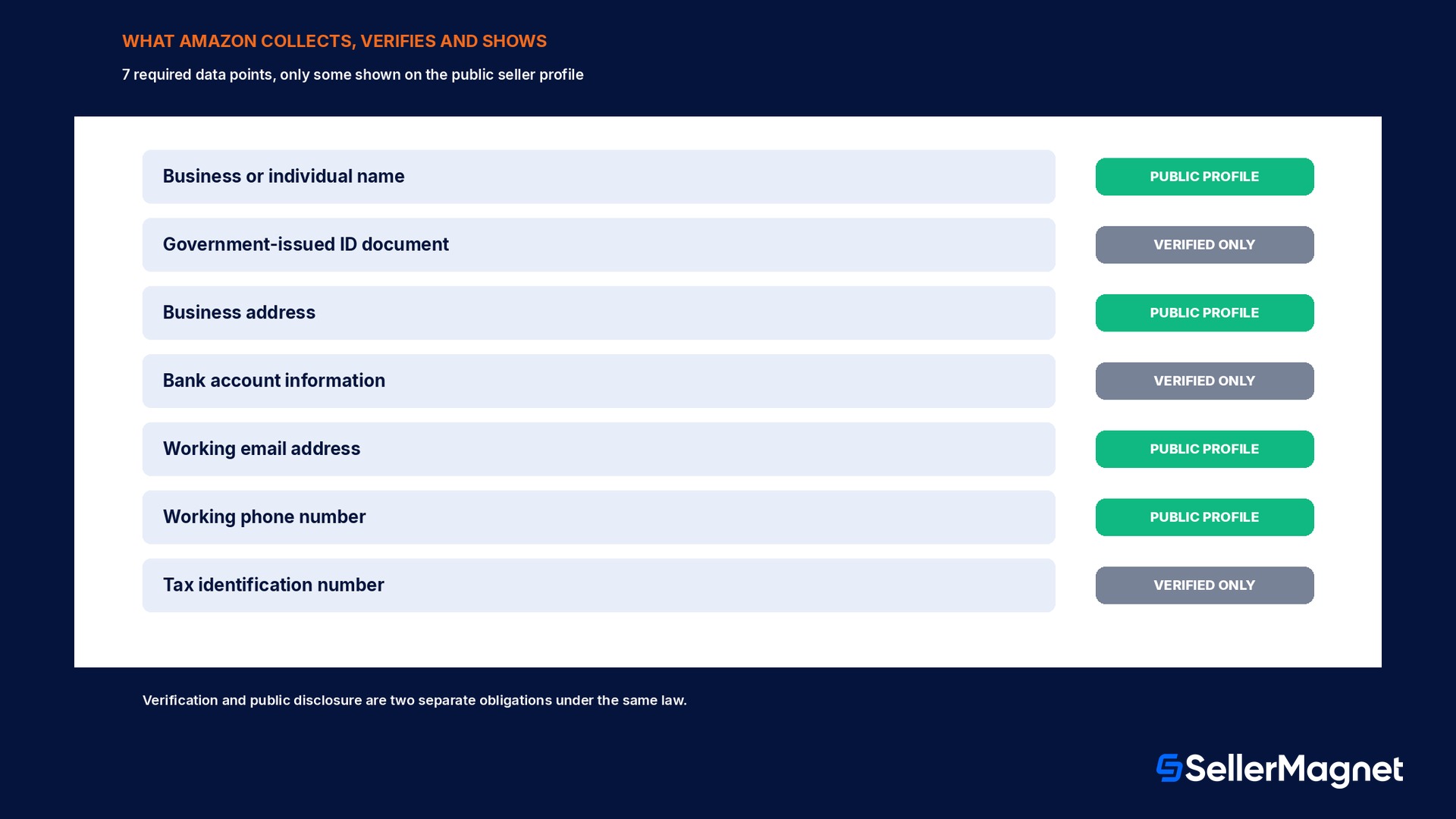
Once a seller crosses the threshold, Amazon's help page lists exactly what it must collect and verify: the seller's name, a government-issued identification document, a business address, bank account information, a working email address, a working phone number, and a tax identification number. That information must be provided either in the business's own name or in the name of an individual who is legally authorized to act on the seller's behalf, and Amazon re-verifies it any time the seller's information changes, not only at account setup. A separate part of the law requires Amazon to disclose some information publicly, and Amazon's own help page is specific about what that public seller profile page actually shows: the seller's business name and address, an optional customer-service phone number only if the seller chooses to provide one, and a link to Amazon's own Buyer-Seller Messaging service, not the seller's raw email address or bank details, so a customer browsing a high-volume seller's listings can identify and contact who they are actually buying from. The verification step and the disclosure step are two different obligations under the same law, and Amazon's page states plainly that this profile page already satisfied part of the disclosure requirement before the law existed, so the fields the law intends customers to see are narrower than everything Amazon collects for verification.
Data Amazon collects and verifies
Shown publicly on the seller profile
Business or individual name
Yes, business name shown
Government-issued identification document
No
Business address
Yes, address shown
Bank account information
No
Working email address
No, not shown
Working phone number
Optional, only if the seller provides one
Tax identification number
No
Worked example: a seller crossing the threshold mid-year
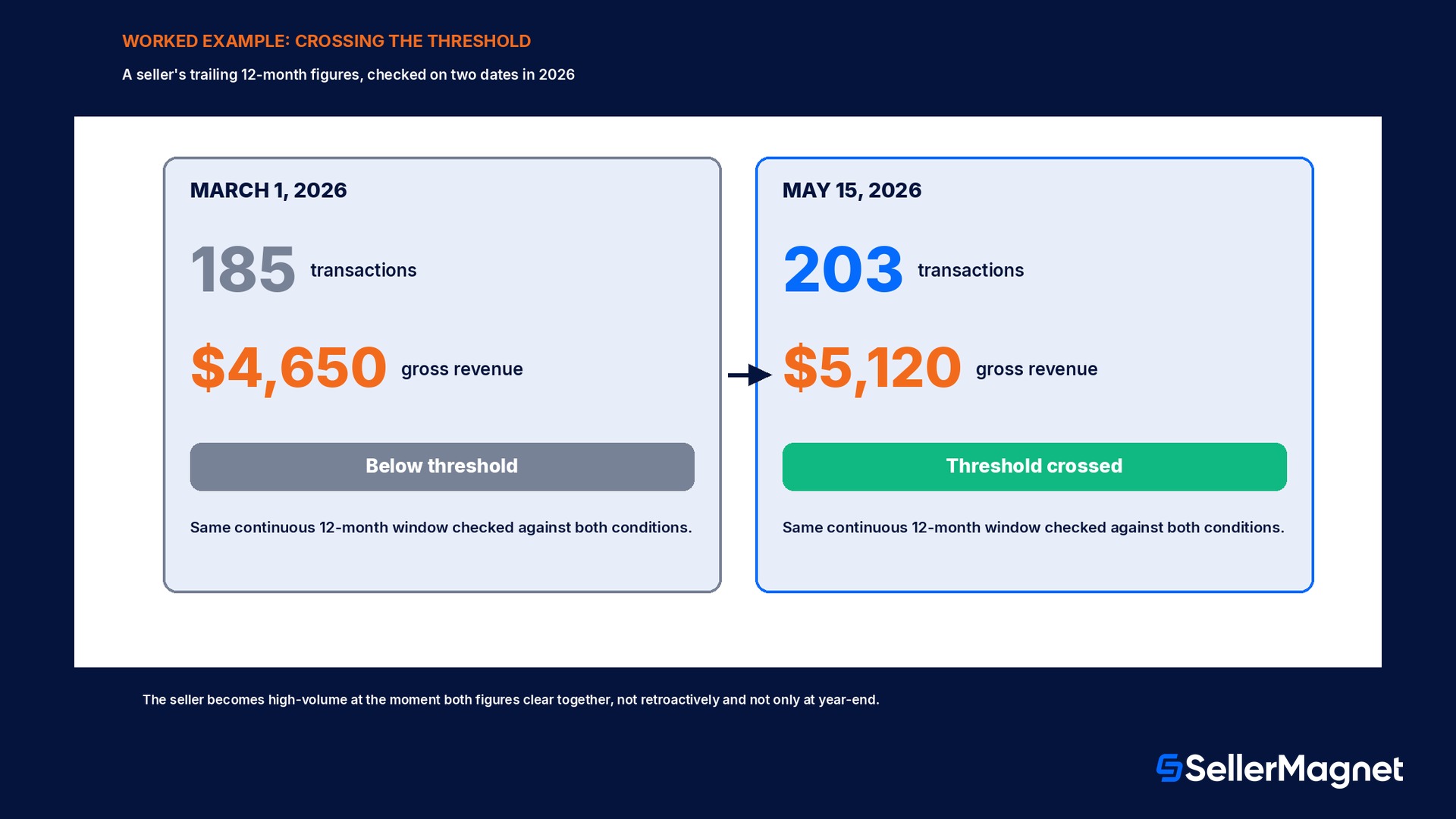
Take a seller whose trailing 12-month figures on March 1, 2026 stood at 185 transactions and $4,650 in gross revenue on Amazon's US store, below both parts of the threshold. By May 15, 2026, a seasonal sales run pushed the same trailing 12-month window to 203 transactions and $5,120 in gross revenue, crossing the 200-transaction mark and the $5,000 revenue mark inside the same continuous 12-month span. Because both conditions are now true in that one window, this seller becomes a high-volume seller under the law at that point, not retroactively from January and not only once a full calendar year has passed; Amazon's verification and disclosure obligations begin as soon as the rolling 12-month figures clear both thresholds together. A seller watching only total lifetime sales, or only the current calendar year, can miss this moment entirely, since the relevant number is whichever continuous 12-month window inside the trailing 24 months first clears both the 200-unit and $5,000 marks, and that window can start and end on any date, not just January 1.
Date checked
Trailing 12-month transactions
Trailing 12-month revenue
Threshold crossed
March 1, 2026
185
$4,650
No, both conditions still below threshold
May 15, 2026
203
$5,120
Yes, both conditions cleared in the same window
The annual certification cycle, and what triggers re-verification outside it
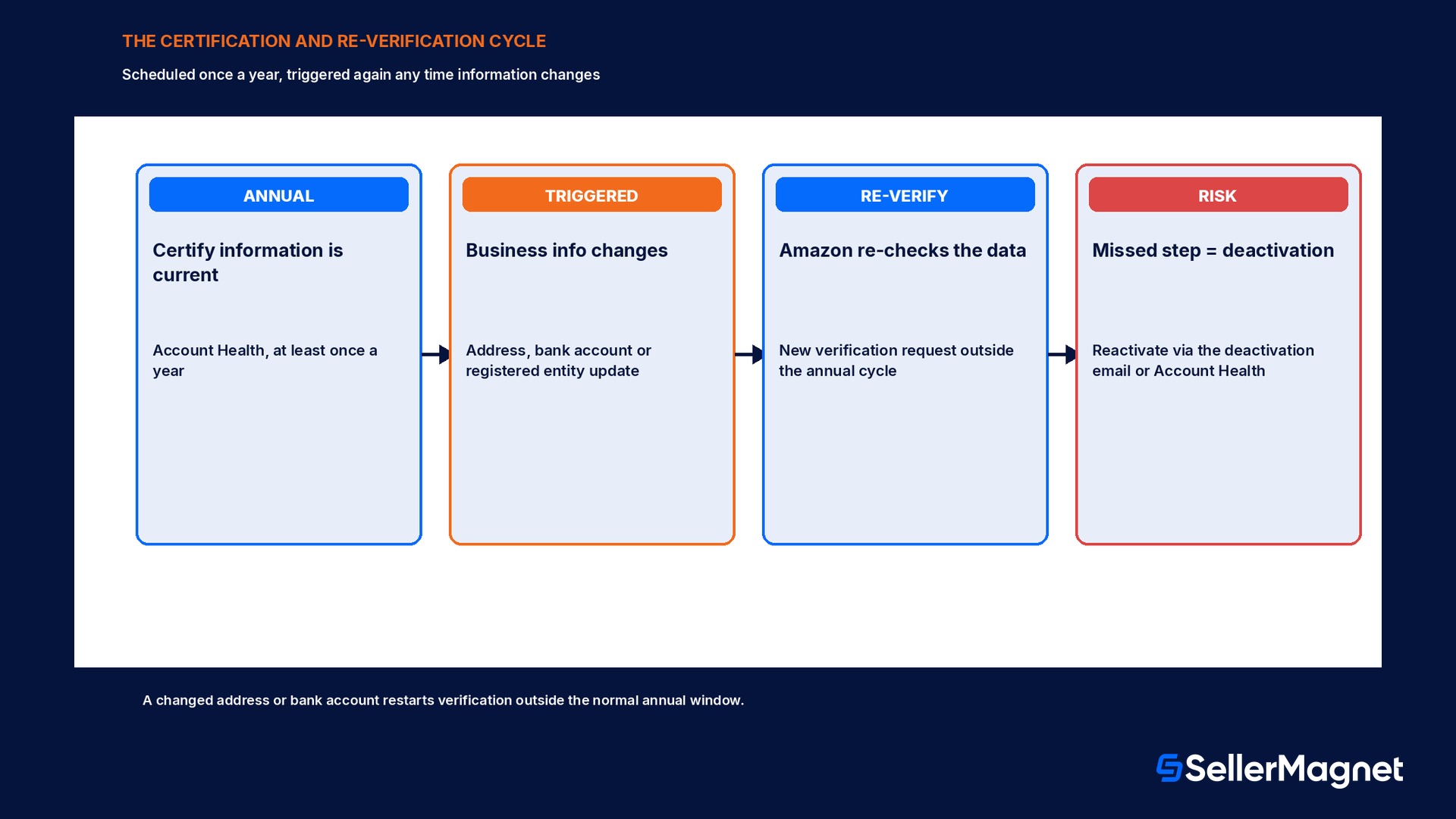
Amazon's help page describes the certification step as something a high-volume seller is asked to complete at least once a year: from the Account Health page, a seller reviews the information on file and, if it is accurate, certifies it for the INFORM Consumers Act. That annual cycle is the baseline, but it is not the only time the law resurfaces. Amazon's own guidance states it must verify a seller's information again any time that information changes, which in practice means a changed business address, a new bank account on file, or an updated registered business entity each restart the verification process outside the normal yearly schedule; Seller Forums threads describe exactly this pattern, where a routine change to a store's registered business entity triggered an unplanned re-verification requirement days later. A seller who only thinks about this law once a year, at the scheduled certification prompt, can be caught off guard by one of these change-triggered re-verifications in between, and Amazon's page is clear that the consequence for missing either kind of request, scheduled or triggered, is the same: the account can be deactivated until the verification or certification is completed.
Deactivation for a missed certification is an account-level event, not a warning
Amazon's own help page states an account can be deactivated if required verification or certification steps are not completed when requested. Reactivation runs through the steps named in the account's deactivation email, or the Reactivate Your Account link at the top of the Account Health page; there is no separate grace-period mechanism described on Amazon's own page beyond completing the outstanding step.
Mistakes that turn this into a deactivation risk
Tracking only the current calendar year. The law checks every possible continuous 12-month window inside the trailing 24 months, not just January to December; a strong stretch a year ago can still trigger the threshold today.
Treating the 200-unit and $5,000 conditions as separate triggers. Both have to be true in the same continuous 12-month window; clearing one alone does not make a seller high-volume under the law.
Changing a business address or bank account without expecting a re-verification request. Amazon's own page states it re-verifies information any time it changes, which restarts the process outside the normal annual cycle.
Waiting for a deadline reminder that never specifically says 'INFORM Consumers Act.' The certification prompt sits inside the Account Health page under Account Info, not in a separate standalone notice; check it directly rather than waiting to be told.
Assuming verified information stays private. The public seller profile page shows business name, address, an optional customer-service phone number, and a Buyer-Seller Messaging link, not the raw email address or bank details collected for verification; the law's disclosure requirement is intentional, not a privacy leak.
Ignoring a deactivation notice because the account otherwise looks healthy. This law's deactivation trigger is independent of every other Account Health metric; a seller can be in perfect standing everywhere else and still be deactivated for a missed certification.
Where SellerMagnet fits around INFORM Consumers Act compliance
Amazon runs every part of the INFORM Consumers Act's verification, certification, and disclosure process itself; SellerMagnet has no role in that process and cannot verify or certify a seller's information on their behalf. What SellerMagnet's tools help with is the part a seller has to track without Amazon's help: knowing where a trailing 12-month sales figure actually stands against the 200-unit and $5,000 thresholds before Amazon's own systems flag it. Profit Analytics tracks rolling sales volume and revenue over time, which is the same kind of trailing-window view this law's threshold is built on, so a seller can see a threshold crossing coming rather than discovering it only after Amazon's own certification prompt appears.
After certification, staying ahead of a change-triggered re-verification matters just as much; Amazon Alerts flags account-health events as they land, so a deactivation notice tied to a missed certification or a triggered re-verification gets seen and acted on the same day it appears, rather than during a routine check days later.
Checklist for staying ahead of the INFORM Consumers Act
How to stay compliant with the INFORM Consumers Act
Check trailing 12-month sales against both thresholds - Look at every rolling 12-month window inside the last 24 months, not just the current calendar year, for 200+ units and $5,000+ in revenue together.
Review Account Info for current data - Go to Settings, then Account Info, and confirm name, address, bank information, email, phone number, and tax ID are all accurate.
Complete the annual certification when prompted - The Account Health page surfaces the certification step at least once a year; complete it promptly rather than letting it sit.
Expect re-verification after any change - A changed business address, bank account, or registered business entity restarts verification outside the normal annual cycle.
Know what becomes public - Business name, address, an optional customer-service phone number, and a Buyer-Seller Messaging link are shown on the public seller profile once verified, not the raw email or bank details; this is expected, not a leak.
Act immediately on a deactivation notice - Follow the steps in the deactivation email or use Reactivate Your Account on the Account Health page without delay.
Which sellers does the INFORM Consumers Act apply to?
Third-party sellers on Amazon's US store who, in any continuous 12-month period during the previous 24 months, sold 200 or more new or unused consumer products and had $5,000 or more in gross revenue from those sales.
What information does Amazon collect and verify under this law?
A seller's name, a government-issued identification document, a business address, bank account information, a working email address, a working phone number, and a tax identification number.
Is any of that information shown publicly?
Partly. The public seller profile page shows the seller's business name and address, an optional customer-service phone number if the seller provides one, and a link to Amazon's Buyer-Seller Messaging service, so customers can identify and contact who they are buying from. The raw email address, bank account information, government ID, and tax ID are not shown publicly.
How often do I need to certify my information?
At least once a year, from the Account Health page. Amazon also re-verifies information any time it changes, which can trigger an additional request outside the annual cycle.
What happens if I miss the certification or verification?
Amazon's own help page states the account can be deactivated. Reactivation follows the steps in the deactivation email or the Reactivate Your Account link on the Account Health page.
When did the INFORM Consumers Act take effect?
June 27, 2023. It remains an ongoing obligation in 2026 for every seller who meets the threshold, not a requirement that applied only at launch.
Stop Juggling Tools. SellerMagnet Combines Everything You Need.