A seller who has run a Buy X, Get Y promotion before November 2026 is used to it costing nothing beyond the customer discount itself: no listing fee, no percentage taken off the top, just the lost margin on the free or discounted units. That changes on January 15, 2027. Amazon's own 2027 fee update, posted to the Seller Forums on November 5, 2026, introduces a brand-new performance-based fee on every Buy X, Get Y promotion that runs, to bring it in line with the fee structure Amazon already charges on deals and coupons. The fee has two parts, a flat charge per promotion created and a percentage of the sales it generates, and Amazon has published its own worked examples showing exactly what that looks like on a real promotion. This guide walks through both fee components, Amazon's own worked examples recomputed from scratch, the separate monthly billing change that starts a few weeks later, and the specific situations where the fee is waived entirely.
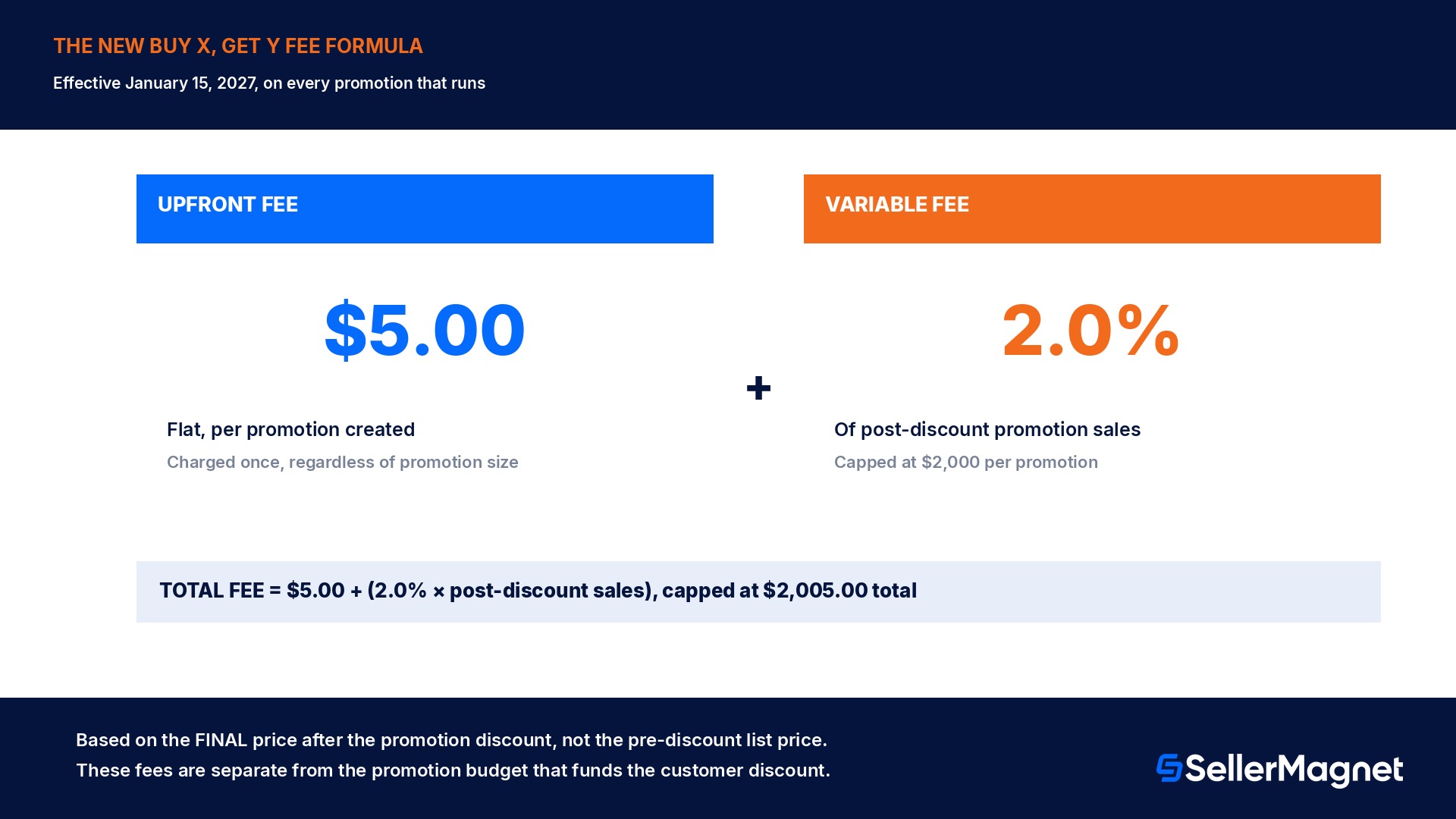
Starting January 15, 2027, Amazon charges a new fee on every Buy X, Get Y promotion: a flat $5.00 upfront fee per promotion created, plus a 2.0% variable fee on the promotion's sales, capped at $2,000 per promotion. The fee applies to the final, post-discount price, and starting February 2027 it is billed monthly instead of at the end of the promotion. It is waived only if the promotion is canceled before it starts, or if every listing in it is deactivated for the whole promotion period.
Why is Amazon charging a fee for Buy X, Get Y now?
Buy X, Get Y, also known as buy one get one or a percentage-off promotion, is a promotion type built into Seller Central that gives a customer a free or discounted unit of the same or a related product when they buy a qualifying quantity. Until this change, it sat apart from Amazon's other promotion types: a seller running a coupon or a Lightning Deal already pays an upfront and a variable fee on it, but a Buy X, Get Y promotion carried no fee of its own beyond the discount itself. Amazon's own November 5, 2026 announcement frames the new fee explicitly as alignment, not a new category of charge: the goal stated in the announcement is to bring Buy X, Get Y in line with the fee structure Amazon already runs for deals and coupons, rather than leaving one major promotion type as the one exception. The practical effect for a seller's PPC and promotions budget is the same either way: a tactic that used to cost only the lost margin on each discounted unit now also carries a direct, calculable platform fee, on top of that lost margin, from January 15, 2027 onward.
The two-part fee: $5.00 flat, plus 2.0% capped at $2,000
Amazon's own Buy X, Get Y fees help page lays out two separate components that are both charged on every promotion that is submitted and actually runs. The upfront fee is a flat $5.00, charged once per Buy X, Get Y promotion created, regardless of how large or small the promotion turns out to be. The variable fee is 2.0% of the promotion's sales, specifically the sales total calculated using the final price after the promotion discount has already been applied, not the original list price before the discount; this detail matters because it means the 2.0% is charged on the smaller, discounted revenue number, not the larger pre-discount one. The variable fee is capped at $2,000 per promotion, so a very large promotion never pays more than $2,000 in variable fees no matter how much it sells, on top of the flat $5.00. Amazon's help page is explicit on two more points worth planning around: these fees are separate from the promotion budget that funds the customer-facing discount itself, so the fee is additional spend layered on top of whatever margin the seller already gives up on each discounted unit, and the fee is not refunded if a customer later returns the item purchased under the promotion, so a return does not undo the fee that was already charged on that sale.
Fee component
Rate / amount
Applies to
Upfront fee
$5.00 flat
Charged once per promotion created, any size
Variable fee
2.0% of sales
Post-discount promotion sales, capped at $2,000 total
Billing timing (from Feb 2027)
Monthly
Upfront fee on first cycle after creation; variable fee on prior month's sales
Refund on customer return
Not refunded
Fee stands even if the purchased unit is later returned
This fee is separate from the promotion budget
The $5.00 upfront fee and the 2.0% variable fee are platform charges on top of the customer discount itself, not drawn from the promotion budget that funds that discount. A seller planning a Buy X, Get Y promotion from January 15, 2027 onward needs to budget for the lost margin on discounted units AND this fee as two separate numbers.
Three worked examples, straight from Amazon's own fee table
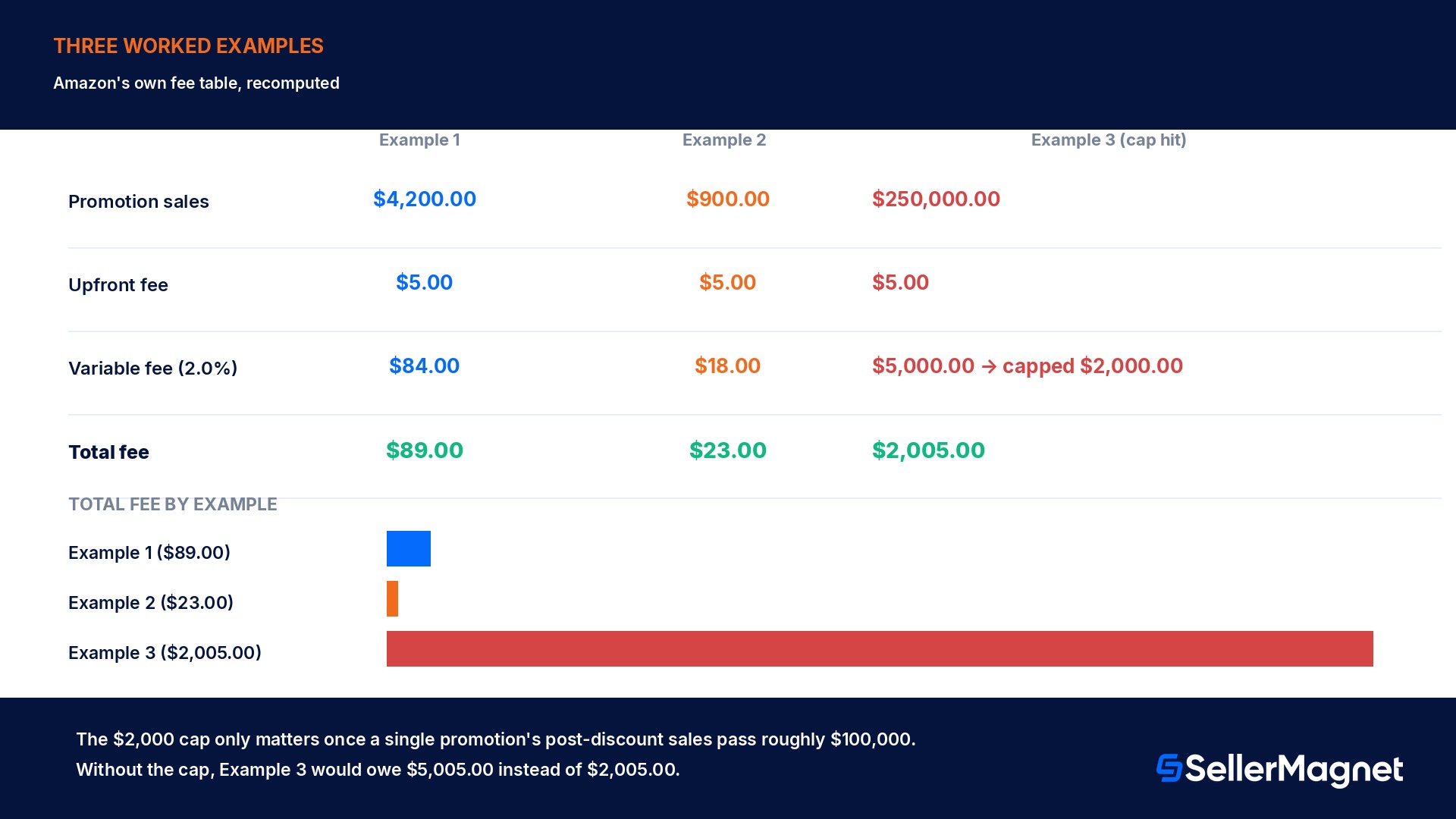
Amazon's own help page publishes three worked examples of the fee formula, and recomputing each one from the stated $5.00 upfront plus 2.0%-capped-at-$2,000 variable fee confirms the published totals. Example one: a promotion with $4,200.00 in total Buy X, Get Y sales. The variable fee is 2.0% of $4,200.00, which is $84.00; added to the $5.00 upfront fee, the total Buy X, Get Y fee for that promotion is $89.00, matching Amazon's own published figure exactly. Example two: a smaller promotion with $900.00 in sales. The variable fee is 2.0% of $900.00, which is $18.00; added to the $5.00 upfront fee, the total comes to $23.00. Example three shows the cap in action: a promotion with $250,000.00 in sales. A straight 2.0% of $250,000.00 would be $5,000.00, well above the $2,000 cap, so the variable fee is capped at exactly $2,000.00 instead; added to the $5.00 upfront fee, the total Buy X, Get Y fee for that promotion is $2,005.00, not the $5,005.00 an uncapped calculation would suggest. The cap only starts to matter once a single promotion's post-discount sales cross roughly $100,000.00, the point at which 2.0% of sales would otherwise exceed the $2,000 ceiling on its own.
The separate change: monthly billing starts in February 2027
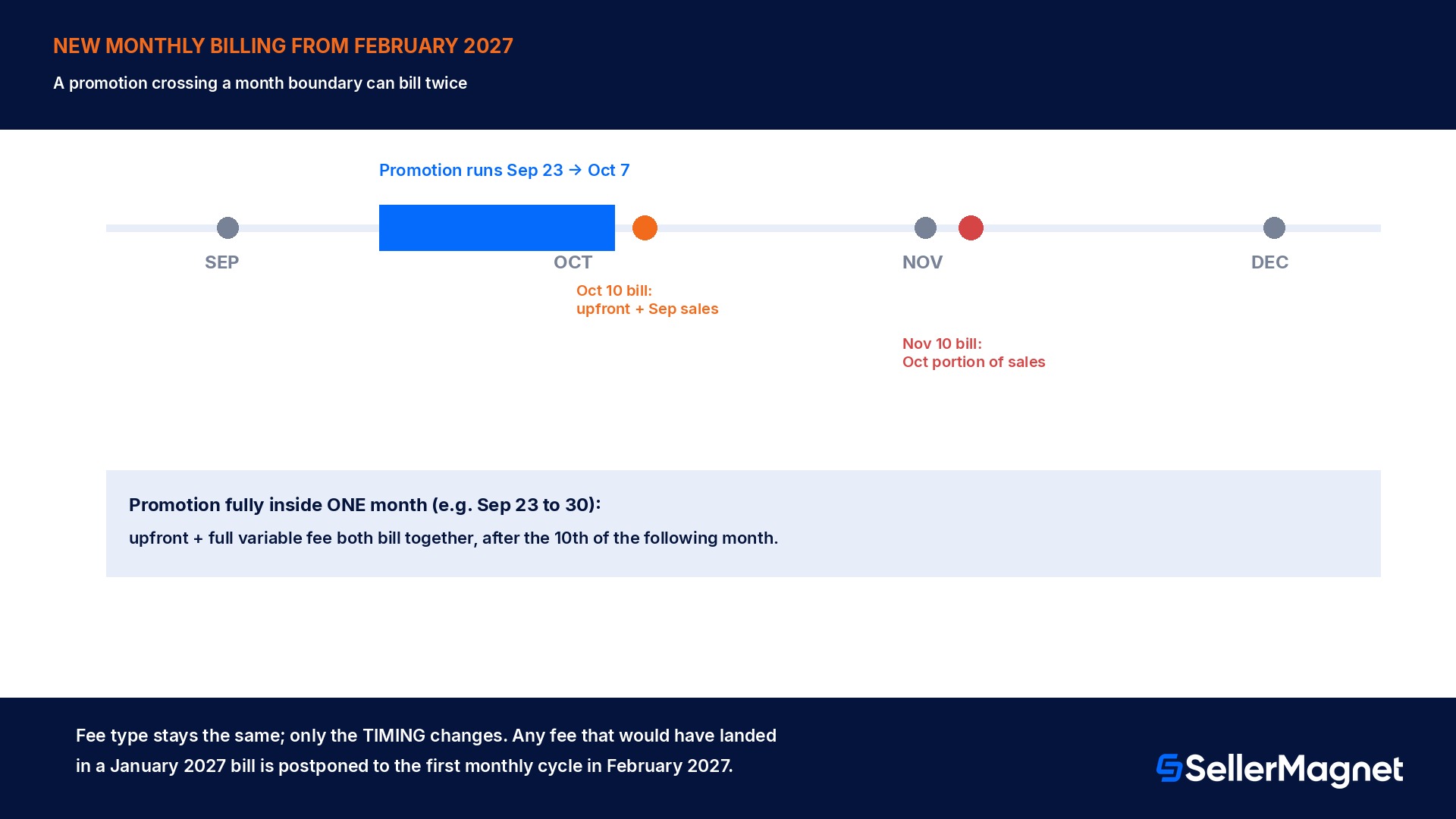
A second change in the same announcement affects when the fee actually gets charged, not how much it is. Effective February 2027, Amazon moves ALL promotion fees, not just Buy X, Get Y, to monthly billing: coupons, Buy X, Get Y promotions, deals and price discounts alike. For coupons and Buy X, Get Y promotions specifically, the upfront fee is charged in the first monthly billing cycle after the promotion is created, and the variable fee is charged based on the prior month's sales, rather than being tied to when the promotion itself ends. Amazon's own help page gives two examples of how this plays out across a promotion that straddles a month boundary. A promotion that runs entirely within one month, say September 23 to September 30, has both its upfront fee and its full variable fee charged together after the billing cycle following that month closes, on the 10th of the next month. A promotion that instead runs from September 23 to October 7, crossing into the next month, splits differently: the upfront fee and the variable fee for the September portion of its sales are charged after the 10th of October, and the variable fee for the October portion of sales is charged separately, after the 10th of November. The practical result is that a promotion's total fee can arrive across two separate monthly charges instead of one lump sum at the end, if the promotion itself spans a month boundary, and any fee that would previously have landed in a January bill is postponed to the first monthly cycle in February instead.
When is the fee NOT charged?
Amazon's own fee page lists exactly two situations where a Buy X, Get Y promotion generates no fee at all. The first is cancellation before the promotion's scheduled start time, regardless of whether the seller cancels it or Amazon does; a promotion that never actually goes live never triggers the $5.00 upfront fee or the variable fee. The second is that every listing included in the promotion is deactivated for the entire promotion period; if none of the promoted listings were ever buyable during the window the promotion was scheduled to run, no fee applies. Neither exemption covers a promotion that runs normally and later sees a return on a purchased unit: a completed sale under the promotion generates the variable fee at the time of the sale, and that fee is not refunded or clawed back if the customer returns the item afterward, which is a different outcome from the two exemption cases above.
A smaller, related change: the lower referral fee for 3D printers
The same November 5, 2026 fee announcement that introduces the Buy X, Get Y fee also includes a narrower, unrelated change worth noting for the specific sellers it affects: a new, lower referral fee category for 3D printers, effective November 5, 2026. Previously, 3D printers were categorized under the broader Business, Industrial and Scientific Supplies referral fee schedule. Under the new category, the referral fee for 3D printers is 12% on the first $200.00 of the total sales price, and 5% on any amount above $200.00, a tiered structure that lowers the overall fee rate as the price climbs, which benefits higher-priced 3D printers the most. A seller listing 3D printers under the old Business, Industrial and Scientific Supplies category should confirm the listing has moved to the correct, lower-fee category rather than assuming the change applied automatically to an existing listing; the 2027 FBA fulfillment fee changes guide and the referral fees by category guide cover the rest of the 2026 and 2027 fee schedule outside this narrower 3D printer change and the Buy X, Get Y fee.
Does SellerMagnet cover this fee?
SellerMagnet does not create, submit or manage Buy X, Get Y promotions inside Seller Central; running the promotion itself, choosing the discount structure, and confirming the exact live fee at the moment of submission all happen directly in Seller Central's own promotions tools. Where SellerMagnet's Analytics Dashboard is useful is on the profit side of the same decision: it shows net profit per order and per product after Amazon's own fees, so a seller weighing whether a Buy X, Get Y promotion is worth running from January 15, 2027 onward can see the real margin impact of the discounted units alongside everything else already eating into that order's profit. The free Fee Calculator computes Amazon's marketplace referral and FBA fee schedule on a given ASIN; it does not yet model the new Buy X, Get Y promotion fee covered in this guide, since that fee is calculated on total promotion sales rather than on a single order, so a seller should add the $5.00 plus 2.0%-capped-at-$2,000 formula on top of the Fee Calculator's own referral/FBA numbers by hand when budgeting a specific promotion.
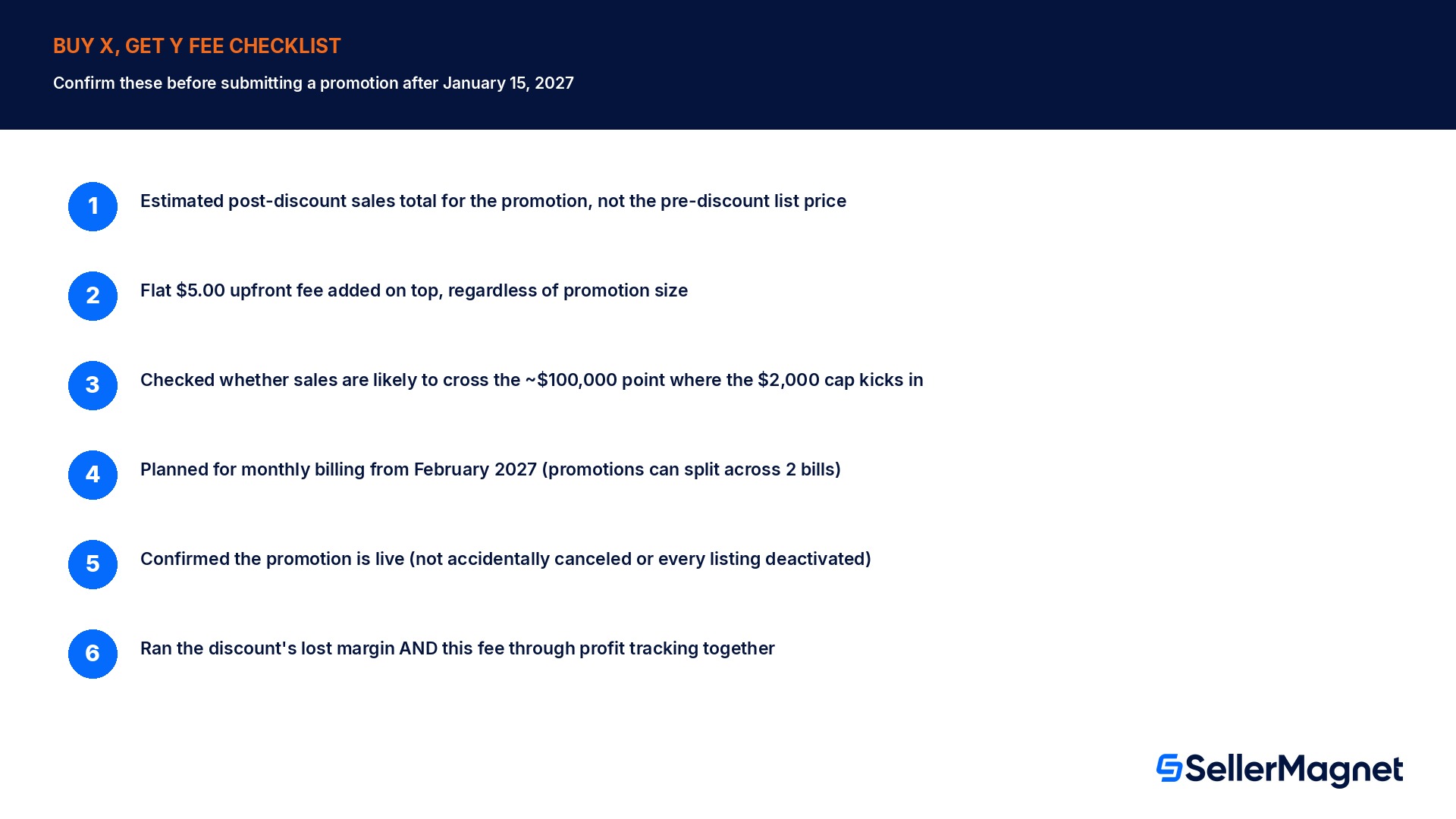
Checklist before submitting a Buy X, Get Y promotion after January 15, 2027
How to budget for the new Buy X, Get Y promotion fee
Estimate the promotion's expected post-discount sales total - The 2.0% variable fee is charged on sales AFTER the discount, not the pre-discount list price; estimate from the discounted total, not the full price.
Add the flat $5.00 upfront fee on top - Charged once per promotion created, regardless of the promotion's size.
Check whether the promotion is likely to cross the $2,000 cap - The variable fee caps at $2,000 once post-discount sales pass roughly $100,000.00 for that single promotion.
Plan for monthly billing from February 2027 onward - A promotion that spans a month boundary can bill in two separate monthly cycles instead of one lump sum at the end.
Confirm the promotion is live, not accidentally deactivated - No fee applies if the promotion is canceled before its start, or if every listing in it is deactivated for the whole period, but a normal completed sale is never refunded if the item comes back.
Run the discounted margin AND this fee through profit tracking together - The promotion fee is additional spend on top of the discount's own lost margin, not drawn from the promotion budget.
When does the new Buy X, Get Y fee start?
The fee applies to Buy X, Get Y promotions submitted and run from January 15, 2027 onward. A separate change to how the fee is billed, moving to monthly billing instead of being charged at the end of a promotion, takes effect in February 2027.
How much is the new Buy X, Get Y fee?
Two parts: a flat $5.00 upfront fee per promotion created, plus a 2.0% variable fee on the promotion's post-discount sales, capped at $2,000 per promotion. A promotion with $4,200 in sales pays $89 total; one with $900 pays $23; one with $250,000 pays $2,005 since the variable fee hits the $2,000 cap.
Is the fee charged on the full price or the discounted price?
The discounted price. Amazon's own fee page states the fee is based on the final price AFTER the Buy X, Get Y promotion discount has been applied, not the original list price.
Do I get the fee back if a customer returns the item?
No. Buy X, Get Y fees are not refunded if a customer returns the item purchased under the promotion; the fee is charged at the time of the qualifying sale.
When is the fee NOT charged?
Only two cases: the promotion is canceled before its scheduled start time (by the seller or by Amazon), or every listing included in the promotion is deactivated for the entire promotion period.
How does the new monthly billing work?
From February 2027, all promotion fees bill monthly. For Buy X, Get Y, the upfront fee bills in the first cycle after the promotion is created, and the variable fee bills based on the prior month's sales; a promotion spanning a month boundary can generate two separate monthly charges.
Is this the same change as the 2027 FBA fulfillment fee update?
No. The Buy X, Get Y fee and the related 3D printer referral fee change were both announced alongside the 2027 FBA fulfillment, storage and low-inventory-level fee changes on November 5, 2026, but they are separate fee schedules that a seller needs to budget for independently.
Stop Juggling Tools. SellerMagnet Combines Everything You Need.