Amazon's 2027 Fee Changes: What Rises and What Gets Simpler
R
RenéFreelance Amazon Editor
|
14 min read
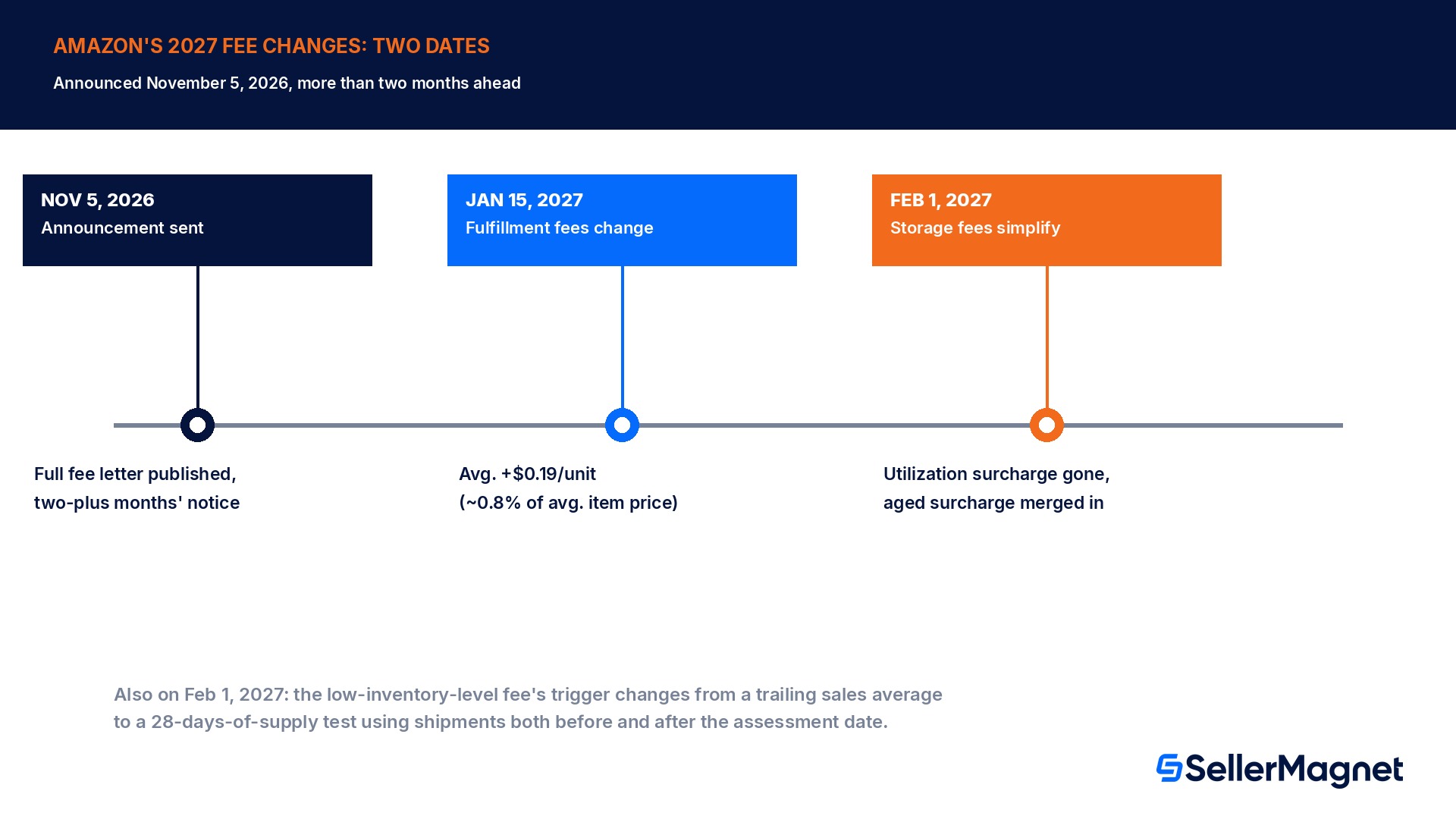
Amazon sent its 2027 fee letter to US sellers on November 5, 2026, more than two months before most of it takes effect, specifically so sellers have time to plan during the busiest part of the year. The headline is not one number: it is three separate moves happening on two different dates. FBA fulfillment fees rise by an average of $0.19 per unit on January 15, 2027. Then, on February 1, 2027, Amazon eliminates the storage utilization surcharge outright and folds the aged inventory surcharge into monthly storage fees as one age-based rate, and separately rewrites how the low-inventory-level fee is triggered.
This guide walks through what each of those three changes actually does, with the exact wording Amazon used, worked examples on what the fulfillment fee increase and the new low-inventory-level test mean in practice, and what is still unknown because Amazon has not published the full new rate table yet.
Amazon's 2027 US fee changes, announced November 5, 2026, raise FBA fulfillment fees by an average of $0.19 per unit starting January 15, 2027, while keeping the fuel and logistics surcharge flat. On February 1, 2027, Amazon eliminates the storage utilization surcharge, merges the aged inventory surcharge into monthly storage fees as one age-based rate, and changes the low-inventory-level fee to trigger only below 28 days of supply based on actual shipments before and after the assessment date.
Why Amazon is doing this now, in its own words
Amazon's cover letter frames this as an annual review, not a one-off correction: fulfillment fees move to track Amazon's actual cost of handling each product more closely, while storage fees move toward something sellers can predict further in advance. Amazon's own context for the review: independent sellers represent more than 60% of sales in its US store and support over 2,000,000 jobs, and more than 75,000 sellers passed $1 million in sales in 2025, up 36% year over year. Amazon also ties the fee review to delivery speed: it says a delivery promise moving from more than 4 days down to 2 days lifts purchase conversion by more than 20%, and moving from 2 days to just hours lifts conversion by 15% more. The fulfillment-fee increase is presented as the cost side of funding that speed; the storage-fee simplification is presented as a direct response to seller feedback that storage costs are too hard to predict.
Change 1: FBA fulfillment fees rise $0.19/unit on average, January 15, 2027
Amazon states the fulfillment fee increase averages $0.19 per unit sold, which it calculates as roughly 0.8% of the average item's selling price. That average hides real variation: Amazon is explicit that the goal is to match each product's fee to what it actually costs to fulfill, so some products' fees go up, some go down, and the size, weight and price of a specific product decide which side of that average it lands on. Amazon built a Fee Change Comparison view inside its own Profit Analytics tool specifically so a seller can see the account- and product-level impact instead of relying on the account-wide average.
Standard-size products priced under $10: fulfillment fees rise about $0.20/unit on average.
Apparel in that same under-$10 band: fulfillment fees rise about $0.08/unit on average.
Non-apparel large standard-size products under $10: fulfillment fees are unchanged.
The FBA fuel and logistics surcharge, in place since April 2026, is not changing for 2027; Amazon says it will keep reviewing that surcharge separately as fuel and trucking costs evolve.
Worked example: a $0.19/unit increase at real volume
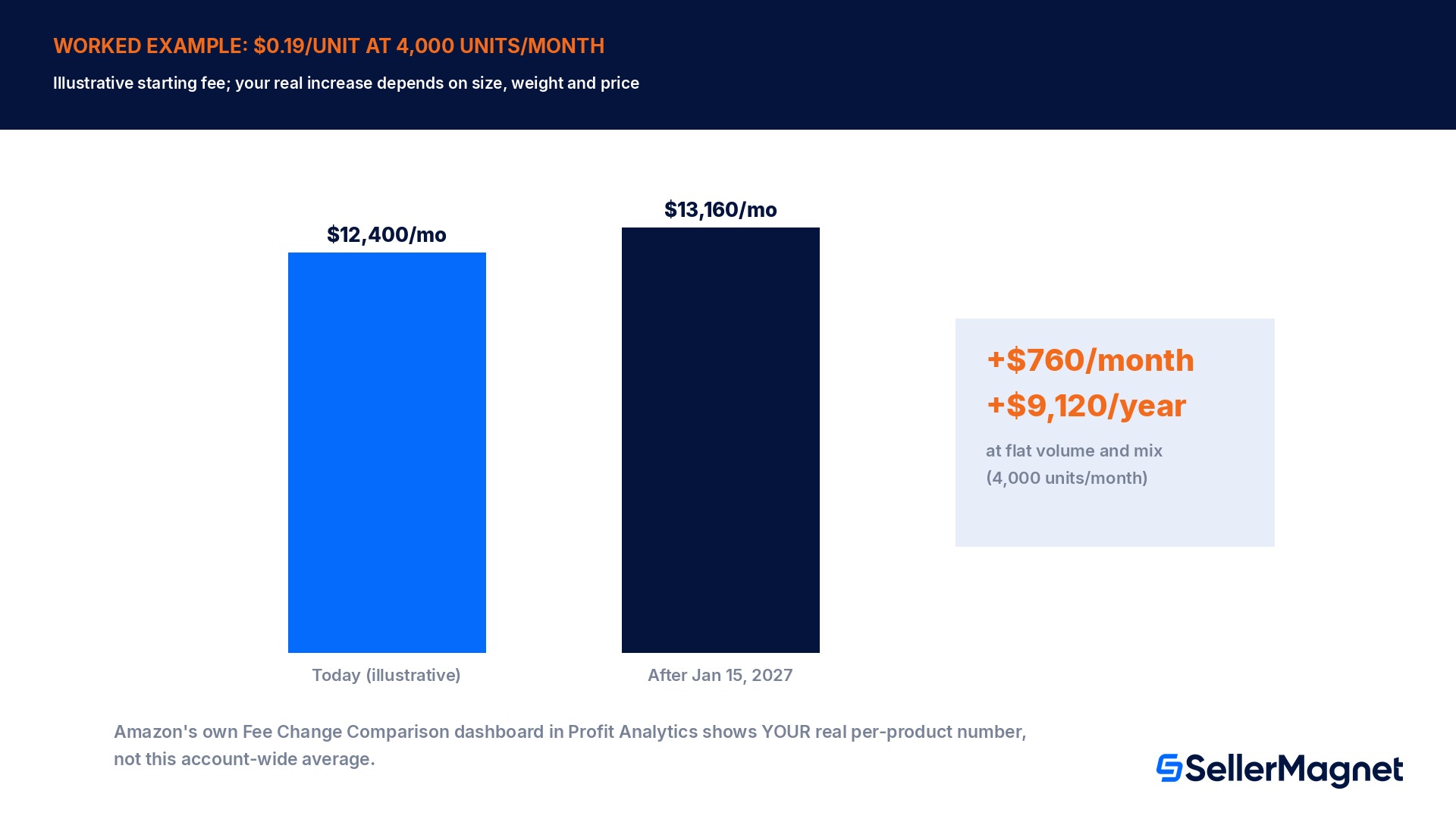
The account-wide average is easiest to see at volume. A seller shipping 4,000 FBA units a month, at an illustrative current average fulfillment fee of $3.10/unit, pays about $12,400 a month in fulfillment fees today. A flat $0.19/unit increase on that same volume adds $760 a month, for a new estimated total of $13,160, or $9,120 more over a full year if volume and mix stay flat.
This worked example uses an illustrative starting fee, not your account's real number
Amazon has not published a single flat per-unit fulfillment fee; $3.10 here is an illustrative starting point so the math is visible. Your own increase depends on your specific products' size, weight and price tier, which is exactly why Amazon built the Fee Change Comparison dashboard inside Profit Analytics rather than publishing one number for everyone.
Today (illustrative)
After Jan 15, 2027
Avg. fulfillment fee/unit
$3.10
$3.29
Monthly fulfillment cost at 4,000 units
$12,400
$13,160
Annual difference
-
+$9,120
Change 2: storage fees get simpler, February 1, 2027
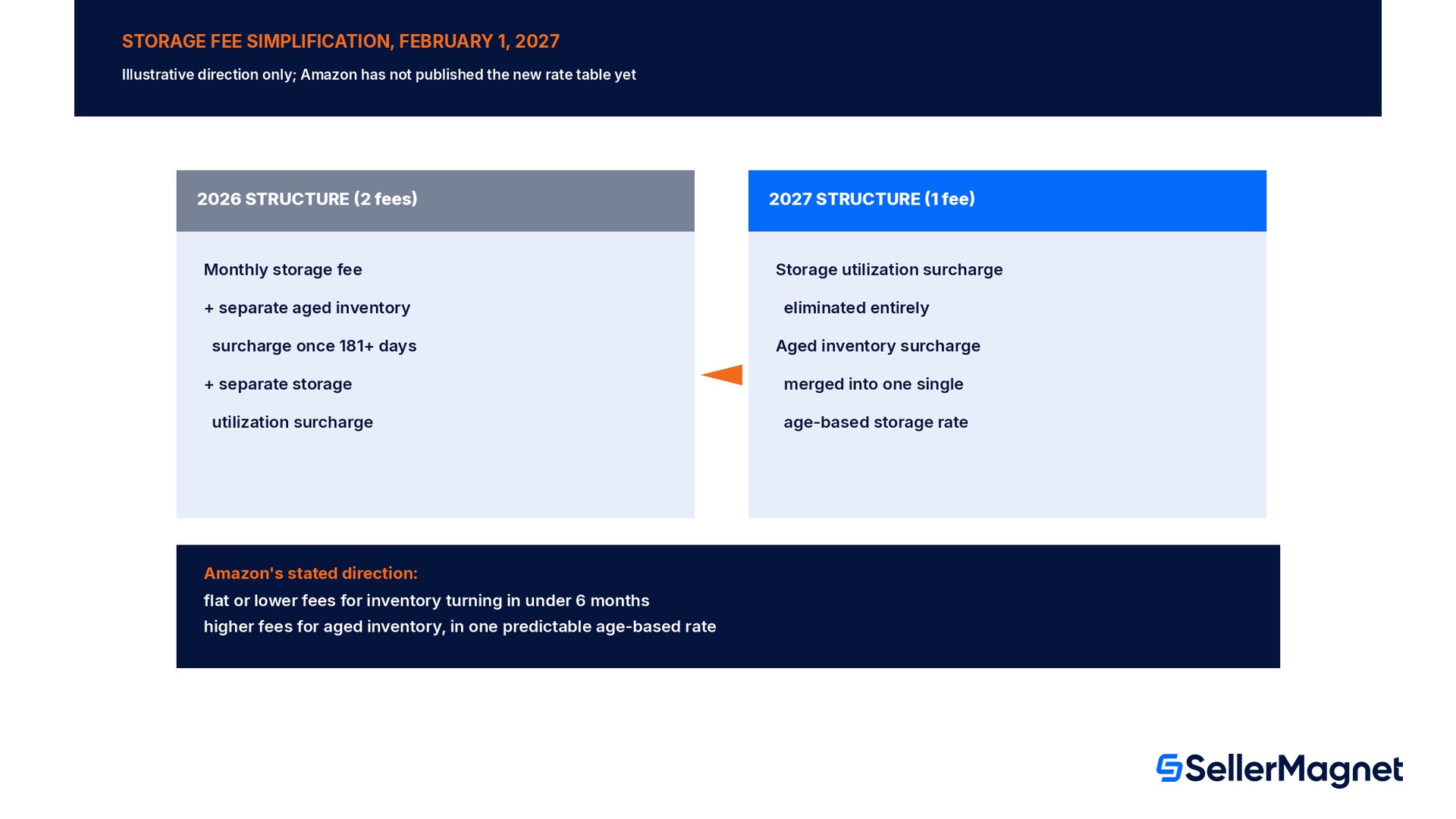
The storage-fee change is really two separate removals landing on the same date. First, Amazon eliminates the storage utilization surcharge entirely, a fee that previously discouraged sellers from stocking up heavily ahead of a demand spike; Amazon says removing it is meant to make it easier to build inventory ahead of high-demand events like Q4 or a planned promotion. Second, Amazon removes the aged inventory surcharge as its own separate line item and folds it into monthly storage fees, producing one single age-based storage rate instead of two fees stacked on top of each other.
Amazon states the direction of that merge plainly: inventory that turns in under 6 months should see flat or lower storage costs under the new age-based rate, while inventory that sits longer should see higher costs. That is consistent with Amazon's stated goal, cutting the cost of predictable, fast-moving stock while pricing genuinely aged inventory more clearly. What Amazon has not yet published, as of this writing, is the actual new rate table itself: the exact dollar-per-cubic-foot numbers at each age band.
Two different "inventory" posts, two different fees; both change here
If you already track the storage-utilization and aged-inventory surcharges separately, note that both change on the same date but in different ways: the storage utilization surcharge disappears completely, while the aged inventory surcharge does not disappear so much as get absorbed into one combined storage rate. See our existing guides to the aged inventory surcharge and FBA restock limits for how those mechanics worked before this change; both will need a fresh look once Amazon publishes the new rate table.
Illustrative before/after: fast-turning stock versus aged stock
Amazon has not published the new combined rate, so the numbers below are an illustration of the DIRECTION Amazon describes (lower for fast turns, higher for aged stock), not a projection of your actual February 2027 bill. Under the 2026 structure, a cubic foot of inventory sitting 10 months could carry an illustrative $0.78 monthly storage fee plus a separate $6.90 aged inventory surcharge, a combined $7.68 per cubic foot. Amazon's stated direction says the new single age-based rate should land lower than that combined total for a SKU turning in 4 months, and higher than that combined total for a SKU still sitting at 10 months, once the real rate table is published.
Turn time
2026 structure (illustrative, 2 fees)
2027 structure (direction, 1 fee)
4 months (fast turn)
Monthly storage only, no surcharge
Flat or lower, per Amazon's stated direction
10 months (aged stock)
$7.68/cu ft combined (storage + aged surcharge)
Higher age-based rate, per Amazon's stated direction
Do not budget against the illustrative numbers above
The $0.78 and $6.90 figures are 2026-era illustrations used to show the mechanic, not Amazon's new 2027 rate. Watch Seller Central and Amazon's official fee page for the published age-based rate table before changing your pricing or reorder points.
Change 3: the low-inventory-level fee gets a new trigger, February 1, 2027
The low-inventory-level fee itself is not disappearing, but how Amazon decides a SKU is "low inventory" is changing completely. Today, the fee is assessed using trailing 30- and 90-day sales history. Effective February 1, 2027, it applies only when a SKU's inventory falls below 28 days of supply, and that days-of-supply number is calculated from actual shipments in the 4 weeks BEFORE the assessment date AND the 4 weeks AFTER it, not from a purely backward-looking sales average.
Amazon's own stated reason for adding the forward-looking 4-week window: checking what actually happened after the assessment date confirms whether the low stock really reflects ongoing, real demand, rather than a one-time spike. Amazon names two specific false-positive cases this is meant to reduce: a SKU that looked low on a trailing 30/90-day average purely because of an unexpected demand spike that has since cooled off, and a SKU nearing end-of-season or end-of-life that will not be restocked anyway, where the old trailing-average test could still trigger a fee with no genuine replenishment need behind it.
Worked example: the new days-of-supply test
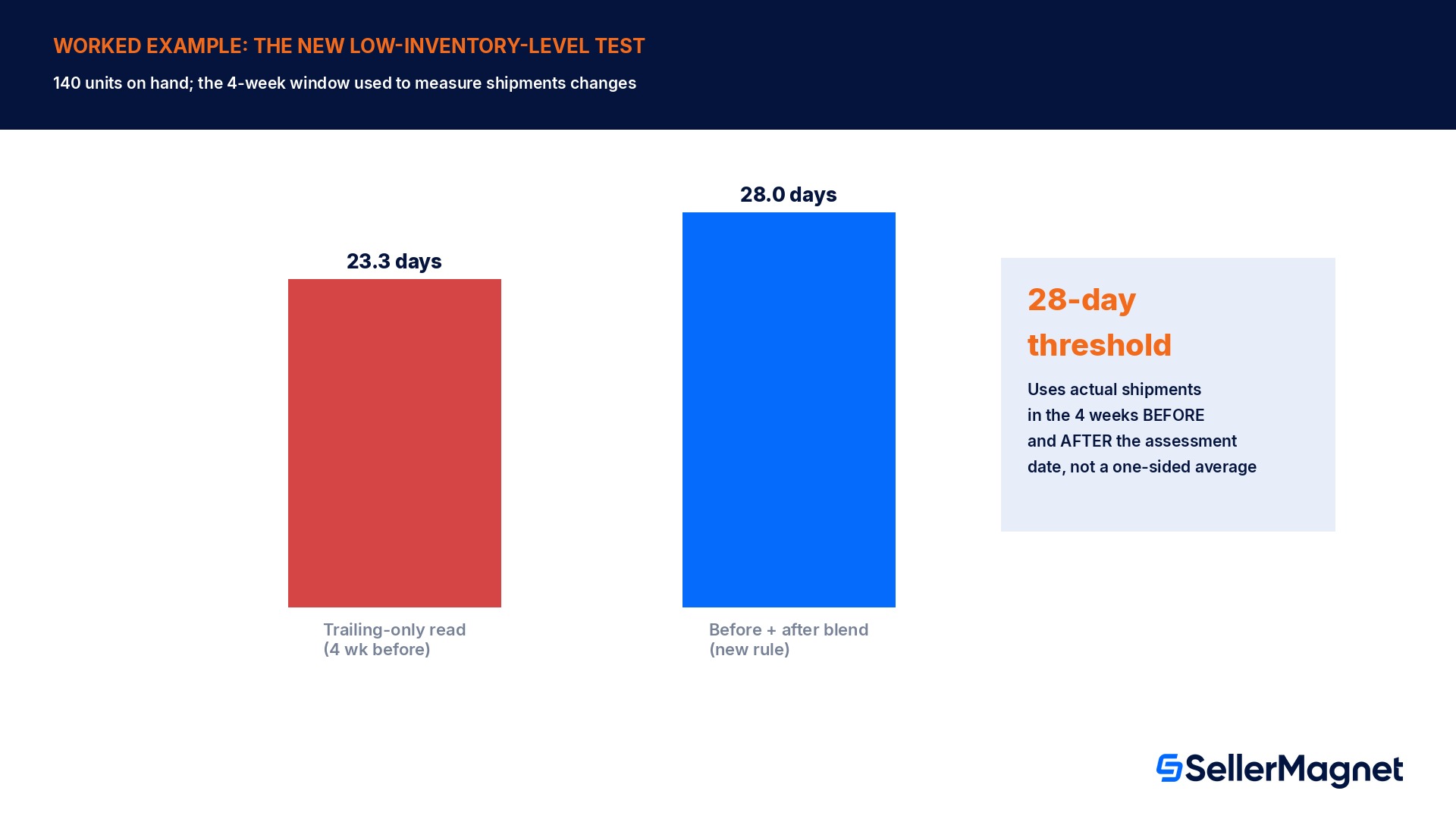
Take a SKU sitting at 140 units on hand. Under a trailing-sales-style read using only the 4 weeks before the assessment, at an illustrative 6 units shipped per day, that SKU looks like it has 23.3 days of supply left, which is under the 28-day threshold and would flag it as low inventory. Now blend in the 4 weeks AFTER the assessment date, where shipments slowed to an illustrative 4 units/day because the earlier spike passed. The blended daily rate across both windows comes out to 5.0 units/day, which puts that same 140-unit SKU at exactly 28.0 days of supply, right at the new threshold, instead of flagged as clearly low under the old method.
Trailing-only read (old-style)
Before + after blend (new rule)
Units on hand
140
140
Daily shipment rate used
6/day (4 wk before only)
5.0/day (4 wk before + after)
Days of supply
23.3
28.0
Below 28-day threshold?
Yes
Right at the line
This still does not remove restock-limit mechanics
The low-inventory-level fee and FBA restock limits are two separate systems: this fee is about whether Amazon charges extra for thin stock, while restock limits cap how much you can ship in. Our existing guide to FBA restock limits covers that separate mechanic, which this fee change does not alter.
What Amazon has not published yet
Three things are explicitly real, dated changes with wording Amazon has already published, and one thing is still missing. Real and dated: the $0.19/unit average fulfillment increase on January 15, 2027; the elimination of the storage utilization surcharge on February 1, 2027; and the new low-inventory-level fee trigger, also on February 1, 2027. Still missing as of this writing: the actual new combined age-based storage rate table itself, the one number every seller carrying slow-turning inventory needs most to plan around. Amazon has stated the direction (lower under 6 months, higher for aged stock) without stating the numbers. Treat any specific age-based rate you see quoted anywhere before Amazon itself publishes the table as unconfirmed.
Other changes in the same letter, briefly
Amazon's full fee-change summary page also lists updates to small and large standard-size fulfillment fees beyond the under-$10 band covered above, items priced above $50, "Buy X, Get Y" promotion fee handling, Multichannel Fulfillment, and Amazon Warehousing and Distribution. Amazon is also consolidating standard-size inbound shipping from 3 regions down to 2 (East and West) to improve efficiency getting shipments into its fulfillment network. Those pages sit behind Seller Central's own fee-change summary and are worth checking directly for your specific size tiers; our existing guides to low-price FBA fees and the aged inventory surcharge cover the 2026-era mechanics those same categories work under today.
What to do before January 15, 2027
How to prepare for Amazon's 2027 fee changes
Check the Fee Change Comparison dashboard - Open Profit Analytics in Seller Central and review the real per-product impact on your own catalog instead of relying on the $0.19/unit account-wide average.
Re-check sub-$10 standard-size margins - Re-run margin math on any SKU priced under $10, since that band carries a specifically named fulfillment fee increase, larger for apparel than for other categories.
Flag aged inventory now - List every SKU past 6 months of inventory age; those are most exposed to the February 1 aged-inventory rate increase once Amazon publishes the real number.
Model the new low-inventory-level test - Estimate which SKUs would clear or miss the new 28-day-of-supply threshold under a before-and-after shipment read, not just a trailing sales average.
Watch for the published rate table - Check Seller Central for the age-based storage rate table before February 1, 2027, and re-check reorder points once it lands.
Common mistakes sellers make with the 2027 fee changes
Assuming the $0.19/unit figure applies evenly to every product, when Amazon states explicitly that some products' fees fall while others rise.
Treating the storage utilization surcharge elimination and the aged inventory surcharge merge as the same change; they are two separate removals landing on the same date.
Budgeting against an illustrative or rumored age-based storage rate before Amazon publishes the real table.
Confusing the low-inventory-level fee's new trigger with FBA restock limits, which is a separate shipment-cap mechanic this change does not alter.
Ignoring the under-$10 standard-size fulfillment fee increase because it looks small per unit; at real monthly volume it is the single line item most sellers will notice first.
Waiting until January 2027 to check your account's specific impact instead of using the Fee Change Comparison dashboard now, while there is still time to adjust pricing or reorder cadence.
2027 fee change readiness checklist
You have opened the Fee Change Comparison dashboard in Profit Analytics and reviewed your account-level and product-level impact, not just the account-wide average.
You know which of your SKUs are priced under $10 standard-size, and whether they are apparel, since the increase differs by category.
You have a list of SKUs that have been in Amazon's fulfillment network past 6 months, ready to re-check once the new age-based storage rate is published.
You understand the new low-inventory-level fee test uses 4 weeks of shipments before AND after the assessment date, not a trailing-only average.
You are tracking Seller Central for the published age-based storage rate table rather than planning around an estimate.
How SellerMagnet fits into planning for the 2027 fee changes
The hardest part of a fee change like this is not reading the announcement, it is seeing the real dollar impact on your own catalog before it hits. Fee Calculator lets you model a specific product's fulfillment and storage fees so you can sanity-check Amazon's account-wide average against your own size tiers and price points ahead of January 15, 2027. Profit Analytics tracks real per-order margin over time, which is what actually shows whether a $0.19/unit fee increase moved your bottom line once it lands, instead of waiting to notice it in a monthly payout report. See plans and pricing for current rates.
On the storage side, Inventory Planner flags SKUs approaching the 6-month aged-inventory line so you can clear or reprice them before the new age-based rate applies, and Alerts can notify you the moment a SKU's days-of-supply crosses the new 28-day threshold, so you see the low-inventory-level fee risk as it forms rather than after the fee is charged.
When do Amazon's 2027 fee changes take effect?
Most of the fulfillment fee changes take effect January 15, 2027. The storage fee simplification (eliminating the storage utilization surcharge and merging the aged inventory surcharge into monthly storage fees) and the new low-inventory-level fee trigger both take effect February 1, 2027.
How much will FBA fulfillment fees increase in 2027?
Amazon states the average increase is $0.19 per unit sold, about 0.8% of the average item's selling price. That is an account-wide average, not a flat per-product number; Amazon says some products' fees will fall while others rise, which is why it built a Fee Change Comparison dashboard inside Profit Analytics for sellers to check their own catalog's real impact.
Is the FBA fuel and logistics surcharge changing for 2027?
No. Amazon states the fuel and logistics surcharge, introduced in April 2026, remains unchanged for 2027, citing elevated fuel and line-haul trucking costs, though it says it will keep reviewing that surcharge separately as conditions change.
What exactly is Amazon eliminating from storage fees in 2027?
Two things, both effective February 1, 2027: the storage utilization surcharge is eliminated entirely, and the aged inventory surcharge is merged with monthly storage fees into one age-based rate. Amazon says this means flat or lower costs for inventory turning under 6 months and higher costs for aged inventory, though the exact new rate table is not published yet.
How is the low-inventory-level fee changing in 2027?
Instead of trailing 30- and 90-day sales history, the fee will apply only when a SKU's inventory falls below 28 days of supply, calculated from actual shipments in the 4 weeks before AND after the assessment date. Amazon says this targets SKUs that genuinely need replenishment and cuts false positives from one-time demand spikes or end-of-season products.
Has Amazon published the new 2027 storage fee rate table yet?
Not as of this writing. Amazon has stated the direction of the change (lower costs for fast-turning inventory, higher for aged inventory) but has not published the specific dollar-per-cubic-foot age-based rate. Sellers should watch Seller Central's official fee-change page for the real numbers before budgeting against any estimate.
Where can I see how the 2027 fee changes affect my own account?
Amazon built a Fee Change Comparison dashboard inside Seller Central's Profit Analytics tool specifically for this, showing the account- and product-level impact of the 2027 changes. You can also model scenarios with Amazon's Revenue Calculator.
Stop Juggling Tools. SellerMagnet Combines Everything You Need.