Amazon On-Time Delivery Rate: The 2026 Rule Changes
R
RenéFreelance Amazon Editor
|
9 min read
Amazon changed two rules for seller-fulfilled offers in its US store in 2026. From 28 February 2026, falling below the 90 percent on-time delivery rate no longer deactivates every one of your seller-fulfilled listings, only the ones driving the drop. From 29 June 2026, handling time that is padded rather than accurate became a compliance problem of its own. Both land on the same sellers, and the protection rules are not identical for standard and Prime offers.
Amazon's on-time delivery rate requirement for seller-fulfilled listings is ninety percent. Since February 2026, falling below it deactivates only the listings causing the drop rather than all of them. Since June 2026, sellers must also keep each SKU's handling time accurate, or Amazon sets it for them.
What changed on 28 February 2026?
The penalty got narrower, not softer. Amazon's announcement of the change says it is updating "how we apply the existing 90% on-time delivery rate (OTDR) requirement for seller-fulfilled listings", which means the threshold itself is untouched.
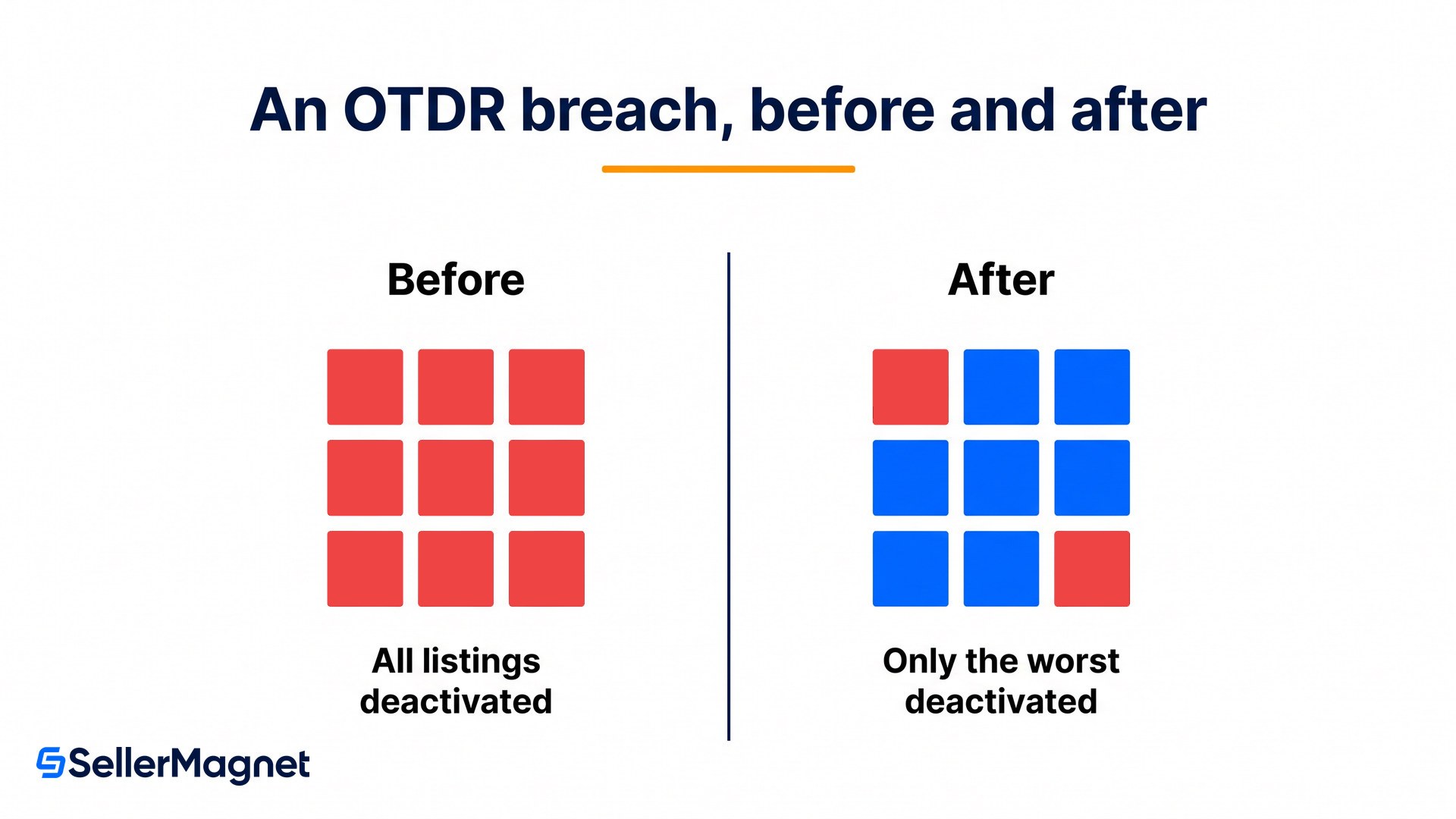
The difference is in the blast radius. Amazon describes the old behaviour this way: "Previously, if your OTDR fell below 90%, all of your seller-fulfilled listings would be deactivated." And the new one: "With this change, only the listings that have the most impact on your ratings drop will be deactivated. Your other listings will remain active." Enforcement notices still arrive by email.
Situation
Before 28 February 2026
From 28 February 2026
OTDR below 90%
Every seller-fulfilled listing deactivated
Only the listings with the most impact on the drop
OTDR significantly below 90%
Every seller-fulfilled listing deactivated
Amazon may still deactivate all of them
Repeated failures to meet the requirement
Every seller-fulfilled listing deactivated
Amazon may still deactivate all of them
How you hear about it
Email notification
Email notification, unchanged
Read the second and third rows before celebrating. Amazon keeps the old hammer for the bad cases: "if your OTDR is significantly below 90%, or you repeatedly fail to meet the requirement, you will be notified and we may deactivate all your seller-fulfilled listings." A seller who treats the new rule as a smaller consequence, and drifts, ends up exactly where the old rule would have put them.
How do you get on-time delivery rate protection?
By letting Amazon set the promise and buying the labels it can verify. Protection means late deliveries do not count against your OTDR, and the conditions are listed per shipping type rather than as one rule for everyone.
Requirement
Standard shipping
Seller Fulfilled Prime and premium shipping
Shipping settings automation enabled
Required
Required
OTDR protected labels via Amazon Buy Shipping or Veeqo
Required
Required
Automated handling time enabled
Required
Not required
Ship on time
Not listed as a separate condition
Stated explicitly as a condition
That third row is the detail worth knowing. For standard shipping Amazon lists "enable automated handling time" as one of three conditions. For Prime and premium it writes that "you aren't required to have automated handling time enabled", and asks instead that you ship on time, enable shipping settings automation and buy protected labels.
There is also a disruption carve-out
In its earlier policy update, effective 29 June 2025, Amazon said that even without those tools, if there is a major disruption event affecting all sellers shipping to a region, as determined by Amazon, deliveries that are late as a result are not counted in your OTDR. You do not apply for it and Amazon decides what qualifies.
What is the handling time requirement that started on 29 June 2026?
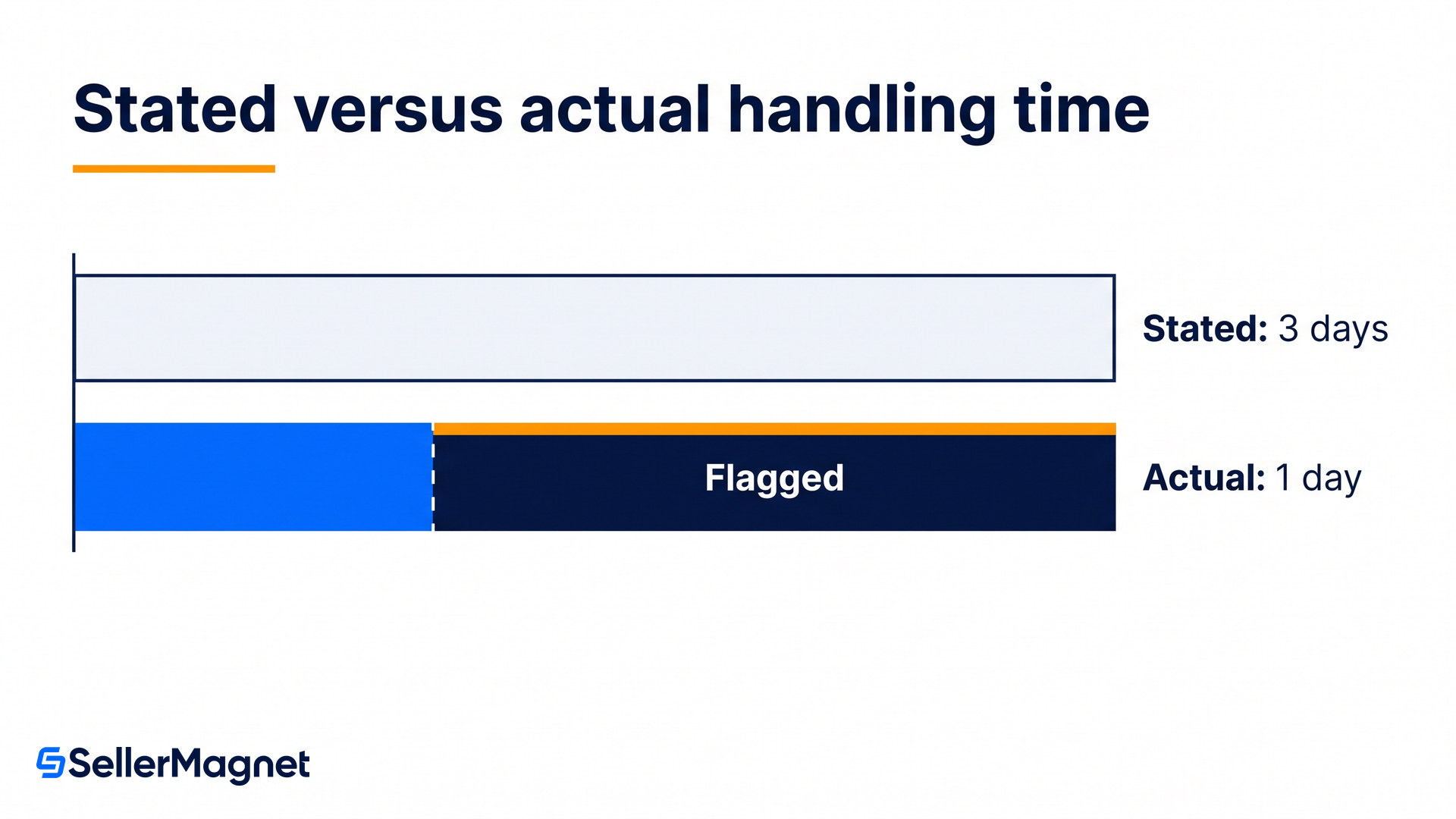
Your stated handling time now has to match your real one. Amazon's handling time announcement puts the test plainly: handling time "is considered accurate when the actual handling time consistently matches your configured handling time for each SKU".
The target here is padding, not lateness. Amazon says "over 87% of seller-fulfilled orders received in the US are handled within one day", but that "many sellers set longer SKU-specific handling times than needed, leading to overestimated delivery promises". Its stated reason for caring is a figure of its own: "every one day improvement in promised delivery time leads to an average 5% increase in sales", which is Amazon's own number with no published methodology behind it, so read it as a statement of motive rather than as a forecast for your catalogue.
Automated handling time is the recommended route. Amazon says it "sets handling time for your SKUs based on your recent shipping history and provides late shipment rate (LSR) protection", and it is the option that needs no per-SKU monitoring from you.
Manual SKU handling times stay allowed, as long as they stay accurate.
The monitoring window is 30 days, and it applies to the manual route rather than to automated handling time. A SKU "consistently shipped at least one day faster than stated" gets flagged.
You then get 30 days to update it before Amazon acts.
Custom, handmade and Heavy & Bulky less-than-truckload shipments are excluded from the requirement entirely.
What happens if you ignore a flagged SKU
Amazon takes the setting off you rather than penalising you for it: "if accurate handling time is not provided, we'll start managing the SKUs on your behalf and provide LSR protection for 180 days." That is a soft landing, but it is still Amazon deciding your delivery promise on a SKU you priced and planned around, and the protection has an expiry date on it.
What lands next: the Business Hour Delivery Rate
A third requirement starts on 30 September 2026, and the same three tools cover it. Amazon's Business Hour Delivery Rate announcement applies the rule "to seller-fulfilled shipments in our US store" and states that "starting September 30, 2026, you'll need to maintain a Business Hour Delivery Rate of 90% or higher", measured over "a rolling 14-day period" for shipments delivered to Amazon Business customers inside their operating hours.
The consequence is narrower than an OTDR breach. Amazon notifies sellers below 90 percent on 30 September, and "if your rate doesn't improve by October 30, your seller-fulfilled offers may be deactivated for Amazon Business customers", while "Fulfillment by Amazon (FBA) and retail offer eligibility will not be impacted". The useful part is the overlap: Amazon says shipments fulfilled using automated handling time, shipping settings automation and Amazon Buy Shipping "are guaranteed to meet the Business Hour Delivery Rate requirement", so the three tools that protect your OTDR also settle this one.
How do you reactivate a deactivated listing?
Through the Account Health dashboard, and the appeal is automatic rather than written. Amazon gives an exact path, which is worth following literally because the label it names is the one you have to match.
How to reactivate listings deactivated for on-time delivery rate
Open Other Policy Violations on Account Health - Go to your Account Health dashboard and select Other Policy Violations. This is the same page that carries your account health rating, so you may see other items alongside the delivery ones.
Find the on-time delivery entries - In Product Policy Compliance, look in the Reasons column for listings labelled Order Performance - On time Delivery Rate. Those are the ones deactivated for this rule rather than for anything else.
Submit the appeal to reactivate - Select Submit Appeal. Amazon states this automatically reactivates the listings, so there is no plan of action to write for this particular enforcement.
Turn on the protection you are entitled to - Enable shipping settings automation, and buy OTDR protected labels through Amazon Buy Shipping or Veeqo. If you sell on standard shipping rather than Prime, also enable automated handling time, because Amazon lists it as a condition there.
Fix the handling times that caused the promise - Review the handling time on the SKUs that were deactivated. A padded setting makes every promise harder to hit than it needs to be, and since June 2026 it is also a requirement in its own right.
Quick win for today
Open your shipping settings and look at the handling times you set when you launched. Most sellers padded them once and never went back, and Amazon's own figure is that over 87 percent of seller-fulfilled orders received in the US are handled within one day. Then check in the SellerMagnet profit dashboard which SKUs carry the margin, because those are the ones where a shorter, honest promise is worth the most and a deactivation hurts most.
Two dates that get mixed up
Two changes share a 29 June date and they are not the same thing. The Seller Fulfilled Prime and Premium Shipping policy update was effective 29 June 2025; the handling time requirement started 29 June 2026. If something you read merges them, treat the rest of its dates with the same suspicion.
Delivery performance lives on the same page as the rest of your account admin. Our guide to the Account Health Rating covers that dashboard and the four delivery and defect targets, the Featured Offer guide explains what decides which offer a shopper sees, and the FBA storage fee guide covers the cost side if you are weighing self-fulfilment against FBA.
Amazon OTDR and handling time FAQ
What is Amazon's on-time delivery rate requirement?
90 percent for seller-fulfilled listings. The February 2026 change did not move the threshold, only which listings are deactivated when you fall below it.
Will all my listings be deactivated if my OTDR drops?
Not usually, since 28 February 2026. Amazon deactivates the listings with the most impact on the drop and leaves the rest active, but it may still deactivate all of them if you are significantly below 90 percent or fail repeatedly.
How do I get late deliveries excluded from my OTDR?
Enable shipping settings automation and buy OTDR protected labels through Amazon Buy Shipping or Veeqo. For standard shipping you also need automated handling time enabled; for Seller Fulfilled Prime and premium shipping you do not.
What counts as an accurate handling time?
Amazon says handling time is accurate when the actual handling time consistently matches what you configured for that SKU. A SKU consistently shipped at least one day faster than stated is flagged.
What happens if I do not fix a flagged SKU?
You have 30 days to update it. After that Amazon starts managing the handling time on your behalf and gives late shipment rate protection for 180 days.
Does the handling time rule apply to everything I sell?
No. Amazon excludes custom products, handmade products and Heavy and Bulky less-than-truckload shipments from the requirement.
Stop Juggling Tools. SellerMagnet Combines Everything You Need.