Amazon's Agent Policy: What It Means for Your Tools
R
RenéFreelance Amazon Editor
|
10 min read
On 4 March 2026 Amazon updated the Business Solutions Agreement and attached a new Agent Policy covering automated software and AI agents that touch Amazon Services. Most of the work lands on whoever built your repricer, not on you, but the account it runs against is yours. Three obligations, one reserved power, and a sentence saying that carrying on selling is how you accept it.
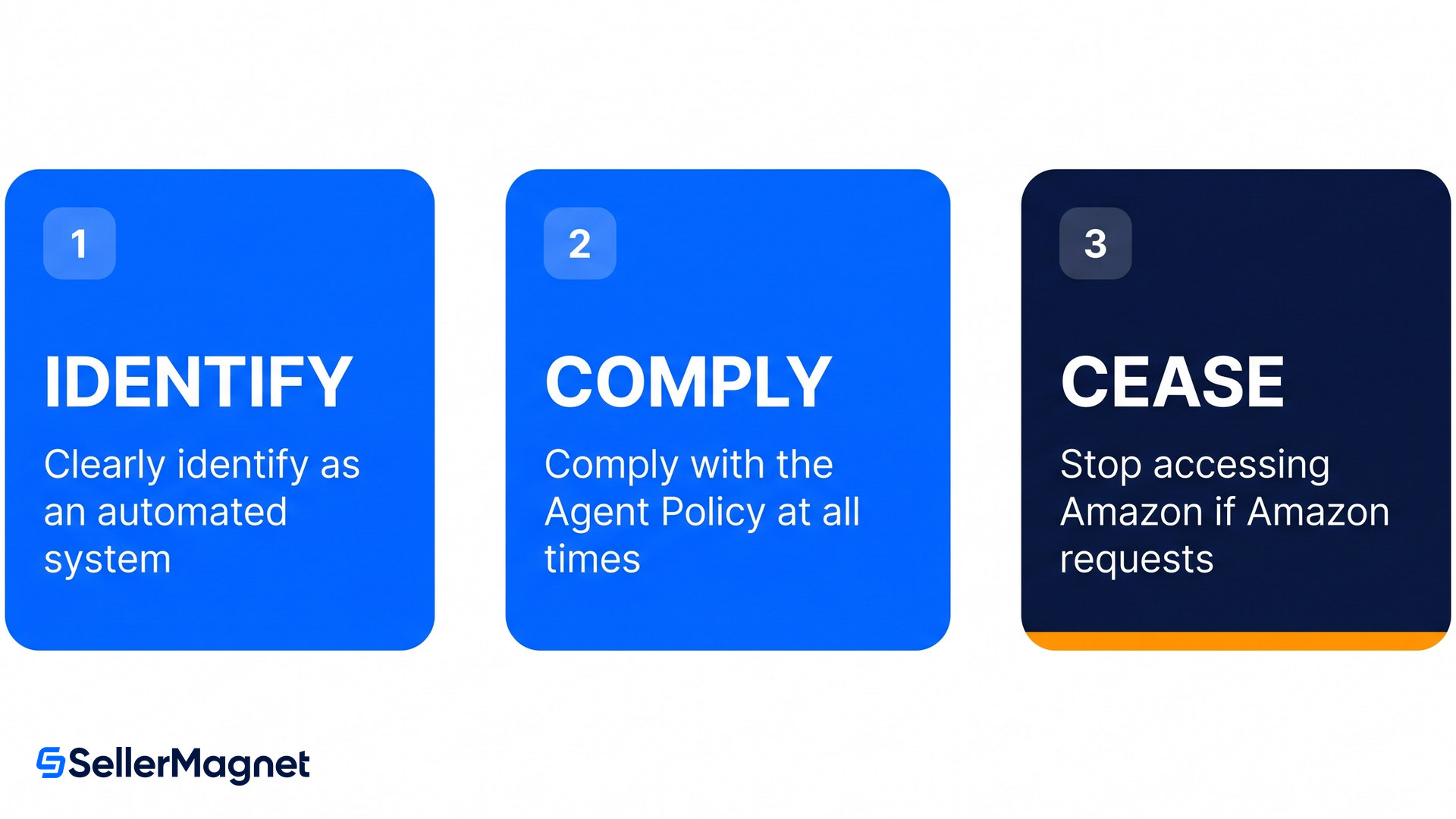
Amazon's Agent Policy took effect on the fourth of March, twenty twenty-six, as part of an updated Business Solutions Agreement. It adds requirements for automated software or AI agents that access Amazon Services, and says all AI agents must identify themselves as automated systems, comply with the policy at all times, and stop accessing Amazon if Amazon asks.
What changed in the Business Solutions Agreement?
Four things, and only one of them is about agents. Amazon's announcement opens with the summary: "effective March 4, 2026, we're updating the Amazon Services Business Solutions Agreement (BSA) and including a new Agent Policy with new requirements for AI usage and automated systems, along with updates to our dispute resolution process".
A separate agreement for Mexico. Amazon says it will "add a separate Business Solutions Agreement for the Mexico store" and remove all references to Mexico from the US and Canada agreement.
Restrictions on AI development. Amazon will "add BSA restrictions on using Amazon materials or services for AI development with enhanced protection against reverse engineering". That is aimed at anyone training on Amazon data, not at a seller using a tool.
The agent restriction and the Agent Policy, which is the part that reaches into everyday seller software.
A new Section 20 on dispute resolution. Amazon is explicit that "while this section is new, the content includes our existing binding arbitration language and class action waiver", so it consolidates the existing terms into a dedicated section, alongside new detail on an arbitrator's power.
What does the Agent Policy actually require?
Three obligations, stated in one short list. Amazon says it will "add requirements for the use of automated software or AI agents to access Amazon Services" and that "we may restrict their access in certain instances under the BSA and new Agent Policy". The requirements themselves are these.
Obligation
Amazon's wording
What it implies in practice
Disclose
"Clearly identify themselves as automated systems"
An agent should be recognisable as software to Amazon, not disguised as a person
Comply
"Comply with the new Agent Policy at all times"
Continuous, not a one-off certification at signup
Stop on request
"Cease access if Amazon requests"
Amazon can switch a tool off and expects the tool to go quietly
Amazon's own power
Amazon "may restrict their access in certain instances"
Enforcement does not need a breach finding first
The sentence that decides how it applies to you closes the list of changes: "your continued use of Selling Services after the effective date constitutes acceptance of these changes". There was no acceptance screen and no opt-in. Every seller trading after 4 March 2026 is on the new terms, which is the ordinary way Amazon amends the BSA and still worth knowing when a policy question turns into a dispute.
The policy itself is behind a login
Amazon's announcement links to an Agent policy help page. That page is published, but an unauthenticated request redirects to the Seller Central sign-in flow, which we confirmed ourselves on 17 September 2026. So the full text is readable by a seller who signs in and not by anyone else, including every article summarising it. We could not read it either, which is why you will find no quotation from it here. Treat a blog that quotes it at length accordingly.
Is my repricer or PPC tool affected?
Almost certainly in scope, and Amazon has not said where the boundary is. The BSA update adds definitions for "Agent", "Applicable Government Authority" and "Our Materials", so the term is defined somewhere in the agreement, but the public announcement does not reproduce the definition. Software that logs in, polls orders, changes prices or adjusts bids on your behalf is automated software accessing Amazon Services on any plain reading.
Sellers asked exactly this in Amazon's own thread. PPC Land's report of 22 February 2026 records one seller asking whether software that obtains pending orders for fulfilment and sends tracking back counts, and another asking whether a reimbursement service counts. It reports that no official response to the reimbursement question appears in the thread, and that neither Amazon's announcement nor the policy documentation cited in it had clarified the scope question. PPC Land also reports that the BSA update covers the United States, Canada and Mexico while the Agent Policy governs automated software accessing Amazon Services globally, a distinction Amazon's own post does not spell out.
The obligation lands on the builder, the consequence lands on you
Identifying as an automated system, complying continuously and ceasing access on request are all things a piece of software does, and none of them are things a seller can perform by hand. What a seller owns is the account the software connects to and the commercial damage if that connection is restricted mid-quarter. That asymmetry is the whole practical story here: you cannot comply on your vendor's behalf, and you cannot avoid the consequence if they do not.
What should a seller actually do?
Inventory what is connected, then ask the people who built it. There is no seller-side setting for this and no compliance checkbox in Seller Central, so the only real work is knowing your own surface area and getting answers in writing before you need them.
How to review your connected tools against the Agent Policy
List everything that touches the account - Go through authorised applications in Seller Central and write down every tool, agency and freelancer with access, including anything connected through the Selling Partner API. Old agency and freelancer connections often outlive the relationship, so read the list rather than assuming you remember it.
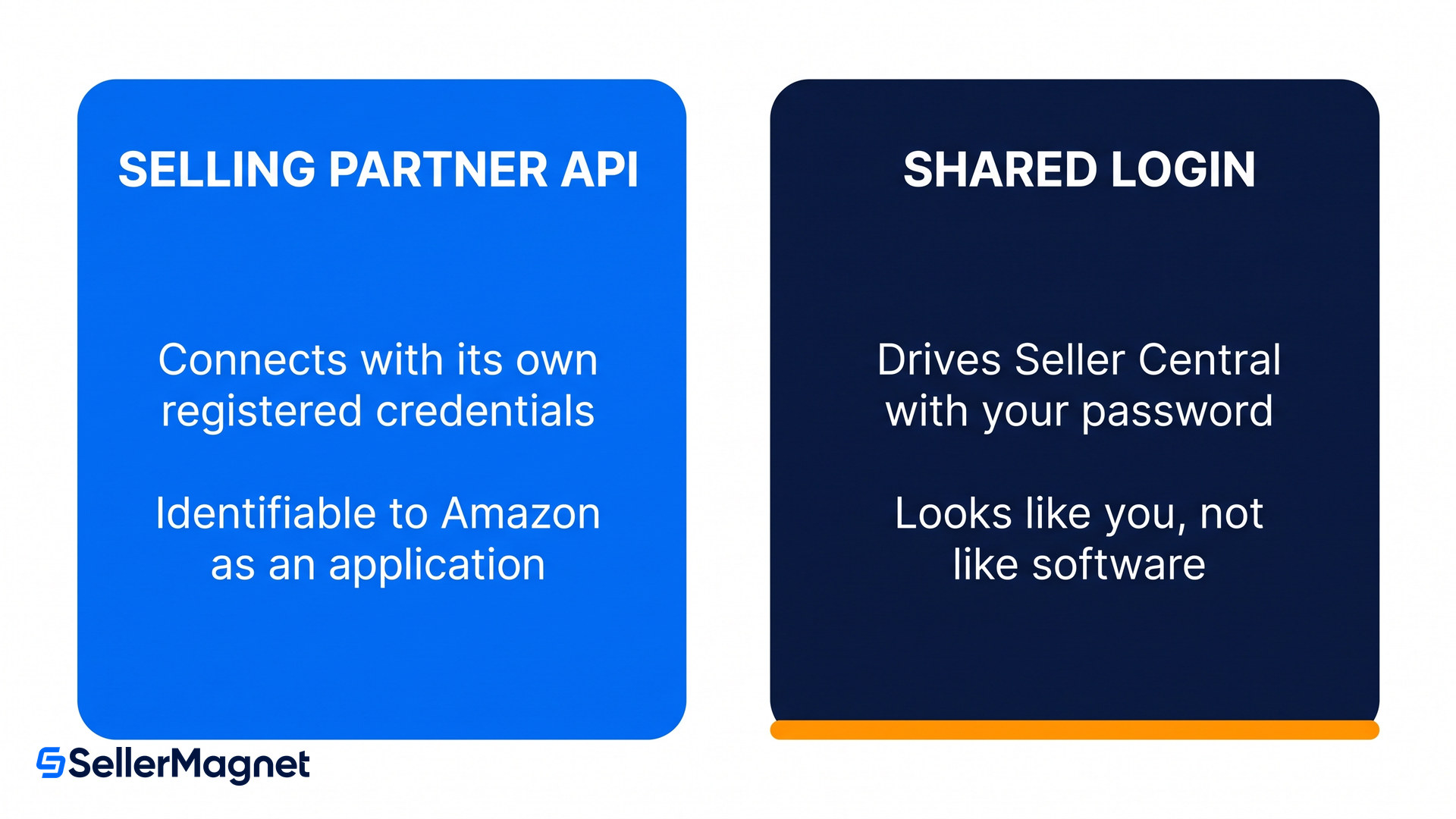
Separate API connections from password sharing - A tool connected through the Selling Partner API connects with its own registered credentials; a tool driving the Seller Central interface with your login does not. Amazon has not said whether either arrangement satisfies the identification requirement, and PPC Land notes that the requirement raises open implementation questions precisely for software that talks to Amazon through API calls rather than a user-facing interface. The distinction is still the one worth knowing per vendor.
Ask each vendor three questions in writing - Ask whether they connect through the Selling Partner API or by other means, whether they have reviewed the Agent Policy that took effect on 4 March 2026, and what happens to your data and your automations if Amazon restricts their access. A vendor who cannot answer the first question quickly is the answer to the third.
Know what breaks if a tool goes dark - Write down what each tool is currently doing unattended, such as repricing, bid changes or order acknowledgements, and what the manual fallback is. Amazon reserves the right to restrict an agent's access, and the time to discover that your prices sit still without the repricer is not the day it happens.
Quick win for today
Open the authorised applications list in Seller Central and read it properly. Anything you do not recognise, or that belongs to an agency you stopped working with, can be revoked today and costs nothing to revoke. Then send the three questions above to every vendor still on the list. We would expect you to send them to us too: SellerMagnet connects through the Selling Partner API, and that is the answer you should be able to get from any tool in under a day. What our own integration reads is on the analytics dashboard; the authorised-applications list itself lives in Seller Central.
Be careful with the compliance checklists doing the rounds
This announcement produced a wave of posts with confident lists of which software categories count as an Agent and what each one must now do. Amazon's public post defines none of that, the definition of Agent lives in an agreement the post does not reproduce, and the scope questions sellers asked in Amazon's own thread went unanswered. A checklist that reads as more certain than the source is inventing the certainty.
Automated tools mostly earn their keep on the numbers they move. The Featured Offer guide covers what a repricer is actually competing for, the Account Health Rating guide covers the page where automation problems become account problems, and the Alexa for Shopping guide covers Amazon's own agent, on the buyer's side of the same shift.
Amazon Agent Policy FAQ
What is Amazon's Agent Policy?
A policy Amazon added alongside the Business Solutions Agreement update that took effect on 4 March 2026, setting requirements for automated software and AI agents that access Amazon Services.
What does the Agent Policy require?
Three things of an AI agent: that it declares itself automated, that it keeps to the policy continuously rather than certifying once, and that it stops when told. Amazon adds a fourth thing of itself, that it may restrict an agent's access in certain instances, without tying that to a breach.
Did I have to accept the new terms?
There was nothing to sign. Amazon states that continued use of Selling Services after the effective date constitutes acceptance of the changes.
Does it apply outside the United States?
The BSA update Amazon describes covers the US and Canada agreement plus a new separate agreement for the Mexico store. PPC Land reports that the Agent Policy governs automated software accessing Amazon Services globally; Amazon's own announcement does not state a geographic scope for the policy.
Is my repricer or PPC tool an Agent?
Amazon has not published the boundary. The BSA adds a definition of Agent that the announcement does not reproduce, and sellers who asked about specific tool types in Amazon's thread did not get an official answer. Software that acts on your account automatically is the obvious candidate.
Can I read the Agent Policy myself?
Only from inside a seller account, and possibly not at the link Amazon gave. Both the Agent policy page and the BSA changes page redirect to a Seller Central sign-in, and the first reply in Amazon's own thread reported that the announcement's Agent Policy link routed to the wrong policy page.
Stop Juggling Tools. SellerMagnet Combines Everything You Need.