A listing can sit at a healthy Best Sellers Rank for weeks, then lose the Buy Box on a Tuesday afternoon, and the first sign most sellers get is a sales graph that looks wrong three or four days later, by which point the rank itself has already slid and a competitor has had days to collect the orders a shopper would otherwise have placed. Amazon's own Sales Rank FAQ confirms the mechanic behind that lag: the best sellers list is recalculated every hour, but a single order can take up to 12 hours to actually register in the number a seller sees, and the rank itself is a weighted, all-time calculation rather than a simple snapshot of yesterday's units. That combination, a rank that reacts slowly and a Buy Box that can change hands in seconds, is exactly the gap between "something changed on my listing" and "I found out about it," and it is the gap a rank or Buy Box monitor is built to close. This guide works through what BSR actually measures, the handful of events that most often make it move, how a Buy Box ownership change shows up before the rank catches up, and how to get an alert at the moment something shifts instead of three days into a quiet sales slump.
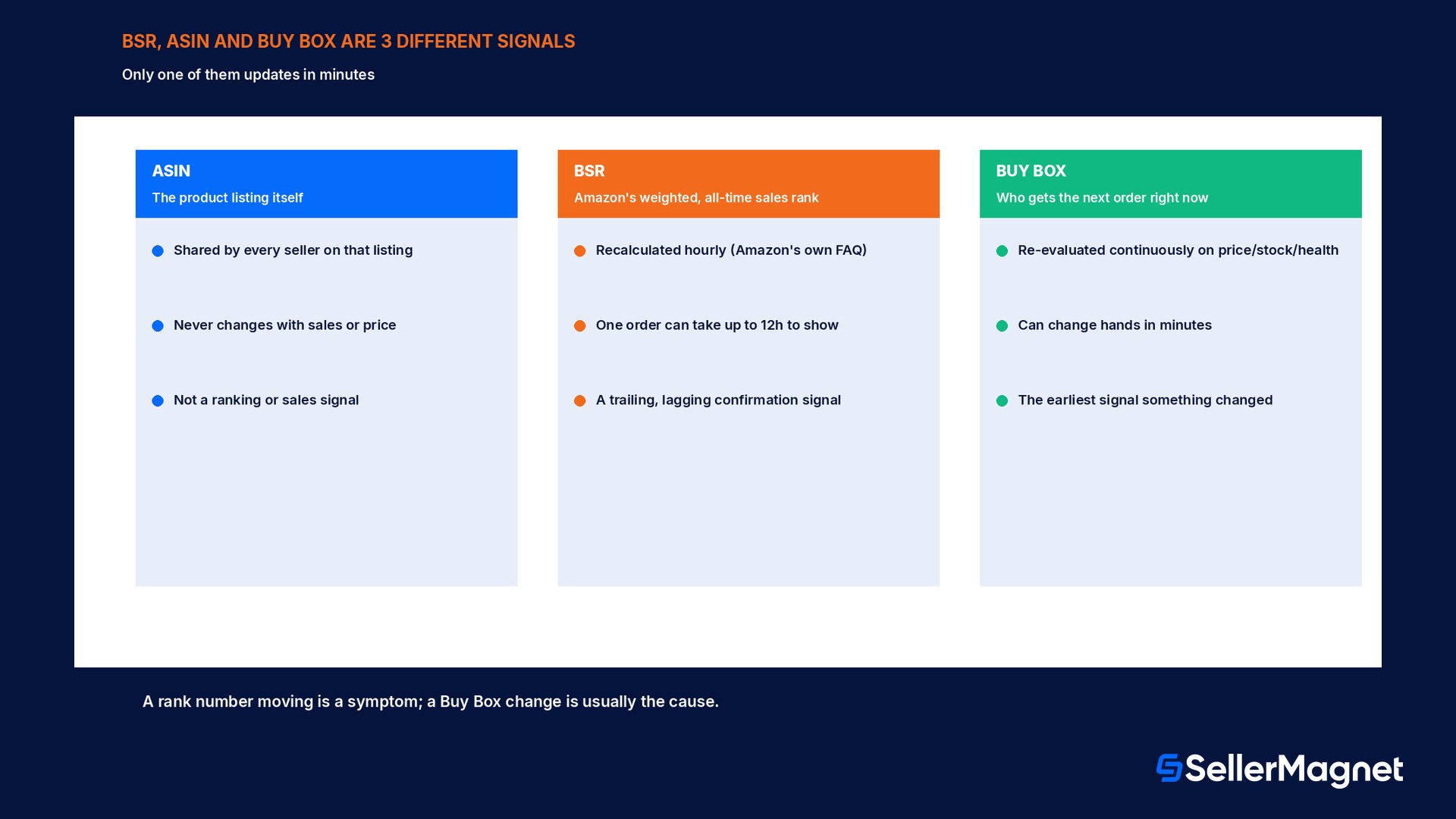
Amazon Best Sellers Rank (BSR) is a weighted, all-time sales calculation that recent sales count more toward than older ones, and Amazon's own Sales Rank FAQ states the best sellers list recalculates every hour, though a single order can take up to 12 hours to show up in the number. A BSR drop is usually the lagging symptom of something that already happened faster: a Buy Box (Featured Offer) loss, a stockout, a suppressed listing, a price change, or a run of negative reviews. A Buy Box change itself can happen in minutes on price, availability, and account health, which is why monitoring the Buy Box and the catalogue directly, rather than waiting for BSR to confirm it, catches the problem hours or days earlier.
What BSR actually measures, and why it lags
Best Sellers Rank gets talked about as if it were a live scoreboard, but Amazon's own Sales Rank FAQ describes a slower mechanism underneath it. Sales rank is calculated from all-time sales of an ASIN, with recent sales weighted more heavily than older ones, so a product's rank reflects a rolling sales history rather than resetting fresh each day. Amazon states it updates the best sellers list every hour, but the same page is explicit that an individual order can take up to 12 hours before it is reflected in that number, and a rank is only generated for an ASIN once it has at least one qualifying sale and sits in one of Amazon's featured categories. Two consequences follow directly from that: first, a single bad day rarely moves BSR by much on its own, because the all-time weighting smooths short spikes and dips; second, and more important for monitoring, BSR is structurally a trailing indicator. By the time a sustained BSR slide is visible and unmistakable, the event that caused it, whether that is a Buy Box loss, a stockout, or a listing getting suppressed, has usually been running for the better part of a day or more already.
The events that actually move BSR, ranked by how fast they show up
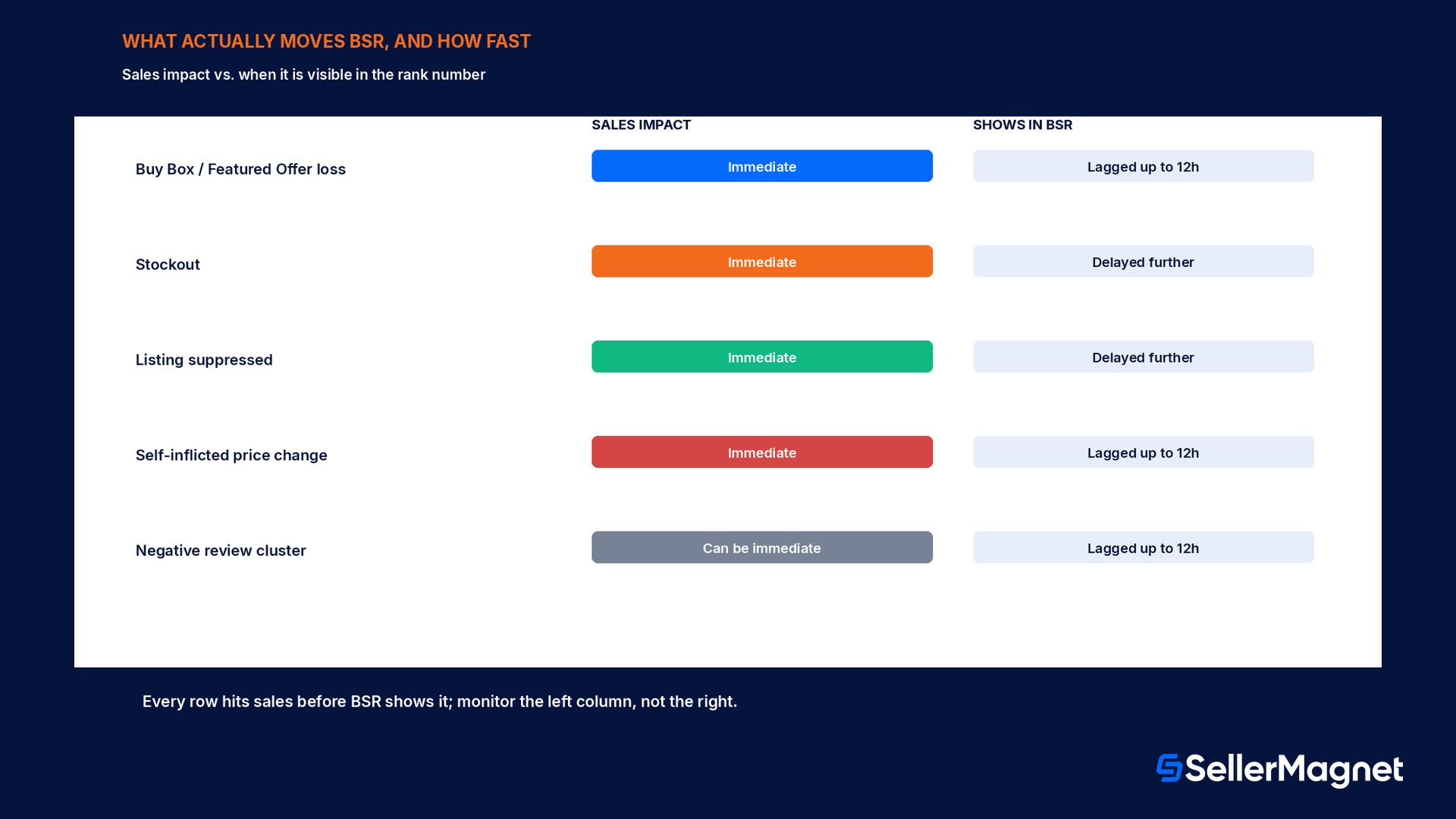
A sustained BSR slide almost always traces back to one of a short list of upstream events, and each one has a very different speed. A Buy Box (Featured Offer) loss is the fastest: Amazon's algorithm re-evaluates the Featured Offer continuously on price, availability, fulfillment method, and account health signals, so a seller can lose the box the moment a competitor undercuts the price or runs out of the stock buffer Amazon expects, and every order that would have gone to that seller starts flowing to whoever holds the box instead, with zero delay on the buyer side even though the seller's own BSR will not reflect the lost sales for up to 12 hours. A stockout is similarly immediate on the sales side (zero units available means zero new orders, full stop) but, confusingly, does not always tank BSR right away, because the all-time weighting still credits recent pre-stockout sales for a period before the rank catches up to the silence. A listing suppression (removed from search and browse for a catalog, image, or compliance issue) cuts off new discovery traffic entirely, which behaves like a stockout for ranking purposes but without the account notification always being obvious. A price change that moves a seller's own offer out of Buy Box contention acts exactly like a competitor undercut, just self-inflicted, often after a repricer hits a floor or a manual price edit. A sudden cluster of negative reviews, or a dropped star rating, can also cost a Buy Box placement even at an unchanged price, since Amazon's eligibility checks weigh seller and product performance signals alongside price.
Event
How fast it affects sales
How fast it shows up in BSR
What a monitor should watch directly
Buy Box / Featured Offer loss
Immediate (next order goes to the new holder)
Lagged up to 12h, then trails in over the following hours
Buy Box owner per ASIN
Stockout
Immediate (no units to sell)
Delayed; recent pre-stockout sales still count for a time
Available stock / inventory level
Listing suppressed
Immediate (removed from search/browse)
Delayed, same mechanism as a stockout
Listing/search visibility status
Self-inflicted price change
Immediate if it exits Buy Box contention
Lagged up to 12h
Own price vs. the lowest competing offer
Negative review cluster / rating drop
Can be immediate if it costs Buy Box eligibility
Lagged up to 12h
Review count and star rating trend
Why the Buy Box moves faster than BSR, and why that gap matters
The Buy Box, which Amazon's own documentation calls the Featured Offer, is the default "Add to Cart" button on a listing with more than one seller, and Amazon re-evaluates who holds it continuously rather than on any fixed schedule, weighing price, availability, fulfillment method (FBA vs. FBM shipping performance), and account health together. An often-cited industry estimate puts the large majority of Amazon unit sales as flowing through whichever offer holds the Featured Offer at the moment of purchase, though Amazon itself does not publish an exact percentage, so that number is best treated as a widely repeated estimate rather than an official figure. What matters operationally is the direction of the gap: a seller can lose the Buy Box in the time it takes a competitor's repricer to shave a price by a few percent, while that same seller's BSR will not fully reflect the resulting sales drop for up to half a day under Amazon's own stated update mechanics, and longer still before the trend is unambiguous on a dashboard checked only occasionally. A monitor that watches Buy Box ownership and the competing offer directly, instead of waiting on the rank number to confirm a problem, is reacting to the cause within minutes instead of reacting to the symptom a day or more later.
A worked example: the same Buy Box loss, caught at hour 1 versus discovered at hour 50
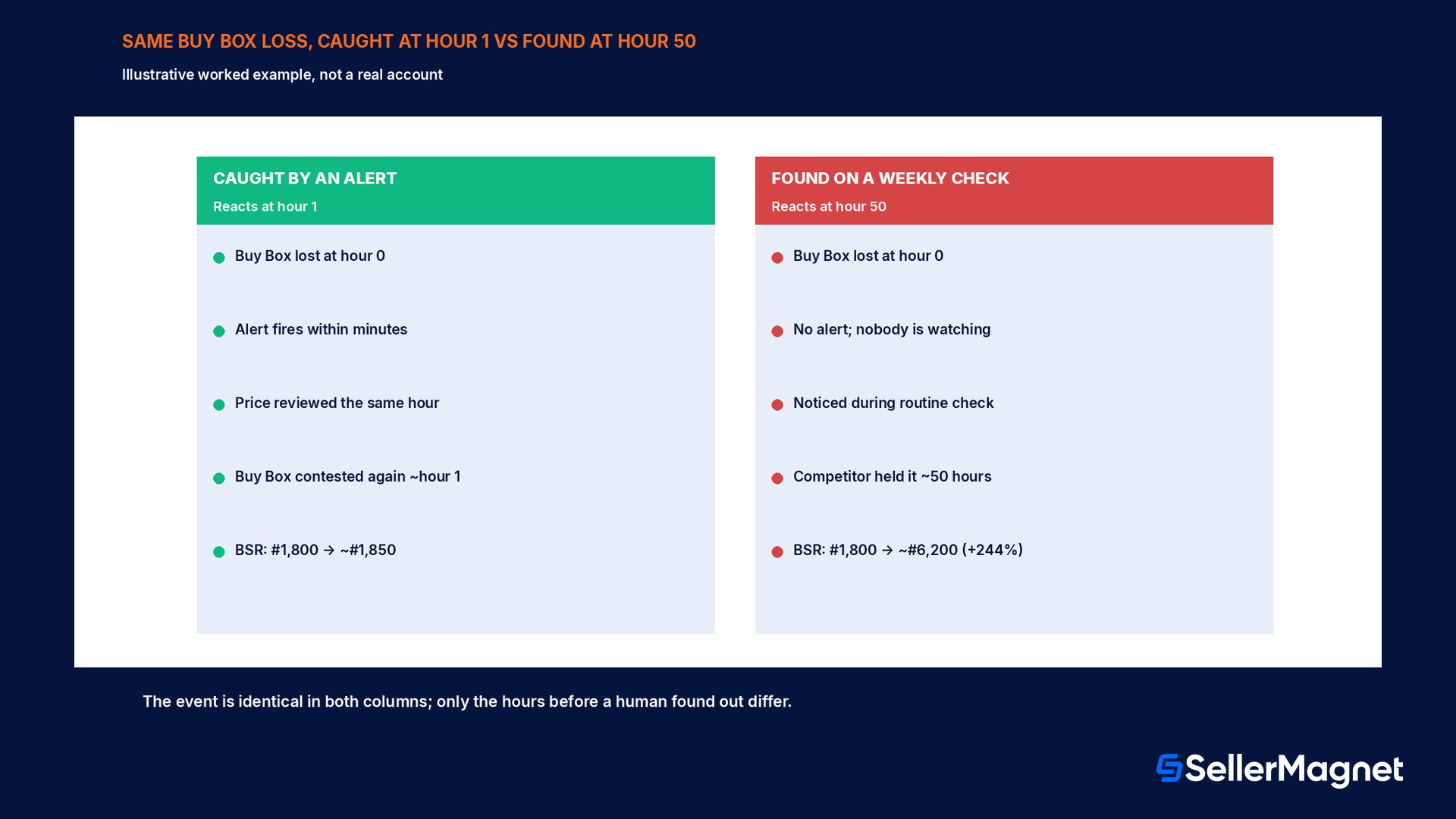
The numbers below are built to make the mechanics concrete, not a real account's sales data. A listing sits at BSR #1,800 in its category and holds the Buy Box at $24.99. At hour 0, a competitor lists the identical product at $22.49 and takes the Buy Box. Orders that would have gone to the original seller start going to the competitor immediately, at hour 0, with no visible change yet on the original seller's own BSR because of the up-to-12-hour reporting lag Amazon's Sales Rank FAQ describes. In the caught-early scenario, an alert on Buy Box ownership fires within minutes of hour 0; the seller reviews the price gap the same hour and either matches it or starts a repricing strategy, holding the lost-sales window to roughly 1 hour before the Buy Box is contested again. In the discovered-late scenario, nobody is watching Buy Box ownership directly, and the first sign of a problem is a visibly worse BSR noticed during a routine weekly check at hour 50; by that point the competitor has held the Buy Box uncontested for 50 hours, and the seller's BSR, after the reporting lag fully catches up, has slid from #1,800 to roughly #6,200, a 244 percent worsening in rank position for the exact same underlying event. The gap between the two scenarios is not the event itself, which was identical in both, but entirely how many hours passed between the Buy Box changing hands and a human finding out.
Scenario
Hours Buy Box held by competitor before a reaction
BSR at discovery
Caught by an alert at hour 1
about 1 hour
#1,800 to #1,850 (reporting lag has barely moved it)
Discovered during a weekly check at hour 50
about 50 hours
#6,200 (244% worse than the #1,800 starting point)
Mistakes that stretch the gap between a rank change and noticing it
Watching BSR itself as the early-warning signal. By the time it moves, the Buy Box, stock, or listing event that caused it has usually already been running for up to 12 hours or more.
Checking Buy Box ownership manually, by eye, on a weekly or monthly cadence. A Buy Box can change hands and change back several times inside a single week with nobody noticing either shift.
Treating a stockout as a pure inventory problem with no ranking consequence. The all-time weighting delays the damage, but it still arrives once the pre-stockout sales age out of the rolling calculation.
Assuming a suppressed listing will generate an obvious account alert. A catalog or compliance suppression can cut off search and browse visibility quietly, with the same ranking effect as a stockout.
Reacting to a price war with a single manual price edit instead of a repricing strategy. A one-time match does not hold the Buy Box if the competitor's own repricer immediately undercuts again.
Not separating "my price changed" from "someone else's price changed." Both can cost a Buy Box placement, but only one is inside the seller's own control to fix with a price edit.
Checklist for catching a rank or Buy Box change early
How to catch a BSR or Buy Box change before it costs days of sales
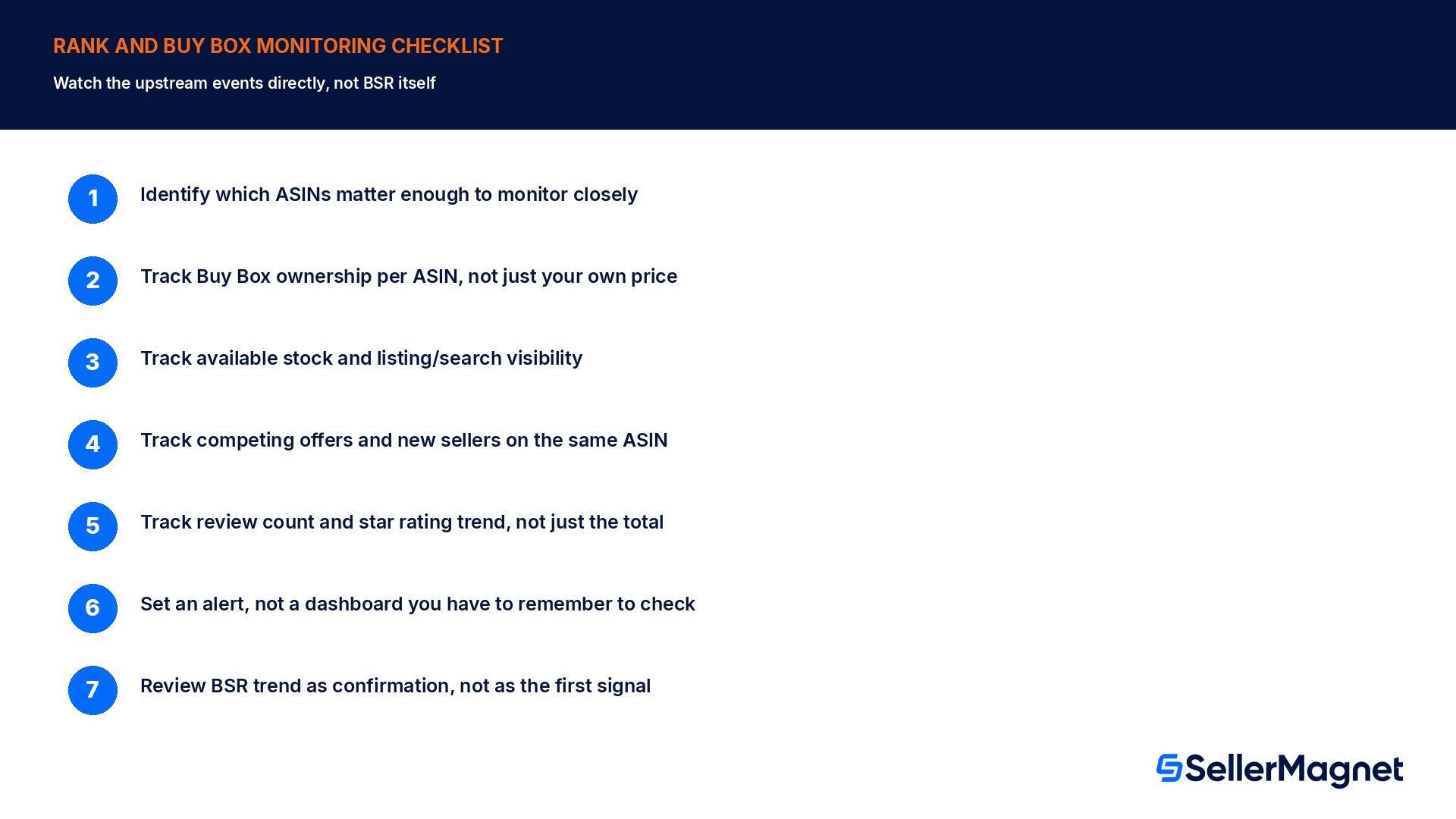
Identify which ASINs matter enough to monitor closely - Prioritize by sales volume or margin; monitoring every SKU in an enormous catalogue equally is rarely the efficient choice.
Track Buy Box ownership per ASIN, not just your own price - A loss shows the moment it happens; a price number alone does not show who currently holds the Featured Offer.
Track available stock and listing/search visibility - Both behave like a stockout for ranking purposes even when the root cause is a catalog or compliance issue.
Track competing offers and new sellers on the same ASIN - A new seller entering at a lower price is the single most common trigger for a Buy Box change.
Track review count and star rating trend, not just the total - A sudden cluster of negative reviews can cost Buy Box eligibility even at an unchanged price.
Set an alert, not a dashboard you have to remember to check - The worked example above shows the same event costing roughly 1 hour of lost Buy Box time versus roughly 50, purely based on how the change was noticed.
Review BSR trend as a confirmation signal, not the first signal - Use it to see whether a reaction worked over the following days, not to find out something went wrong in the first place.
What SellerMagnet watches so a rank change does not go unnoticed
SellerMagnet's Offer Watch checks a seller's whole connected catalogue automatically for the upstream events covered above: a new seller appearing on an ASIN, a Buy Box loss, an undercut on price, and a suppressed listing, instead of requiring someone to click through every ASIN by hand. The separate Competitor Tracker follows any specific ASIN, including ones a seller does not sell themselves, for who holds the Buy Box, its price, stock level, listing edits, and rating or review drops, which is the direct-monitoring approach this guide argues for instead of waiting on BSR to confirm a change days later.
A BSR or Buy Box alert is only half the picture if the response itself is slow to follow; the separate feedback removal guide and returnless refunds cost guide cover two of the specific downstream issues (a damaging piece of feedback, or a refund policy eating into margin) that often surface alongside a Buy Box or rank problem rather than being its root cause; treat a rank or Buy Box alert as the trigger to investigate the specific cause, not the full diagnosis by itself.
How often does Amazon actually update Best Sellers Rank?
Amazon's own Sales Rank FAQ states the best sellers list is recalculated every hour, but an individual order can take up to 12 hours to be reflected in the number, and the calculation itself weighs all-time sales with recent sales counted more heavily than older ones.
If my BSR has not moved, does that mean I still have the Buy Box?
Not necessarily. Because BSR lags a Buy Box change by up to 12 hours or more, a loss that happened in the last few hours will not be visible in BSR yet even though the sales impact already started the moment the Buy Box changed hands.
What is the single most common cause of a sudden BSR drop?
There is no single universal cause, but a Buy Box (Featured Offer) loss to a competitor on price or availability is one of the most frequent triggers, alongside a stockout, a suppressed listing, and a sudden cluster of negative reviews.
Is it true that most Amazon sales go through the Buy Box?
An often-cited industry estimate puts the large majority of Amazon unit sales as going through whichever offer holds the Buy Box (Featured Offer) at the time, though Amazon does not publish an official figure, so treat it as a widely repeated estimate rather than Amazon's own stated number.
Can a stockout hurt my rank even after I restock?
Yes, temporarily. Because BSR weights recent all-time sales rather than resetting daily, a stockout period shows up as a gap in recent sales that takes time to recover from even after inventory is back and selling again.
Does watching BSR itself count as monitoring for Buy Box problems?
Only as a delayed confirmation. Because of the reporting lag Amazon describes, BSR tells you a problem already happened, not that one is happening; monitoring Buy Box ownership, stock, and competing offers directly catches the event itself, hours or days earlier.
Stop Juggling Tools. SellerMagnet Combines Everything You Need.