Amazon EPR Packaging ERN 2026: Deadline and Submission Guide
R
RenéFreelance Amazon Editor
|
17 min read
Starting 12 August 2026, the EU Packaging and Packaging Waste Regulation (PPWR), Regulation (EU) 2025/40, applies across every EU member state, replacing the older Packaging and Packaging Waste Directive 94/62/EC that Germany, France, Italy and Spain have enforced for years under their own national laws. For a seller shipping packaged products into the EU through Amazon, the regulation does not stay abstract: Amazon requires proof of compliance inside Seller Central, one submission per country, in the form of an EPR registration number, called an ERN, filed under Account Health's Regulatory Compliance section. Miss the submission, submit an invalid number, or resubmit a number that was already validated, and Amazon can deactivate the affected listings, both the primary packaging around the product itself and the secondary packaging Amazon uses to ship it under FBA, until a valid ERN is confirmed. Germany's own packaging law already runs this exact mechanism today under the national LUCID register, which makes it the clearest working preview of what every other EU country's registry will do once PPWR applies in August 2026. This guide works from Amazon's own EPR help pages, the PPWR regulation text, and Germany's live LUCID enforcement pages to lay out who actually owes a registration, the country-by-country registries, the exact Seller Central submission steps, the timing that catches sellers out, and the mistakes that get a valid listing deactivated over a packaging technicality rather than a real compliance failure.
The EU Packaging and Packaging Waste Regulation (PPWR) requires sellers who place packaged goods on the EU market to register an EPR registration number (ERN) with a national producer responsibility organization and submit that number to Amazon, per country, through Seller Central's Account Health, Regulatory Compliance page, before the 12 August 2026 enforcement date. Submitting an invalid, expired or resubmitted ERN, or missing the deadline, can get the affected listings deactivated in that country until a valid number is confirmed.
What PPWR actually changes, and why Germany already shows how it works
The Packaging and Packaging Waste Regulation, formally Regulation (EU) 2025/40, was published on 22 January 2025 and is a regulation rather than a directive, meaning it takes direct legal effect in every EU member state on the same date rather than needing each country to pass its own implementing law first. It replaces the Packaging and Packaging Waste Directive 94/62/EC, the older framework that Germany, France, Italy, Spain and other member states had each turned into their own national packaging law over the past two decades, which is exactly why the national systems look so different from each other today: Germany's VerpackG runs through a government-operated register called LUCID, France splits household packaging and catering packaging between two separate producer responsibility organizations, and Italy runs a single consortium, CONAI, covering the whole market. Amazon's own guidance is candid that the national detail is still being worked out as of this writing: individual countries have not all finished publishing exactly how they will implement the new regulation, and Amazon states it will share country-specific requirements as that information becomes available through 2026. What is already fixed and not waiting on any country's implementation detail is the enforcement date, 12 August 2026, and the core producer obligations the regulation itself defines. Because Germany's LUCID system already enforces an equivalent obligation today under the old directive, it is the single best working example of what deactivation and reinstatement will actually look like everywhere else once PPWR applies: Amazon is legally required to check compliance and deactivate non-compliant listings, the deactivation affects both the product's own primary packaging and Amazon's own FBA shipping packaging, and reinstatement never happens automatically even after the registration number itself is confirmed valid.
The four producer obligations the regulation actually creates
Amazon's own EPR education page lists four separate obligations that apply to a producer under the EU Packaging Waste Regulation, and a seller preparing for August 2026 needs to recognize that registering a number with a government register is only the first of the four, not the whole requirement. The first is producer registration itself: a producer must be registered in the register of producers that each member state where it places packaging, or packaged goods, on the market has established, which can be done directly or through an authorized representative or producer responsibility organization where the country allows it. The second is reporting: a registered producer has to report, to the relevant authority or producer responsibility organization, the amount of packaging placed on the market in that country, the types of materials used, the weight of the packaging, and whether it is designed for reuse or is single-use, data points that mean a seller needs real packaging specifications on file, not just a registration number. The third is the eco-contribution fee itself, paid to the producer responsibility organization or environmental authority to fund waste management for that packaging, and the fourth applies specifically to a producer that is not established in the country of sale: it must appoint an authorized representative established there to act as its legal representative for the producer obligations, with the appointment rule for non-EU producers varying by country, so checking local requirements before appointing anyone is Amazon's own stated advice rather than assuming one representative covers every market.
Where to actually register: the country-by-country registry list
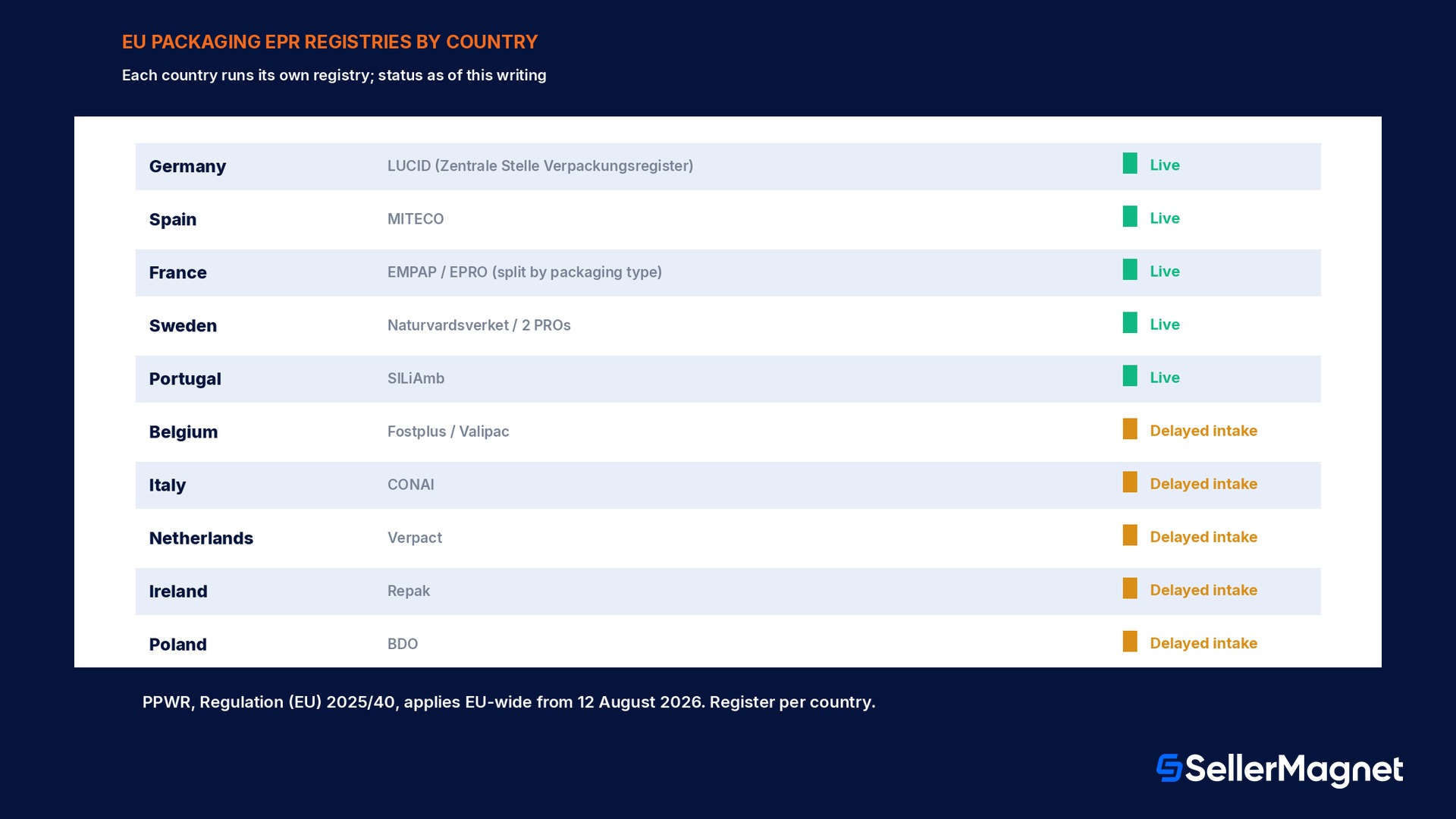
There is no single EU-wide portal for PPWR registration. Each member state runs, or is in the process of standing up, its own national register or producer responsibility organization, and a seller selling the same packaged product into several EU stores through Amazon needs a separate registration, and later a separate ERN submission inside Seller Central, for every one of them. Amazon's own help page lists the government or producer-responsibility-organization website for each country it currently names, reproduced in full below because getting the right registry for the right country the first time avoids weeks of delay chasing the wrong portal.
The UK and Austria are not on this list by accident
Amazon states the United Kingdom is not subject to the new EU PPWR at all; UK packaging compliance runs under its own separate EPR requirements. Austria also has its own dedicated EPR requirements page rather than following the general EU table. Check the country-specific page for either before assuming the general PPWR steps apply there.
The exact Seller Central submission steps, and the registry-timing rule that trips sellers up
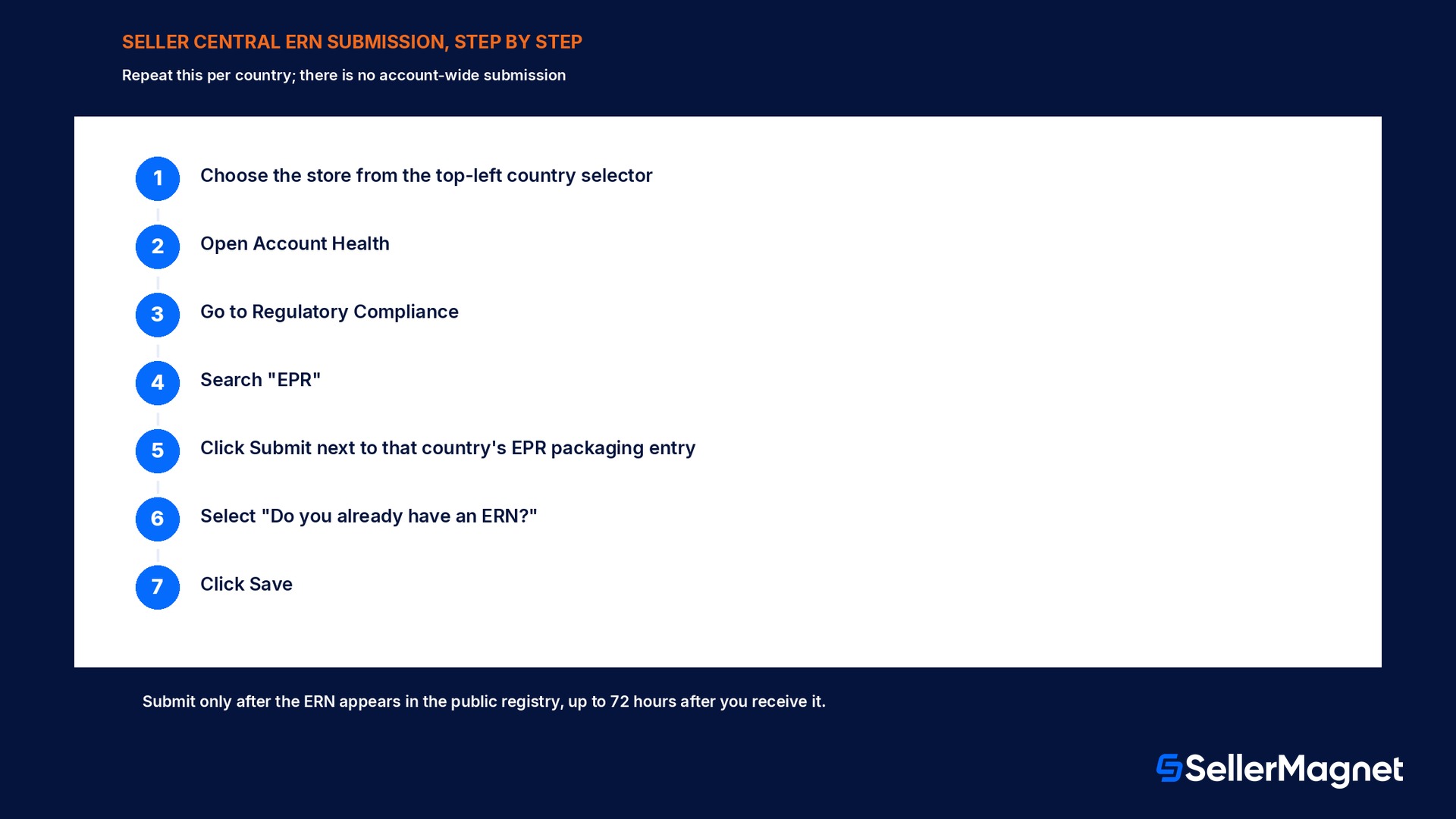
Once a seller holds a valid ERN from the correct national registry, Amazon's submission mechanism inside Seller Central is the same shape in every country: choose the country from the store selector in the top-left corner of the Seller Central page, open Account Health, go to Regulatory Compliance, search for EPR, click Submit next to the EPR entry for that country's packaging obligation, select the option confirming an ERN is already held, and click Save. That sequence has to be repeated separately in every store where the seller actually sells packaging, there is no bulk or account-wide submission, which matters most for a seller active in five or six EU stores at once rather than one. The rule that catches far more sellers than the submission steps themselves is timing: in countries with a public registry, Amazon states a seller should submit the ERN only after it has actually appeared in that public registry, which can take up to 72 hours after the seller first receives the number by email from the registration body. Submitting the number before it shows up in the public registry gets it marked invalid by Amazon's own validation check, and the seller then has to resubmit it, which restarts the review rather than speeding anything up. After a valid submission, Amazon states a seller will get a decision within 5 working days in countries where the registry is publicly searchable; the status itself, Approved or Rejected, is checked back in Regulatory Compliance under "Submit compliance information." A Rejected status comes with one of three stated reasons: the EPR number was not found in the registry, the EPR number has expired, or the producer name on the registration does not match Amazon's records, and the fix in every case is the same button, "Replace with a new submission," never a resubmission of the identical number.
Never resubmit a number that is already marked valid
Germany's live LUCID enforcement page states this directly, and it generalizes to every country's registry once PPWR applies: resubmitting a registration number that Amazon has already validated resets the validation process, which can push a currently active, fully compliant listing straight back into deactivation. If the status already reads Approved, leave it alone.
Not every seller is a "producer": the supplier-ERN path
A seller who did not manufacture the product, is not the brand owner, and is not the importer of record bringing it into the EU for the first time is usually not the legal "producer" under the regulation at all, and does not need to register their own ERN in every case. Amazon's own policy names eight countries, Spain, France, the Netherlands, Belgium, Sweden, Poland, Italy and Ireland, where a seller can be treated as a non-producer: instead of registering independently, that seller submits the supplier's existing EPR registration number through the same Regulatory Compliance flow and checks a box confirming they are not the producer. This path only works when the actual producer, normally further up the supply chain, already holds a valid registration of their own; a seller cannot invent a non-producer claim to skip registration entirely when no one in the chain has registered, because Amazon's validation checks the submitted number against the real registry regardless of who submits it. Germany, by contrast, does not offer this seller-level non-producer shortcut inside the Amazon flow; a UK or non-EU-based seller importing into Germany is generally treated as the producer themselves and needs a LUCID registration under their own company name, unless a different party in the chain has already registered and the seller can document that clearly.
EPR Pay on Behalf: Amazon's fallback, and why it is not a substitute for registering
For a defined list of EPR-applicable product types, Amazon operates a Pay on Behalf service, under which Amazon itself declares sales and pays the eco-contribution fee to the relevant producer responsibility organization on a seller's behalf, until that seller submits a valid ERN of their own before the relevant reporting cut-off. The moment a seller does submit a valid number, Amazon stops declaring and paying on their behalf from that reporting cycle forward, and the seller becomes responsible for their own ongoing declarations and payments directly to the organization. This service is scoped narrowly: it only ever covers the declaration and payment of eco-contribution fees for the specific products Amazon lists as EPR-applicable, and Amazon's own terms state plainly that providing this service does not make Amazon responsible or liable for the seller's underlying EPR obligations. A seller who neither holds a valid ERN nor wants Amazon's Pay on Behalf coverage has exactly one other option under Amazon's stated policy: stop selling the EPR-applicable products in that country.
A worked example: one seller, three countries, three separate clocks
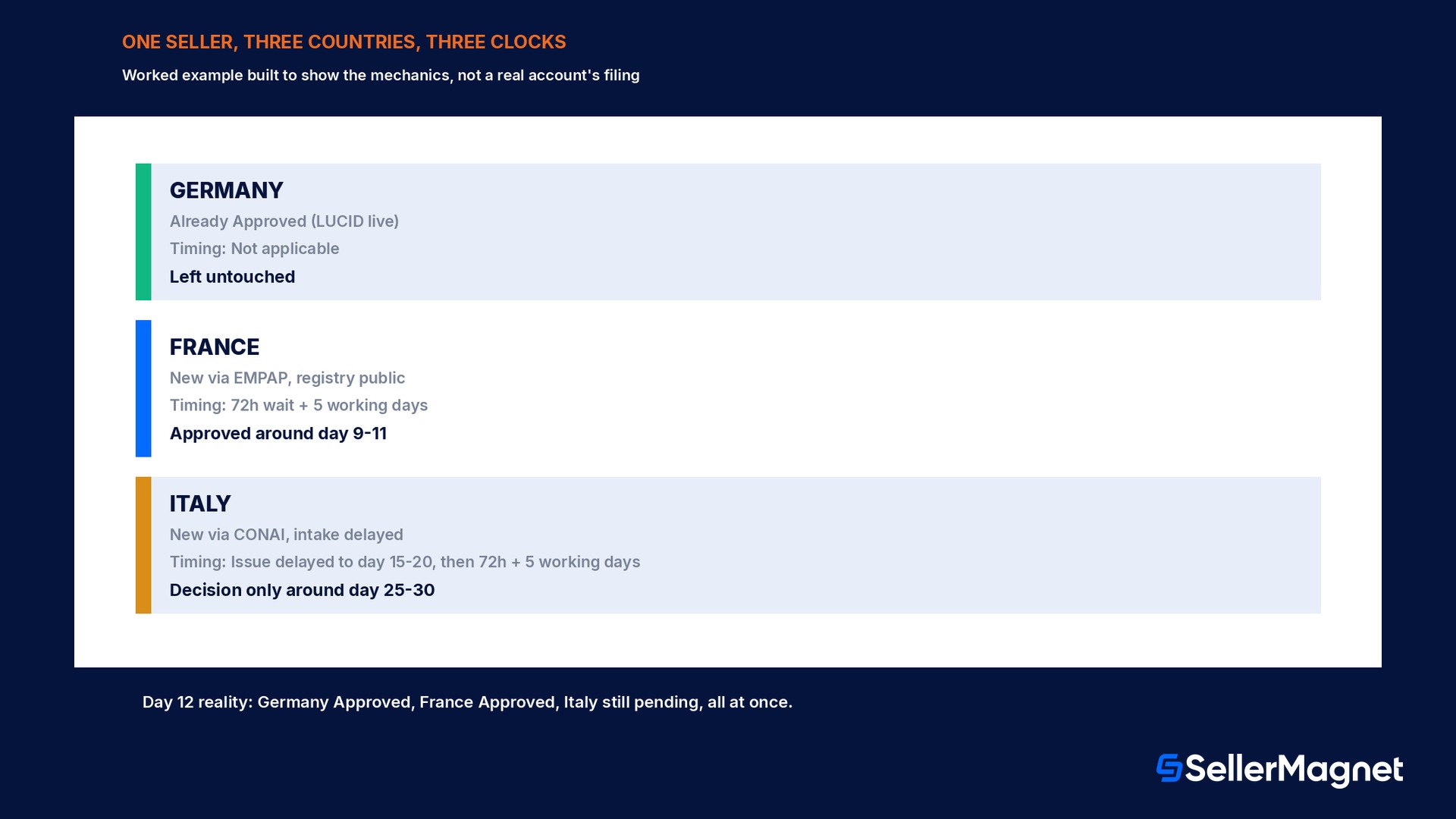
The scenario below is built to make the per-country timing concrete, not a real account's filing. A private-label kitchenware brand already sells the same packaged product set into Germany, France and Italy through Amazon, and is preparing its EPR submissions ahead of the 12 August 2026 enforcement date. Germany is the simplest case because LUCID is already live and the seller registered there months earlier under the existing VerpackG obligation; the LUCID number is already marked Approved in Seller Central, so the only action needed is to leave that submission alone, resubmitting it would reset a validation that already passed. France requires a fresh registration, split by packaging type: because this seller's packaging is household-type retail packaging rather than catering packaging, the relevant producer responsibility organization is EMPAP, not EPRO, and the seller registers there, receives the ERN by email on day 1, and because France's registry is public, waits roughly 2 to 3 days for the number to actually appear in it before submitting inside Seller Central on day 4; Amazon's stated 5-working-day review then lands the France decision around day 9 to day 11, accounting for a weekend inside that window. Italy is the slowest of the three in this example purely because CONAI's registration process is one of the ones Amazon flags as delayed: the seller can request registration on day 1, but a delayed intake process pushes the ERN issue date out to roughly day 15 to day 20 in this scenario, after which the same 72-hour registry-appearance wait and 5-working-day Amazon review apply, landing a decision only around day 25 to day 30. The seller's real compliance picture on, say, day 12, is therefore three different statuses at once: Germany Approved and untouched, France Approved and newly submitted, Italy still pending registration, which is exactly the kind of per-country patchwork a seller selling into several EU stores should expect to track individually rather than assuming one submission covers the whole EU.
Country
Registry status at day 1
Registry appearance wait
Amazon decision window
This example's outcome
Germany
Already registered, LUCID live
Not applicable, already Approved
Not applicable
Approved, left untouched
France
New registration via EMPAP
Up to 72 hours, public registry
5 working days after submission
Approved around day 9 to 11
Italy
New registration via CONAI, intake delayed
Up to 72 hours once issued
5 working days after submission
Decision only around day 25 to 30
What actually happens to a listing without a valid ERN
Germany's live enforcement under the pre-PPWR directive is the clearest existing picture of what deactivation looks like once PPWR applies everywhere: Amazon states it is legally obliged to check EPR compliance and deactivate non-compliant listings, and that the deactivation covers both primary packaging, the product's own retail packaging, and secondary packaging, meaning Amazon's own FBA shipping materials, not only packaging the seller controls directly. A seller can find exactly which listings were affected through Manage All Inventory, filtering the Listing status dropdown to Search suppressed, rather than discovering it product by product. Submitting a valid, registry-confirmed ERN does not instantly bring a deactivated listing back: Amazon's own guidance is explicit that reinstatement is never automatic, because separate compliance teams still run additional manual checks after the registration number itself passes validation, and only once those additional checks confirm full compliance can the seller actually reinstate the listing, using the individual or bulk reinstatement tool. A seller who decides not to continue selling packaged goods in a given country at all has a cleaner exit than fighting the compliance check: removing the affected listings through the Manage Inventory dashboard rather than leaving them suppressed indefinitely.
Mistakes that get a valid listing deactivated anyway
Submitting the ERN before it appears in the public registry. Amazon's own validation marks an early submission invalid, which forces a resubmission and restarts the review clock instead of saving time.
Resubmitting an ERN that already shows Approved. Amazon's guidance states this resets the validation process and can push an active, compliant listing back into deactivation for no underlying compliance reason.
Assuming one EU-wide registration covers every store. Each country runs its own registry and its own Seller Central submission; a number valid in Germany does nothing for a France or Italy listing.
Treating a non-producer claim as a way to skip registration entirely. The supplier-ERN path only works when the actual producer further up the chain already holds a valid registration; it does not create a free pass when no one has registered.
Ignoring the authorized-representative requirement for a producer not established in the country of sale. Rules differ by country, and skipping this step can leave even a correctly registered producer non-compliant on a technicality.
Not checking the rejection reason before resubmitting. "EPR number not found," "expired," and "producer name mismatch" each need a different fix; resubmitting the same number without addressing the stated reason fails again.
Assuming Pay on Behalf is a permanent solution. It only covers listed EPR-applicable products until a seller submits their own valid ERN, and Amazon's own terms state it does not transfer legal responsibility for the underlying obligation.
Waiting until close to 12 August 2026 to start registering in a country with a known delayed intake process. Belgium, Italy, the Netherlands, Ireland and Poland are the countries Amazon itself flags as delayed; a registration started late in a slow country can miss the enforcement date entirely.
Checklist before 12 August 2026
How to get an EU packaging EPR submission right before the PPWR deadline
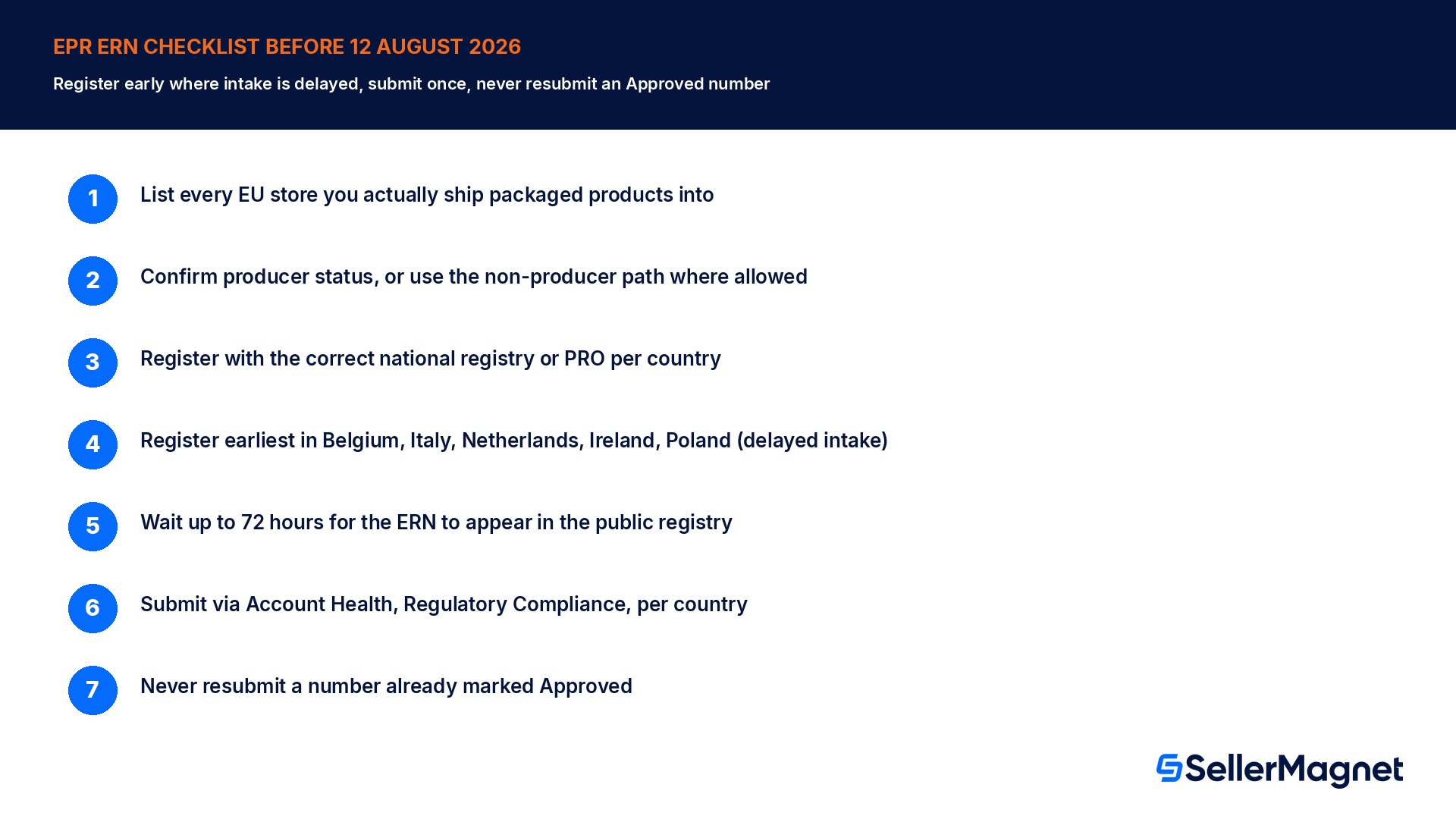
Identify every EU store you actually ship packaged products into - A separate registration and a separate Seller Central submission are needed per country, not once for the whole EU.
Confirm whether you are the legal producer or can use the non-producer path - Spain, France, the Netherlands, Belgium, Sweden, Poland, Italy and Ireland allow submitting a supplier's ERN with a non-producer checkbox; Germany generally does not.
Register with the correct national registry or producer responsibility organization for each country - Use Amazon's own country table; France splits household packaging (EMPAP) from catering packaging (EPRO).
Register earliest in the countries Amazon flags as delayed - Belgium, Italy, the Netherlands, Ireland and Poland have delayed intake as of this writing; starting early absorbs that delay before 12 August 2026.
Wait for the ERN to actually appear in the public registry before submitting it - Up to 72 hours after receiving it by email; an early submission is marked invalid and restarts the process.
Submit via Account Health, Regulatory Compliance, per country - Search EPR, click Submit next to that country's packaging entry, confirm an ERN is already held, click Save.
Never resubmit a number already marked Approved - A resubmission resets the validation process and can deactivate an already-compliant listing.
If Rejected, read the stated reason before acting - Number not found, expired, or producer name mismatch each need a different fix; use "Replace with a new submission" rather than retyping the same number.
What SellerMagnet can and cannot do about this
Registering with a national producer responsibility organization and submitting the resulting ERN inside Seller Central's Regulatory Compliance page are steps Amazon requires directly from the seller or their authorized representative; no third-party analytics or listing tool, SellerMagnet included, performs that registration or submission on a seller's behalf. Where SellerMagnet's Analytics dashboard genuinely helps is visibility across stores: a seller selling the same packaged product into several EU marketplaces at once can lose track of which store's compliance status is Approved, Pending or Rejected simply because each one lives on a separate country-specific Seller Central page, and a consolidated, per-marketplace view of that kind of account-health status makes the patchwork easier to track without logging into six separate Seller Central sessions.
This sits alongside, not instead of, the design-level packaging rules covered in the PPWR packaging design guide and the fee mechanics in the SIPP packaging fee guide: a seller can have fully compliant packaging materials and still get a listing deactivated purely for a missing or mistimed ERN submission, so treat registration as its own separate checkpoint, not something a compliant package design or a paid fee automatically covers.
What does PPWR actually stand for, and when does it apply?
The Packaging and Packaging Waste Regulation, Regulation (EU) 2025/40, published 22 January 2025. Its requirements are expected to apply EU-wide starting 12 August 2026, replacing the older Packaging and Packaging Waste Directive 94/62/EC.
Is the United Kingdom covered by PPWR?
No. Amazon states the UK is not subject to the new EU PPWR and runs its own separate UK packaging EPR requirements instead.
What is an ERN?
An EPR registration number: the identifier a national registry or producer responsibility organization issues once a producer registers, which Amazon then requires as proof of compliance, submitted per country inside Seller Central.
Do I need to register in every EU country separately?
Yes. Each member state runs its own registry or producer responsibility organization and its own Seller Central submission; there is no single EU-wide registration or submission.
I'm not the manufacturer. Do I still need my own ERN?
Not necessarily. In Spain, France, the Netherlands, Belgium, Sweden, Poland, Italy and Ireland, a non-producer seller can submit the supplier's valid ERN and check a box confirming they are not the producer, instead of registering independently.
What happens if I submit my ERN before it appears in the public registry?
Amazon's validation check marks it invalid, and you have to resubmit it, which restarts the review rather than saving time. Wait up to 72 hours after receiving the number by email before submitting.
What happens to my listings if I miss the deadline or submit an invalid ERN?
Amazon can deactivate the affected listings, covering both the product's own packaging and Amazon's FBA shipping packaging, until a valid ERN is confirmed, and reinstatement after that is a manual process, not automatic.
My ERN already shows Approved. Should I resubmit it just to be safe?
No. Amazon's own guidance states resubmitting an already-validated number resets the validation process and can push a currently active, compliant listing back into deactivation.
Stop Juggling Tools. SellerMagnet Combines Everything You Need.