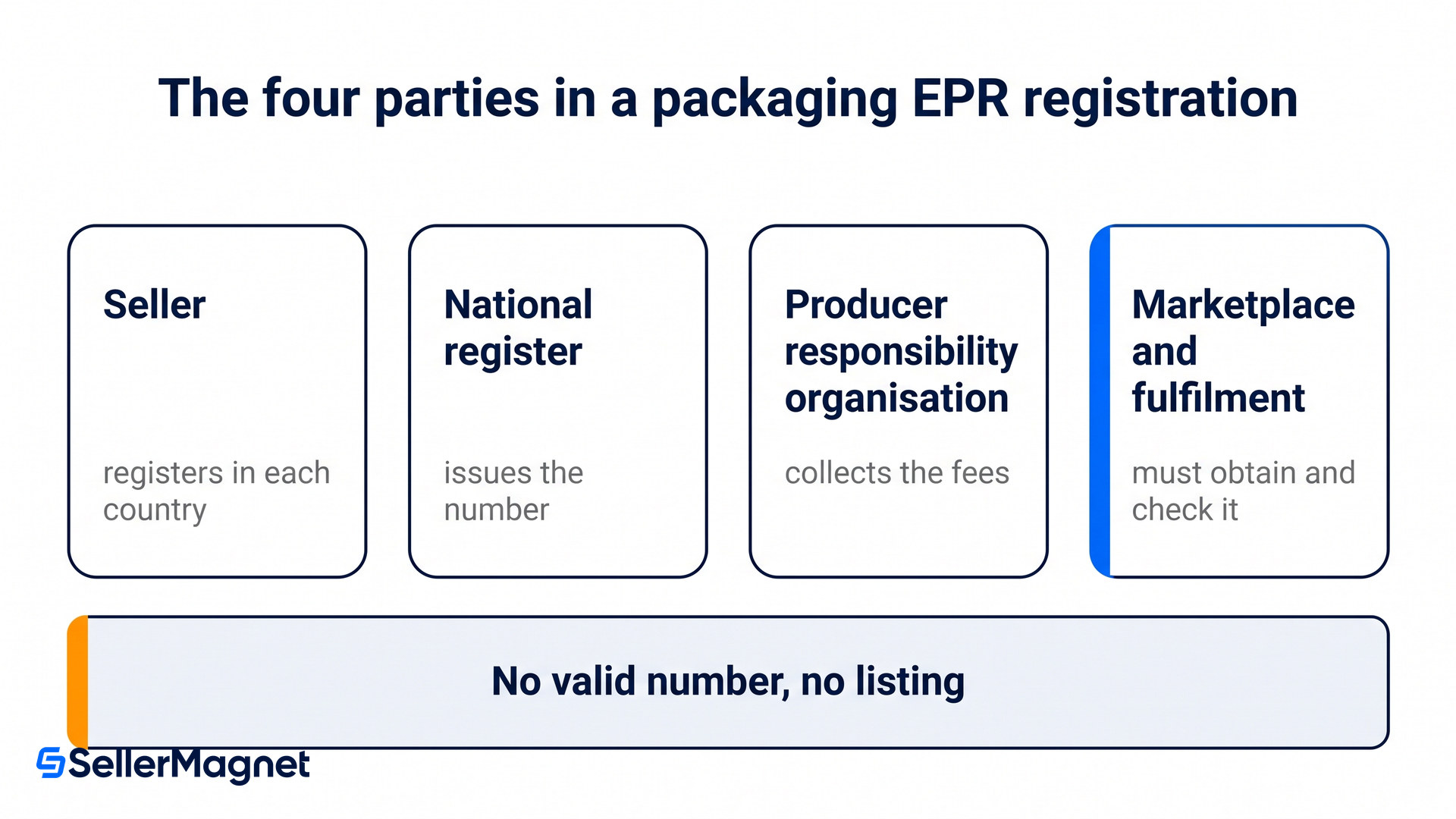
The EU Packaging and Packaging Waste Regulation applies from 12 August 2026, and almost nothing about how your boxes are designed has to change that day. What changes is administrative and much harder to fix late: you must be registered as a packaging producer in every Member State you sell into, and the marketplace is legally required to collect that registration number before it lets you sell.
The EU Packaging and Packaging Waste Regulation, known as PPWR, applies from 12 August 2026. From that date sellers must be registered as packaging producers in each EU country where they first place packaging on the market, and online marketplaces must collect that registration number before allowing sales. Most packaging design requirements start later, between 2028 and 2038.
What actually happens on 12 August 2026?
The Regulation starts applying, in full, with one exception. Article 71 of Regulation (EU) 2025/40 is two sentences long: "It shall apply from 12 August 2026. However, Article 67(5) shall apply from 12 February 2029." The old framework goes at the same moment, because Article 70(1) says "Directive 94/62/EC is repealed with effect from 12 August 2026", keeping only a handful of its provisions alive into 2028 and 2029.
That is why coverage splits into two wrong halves. One says the rules land in August 2026 and you should redesign your packaging now. The other says nothing real happens until 2030. Both are reading the same document and missing that a regulation can apply while most of its substantive duties sit behind dates written inside their own articles.
Which design rules are deferred, and until when?
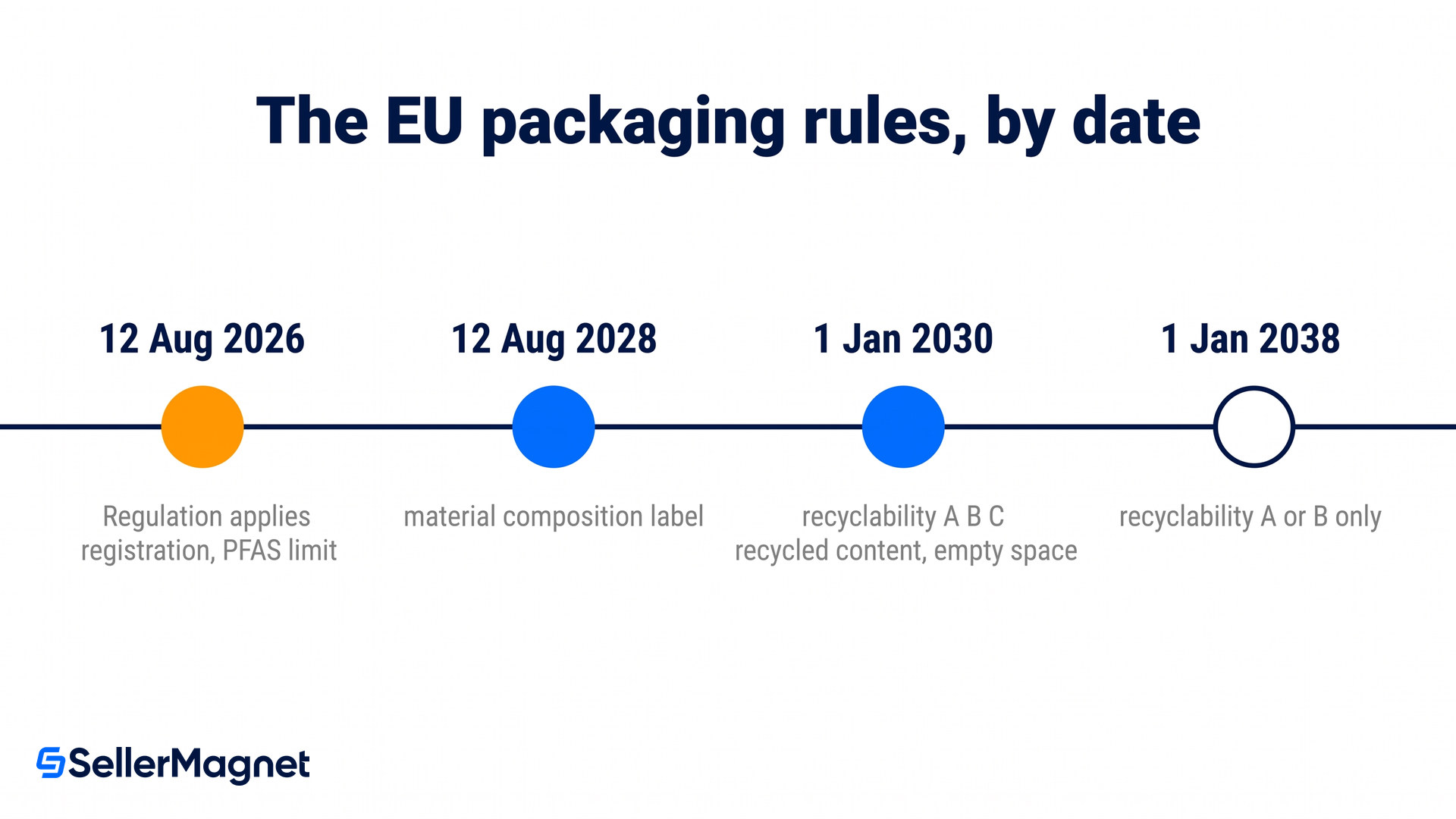
Nearly all of them, on four separate clocks. The dates below are each quoted from the article that carries them, which matters because several are conditional rather than fixed.
Requirement
Article
Applies from
PFAS limits in food-contact packaging
5(5)
12 August 2026
Harmonised material-composition label
12(1)
12 August 2028, or 24 months after the implementing acts, whichever is later
Recyclability grades A, B or C
6(3)
1 January 2030, or 24 months after the delegated acts, whichever is later
Minimum recycled content in plastic
7(1)
1 January 2030, or 3 years after the implementing act, whichever is later
Packaging minimisation
10(1)
1 January 2030
Banned formats in Annex V
25(1)
1 January 2030
Maximum 50% empty space ratio
24(1)
1 January 2030, or 3 years after the implementing acts, whichever is later
Recyclability grade A or B only
6(3)
1 January 2038
The empty space ratio may not arrive in 2030
Article 24(1) reads "By 1 January 2030 or 3 years from the entry into force of the implementing acts adopted pursuant to paragraph 2, whichever is the latest", and Article 24(2) gives the Commission until 12 February 2028 to adopt the calculation methodology. If that methodology arrives on its deadline, the ratio binds no earlier than February 2031, not January 2030, because the three years run from entry into force rather than adoption. Anyone quoting a flat 2030 date for e-commerce boxes is quoting half the sentence.
Two of these deferred rules carry detail worth knowing now. Recyclability is not one switch but three: grades A, B or C from 2030, the recycled-at-scale condition from 1 January 2035, and grades A or B only from 2038. And the labelling duty does reach this audience, because Article 12(1) exempts transport packaging "With the exception of e-commerce packaging". One design rule has no later date attached at all. Article 10(2) already forbids placing on the market packaging "with characteristics that aim only to increase the perceived volume of the product, including double walls, false bottoms and unnecessary layers". If your retail box is padded out to look bigger on a shelf, that is the provision to read before August.
What binds sellers on day one?
Registration, representation and a short list of substantive rules, taken here in reverse order. Article 5(5) is the one that reaches anyone selling food: "From 12 August 2026, food-contact packaging shall not be placed on the market if it contains per- and polyfluorinated alkyl substances (PFAS) in a concentration equal to or above the following limit values", which are 25 ppb for any single PFAS, 250 ppb for the sum, and 50 ppm including polymeric PFAS. Above 50 mg/kg of total fluorine it is "the manufacturer, importer or downstream user" who must show an enforcement authority proof of what that fluorine is, which makes it a question to put to your supplier in writing. Article 5(4) keeps the older limit alongside it: lead, cadmium, mercury and hexavalent chromium together "shall not exceed 100 mg/kg".
The rest is paperwork with teeth. Article 44(2) requires producers to register "in each Member State where they make packaging or packaged products available on the territory of the Member State for the first time", and Article 44(4) turns that into a selling ban: producers "shall not make available packaging or packaged products on the territory of a Member State for the first time ... if they or ... their authorised representatives for the extended producer responsibility are not registered in that Member State."
The PPWR register may not be open yet where you sell
Article 44(1) gives each Member State "within 18 months of the date of entry into force of first implementing act adopted pursuant to paragraph 14" to establish its national register, so on 12 August 2026 some of those registers will not exist. What is already running is the national packaging EPR each country built under the old directive, which is why Germany can deactivate listings today. PPWR does not start that machine. It generalises it, hardens it and puts the marketplace on the hook for checking. Where a PPWR register is not open yet, the national registration you already hold is what a compliance sweep will ask for.
Selling into a country makes you a producer there
This is the definition that catches most sellers. Under PPWR the producer is whoever first makes the packaged product available in that Member State, and the recitals are explicit that for online platforms "the initial offering of a product should be considered as being made available". A UK, US or Chinese seller shipping to a French customer is the producer in France. Pan-EU FBA multiplies the problem, because the platform duty keys on where the customer is, and pan-EU exists precisely to put stock closer to more customers in more countries.
Why does Amazon have to care?
Because Article 45(4) makes checking your number the platform's legal duty, not a courtesy. Two things have to reach the platform before it may let you sell: your registration number for the country the buyer is in, and a self-certification that you are compliant there. The Regulation words the first as "information on the registration of the producers referred to in Article 44 ... in the Member State where the consumer is located and the registration number(s) of the producer in that register".
The platform duty does not stop at collecting the number. Article 45(6) requires the platform to "make best efforts to assess whether the information received is complete and reliable", and Article 45(7) extends the same disclosure to fulfilment service providers at the moment the contract is signed. FBA is a fulfilment service in that sense, so the number has to reach Amazon twice, once as a marketplace and once as your logistics provider.
What does that look like in practice?
Exactly like Germany, which has been running the same idea under national law for years and shows what enforcement feels like. The German check rests on the Verpackungsgesetz rather than on PPWR; what PPWR adds is the same arrangement across the EU, with the platform legally on the hook. Amazon's EPR requirements page states it without hedging: "In Germany, Amazon is obliged to check if you comply with your EPR in two product categories: (1) packaging and (2) electrical and electronic equipment (EEE)", and "For packaging, you must prove your compliance to Amazon by submitting your registration number (LUCID number) on the Account Health page." Listings that cannot show a valid number are deactivated.
The German sequence is the template the rest of the EU is converging on, and Amazon publishes it as four steps.
Register on the national packaging register. In Germany that is LUCID, and the number cannot be used until the entry is visible, which takes up to 72 hours.
Sign a system participation contract with a producer responsibility organisation, after working out the packaging volumes you sell in that country by type.
Report volumes and pay the fees, submitting to the register "the exact same data report provided to the selected PROs".
Hand the number to Amazon on the Account Health page. Amazon validates it with the national authority, which "can take up to five working days".
Do not resubmit a number that already worked
Amazon's own note is blunt about the most common self-inflicted outage: "If you have already submitted your LUCID number on the Account Health and it has been marked as valid, do not submit it again. This will count as a resubmission and reset the validation process, which will cause your listings to become inactive." The page currently carries a second warning that validation is running slower than usual because of submission volume. If your number is green, leave it alone, and route any account tidy-up around it.
Can someone else carry the obligation for you?
Partly, and the part that cannot be delegated is the part sellers assume is automatic. Article 45(3) requires a producer to "appoint, by written mandate, an authorised representative for the extended producer responsibility in each Member State where the producer makes packaging or packaged products available for the first time, other than the Member State where the producer is established", and lets Member States extend that to third-country producers.
A representative is not a way out of registering, though. Amazon's German page draws the line precisely: "Only international companies without a branch in Germany can appoint an authorised representative", and "With the exception of registering in the LUCID packaging register, the authorised representative assumes responsibility for all of your obligations under VerpackG and fulfils them in their own name. The one-off LUCID registration requirement is a personal obligation that rests with you the original party under obligation."
What about small volumes?
There is a lighter reporting track, not an exemption. Article 44(8) applies where a producer makes available "a quantity of packaging, including packaging of packaged products, of less than 10 tonnes during one calendar year", and such producers file the shorter report in Part B, point 2 of Annex IX instead of the full one. Member States may set the threshold lower, so it is not a number to rely on across borders.
Everyone else reports annually. Article 44(7) sets the deadline at "1 June for each full preceding calendar year", and Member States may require the figures to be "audited and certified by independent auditors". Penalties are national: Article 68 leaves the rules to Member States, which must notify the Commission of them by 12 February 2027.
How to be ready for 12 August 2026
List the countries you actually place packaging in - Not the countries you have listings in, the ones where your goods first reach the market. Pan-EU FBA, a Multi-Country Inventory setup and direct cross-border shipments all create that moment in different places, so start from where stock physically lands and where orders are delivered from.
Check which registrations you already hold - Germany's LUCID number and France's packaging identifier are the two that most sellers already hold, often obtained years ago under national law. Confirm each number is current and that the brand names and packaging types on file still match what you ship, because the registration is only as good as the declaration behind it.
Appoint a representative where you are not established - Article 45(3) requires a written mandate in every Member State where you place packaging and are not established. Line these up before August rather than during a listing outage, and remember that in Germany the register entry itself stays your personal obligation even with a representative appointed.
Get the number into Amazon before it is asked for - Once the platform duty applies, a missing number is not a warning, it is a block on using the service. Submit through the Regulatory Compliance section under Account Health, allow up to five working days for validation, and do not resubmit a number that is already marked valid.
Check food-contact packaging for PFAS - This is the design question with an August 2026 date. Ask suppliers for total fluorine figures on any packaging that touches food, and keep the documentation, because above 50 mg/kg of total fluorine the manufacturer, importer or downstream user has to prove to an enforcement authority what that fluorine is.
Diary the deferred dates rather than acting on them - Labelling in 2028, recyclability grades and recycled content in 2030, banned formats in 2030, grade A or B in 2038. Three of those are conditional on Commission acts, so the practical move now is a calendar entry and a supplier conversation, not a packaging redesign.
The spreadsheet that answers this
One row per Member State you sell into. Four columns: do you place packaging there, do you hold a registration number, are you established there, and do you have a representative appointed. Any row with a yes in the first column and a gap in the second or fourth is a listing outage waiting for a compliance sweep. That sheet takes an hour and it settles the part that can stop you selling, because a missing registration number blocks a listing in 2026 and a deferred design rule cannot. Food-contact packaging needs one more line for the PFAS question.
Compliance sweeps are one of the few things that take a healthy EU account offline overnight. Knowing which marketplaces carry enough revenue to be worth the registration fees, and which are small enough to close instead, is a margin question before it is a legal one. A seller analytics dashboard that splits sales by marketplace shows which ones carry the revenue, and our guide to Amazon GPSR compliance covers the other EU regime that removes listings for a missing contact detail.
When does PPWR apply?
From 12 August 2026. Article 71 of Regulation (EU) 2025/40 defers only Article 67(5), to 12 February 2029, and Directive 94/62/EC is repealed with effect from the same August date.
Do I have to change my packaging by August 2026?
In most cases no. Labelling applies from 2028, recyclability grades and recycled content from 2030, banned formats from 2030. The exceptions are the PFAS limits for food-contact packaging and the standing ban on false bottoms and double walls used to inflate perceived volume.
Do I need to register in every EU country I sell to?
In every Member State where you first make packaging or packaged products available. Article 44(4) forbids doing so without being registered there, or without a registered authorised representative for extended producer responsibility.
Will Amazon block my listings over this?
Amazon already does it in Germany, under German packaging law rather than PPWR, where it is obliged to check packaging EPR and deactivates listings without a valid LUCID number. Article 45(4) puts the same duty on online platforms across the EU, and Article 45(6) requires them to assess whether what you submitted is complete and reliable.
Is there a small-seller exemption?
No. Below 10 tonnes of packaging a year you file a shorter annual report under Article 44(8) rather than the full one, and Member States may set the threshold lower. Registration itself still applies.
When does the 50% empty space rule start?
On 1 January 2030 or three years after the Commission's calculation methodology enters into force, whichever is later. The methodology is itself due by 12 February 2028, so the real date depends on Brussels keeping to its own deadline.
Stop Juggling Tools. SellerMagnet Combines Everything You Need.