Amazon GPSR Compliance: What Gets a Listing Removed
R
RenéFreelance Amazon Editor
|
9 min read
GPSR is the EU's General Product Safety Regulation, and it has applied since 13 December 2024. On Amazon it means a non-food listing in an EU store generally needs a responsible operator established in the EU, the manufacturer's contact details, and any warning or safety information, submitted through Seller Central. Offers Amazon finds non-compliant get deactivated. The part most sellers get wrong is who is allowed to hold that responsible role.
GPSR is the European Union's General Product Safety Regulation, applicable since December 2024. To sell non-food products in Amazon's EU stores you must name a responsible operator established in the EU, give the manufacturer's contact details, and supply warning and safety information. Amazon deactivates offers that are not compliant.
What is GPSR and who does it apply to?
GPSR is the rulebook for consumer product safety in the EU. The European Commission's Access2Markets briefing describes it as "Applicable from the 13 December 2024", replacing the General Product Safety Directive. The instrument itself is Regulation (EU) 2023/988, whose Article 52 says simply that it shall apply from that date.
Coverage is broad rather than niche. Amazon's April 2024 implementation announcement told sellers that "most non-food consumer products offered for sale in the EU will fall under the jurisdiction of GPSR, including used, repaired, and reconditioned items", with exceptions it lists as "medicinal products, food and drinks, and living plants and animals". Second-hand and refurbished stock being in scope catches a lot of sellers who assumed the rules were for manufacturers.
Do you really need to pay for an EU Responsible Person?
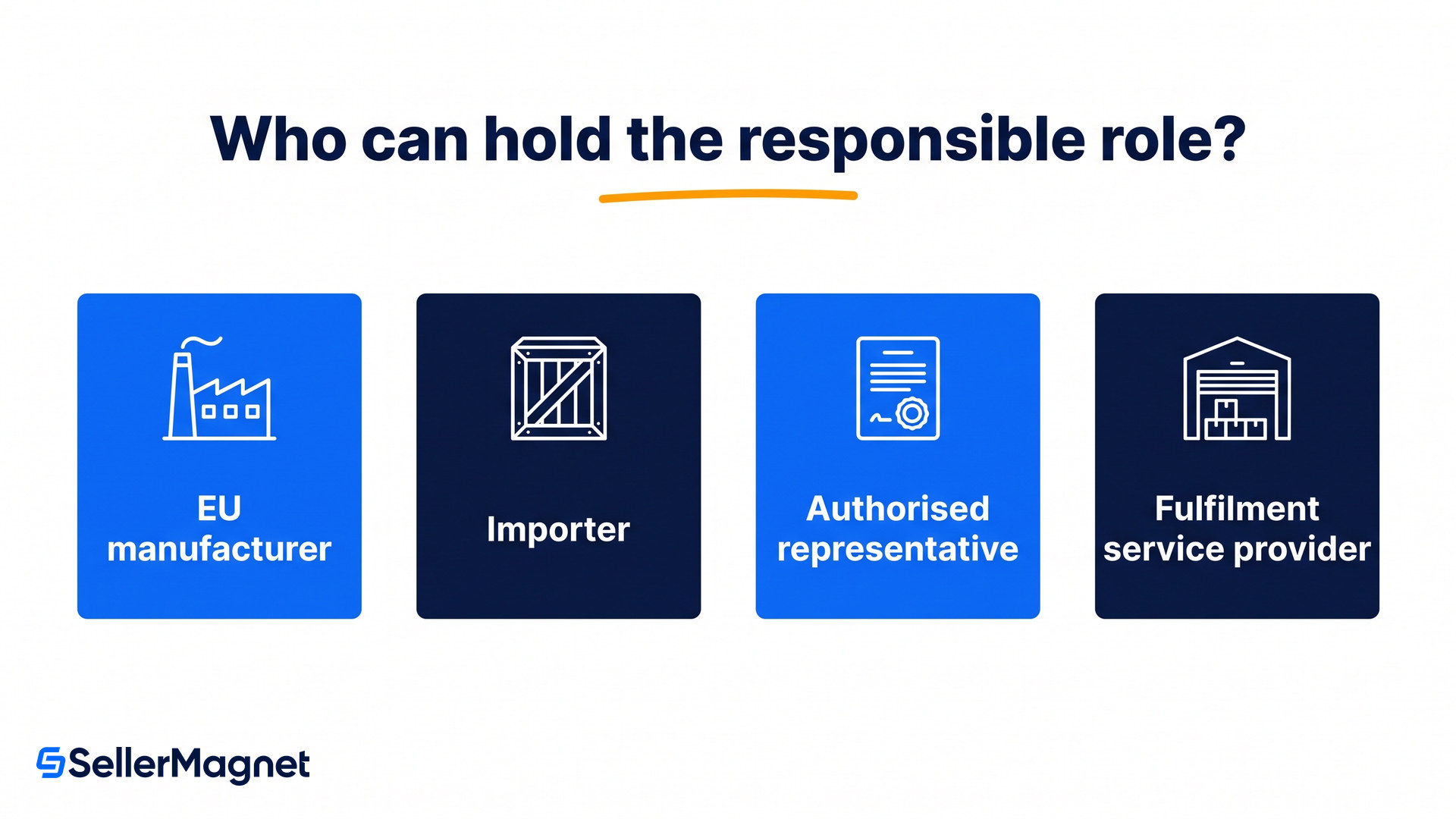
Check your supply chain before you buy a subscription. The European Commission's wording is that "a responsible economic operator in the EU (an EU manufacturer, importer, authorised representative or a fulfilment service provider) shall be entrusted with tasks relating to the safety of each product covered by the regulation". Four types can hold it, but read them as a cascade rather than a menu. GPSR Article 16 imports Article 4(2) of Regulation (EU) 2019/1020, where the importer slot arises "where the manufacturer is not established in the Union", and a fulfilment service provider qualifies only "where no other economic operator as mentioned in points (a), (b) and (c) is established in the Union".
Operator type
When it already exists in your chain
What it means for you
EU manufacturer
You buy from a producer established inside the EU
The role is already filled by someone you have a commercial relationship with
Importer
The manufacturer sits outside the EU and an EU-established company brings the goods in, possibly your own EU entity
Often the cheapest answer for a seller who already imports through an EU company
Authorised representative
The manufacturer appoints one under a written mandate
This is what most paid services sell, but the mandate has to come from the manufacturer, not from you
Fulfilment service provider
An EU-established logistics provider handles storage and dispatch, and none of the three above exists in the Union
Worth asking your provider whether it takes the role and on what terms
None of this removes the obligation, and none of it is legal advice. Amazon says so about its own guidance too: "this post serves as a guide and not legal advice". The point is narrower and practical. A seller importing through their own EU entity, or selling goods made by an EU manufacturer, should establish who holds the role before paying for a service that may duplicate it. A seller with no EU presence at all will need one of the later rungs of that cascade. Either way one thing does not change: whoever holds the role, you still enter that entity in Amazon's EU Responsible Person field, so establishing that your importer already covers it saves you a subscription, not a submission.
What does Amazon make you submit?
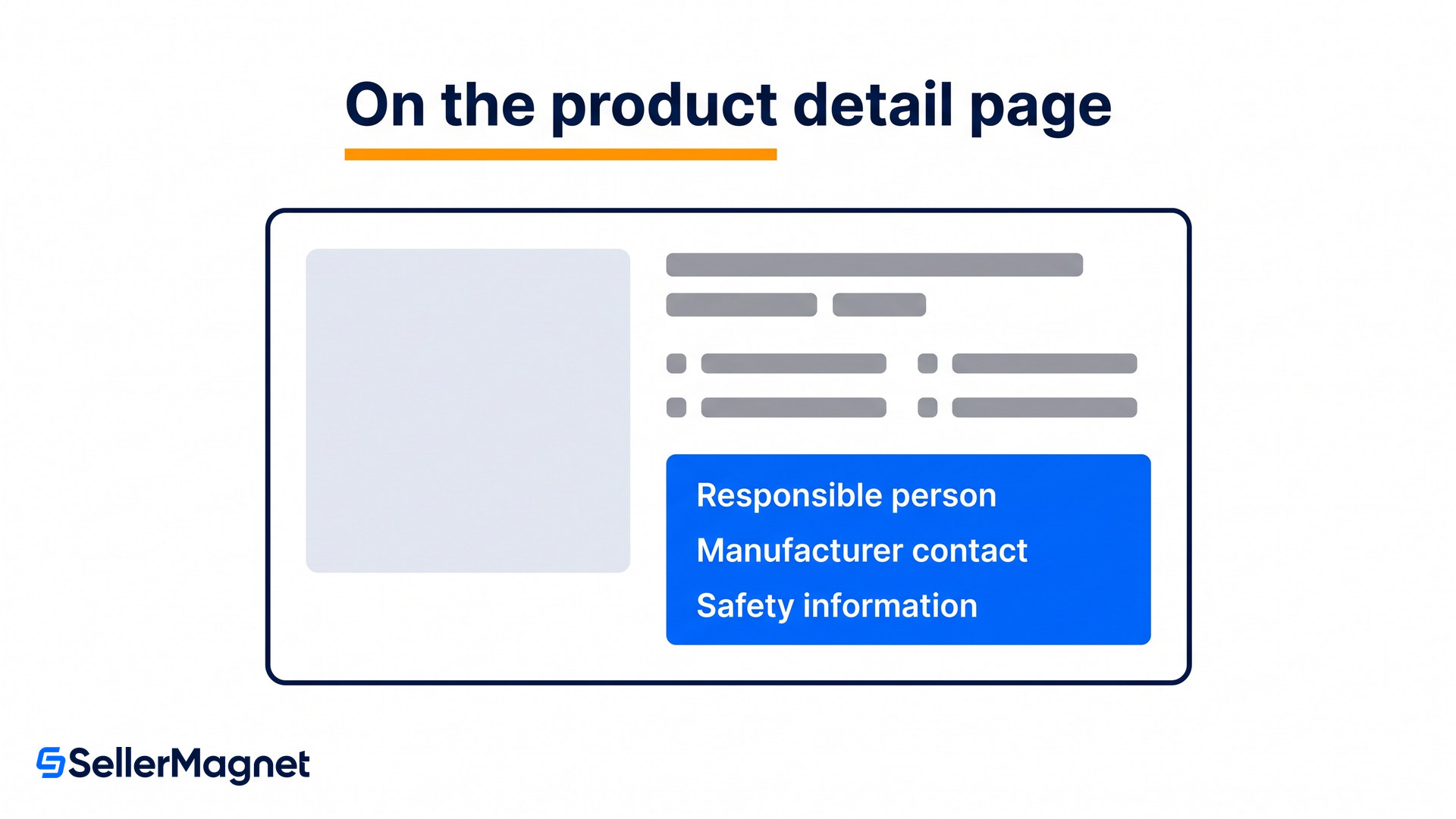
Three items per offer, entered in Seller Central. Amazon's post on proving compliance on the Account Health page lists them as "EU Responsible Person", "Manufacturer contact", and "Warning and safety PDFs or images (or acknowledgement that this isn't required)".
What Amazon asks for
Where it goes
What it looks like to a shopper
EU Responsible Person
Account Health, regulatory compliance section, or the compliance widget
Name and contact details on the product detail page
Manufacturer contact
Same submission flow
Manufacturer name and contact details on the detail page
Warning and safety files
Uploaded as PDFs or images, or acknowledged as not required
Warnings and safety documents shown with the listing
Nothing, for UK-store listings
No submission to Amazon at all
Unchanged
Publication is quick once you confirm. Amazon states that "Responsible Person and manufacturer information, along with relevant images and safety documents, will be displayed on product detail pages within 24 hours of confirmation".
The goods carry their own share of this, though not always the product itself. Article 16(3) lets the responsible operator's details be indicated "on the product or on its packaging, the parcel or an accompanying document", while Amazon's current help pages are stricter about the manufacturer's details, which belong on the product. Four things have to be visible somewhere on what the buyer receives, and that is the half of GPSR a Seller Central submission cannot cover for you.
The responsible person's contact information, which Amazon says must be "in one of the EU's official languages".
The manufacturer's contact details, plus the importer's where one applies.
A unique identifier, so Amazon asks that each product carries one "for easy identification".
Warning and safety information, which Amazon wants "both physically and in online listings".
The UK store is a separate question
Amazon is explicit that "for listings on Amazon UK-based store, you don't need to submit any information to Amazon", while EU-store listings do require it. That is a statement about Amazon's submission process, not about UK product-safety law, which has its own regime. Northern Ireland is the awkward case, and not the way most guides tell it: GPSR applies in Northern Ireland but not in Great Britain, while Northern Ireland is served by the UK store, where Amazon asks for nothing. Sellers raised exactly that gap under Amazon's announcement and did not get an answer, so treat the obligation as live even where the submission box is not.
What happens to a non-compliant listing?
Amazon deactivates offers it becomes aware are non-compliant. The wording in its Account Health post is "after December 13, if we become aware of non-compliant offers, such as those with invalid information or expired contracts, we will deactivate them", and the implementation announcement adds that "non-compliant listings risk removal and ineligibility for flash sales".
Two details in that sentence matter more than the headline. Expired contracts count as non-compliance, which makes an authorised representative agreement a renewal you have to diary rather than a one-off purchase. And invalid information covers a field that was filled in badly, so an offer can be flagged even though every box on the form has something in it.
Where GPSR meets your account health
Amazon put the GPSR queue on the Account Health page, in the product policy compliance area, so compliance work and account health are now the same screen. If the score on that page is a mystery to you, our guide to the Account Health Rating explains what the number reacts to and what a deactivation looks like in the violations box.
How do you clear a flagged offer?
Work from Amazon's own list rather than from your catalogue. The Account Health page shows the brands and offers Amazon expects to be compliant, which is a shorter and better-ordered list than every ASIN you sell.
How to clear a GPSR flag on an Amazon EU listing
Open the regulatory compliance list on Account Health - Go to the Account Health page in a European Seller Central account and open the product policy compliance area. Amazon lists the brands and offers it expects to be compliant, and adds to that list over time, so check it again after you have cleared it once.
Establish who your responsible operator actually is - Before paying anyone, check whether an EU manufacturer, an importer, an authorised representative or a fulfilment service provider in your chain already holds the role. If none does, work down the cascade: an authorised representative has to be mandated by the manufacturer, so that conversation starts with your supplier. Keep the agreement on file with its renewal date.
Submit the responsible person and manufacturer details - Use the compliance widget to enter the responsible person and the manufacturer contact for each offer. Enter details that would survive a check, because Amazon treats invalid information the same as missing information.
Upload warnings and safety files, or acknowledge that none apply - Attach the warning and safety documents as PDFs or images. Where a product genuinely needs none, use the acknowledgement option rather than leaving the section empty.
Check the detail page and diary the renewals - Amazon publishes the information on the product detail page within 24 hours of confirmation, so look at the live page to confirm it arrived. Then put the contract end dates in a calendar, because an expired agreement is treated as non-compliance.
Quick win for today
Open the regulatory compliance list and sort your own side of it by revenue rather than working alphabetically. A deactivated offer costs you whatever that offer earns, so the order you clear them in is worth real money. The SellerMagnet profit dashboard shows which ASINs actually carry your margin, which is the order to work in when the list is long.
Be careful what you read about enforcement timing
This topic attracts confident vendor posts with numbers Amazon has never published, including specific suppression windows measured in hours and descriptions of how the detection works. Amazon's own wording carries no timer at all: it deactivates offers when it becomes aware they are non-compliant. Treat any precise enforcement clock you meet as a vendor's estimate, and treat all of this, including this article, as a starting point rather than legal advice.
13 December 2024. The European Commission describes the regulation as applicable from that date, replacing the previous General Product Safety Directive.
Does every seller have to appoint an EU Responsible Person?
Every product needs a responsible economic operator established in the EU, and four types qualify in a fixed order: an EU manufacturer, then an importer, then an authorised representative the manufacturer mandates, then a fulfilment service provider. Check your chain before buying a service.
Do I need to submit GPSR information for my UK listings?
Not to Amazon. Amazon states that listings in its UK store need no information submitted, while listings in EU stores do. That is about Amazon's process, not about UK law.
Are used and refurbished products in scope?
Yes. Amazon's announcement puts used, repaired and reconditioned items inside the scope of GPSR, alongside most other non-food consumer products.
What exactly gets my offer deactivated?
Amazon says it deactivates offers it becomes aware are non-compliant, and names invalid information and expired contracts as examples. A filled-in but wrong field counts, and so does a lapsed agreement.
How quickly does the information appear on my listing?
Amazon states that the responsible person and manufacturer information, with any images and safety documents, is displayed on the product detail page within 24 hours of confirmation.
Stop Juggling Tools. SellerMagnet Combines Everything You Need.