Amazon Seller Insurance: The 2 November 2026 Change
R
RenéFreelance Amazon Editor
|
11 min read
From 2 November 2026, Amazon requires USD 1 million of commercial liability insurance for any product in a category with enhanced safety listing requirements, regardless of your gross sales proceeds. The USD 10,000-a-month trigger that most small sellers rely on stops applying to those listings. Insurance is also only one of three requirements Amazon attaches to those categories, and the category list is not fixed.
From 2 November 2026, Amazon requires one million US dollars of commercial liability cover for any listing in a category with enhanced safety listing requirements, no matter how little you sell. The ten thousand dollar monthly threshold still governs everything else, but it no longer applies to those categories.
What changes on 2 November 2026?
Two things, both added to the existing rule rather than replacing it. Amazon's Commercial Liability Insurance Requirements page lists them under the line "The following additional requirements will apply effective November 2, 2026".
Enhanced-safety categories lose the threshold. If you sell products in categories with enhanced safety listing requirements, you must hold a policy with USD 1 million coverage per occurrence and in aggregate, in Amazon's words "regardless of your gross sales proceeds".
Mainland China sellers lose the choice of insurer. A seller based in Mainland China is required to obtain the policy through the Amazon Insurance Accelerator programme, "unless otherwise agreed in writing by Amazon".
Everything else on that page stays as it is. The USD 1 million limit is not new, the list of policy criteria is not new, and the Amazon Insurance Accelerator has existed for years as one route to a compliant policy among others. What is new is who gets asked, and when.
Which categories are affected?
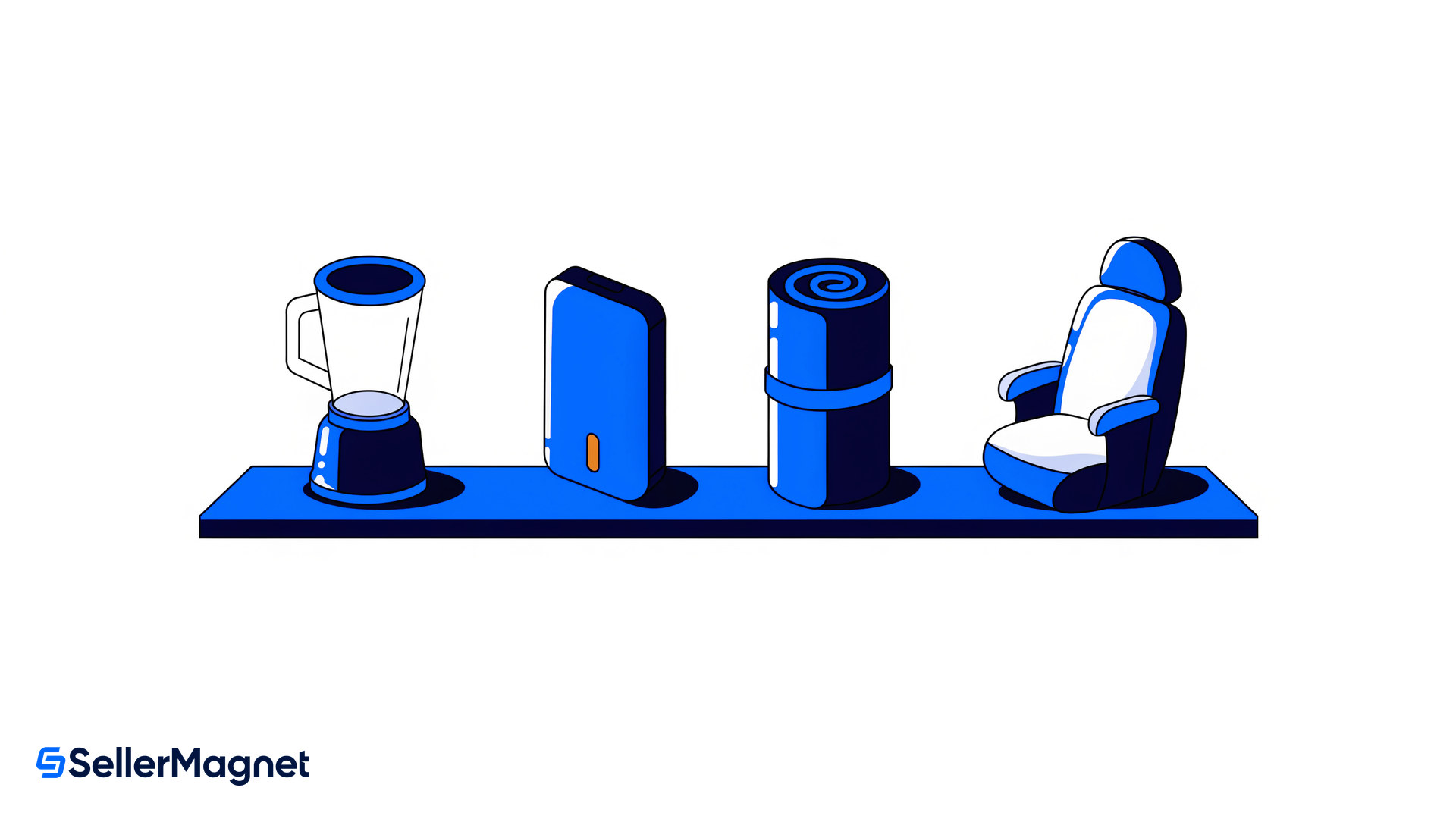
Amazon groups them on a separate page, Product categories with enhanced safety listing requirements. Eleven groups are named there at the time of writing. They are broader than the phrase "safety products" suggests: a countertop blender, a power bank and a mattress all sit inside them.
Category group
What Amazon lists under it
Children's products
Child restraint systems; booster seats; travel systems; children's toys; infant support cushions and nursing pillows; infant and toddler sleep products; play yards; children's portable bed rails
Consumable and ingestible products
Dietary supplements; ingestible over-the-counter medication; ophthalmic drug products
Fire-related products
Fire extinguishers; smoke and carbon gas alarms
General household devices
Immersion water heaters; small kitchen appliances
Home medical devices
Medical mobility and transfer equipment; respiratory care supplies for home use; walkers and rollators
Lithium battery products
Lithium batteries; portable power supplies; e-mobility devices and accessories; lithium-battery-powered home appliances; lithium-battery-powered smart home and consumer electronics
Climbing harnesses and ropes; fall-protection harnesses; mountaineering carabiners and helmets; safety helmets
Sleep products
Mattresses; adult portable bed rails
Transport-related products
Auto and motorcycle tires
Water and marine safety products
Wearable or inflatable flotation products; pool safety and access control products
The list is not a checklist
Amazon's own wording on that page is that the list "changes as Amazon adds new categories, and it does not cover all products with these requirements". Reading the eleven groups and concluding you are outside them is not a safe answer. Amazon points sellers to Account Health instead.
Does the USD 10,000 threshold still matter?
Yes, for everything outside the enhanced-safety categories. The baseline rule is unchanged: under section 9 of the Business Solutions Agreement you must obtain and maintain commercial liability insurance within 30 days after exceeding USD 10,000 in gross proceeds in sales in one month, or if Amazon otherwise requests it.
What changes is that the threshold stops being a shield for one part of the catalogue. A seller who ships forty nursing pillows a month has never been near USD 10,000 and has never been asked for a certificate. From 2 November that seller is inside the requirement, and the trigger is the category, not the turnover.
That is also why the change lands hardest on the smallest accounts. Sellers above the threshold already hold a policy and already uploaded a certificate. The population newly in scope is the one that has never done either, and it has until 2 November to work out how.
Why is insurance only one of three gates?
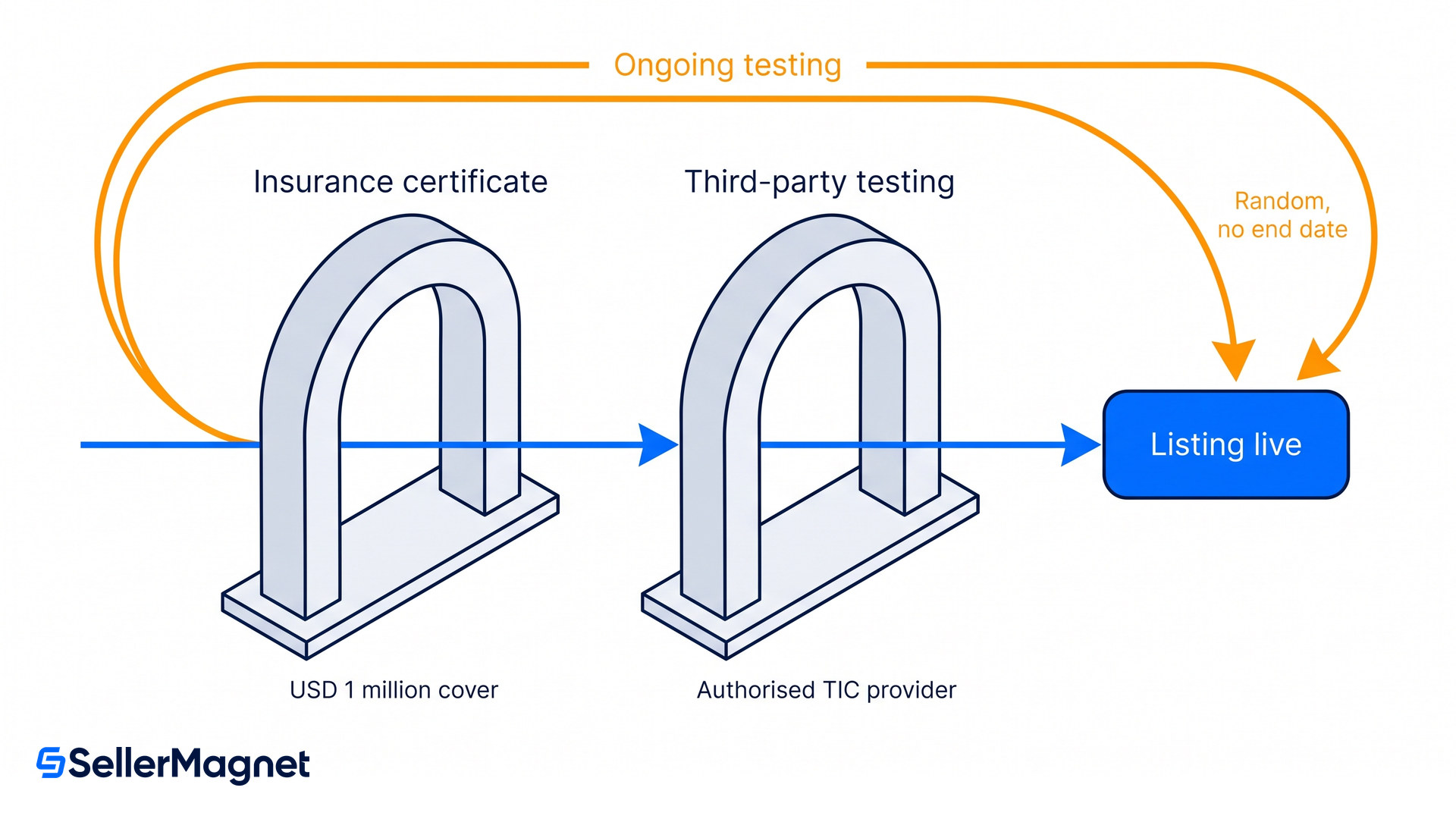
Because clearing the certificate still leaves two conditions behind it, and both take longer to satisfy. The enhanced-safety page attaches three things to those categories: a policy, a laboratory, and an open-ended right to retest. Only the first has travelled in the coverage.
Product liability insurance. You need a Certificate of Insurance with at least USD 1 million per occurrence and in aggregate, submitted through Business Insurance verification in Seller Central. Amazon reviews it, and in Amazon's words, "Once it meets the requirements, your selling privileges will be turned on." The certificate is a switch, not a filing.
Third-party product testing. To list, you must work with a direct product validation authorised third-party testing, inspection and certification provider to verify all notified ASINs. Amazon has moved the paperwork out of your hands: "You will no longer submit documents directly to Amazon. Instead, the TIC provider will submit them on your behalf." You may use another accredited lab, but an authorised TIC provider then has to validate its results.
Ongoing testing. Products may be selected for periodic testing or inspection at any time. A failure brings required actions, and Amazon states that for serious safety issues it must report to regulators and that you may be required to issue a product recall. This one has no end date.
What happens if you do nothing
Amazon's enforcement line on the enhanced-safety page is short: products that do not comply "are subject to action", and it reserves the right to act under the Business Solutions Agreement, "including, but not limited to, removing the relevant product listings". The page names no fee, no warning period and no grace tier. The consequence it does name is the listing.
What must the policy actually say?
More than "USD 1 million". Amazon's criteria list is specific, and the wording matters as much as the amount. A generic liability policy will not carry several of these clauses unless somebody asks for them.
Commercial general, umbrella or excess liability, written on an occurrence basis. If your category cannot be written that way, Amazon's FAQ points you to a claims-made policy instead.
At least USD 1 million per occurrence and in aggregate, covering products/completed operations and bodily injury.
A deductible of no more than USD 10,000, and the deductible amount has to be listed on the certificate itself.
"Amazon.com Services LLC and its affiliates and assignees" named as additional insureds, in those words.
No sunset clause.
The insured name matching the legal entity name in your Account Info, with a trade name accepted only for single-member LLCs.
An insurer with global claim handling and a financial rating of S&P A- or AM Best A- or better, or a local equivalent where those ratings are not used.
The policy completed in full and signed by an authorised representative of the insurer, with at least 30 days' notice to Amazon of cancellation, modification or non-renewal.
There is a stated exception route
Amazon says it "will consider exceptions to these requirements on a case-by-case basis if you are unable to secure a policy that meets these requirements". The page does not describe how to request one or what evidence it wants, so treat it as a fallback to raise with Selling Partner Support, not a plan.
Does this apply to sellers outside the United States?
The rule applies to your Amazon.com store, whoever and wherever you are. The page carries the banner "This article applies to selling in: United States" and its text refers throughout to gross proceeds and listings on Amazon.com. A German or Italian seller who runs a US store is squarely inside it; the passport does not matter, the marketplace does.
European stores are a separate question. The page is the Amazon.com rule, published in the US help layer, and nothing on it speaks to Amazon.de or Amazon.it. If you sell in Europe, read it as the rule for your US operation and check your European obligations separately, including the product safety rules that already bite there. Our guide to what GPSR non-compliance costs an EU listing covers the European side of the same problem.
One group is singled out by location rather than marketplace. A seller based in Mainland China must buy through the Amazon Insurance Accelerator from 2 November, unless Amazon has agreed otherwise in writing. For everyone else the Accelerator stays optional: any insurer meeting the criteria above is acceptable.
How to get your certificate accepted before 2 November
Check Account Health, not the category list - Amazon tells sellers to check Account Health for the requirements that apply to their products. That is the authoritative answer for your catalogue, because the published category list changes and does not cover every affected product.
List the ASINs that are inside - Work out which of your live ASINs fall in an affected group. A single lithium-battery accessory or one mattress puts you in scope even if the rest of the catalogue is untouched.
Send your broker the criteria, not the summary - Give them Amazon's full criteria list. The clauses a generic policy is least likely to carry are the additional-insured wording, the deductible cap, the deductible printed on the certificate itself, and the occurrence basis.
Check the insured name against Account Info - The name on the policy has to match the legal entity name Amazon holds for you. If those drifted apart after a company change, fix the mismatch before the certificate is issued rather than after it is rejected.
Upload through Business Insurance verification - Submit the certificate in Seller Central under Business Insurance verification and leave time for Amazon's review. Selling privileges for the affected products turn on once the policy meets the requirements, so the review sits between you and the listing.
Line up the testing route in parallel - If your products are in an affected group, an authorised TIC provider has to verify the notified ASINs and submit on your behalf. Booking that after the certificate is approved wastes the only slack you have.
It attaches per product, not per account
Two ASINs in the same account can get different answers. A flagged product needs the certificate, the laboratory and a tolerance for random retesting; an unflagged one carries on under the old threshold rule, even if it sits in the same shipment. Work the question product by product, and do not assume one clean ASIN clears the account.
Knowing which ASINs actually carry your volume makes the triage quicker. If you track margin and unit movement per ASIN in a seller analytics dashboard, the question of whether one affected listing is worth keeping answers itself in a minute. And because non-compliance lands as listing removal rather than a fee, it shows up first in the metrics behind your Account Health Rating.
Do I need insurance if I sell under USD 10,000 a month?
Outside the enhanced-safety categories, no: the 30-day trigger after exceeding USD 10,000 in a month still applies. Inside them, yes, from 2 November 2026, regardless of your gross sales proceeds.
How much does Amazon seller insurance cost?
Amazon does not publish premiums and they vary by category, limits and claims history. The Amazon Insurance Accelerator is a network of providers that quotes qualifying sellers at competitive rates, and using it is optional today. From 2 November 2026 it becomes mandatory for sellers based in Mainland China, unless Amazon agrees otherwise in writing.
What is a Certificate of Insurance on Amazon?
It is the document proving your policy, uploaded through Business Insurance verification in Seller Central. Amazon reviews it, and selling privileges for affected products turn on once it meets the requirements.
Does one policy cover all my Amazon marketplaces?
The rule described here is the Amazon.com one, and it asks for a policy covering all products you list in the Amazon.com store. Obligations in other stores are set separately, so confirm them for each marketplace you sell in.
What happens if my certificate is rejected?
Selling privileges for the affected products turn on only once a compliant policy is accepted. The criteria most likely to trip a first certificate are the additional-insured line, a deductible over USD 10,000, and the occurrence basis.
Is insurance the only new requirement in these categories?
No. The same Amazon page requires verification by an authorised third-party testing provider before listing, and warns that products may be selected for surveillance testing at any time, with a recall possible if one fails.
Stop Juggling Tools. SellerMagnet Combines Everything You Need.