A seller who sold on Amazon before August 2023 still searches for "FBA Small and Light enrollment" and lands on a help page that opens with a closure notice instead of a sign-up form. The program that program is gone: Amazon closed FBA Small and Light on August 29, 2023, and replaced it with Low-Price FBA rates, a discount that needs no enrollment, no separate SKU, and no approval queue. Every standard-size item priced under $10 in an eligible category now gets the lower rate automatically, the moment it lists at that price, and loses it automatically the moment the price crosses back over $10. That automatic, no-action design is also why it is easy to get wrong in a spreadsheet: the discount is not a flat percentage, it moves seller to seller by weight tier and category, a 3.5 percent fuel and logistics surcharge sits on top of every number Amazon itself publishes as "surcharge not included," and from January 15, 2027, five whole categories stop qualifying no matter how low the price goes. This guide works through what Low-Price FBA actually pays today, the exact price gates at $10 and $50, the fuel surcharge sellers keep leaving out of their own math, the holiday peak-period rates that apply from October 15 through January 14, and the specific category exclusions arriving in January 2027.
Low-Price FBA is Amazon's automatic fulfillment-fee discount for standard-size items priced under $10 in eligible fee categories, introduced August 29, 2023 to replace the closed FBA Small and Light program. No enrollment, approval, or separate SKU is required: Amazon applies the lower rate the moment a product's price is strictly below $10 and removes it the moment the price rises to $10 or above. A 3.5% fuel and logistics-related surcharge (US, since April 17, 2026) and holiday peak rates (October 15 to January 14) both apply on top of the published Low-Price FBA rate, and from January 15, 2027, five fee categories (Automotive and Powersports, Compact Appliances, Musical Instruments and AV Production, Media, and Computers) stop qualifying for the discount at any price.
What replaced FBA Small and Light, and when
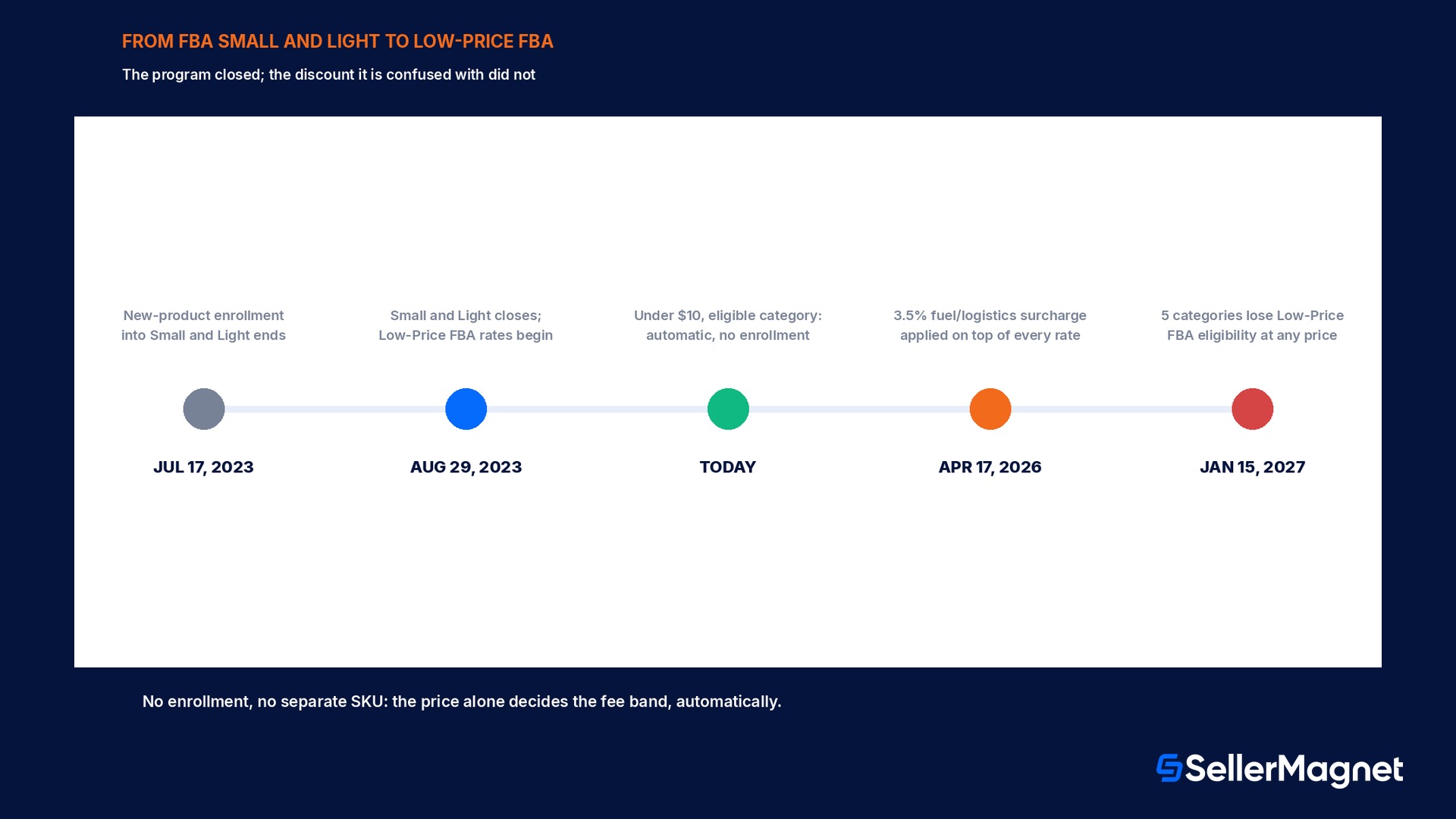
Amazon's own closure FAQ states it plainly: "On August 29, 2023, the FBA Small and Light program will end and Low-Price FBA rates will be introduced. The new rates make it simpler for every seller to take advantage of lower fees on their low-priced selection, while providing the same FBA delivery speeds that customers love." Enrollment of new products into Small and Light stopped on July 17, 2023, six weeks before the closure itself, and items already enrolled kept their old Small and Light rates right up to August 28. Nothing about an existing SKU needed to change on the seller's side: Amazon's FAQ confirms a seller did not need to remove SKUs from the program, that inventory stayed associated with the same SKU, and that items enrolled in Small and Light simply remained FBA-eligible once the switch happened. The one practical snag for a seller who ran parallel SKUs, one for standard FBA and one for Small and Light on the same ASIN, was that SKUs using Amazon's own barcode labels (rather than manufacturer UPCs) could not be merged after the fact, because the physical FNSKU labels differed; Amazon's guidance was to pick one SKU going forward and wind the other down through normal inventory removal.
FBA Small and Light (closed)
Low-Price FBA (current)
Enrollment
Required, through a separate enrollment page
None; automatic based on price
Separate SKU
Yes, a distinct SKU per enrolled product
No; same SKU, price alone decides the rate
Price cap at close
$12 or less (raised from $8 in 2022)
Under $10 (narrows further Jan 15, 2027)
Size/weight cap
18 x 14 x 8 in, 3 lb or less
No separate cap; set by the product's own size tier
Delivery speed
Standard FBA Prime speeds
Same standard FBA Prime speeds (unchanged)
Status
Closed August 29, 2023
Current; narrows January 15, 2027
The exact price gate: what happens at $10 and at $50
Amazon's own 2027 FBA fee-change FAQ answers the boundary question sellers most often get wrong, and the answer is strict rather than inclusive: "Items priced at $10 and $50 will be eligible for $10-$50 rates. Items priced below $10 (except select fee categories) will be eligible for <$10 rates, and items priced above $50 will be eligible for >$50 rates." A product priced at exactly $9.99 qualifies for the <$10 band; the same product re-priced to exactly $10.00 drops into the $10-$50 band and loses the Low-Price FBA discount entirely, even though the price moved by one cent. The same strict rule applies at the next boundary: $50.00 exactly still belongs to the $10-$50 band, not the >$50 band. A seller running a dynamic repricer close to either line should treat $10.00 and $50.00 themselves as the discount's hard edge, not a rounding buffer; a listing priced at $9.999 that Amazon's own storefront displays as $9.99 to shoppers is evaluated by Amazon's fee engine at its stored price, so a repricer that nudges a product to exactly $10.00 silently removes the discount on every unit sold from that point.
No action is required, which also means no warning is sent
Amazon's FAQ is explicit that no enrollment or action is needed to receive Low-Price FBA rates, and the same applies in reverse: there is no notification when a price change moves a SKU out of the band. A price edited from $9.98 to $10.00 for an unrelated reason (matching a competitor, rounding a promotion) changes the fulfillment fee with no separate alert.
What Low-Price FBA actually pays today (non-peak, before the fuel surcharge)
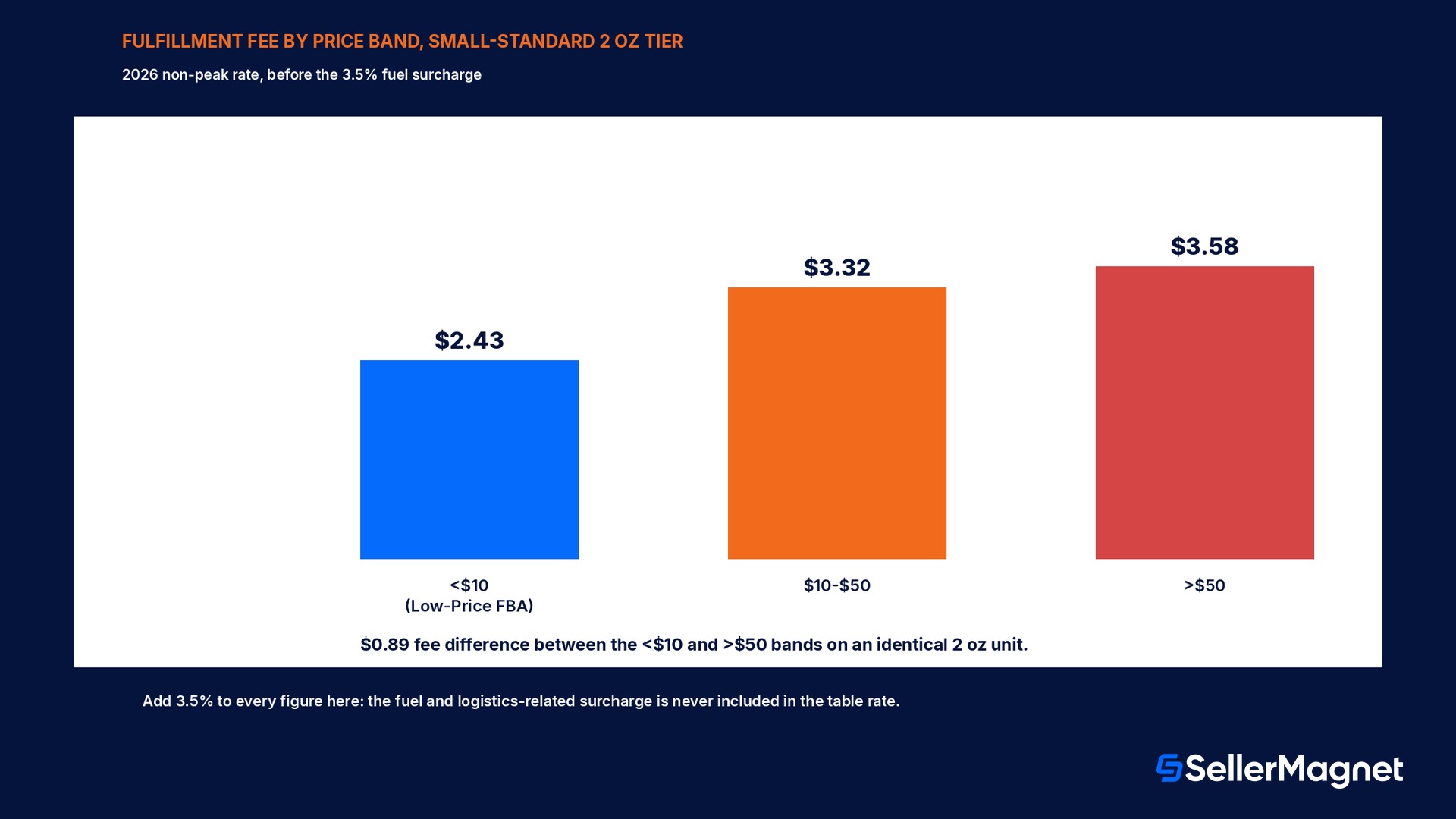
Amazon's published 2027 US Referral and Fulfillment by Amazon fees page carries the current non-peak rate card, in effect January 15, 2026 through October 14, 2026, for standard-size, non-apparel products, with the figures explicitly labeled "fuel and logistics-related surcharge not included." At the lightest small-standard tier, 2 oz or less, the <$10 rate is $2.43 against $3.32 for the $10-$50 band and $3.58 above $50, an $0.89 fee difference for crossing a single price line on an identically sized, identically weighed unit. The gap narrows at heavier tiers but never disappears inside small-standard: at 14+ to 16 oz the rates are $2.95 / $3.96 / $4.22. Large-standard tiers follow the same three-column pattern starting at $2.91 for 4 oz or less. Every one of these published figures is a base rate only; it does not yet include the fuel and logistics-related surcharge covered next, and Amazon's own table footnote names that explicitly rather than leaving it to a separate page a seller might not open.
Size tier
Shipping weight
<$10 (Low-Price FBA)
$10-$50
>$50
Small-standard
2 oz or less
$2.43
$3.32
$3.58
Small-standard
4+ to 6 oz
$2.56
$3.45
$3.71
Small-standard
8+ to 10 oz
$2.77
$3.68
$3.94
Small-standard
14+ to 16 oz
$2.95
$3.96
$4.22
Large-standard
4 oz or less
$2.91
$3.73
$3.99
Large-standard
12+ to 16 oz
$3.78
$4.60
$4.86
The 3.5% fuel surcharge Low-Price FBA's own rate card does not include
Amazon's 2027 FBA fulfillment fee changes page states the surcharge in one unambiguous sentence: "As of April 17, 2026, a 3.5% fuel and logistics-related surcharge applies to fulfillment fees across Fulfillment by Amazon (FBA) in the US and Canada, as well as to Remote Fulfillment with FBA from the US into Canada, Mexico, and Brazil." It extended further on May 2, 2026, to also cover Buy with Prime in the US and Multichannel Fulfillment in the US and Canada, and Amazon states it will keep reviewing the surcharge as conditions change rather than treating 3.5% as fixed indefinitely. Because every rate quoted on the official fee pages, including every Low-Price FBA figure above, is labeled "surcharge not included" in the table footnote, a seller who reads $2.43 as the actual per-unit fee for a 2 oz small-standard item under $10 is reading the pre-surcharge number: the real fee today is $2.43 plus 3.5%, or about $2.52. That 9 cent difference on a single unit looks trivial until it is multiplied across a catalog's full monthly unit count, which is exactly the gap a seller reconciling Amazon's own payout against a spreadsheet built from the published rate card tends to find and not immediately explain.
Holiday peak rates apply to Low-Price FBA too
Low-Price FBA's discount does not pause the standard FBA holiday peak-period surcharge; it simply keeps the same three-column price-band structure at a higher baseline. Amazon's fee page states peak fulfillment fees apply "from October 15, 2026, to January 14, 2027, for FBA, Remote Fulfillment with FBA into Canada and Mexico, Multichannel Fulfillment (MCF), and Buy with Prime," and that "the fuel and logistics-related surcharge applies to these fees" as well, meaning the 3.5% stacks on top of the already-higher peak number rather than replacing it. For the same 2 oz small-standard tier used above, the 2026 peak <$10 rate is $2.62 against $2.43 non-peak, a $0.19 jump before the surcharge is even added. A seller planning Q4 margin on a sub-$10 SKU has three separate numbers to stack, not one: the published Low-Price FBA base rate, the October 15-January 14 peak uplift, and the 3.5% surcharge on top of whichever of those two applies on the order date.
What narrows on January 15, 2027: five categories lose Low-Price FBA eligibility
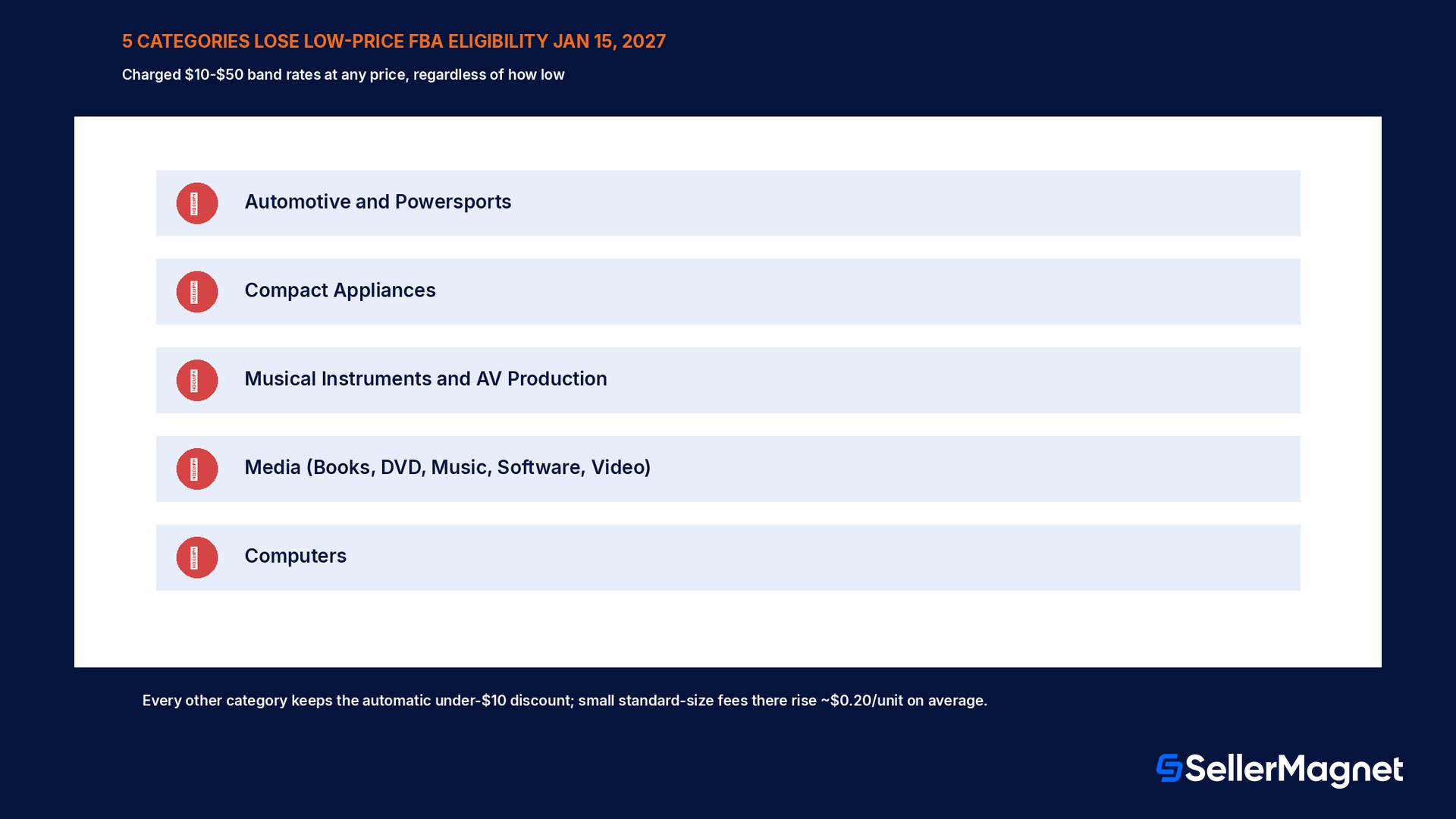
Amazon's own fee-change announcement sets a hard date for the eligibility rules themselves to change, separate from the fee amounts: "Through January 14, 2027, all products priced under $10 automatically receive Low-Price FBA rates. Effective January 15, 2027, Low-Price FBA rates will be restricted to a narrower set of fee categories." The five categories named as losing eligibility outright, regardless of how far under $10 the price sits, are Automotive and Powersports, Compact Appliances, Musical Instruments and AV Production, Media (Books, DVD, Music, Software, Video), and Computers; a product in any of those categories is charged the same rate as a $10-$50 item even if it is priced at $4.99. Every other fee category keeps automatic Low-Price FBA eligibility under $10 with no change to the no-enrollment design. Amazon's figures for the change itself land specifically on standard-size products in that under-$10 band: small standard-size fulfillment fees there rise by $0.20 per unit on average, large standard-size fees in non-apparel categories stay unchanged, and apparel in that band rises by $0.08 per unit on average.
Change, effective January 15, 2027
Detail
5 categories lose Low-Price FBA eligibility
Automotive and Powersports, Compact Appliances, Musical Instruments and AV Production, Media (Books/DVD/Music/Software/Video), Computers; charged $10-$50 rates at any price
Small standard-size, under $10, all other categories
Fulfillment fee rises by $0.20 per unit on average
Large standard-size, under $10, non-apparel
No change
Large standard-size, under $10, apparel
Fulfillment fee rises by $0.08 per unit on average
Bulky and extra-large size tiers
Current small/large bulky and extra-large tiers split into new, narrower tiers; smaller/lighter items get lower fees, larger/heavier items get higher fees
The specific mistakes that distort a Low-Price FBA margin estimate
Searching for a Small and Light enrollment page that no longer exists. The program closed August 29, 2023; there is nothing to enroll in, and no action restores it. Low-Price FBA applies automatically by price alone.
Reading a published fee table rate as the final fee. Every official rate card is labeled "surcharge not included"; the 3.5% fuel and logistics-related surcharge (US and Canada, since April 17, 2026) applies on top of every figure, including Low-Price FBA's own <$10 band.
Pricing a repricer right at $10.00 or $50.00 without checking which band that lands in. Both boundaries are strict: a price of exactly $10.00 or exactly $50.00 belongs to the $10-$50 band, not the lower or higher band either side of it.
Assuming the holiday peak period does not touch sub-$10 items. Low-Price FBA's <$10 band has its own, higher peak rate from October 15 through January 14, on top of which the surcharge still applies.
Carrying Small and Light's old 3 lb / 18x14x8 in enrollment caps into a 2026 catalog review. Those limits belonged to the closed enrollment program; Low-Price FBA eligibility is governed by the product's existing FBA size tier and fee category, not a separate weight/dimension ceiling.
Not checking category against the January 15, 2027 exclusion list before relying on next year's margin math. A product in Automotive and Powersports, Compact Appliances, Musical Instruments and AV Production, Media, or Computers stops getting the discount at any price from that date, independent of anything else changing on the listing.
What SellerMagnet can and cannot do about this
Low-Price FBA's rate assignment itself happens entirely inside Amazon's own fulfillment-fee engine at the moment of sale; no third-party tool, including SellerMagnet, sets, requests, or overrides which price band a unit is charged under. Where SellerMagnet's Fee Calculator and Profit Analytics help is in keeping the surcharge and the band boundary visible per SKU rather than buried in a monthly payout total: the fee calculator breaks a listed price down against the current <$10 / $10-$50 / >$50 tiers so a seller can see which side of $10.00 or $50.00 a planned price actually lands on before publishing it, and analytics flags the per-unit fulfillment fee actually charged against the catalog's own prices, which is the fastest way to notice a SKU that drifted to exactly $10.00 and silently lost its discount.
For the full current fee schedule across every size tier, referral-fee category, and the broader set of 2026/2027 changes beyond Low-Price FBA specifically, see SellerMagnet's Amazon FBA fees 2026 guide, which covers the complete rate card rather than the under-$10 band alone.
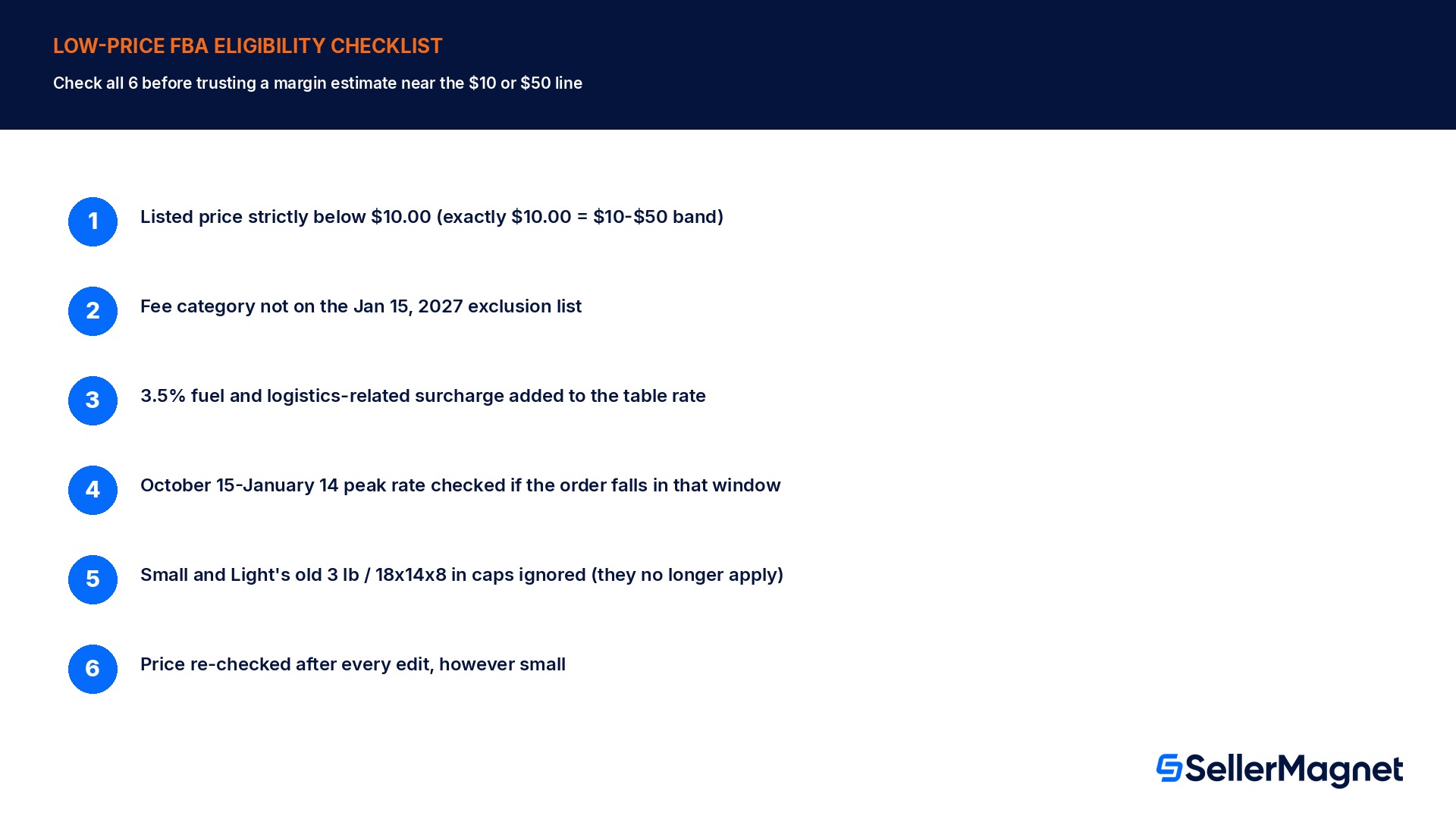
Checklist before pricing a product near the $10 or $50 line
How to confirm a product actually qualifies for Low-Price FBA rates
Confirm the listed price is strictly below $10.00, not at or above it - Amazon's own FAQ treats $10.00 exactly as the $10-$50 band, not the Low-Price FBA band.
Check the product's fee category against the January 15, 2027 exclusion list - Automotive and Powersports, Compact Appliances, Musical Instruments and AV Production, Media, and Computers lose eligibility at any price from that date.
Add the 3.5% fuel and logistics-related surcharge to the published rate - Every official rate-card figure is labeled surcharge not included; the real fee is the table rate plus 3.5% (US and Canada, since April 17, 2026).
Check whether the order date falls in the October 15-January 14 peak window - Peak fulfillment fees are higher across every price band, including <$10, before the surcharge is even added.
Ignore Small and Light's old 3 lb / 18x14x8 in caps - Those applied to the closed enrollment program; Low-Price FBA eligibility is set by the product's existing FBA size tier.
Re-check after any price change, however small - A one-cent move to exactly $10.00 or $50.00 removes the discount immediately, automatically, and without a separate notification.
Does FBA Small and Light still exist?
No. Amazon closed FBA Small and Light on August 29, 2023, and replaced it with Low-Price FBA rates. Enrollment of new products into Small and Light had already stopped on July 17, 2023.
Do I need to enroll in Low-Price FBA?
No. Amazon's own FAQ states no action is required; products priced under $10 in eligible categories automatically receive the lower rate, and lose it automatically if the price rises to $10 or above.
What happens to a product priced at exactly $10.00?
It is charged the $10-$50 band rate, not the <$10 Low-Price FBA rate. Amazon's FAQ states items priced at exactly $10 and exactly $50 belong to the $10-$50 band.
Are the published Low-Price FBA rates the final fee I pay?
No. Every official rate card is labeled "surcharge not included." A 3.5% fuel and logistics-related surcharge has applied to US and Canada FBA fulfillment fees since April 17, 2026, on top of the table rate.
Does the holiday peak period affect Low-Price FBA items?
Yes. The <$10 band has its own, higher peak rate from October 15 to January 14, and the fuel surcharge still applies on top of that peak rate.
Will my products still ship with Prime speed under Low-Price FBA?
Yes. Low-Price FBA uses the same standard FBA delivery speeds; only the fulfillment fee changes, not the shipping speed shown to customers.
What changes on January 15, 2027?
Five fee categories (Automotive and Powersports, Compact Appliances, Musical Instruments and AV Production, Media, Computers) stop qualifying for Low-Price FBA rates at any price. Other categories keep the automatic under-$10 discount, with small standard-size fees rising about $0.20 per unit on average.
Do the old Small and Light weight and size limits still apply?
No. Those limits (3 lb, 18 x 14 x 8 in) belonged to the closed enrollment program. Low-Price FBA eligibility is based on price and fee category, using the product's existing FBA size tier, not a separate cap.
Stop Juggling Tools. SellerMagnet Combines Everything You Need.