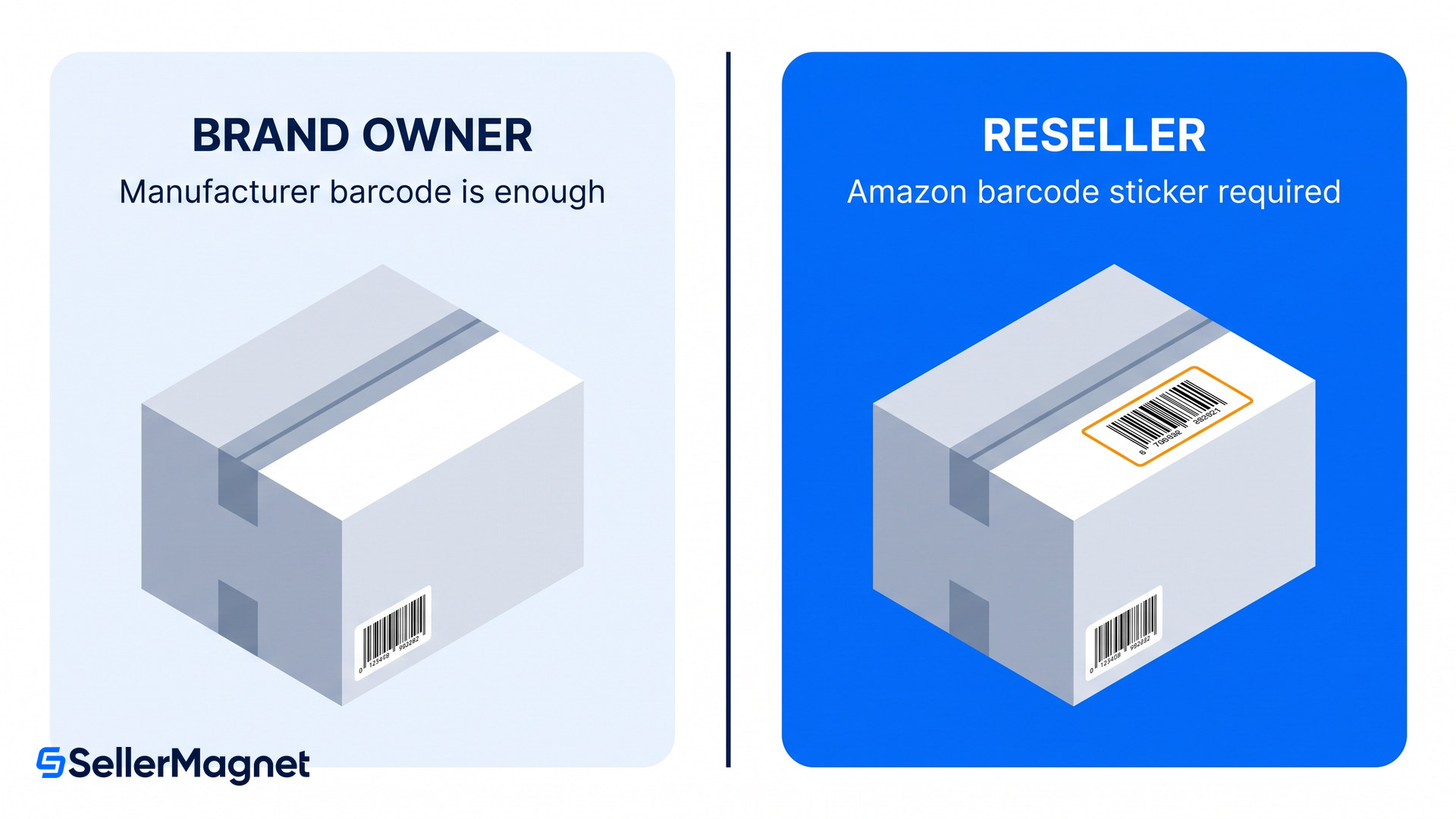
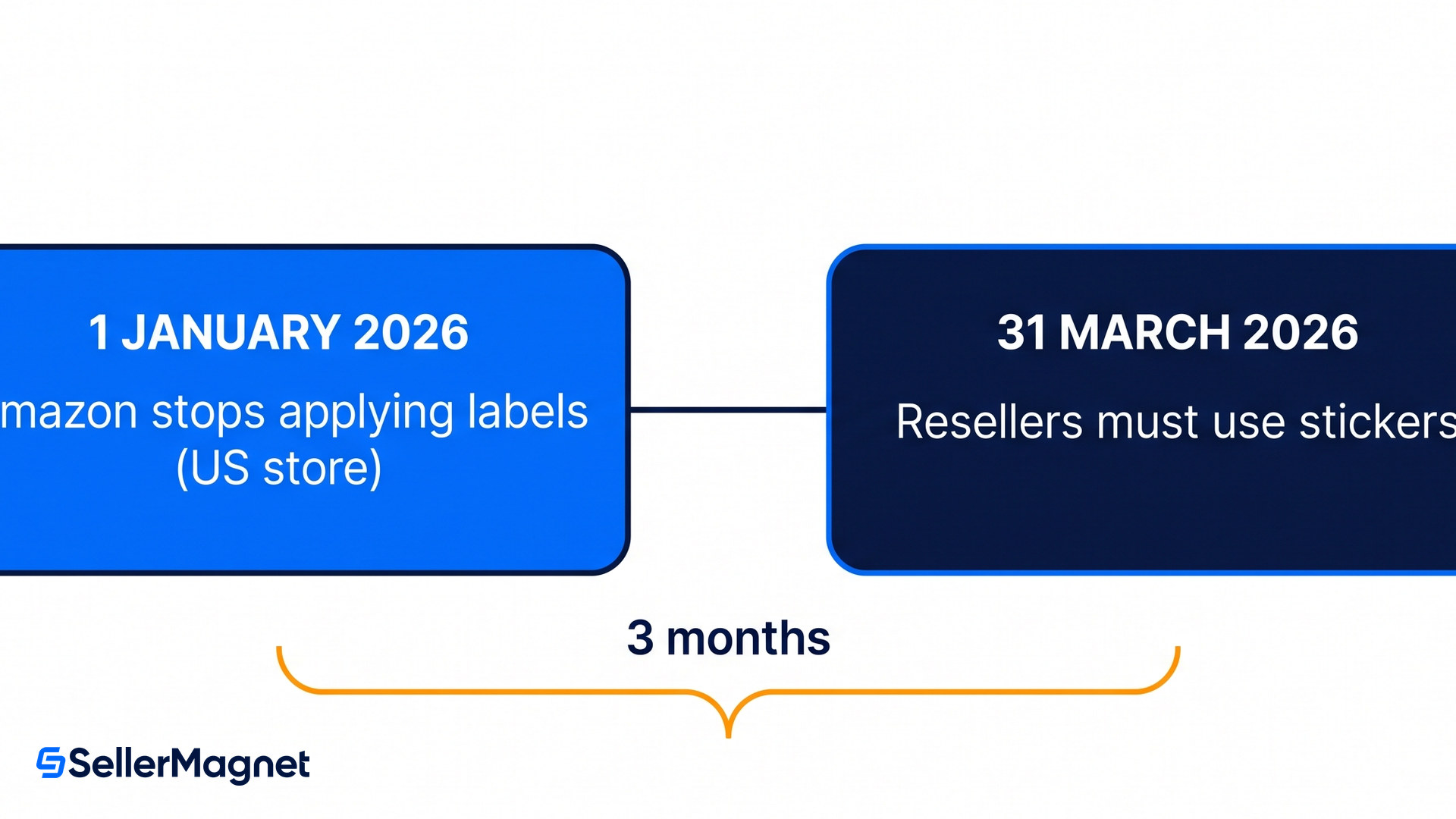
For inventory shipped on or after 31 March 2026, Amazon stopped commingling. The rule that replaced it splits sellers in two: a brand owner with the Brand Representative role can keep using the manufacturer's own barcode, while a reseller must apply an Amazon barcode sticker even on a product that already carries a UPC. The part that is easy to miss is that in the US store Amazon had already stopped applying those stickers for you on 1 January.
Amazon ended commingling for inventory shipped on or after the thirty-first of March, twenty twenty-six. Brand owners with the Brand Representative role in Brand Registry can use manufacturer barcodes without Amazon stickers. Resellers must apply Amazon barcode stickers even when the product already has a manufacturer barcode.
What is commingling, and what exactly ended?
Commingling is Amazon treating identical units as interchangeable. In Amazon's own words, it is "when we fulfill customer orders using exact product matches from the closest available inventory in the Amazon fulfillment network, even if that inventory belonged to a different seller, to achieve faster delivery speeds". Your unit sat in a pool with everyone else's, and whoever's box was nearest the buyer went out of the door.
Amazon retired it because the speed argument had expired: "now that most sellers maintain inventory levels that keep products close to customers, we can achieve fast delivery without commingling". The announcement, posted on 8 December 2025, ties the change to a shipping date rather than a calendar switch: the requirements "will go into effect for inventory shipped on or after March 31, 2026". Amazon does not define "shipped" anywhere on that page, and sellers who asked in the thread what happens to a shipment created before 31 March that arrives after it were not answered.
It made stickerless simple. Send a case of manufacturer-barcoded units, skip the labelling step entirely, and let Amazon sort out whose is whose.
It let one pool serve several channels. Units were not tied to Amazon before they shipped, so stock could be redirected late.
It mixed your units with other sellers' units of the same ASIN, which is why the long-running seller complaint about commingling was never about speed but about what turned up when a buyer was sent someone else's unit.
It is now over for new shipments, and the replacement rule depends entirely on which Brand Registry role you hold.
Who needs Amazon barcode stickers from 31 March 2026?
The split comes down to one role in Brand Registry, and it moves the work in opposite directions for the two groups. Brand owners get lighter, resellers get heavier.
Your situation
What Amazon says
What you actually do
Brand owner with the Brand Representative selling role, product has a manufacturer barcode
Will "no longer need to apply Amazon barcode stickers to prevent commingling for products that already have manufacturer barcodes (such as UPC, ISBN)"
Stop stickering to prevent commingling, provided the product carries a manufacturer barcode
Reseller not enrolled as a Brand Representative, product has a manufacturer barcode
"Will now be required to use Amazon barcode stickers for products even if they have a manufacturer barcode"
Add a labelling step you may never have had
Already using Amazon barcode stickers
"If you are already using these stickers, you can continue to follow your existing process"
Nothing changes
Product has no manufacturer barcode
"Both brand owners and resellers will need to use Amazon Barcode stickers"
Label it, whichever side you are on
The brand-owner half comes with a second benefit that is easy to skim past. Amazon frames it as inventory flexibility: "this means more flexibility in how you manage inventory because you will not need to pre-allocate units to Amazon or other channels". A unit with only a manufacturer barcode on it is a unit you have not yet committed to a channel, which matters if you also sell through a distributor, your own site or a second marketplace.
Amazon's post names no store
The commingling announcement says "across our supply chain" and never names a marketplace, a country or a store. The post sits on US Seller Central, but its text names no store, so we cannot tell you from the source whether a European seller's EU inventory is in scope, out of scope, or on a different timetable. Check the barcode requirement for the store you actually ship into rather than assuming your account is covered either way.
Why this lands harder on resellers than it looks
A second change, taking effect three months earlier, is the reason. Amazon announced it separately and neither post mentions the other, though sellers in the commingling thread made the link themselves within days. the company made the sticker mandatory for resellers in the same quarter it stopped being willing to apply one.
On the Seller Forums, Jameson_Amazon confirmed that "starting January 1, 2026, we'll no longer offer prep and item labeling services for Fulfillment by Amazon (FBA) shipments in the US store", and that this "applies to all inventory that is sent to our US FBA service, including inventory that you send directly into FBA as well as inventory from Amazon Warehousing and Distribution (AWD), Amazon Global Logistics (AGL), Amazon SEND, and Supply Chain Portal, when that inventory goes through FBA". From that date "all products must be prepped and labeled before sending them to our facilities".
The sentence that costs money
Amazon adds that "shipments created after January 1, that arrive without proper prep and item labeling won't be eligible for reimbursement if damaged or untraceable". Read that next to the March rule. A reseller still sending stickerless units into the US store is breaking a labelling requirement, and those units also look like inventory arriving "without proper prep and item labeling", which Amazon has said will not be reimbursed if damaged or untraceable. Amazon has never said the two rules interact; that inference is ours. The changes take effect three months apart and were posted a week apart in two different forum categories, and neither Amazon post points at the other.
What to do if you are still shipping stickerless
Work out which side of the split you are on, then fix the labelling step before the next shipment rather than after it. Amazon does read these rules off the shipment record, at least for the prep change, which was grandfathered by creation date rather than arrival: "for shipments created before January 1, we'll continue to provide prep and item labeling services, even if inventory arrives after that date". Amazon stated no equivalent grandfathering for the commingling rule.
How to check where you stand on barcodes
Check which selling role you hold in Brand Registry - The whole rule turns on whether you are a brand owner with the Brand Representative selling role. If you are not sure, that is the first thing to confirm in Brand Registry, because it decides whether your labelling work goes to zero or goes up.
Split your catalogue by barcode - List which ASINs carry a manufacturer barcode such as a UPC or ISBN and which do not. Anything without one needs an Amazon barcode sticker regardless of which side of the split you are on, so that group is settled already.
Decide where the label gets applied - Amazon no longer does it for US FBA shipments, so the options are at your own premises, at your supplier before it ships, or at a prep provider. Ask your supplier first: a label applied on the production line costs less than one applied twice over by a warehouse.
Price the change into your reseller lines - If you resell manufacturer-barcoded goods at thin margins, a per-unit labelling cost you did not have last year lands on every unit, not on a percentage of them. Some lines will stop working. Better to find that out on a spreadsheet than on a restock.
Check what you have shipped since 31 March - The requirement attaches to inventory shipped on or after 31 March 2026, so every shipment you create today is already past that line. If you are a reseller who has kept sending stickerless units, the useful question is not when to switch but how much of what is already in the network went in unlabelled.
Quick win for today
Open Brand Registry and check your selling role, then count how many of your ASINs are reseller lines with a manufacturer barcode. That number is the size of your problem, because those are the exact units that go from needing no label to needing one. Then check in the SellerMagnet profit dashboard what those ASINs earn per unit today, because a labelling step is a fixed cost per unit and the thinnest lines feel it first.
Be careful with the per-unit prices you will read
Articles about this change quote confident per-unit labelling costs, and the published figures disagree with each other by more than an order of magnitude. Prep-centre pricing is negotiated per contract and varies with volume, product and location, and none of the published figures come with a stated methodology. Get a quote for your own units and your own volume before you plan around anyone's number, including the absence of one here.
Inventory identified only by a manufacturer barcode, so Amazon can fulfil an order with any matching unit from the nearest location regardless of which seller sent it in. Amazon describes it as using exact product matches from the closest available inventory to achieve faster delivery speeds.
When did Amazon commingling end?
The requirements apply to inventory shipped on or after 31 March 2026. Amazon states the trigger as the shipping date and does not define the term further on the announcement.
Do brand owners still need FNSKU labels?
Not for the commingling reason, which was the reason most of them were applying them. The relief is conditional on holding the Brand Representative selling role and on the product carrying a manufacturer barcode; a product with no manufacturer barcode still needs an Amazon barcode sticker.
Do resellers have to label every unit now?
Only resellers outside the Brand Representative role, and only for FBA inventory. If you were already applying Amazon barcode stickers before the change, nothing about your process moved. If you were shipping stickerless on the strength of a UPC, that route closed.
Can Amazon apply the barcode stickers for me?
Not for FBA shipments in the US store. Amazon stopped offering prep and item labeling services there on 1 January 2026, and says products must be prepped and labeled before they are sent to its facilities.
What happens if unlabelled inventory goes missing?
For FBA shipments in the US store, Amazon has said that shipments created after 1 January 2026 which arrive without proper prep and item labeling will not be eligible for reimbursement if they are damaged or untraceable.
Stop Juggling Tools. SellerMagnet Combines Everything You Need.