Seller Fulfilled Prime Delivery Speed Requirements 2026
R
RenéFreelance Amazon Editor
|
10 min read
Since July 6, 2026, the bar for keeping the Prime badge on a seller-fulfilled listing has moved, and it caught sellers who had not touched their shipping setup in months. Amazon did not change the Prime badge itself. It changed how many of your product page views have to show a fast delivery date before that badge disappears. If your delivery-speed numbers were comfortably above the old minimums, you may now be below the new ones without a single order going wrong. This guide works through the exact new thresholds by size tier, how Amazon counts a page view toward them, a worked example with real numbers, and the checklist to run before your next quarterly review.
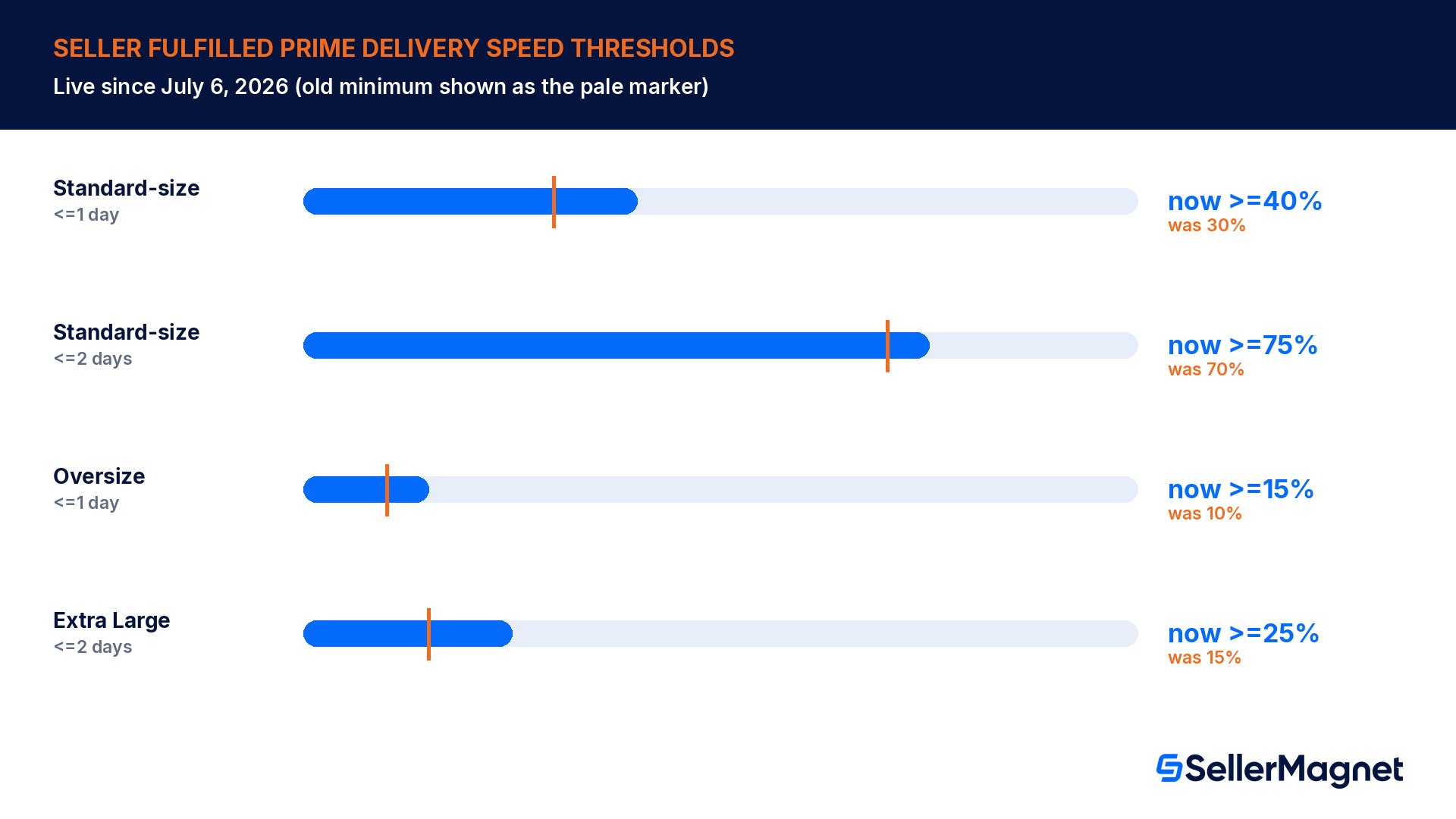
Since July 6, 2026, Amazon raised the minimum delivery speed requirements for Seller Fulfilled Prime. Standard-size listings now need 40% of Prime customer page views to show a delivery date within 1 day (up from 30%) and 75% within 2 days (up from 70%). Oversize needs 15% within 1 day (up from 10%). Extra Large needs 25% within 2 days (up from 15%). All three tiers also now carry a 5-day threshold: 90% standard, 80% oversize, 60% extra large. Falling below your tier's thresholds risks losing Seller Fulfilled Prime eligibility on that tier.
The new thresholds, tier by tier
Amazon's announcement on help page GXCRLXHNJNPE2DHM is specific about what moved and by how much: "Starting July 6, 2026, we're updating the minimum delivery speed requirements for Seller Fulfilled Prime (SFP)... To remain eligible for SFP, page views of your Prime offers must meet the following updated delivery speed requirements." The current live reference table on help page G202072550 confirms these are the numbers in force now, not a future change still pending:
Size tier
<=1 day
<=2 days
<=5 days
Standard-size
>=40% (was 30%)
>=75% (was 70%)
>=90%
Oversize
>=15% (was 10%)
>=45% (unchanged)
>=80%
Extra Large
N/A
>=25% (was 15%)
>=60%
Two things are easy to miss in that table. First, the 5-day column is new at this level of attention: Amazon tracked it before, but this update is the first time it sits next to the headline 1-day and 2-day numbers that sellers watch. Second, "if you already meet these updated thresholds, no action is required", per Amazon's own note, which means a seller already running fast carriers on most SKUs may see no visible change at all. The risk sits with sellers whose speed metrics were sitting just above the OLD minimum, since that same number can now read as a shortfall.
How does Amazon actually count a page view toward your speed metric?
Delivery speed is not an order-fulfillment metric. Per help page G202072550, it is "the count of Prime customer page views where your offer was featured and the customer saw a delivery date of less than or equal to (<=) 1 day or <=2 days from when they are browsing your product." A page view counts toward the <=1 day threshold if the customer saw a same-day or next-day promise; it counts toward <=2 days if they saw same-day, next-day, or two-day; and toward <=5 days for anything up to a five-day promise. A promise of 6 days or more still counts in your total page views, but not in any of the three thresholds, which is exactly how a slow-shipping SKU drags the percentage down even if every one of its orders eventually arrives fine.
The calculation covers every Prime page view in the contiguous US
Amazon's own note is explicit: "The delivery speed calculation incorporates all page views by Prime customers in the contiguous US" when your offer is featured, regardless of which shipping option the customer actually chose. A listing that offers a fast option but defaults most browsers to a slower estimated date, because of handling time, inventory placement, or a carrier cutoff the buyer sees before checkout, loses ground on this metric even if no order was ever late. Only page views with promise extensions applied, which Amazon limits to severe weather or major events with constrained carrier capacity, are exempt.
Tiers are now judged independently, and the weekend grace window has ended
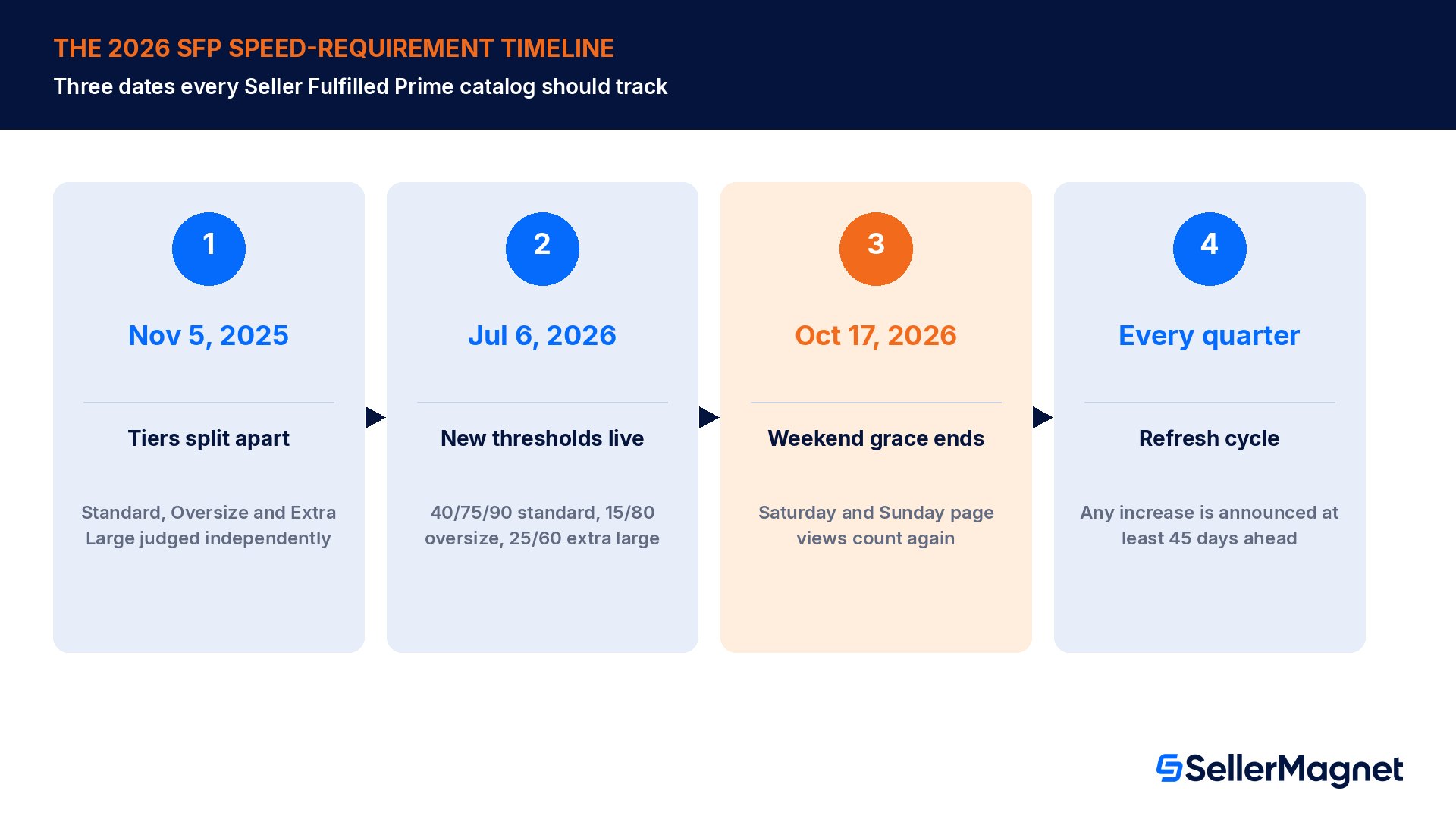
Two mechanical changes sit alongside the July 6 numbers and change how a multi-tier catalog should read its own dashboard. Since November 5, 2025, per-tier evaluation means your Standard-size SKUs are judged only against the Standard-size thresholds, and an Oversize shortfall no longer pulls down Standard-size eligibility; a seller running strong on small items and weak on big ones keeps the Prime badge on the small items regardless. Separately, Amazon's changes announcement included a temporary grace period: "Weekends will be excluded from your speed metric evaluation until October 17, 2026, so you have time to adopt the new feature and adapt to the new requirements." That window has now closed. Saturday and Sunday page views count toward every threshold again, which matters for any seller whose weekend carrier pickups or warehouse staffing run thinner than during the week.
The requirements also refresh on a quarterly cadence, and Amazon commits to naming any increase at least 45 days ahead of when it takes effect. That gives a real planning window: the moment Amazon posts the next change on the Seller Forums or the SFP performance requirements page, a seller has over a month to confirm handling time, carrier cutoffs, and inventory placement against the new numbers before they bind.
Worked example: a mixed Standard and Oversize catalog
A seller runs 400 Standard-size SKUs and 60 Oversize SKUs, all enrolled in Seller Fulfilled Prime. Over the last 30 days, the Standard-size catalog logged 220,000 Prime customer page views; 76,000 of them (about 35%) showed a delivery date within 1 day, and 158,400 of them (72%) showed within 2 days. Against the new thresholds of 40% and 75%, the 1-day number clears with room to spare, but the 2-day number sits right on the line, close enough that a single slow-shipping SKU with high traffic could push the whole tier under 75%. The Oversize catalog logged 18,000 page views with 2,160 (12%) showing within 1 day, below the new 15% minimum (it cleared the old 10% easily). Because tiers are judged independently, the Oversize shortfall puts only the Oversize SKUs at risk of losing Prime eligibility; the Standard-size catalog keeps its badge regardless of what happens with Oversize.
Catch a tier slipping before Amazon does. SellerMagnet's Analytics tracks Prime delivery-speed performance per size tier over time, so a slow drift under a quarterly threshold shows up on your dashboard weeks before it threatens the badge, instead of in Amazon's own speed report after the fact. Repricer helps when the fix is competitive, since Buy Box share leans on delivery promise as much as price, and a faster effective ship option on a borderline SKU can move both numbers at once.
Why is a page-view metric harder to fix than an order metric?
An order-based metric, like on-time delivery rate, is fixed by shipping better on the orders you already have. A page-view metric is fixed by changing what the BROWSING customer sees before they ever order, which means the fix usually sits in handling time settings, carrier selection defaults, and inventory placement across fulfillment centers, not in any single shipment. A SKU with inventory sitting in only one warehouse on the wrong coast shows a slower delivery promise to every browsing customer on the other coast, dragging the page-view percentage down on every view, whether or not a customer in that region ever actually orders it. Reviewing the ASIN-level breakdown in the speed report (help page G4EPNZYYU6ELW96U, downloadable from the Seller Fulfilled Prime performance dashboard under Speed Metrics) is the fastest way to find which specific SKUs are pulling a tier average down, rather than treating the tier percentage as one undifferentiated number.
Pre-review checklist
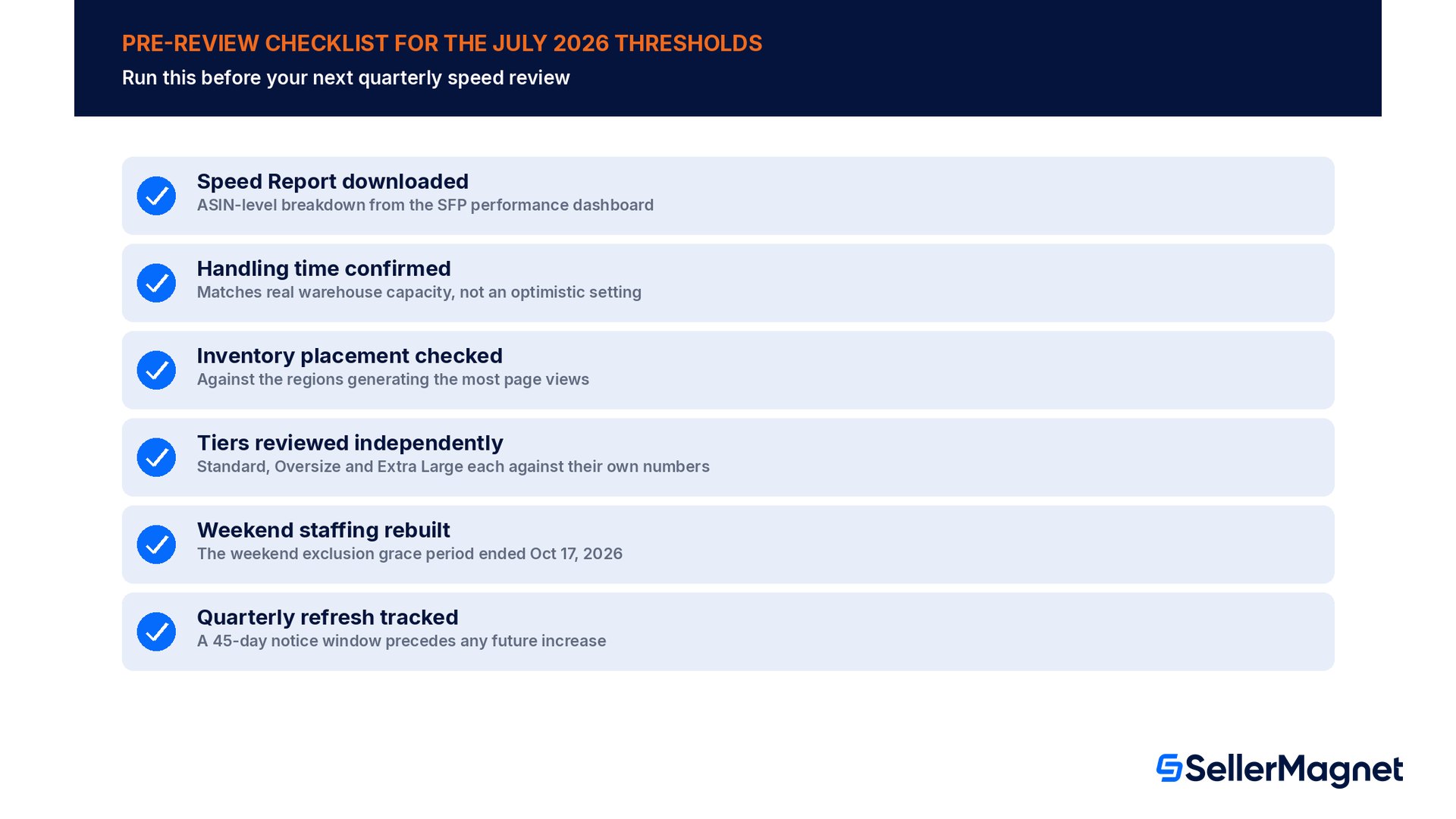
Downloaded the current Speed Report from the Seller Fulfilled Prime performance dashboard and identified which ASINs sit below the new per-tier thresholds.
Confirmed handling time settings reflect real warehouse capacity, since an optimistic handling time that is not met in practice shows a fast promise on the page view but risks the on-time rate instead.
Checked inventory placement for high-traffic SKUs against the regions generating the most page views, not just total sales volume.
Verified Oversize and Extra Large SKUs are checked against their own thresholds separately, since a Standard-size average will not surface a tier-specific shortfall.
Rebuilt any weekend-staffing assumption that relied on the (now-expired) weekend exclusion window.
Set a recurring calendar check against Amazon's quarterly refresh cadence, so a future threshold increase is caught inside its 45-day notice window, not after it has already taken effect.
How do I check my current delivery speed metrics?
Check your Seller Fulfilled Prime delivery speed against the current thresholds
Open the SFP performance dashboard - Go to the Seller Fulfilled Prime performance dashboard in Seller Central.
Find the Speed Metrics section - Review your current <=1 day, <=2 days, and <=5 days percentages for each size tier you sell in.
Compare against your tier's current thresholds - Standard-size needs 40% / 75% / 90%; Oversize needs 15% / 45% / 80%; Extra Large needs N/A / 25% / 60%.
Download the Speed Report - Select Download speed report under Speed Metrics to get the ASIN-level breakdown behind each tier average.
Identify the SKUs pulling the average down - Sort by delivery promise shown and page view volume to find which specific ASINs show the slowest promises to the most customers.
Fix handling time and inventory placement - Adjust handling time to match real capacity and move inventory closer to the regions generating the most page views for those SKUs.
Common mistakes sellers make with the July 2026 thresholds
Checking only the <=1 day number and missing that <=2 days and the new <=5 days threshold can fail independently of it.
Reading one blended delivery-speed percentage across the whole catalog instead of per size tier, which hides an Oversize or Extra Large shortfall sitting under a healthy Standard-size average.
Assuming an order that shipped on time means the page-view promise was fast, when the two are measured completely differently.
Planning weekend staffing or carrier pickups around the exclusion window that ended October 17, 2026, rather than the current always-counts rule.
Treating the 45-day notice window as something to react to only once it starts, instead of building a quarterly check so the notice window itself becomes the trigger.
Fixing the symptom, a slipping percentage, by shipping faster on the orders coming in, without checking whether an inventory placement or handling-time setting is producing a slow PROMISE on page views regardless of how fast the eventual shipment moves.
When did the new Seller Fulfilled Prime delivery speed thresholds take effect?
July 6, 2026. The thresholds are confirmed as the current, live requirement table on Amazon's own Seller Fulfilled Prime performance requirements help page as of this writing.
What are the new Standard-size delivery speed requirements?
At least 40% of Prime customer page views must show a delivery date within 1 day (up from 30%), at least 75% within 2 days (up from 70%), and at least 90% within 5 days.
What changed for Oversize and Extra Large?
Oversize now needs at least 15% of page views within 1 day (up from 10%) and at least 80% within 5 days; the 2-day minimum stayed at 45%. Extra Large now needs at least 25% within 2 days (up from 15%) and at least 60% within 5 days; it has no 1-day requirement.
Is delivery speed based on orders or page views?
Page views. It counts how often a Prime customer browsing your listing saw a fast delivery date promised, across all page views in the contiguous US, independent of which shipping option the customer actually chose or how the order was ultimately fulfilled.
Does falling below the threshold on one size tier affect my other tiers?
No. Since November 5, 2025, each size tier is evaluated independently, so a shortfall on Oversize or Extra Large does not affect Seller Fulfilled Prime eligibility on your Standard-size listings.
Is the weekend exclusion from the speed calculation still active?
No. That grace period, given to sellers to adapt to the new thresholds, ended October 17, 2026. Every day of the week now counts toward the speed metric.
How often do these requirements change?
Amazon refreshes the minimum delivery speed requirements quarterly and commits to announcing any increase at least 45 days before it takes effect.
Where do I see my current delivery speed numbers?
On the Seller Fulfilled Prime performance dashboard in Seller Central, under the Speed Metrics section, with a downloadable ASIN-level speed report for a tier-by-tier breakdown.