A UK seller with stock sitting in a local fulfilment centre can start selling into Germany, France, Italy or Spain without shipping a single unit across the border in advance, and generally without a destination-country VAT number, through Remote Fulfilment with FBA. It is a different mechanism from Pan-European FBA, which this blog has covered separately for the Netherlands offer rule, and the two get confused constantly because both move inventory across EU borders. This guide covers exactly how Remote Fulfilment with FBA works between the UK and the EU (and from the UK to the UAE and Saudi Arabia), its price caps, the 2026 fuel and logistics surcharge and the new EU customs duty that now shows up on the customer-facing price, and when it actually beats placing inventory locally through Pan-EU or a third-party logistics provider.
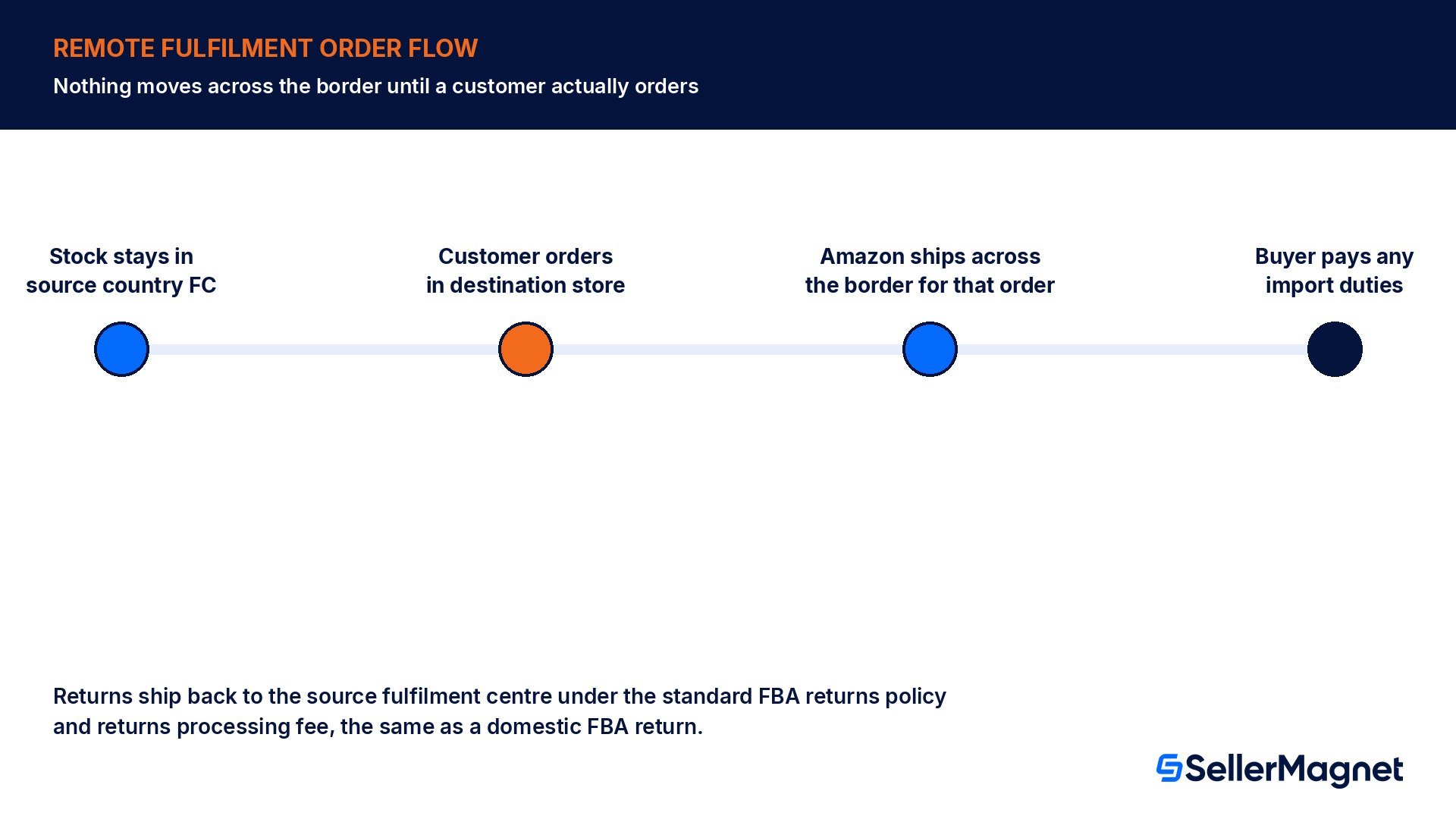
Remote Fulfilment with FBA lets a seller with inventory in one country's fulfilment centre sell across the customs border between the UK and the EU, or from the UK into the UAE and Saudi Arabia, without physically moving stock there in advance. Amazon fulfils each cross-border order from the seller's existing local stock, and the buyer pays any import fees and duties. It requires active FBA offers and Seller Central access in both the source and destination stores, and eligible items are capped at EUR 150 in the EU or GBP 135 in the UK. A 1.5% fuel and logistics surcharge has applied to the fulfilment fee since April 17, 2026, rising to 2% from November 2, 2026, and a separate EUR 3 per-item customs duty applies to low-value shipments into EU stores from outside the EU.
What does Remote Fulfilment with FBA actually do?
Remote Fulfilment with FBA, previously called the European Fulfilment Network between the UK and EU, lets a seller with FBA inventory in a local fulfilment centre enrol to sell across the customs border between the UK and the EU without sending inventory to the destination store and, generally, without obtaining a VAT number there. Amazon has extended the programme to MENA (the United Arab Emirates and the Kingdom of Saudi Arabia) for UK sellers as well, following the same UK-to-EU process. Any import fees and duties on a Remote Fulfilment order are paid by the buyer, not deducted from the seller's payout the way a standard FBA fee is. (Source: Amazon's Remote Fulfilment with FBA help page.)
Confirm you have active Seller Central accounts in both the source country and the destination country (for example, UK and Germany).
Confirm you already have active FBA offers for the product in the source country, with inventory physically stored in a local fulfilment centre there.
Check the item price against the eligibility cap: EUR 150 in the EU, GBP 135 in the UK; items priced above the cap are not eligible for Remote Fulfilment.
Go to the Remote Fulfilment with FBA page, tick the destination stores under Marketplace enrolment, and click Enrol now.
Choose Automatic Listing Expansion to let the Build International Listings tool create the destination listings using the "same as source marketplace, adjusted for fees and taxes" pricing rule.
Confirm your export settings update automatically: for EU-to-UK fulfilment, the Germany, Italy, France and Spain stores must be enabled for exports; for UK/EU4-to-MENA fulfilment, the UAE and KSA stores must be enabled for exports.
The eligibility price cap, and why it matters more than it looks
The price cap is not a soft guideline. Amazon's rule is specific: the price of an eligible item must not exceed EUR 150 in the EU or GBP 135 in the UK. Amazon's own guide does not state how the EUR 3 customs duty or its automatic pricing-rule adjustment interact with that cap, so treat any price sitting close to either limit as worth checking. After any price change, confirm the item's status on the Manage your listing tab, or in the downloadable product eligibility report, rather than assuming it stays enrolled.
Amazon may show a higher price than you set
Amazon applies the "same as source marketplace, adjusted for fees and taxes" pricing rule by default, and when applicable adds import duties to the customer-facing price. That means the price a customer in Germany sees for your UK-sourced item can be higher than the price you configured, because Amazon layers duties and fee adjustments on top automatically.
The 2026 fee changes: fuel surcharge and the new EU customs duty
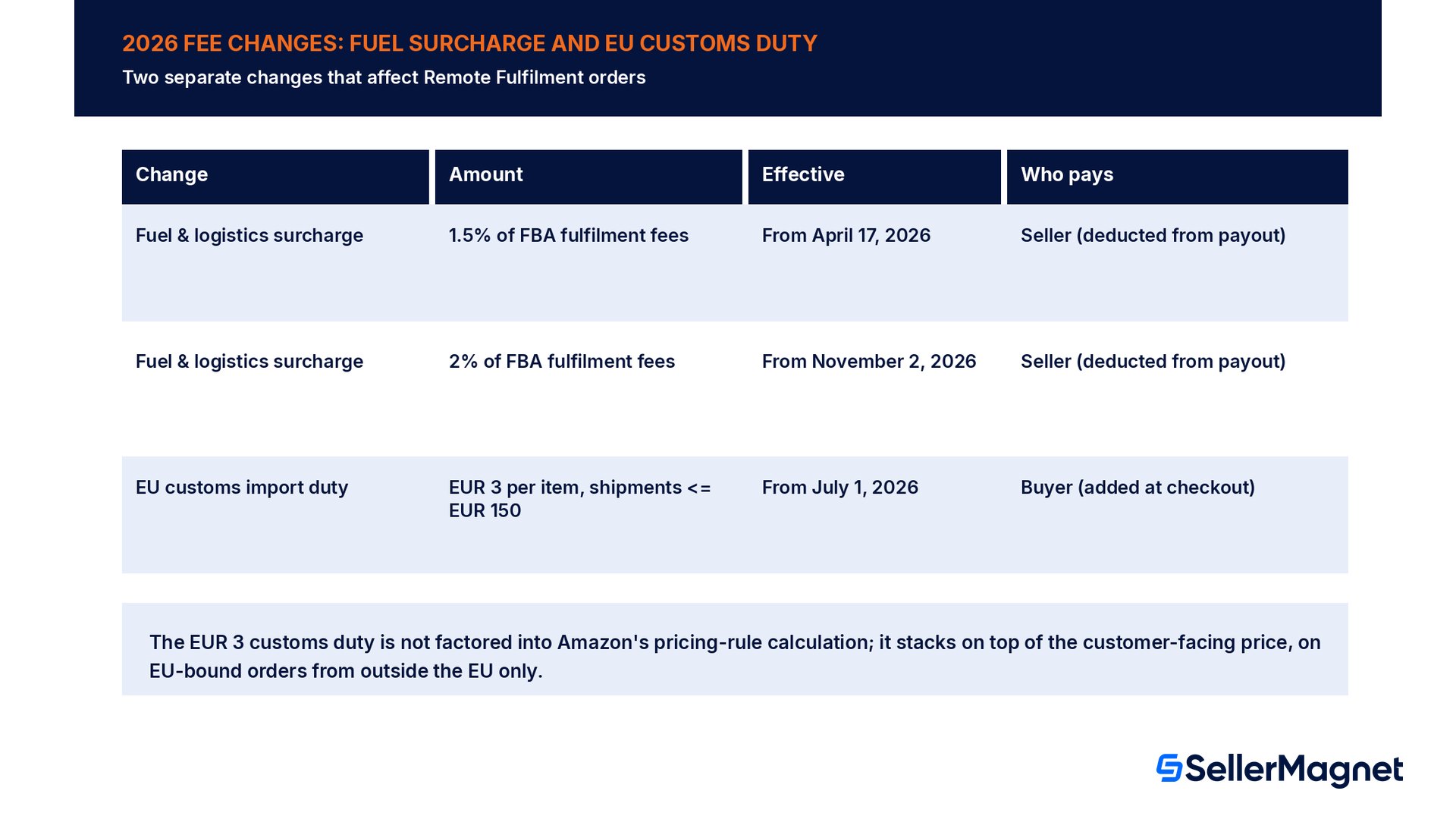
Two separate 2026 changes affect the real cost of running Remote Fulfilment, and they apply differently. A 1.5% fuel and logistics-related surcharge has applied to fulfilment fees across FBA, including Remote Fulfilment, since April 17, 2026, in the UK, France, Germany, Italy, Spain, Poland, Sweden, Netherlands, Ireland and Belgium stores; Amazon's live help page states it rises to 2% from November 2, 2026. Amazon's Revenue Calculator, Profit Analytics dashboard and Fee and Economics Preview reports have all been updated to reflect it, so the surcharge already shows in those tools rather than needing to be added manually to older fee estimates.
Second, and separately, from July 1, 2026 a EUR 3 customs import duty applies per item to low-value business-to-consumer shipments of EUR 150 or less shipped from outside the EU into EU stores, under EU Regulation 2026/382. It applies to Remote Fulfilment orders crossing into an EU store from outside the EU, such as a UK-sourced order; it does not apply to EU-to-UK orders or to UK-to-MENA orders. This is explicitly not an Amazon fee; it is an EU-mandated duty that Amazon adds automatically on top of the price calculated by the Remote Fulfilment pricing rule, shown on the product detail page, in the cart and at checkout, and it is not factored into the pricing-rule calculation itself.
Remote Fulfilment orders into the UK (from the EU) and into Germany (from the UK) placed between 15 October 2026 and 14 January 2027 also carry Amazon's festive peak fulfilment fee, and the fuel and logistics surcharge is charged on top of that peak fee too; it does not apply to oversized or low-price FBA, or to orders delivered to buyers in other EU countries. See our festive peak surcharge guide for the exact per-unit figures. For the wider customs-declaration mechanics behind the EUR 3 duty, see our EU customs and IOSS guide.
Change
Effective date
What it applies to
Who pays it
Fuel and logistics-related surcharge
April 17, 2026 (1.5%); November 2, 2026 (2%)
FBA fulfilment fees, incl. Remote Fulfilment, across 10 EU/UK stores
Seller (deducted from payout, like other FBA fees)
EU customs import duty
July 1, 2026
EUR 3 per item on low-value (up to EUR 150) B2C shipments into EU stores from outside the EU
Buyer (added to the customer-facing price, not the seller's payout)
Remote Fulfilment with FBA vs Pan-EU: are they the same tool?
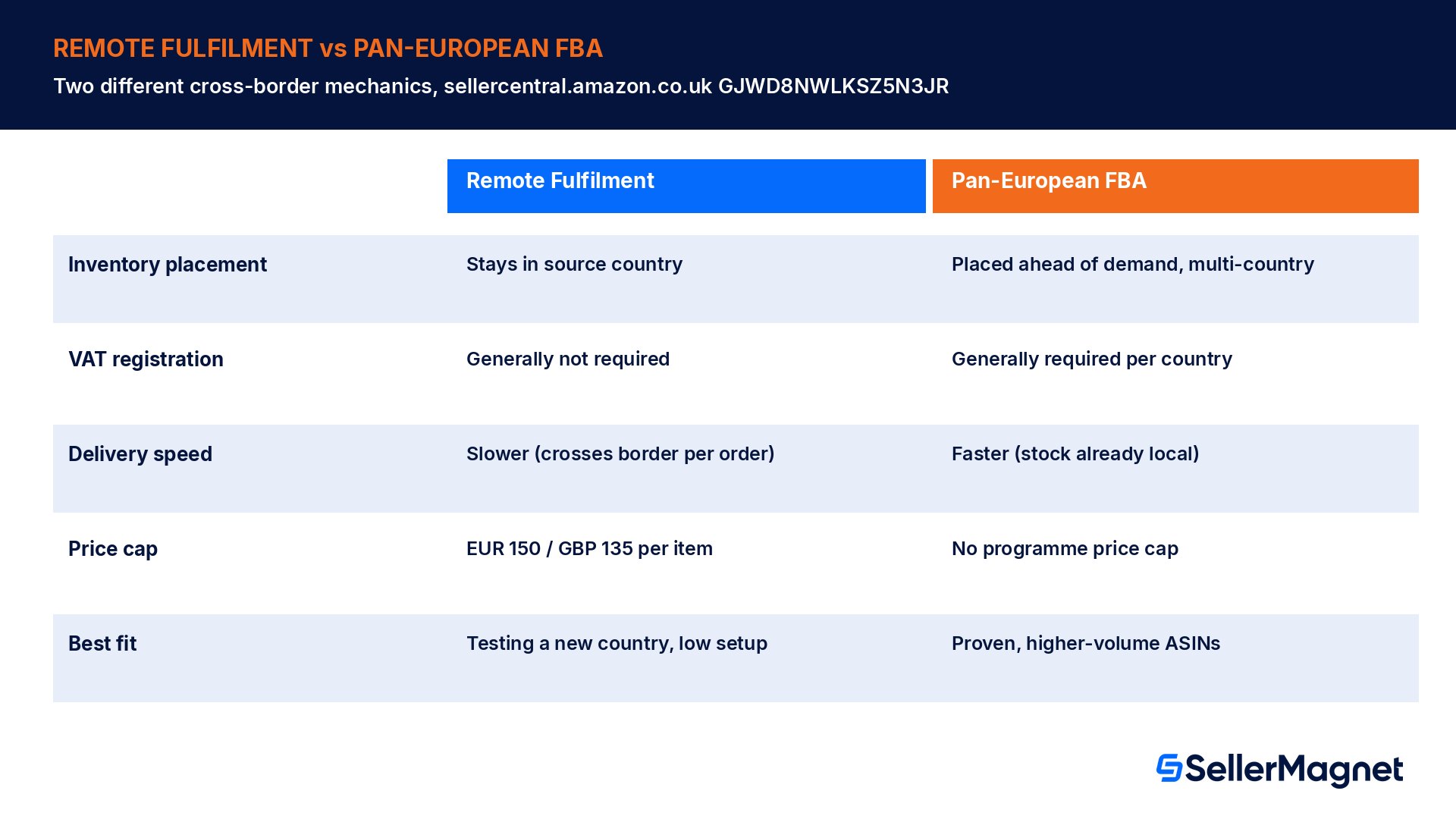
Remote Fulfilment and Pan-EU solve the same broad problem, selling across EU borders, with opposite mechanics. Remote Fulfilment ships each order from your existing local stock across the border at the moment the order comes in; nothing moves until a customer buys. Pan-EU, by contrast, places your inventory ahead of demand into fulfilment centres across several EU countries, so an order placed in Germany can ship from a German fulfilment centre rather than crossing a border after the fact. That structural difference drives every other difference between the two programmes.
Remote Fulfilment with FBA
Pan-European FBA
Inventory placement
Stays in the source country; nothing moves ahead of an order
Amazon places stock across multiple EU fulfilment centres ahead of demand
VAT registration needed
Generally no destination-country VAT number required
Yes, VAT registration generally required in each country holding stock
Delivery speed to the customer
Usually slower; each order crosses a border after purchase
Faster; stock can already be local to the customer
Price eligibility cap
EUR 150 (EU) / GBP 135 (UK) per item
No price cap in the programme itself
Who pays import duty
The buyer, added to checkout price (EU orders from outside the EU)
No cross-border import at sale; stock is already in the EU
Best fit
Lower-volume, lower-price cross-border tests without VAT overhead
Established, higher-volume ASINs where speed and VAT setup are already justified
This blog has covered Pan-EU's own 2026 change, the new Netherlands active-offer requirement, in a separate guide; that post is about where Pan-EU stock must have an active offer, not about choosing between Pan-EU and Remote Fulfilment in the first place, which is the question this guide answers.
Requirements, listings and the fine print that trips sellers up
Enrolling authorises Amazon and its affiliates to export goods on your behalf, including signing a commercial invoice that itemises the shipment and authorises any additional export documents required, so this is a genuine legal authorisation, not just a settings toggle. On the listings side, if Automatic Listing Expansion was not selected at enrolment, the Build International Listings tool can still expand listings manually, but check the product exclusions list afterward: an offer that was synced through Build International Listings can fall off the pricing connection if changes were made directly in the destination store, and those offers need to be removed from the exclusions list to reconnect.
Remove any seller-fulfilled offers sharing the same SKU as the FBA offer; Fulfilled by Merchant inventory on a shared SKU is set to zero automatically. Use a different SKU to keep a seller-fulfilled offer alive alongside the FBA one.
The same SKU must be used for the offer in both the source and destination store. Amazon's Build International Listings tool can expand listings automatically using that shared SKU, or a seller can create the destination offer manually using the same SKU and the same listing-creation process used in the source store.
Enrolment status for each listing can be seen and edited on the Manage your listing tab, with a downloadable product eligibility report for bulk Enable/Disable edits across many ASINs at once.
Returns from a Remote Fulfilment order ship back to the source fulfilment centre, under the same FBA customer returns policy and returns processing fee as a domestic FBA return.
Why the fuel surcharge rarely decides the budget
Applying the fuel and logistics surcharge, 1.5% until November 2, 2026 and 2% after, to a typical Remote Fulfilment per-item fee adds a small, predictable amount per unit; on a modest fulfilment fee the surcharge itself is usually a rounding error compared with the fee it is layered on top of. The variable that actually decides whether a SKU keeps running on Remote Fulfilment is whether its price stays safely under the EUR 150 / GBP 135 eligibility cap, since Amazon does not publish how its own pricing-rule adjustment or the EUR 3 duty interact with that cap; check the live rate card and the product eligibility report for the specific size tier and store before enrolling a full catalogue, rather than relying on a single illustrative number.
Check the live rate card before committing a catalogue
Amazon's guide points sellers to the Sell on Amazon pricing page for the full, current list of Remote Fulfilment fees per store and size tier, because fulfilment fees vary by product size and shipping weight. Treat any single fee number you find elsewhere as a planning estimate, and check the actual rate card for the specific size tier before enrolling a full catalogue.
Which SKUs should actually use Remote Fulfilment?
Remote Fulfilment is a reasonable starting point for a UK seller testing demand in a new EU store (or a UAE/KSA store) without the overhead of a new VAT registration, particularly for lower-priced items that comfortably sit under the EUR 150 or GBP 135 cap and for sellers who are not yet confident a destination market justifies placing dedicated stock there. It is a weaker fit for high-volume, price-sensitive categories where delivery speed drives conversion, because each order still crosses a border after the purchase happens, which is usually slower than Pan-EU's pre-positioned stock model. Amazon's own guide notes it prioritises fulfilling from local inventory first and only switches to Remote Fulfilment once local stock runs out, which is worth keeping in mind when comparing the two side by side.
Common mistakes
Assuming Remote Fulfilment and Pan-EU are interchangeable names for the same programme; they move inventory on fundamentally different schedules with different VAT implications.
Assuming an item's eligibility is guaranteed once its listed price is under the cap; Amazon does not publish how its pricing-rule adjustment or the EUR 3 duty interact with the EUR 150 / GBP 135 cap, so a price sitting close to either limit is worth rechecking on the Manage your listing tab after any change.
Reading the EUR 3 customs duty as a seller cost deducted from payout; it is added to the buyer's checkout price, not subtracted from what the seller receives.
Forgetting that enrolling authorises Amazon to sign export documents on the seller's behalf, which is a real legal step, not a cosmetic settings change.
Leaving a seller-fulfilled offer on the same SKU as the Remote Fulfilment FBA offer, which silently zeroes the seller-fulfilled inventory instead of running both in parallel.
Not checking the exclusions list after a manual price change in a destination store, which can quietly disconnect a Build International Listings pricing sync.
Pre-enrolment checklist
Active Seller Central accounts and active FBA offers confirmed in both source and destination stores.
Item price checked against the EUR 150 (EU) or GBP 135 (UK) cap, rechecked on the Manage your listing tab after any price change.
Decision made on Automatic Listing Expansion versus manual Build International Listings setup.
SKU strategy confirmed: same SKU across source and destination, with any seller-fulfilled offer moved to a different SKU first.
Export settings confirmed enabled for the relevant stores (Germany, Italy, France, Spain for EU-to-UK fulfilment; UAE, KSA for UK/EU4-to-MENA fulfilment).
Live Remote Fulfilment fee rate card checked for the specific size tier, rather than relying on a general estimate.
Where SellerMagnet fits in
SellerMagnet's Analytics dashboard shows net profit per order, product and marketplace after Amazon fees, cost of goods, shipping, VAT and refunds, which is the cleanest way to see whether a specific ASIN's net margin on Remote Fulfilment orders into a new store is holding up once the fuel surcharge and any customs-duty-driven price change are reflected in the actual completed orders, not just the rate card estimate.
The Fee Calculator compares FBA versus FBM fees, the referral fee, profit and ROI for any ASIN using Amazon's public fee schedule, which is useful here because the fuel and logistics surcharge is deducted from the seller's payout while the EUR 3 customs duty is added to the buyer's price, and conflating the two in a landed-cost estimate overstates or understates the real seller-side cost. SellerMagnet's Repricer never sets a price outside the minimum and maximum a seller defines, which keeps a Remote Fulfilment price adjustment in one store from drifting outside the bounds set for the domestic Buy Box strategy.
How do I enrol in Remote Fulfilment with FBA?
Enrolling in Remote Fulfilment with FBA
Check eligibility - Confirm the item's price sits under EUR 150 (EU) or GBP 135 (UK), and that it already has an active FBA offer with stock in a local fulfilment centre in the source country.
Open Remote Fulfilment with FBA - In Seller Central, go to the Remote Fulfilment with FBA page and open the Marketplace enrolment tab.
Select destination stores - Tick the boxes for the destination stores you want to enrol (for example Germany, France, Italy, Spain for EU, or UAE/KSA for MENA) and click Enrol now.
Choose a listing expansion method - Pick Automatic Listing Expansion to let Build International Listings create destination listings automatically, or expand listings manually afterward if you need more control over destination pricing.
Confirm export settings - Check that the required stores are enabled for exports: Germany, Italy, France and Spain for EU-to-UK fulfilment, or UAE and KSA for UK/EU4-to-MENA fulfilment; this updates automatically for most sellers but is worth confirming before the first live order.
Monitor enrolment status per listing - Use the Manage your listing tab, or the downloadable product eligibility report for bulk changes, to check and adjust which ASINs are actually enrolled.
Why does Remote Fulfilment exist alongside Pan-EU at all?
The two programmes exist because cross-border EU selling has two genuinely different cost structures, and no single model serves both well. Placing inventory ahead of demand through Pan-EU buys delivery speed and a better customer experience, but it comes with the fixed cost of VAT registration in every country holding stock, plus the inventory-planning risk of guessing demand wrong in a specific country before a single order has been placed there. Remote Fulfilment removes both of those fixed costs by waiting for an actual order before moving anything across a border, at the cost of a slower delivery and a hard price cap that Pan-EU does not have. Amazon built both because a seller testing a brand-new country and a seller scaling an already-proven one are solving different problems, and forcing either group through the other programme's cost structure would be the wrong trade-off for one of them.
In practice, the decision rarely needs to be made once for an entire catalogue. A seller can run Remote Fulfilment on a long tail of lower-priced, lower-volume SKUs being tested in a new store while running Pan-EU on the proven, higher-volume ASINs that already justify the VAT and placement overhead in that same store. The two mechanisms are not exclusive, and the price cap on Remote Fulfilment (EUR 150 / GBP 135) naturally pushes higher-priced items toward Pan-EU or local placement anyway, since those items cannot use Remote Fulfilment at all once they exceed the cap.
What is Remote Fulfilment with FBA?
A programme that lets a seller with FBA inventory in one country's fulfilment centre sell across the customs border between the UK and the EU, or from the UK into the UAE and Saudi Arabia, with Amazon fulfilling each order from existing local stock. No destination-country VAT number is generally required, and no advance inventory placement is needed.
Is Remote Fulfilment with FBA the same as Pan-European FBA?
No. Remote Fulfilment ships each order from the source country across the border after a purchase happens. Pan-EU places inventory ahead of demand into fulfilment centres across multiple EU countries, generally requiring VAT registration in each one, so stock is already local when an order comes in.
What is the price cap for Remote Fulfilment with FBA?
EUR 150 per item in the EU and GBP 135 per item in the UK. An item priced above the applicable cap is not eligible for the programme, regardless of category.
Who pays the new EUR 3 EU customs duty?
The buyer. From July 1, 2026 a EUR 3 per-item customs duty is added on top of the Remote Fulfilment pricing-rule price at checkout, for low-value shipments of EUR 150 or less into EU stores from outside the EU; it is explicitly not factored into the seller's pricing-rule calculation or deducted from the seller's payout.
Does the 2026 fuel surcharge apply to Remote Fulfilment orders?
Yes. A 1.5% fuel and logistics-related surcharge has applied to FBA fulfilment fees generally, including Remote Fulfilment, since April 17, 2026, across the UK, France, Germany, Italy, Spain, Poland, Sweden, Netherlands, Ireland and Belgium stores; it rises to 2% from November 2, 2026.
Do I need a VAT number to use Remote Fulfilment with FBA?
Generally no destination-country VAT number is required for Remote Fulfilment, which is one of its main advantages over Pan-EU placement, where VAT registration in each country holding stock is generally required. VAT information here is for general reference only and is not tax advice.
Can I run Remote Fulfilment and Pan-EU on different ASINs at the same time?
Yes, the two programmes are not mutually exclusive. Amazon's own guide notes it fulfils from local inventory first, falling back to Remote Fulfilment once local stock runs out. One way to use both: test demand with Remote Fulfilment, then move higher-volume ASINs to Pan-EU once VAT registration and faster delivery are justified by the volume.
Stop Juggling Tools. SellerMagnet Combines Everything You Need.