Amazon Referral Fee Calculator: How to Work Out Your Exact Fee (2026)
R
RenéFreelance Amazon Editor
|
15 min read
Last updated: Oct 31, 2026
Amazon's referral fee rate card is simple to read and surprisingly easy to miscalculate: the fee is not just a flat percentage of the item price, it includes shipping and gift-wrap charges in the base, it is capped underneath by a per-item minimum, and in several categories the percentage itself works in one of two very different ways once the total sales price crosses a breakpoint. This guide works through Amazon's own Referral fees help page and the Selling on Amazon fee schedule, shows the exact formula, explains the two different kinds of tiered rate, and walks four worked examples, Amazon's own published toy calculation, a cheap item where the minimum fee takes over, a clothing item that crosses a whole-price threshold, and a furniture item split across portion bands, so a seller can work out the real referral fee on any listing before it ships, not after the settlement report shows it.
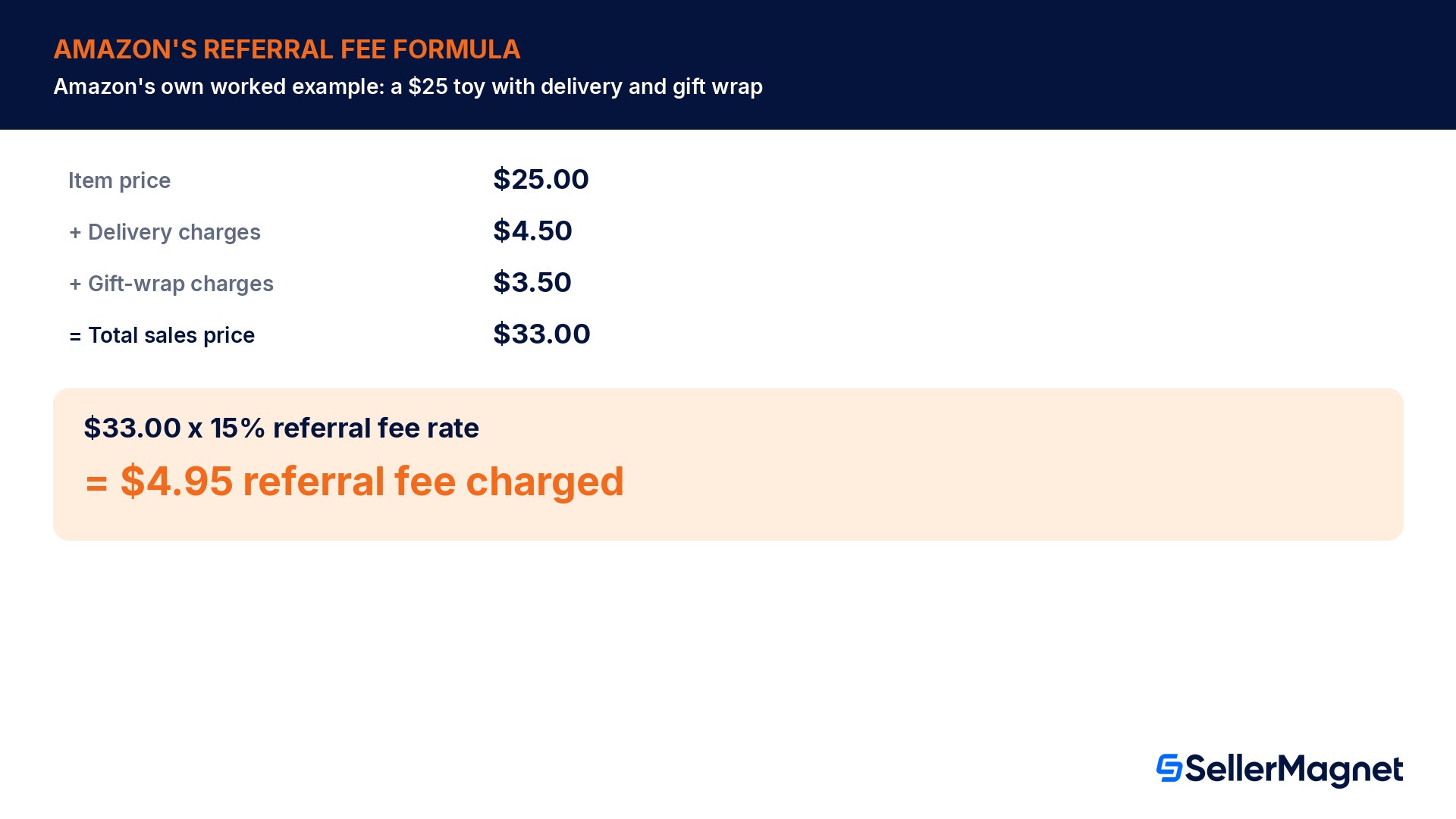
Amazon's referral fee formula is the total sales price, meaning item price plus delivery charges plus gift-wrap charges, multiplied by the category's referral fee percentage, or the category's per-item minimum fee, whichever is greater. On Amazon's own example, a toy priced at $25.00 with $4.50 delivery and $3.50 gift wrap has a $33.00 total sales price, and at a 15% referral fee rate that comes to $4.95. Cheap items are often billed on the per-item minimum instead of the percentage, and several categories use tiered rates, either a whole-price threshold or a portion band, that change at specific price points.
The referral fee formula, in full
Amazon's Referral fees help page states the rule directly: "For all products, Amazon deducts the applicable referral fee percentage calculated on the total sales price," and defines that base explicitly: "The total sales price is the total amount paid by the buyer, including the item price and any delivery charges or gift wrapping charges." The formula given on the same page is: "Referral fee = [(Item price + delivery charges + giftwrap charges) multiplied by the category referral fee rate] OR [applicable minimum referral fee], whichever is greater."
Component
What it includes
Item price
The listed selling price of the item
Delivery charges
Any amount the seller charges the buyer for shipping, if fulfilling the item themselves
Gift-wrap charges
Any amount charged for a gift-wrapping service
Total sales price
Item price + delivery charges + gift-wrap charges, the base the referral fee percentage is applied to
Referral fee
The greater of (total sales price x category rate) or the category's per-item minimum fee
Source: Referral fees. The fee is charged "when the buyer's order is shipped," so a seller forecasting cash flow should treat it as a cost realized at shipment time, not at the moment a listing goes live or an order is placed. Taxes calculated through Amazon's own tax calculation services are explicitly excluded from the base; the referral fee is calculated before any such tax is added.
Delivery and gift-wrap charges are part of the fee base, not separate from it
A seller who charges extra for shipping or gift wrapping pays a referral fee on that extra amount too, since both are added into the total sales price before the category percentage is applied. Pricing shipping or gift wrap as if it were fee-free understates the true cost of offering either.
How much is Amazon's referral fee, and is there a minimum?
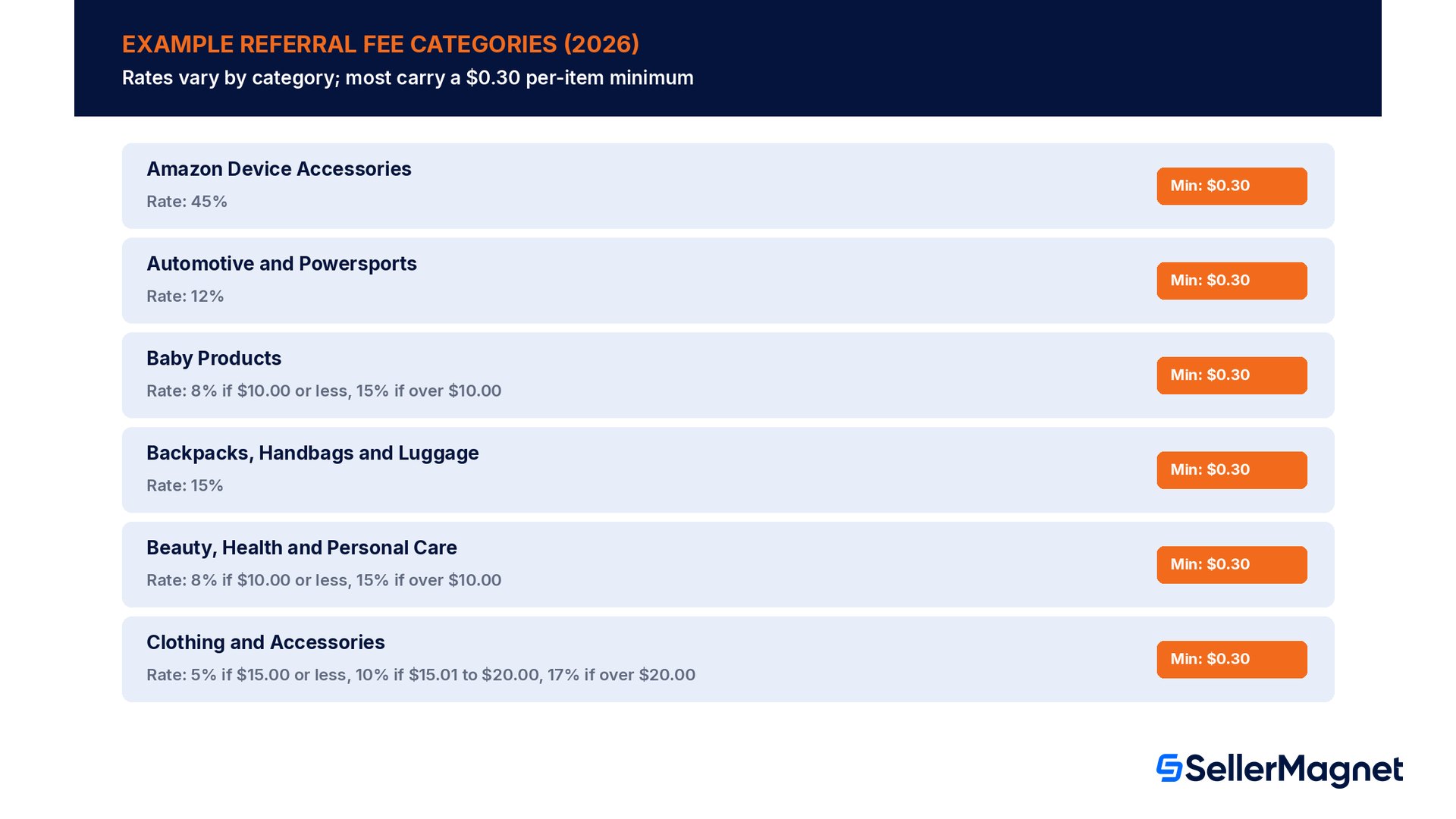
Referral fee percentages vary by product category, and Amazon's Selling on Amazon fee schedule lists the applicable minimum fee alongside each one, most commonly $0.30 per unit, though a few categories carry no minimum at all. The minimum exists specifically to stop very cheap items from generating a referral fee of a few cents; once the percentage calculation falls under the minimum, the minimum applies instead, but only below a specific price.
Fee category
Referral fee percentage
Per-item minimum
Amazon Device Accessories
45%
$0.30
Automotive and Powersports
12%
$0.30
Baby Products
8% if $10.00 or less, 15% if over $10.00
$0.30
Backpacks, Handbags and Luggage
15%
$0.30
Beauty, Health and Personal Care
8% if $10.00 or less, 15% if over $10.00
$0.30
Clothing and Accessories
5% if $15.00 or less, 10% if $15.01 to $20.00, 17% if over $20.00
$0.30
Grocery and Gourmet
8% if $15.00 or less, 15% if over $15.00
no minimum
Furniture
15% for the portion up to $200.00, 10% for the portion over $200.00
$0.30
Computers
8%
$0.30
Everything Else
15%
$0.30
Source: Selling on Amazon fee schedule. Several categories in this table, Baby Products, Beauty/Health/Personal Care, Clothing and Accessories and Furniture among them, do not use one flat percentage; the rate itself changes once the total sales price crosses a breakpoint. That change works in one of two completely different ways depending on the category, which is the part sellers most often get backwards.
What's the difference between a threshold rate and a portion band rate?
Amazon's own fee schedule uses two different kinds of tiered wording, and mixing them up gets the fee wrong in both directions. A whole-price threshold category reads "for products with a total sales price of $X or less" and "greater than $X": Amazon looks at the FULL total sales price, picks the single bracket it falls into, and applies that ONE rate to the entire price, not just the amount above the breakpoint. Clothing and Accessories, Baby Products, Beauty/Health/Personal Care, Grocery and Gourmet and Lawn Mowers and Snow Throwers all work this way (Clothing and Accessories at $15.00 and $20.00, Baby Products and Beauty/Health/Personal Care at $10.00, Grocery and Gourmet at $15.00, Lawn Mowers and Snow Throwers at $500.00).
A portion (marginal band) category instead reads "for the portion of the total sales price up to $X" and "for any portion ... greater than $X": Amazon splits the price into bands and charges each band's own rate on only its own slice, then adds the results together. Compact Appliances, Electronics Accessories, Fine Art, Furniture, Jewelry and Watches all work this way. Amazon's own published fee-example page uses exactly this math for a watch: a $7,000.00 watch pays 16% on the first $1,500.00 ($240.00) plus 3% on the remaining $5,500.00 ($165.00), for a $405.00 total, not 3% on the whole $7,000.00.
Kind
Live-schedule wording
Example categories
How the rate is applied
Whole-price threshold
"for products with a total sales price of $X or less"
Clothing and Accessories, Baby Products, Beauty/Health/Personal Care, Grocery and Gourmet and Lawn Mowers and Snow Throwers
ONE rate on the entire total sales price, chosen by which price bracket it falls into
Portion (marginal band)
"for the portion of the total sales price up to $X"
Compact Appliances, Electronics Accessories, Fine Art, Furniture, Jewelry and Watches
Each band of the price is charged at its own rate, then the bands are added together
The two models produce very different numbers on the same price, which is exactly why the worked examples below walk one of each: Clothing and Accessories as a threshold category, and Furniture as a portion category.
The distinction matters most for margin planning right around a breakpoint. In a threshold category, a seller pricing just above the cliff pays a much higher referral fee on the WHOLE item than a seller pricing just below it, so a small price increase can erase more margin than the increase itself, and a small price decrease can be worth more than it looks. In a portion category, there is no such cliff: the fee changes smoothly as the price moves, because only the new slice of the price is taxed at the new rate. Reading the live fee schedule's exact wording for the product's own category, before setting a price near a breakpoint, avoids both traps.
Worked example 1: Amazon's own published toy calculation
Amazon's Referral fees page publishes its own example for a toy product at a 15% referral fee rate with a $0.30 per-item minimum. The item price is $25.00, delivery charges are $4.50, and gift-wrap charges are $3.50.
Line
Amount
Item price
$25.00
Delivery charges
$4.50
Gift-wrap charges
$3.50
Total sales price
$33.00
Referral fee at 15%
$33.00 x 15% = $4.95
Per-item minimum
$0.30
Referral fee charged (greater of the two)
$4.95
Source: Referral fees. The $4.95 result comes entirely from the total sales price, $33.00, not from the $25.00 item price alone; a seller who calculated the fee from the item price only would have arrived at $3.75, understating the real fee by ignoring delivery and gift-wrap charges entirely.
Worked example 2: when the per-item minimum takes over
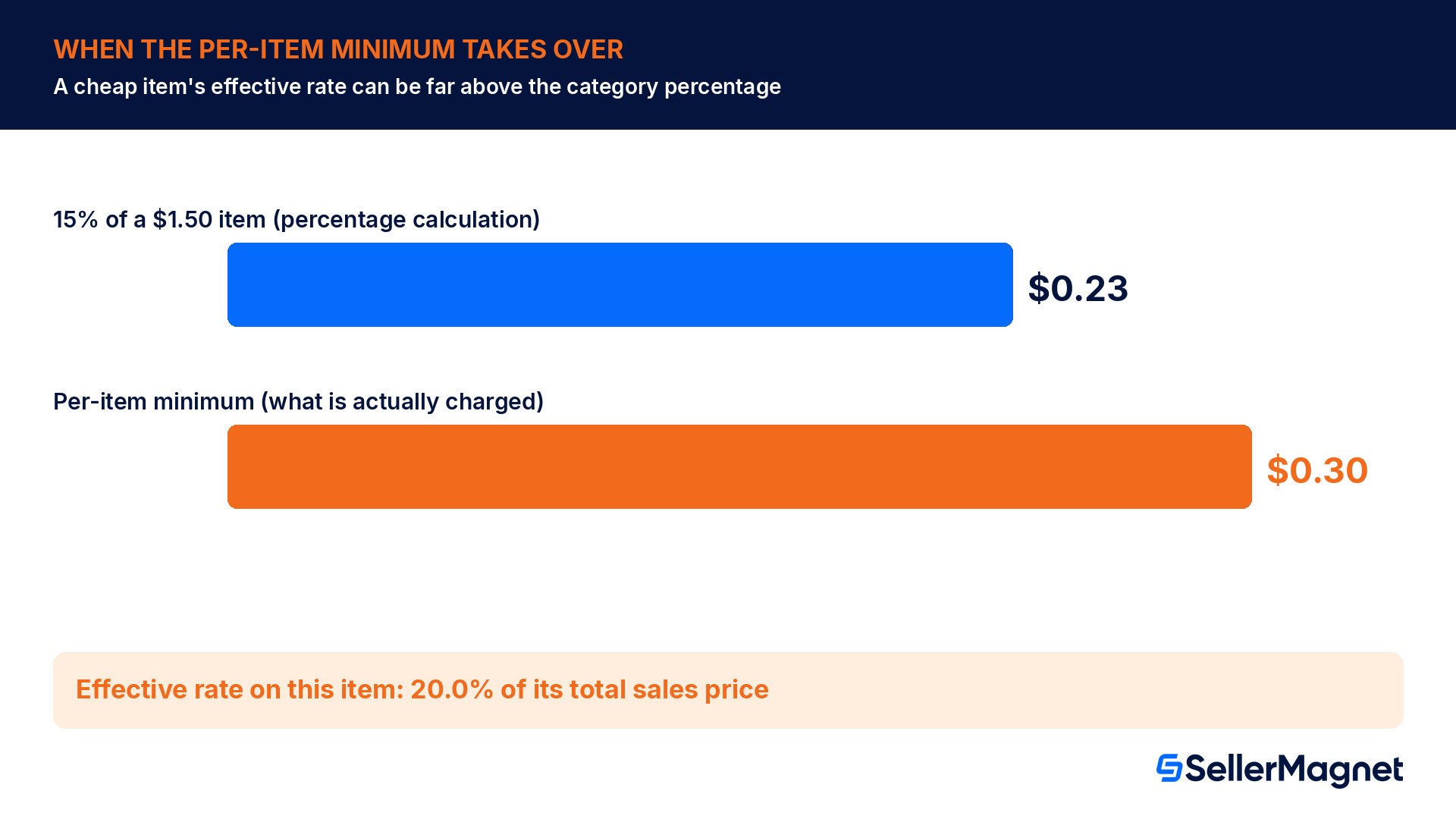
Low-priced items flip the calculation. Take a $1.50 item in a category with the same 15% rate and $0.30 minimum, no delivery or gift-wrap charges added. The straight percentage calculation gives $0.23, but since that is below the $0.30 per-item minimum, the minimum applies instead.
Line
Amount
Item price (total sales price)
$1.50
Referral fee at 15%
$0.23
Per-item minimum
$0.30
Referral fee charged
$0.30 (the minimum, since it is greater)
Effective rate on this item
20.0% of the total sales price
The $0.30 minimum works out to an effective rate of 20.0% on this item, well above the category's nominal 15%. But the minimum does not win on every cheap item: at a 15% rate it only takes over below $2.00, at 8% below $3.75, and at 5% below $6.00. Above its break-even price, the percentage calculation is already higher than $0.30, so the minimum never comes into play.
Worked example 3: a whole-price threshold category, Clothing and Accessories
Clothing and Accessories is a threshold category: 5% applies when the total sales price is $15.00 or less, 10% when it is greater than $15.00 and up to $20.00, and 17% once it is over $20.00, and in every case that ONE rate applies to the WHOLE price, not just the slice above the breakpoint. That produces a price cliff right above each breakpoint: a one-cent increase from $20.00 to $20.01 moves the ENTIRE price into the 17% bracket.
Total sales price
Bracket
Rate
Referral fee
$20.00
$15.01 to $20.00
10%
$2.00
$20.01
over $20.00
17%
$3.40
$45.00
over $20.00
17%
$7.65
Raising the price by one cent, from $20.00 to $20.01, moves the whole total sales price into the 17% bracket and the referral fee jumps $1.40, from $2.00 to $3.40, not because of the extra cent itself but because the WHOLE price is now taxed at the higher rate. A $45.00 clothing item is well inside the top bracket, so it pays 17% x $45.00 = $7.65 outright; there is no 5%/10%/17% split to add up, because Clothing and Accessories is a threshold category, not a portion category.
Worked example 4: a portion band category, Furniture
Furniture works the opposite way: it is a portion category, so only the slice of the price inside each band is charged at that band's own rate. A $300.00 furniture item pays 15% on the first $200.00 ($30.00) plus 10% on the remaining $100.00 ($10.00), for a $40.00 total, not 10% on the whole price ($30.00) and not 15% on the whole price ($45.00) either.
Price band
Amount in this band
Rate
Fee for this band
$0.00 to $200.00
$200.00
15%
$30.00
$200.01 to $300.00
$100.00
10%
$10.00
Total referral fee
$40.00
Unlike the clothing example, there is no cliff here: raising the price by one cent inside a band changes the fee by a cent or two, never by a dollar at a time, because only the new slice is taxed at the new rate. Confusing a portion category for a threshold one would have a seller apply 10% to the whole $300.00 ($30.00), understating the real $40.00 fee; confusing a threshold category for a portion one, as the clothing example above would if band math were used, overstates it instead. Knowing which kind applies, not just the headline percentage, is what gets the number right.
Run the numbers on the exact ASIN instead of estimating from memory. SellerMagnet's Fee Calculator compares FBA vs FBM fees, referral fee, profit and ROI for any ASIN, using Amazon's public fee schedule, with 5 free lookups a day. The Referral Fees by Category 2026 guide covers the full category rate table, and FBA Fees 2026 covers how the referral fee fits alongside fulfillment and storage fees in total landed cost.
What mistakes do sellers make calculating the referral fee?
Calculating the fee from the item price alone and forgetting that delivery charges and gift-wrap charges are part of the total sales price the percentage applies to.
Treating a whole-price threshold category, Clothing and Accessories, Baby Products or Beauty/Health/Personal Care among them, like a portion category, splitting the price into bands when Amazon actually applies ONE rate to the entire total sales price once it crosses the breakpoint.
Assuming the percentage calculation always wins and missing the per-item minimum, which only takes over below a specific price: $2.00 at a 15% rate, $3.75 at 8%, or $6.00 at 5%.
Using a stale category percentage after Amazon updates a fee schedule, rather than re-checking the current Selling on Amazon fee schedule page.
Forgetting that the referral fee is charged when the order ships, not when it is placed, which matters for cash-flow timing on orders held before fulfillment.
Ignoring that the fee base excludes any tax calculated through Amazon's own tax calculation services, and accidentally including tax when estimating the fee by hand.
How to calculate your exact referral fee
Calculate an Amazon referral fee by hand
Find the total sales price - Add the item price, any delivery charges you collect, and any gift-wrap charges together. This full amount, not the item price alone, is the base the referral fee percentage applies to.
Confirm the category rate - Look up the current referral fee percentage for the product's category on the Selling on Amazon fee schedule; check whether the category uses one flat rate or a tiered rate with price breakpoints.
Check whether the tier is a whole-price threshold or a portion band - Read the live wording: "for products with a total sales price of ... or less" / "greater than ..." (Clothing and Accessories, Baby Products, Beauty/Health/Personal Care, Grocery and Gourmet and Lawn Mowers and Snow Throwers) means ONE rate applies to the entire price. "For the portion of the total sales price up to ..." (Compact Appliances, Electronics Accessories, Fine Art, Furniture, Jewelry and Watches) means the price is split into bands and each band's own fee is added up.
Compare to the per-item minimum - Compare the percentage result to the category's per-item minimum fee, commonly $0.30 and absent entirely in a few categories, and charge whichever of the two is greater.
Pre-list checklist for referral fees
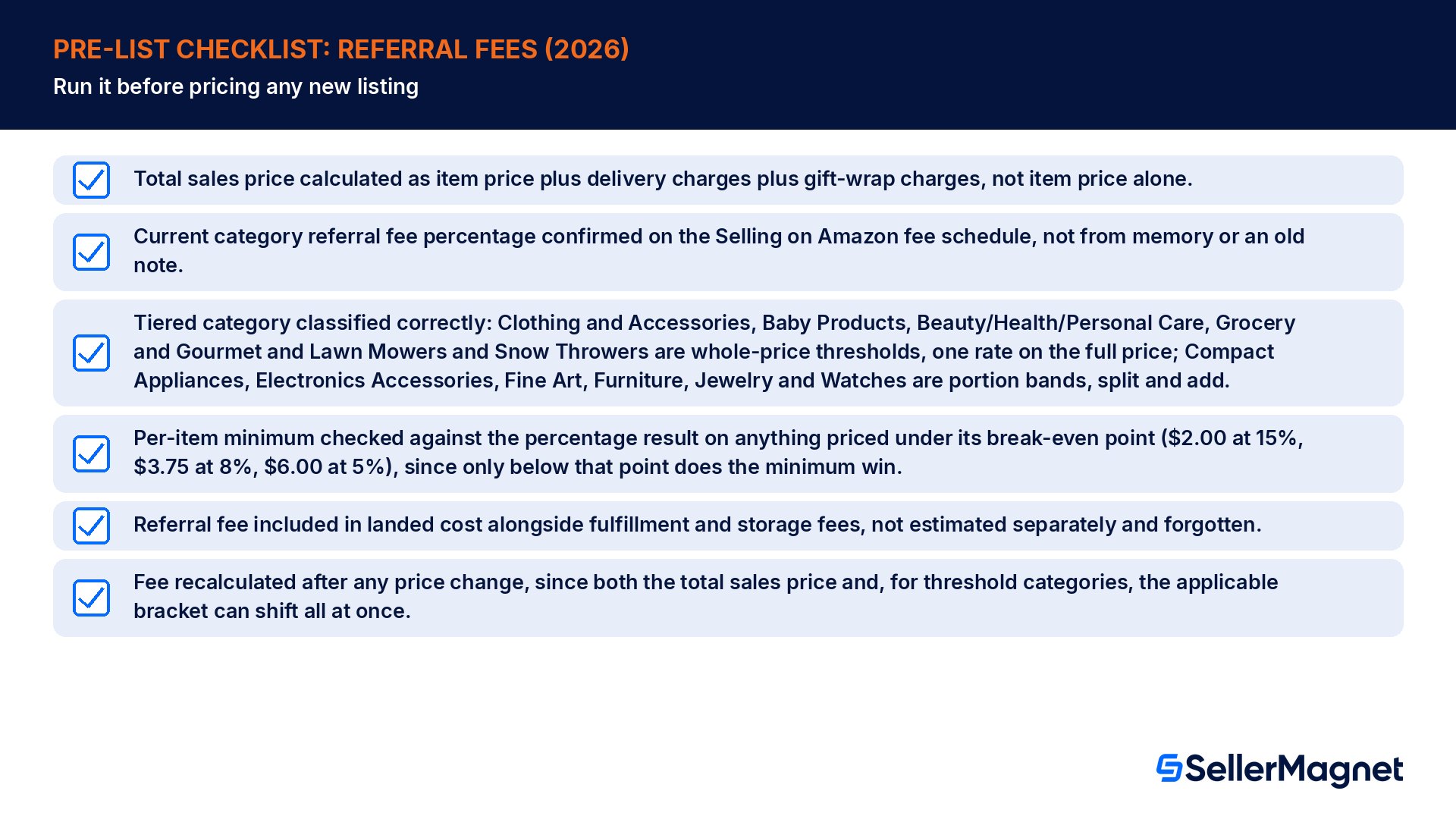
Total sales price calculated as item price plus delivery charges plus gift-wrap charges, not item price alone.
Current category referral fee percentage confirmed on the Selling on Amazon fee schedule, not from memory or an old note.
Tiered category classified correctly: Clothing and Accessories, Baby Products, Beauty/Health/Personal Care, Grocery and Gourmet and Lawn Mowers and Snow Throwers are whole-price thresholds, one rate on the full price; Compact Appliances, Electronics Accessories, Fine Art, Furniture, Jewelry and Watches are portion bands, split and add.
Per-item minimum checked against the percentage result on anything priced under its break-even point ($2.00 at 15%, $3.75 at 8%, $6.00 at 5%), since only below that point does the minimum win.
Referral fee included in landed cost alongside fulfillment and storage fees, not estimated separately and forgotten.
Fee recalculated after any price change, since both the total sales price and, for threshold categories, the applicable bracket can shift all at once.
How do I calculate the referral fee on a tiered clothing item?
Clothing and Accessories is a whole-price threshold category: find which bracket the total sales price falls into, $15.00 or less, $15.01 to $20.00, or over $20.00, and apply that ONE rate to the entire price. A $45.00 item is over $20.00, so it pays 17% x $45.00 = $7.65; there is no band-by-band split to add up.
At what price does the $0.30 minimum stop applying?
The $0.30 per-item minimum only wins below a specific break-even price: under $2.00 at a 15% rate, under $3.75 at 8%, or under $6.00 at 5%. Above that price the percentage calculation is already higher than $0.30, so the minimum never comes into play.
What is the per-item minimum referral fee?
Most categories carry a per-item minimum of $0.30 that applies once the percentage calculation falls under that amount, which happens below $2.00 at a 15% rate, below $3.75 at 8%, or below $6.00 at 5%. A few categories, such as Media, Gift Cards and Grocery and Gourmet, carry no minimum at all.
Why do some categories charge one rate on the whole price while others split it into bands?
It depends on the live schedule's exact wording. A "total sales price of ... or less" category, like Clothing and Accessories or Baby Products, is a whole-price threshold: ONE rate covers the entire price. A "for the portion of the total sales price up to ..." category, like Furniture or Watches, is a portion band: each slice is charged at its own rate and the results are added.
When is the referral fee actually charged?
Amazon charges the referral fee when the buyer's order is shipped, not when the order is placed or when the listing goes live. Sellers forecasting cash flow should treat it as a cost realized at the shipment date.
Is tax included in the referral fee calculation?
No. Amazon's total sales price for referral fee purposes excludes any tax calculated through Amazon's own tax calculation services, so the fee is based on the item price, delivery and gift-wrap charges only, before tax.
Where can I check the current rate for my product category?
Amazon publishes the full, current category rate table on its Selling on Amazon fee schedule help page. SellerMagnet's Fee Calculator compares FBA vs FBM fees, referral fee, profit and ROI for any ASIN using that same public fee schedule, with 5 free lookups a day.
Stop Juggling Tools. SellerMagnet Combines Everything You Need.