Amazon Prepaid Return Label Policy 2026: What Changes
R
RenéFreelance Amazon Editor
|
12 min read
Starting December 18, 2026, Amazon is closing a loophole that many sellers relied on for cheap returns. Today, a seller-fulfilled order can be returned with an address-only label, the kind where the buyer pays for return shipping out of pocket. After that date, in the US, that option disappears for almost every category: every return must ship on a label Amazon already paid for, or the seller must refund the buyer without asking for the item back. Miss the window and Amazon makes the decision for you, as a returnless refund charged straight to your account. This guide works through exactly what changes, what stays the same, the 7-day clock you now have to beat, and who is still exempt.
Starting December 18, 2026, US sellers can no longer use an address-only return label on a seller-fulfilled order. Within 7 calendar days of a return request, the seller must upload a prepaid return shipping label through Manage Seller Fulfilled Returns, or refund the buyer in full without asking for the item back. If neither happens in time, Amazon can automatically issue a returnless refund and deduct it from the seller's account. Heavy and bulky items are temporarily exempt.
What actually changes on December 18, 2026?
Amazon's announcement, sent directly to affected sellers and posted by its News team on the Seller Forums, is specific about the mechanics: "Starting December 18, 2026, all US returns for seller-fulfilled orders (excluding heavy and bulky items) will require a prepaid return shipping label. Address-only labels that require customers to pay for return shipping will no longer meet the requirement, except temporarily for heavy and bulky items. This change allows for a consistent process for your US and international returns and helps improve the customer experience." That last sentence is the context sellers miss: Amazon already requires a prepaid label on international returns (see below); this update brings domestic seller-fulfilled returns in line with that same standard.
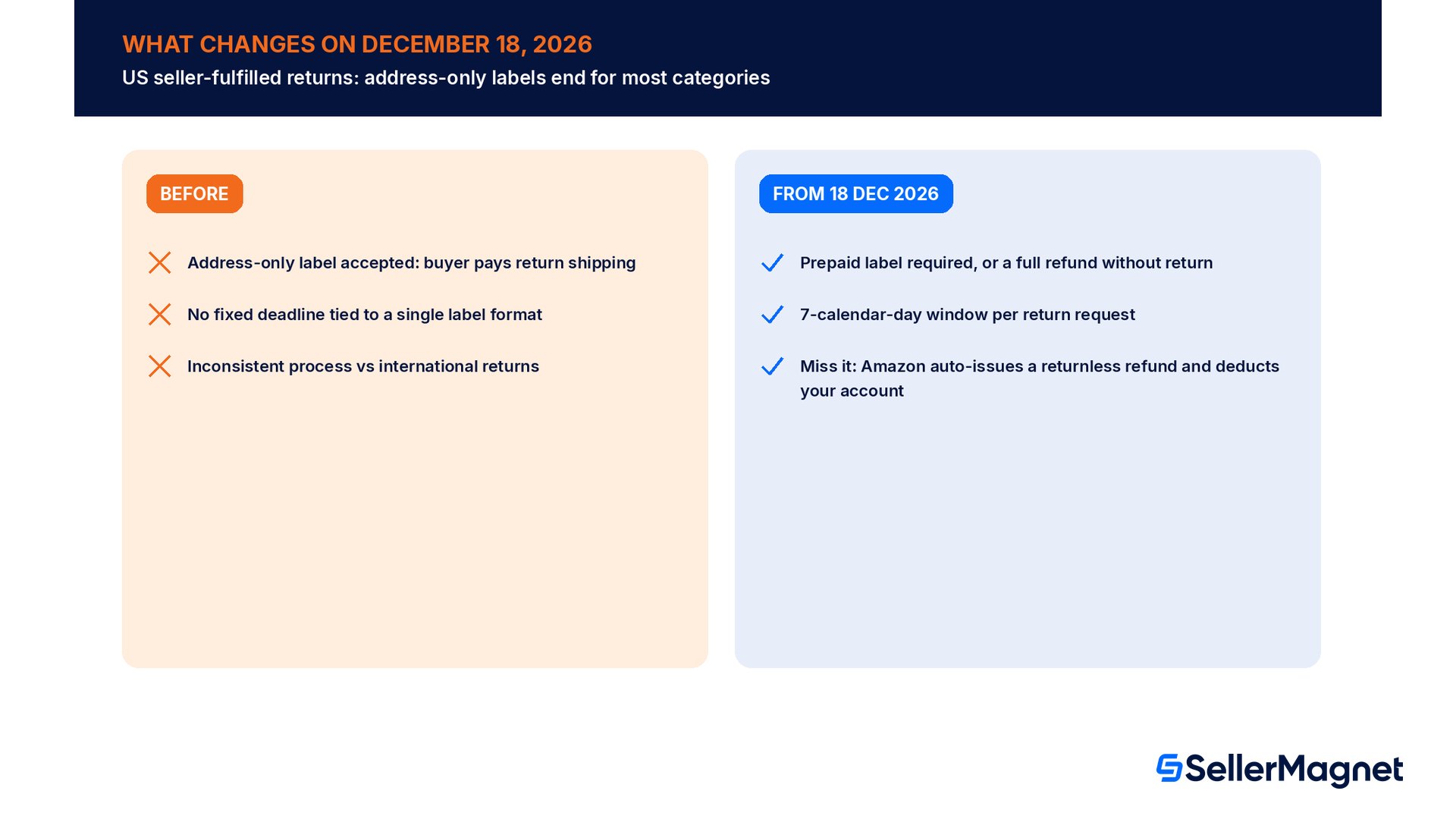
Before 18 Dec 2026
From 18 Dec 2026
Address-only label (buyer pays return shipping)
Accepted for most seller-fulfilled returns
No longer accepted, except temporarily for heavy and bulky items
Prepaid return label
Optional, or already standard for many categories via the prepaid return program
Required within 7 calendar days, unless a returnless refund is issued instead
Missed deadline
Handled case by case through authorization and refund timelines
Amazon may auto-issue a returnless refund and deduct the seller's account
Label delivery channel
Sometimes shared informally with the buyer
Must go through the Manage Seller Fulfilled Returns workflow; Buyer-Seller Messaging labels do not count
The 7-day clock: your two compliant options
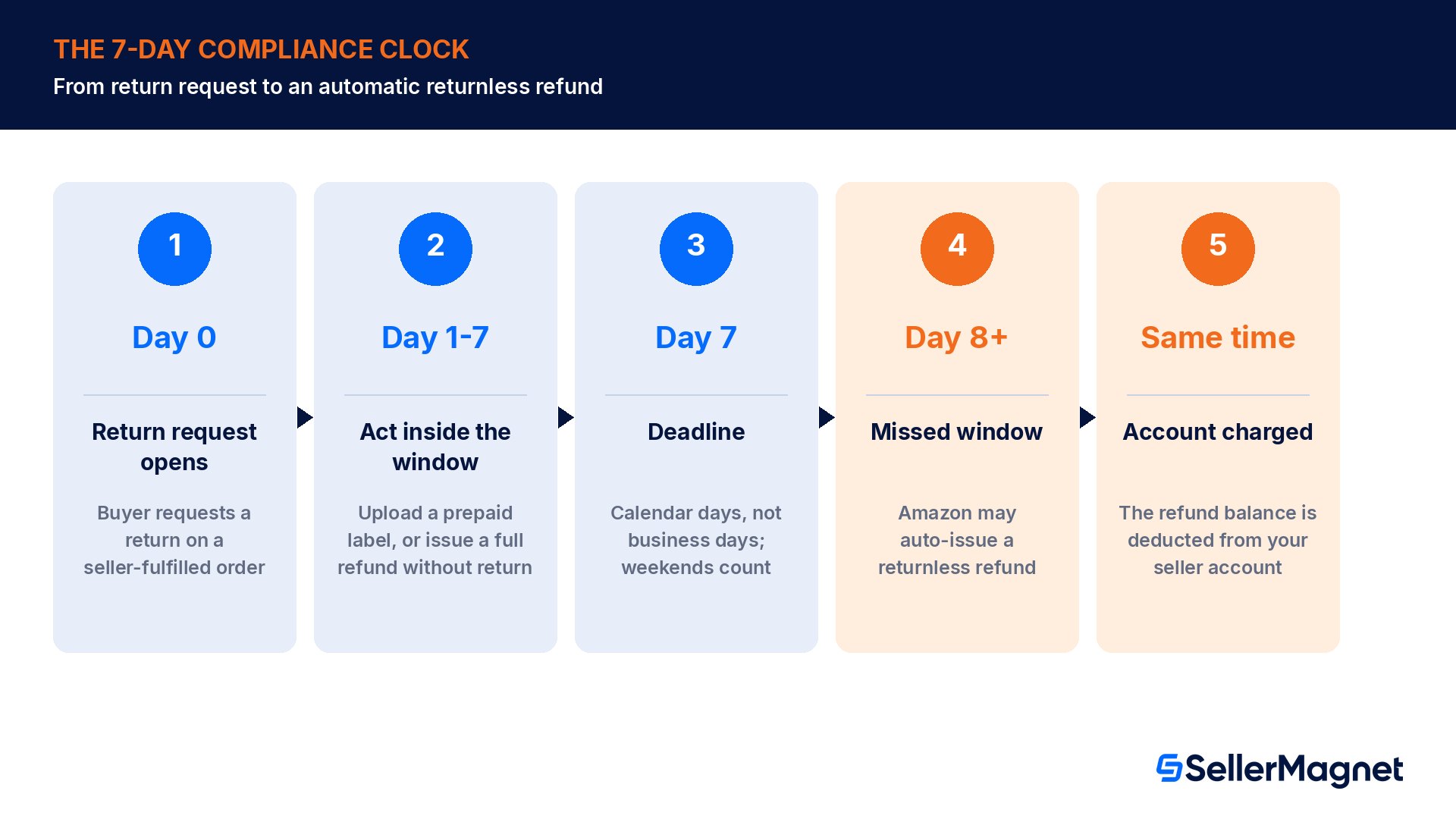
The announcement gives sellers exactly two ways to stay compliant once a return request comes in, and a fixed window to choose one: "To meet the requirement, within seven calendar days of a return request, you must either: Upload a prepaid return shipping label against the return request on the Manage seller-fulfilled returns workflow. Issue a full refund without requiring customer to return the item." Note the word calendar, not business days; weekends and holidays count toward the 7-day clock. The announcement is equally explicit about what happens if neither action is taken: "If a prepaid return label or returnless refund isn't provided within this timeframe, a returnless refund may be automatically issued and the balance deducted from your selling account."
A label sent outside Manage Returns does not count
Amazon's note is direct: "Labels shared through Buyer Seller Messaging or other channels outside the Manage Returns workflow don't meet the requirements listed on Upload a prepaid return label." Emailing a label link to the buyer, or pasting a tracking number into a message, does not stop the 7-day clock. The label has to be uploaded against the return request inside Manage Seller Fulfilled Returns itself.
This is not the same as the existing international returns rule
Amazon's Manage seller-fulfilled returns page already carries a related, but separate, requirement for cross-border orders: "For international returns (where there is a non-US return address), you are required to provide the buyer with a merchant pre-paid label through the Manage Seller Fulfilled returns page within 2 days of the return request. Alternatively, you can provide a returnless refund or a valid US domestic return address through your Seller Central Return settings." That rule has applied to international, non-US-address returns for some time, with a 2-day window. The December 18 change extends the same prepaid-label logic to domestic US seller-fulfilled returns, but on a longer 7-day clock. Track both deadlines separately: an international return still needs action within 2 days, a domestic one within 7.
The existing US prepaid return program itself is already broad. Per Amazon's prepaid-returns page, "US sellers are automatically enrolled in the prepaid return program per our returns policies," and Amazon provides the label through its Buy Shipping services, then charges the seller's account "for the cost of the return shipping once the buyer sends the product back," calculated from the weight and size data on file for that listing. What is new on 18 Dec 2026 is not the existence of prepaid labels, it is removing the address-only fallback that some sellers (or some return workflows) were still using instead.
Who is still exempt, and what counts as heavy and bulky?
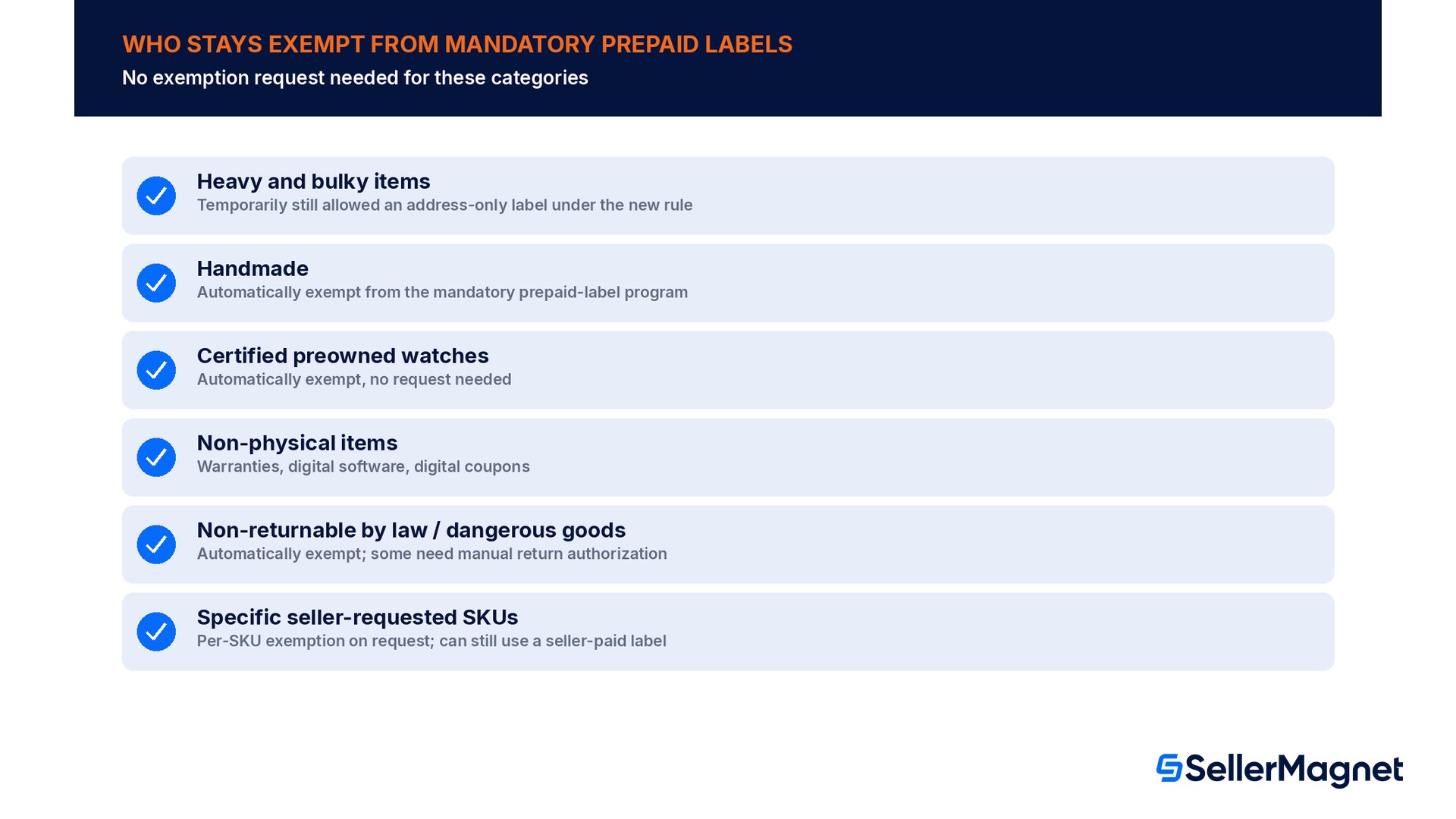
The announcement's heavy-and-bulky carve-out is explicitly temporary, which means it is worth watching rather than treating as permanent. Separately, Amazon's prepaid-returns page lists the categories that are automatically exempt from the mandatory prepaid-label program, with no exemption request needed: "Handmade. Certified preowned watches. Non-physical items (for example, warranties, digital software, and digital coupons). Items that are non-returnable by law and dangerous goods. Extra-large or heavy items." A seller can also request an exemption for specific SKUs outside those categories, per the Manage Returns page: "You can request an exemption for certain SKUs. For more information, go to Request exemption from prepaid returns for seller-fulfilled orders. For exempt SKUs, you can provide a pre-paid label to the buyer through the Manage Seller Fulfilled returns page."
Exempt category / situation
What it means
Heavy and bulky items
Temporarily still allowed an address-only label under the new rule; watch for this exemption to tighten
Handmade
Automatically exempt from the mandatory prepaid-label program, no request needed
Certified preowned watches
Automatically exempt, no request needed
Non-physical items
Warranties, digital software, digital coupons: automatically exempt
Non-returnable by law / dangerous goods
Automatically exempt; some dangerous goods also require manual return authorization
Specific SKUs (seller-requested)
Sellers can request a per-SKU exemption; exempt SKUs can still get a seller-paid label through Manage Returns
The return workflow around the new deadline
The 7-day label rule sits inside Amazon's existing return process, which has its own clocks. Per the Manage Seller Fulfilled Returns page: Amazon auto-authorizes most in-policy US return requests, including items exempt from prepaid returns; out-of-policy or manual-authorization categories (such as some dangerous goods) need a seller response within 24 hours; once a return is authorized, the buyer has 15 days after the return window closes to ship the item back; and the seller must "issue refunds within two business days of receiving a return." Amazon is explicit about the consequence of inaction at any of these stages: "Failure to act may result in Amazon issuing a refund to the buyer on your behalf and charging your account."
Catch the 7-day clock before it runs out. SellerMagnet's Alerts can flag a return request that is approaching its deadline, so a label gets uploaded or a refund issued before Amazon steps in with an automatic returnless refund. Analytics tracks the return-shipping charges that land in your Settlement and Payments reports, so the added prepaid-label cost on domestic returns shows up in your real margin per order, not just at month end.
The standard Amazon return window is 30 days from the estimated delivery date for most items, though some categories get a longer window. A buyer-damaged item is handled separately from this rule: per the restocking fee policy, reimbursement for a buyer-damaged item is capped at a maximum of 50% of the order value, and a seller can appeal a refund issued on their behalf with photos of the damage, the shipping label, the tracking ID and proof of delivery. None of that appeal process changes on 18 Dec 2026; what changes is only the label-format requirement on the return itself.
Worked example: a $45 seller-fulfilled return after the rule change
A seller-fulfilled kitchen tool sells for $45 and ships US domestic, not in any exempt category. A buyer requests a return on day 0 because the item does not fit their needs. Before 18 Dec 2026, the seller could have sent an address-only label and let the buyer pay for return shipping, or ignored it and risked Amazon stepping in. From 18 Dec 2026, the seller has 7 calendar days to do one of two things: upload a prepaid return label through Manage Seller Fulfilled Returns (Amazon will later charge the seller's account for that shipping cost once the item is actually sent back), or issue the $45 refund immediately without asking for the item back, a returnless resolution the seller controls and times. If the seller does neither by day 7, Amazon can issue the $45 refund itself and simply deduct it from the seller's account, the exact same financial outcome as the returnless-refund option, minus the seller's say in the timing.
A proactive returnless refund is often the cheaper, faster choice
For low-value or hard-to-resell items, issuing the refund immediately on day 0 to 1, rather than waiting out the 7-day window for a label, avoids paying for a return label at all. See our guide on returnless refunds for when that trade-off makes sense on margin, not just on speed.
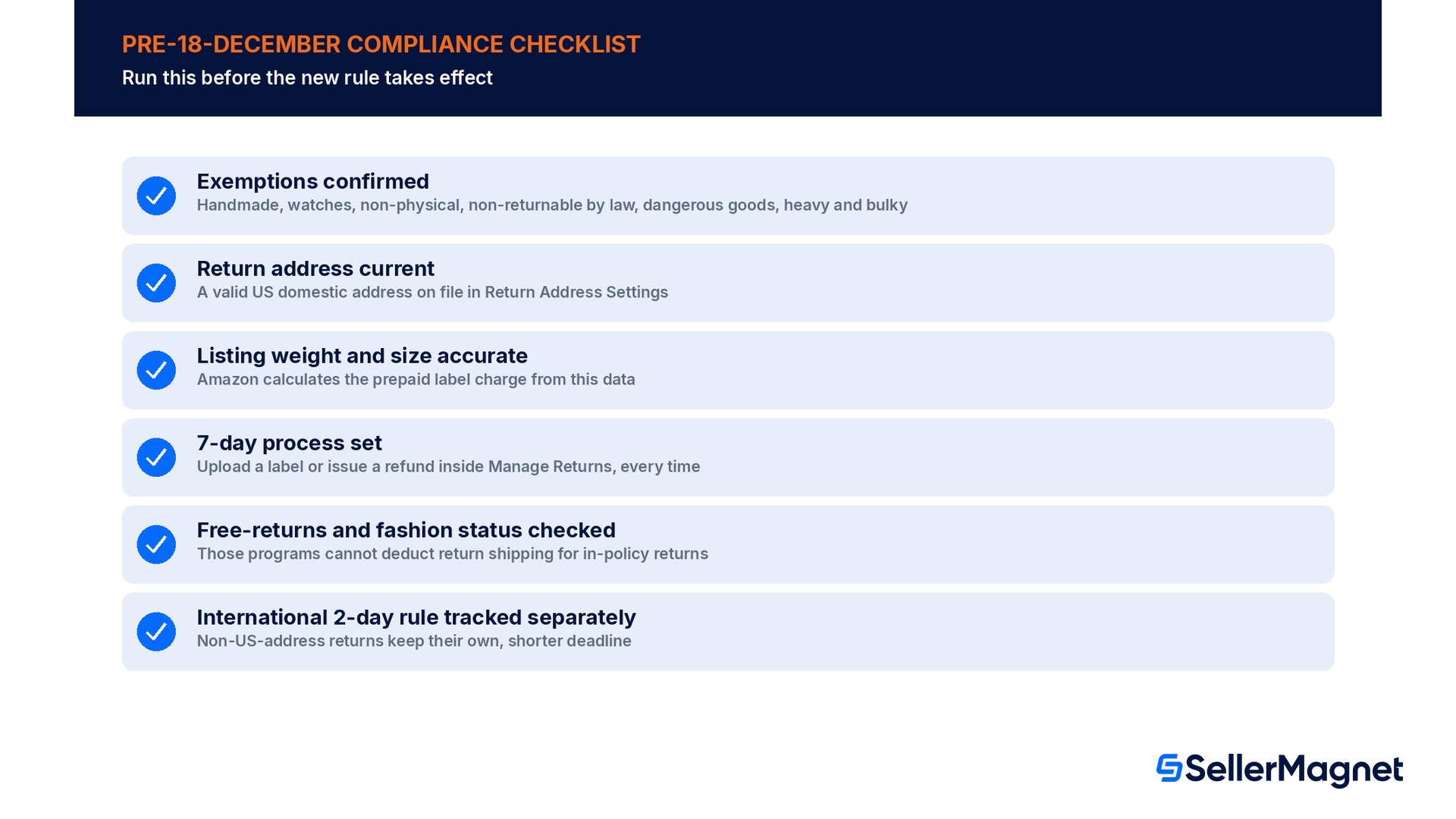
Pre-18 December compliance checklist
Confirmed which of your seller-fulfilled SKUs fall under the automatic exemptions (Handmade, certified preowned watches, non-physical items, non-returnable by law, dangerous goods) versus the temporary heavy-and-bulky carve-out.
Checked whether any remaining SKUs should get a seller-requested exemption through Request exemption from prepaid returns for seller-fulfilled orders.
Verified your default US domestic return address is current in Return Address Settings, since an outdated address can get returned items deemed abandoned.
Confirmed weight and size data is accurate for every active listing, since Amazon calculates the prepaid return shipping charge from that data.
Set a process to upload a prepaid label or issue a refund inside Manage Seller Fulfilled Returns within 7 calendar days of every return request, not just international ones.
Reviewed free-returns and fashion-item enrollment, since sellers in either program cannot deduct return shipping cost for in-policy returns regardless of this change.
How do I upload a prepaid return label the compliant way?
Upload a prepaid return label through Manage Seller Fulfilled Returns
Open the return request - Go to Manage Seller Fulfilled Returns and find the return request within its 7-day clock.
Check exemption status - Confirm the SKU is not in an automatically exempt category (Handmade, certified preowned watches, non-physical items, non-returnable by law, dangerous goods) and not under the temporary heavy-and-bulky carve-out.
Choose your compliant action - Either upload a prepaid return shipping label against the return request, or issue a full refund without requiring the item back.
Upload inside the workflow, not a message - Attach the label directly on the return request inside Manage Seller Fulfilled Returns; a label sent through Buyer-Seller Messaging does not satisfy the requirement.
Confirm before day 7 - Complete the upload or refund within 7 calendar days of the return request to avoid an automatic Amazon-issued returnless refund.
Track the shipping charge - Once the buyer ships the item back, Amazon charges your account for the return shipping cost, calculated from the listing's weight and size data; reconcile it in your Settlement and Payments reports.
Common mistakes sellers make with the new rule
Continuing to send address-only labels on non-exempt US seller-fulfilled returns after 18 Dec 2026, which no longer meets the requirement.
Sending a prepaid label link through Buyer-Seller Messaging instead of uploading it inside the Manage Seller Fulfilled Returns workflow, which does not stop the 7-day clock.
Confusing the new 7-day domestic deadline with the existing 2-day international deadline and missing one of them.
Assuming the heavy-and-bulky exemption is permanent rather than temporary, and not watching for Amazon to tighten it.
Letting a return request sit unanswered until Amazon auto-issues the refund, losing control over the timing and any dispute window.
Treating every return the same way regardless of item value, instead of weighing a proactive returnless refund against a prepaid label cost for low-value SKUs.
When does Amazon's new prepaid return label policy take effect?
December 18, 2026, for US returns on seller-fulfilled orders. Heavy and bulky items get a temporary exemption from the new requirement.
What do I have to do within 7 days of a return request?
Either upload a prepaid return shipping label against the return request inside the Manage Seller Fulfilled Returns workflow, or issue a full refund without requiring the buyer to return the item. Both stop the clock; doing neither does not.
What happens if I miss the 7-day window?
Amazon may automatically issue a returnless refund to the buyer and deduct the balance from your seller account, the same financial outcome as issuing the refund yourself, minus your control over the timing.
Can I send the buyer a prepaid label through Buyer-Seller Messaging instead?
No. Amazon states that labels shared through Buyer-Seller Messaging or any channel outside the Manage Returns workflow do not meet the requirement. The label has to be uploaded against the return request inside Manage Seller Fulfilled Returns.
Is this the same as the existing international returns rule?
No, it is a parallel rule on a different clock. International (non-US address) returns already require a merchant prepaid label within 2 days of the return request. The new December 18, 2026 rule applies to domestic US seller-fulfilled returns on a 7-day clock.
Which categories are exempt from mandatory prepaid return labels?
Handmade, certified preowned watches, non-physical items such as warranties and digital software, items non-returnable by law and dangerous goods, and extra-large or heavy items (currently as a temporary carve-out under the new rule). Sellers can also request a per-SKU exemption.
Who pays for the prepaid return label?
Amazon provides the label through its Buy Shipping services and charges the seller's account for the return shipping cost once the buyer actually sends the product back, calculated from the weight and size data on file for the listing.
Stop Juggling Tools. SellerMagnet Combines Everything You Need.