Amazon Overmax Handling Fee 2026: Which Products Pay a Surcharge
R
RenéFreelance Amazon Editor
|
14 min read
An Extra-Large product does not need to weigh more to get more expensive in 2026: it just needs to be long. Starting 15 January 2026, Amazon adds an Overmax handling fee on top of the regular FBA fulfillment fee for any Extra-Large item whose longest side exceeds 96 inches or whose length plus girth exceeds 130 inches, even when the item sits well under the 150 lb Extra-Large weight ceiling. This guide works through Amazon's Overmax Handling Fee page and the 2026 US FBA fulfillment fee changes page, shows the exact dimension math that decides whether a box crosses the line, stacks the new fee against the separate 3.5% fuel and logistics surcharge that lands later in the year, and gives a pre-ship checklist so a long, awkward box does not quietly cost 50% more than last year's identical shipment.
Amazon's Overmax handling fee applies from 15 January 2026 to Extra-Large products, up to 150 pounds, that exceed 96 inches on their longest side or 130 inches for length plus girth. The fee is added on top of the normal FBA fulfillment fee: $17 for 0 to 50 pounds, $21 for 50 plus to 70 pounds, and $25 for 70 plus to 150 pounds. It applies to non-apparel, apparel and dangerous goods alike, and it stacks with the separate 3.5% fuel and logistics surcharge that starts 17 April 2026.
What makes a product Overmax
Amazon's Overmax Handling Fee page sets the rule in one sentence: "Extra-Large (up to 150 lb) products exceeding 96 inches for longest side or 130 inches for length plus girth will be considered Overmax." Two things stand out. First, this is an either/or test, failing either measurement is enough; a short, fat box can be Overmax on length plus girth alone even if its longest side is nowhere near 96 inches. Second, the fee only applies inside the existing Extra-Large size tier (up to 150 lb); it is not a new size tier of its own, it is a surcharge layered onto a size tier that already existed.
Measurement
Overmax threshold
What it means
Longest side
> 96 inches
Fails on its own, regardless of the other two dimensions
Length + girth
> 130 inches
Girth = 2x(width + height); fails on its own even with a short longest side
Weight ceiling
up to 150 lb
Overmax only applies inside the Extra-Large weight range; above it a different size tier and process applies
Source: Overmax Handling Fee. The page does not exempt any product category: the same two dimension checks and the same fee table apply to "non-apparel, apparel and dangerous goods" alike, so a long apparel garment bag or a dangerous-goods item in an oversized box is not treated differently from a long piece of furniture.
Length plus girth catches boxes that look fine on paper
A box with a modest longest side can still be Overmax once its girth is added in. Check length + 2x(width + height) explicitly, not just the single longest measurement, before assuming a box is safely under the limit.
This fee is scoped to the US store
Amazon's Overmax Handling Fee page states it applies to selling in the United States. A seller running the identical oversized SKU through EU or UK fulfillment centers should check the matching size-tier and surcharge pages for that store rather than assuming the $17-$25 US rate card applies there too.
The 2026 Overmax fee rate card
The Overmax handling fee is flat per weight tier, charged in addition to the item's normal Extra-Large fulfillment fee. It is not a percentage of the fulfillment fee and it does not change with how far over the dimension limit the box is: one inch over 96 inches on the longest side, or one hundred inches over, pays the same flat fee for that weight tier.
Shipping weight
Overmax handling fee (added to fulfillment fee)
0 to 50 lb
$17
50+ to 70 lb
$21
70+ to 150 lb
$25
Source: Overmax Handling Fee. These are the "Overmax additional fees" rates effective 15 January 2026, listed as applying "in addition to FBA fulfillment fees"; the base fulfillment fee itself still follows the normal Extra-Large rate card by weight on the 2026 US FBA fulfillment fee changes page.
Worked example 1: Amazon's own 0-50 lb product
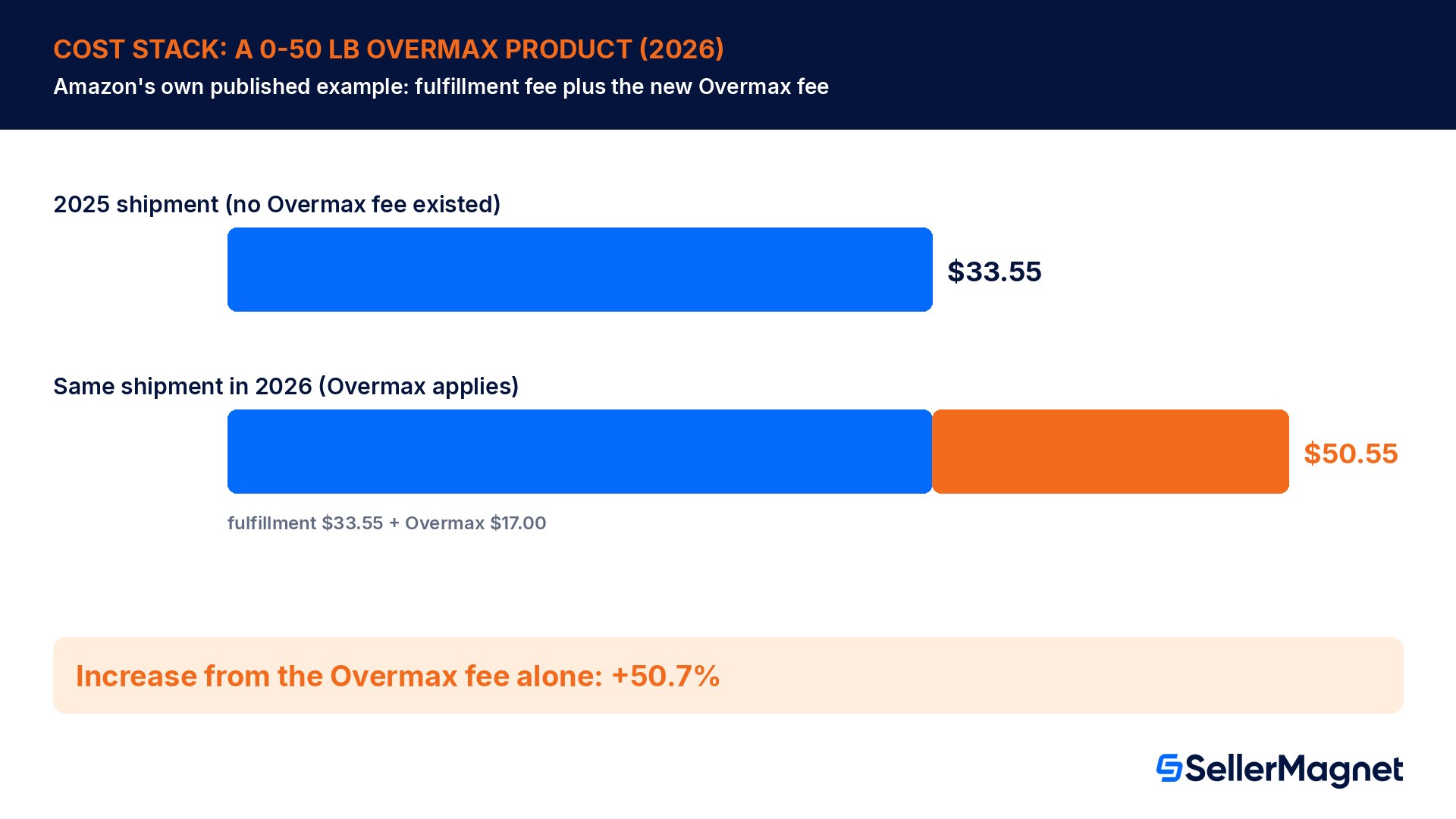
Amazon's Overmax Handling Fee page publishes its own worked product example for the lightest Extra-Large bracket. The 2025 non-peak fulfillment fee for that bracket was $33.55 (listed as "$33.55 ($26.33 + $0.38/lb interval)"), and that base rate carries over unchanged into 2026 non-peak. What changes is the line underneath it: once the product is classed Overmax, a flat $17.00 is added, taking the total from $33.55 to $50.55.
Overmax handling fee (longest side or length+girth over the limit)
$17.00
$50.55
Increase versus the same shipment in 2025
$17.00
50.7% higher
That percentage increase comes entirely from a dimension check, with no change to the product's weight, category, or selling price. A seller who ships the identical box in 2026 that they shipped in 2025 absorbs the full $17.00 unless the packaging itself changes.
Worked example 2: stacking with the 3.5% fuel and logistics surcharge
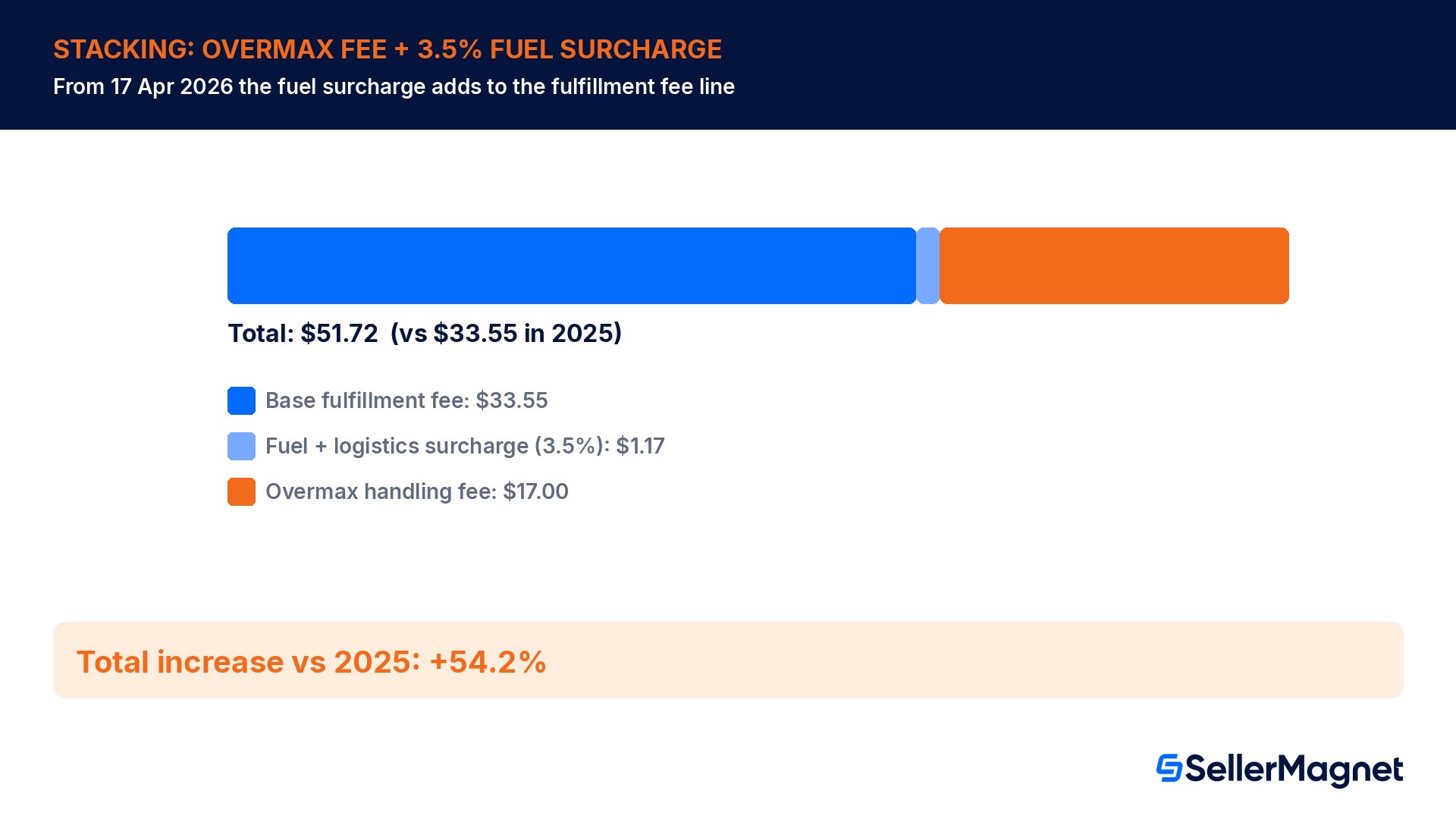
The Overmax fee is not 2026's only change to this shipment's cost. Amazon's 2026 US FBA fulfillment fee changes page states: "Starting April 17, 2026, a 3.5% fuel and logistics-related surcharge will be applied to fulfillment fees across Fulfillment by Amazon (FBA) in the US and Canada." That surcharge is calculated on the fulfillment fee line, not on the flat Overmax fee, but the two still land on the same shipment and the same invoice. Applying both to the same 0-50 lb example: the $33.55 fulfillment fee plus a 3.5% surcharge of $1.17 comes to $34.72, and adding the flat $17.00 Overmax fee on top brings the total to $51.72.
Line
Calculation
Amount
2026 non-peak fulfillment fee
Base rate
$33.55
Fuel and logistics surcharge (from 17 Apr 2026)
$33.55 x 3.5%
$1.17
Fulfillment fee with surcharge
$33.55 + $1.17
$34.72
Overmax handling fee (flat, 0-50 lb)
Added separately
$17.00
Total fee on this shipment
$34.72 + $17.00
$51.72
Total increase versus the 2025 fee for the same box
$51.72 - $33.55
$18.17 (54.2%)
Two different effective dates
The Overmax handling fee starts 15 January 2026. The 3.5% fuel and logistics surcharge starts later, 17 April 2026 for standard FBA (2 May 2026 for Buy with Prime and Multi-Channel Fulfillment). An overmax shipment made in February 2026 pays the Overmax fee alone; the same shipment from May 2026 onward pays both.
The same math across all three weight tiers
The 0-50 lb bracket above is the lightest and cheapest Overmax tier, so it understates the dollar impact on a heavier product. The fee itself only moves in three flat steps, $17, $21, $25, but the base fulfillment fee it sits on top of rises much faster with weight, so the same flat Overmax charge becomes a smaller percentage of a heavier shipment's total cost even as its dollar impact on margin stays real. A seller selling a mix of light, long items (curtain rods, fitness tubes) and heavy, long items (flat-pack furniture, large mirrors) should price Overmax risk per SKU rather than assuming one tier's percentage applies across the catalog.
Weight tier
Overmax fee
Typical base fulfillment fee range
Overmax as % of a typical base fee
0 to 50 lb
$17
roughly $29-$34
about 50-59%
50+ to 70 lb
$21
roughly $36-$42
about 50-58%
70+ to 150 lb
$25
roughly $51-$59
about 42-49%
The pattern holds across every bracket: even the heaviest, most expensive Extra-Large shipments see the Overmax fee add somewhere around 40 to 60 percent on top of the existing fulfillment fee once a shipment crosses either dimension line. That range is wide enough that treating Overmax as a rounding error, rather than a line to actively avoid through packaging, is the most expensive mistake available here.
Why Amazon added this fee
Amazon's fee pages do not spell out the operational reasoning behind Overmax, but the two thresholds it chose point at the likely cause. A box with a longest side past 96 inches, or a length-plus-girth total past 130 inches, does not fit standard fulfillment-center conveyors, standard pallet footprints or standard delivery-van racking the way a compact Extra-Large item does; it needs manual handling, dedicated floor space, and often a different last-mile carrier path than a parcel of the same weight that is simply boxier. The fee lines up with the same cost logic Amazon has applied to other 2026 changes, where a specific operational cost (fuel, logistics, now oversized handling) gets its own line item instead of being folded into the general fulfillment-fee rate card for everyone.
Measuring a box before it becomes an expensive surprise
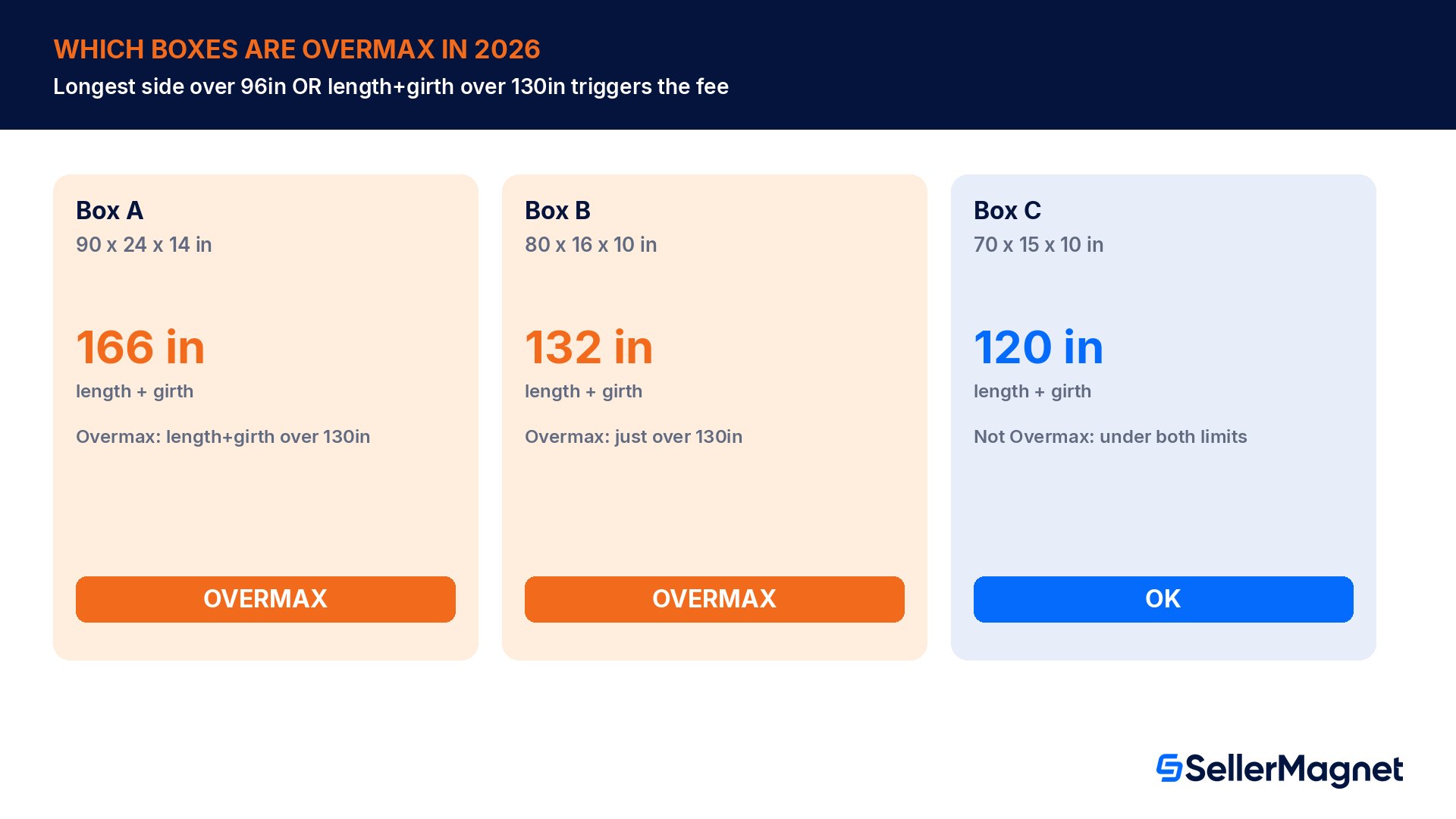
Length plus girth is the measurement sellers most often skip. Girth is two times the sum of the two smaller dimensions (width and height), added to the longest side (length). A box can pass the simple 96-inch longest-side check and still fail length plus girth, because girth adds in bulk from the other two sides that a single longest-side glance ignores.
Box
Dimensions (L x W x H, in)
Length + girth
Overmax?
A
90 x 24 x 14
166 in
Yes, over 130in on length+girth despite a longest side under 96in
B
80 x 16 x 10
132 in
Yes, just over the 130in limit
C
70 x 15 x 10
120 in
No, under both limits
Box A shows the trap clearly: a 90-inch longest side comfortably clears the 96-inch limit, but its length plus girth of 166 inches fails the second test on its own. Box B shows how close the line can be, 132 inches against a 130-inch limit, a gap small enough that a repackaging decision can move a product from one side of it to the other. Box C, with both dimensions comfortably inside the thresholds, pays only the normal Extra-Large fulfillment fee with no Overmax surcharge.
Catch Overmax risk before it reaches the fulfillment center. SellerMagnet's Fee Calculator runs your product's actual length, width, height and weight against the current size-tier and surcharge rules, including Overmax, so you see the real landed fulfillment cost before a shipment ships, not after a fee hits your settlement report. The FBA Fees 2026 guide covers the full size-tier table this fee sits inside, and the FBA Box Requirements 2026 guide covers the broader packaging rules Overmax sits on top of.
Who this hits hardest
The products most exposed are not necessarily heavy; they are long or boxy relative to their category norm. Furniture components (long table legs, rolled rugs, flat-packed shelving), fitness equipment (resistance bands sets packaged in long tubes, yoga mat bundles), outdoor and garden items (long-handled tools, patio umbrella poles), and window treatments or curtain rods are common candidates, because their natural shape pushes either the longest side or the length-plus-girth total over the line well before 150 lb of weight is reached. A seller whose catalog skews toward these shapes should run every active Extra-Large SKU through the two dimension checks once, rather than waiting for the first Overmax line item to show up on a settlement report.
Private-label sellers who design their own packaging have the most control here, and the most to lose from ignoring it: a box drawn a few inches longer than necessary, to leave handling room or to reuse a stock carton size, can cross either Overmax threshold for no functional reason. Reviewing packaging dimensions against both thresholds at the product-development stage, before the first production run, costs nothing and avoids redesigning packaging after months of paying the fee on every unit sold. Wholesale and arbitrage sellers have less control over original packaging, but can still check a candidate product's listed dimensions against both thresholds before committing to inventory, since an Overmax item bought at a thin margin can turn unprofitable once $17 to $25 a unit is added to its landed fulfillment cost.
Common Overmax mistakes
Checking only the longest side and assuming a box is safe, without adding up length plus girth separately.
Using the dimensions printed on an old packaging spec sheet instead of the box as it currently ships, after a packaging redesign quietly added bulk.
Assuming Overmax is a new size tier rather than a surcharge inside the existing Extra-Large tier, and comparing it to the wrong weight bracket's fulfillment fee.
Forgetting that the 3.5% fuel and logistics surcharge (from 17 April 2026) applies to the fulfillment fee on top of any Overmax fee, and under-forecasting the total.
Not re-measuring a product after a vendor or packaging change, since Amazon applies Overmax based on the dimensions it actually measures in the fulfillment center.
Treating all oversized products the same, when dangerous goods, apparel and non-apparel items all share the identical Overmax fee table and thresholds, so none of them is exempt by category.
How to check a product for Overmax risk before shipping
Check an Extra-Large product for Overmax risk
Measure the actual shipping box - Measure the box as it currently ships, length, width and height in inches, not the dimensions from an old spec sheet or the product's own packaging design file.
Check the longest side - Confirm the single longest dimension is 96 inches or under. If it already exceeds 96 inches, the product is Overmax regardless of the other two measurements.
Check length plus girth - Add the longest side to two times the sum of the other two sides (girth). If that total exceeds 130 inches, the product is Overmax even with a short longest side.
Price the full stack - If either check fails, add the flat Overmax fee for the product's weight tier to the normal Extra-Large fulfillment fee, and add the 3.5% fuel and logistics surcharge on the fulfillment-fee line for any shipment from 17 April 2026 onward.
Pre-ship checklist for Extra-Large products
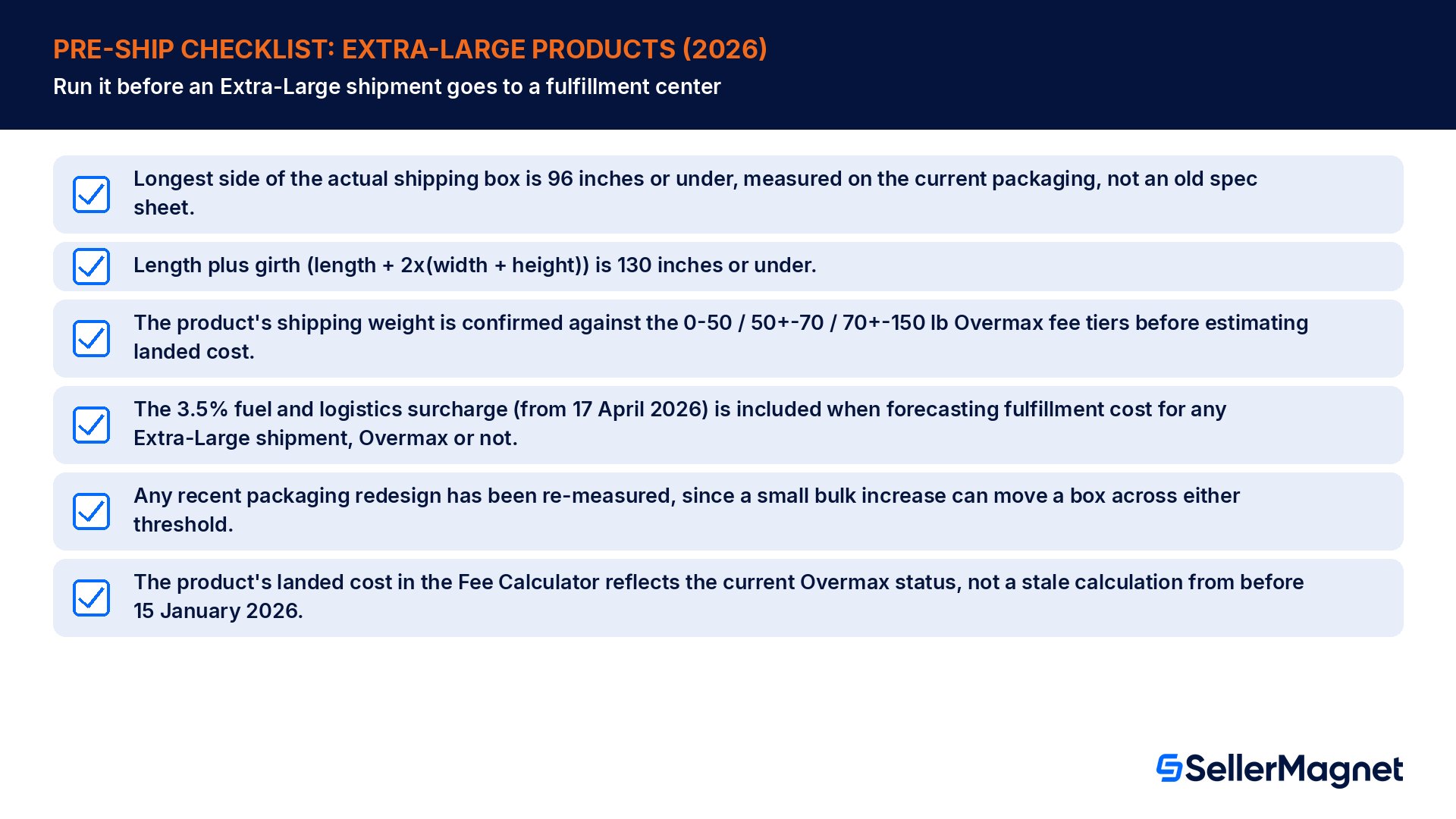
Longest side of the actual shipping box is 96 inches or under, measured on the current packaging, not an old spec sheet.
Length plus girth (length + 2x(width + height)) is 130 inches or under.
The product's shipping weight is confirmed against the 0-50 / 50+-70 / 70+-150 lb Overmax fee tiers before estimating landed cost.
The 3.5% fuel and logistics surcharge (from 17 April 2026) is included when forecasting fulfillment cost for any Extra-Large shipment, Overmax or not.
Any recent packaging redesign has been re-measured, since a small bulk increase can move a box across either threshold.
The product's landed cost in the Fee Calculator reflects the current Overmax status, not a stale calculation from before 15 January 2026.
What exactly is Amazon's Overmax handling fee?
It is a flat fee Amazon adds on top of the normal FBA fulfillment fee for Extra-Large products, up to 150 lb, whose longest side exceeds 96 inches or whose length plus girth exceeds 130 inches, effective 15 January 2026. It applies by weight tier: $17 for 0-50 lb, $21 for 50+-70 lb, $25 for 70+-150 lb.
Can a product be Overmax even if its longest side is under 96 inches?
Yes. The length-plus-girth check is a separate, independent threshold of 130 inches, calculated as length plus two times the sum of width and height. A box with a longest side well under 96 inches can still fail that second check once width and height are added in as girth, so both measurements need checking.
Does the Overmax fee apply to apparel or dangerous goods differently?
No. Amazon's rate table lists the identical Overmax fee for non-apparel, apparel and dangerous goods at each weight tier, so no product category is exempt or charged a different rate purely because of what it is. The dimension thresholds and the flat $17, $21 or $25 fee apply the same way across every category Amazon sells.
How much more does an Overmax product cost in total?
On Amazon's own published 0-50 lb example, a $33.55 fulfillment fee becomes $50.55 once the Overmax fee is added, a 50.7 percent increase from one dimension check alone. Once the separate 3.5 percent fuel and logistics surcharge also applies from 17 April 2026, the same shipment totals $51.72, a 54.2 percent increase over the 2025 fee for an identical box.
Is the Overmax fee the same as the 3.5% fuel and logistics surcharge?
No, they are two separate 2026 changes with different effective dates. The Overmax fee is a flat charge tied purely to a product's dimensions, effective 15 January 2026. The fuel and logistics surcharge is a 3.5 percent addition to the fulfillment fee line itself, effective 17 April 2026, and the two stack on one shipment.
Does Overmax create a new size tier?
No. Overmax is a surcharge layered on top of the existing Extra-Large size tier, up to 150 lb; it is not a new, separate size tier with its own rate card. The underlying Extra-Large fulfillment fee for the product's actual weight still applies in full, with the flat Overmax fee added on top when either dimension threshold is exceeded.
What dimensions does Amazon use to decide Overmax status?
Amazon applies the check to the product as it actually ships, so the dimensions measured at the fulfillment center determine Overmax status, not the dimensions entered on the listing or an older packaging spec sheet. Re-measuring the current shipping box after any packaging change is the only reliable way to know a product's real status.
How can I avoid the Overmax fee?
Reduce the shipping box so its longest side is 96 inches or under and its length plus girth is 130 inches or under: tighter packaging, disassembling long components, or redesigning a box bulkier than needed all work. If it genuinely cannot ship smaller, price the fee into the margin forecast instead of absorbing it as a surprise.
Stop Juggling Tools. SellerMagnet Combines Everything You Need.