Amazon Lithium Battery TIC Compliance 2026: New Testing Rules for Smart Home Devices and Electronics
R
RenéFreelance Amazon Editor
|
14 min read
A product that passed Amazon's listing checks for years can still land on the wrong side of a policy change if it runs on a rechargeable battery. Starting September 30, 2026, Amazon requires sellers of lithium battery powered smart home devices and consumer electronics, security cameras, video doorbells, locks, game consoles, tablets, speakers, headsets and more, to verify those products through an Amazon-authorized third-party testing, inspection, and certification (TIC) provider instead of submitting compliance documents directly to Amazon. This guide works through exactly which products are covered, which are excluded, the standards behind the policy, the four things Amazon now requires on file, and the phased Account Health Dashboard notifications that run from September 30, 2026 to November 16, 2026.
Starting September 30, 2026, Amazon requires lithium battery powered smart home devices and consumer electronics, security cameras, video doorbells, locks, motion sensors, air quality monitors, digital multimeters, game consoles, tablets, speakers, headsets, earbuds and displays, to be verified through an Amazon-authorized third-party testing, inspection, and certification (TIC) provider. Sellers no longer submit compliance documents straight to Amazon; the TIC provider reviews existing test reports or runs new testing, then submits the results on the seller's behalf. Product detail pages also need a model, part or item number and a brand name, and the seller's Certificate of Insurance must be current. Account Health Dashboard notifications go out in phases from September 30 to November 16, 2026.
Who this policy affects
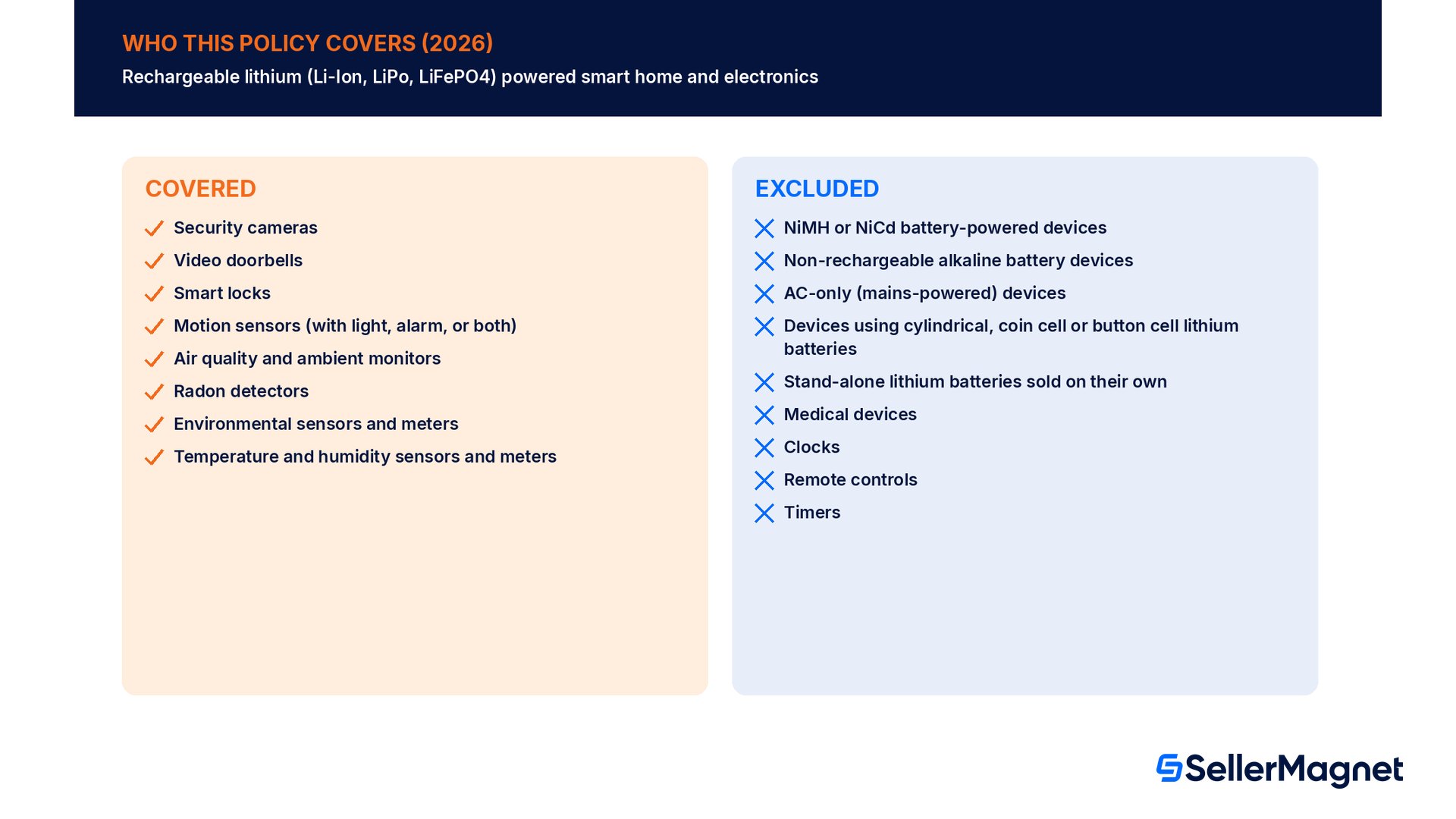
Amazon's own forum announcement, posted by Kris_Amazon, opens with the affected categories directly: "If you sell products like security cameras, video doorbells, smart locks, motion sensors, air quality monitors, digital multimeters, game consoles, tablets, Bluetooth speakers, headsets, earbuds, or displays powered by rechargeable lithium batteries (Li-Ion, LiPo, or LiFePO4), these new requirements apply to you." The matching device-scope help page lists the same categories more generally, as locks and speakers rather than smart locks and Bluetooth speakers, and adds a few categories the forum summary leaves out: radon detectors, environmental sensors and meters, temperature and humidity sensors and meters, current clamps, roller blinds and window shades. The common thread is not the product category itself, it is the power source: a rechargeable lithium-chemistry battery (Li-Ion, LiPo or LiFePO4) built into a smart-home or consumer-electronics device.
The forum announcement is just as specific about what does not need a TIC review. "This policy does not apply to devices powered by nickel metal hydride or nickel cadmium batteries, non-rechargeable alkaline batteries, AC-only devices, or devices using cylindrical, coin cell, or button cell lithium batteries. Stand-alone lithium batteries, medical devices, clocks, remote controls, and timers are also excluded." The matching device-scope help page lists one more exclusion the forum summary omits: fall alert devices and fall alert systems are also excluded from this policy. Two of those exclusions are easy to misread. "Cylindrical" lithium cells are excluded here even though they are still lithium, because the format itself (an 18650-style cell, for example) sits under a different, separate Amazon battery policy rather than this smart-home and consumer-electronics one. "Stand-alone lithium batteries" means a battery sold by itself as the product; a battery built inside a device you sell is still covered.
NiMH or NiCd battery-powered devices
Non-rechargeable alkaline battery devices
AC-only (mains-powered) devices
Devices using cylindrical, coin cell or button cell lithium batteries
Stand-alone lithium batteries sold on their own
Medical devices
Fall alert devices
Fall alert systems
Clocks
Remote controls
Timers
Excluded from this policy is not the same as exempt from every battery rule
A cylindrical lithium cell or a stand-alone battery you sell on its own is outside this specific smart-home/consumer-electronics TIC requirement, but it can still fall under Amazon's separate standalone-battery or dangerous-goods listing rules. Check the product's own listing requirements before assuming no compliance step applies.
The standards behind the policy
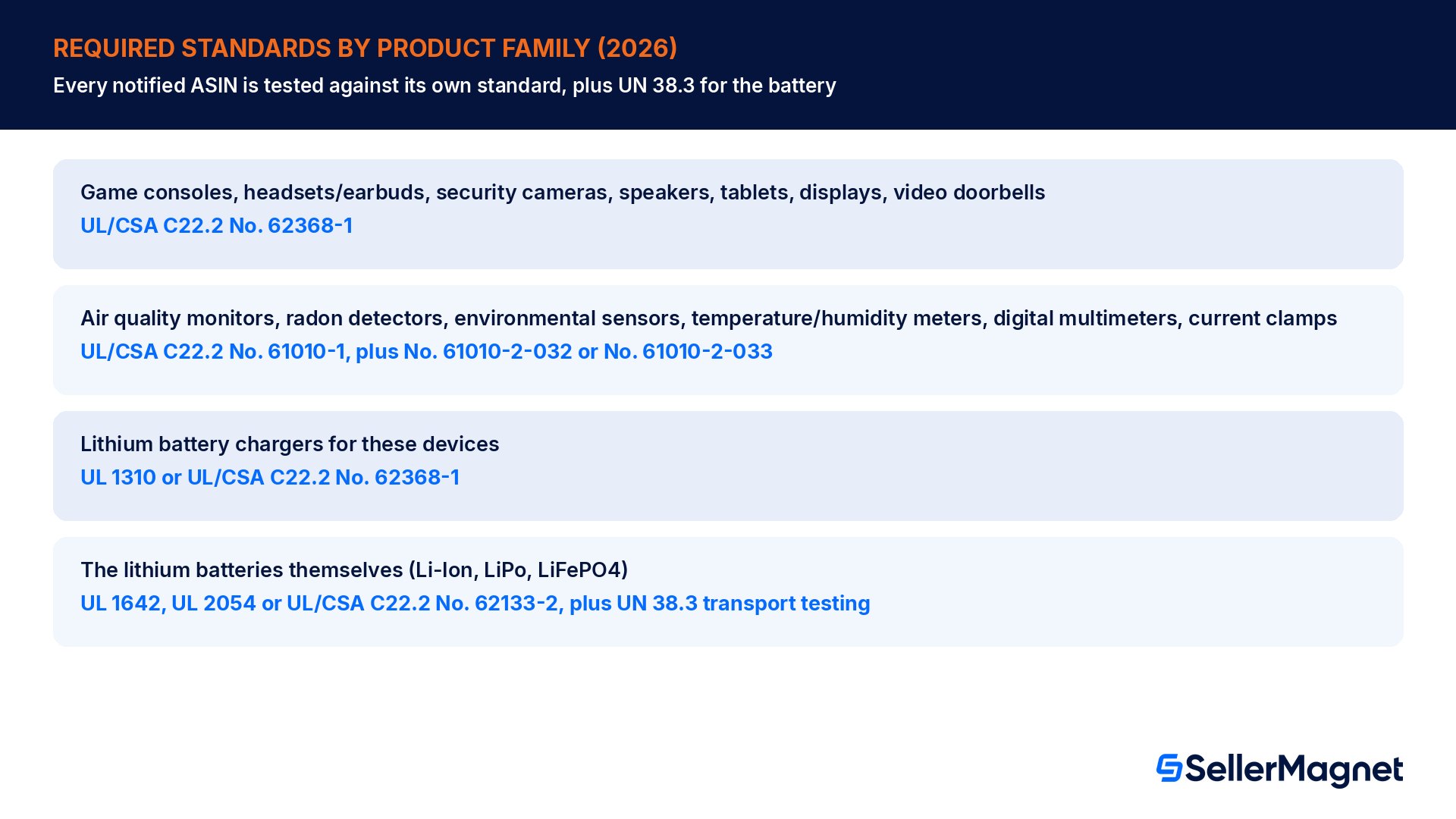
The requirement is not a vague "get your product tested" instruction. Amazon's device-scope help page lists exact UL and CSA standards per product family, plus UN 38.3 transport testing for the battery itself, regardless of the finished device's category.
Product family
Required standard(s)
Game consoles, headsets/earbuds, security cameras, speakers, tablets, displays, video doorbells
UL/CSA C22.2 No. 62368-1
Air quality monitors, radon detectors, environmental sensors, temperature/humidity meters, digital multimeters, current clamps
UL/CSA C22.2 No. 61010-1, plus No. 61010-2-032 or No. 61010-2-033
Lithium battery chargers for these devices
UL 1310 or UL/CSA C22.2 No. 62368-1
The lithium batteries themselves (Li-Ion, LiPo, LiFePO4)
UL 1642, UL 2054 or UL/CSA C22.2 No. 62133-2, plus UN 38.3 transport testing
Source: Lithium battery powered smart home devices and consumer electronics. Every applicable test report has to come from an ISO 17025-accredited laboratory, issued within the previous 12 months, and show a result of "Pass" or "Not applicable (NA)"; a report showing "Fail", "Not compliant", "Not met" or a blank result field will not be accepted. The UN 38.3 report (or an equivalent Battery Test Summary) is required for the battery itself in addition to whichever device-level standard applies to the finished product.
The four things Amazon now requires on file
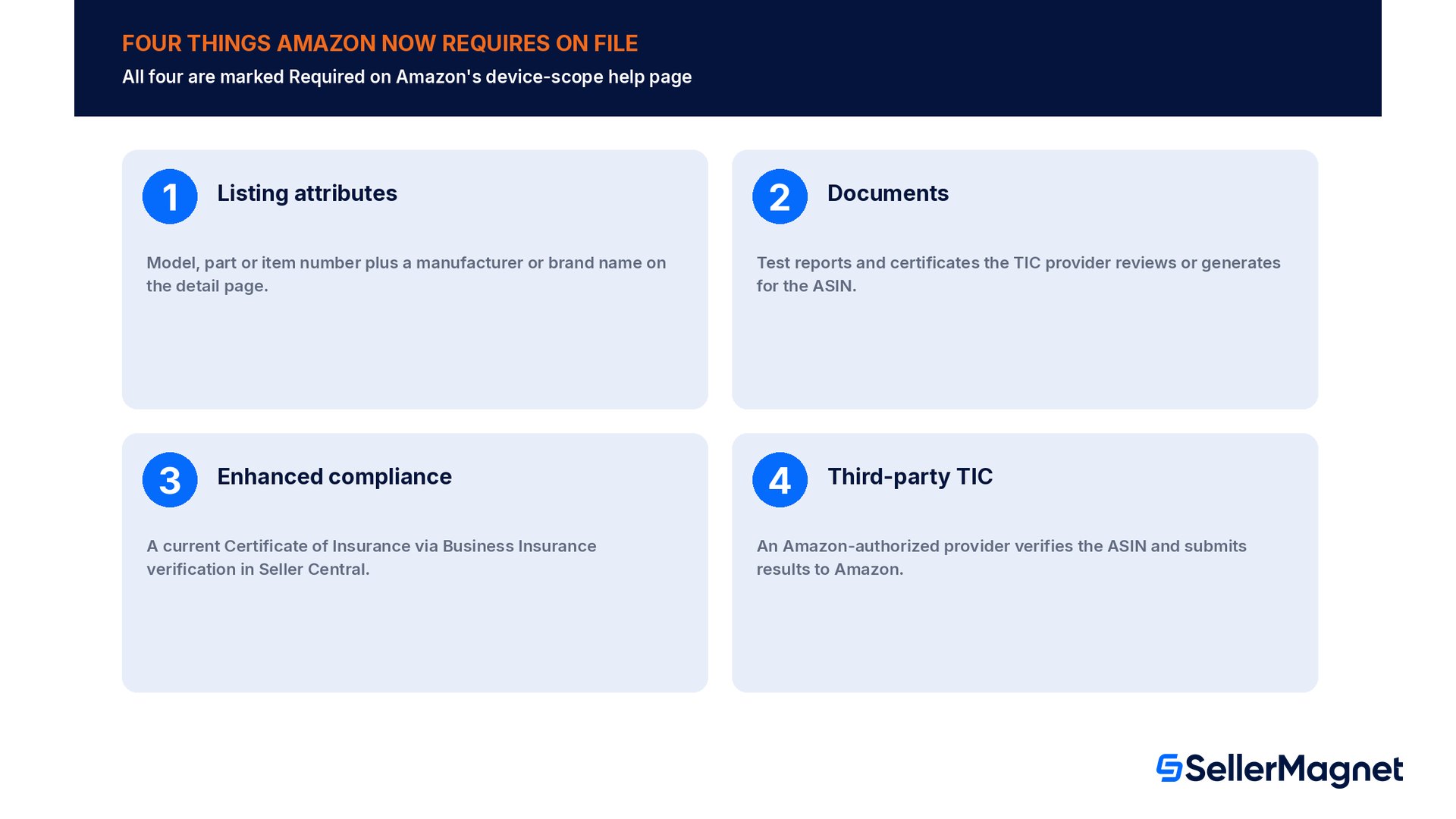
Strip away the standards table and the policy comes down to four concrete requirements, all marked "Required" on the device-scope help page.
Requirement
What it means in practice
Listing attributes
Model, part or item number, plus a manufacturer or brand name, on the product detail page.
Enhanced compliance documents
A current Certificate of Insurance (COI) through Business Insurance verification in Seller Central.
Third-party testing, inspection, and certification
Every notified ASIN verified through an Amazon-authorized TIC provider, who submits the results to Amazon directly.
Documents
The underlying test reports and certificates the TIC provider reviews or generates for each notified ASIN.
The listing-attributes requirement is the one easiest to fix without touching a lab at all: it is purely a data-completeness check on the product detail page. The TIC and enhanced-compliance requirements are the ones that require an outside provider and, for insurance, a current Business Insurance verification in Seller Central.
How the TIC process actually works
The forum post flags two starting points, and the dedicated TIC help page spells out the steps behind each one. "Already have testing documents? You can submit them to an authorized TIC provider for review. If you don't, the TIC provider can conduct the necessary testing for you." Either way, the seller no longer uploads anything straight to Amazon; everything routes through the provider.
Submit a product for lithium battery TIC verification
Open Account Health - Go to Account Health, then under Policy compliance click Food and product safety issues.
Start the request for the flagged ASIN - Under the Next steps column, click Submit for the product you are taking action on, then select Verify your product.
Choose Test or Validate - Pick Test to select a provider who will run the testing for you, or Validate to upload an existing document for review.
Select providers and confirm - Select one or more products, continue to provider selection, choose one or more authorized providers, confirm your contact details, then copy the generated Order ID and TRF details to share with the provider you picked.
Work directly with the provider - The provider guides you through sending product samples or existing test documents, including any intake steps of their own, then submits the results to Amazon directly once testing is complete.
You can also use an accredited lab that Amazon has not specifically authorized, but the help page is explicit that "if you use a lab that is not authorized by Amazon, an authorized TIC provider must validate the results", so an unauthorized lab adds a validation step rather than replacing the TIC provider entirely. The list of authorized providers is store-specific and updated monthly; the current list lives inside the Select a Provider step in Seller Central rather than on the public help page.
Get the product data side right before the TIC paperwork even starts. SellerMagnet's Listing Optimizer runs a pre-flight check on every listing's title and bullet fields, including the model, part number and brand data this policy now requires on the detail page, so a missing attribute does not stall a TIC submission that already took weeks with the lab. The Brand Registry 2026 guide covers how brand and model data ties into your listings more broadly.
The Certificate of Insurance step
The enhanced-compliance requirement is easy to overlook because it runs on a completely different track from the TIC testing: a current Certificate of Insurance, verified through Business Insurance verification in Seller Central, submitted directly to Amazon rather than through the TIC provider. A seller who sorts out TIC testing for every affected ASIN but lets a COI lapse can still end up blocked on this one requirement alone. The Enhanced Safety and Insurance 2026 guide covers which product categories trigger a COI requirement and how Business Insurance verification works inside Seller Central.
When you will be notified, and what happens if you miss it
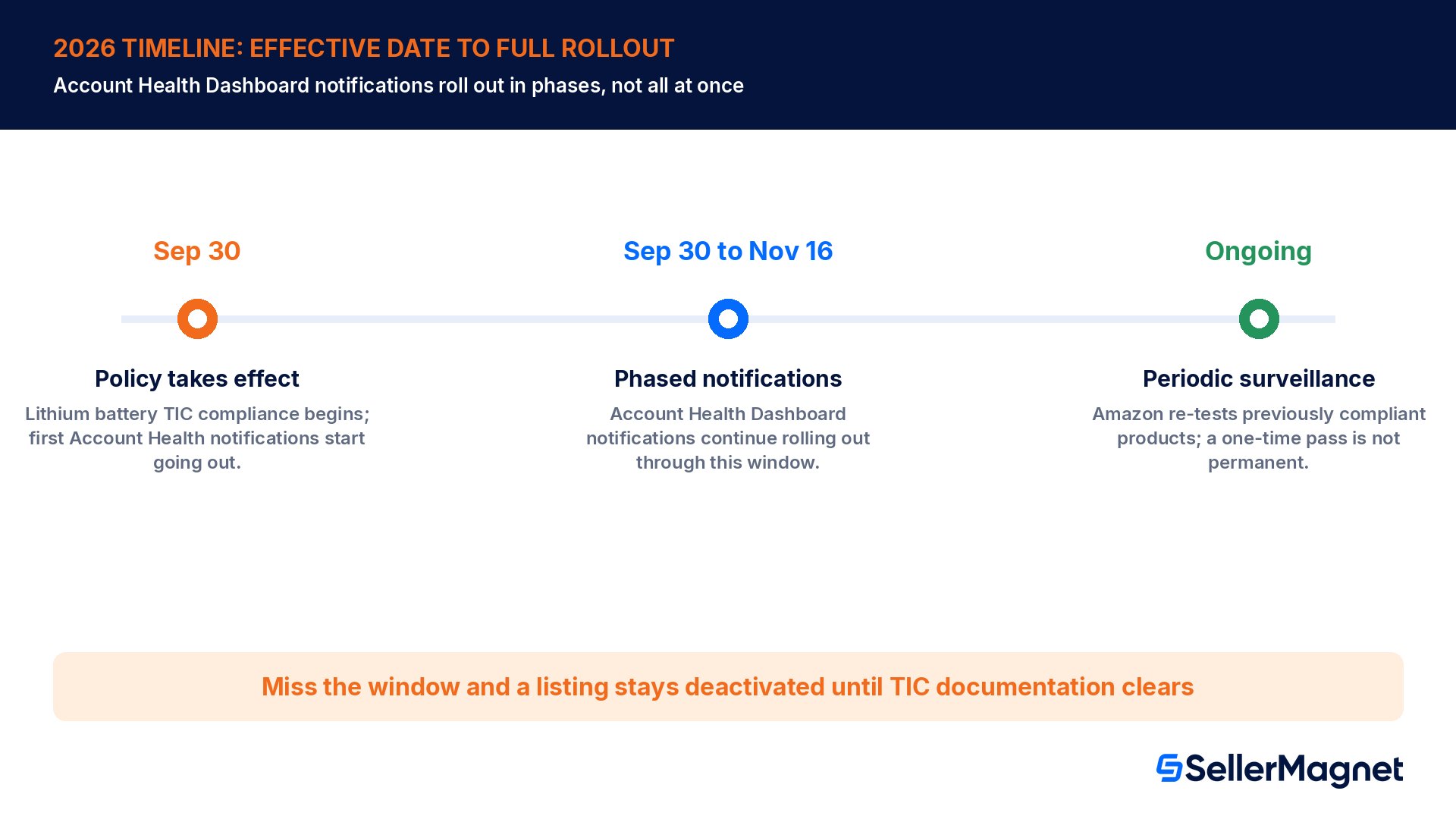
Amazon is not sending every affected seller the same notice on the same day. The forum post states: "Notifications are rolling out in phases through your Account Health Dashboard starting September 30, 2026, with all notifications completed by November 16, 2026. Check your Account Health Dashboard regularly so you don't miss any action items." A seller who checks Account Health once in late September and sees nothing can still receive a notification in October or November as Amazon works through the phased rollout.
Deactivation does not reverse itself
The forum post is direct about the consequence: "Non-compliant listings may be deactivated and won't be reactivated until compliant documentation is submitted through the TIC process." It also adds that "Amazon also conducts periodic surveillance testing, so staying compliant is an ongoing responsibility", meaning a product that passes once can still be re-checked later.
Treat an Account Health Dashboard notification on an affected ASIN the same way you would treat a suppressed listing: the fastest fix is the one that starts the TIC request the same day, since lab turnaround, sample shipping and provider review all take real time, and a listing stays down for the full length of that process.
Do not rely on remembering to check Account Health. SellerMagnet's Offer Watch already flags your connected catalogue for suppressed listings automatically, and Alerts lets you set a custom tracker on top of it, so a deactivation lands in your notification feed the same day instead of surfacing only when a buyer complains or a sales chart flattens out. The Account Health Rating 2026 guide covers how a deactivated ASIN affects your account-level health score.
Where this fits next to other Amazon compliance programs
This is not Amazon's first category-specific third-party testing program, and it will not be its last. The REACH certification process for chemical-content compliance and the dangerous-goods listing questions sellers face for batteries, aerosols and similar products both follow a similar shape: a defined product scope, a required document type, and a listing step that blocks sale until the paperwork clears. The REACH Certificates guide and the Dangerous Goods Compliance Questions 2026 guide cover two of those adjacent programs; a seller who already has a working TIC/compliance-document workflow for one of them can usually reuse the same internal process (tracking spreadsheet, named owner, renewal calendar) for this lithium battery policy rather than building a separate one from scratch.
Budgeting the cost and the timeline
Amazon's own pages do not publish a fixed price or turnaround for TIC testing, because both depend on which provider you choose, which standard applies to your product, and whether you already hold a usable ISO 17025 report. What the help pages do make clear is the sequence a seller should plan around: an Account Health notification starts the clock, the Verify your product flow inside Food and product safety issues generates a Test Request Form (TRF) and an Order ID, and only after that do you actually hear back from a provider on price and lead time. Request quotes from more than one authorized provider at the TRF stage rather than defaulting to the first name on the list, since the help page is explicit that sellers can compare prices, services and timelines across providers before committing.
Two planning details matter more than the dollar figure. First, an existing report only helps if it is current: Amazon only accepts ISO 17025 test reports and UN 38.3 documentation issued within the previous 12 months, so a two-year-old certificate from the original product development cycle will not clear this policy even if nothing about the product changed. Second, a provider cannot start new testing until it has physical samples or the existing report in hand, so the real bottleneck for sellers with no current documentation is shipping time to the lab, not the review itself. Building both into a realistic timeline, instead of assuming a same-week turnaround, is what keeps an Account Health notification from turning into an extended listing deactivation.
Common mistakes sellers make with this policy
Assuming every lithium battery product is covered, when cylindrical, coin cell and button cell lithium formats are explicitly excluded from this specific policy (they fall under a separate battery rule).
Fixing the TIC testing but letting the Certificate of Insurance lapse, since the two requirements run on separate tracks and both block the listing independently.
Checking Account Health once in late September and assuming the all-clear, when notifications continue rolling out in phases through mid-November.
Submitting a lab report that shows "Fail", "Not compliant" or a blank result field, none of which Amazon will accept even from an accredited lab.
Using an unauthorized lab and expecting Amazon to accept the results directly, when an authorized TIC provider still has to validate them first.
Treating a one-time pass as permanent, when Amazon runs periodic surveillance testing on products that already cleared the process once.
Leaving the model, part or item number or the brand name off the product detail page, a listing-attributes gap that has nothing to do with the lab testing at all but still blocks compliance.
Pre-TIC checklist
Confirm the device is actually in scope: powered by a rechargeable Li-Ion, LiPo or LiFePO4 battery, and not one of the explicitly excluded categories or chemistries.
Check the product detail page for a model, part or item number and a manufacturer or brand name before anything else.
Confirm your Certificate of Insurance is current through Business Insurance verification in Seller Central.
Gather any existing ISO 17025-accredited test reports (device standard plus UN 38.3) issued within the last 12 months, with a Pass or Not applicable result.
If you have no existing reports, budget lab turnaround time into your plan before an Account Health notification forces the timeline.
Check Account Health Dashboard on a recurring schedule through at least mid-November 2026, not just once.
Keep a record of which ASINs have cleared TIC review and when, since periodic surveillance testing can reopen the question later.
When does Amazon's lithium battery TIC compliance policy take effect?
September 30, 2026, for Amazon.com, the US store. A closely related but separately worded policy, with its own documentation details such as SCC-accredited lab reports, applies to Amazon.ca on a comparable timeline, so a seller active on both marketplaces should check each store's own help page rather than assuming one policy covers both.
Which products are covered by this policy?
Smart home devices and consumer electronics powered by rechargeable lithium batteries (Li-Ion, LiPo or LiFePO4), including security cameras, video doorbells, locks, motion sensors, air quality and environmental monitors, digital multimeters, current clamps, game consoles, tablets, speakers, headsets, earbuds, and displays.
What products are excluded?
Devices powered by nickel metal hydride or nickel cadmium batteries, non-rechargeable alkaline batteries, AC-only devices, and devices using cylindrical, coin cell or button cell lithium batteries. Stand-alone lithium batteries sold on their own, medical devices, fall alert devices, fall alert systems, clocks, remote controls and timers are also excluded.
Do I still submit compliance documents directly to Amazon?
No. You work with an Amazon-authorized third-party testing, inspection, and certification (TIC) provider, who reviews your existing documents or runs new testing, then submits the results to Amazon on your behalf.
Can I use a lab Amazon has not authorized?
Yes, but the results from an unauthorized lab must still be validated by an Amazon-authorized TIC provider before Amazon will accept them, so it adds a step rather than replacing the TIC provider.
What happens if my listing is not compliant?
Amazon states that non-compliant listings may be deactivated and will not be reactivated until compliant documentation is submitted through the TIC process. Amazon also runs periodic surveillance testing after a product first passes, so compliance is an ongoing requirement.
How will I know if my products are affected?
Amazon is sending notifications in phases through the Account Health Dashboard, starting September 30, 2026 and completing by November 16, 2026. Checking Account Health only once in that window can miss a later-phase notification.
Does the Certificate of Insurance requirement apply to every seller?
The enhanced-compliance requirement on this policy applies to the products it covers and requires a current Certificate of Insurance verified through Business Insurance verification in Seller Central; it runs separately from, and in addition to, the TIC testing requirement.
Stop Juggling Tools. SellerMagnet Combines Everything You Need.