A shipment leaves your warehouse looking exactly like the last one, and this time it comes back flagged: a missing FNSKU, a bag without a suffocation warning, or a fragile unit with no bubble wrap. In 2026 that mistake costs more than it used to, because Amazon stopped offering prep and item labeling for FBA shipments in the US store on 1 January 2026, and since 31 March 2026 resellers must put an Amazon barcode on every unit. This guide works through Amazon's own US help pages: which products need which prep, the barcode and FNSKU rules that trip sellers up, what happens to a non-compliant unit, and a worked example of what one unprepped shipment puts at risk.
Amazon FBA prep and labeling requirements in 2026 mean every unit you send to a US fulfillment center must arrive already prepped and labeled, because Amazon stopped offering prep and item labeling services in the US store on 1 January 2026. Each unit needs one scannable barcode with readable numbers, and resellers must use an Amazon FNSKU label since 31 March 2026. Products that need bagging, bubble wrap, boxing, a cap seal, an opaque bag or set labels must get that prep before shipping, or Amazon may refuse, return or repackage them at your expense.
What changed for FBA prep and labeling in 2026?
Three dated changes on Amazon's US help pages decide how you prep and label this year. The biggest removes a safety net: until the end of 2025 you could let Amazon bag, bubble-wrap or label units for a per-unit fee. That option is gone for US shipments, and the FBA Prep Service page says so plainly: "When this change takes effect on January 1, all products must be prepped and labeled before sending them to our facilities."
Date (US store)
What changed
What it means for you
1 January 2026
Amazon no longer offers prep and item labeling services for FBA shipments, including inventory sent through AWD, AGL, Amazon SEND and the Supply Chain Portal
You, your supplier or a prep provider must prep and label every unit; shipments created before 1 January were still serviced even if they arrived later
1 January 2026
Shipments created after this date that arrive without proper prep and item labeling are not eligible for reimbursement if damaged or untraceable
An unprepped unit that goes missing or breaks is your loss
15 January 2026
Inbound defect fees for misrouted, deleted or abandoned units become one per-unit fee, from $0.32 (small standard, 16 oz or less) to $5.72 (large bulky, 42+ to 50 lb)
A separate cost from prep: follow the shipping plan you approved
31 March 2026
Brand owners can keep using manufacturer barcodes without stickers; resellers must use Amazon barcodes even if the product has a manufacturer barcode
Resellers who shipped stickerless now need an FNSKU label on every unit
The old fee was a cost; the new risk is the whole unit
Before 2026 a forgotten bag or label usually meant a per-unit service charge. For US shipments created after 1 January 2026, Amazon's wording is that shipments arriving without proper prep and item labeling "won't be eligible for reimbursement if damaged or untraceable." Plan your packing station as if nobody downstream will fix it for you.
What counts as prep, and when is it required?
Amazon's definition is short: prep is required when product packaging is not sufficient to protect the product during shipping and handling. A retail box that looks fine on a shelf can still need prep, because fulfillment centers handle each unit many times. Amazon also puts the decision on you: "Determining the type of preparation required to ship your products safely to Amazon is your responsibility, even if prep guidance for your specific products is not available."
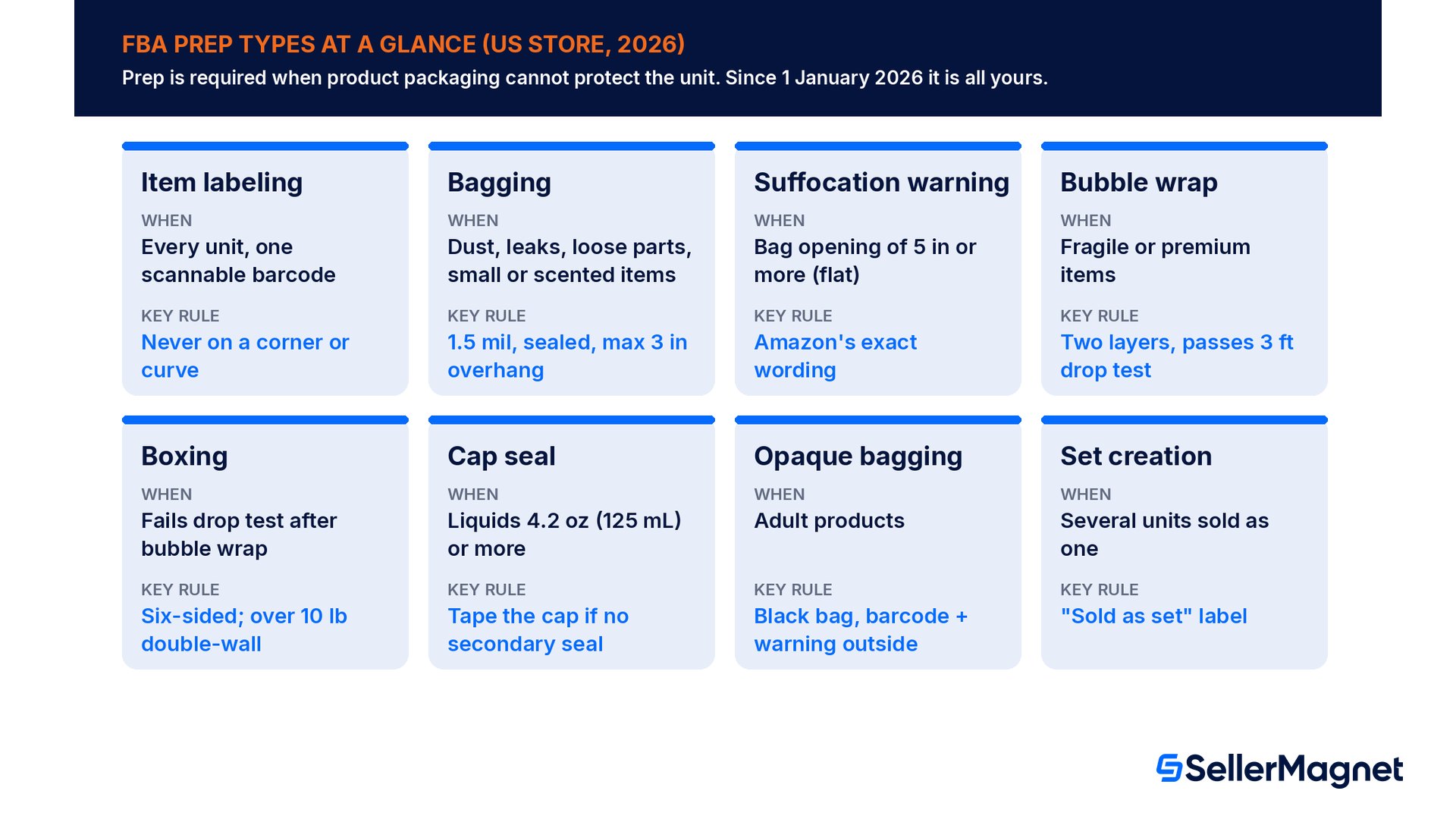
Prep type
When Amazon requires it
Key rule
Item labeling
Every unit needs an exterior scannable barcode; products not tracked by a manufacturer barcode need an Amazon barcode
Label with scannable barcode and human-readable numbers, never on a corner or curve
Bagging
Items that dust or leakage can damage, loose parts or sets, small items, scented items, adult content
At least 1.5 mil thick, fully sealed, no more than 3 inches past the product
Suffocation warning
Any poly bag with an opening of 5 inches or more, measured flat
Printed on the bag or added as a label, in Amazon's exact wording
Bubble wrap
Fragile items, premium products, protruding parts that can snag
At least two layers, nothing exposed, must pass the 3-foot drop test
Boxing
Fragile items that fail the drop test after bubble wrap, uncontained sets, vinyl records
Six-sided box; over 10 lb needs double-wall corrugated
Cap seal
Liquids, pastes, gels and creams of 4.2 oz (125 mL) or more with a twist, clip-on, flip-top or pump lid and no secondary seal
Tape on or around the cap; hazmat liquids need bagging instead
Opaque bagging
Adult products
Black opaque bag with a scannable barcode and a suffocation warning outside
Set creation
Several units sold as one unit
A label such as "Sold as set" or "This is a set. Do not separate."
Sources: Prepare your products for FBA shipping, Bagging requirements and Product packaging requirements. One unit can fall under several prep types at once. Amazon's own example is shampoo and conditioner sold together: both bottles must meet the prep requirements for liquids and carry a "Sold as set" label so they are not separated. The 3-foot drop test that decides between bubble wrap and boxing is five drops from 3 feet onto concrete (top, bottom, largest side, bottom corner and longest bottom edge), and Amazon will not run it for you.
Check Send to Amazon Step 1 before you guess
In Send to Amazon Step 1, Choose inventory to send, edit Packing details and click the product's prep category to open the Prepare your FBA items window. It shows whether the product has specific prep requirements, lets you choose a prep category or No prep needed, and has a More options tab to start an investigation if you think a listed requirement is wrong.
Barcode and FNSKU rules sellers get wrong
Amazon tracks every unit by barcode, so each item you send needs one. There are two kinds: manufacturer barcodes (UPC, EAN, JAN and ISBN) and Amazon barcodes, the FNSKU labels that start with an X. Since 31 March 2026 the choice depends on who you are: brand owners can keep using manufacturer barcodes without stickers, and resellers must use Amazon barcodes even if the product already has a manufacturer barcode. A brand registered in Amazon Brand Registry that has no manufacturer barcode can apply for a GTIN exemption. Non-standard codes such as Codabar or a vendor_barcode value are not recognized for item identification at all.
One FNSKU per distinct product. Each assortment type, such as a size or a color, must have a different FNSKU.
One FNSKU per condition. If you sell the same product as used-like new and used-good, each condition needs its own FNSKU.
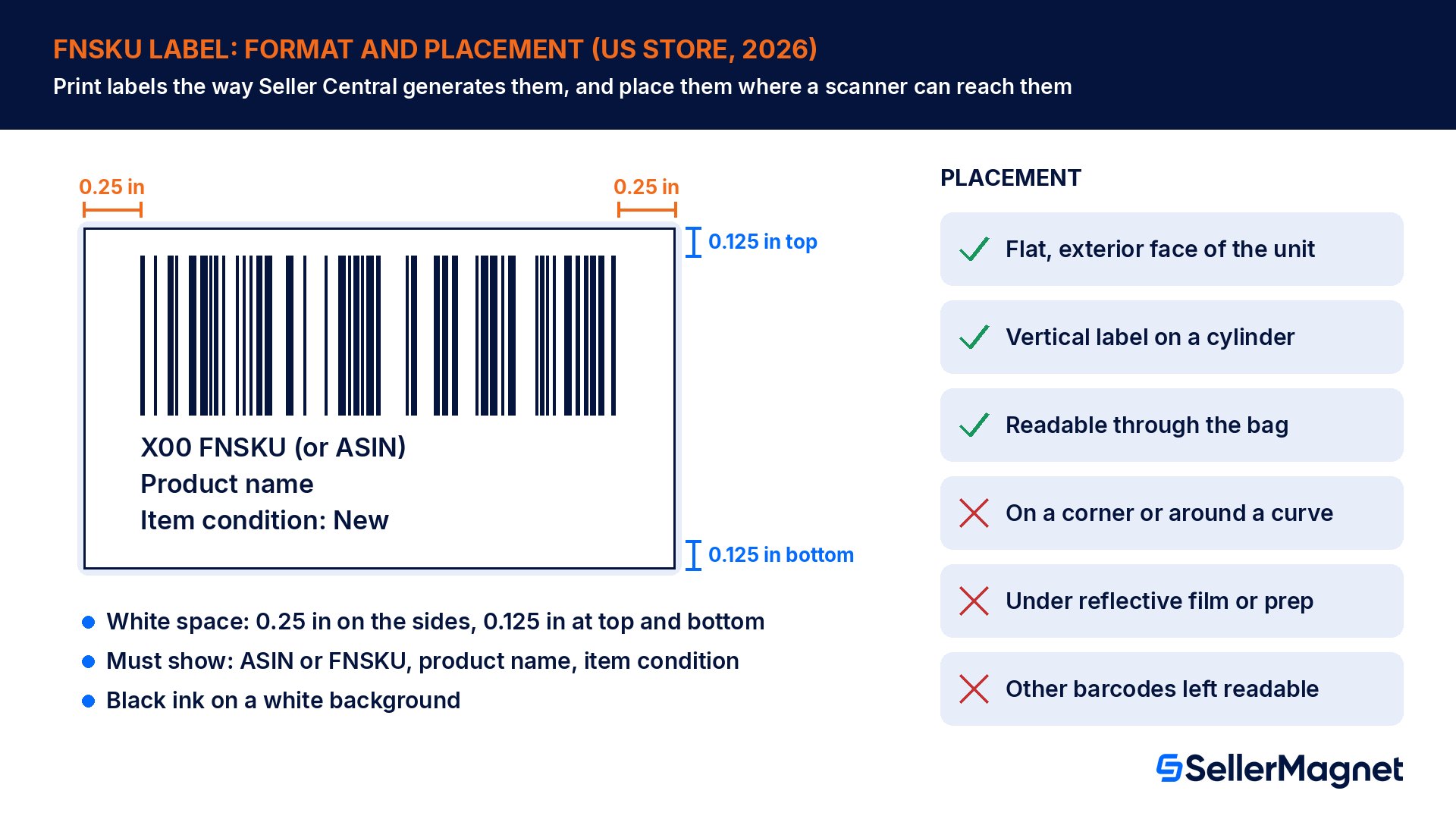
Scannable and accessible placement. Every unit needs an exterior barcode or label with the barcode and its human-readable numbers. Do not apply it to a corner or curve; on a cylindrical product, place the label vertically.
Print it the way Seller Central generates it. Keep 0.25 inch of white space on the sides and 0.125 inch at the top and bottom, include the ASIN or FNSKU, the product name and the item condition, use black ink on a white background, and avoid reflective packaging or prep over the barcode.
No competing barcodes on the outside of shipping boxes. Remove, cover or render unscannable any existing barcode, for example with opaque tape or a black felt-tip marker, so the wrong code is not scanned during receiving.
Sources: FBA barcode requirements, Use an Amazon barcode, Product packaging requirements and the barcode problem types on the Inbound problem summary. Amazon's page on using Amazon barcodes still says that a unit which needs an Amazon barcode and arrives without one is marked as defective and stickered by Amazon, with the defect reported on your Inbound Performance Dashboard. Read that next to the 2026 rule above: for a US shipment created after 1 January 2026, a unit that arrived without proper item labeling has no reimbursement cover if it is later damaged or cannot be traced.
"Sold as set" needs both a label and the right prep on every unit
A multi-unit set such as shampoo and conditioner must carry a label that says it is received and sold as one unit, and each item inside still needs the prep for its own category, for example liquid prep. Without the set label, the units can be separated and received as single items.
What happens when prep or labeling is wrong?
Amazon's pages describe a range of outcomes rather than one penalty: a unit can be refused, returned, repackaged or disposed of, a fee can be charged for the prep Amazon had to apply, and the product can get stricter prep requirements on later shipments.
Outcome
What Amazon says
Source
Refused, returned or repackaged
Products delivered with inadequate or non-compliant packaging, prep or barcode may be refused, returned or repackaged at your expense
Prepare your products for FBA shipping
Refused or disposed of
Inventory with non-compliant, unsafe packaging may be refused or disposed of at your expense and will not be eligible for reimbursement
Product packaging requirements
Preparation defect fee
Missing bagging, bubble wrap, cap seal or opaque bagging can bring a preparation defect fee; the US fee overview lists unplanned service fees per item
Bagging, bubble wrap, cap seal and opaque pages; FBA fulfillment fees
No reimbursement cover
US shipments created after 1 January 2026 without proper prep and item labeling are not eligible for reimbursement if damaged or untraceable
FBA Prep Service
Stricter prep from now on
Amazon may add prep requirements to a product due to damages and damage-related returns
Prepare your products for FBA shipping
Blocked shipments
Non-compliance can lead to blocking of future shipments to the fulfillment center
Use an Amazon barcode
Worked example: one unprepped shipment of small items
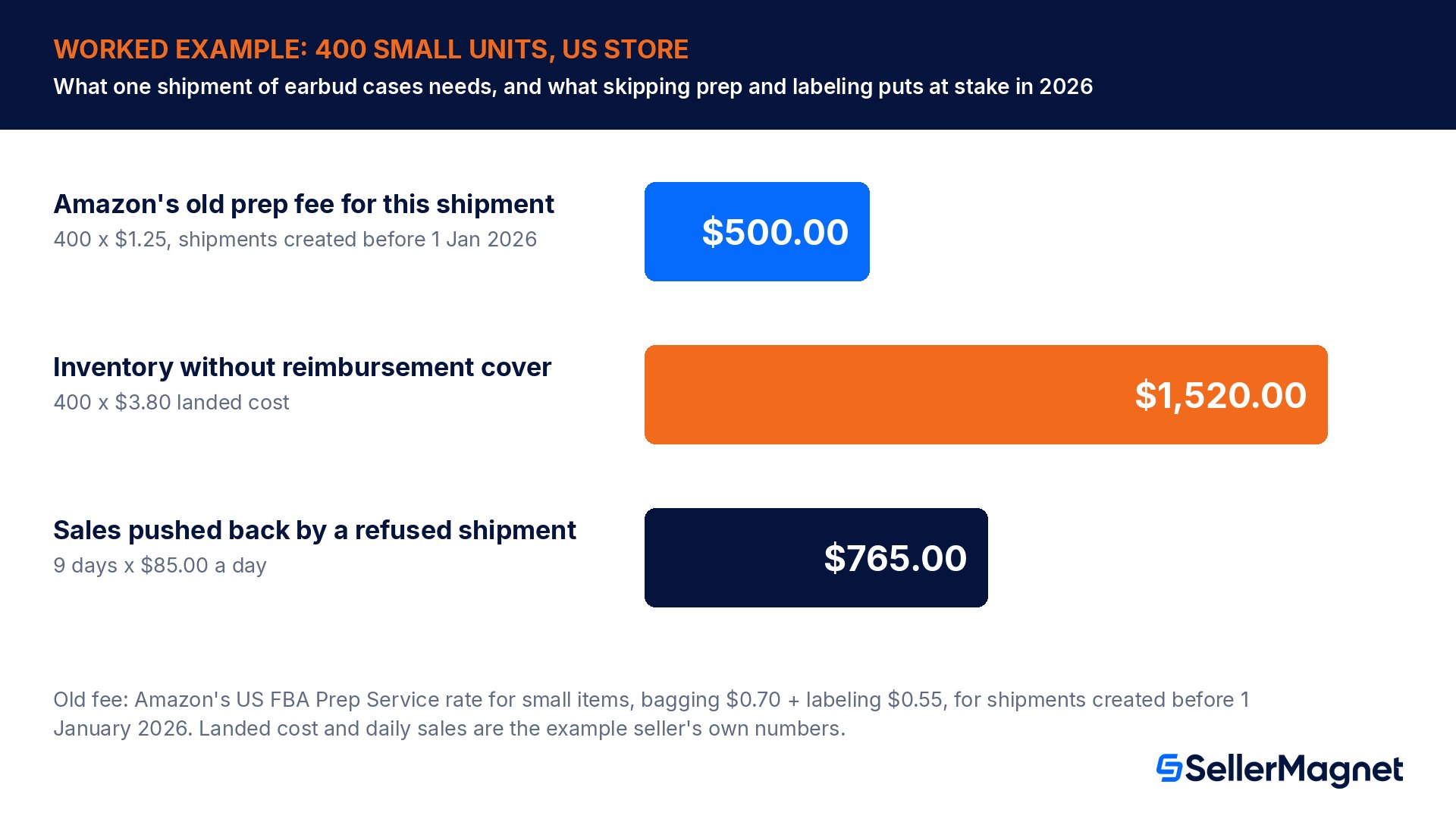
Take a reseller sending 400 units of an earbud case to a US fulfillment center. The packaging's longest side is 1.75 inches, under Amazon's 2 and 1/8 inch limit for small products, so every unit must be bagged or boxed with the barcode visible outside. The seller uses 6 x 8 inch poly bags: the 6 inch opening is above the 5 inch threshold, so each bag needs the suffocation warning, and with a length plus width of 14 inches Amazon's table sets the minimum print size at 10 point. Because the seller is a reseller, every unit also needs an FNSKU label since 31 March 2026, even though the case carries a UPC.
Line
Calculation
Amount
Amazon's old fee for this prep (shipments created before 1 January 2026)
400 units x $1.25 (bagging $0.70 + labeling $0.55)
$500.00
Inventory without reimbursement cover if shipped unprepped in 2026
400 units x $3.80 landed cost
$1,520.00
Sales pushed back if the shipment is refused and reworked
9 days x $85.00 a day
$765.00
The first line is what Amazon used to charge for this exact prep; in 2026 there is no Amazon price for it in the US, so the work moves to your team or a provider. The second line is the real exposure: $1,520.00 of stock that, by Amazon's wording, loses reimbursement cover if it arrives without proper prep and labeling and is then damaged or untraceable. The third line uses the example seller's own sales rate. All three are avoidable with one check before the box is sealed.
Category rules: small items, jewelry, sharp products, batteries and adult products
Amazon publishes extra rules for five product groups whose failure modes are physical: a part goes missing, an edge cuts through packaging, a battery terminal touches metal, or packaging shows content not safe for everyone.
Small products and jewelry
Any product whose largest side is less than 2 and 1/8 inches, about the length of a credit card, must be packaged to prevent loss, damage or misplacement: bagged or boxed, with the barcode visible on the outside of the prep and box sleeves that fit securely. Amazon's examples include charging cords, earbuds, guitar picks, lipsticks, pins, small screws and USB flash drives. Jewelry, regardless of size, must be protected against dirt, dust and humidity. Small or delicate pieces go in a pouch or box with the barcode outside; a mesh bag must close securely with a scannable barcode, or Amazon adds a new bag and barcode. Boxed jewelry made of easily cleanable materials needs no extra bag, while boxed jewelry with fabric-like materials does. For items valued over $2,000, Amazon points you to its reimbursement policy before you ship.
Sharp products
A sharp unit is any object with an edge or point that can cut or pierce packaging or skin, from knives and scissors to needles and saw blades. The packaging must completely cover every edge and point with cut- and puncture-resistant material and keep the item contained until delivery. Amazon lists hardened plastic, blister packs, clamshells, hardened plastic sheaths, Styrofoam and thick corrugated cardboard in fully enclosed boxes as acceptable; bubble wrap and non-corrugated boxes are not. The consequences are spelled out: refusal of inventory, blocking of future shipments or disposal of the units, and disposed non-compliant sharp items are not reimbursed, with the disposal cost charged to you.
Batteries and battery-powered products
Battery handling starts at item setup: Amazon says the product details you enter determine how it handles the item, and you must comply with United Nations, Department of Transportation and International Air Transport Association rules. Packaging must keep terminals from touching metal, including other batteries, and batteries cannot be expired or damaged. Lithium batteries need special labeling (UN3090 for lithium metal, UN3480 for lithium ion), and button cells need child-resistant packaging with a warning statement. Rigid packaging such as the original manufacturer packaging, boxes, clamshells or blister packs is permitted; zipper-sealed bags, shrink wrap and other non-rigid packaging are prohibited.
Adult products
Products that are 18+, 21+, "adult only" or "mature content" by retail standards need discreet packaging: no nudity, obscene or profane language or violence may be visible. They must be bagged in black, opaque bags with a scannable barcode or ASIN label and a suffocation warning on the outside. If the packaging is not compliant, Amazon adds an opaque covering and an item barcode label, and the general rule applies that non-compliant units may be refused, returned or repackaged at your expense.
How a prep or labeling defect follows your account
A flagged shipment does not disappear once the box is fixed. Amazon groups inbound problems into problem groups, such as "Label missing, product related" for units that arrive without the required FNSKU, or "Unplanned prep, bagging" for missing or unsealed bags. The Inbound Performance dashboard shows trends for the past 120 days, and the Inbound Performance report covers the past 365 days. For repeated problems in the same problem group, Amazon escalates your coaching level from standard to elevated to critical, each with its own corrective actions. The inbound defect fee page adds that non-compliant shipments can put an account at risk of suspension, restricted selling privileges or lost access to optimized inbound placement options.
Fix the pattern, not just the shipment
After any flagged shipment, open the Inbound Performance dashboard and check whether the same problem group has appeared before. One defect is a slip; the same defect in several shipments is a packing-station process to fix at the source, because the coaching level is calculated per problem group.
Common prep and labeling mistakes in 2026
Expecting Amazon to bag or label units in the US, a service that ended for shipments created after 1 January 2026.
Shipping stickerless as a reseller after 31 March 2026, when only brand owners may still rely on manufacturer barcodes.
Reusing one FNSKU across sizes, colors or conditions.
Putting the label on a corner or curve, or under reflective film that blocks the scan.
Using bags thinner than 1.5 mil, letting the bag overhang more than 3 inches, or skipping the suffocation warning on a 5 inch opening.
Bubble-wrapping knives or blades: Amazon does not accept bubble wrap as protection for sharp items.
Leaving manufacturer barcodes readable on the outside of the shipping box, so the wrong code is scanned at receiving.
How to prep and label a shipment correctly, step by step
Prep and label an FBA shipment before it ships
Check the prep category - In Send to Amazon Step 1, open Packing details for each product and click its prep category to see the requirement Amazon has on file.
Choose the right barcode - Brand owners may keep the manufacturer barcode; resellers print an Amazon FNSKU label for every unit, one FNSKU per size, color and condition.
Apply every prep type that fits - Bag, bubble-wrap, box, cap-seal or opaque-bag each unit as its category requires, remembering that one unit can need several prep types.
Check the label - Print labels with Seller Central's spacing, place them flat and vertical on cylinders, and make sure the barcode scans through any bag.
Cover carton barcodes - Cover or black out any manufacturer barcode on the outside of the shipping box so only the right codes can be scanned.
Mark sets and test fragile units - Label every set as one unit and run the five-drop, 3-foot test on fragile items before deciding between bubble wrap and boxing.
Keep track of what Amazon owes you after check-in. Prep defects are your cost, and Amazon does not reimburse units that arrive without proper prep and labeling. Units that Amazon loses or damages after a compliant check-in are a different case: Lost & Found scans up to two years of Seller Central data for lost, damaged and unreturned inventory and fee issues, and prepares each claim with a template and evidence. You review and file each claim yourself in a guided flow; nothing is filed without your review. Fee Audit (new) checks flagged fees against Amazon's own published rates and only marks a row claimable when it can verify the overcharge. For the claim windows themselves, see our guide to FBA reimbursements in 2026.
A practical FBA prep and labeling checklist
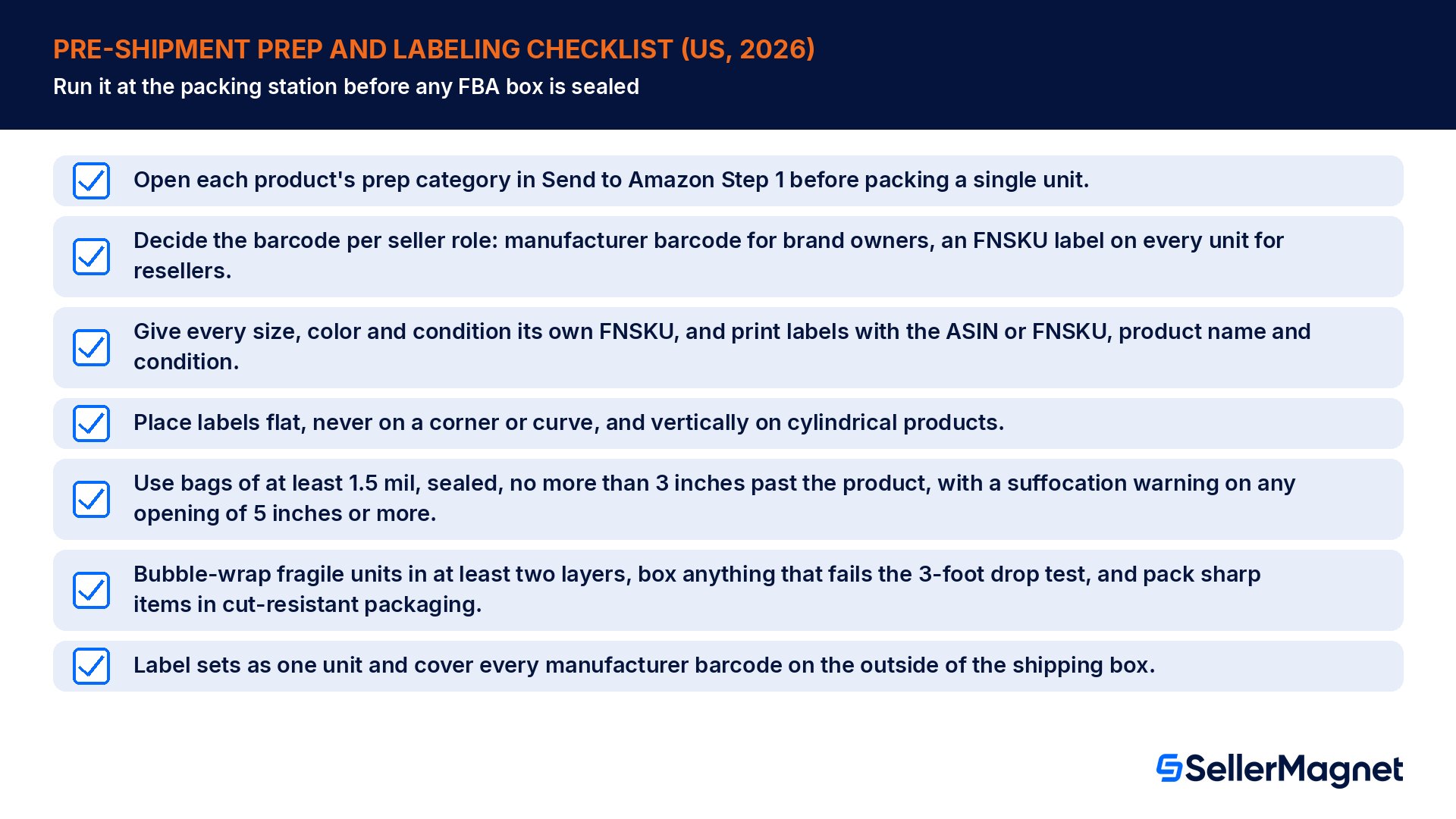
Open each product's prep category in Send to Amazon Step 1 before packing a single unit.
Decide the barcode per seller role: manufacturer barcode for brand owners, an FNSKU label on every unit for resellers.
Give every size, color and condition its own FNSKU, and print labels with the ASIN or FNSKU, product name and condition.
Place labels flat, never on a corner or curve, and vertically on cylindrical products.
Use bags of at least 1.5 mil, sealed, no more than 3 inches past the product, with a suffocation warning on any opening of 5 inches or more.
Bubble-wrap fragile units in at least two layers, box anything that fails the 3-foot drop test, and pack sharp items in cut-resistant packaging.
Label sets as one unit and cover every manufacturer barcode on the outside of the shipping box.
Does Amazon still prep or label FBA inventory in 2026?
Not in the US store. Since 1 January 2026, Amazon no longer offers prep and item labeling services for FBA shipments there, including inventory routed through AWD, AGL, Amazon SEND or the Supply Chain Portal. Shipments created before that date were still serviced. Every unit must now arrive prepped and labeled by you or a provider.
Do I need an Amazon barcode if my product already has a UPC?
It depends on your role since 31 March 2026. Brand owners can keep using manufacturer barcodes such as a UPC or EAN without stickers. Resellers must apply Amazon barcodes, the FNSKU labels starting with an X, even when the product already carries a manufacturer barcode. Codabar codes are not recognized at all.
What happens if a unit arrives without a required Amazon barcode?
Amazon's barcode page says the unit is marked defective, stickered by Amazon and reported on your Inbound Performance Dashboard. For US shipments created after 1 January 2026, units that arrive without proper item labeling are also not eligible for reimbursement if they are later damaged or untraceable, so treat a missing label as a real loss.
When does a poly bag need a suffocation warning?
When its opening is 5 inches or more, measured flat. The warning must be printed on the bag or attached as a label in Amazon's exact wording, in a legible, contrasting print size that grows with the bag, from 10 point to 24 point. The bag itself must be at least 1.5 mil thick and fully sealed.
Can two variations of the same product share one FNSKU?
No. Amazon's packaging rules say every FNSKU must correspond to one unique product, so each size, color or other assortment type needs a different FNSKU. The same applies to conditions: a used-like new unit and a used-good unit of the same item each need their own FNSKU to be received correctly.
Who pays if Amazon refuses, returns or repackages my shipment?
You do. Amazon says products delivered with inadequate or non-compliant packaging, prep or barcodes may be refused, returned or repackaged at your expense, and unsafe packaging can be refused or disposed of at your expense with no reimbursement. Missing bagging or bubble wrap can also bring a preparation defect fee on top.
Where do I find the exact prep requirement for my product?
In Send to Amazon Step 1, Choose inventory to send, edit Packing details and click the product's prep category. The Prepare your FBA items window shows any specific requirement, lets you pick a prep category or No prep needed, and offers a More options tab to request an investigation if you think it is wrong.
What is the 3-foot drop test and who runs it?
It checks whether packaging or prep protects a product: five consecutive drops from 3 feet onto concrete, on the top, bottom, largest side, bottom corner and longest bottom edge. Damage to the container is acceptable if nothing leaks and the product is intact. Amazon does not perform it, so you run it yourself.
Stop Juggling Tools. SellerMagnet Combines Everything You Need.