Amazon EU Product Identifier (PID) Requirement 2026
R
RenéFreelance Amazon Editor
|
12 min read
If you ship inventory into the EU from outside the EU, for example US, UK or China-sourced stock fulfilled into any EU Amazon store, a new customs data rule is no longer a future deadline. As of 1 November 2026, the EU Product Identifier (PID) requirement is mandatory, not voluntary. Every low-value business-to-consumer shipment into the EU now needs three identifiers attached at customs, and Amazon only fills in one of them for you automatically. If your import listings are missing manufacturer part numbers, model numbers or barcodes, this is the guide to what happens next, what still has a short grace window and what does not.
Since November 1, 2026, the EU requires a Product Identifier (PID) on every low-value business-to-consumer shipment imported from outside the EU. Sellers must supply a merchant identifier, a manufacturer part or model number, and a standardized code such as a GTIN or EAN where one exists. Amazon adds the ASIN automatically on Buy Shipping labels but does not add the manufacturer number, so sellers have to supply that themselves or risk a shipment held at EU customs.
Is the EU Product Identifier requirement mandatory now, or still voluntary?
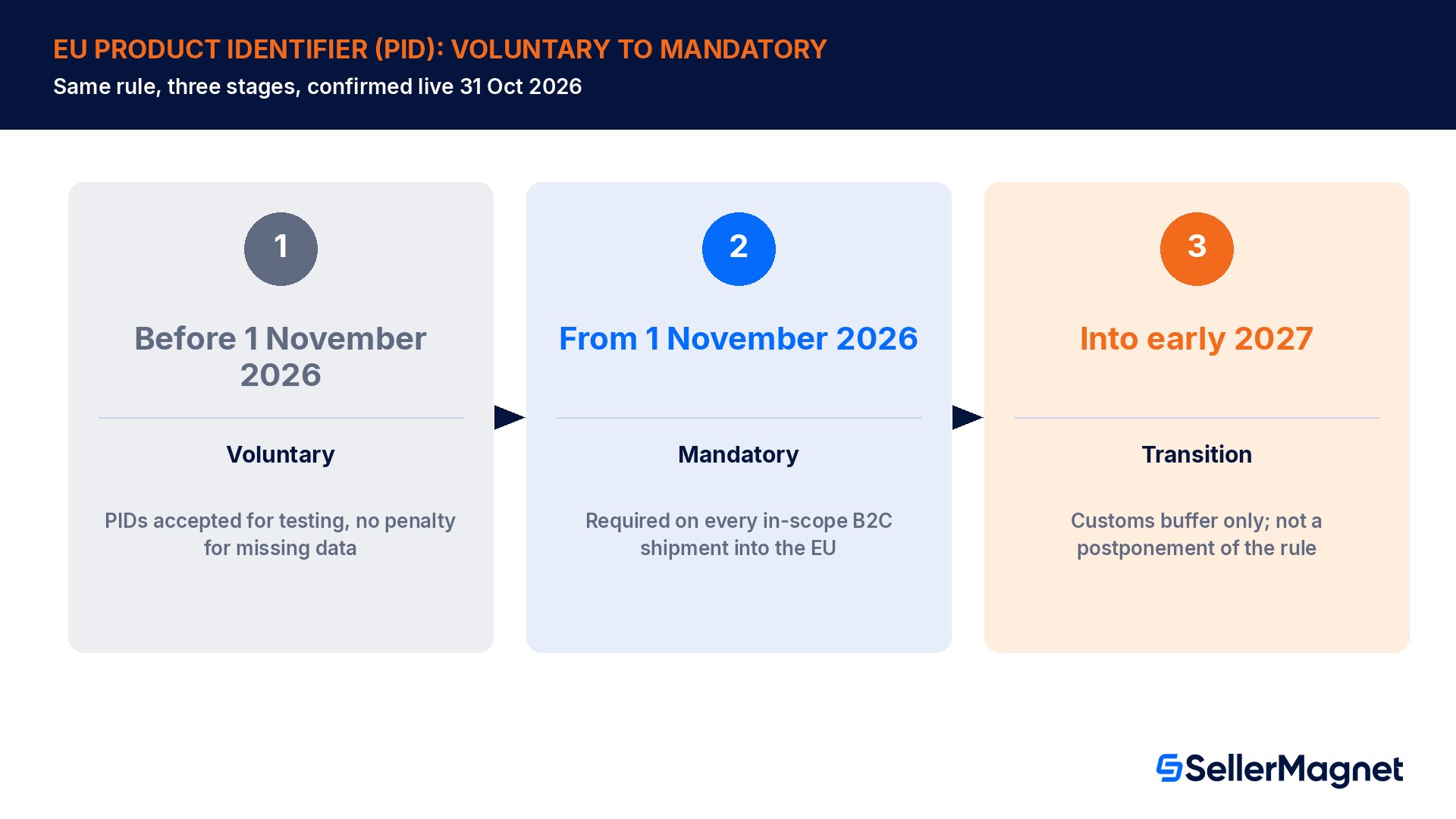
Mandatory, as of 1 November 2026. Amazon's own SP-API changelog is direct about it: "Starting November 1, 2026, EU customs will require product identifiers for all business-to-consumer (B2C) goods shipped into the EU from outside of the EU." The EU Commission's trade page uses the same word for the same date: Product Identifiers must now be declared to customs on import distance sales, effective 1 November 2026. Earlier guidance that circulated through seller forums in the months before the deadline, including Amazon's own announcement and a near-identical notice eBay sent its sellers, said PIDs were accepted for EU imports on a voluntary basis, with no penalty for shipping without them before the deadline. That voluntary window closed on 1 November 2026. If you are reading this after that date, voluntary no longer applies to your shipments.
Before 1 Nov 2026
From 1 Nov 2026
PID data on an import shipment
Optional, accepted for testing with no penalty
Required on every in-scope B2C shipment
Missing manufacturer part number or barcode
No immediate consequence
Risk of a held, delayed or returned shipment at customs
Carrier customs data
PID fields optional in most carrier systems
PID fields required when shipping outside Amazon's own label flow too
Enforcement at the border
Not yet active
Active, with EU member states running a temporary transition into early 2027
The three identifiers EU customs now requires per item
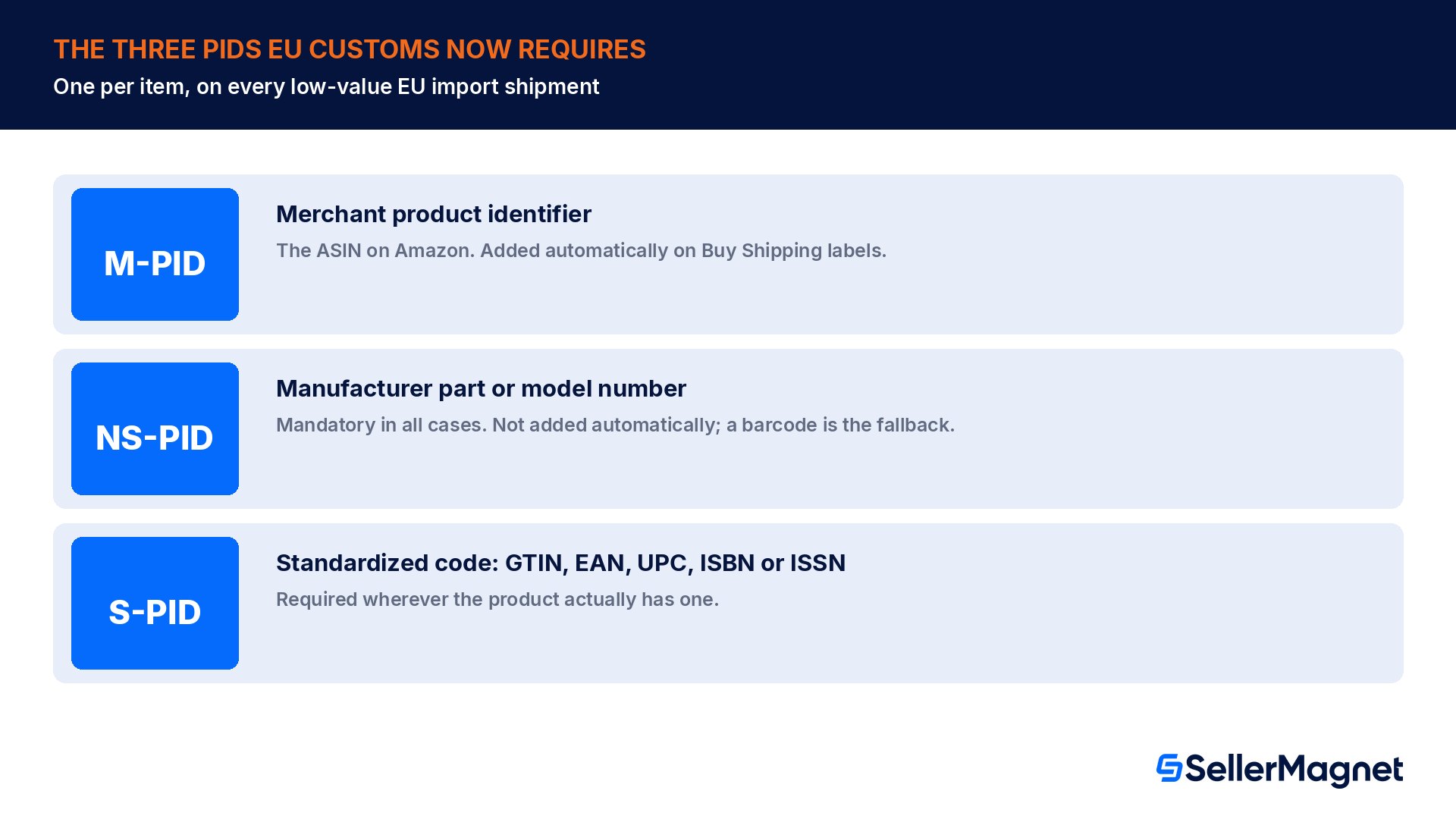
The requirement is not one field, it is three, and Amazon's naming matches the EU Commission's own customs codes. Per the SP-API changelog, your integration (or Amazon on your behalf for Buy Shipping labels) must supply: the ASIN as the Merchant Product Identifier (M-PID), which Amazon adds automatically on its own shipping labels; the manufacturer's part number or model number as the Non-Standard Product Identifier (NS-PID), which Amazon does not add for you, and which is required in every case, with a barcode number as the fallback when a product has neither a part nor a model number; and, where the product has one, a Standard Product Identifier (S-PID) such as an EAN, GTIN, UPC, ISBN or ISSN. The EU Commission's own customs table lists the same three categories under its codes C127, C128 and C129, plus a fourth code, Y081, for a formal declaration that no standardized identifier exists for that product.
Identifier
What it is
Required?
M-PID
Your own merchant product identifier (on Amazon, the ASIN)
Mandatory in all cases; Amazon auto-adds it on Buy Shipping labels
NS-PID
Manufacturer's part number or model number; a barcode if neither exists
Mandatory in all cases; Amazon does not add this automatically
S-PID
A standardized code: GTIN, EAN, UPC, ISBN or ISSN
Required where one exists for the product
Y081 (exception)
A declaration that no standardized identifier exists
Required only when there is genuinely no S-PID
Amazon does not validate the data you send
Amazon's changelog says it plainly: "Amazon applies no format validation and transmits the submitted values to the carrier as provided, so you are responsible for the accuracy of the information you submit." A wrong or placeholder part number is not caught before it reaches customs. It is caught at the border, on a held shipment, after the cost of inventory and freight is already sunk.
Who is actually affected: scope of the EU PID rule
This rule targets a specific shipment type, not every EU order. Per Amazon and the EU Commission, it applies to business-to-consumer (B2C) distance-sale shipments valued at 150 euro or less, shipped from outside the EU to a buyer inside the EU, across all EU Amazon stores. In practice that means import listings: inventory a seller sources and ships from the US, UK, China or anywhere else outside the EU, fulfilled directly to an EU buyer, whether through Amazon's Buy Shipping labels, a self-ship carrier account, or a service like a carrier's own customs clearance tool. It does not apply to B2B VAT-registered recipients, and FBA inventory that is already stored inside an EU fulfillment center cleared EU customs on its own import into that center under the seller's existing customs process, a separate event from this rule. If every one of your EU orders ships from EU-based FBA stock, this rule is not about your inventory. If any portion of your catalog is fulfilled from outside the EU into EU buyers, it is.
What happens if your import listings are missing a PID
The EU Commission's own guidance names the real cost directly: product information "must flow fully and accurately from the seller, marketplace or platform to the customs declarant," and "a generic product description will no longer be enough." Amazon's changelog states the practical risk: "Missing identifiers can cause a shipment to be held or returned at customs, at the seller's expense." That is the chain that matters for an EU import listing today: a missing manufacturer part number or barcode is no longer just an incomplete listing field, it is a customs data gap that can stop the physical shipment before it reaches the buyer, with the delay, return freight or write-off cost landing on the seller, not on Amazon.
Find the missing data before a shipment gets held, not after.Listing Optimizer scores every listing against its data-quality checks, including the fields a part number or barcode belongs in, and pushes only the field fixes you approve back to Amazon, so closing a catalog gap does not mean rewriting a listing from scratch. For a supplier list you have not sourced yet, Bulk Sourcer screens a whole CSV or pasted code list and flags which candidates actually carry a usable GTIN, EAN, UPC or manufacturer part number before you commit to shipping it into the EU without one.
The temporary transition some EU member states are running into early 2027 softens the immediate edge of this, but every primary source is explicit that it is a customs operations buffer, not a change to the rule. FedEx's own guidance to shippers puts it plainly: this is not to be considered a postponement of the requirement, and shippers should keep providing PID information for all applicable shipments without delay. Treat the transition window as the time you have left to close catalog gaps before enforcement tightens everywhere, not as a reason to wait.
A second cost on the same shipment: the end of the de minimis exemption
The PID requirement did not arrive alone. From 1 July 2026, the EU removed its 150 euro customs duty exemption (the de minimis threshold) for low-value goods. Every B2C e-commerce parcel valued at 150 euro or less now carries a flat 3 euro customs duty per item classification, and the EU Commission notes this duty is non-refundable, even if the item is later returned or undelivered. The two changes share the same shipment profile (low-value, B2C, imported from outside the EU), so a seller working through this fix should check both at once: is the PID data complete, and is the flat duty already priced into the landed cost.
Worked example: a 28 euro import order after 1 November 2026
A seller ships a 28 euro accessory from a non-EU warehouse to a buyer in Germany, fulfilled outside Amazon's EU inventory network. Before 1 November 2026, the shipment could move with only the ASIN attached and no penalty. From 1 November 2026, three things need to be true at the same time: the ASIN is present as the M-PID (Amazon adds this automatically on a Buy Shipping label), a manufacturer part number or model number is present as the NS-PID (the seller has to supply this, since Amazon does not), and if the accessory has a real barcode, an EAN or UPC is present as the S-PID. If the seller's listing never had a manufacturer part number on file, and the barcode field was left blank because the product came from a supplier without one, the shipment now needs the seller to go find or assign that number before the label is even purchased. On top of that, since this shipment is under the 150 euro threshold, the flat 3 euro customs duty from the de minimis change applies regardless of whether the PID data is complete. Skipping the PID step risks the shipment being held at the border; paying the flat duty is unavoidable either way.
Pre-shipment checklist for EU import listings
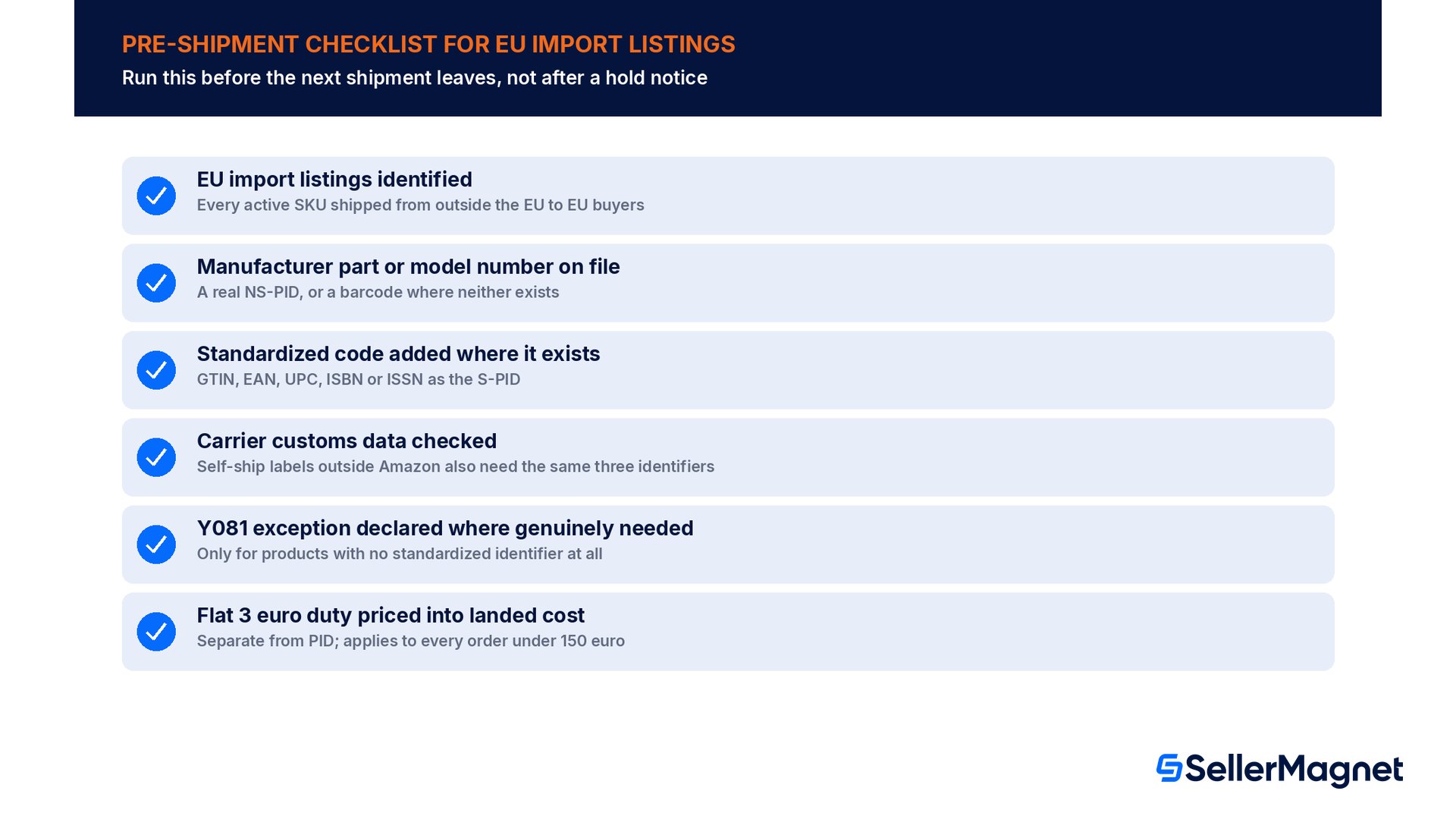
Identified every active listing that ships to EU buyers from outside the EU, not just listings tagged for a specific EU marketplace.
Confirmed a manufacturer part number or model number (NS-PID) is on file for each of those SKUs; added a barcode number instead where no part or model number exists.
Confirmed a standardized code (GTIN, EAN, UPC, ISBN or ISSN) is on file wherever the product actually has one, rather than leaving the S-PID field blank by default.
Checked that any carrier integration or label-purchase flow used outside Amazon's own Buy Shipping also carries the same three identifiers in its customs data submission.
Reviewed whether any SKU genuinely has no standardized identifier, and is ready to be declared under the Y081 exception rather than left blank.
Priced the flat 3 euro per-item customs duty into the landed cost of every 150 euro-or-under EU import order, separate from the PID fix.
How do I add a missing Product Identifier to an import listing?
Close a PID gap on an EU import listing
Flag the affected listings - List every active SKU that ships to EU buyers from outside the EU, since only that shipment type needs a PID.
Check the manufacturer part or model number - Confirm the NS-PID field has a real value; search the manufacturer's own site or packaging when it is missing.
Add a barcode as the fallback - Where no part or model number exists, enter a barcode number in that field instead, since this is the documented fallback.
Add the standardized code where one exists - Enter the GTIN, EAN, UPC, ISBN or ISSN as the S-PID whenever the product genuinely has one.
Declare the exception when it genuinely has none - Use the Y081 exception only for products with no standardized identifier at all, not as a shortcut past missing data you could still find.
Confirm the carrier side too - If you buy labels outside Amazon's own flow, verify the same three identifiers are included in that carrier's customs data submission.
Common mistakes sellers make with the PID requirement
Still treating PID data as voluntary after 1 November 2026, based on guidance that was accurate only before the deadline.
Assuming Amazon fills in every identifier automatically, when only the M-PID (the ASIN) is added for you; the manufacturer part number or model number is the seller's responsibility.
Leaving the S-PID field blank for a product that actually has a real GTIN, EAN or UPC, instead of entering it.
Treating the temporary customs transition into early 2027 as a postponement of the rule, rather than a short operational buffer that every primary source says is ending.
Fixing PID data on Amazon's own listing but not updating the same identifiers in a separate carrier account used for self-ship labels, which customs reads from the carrier's own submission.
Confusing the PID requirement with the flat 3 euro customs duty from the de minimis change; both apply to the same low-value shipment, and fixing one does not remove the other.
Is the EU Product Identifier (PID) requirement mandatory or voluntary right now?
Mandatory, since 1 November 2026. PIDs were accepted on a voluntary basis with no penalty before that date; that window has closed.
What are the three EU Product Identifiers I need to provide?
M-PID (your merchant identifier, the ASIN on Amazon, added automatically), NS-PID (a manufacturer part or model number, or a barcode if neither exists, not added automatically), and S-PID (a standardized code such as GTIN, EAN, UPC, ISBN or ISSN, where the product has one).
Does Amazon fill in the Product Identifiers for me?
Only the M-PID (the ASIN) on Buy Shipping labels. Amazon does not add the manufacturer part/model number or the standardized code; sellers have to supply those, and Amazon applies no format validation to what is submitted.
Which shipments does the PID requirement apply to?
Business-to-consumer shipments valued at 150 euro or less, shipped from outside the EU to a buyer inside the EU, across all EU Amazon stores. It does not apply to B2B VAT-registered recipients or to FBA inventory already stored inside an EU fulfillment center.
What happens if a shipment is missing a Product Identifier?
The shipment risks being held, delayed or returned at EU customs, at the seller's expense. A temporary transition some EU member states are running into early 2027 may still let some shipments move without complete data, but every primary source says this is not a rule postponement.
Is this the same as the new EUR3 customs duty?
No, they are separate changes that apply to the same low-value shipments. The flat 3 euro duty replaced the 150 euro de minimis exemption from 1 July 2026; the PID requirement is a separate customs data rule from 1 November 2026.
What if my product genuinely has no standardized identifier?
The EU Commission's customs table includes a Y081 exception code to declare that no standardized identifier exists for that product; it is for products that genuinely lack one, not a way to skip supplying a manufacturer part number or barcode that does exist.
Stop Juggling Tools. SellerMagnet Combines Everything You Need.