Amazon Digital Services Fee 2026: The EU Tax Surcharge Explained
R
RenéFreelance Amazon Editor
|
15 min read
A UK-based seller shipping into the France store pays a 3% surcharge on both their Selling on Amazon fees and their FBA fulfillment fees, while a US-based seller shipping into that exact same France store pays the identical 3% on Selling on Amazon fees but nothing extra on FBA. Same store, same fee rates, different outcome, because Amazon's digital services fee is driven by where the seller is established, not only by where the sale happens. This guide works through the 2026 Digital services fee changes Amazon rolled out on 20 March 2026, the full establishment-by-store percentage matrix, three worked examples covering different seller/store combinations, and how this fee differs from the Fair Pricing Policy and the base referral fee table.
Amazon's digital services fee passes through government digital services taxes of 2% in the UK and 3% in France, Italy and Spain. Since 20 March 2026 the exact rate and which fees it applies to depend on both where the seller's business is established and which store the sale happens in. For some combinations it applies only to Selling on Amazon fees like the referral fee; for others it also applies to FBA fulfillment fees. The fee appears in the Revenue Calculator and in Payments reports Transaction View.
What the digital services fee actually is
The digital services fee is not a new Amazon fee invented for sellers; it is Amazon passing through taxes that governments already charge on digital services. Amazon's help page states it plainly: "The digital services fee accounts for government digital services taxes (DST) of 2% in the UK, and 3% in France, Italy, and Spain." If your business is established in a country where DST has been introduced, or you sell in a store in one of those countries, the fee applies as a percentage increase on specific Amazon fee lines, not on your product price itself.
Store
Government DST rate
Which Amazon fees it can apply to
UK
2%
Selling on Amazon fees, and FBA fees, for every seller establishment
France
3%
Selling on Amazon fees, and FBA fees, for every seller establishment
Italy, Spain
3%
Selling on Amazon fees; FBA fees too, but only for UK- or France-established sellers
Source: Digital services fee. "Selling on Amazon fees" is defined narrowly on this page: referral fee, fixed closing fee, variable closing fee and get-paid-faster fee. "FBA fees" in this context means the FBA fulfillment fee and the shipping chargeback fee specifically, not every fee FBA charges.
Establishment, not just the sale's store, decides the rate
Two sellers can make an identical sale in the identical store and pay different DST, because the rate depends on where each seller's OWN business is established, looked up against the store the sale happened in. Check your own establishment row in the matrix below, not just the store column.
The 2026 change: the full establishment x store matrix
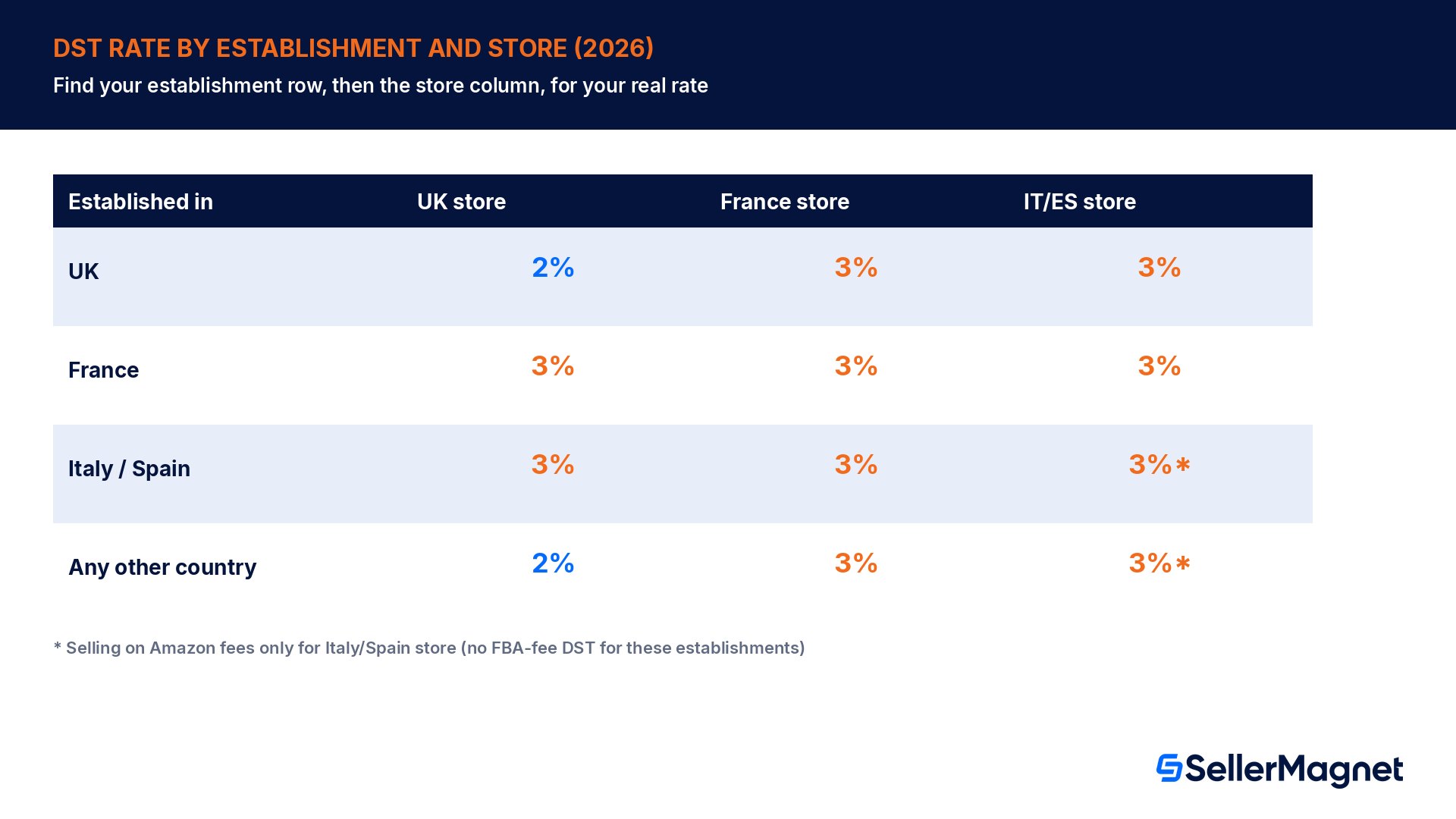
Before 20 March 2026, Amazon applied digital services fees more uniformly. Amazon's 2026 Digital services fee changes page explains the new logic: "we'll update how the digital services fee is applied to sales in our France, Italy, and Spain stores for sellers established outside these countries... we will apply the digital services fee based on the DST rate in the country of sale." The result is a matrix: your rate and which fee lines it hits depend on the combination of where you are established and which store the sale is in.
Seller established in
UK store
France store
Italy, Spain store
UK
2% (Selling on Amazon + FBA)
3% (Selling on Amazon + FBA)
3% (Selling on Amazon + FBA)
France
3% (Selling on Amazon + FBA)
3% (Selling on Amazon + FBA)
3% (Selling on Amazon + FBA)
Italy, Spain
3% (Selling on Amazon + FBA)
3% (Selling on Amazon + FBA)
3% (Selling on Amazon only)
Any other country (US, Canada, Germany, Belgium, Sweden, Netherlands, Poland, Mexico)
2% (Selling on Amazon + FBA)
3% (Selling on Amazon + FBA)
3% (Selling on Amazon only)
Source: 2026 Digital services fee changes. Read the table by finding your own establishment row first, then the store column for where the sale happened; the percentage and the "applies to" note in that cell is what actually lands on that specific sale, not a single flat rate for the whole business.
Australia, Japan, Singapore, India and several other stores have no DST layer
Amazon's matrix lists 0% for every establishment selling into Australia, Japan, Singapore, India, Egypt, the UAE, Saudi Arabia, Brazil and Turkey stores, since none of those stores currently has a matching digital services tax. The DST layer in this guide is specific to the UK/France/Italy/Spain stores.
Why this fee exists at all
Digital services taxes are not an Amazon invention; several European governments created them to tax large digital platforms' local revenue, independent of where the platform's own headquarters sit. The UK's Digital Services Tax, and similar taxes in France, Italy and Spain, apply to qualifying digital businesses operating in those countries. Amazon's seller-fee page is explicit that the digital services fee "accounts for" these government taxes, meaning Amazon is not pocketing an extra margin on the surcharge; it is passing a cost that the tax authority already charges Amazon onward to the transactions that generate it. That framing matters for how a seller should think about the fee: it will not disappear through negotiation with Amazon, because Amazon is not the one setting the underlying 2% or 3% rate, a national government is.
The 20 March 2026 change refined WHO within Amazon's seller base actually carries that pass-through cost. Before the update, a flat store-based rate meant two sellers established in very different countries, selling into the same France store, paid the same DST percentage on the same fee lines. The establishment-aware matrix instead asks a second question, not just which store the sale happened in, but where the selling business itself is established, before deciding the final percentage and which fee lines it touches. That is a more precise pass-through of the underlying tax logic, but it also means a seller's DST exposure can change simply by expanding into a new store, even with no change to their own home country or their pricing.
Measuring the cost: FR/IT/ES/UK revenue share versus total EU revenue
The practical sizing question for most multi-store sellers is not the per-order DST amount, which is small, but what share of total EU-area revenue runs through the four DST-affected stores (UK, France, Italy, Spain). A seller whose EU sales concentrate in Germany, the Netherlands, Belgium, Sweden and Poland, with only a small slice in France, Italy, Spain or the UK, carries a correspondingly small DST exposure even at the full 2-3% rate, because the rate only touches orders placed in those four specific stores. A seller whose EU sales concentrate the other way, heavily into France, Italy, Spain and the UK, should run the monthly math in this guide against their actual order volume in those stores specifically, not against total EU revenue, to avoid over- or under-stating the real cost.
That store-level concentration also shifts over time as a catalog expands. A seller who launches new listings into the France, Italy or Spain store for the first time, after previously selling only in Germany or the Netherlands, picks up a new DST line the moment those listings start selling, even though nothing about their home establishment or their existing EU business changed. Checking DST exposure once at launch is not enough; it is worth revisiting every time a listing expansion adds a new DST-affected store to the mix, the same way a seller would revisit VAT registration thresholds after a similar expansion.
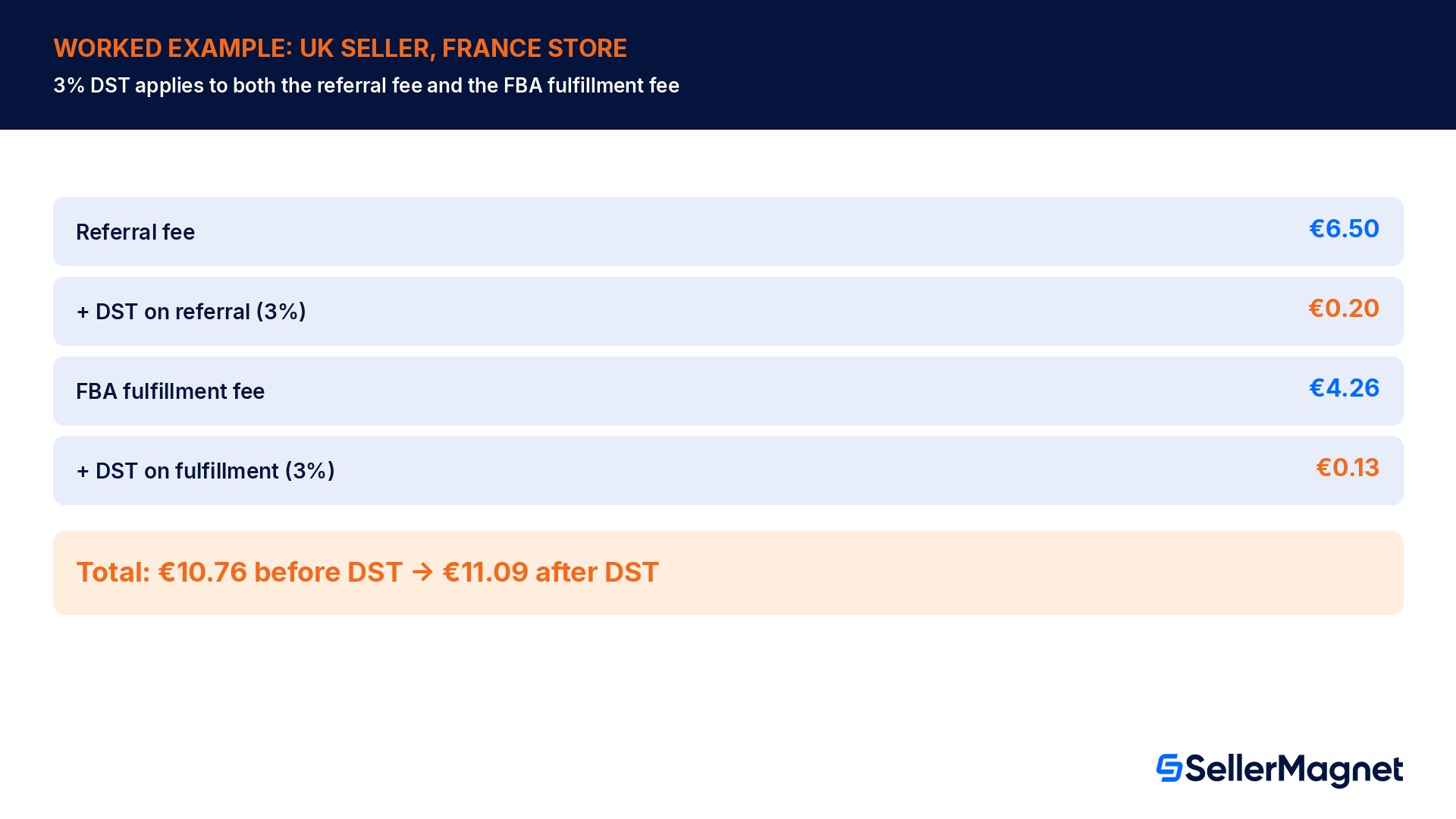
Worked example 1: UK-established seller selling into the France store
A UK-established seller sells an item through the France store. The order carries a referral fee of €6.50 and an FBA fulfillment fee of €4.26. Per the matrix, a UK seller in the France store pays 3% DST on BOTH fee lines, since UK establishment selling into France applies to Selling on Amazon and FBA fees.
Line
Calculation
Amount
Referral fee
Base
€6.50
DST on referral fee
€6.50 x 3%
€0.20
FBA fulfillment fee
Base
€4.26
DST on fulfillment fee
€4.26 x 3%
€0.13
Total fees before DST
€6.50 + €4.26
€10.76
Total fees after DST
€10.76 + €0.33
€11.09
Worked examples 2 and 3: a US-established seller in the Italy store versus the UK store
A seller established in "any other country", which includes the US, pays DST differently depending on the store. Selling into the Italy or Spain store, the matrix applies DST to Selling on Amazon fees only, no FBA layer. Selling into the UK store, the same seller pays a lower 2% rate, but the UK store still carries the FBA layer for every establishment, so this seller pays that 2% on both the Selling on Amazon fee and the FBA fulfillment fee.
Store
Referral fee
FBA fulfillment fee
DST rate
DST amount
Total after DST
Italy
€9.99
not charged (Selling on Amazon fees only)
3%
€0.30
€10.29
UK
£9.99
£3.84
2%
£0.28
£14.11
The US seller in this example never pays DST on the FBA fulfillment fee in the Italy or Spain store, which is the detail that most often gets missed: forecasting FBA costs with a blanket DST assumption for every store overstates the actual fee for sellers in this establishment group selling into Italy or Spain. The UK store is the exception for this establishment, since its 2% rate covers Selling on Amazon AND FBA fulfillment fees, the same FBA-inclusive pattern as the France store at 3%.
What it adds up to over a month
A seller generating €2,000 a month in referral fees across the France, Italy and Spain stores, all at the 3% rate, pays roughly €60.00 a month in DST on referral fees alone, about €720.00 a year, before any FBA-fee layer that applies to their specific establishment is added on top. That number scales linearly with fee volume, so a seller doing ten times that referral-fee volume across the same three stores sees roughly €7,200 a year from this one fee line, a material cost for an EU-focused business that is easy to miss because it never appears as a separate line item on the product price.
See the DST layer before it hits your margin, not after. SellerMagnet's Fee Calculator applies the correct establishment-by-store DST percentage on top of the base referral and fulfillment fee, so your profit-per-order number already reflects the real fee stack for each marketplace rather than a single flat rate across every store. The Referral Fees by Category guide covers the base percentages this surcharge sits on top of, and the Fair Pricing Policy guide covers the separate pricing-conduct rules that apply regardless of which fees a given sale carries.
How this differs from other EU fee and pricing rules
One important distinction before comparing further: DST is not VAT. VAT is a separate consumption tax that Amazon and sellers already handle through existing VAT settings, invoicing and the Amazon VAT Services program; it is charged to the end customer on the item price and remitted to the relevant tax authority. The digital services fee is a seller-side surcharge on Amazon's own fee lines, driven by a different tax (the digital services tax), charged to the seller rather than the customer, and handled entirely inside Amazon's fee schedule rather than through a seller's own VAT registration. Confusing the two risks double-counting a cost that is already modelled correctly elsewhere, or missing this fee entirely because a seller assumes their VAT setup already covers it.
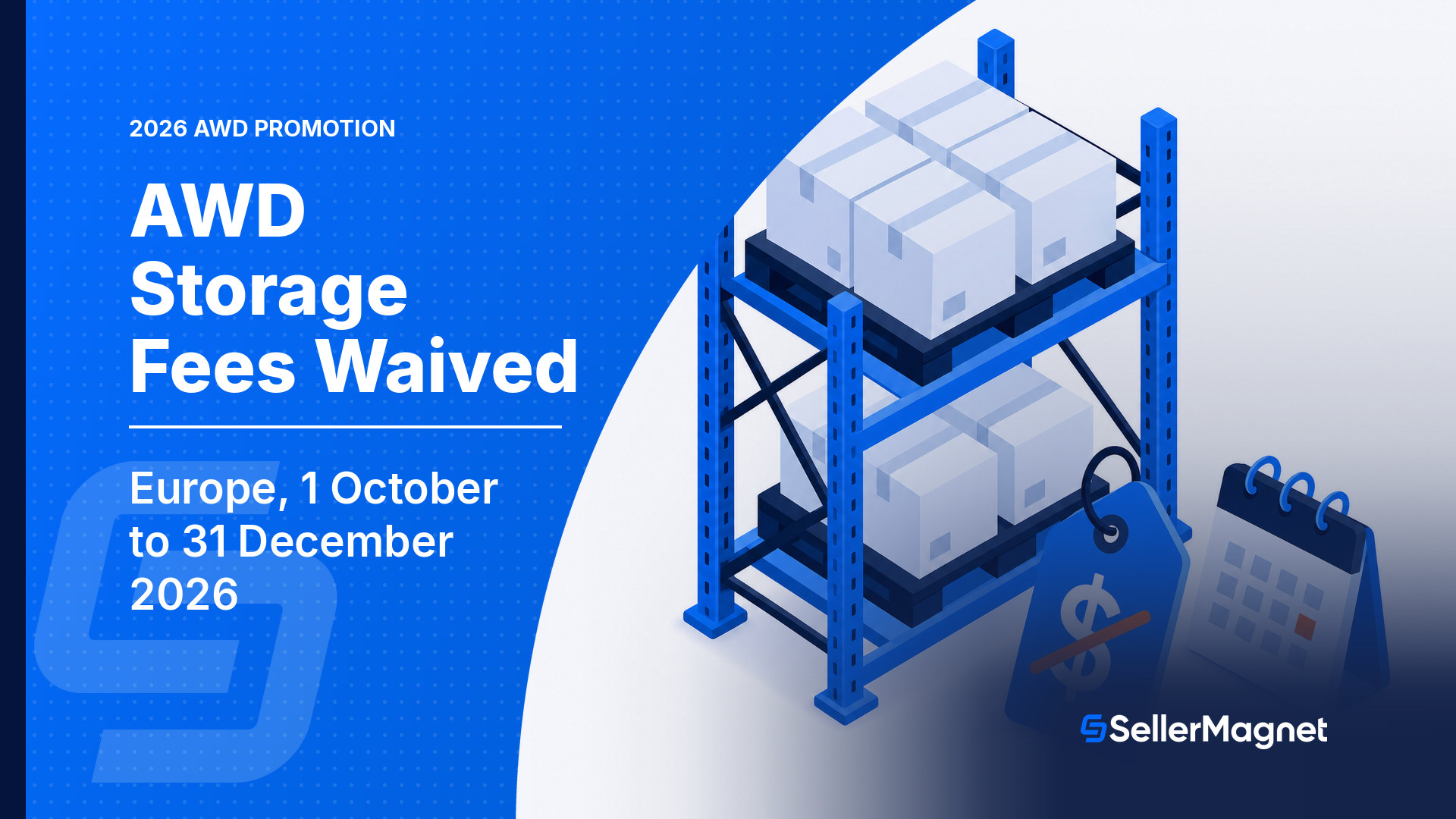
The digital services fee is easy to confuse with other EU-adjacent Amazon changes because it also moves a percentage on a fee line, but the mechanism is different from both. The Fair Pricing Policy polices how a seller sets prices and shipping fees relative to other prices customers can see; it never adds a surcharge to Amazon's own fee lines. The AWD storage fee waiver running through December 2026 reduces a storage cost for inventory at European AWD centres; it has nothing to do with referral or fulfillment fees at all. The digital services fee is narrower and more mechanical than either: it is a fixed pass-through percentage, set by the seller's establishment and the sale's store, applied automatically to specific fee lines, with no pricing judgment or inventory-location choice involved.
Common digital services fee mistakes
Assuming DST is store-only, and missing that the seller's own business establishment changes both the rate and which fee lines it covers.
Applying a single flat DST percentage across every EU store in a profit model, instead of looking up the specific establishment/store cell in the matrix.
Forgetting that for several establishment/store combinations DST applies only to Selling on Amazon fees, with the FBA fulfillment fee left untouched.
Checking the fee table for the store you register in rather than every store a listing actually ships to, since DST follows the sale's store, not the seller's home marketplace.
Treating the digital services fee and the Fair Pricing Policy as the same mechanism, when one is a fixed pass-through surcharge and the other is a pricing-conduct policy with no fixed percentage at all.
Not re-checking the Revenue Calculator after 20 March 2026 before pricing a new EU listing, and relying on an older profit estimate that predates the establishment-based matrix.
Sizing total DST exposure against all EU revenue instead of only the revenue actually placed through the UK, France, Italy and Spain stores, which inflates the perceived cost for a seller whose EU sales are concentrated elsewhere.
Re-registering a business establishment for unrelated reasons (a new entity, a relocation) without checking how the new establishment row changes DST exposure across every store the business already sells into.
How to check your digital services fee exposure
Check your digital services fee exposure per store
Find your establishment row - Identify which establishment row you fall under in Amazon's matrix: UK, France, Italy/Spain, or any other country (which covers the US, Canada, Germany and most others).
Find the store column - For the specific store a sale is going to (UK, France, Italy or Spain), read the DST percentage and the "applies to" note in that cell.
Check which fee lines it hits - Confirm whether the cell applies DST to Selling on Amazon fees only, or to both Selling on Amazon and FBA fulfillment/shipping chargeback fees, before forecasting the full fee stack.
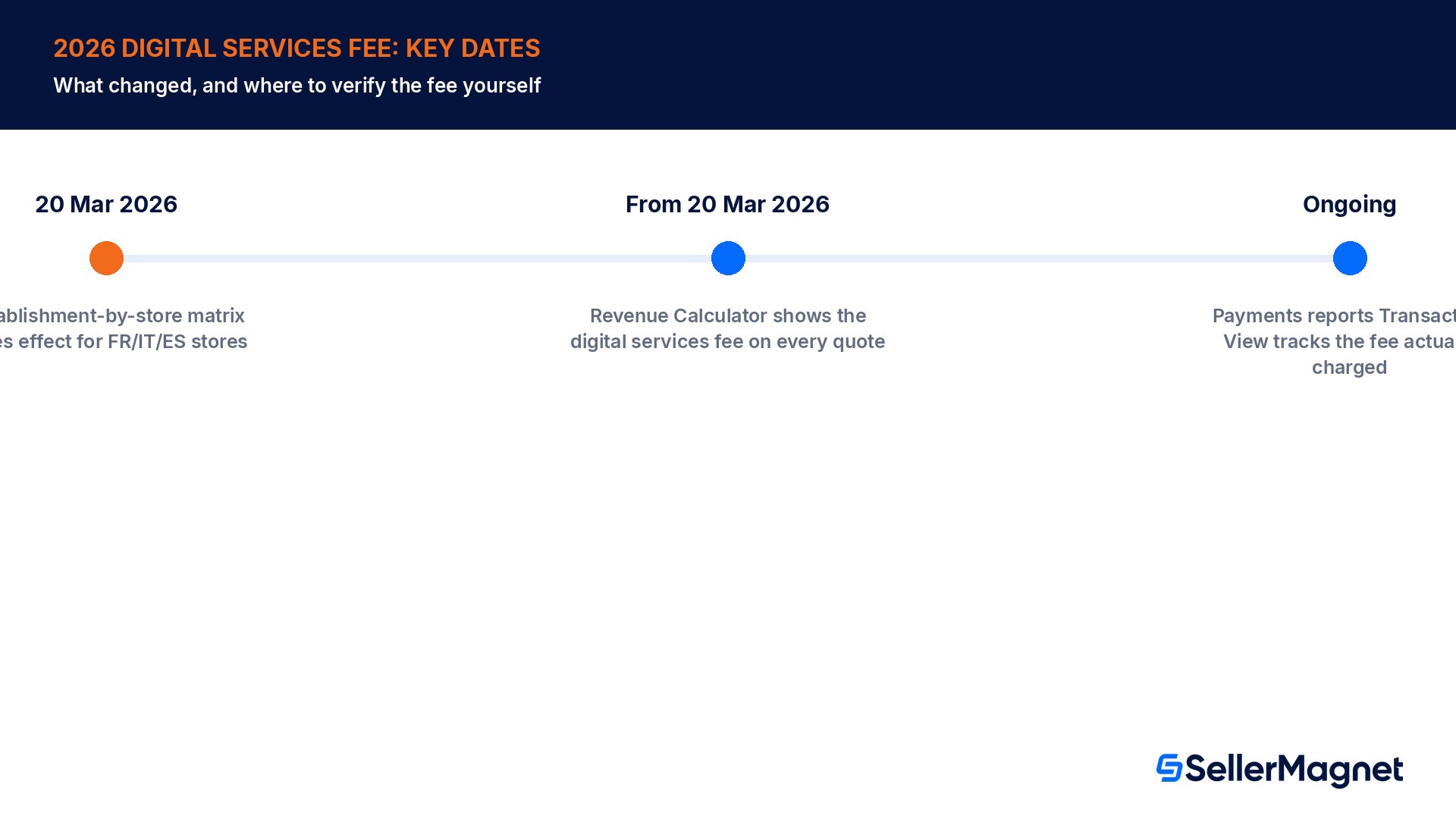
Verify in the Revenue Calculator - Price or re-price the listing in Amazon's Revenue Calculator, which has shown the digital services fee since 20 March 2026, and cross-check it against your own Fee Calculator model.
Pre-pricing checklist for EU-store sellers
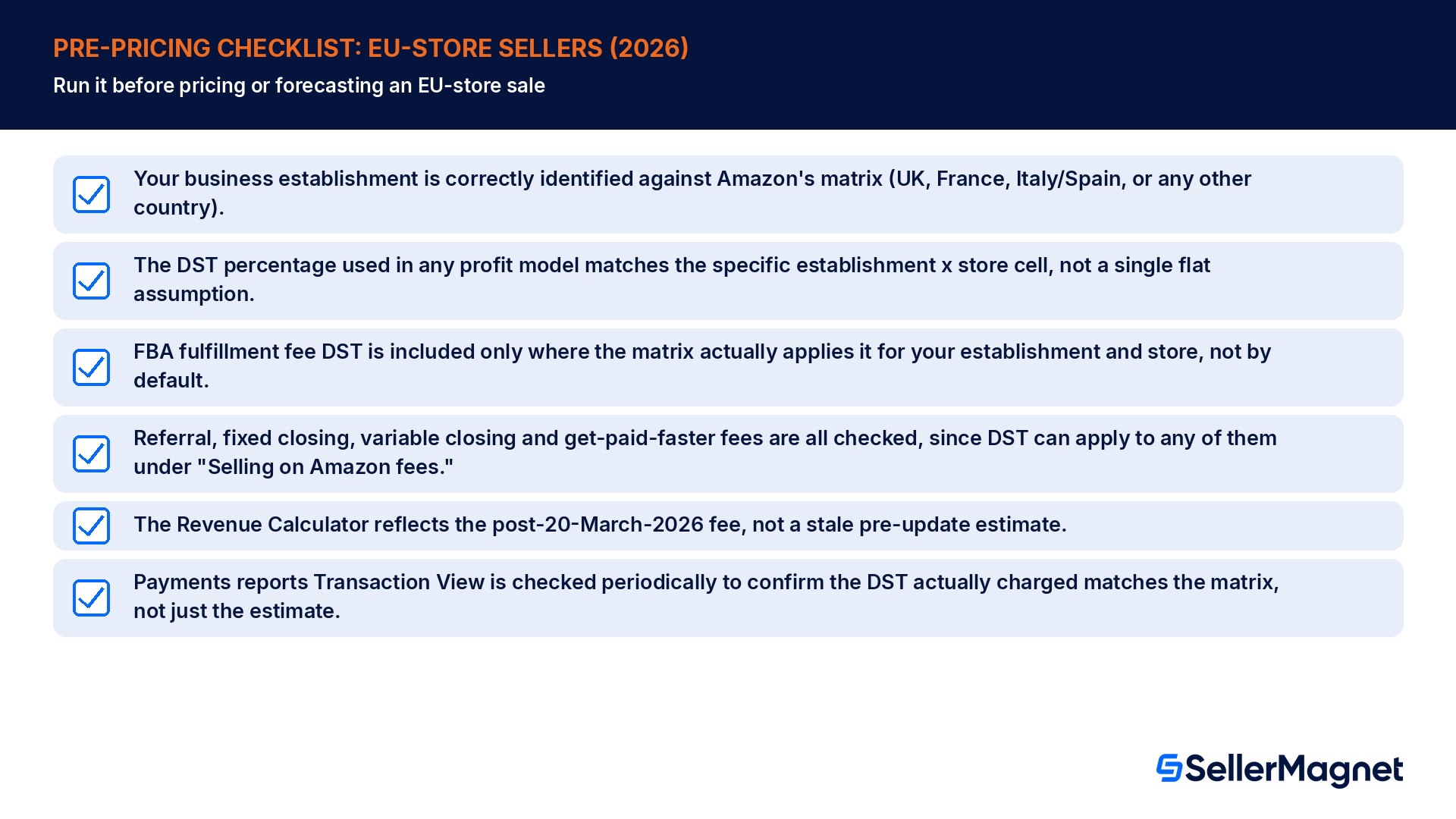
Your business establishment is correctly identified against Amazon's matrix (UK, France, Italy/Spain, or any other country).
The DST percentage used in any profit model matches the specific establishment x store cell, not a single flat assumption.
FBA fulfillment fee DST is included only where the matrix actually applies it for your establishment and store, not by default.
Referral, fixed closing, variable closing and get-paid-faster fees are all checked, since DST can apply to any of them under "Selling on Amazon fees."
The Revenue Calculator reflects the post-20-March-2026 fee, not a stale pre-update estimate.
Payments reports Transaction View is checked periodically to confirm the DST actually charged matches the matrix, not just the estimate.
What is Amazon's digital services fee?
It is a surcharge that passes through government digital services taxes of 2% in the UK and 3% in France, Italy and Spain onto specific Amazon seller fees. Since 20 March 2026 the exact rate and which fee lines it covers depend on both the seller's business establishment and the store the sale happens in.
Does the digital services fee apply to every seller?
Only if your business is established in a country where DST has been introduced, or you sell in the UK, France, Italy or Spain store. Selling into stores like Australia, Japan or Brazil carries 0% DST for every establishment, since those stores have no matching digital services tax layer at all.
Does it apply to FBA fulfillment fees or just the referral fee?
It depends on the establishment/store combination. Several combinations apply DST only to Selling on Amazon fees (referral, closing, get-paid-faster); others, mainly UK or EU-established sellers selling into the France, Italy, Spain or UK stores, also apply it to FBA fulfillment and shipping chargeback fees, so always check your specific row and column in the matrix before assuming either way.
How do I know my exact DST rate?
Find your business establishment's row in Amazon's matrix, then the column for the store the sale happens in; that cell gives both the percentage and whether it covers Selling on Amazon fees only or Selling on Amazon plus FBA fees. The rate is also shown directly in the Revenue Calculator from 20 March 2026 onward.
Is the digital services fee the same as the Fair Pricing Policy?
No. The digital services fee is a fixed pass-through percentage applied automatically to specific Amazon fee lines based on establishment and store. The Fair Pricing Policy is a separate conduct rule about how a seller's price and shipping fee compare to other prices customers can see, with no fixed percentage attached to it at all.
Where can I see how much DST I was actually charged?
Amazon's help page points to two places: the Revenue Calculator for a preview before a sale, and the Transaction View inside Payments reports for what was actually charged on a completed order. Checking both periodically catches a mismatch between an estimate and the real charged fee early.
Did this fee exist before 2026?
Digital services fees existed before this change, but applied more uniformly by store. The 2026 update specifically changed how the fee is calculated for sales in the France, Italy and Spain stores by sellers established outside those countries, introducing the full establishment-by-store matrix described in this guide, with 20 March 2026 as the effective date for the change.
Does the DST rate ever change the item price the customer sees?
No. DST is applied to Amazon's own seller fee lines, referral and in some cases FBA fulfillment fees, not to the listed item price. A customer's checkout price stays exactly the same; the fee only changes what the seller nets after Amazon's fees are deducted from the sale once it settles.
Stop Juggling Tools. SellerMagnet Combines Everything You Need.