Alibaba Suppliers: Factory or Trading Company? A Pre-Deposit Checklist
R
RenéFreelance Amazon Editor
|
11 min read
The storefront photos look identical. Both suppliers answer within the hour, both quote a similar price, and both have a gold "Verified Supplier" badge on their Alibaba profile. One of them owns the factory floor that makes your product; the other buys it from a factory two provinces away and adds a markup you cannot see. Paying the deposit to the wrong one does not usually end in outright fraud, it ends in slower answers to spec questions, a mystery price jump at the second order, and nobody on the line who can actually change the mold. This page is the checklist to run before any deposit leaves your account, not after.
To tell if an Alibaba supplier is a real factory or a trading company, check the business license scope for a manufacturing category (not just import/export), ask for the exact factory address and production capacity per month, and request a live video walk of the actual production floor. A factory answers specific production questions (machine count, current capacity, who owns the mold) without needing to check with a partner; a trading company's answers are vaguer or routed through a third party. Trade Assurance protects your payment but does not confirm who manufactures the product.
Why does it matter before you pay a deposit, not after?
A trading company is not a scam category. Many run efficient multi-factory sourcing and are the right fit for a first small order, mixed-category shipments, or a product made across several processes that no single factory handles end to end. The risk is specifically paying factory-direct pricing and terms while actually buying through a trading company markup and an extra communication hop. Once a 30% deposit is wired through Alibaba's standard terms, correcting a spec error, renegotiating a mold cost, or asking for a rush changes goes through a middleman who does not control the production line, and every one of those requests gets slower and more expensive than it would with the factory directly.
Badges confirm the company is real, not what it does
Alibaba's own Verified Supplier program now includes a third-party on-site verification report (production facilities, process, management, export markets) that buyers can open from the supplier's profile, and Trade Assurance separately protects the payment itself. Neither one is framed as a public "factory" versus "trading company" verdict: the assessment report records a business type and site details, but reading it to tell a factory from a trading company is still something a buyer has to do directly, using the signals below.
6 signals that tell a factory from a trading company
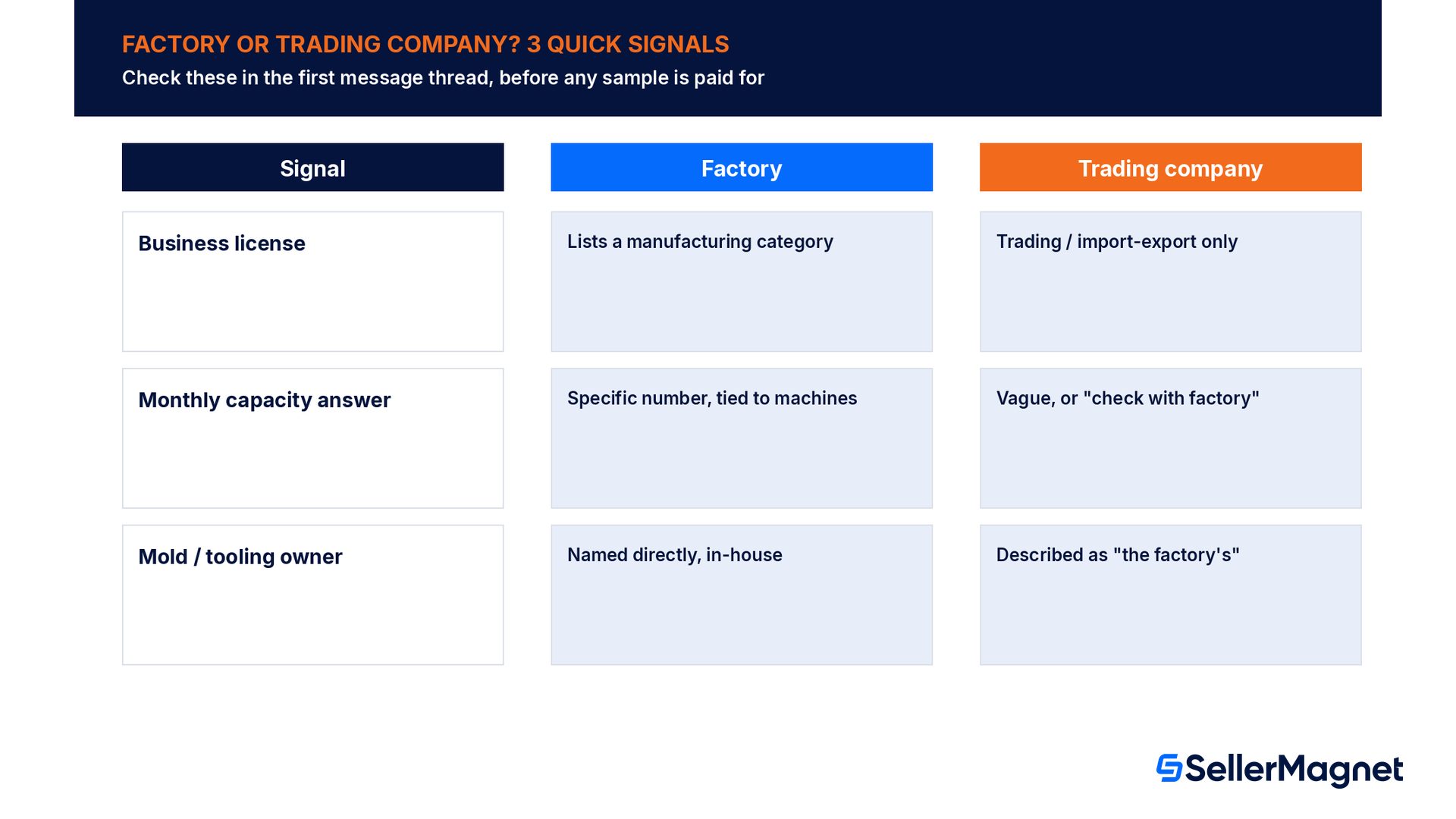
Run through these in order during the first message thread, before any sample is paid for. None of them require a site visit.
Signal
Factory
Trading company
Company name
Often includes Manufacturing, Industrial, Co., Ltd with a product-specific word
Often includes Trading, Trade, Import & Export, Supply Chain, International
Business license scope
Lists a manufacturing category matching the product
Lists wholesale, import/export or trading, no manufacturing category
Factory address vs company address
Same address, or a listed production site you can look up on a map
Registered office only; production site "confidential" or routed through a partner
Answer to "what is your monthly capacity for this SKU"
A specific number tied to machine count or line count
A round, vague number, or "we will confirm with our factory"
Answer to "who owns the mold / tooling for this part"
Names their own tooling department or a named in-house workshop
Unclear, or the mold is described as the "factory's," implying a third party
Product range on the storefront
Narrow, one category or closely related processes (injection molding, for example)
Broad and unrelated categories (electronics, textiles, toys, all on one storefront)
No single signal is proof by itself. A real factory can run a broad product range if it owns several production lines, and a trading company can have a tight, focused catalogue. Three or more trading-company signals together, especially a missing manufacturing license category plus a vague capacity answer, is the pattern worth stopping on before a deposit.
The pre-deposit checklist
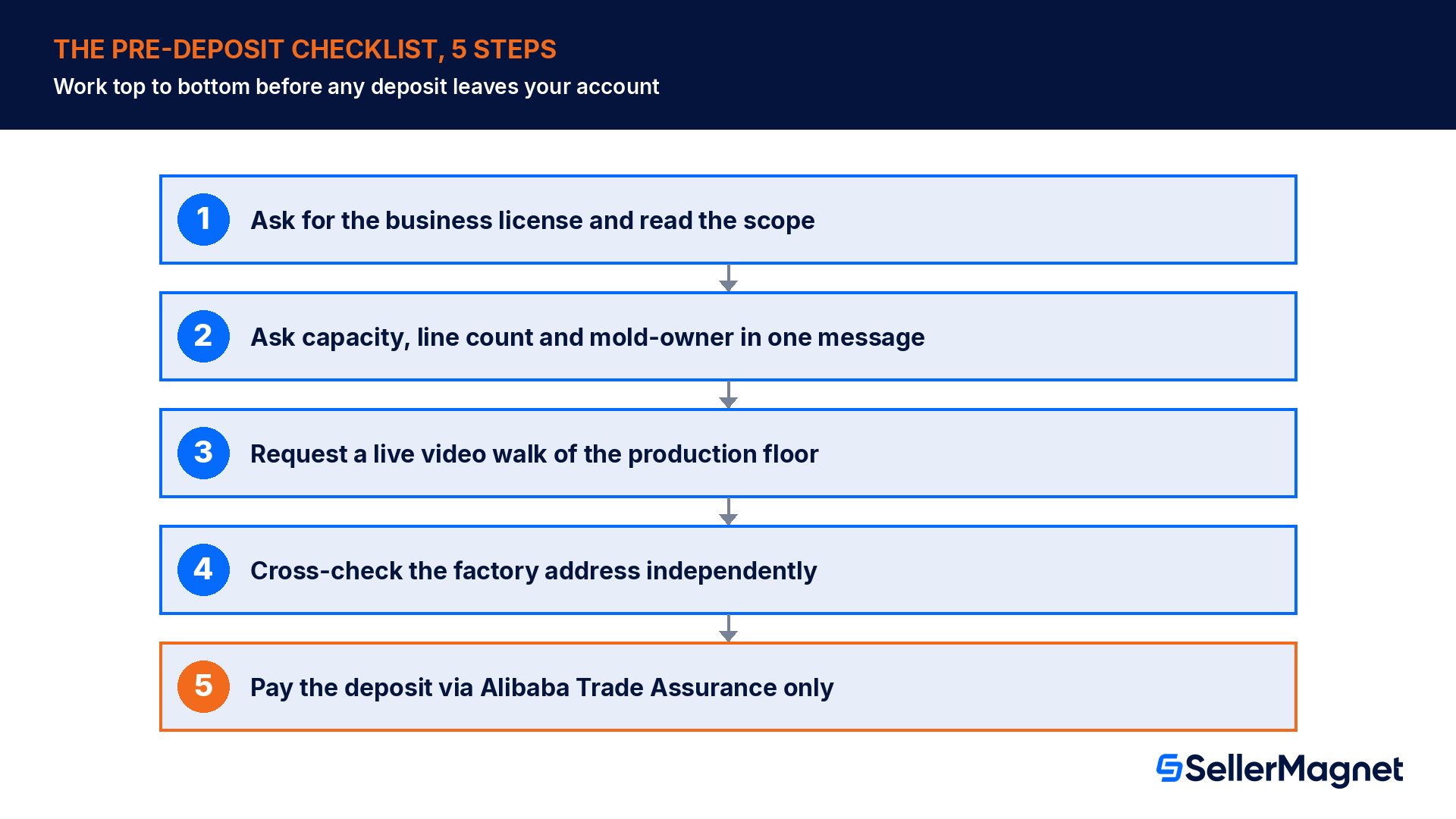
Work through these five checks in order before wiring the deposit. The first two take one message exchange; the video call takes 15 minutes and resolves almost every remaining doubt.
Ask for the business license and read the registered scope. A manufacturing category matching your product is the strongest single document signal; a license limited to trading or import/export is the strongest warning sign.
Ask three specific production questions in one message: current monthly capacity for your exact product type, number of production lines or machines for that process, and who owns the mold or tooling if the product needs one. Specific, consistent answers delivered without delay are a good sign; answers that need to "check with the factory" mean you are already talking to an intermediary.
Request a live video call walking the actual production floor, not a pre-recorded tour. Ask to see the specific machine or line that would run your order, and the current work in progress on it; a supplier unwilling to do this on a reasonable-notice call is the single most common pre-deposit red flag reported by sourcing agents and experienced buyers.
Cross-check the factory address. Search the registered or stated factory address on a map and in Chinese business registries (Qichacha or a sourcing agent can do this for a small fee); a trading company's "factory" address sometimes resolves to a residential building or an unrelated business park.
Pay the deposit through Alibaba's Trade Assurance order flow, not a direct bank transfer, so the payment stays tied to the agreed contract terms and is protected against late delivery or a spec mismatch, even though Trade Assurance itself does not confirm who manufactures the product.
A gold badge and fast replies are not a substitute for the checklist
Fast, polished English responses correlate more with a dedicated sales team, which trading companies often staff more heavily than small factories, than with who is actually running the production line. Treat responsiveness as a service-quality signal, not a factory-ownership signal.
What does paying a trading company markup actually cost?
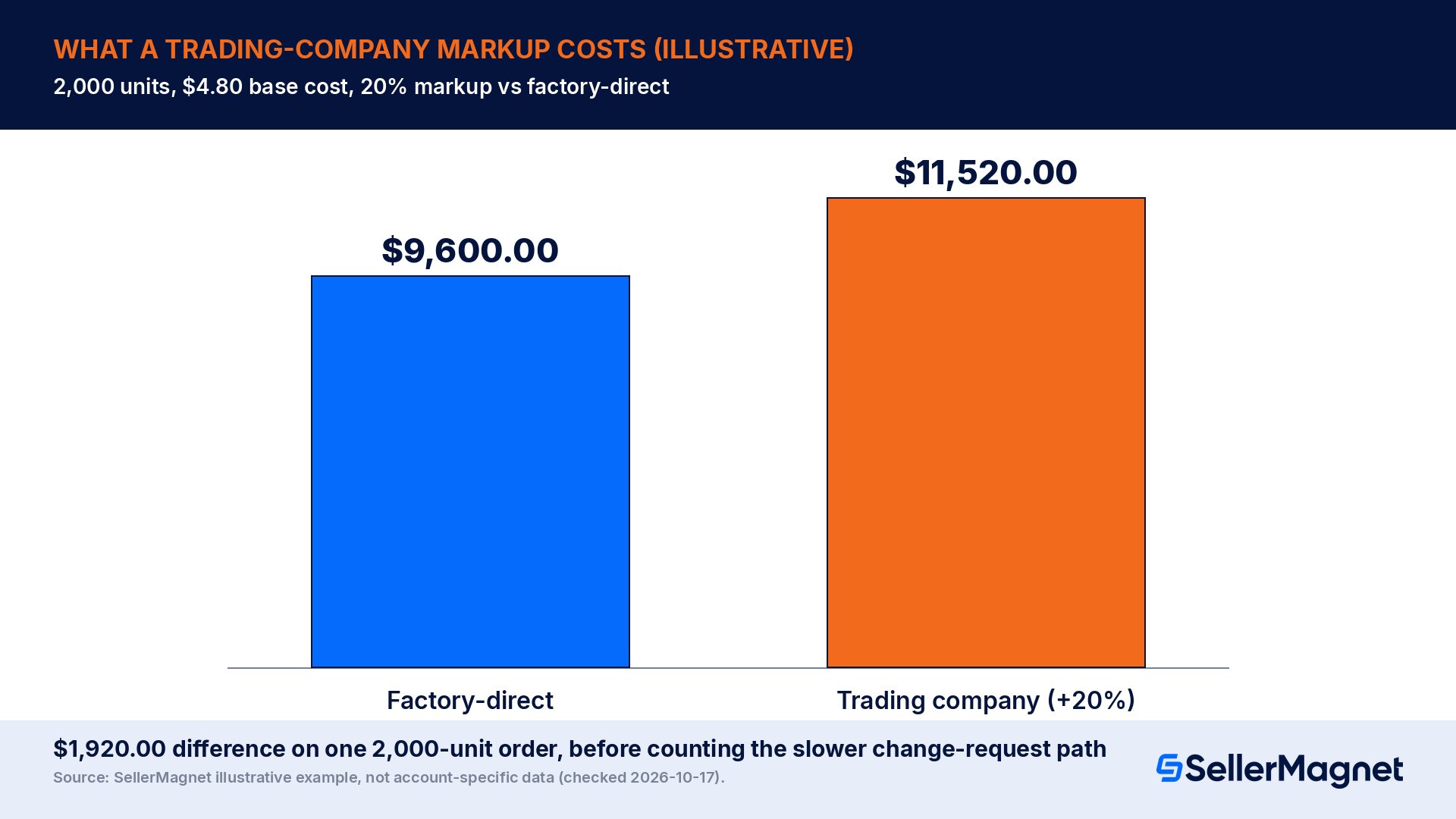
The direct cost is a per-unit markup, typically reported in the 10% to 30% range depending on the category and order size, which is not inherently unreasonable if the trading company is doing real consolidation or quality-control work you would otherwise have to arrange yourself. The cost that actually hurts shows up later: when a spec needs to change, a mold needs adjusting, or a rush order is needed before a seasonal deadline, every request goes through the intermediary first, and the intermediary has no obligation to prioritize your account the way a factory with a direct relationship would. Track the real landed cost against your target margin once the order lands with Profit Analytics, so a markup that looked acceptable on the invoice does not surprise you in the real profit numbers at reorder time. The worked example below is illustrative, not an SellerMagnet account figure, and shows the second-order effect: a 2-week delay on a mold change caused by a routed-through-a-trading-company request, compared to the same change requested factory-direct.
Line item
Factory-direct relationship
Unverified trading company
Per-unit cost at 2,000 units, $4.80 base cost
$4.80
$5.76 (20% markup)
Total landed cost difference, 2,000 units
baseline
+$1,920.00
Mold spec-change turnaround (illustrative)
5 to 7 days
3 to 4 weeks (routed through intermediary)
Direct line to the person who can approve a rush order
Yes
No, approval requested from a third party
$1,920 on a 2,000-unit order is real money, but it is not the number that decides most sellers' experience with a trading company; the mold-change turnaround is. A Q4 seller who discovers a sizing error in week 2 of a 6-week production run has very little slack left if the fix has to clear a second company before it reaches the production floor at all.
Is a trading company always the wrong choice?
Three situations where going through a trading company, knowingly, is a reasonable call: a first order small enough that no factory's minimum order quantity is met directly; a product assembled from parts made at different factories, where one trading company coordinates the whole build; and a mixed-category shipment (several different product types in one container) that no single factory could supply alone. The difference between a reasonable trading-company relationship and a costly mistake is simply knowing which one you are in before the deposit, and pricing the markup and the slower change-request path into the decision instead of discovering both after the first order ships.
Check who you are actually sourcing from before the first container ships.Product Sourcer pulls a target ASIN's current Buy Box history, price trend and estimated sell-through so you can size the order against real demand, not a supplier's minimum order quantity, before you commit to a factory or a trading company. Once the product is listed, Profit Analytics shows whether the landed cost you actually paid, trading-company markup included, still clears your target margin after Amazon fees, so a markup that looked acceptable on the invoice gets caught in the real profit numbers before the next reorder.
How do I verify a factory address or business license myself?
Verify an Alibaba supplier is a real factory before paying a deposit
Request the business license - Ask for a photo or PDF of the business license and read the registered business scope line for a manufacturing category matching your product, not only trading or import/export.
Ask three production questions in one message - Current monthly capacity for your exact product, number of machines or lines for that process, and who owns the mold or tooling; specific answers with no delay are the good sign.
Request a live video walk of the production floor - Ask to see the specific line that would run your order and the current work in progress; decline or reschedule politely if offered only a pre-recorded tour.
Cross-check the factory address - Look up the stated factory address on a map and, where possible, in a Chinese business registry such as Qichacha; a sourcing agent can run this check for a small fee if you cannot read the registry yourself.
Use Trade Assurance for the deposit - Pay through Alibaba's Trade Assurance order flow so the payment stays tied to the agreed contract and is protected against late delivery or a spec mismatch versus the agreed terms.
Checklist: before you wire the deposit
Business license scope includes a manufacturing category matching the product, not only trading or import/export.
Company name and storefront product range are narrow and consistent with owning production, not a broad multi-category catalogue.
Monthly capacity answer was specific (a number tied to machines or lines), not vague or routed through a partner.
Mold/tooling ownership was named directly, not described as belonging to "the factory" in the third person.
A live video call showed the actual production floor and the specific line for this order, not a stock tour.
Factory address checked independently (map search, business registry, or sourcing agent) and matches what the supplier stated.
Deposit paid through Alibaba Trade Assurance, not a direct bank transfer outside the platform.
Markup and change-request turnaround (if any intermediary is involved) are priced into the landed cost and timeline on purpose, not discovered after the order ships.
Does a "Verified Supplier" or gold badge on Alibaba mean the company is a real factory?
No. Verified Supplier and Trade Assurance confirm the company is a real, registered business with transaction protection; for Assessed Suppliers, Alibaba also runs a third-party onsite or video check of the facility on file. None of these confirm the company manufactures the product itself rather than sourcing it from another factory.
What is the fastest single check to tell a factory from a trading company?
A live video call where the supplier walks the actual production floor and shows the specific machine or line that would run your order. A real factory can do this on short notice; a trading company either cannot, or the tour routes through a third party and takes noticeably longer to arrange.
Is a trading company always a worse choice than a factory?
No. Trading companies are a reasonable choice for a first order below any single factory's minimum order quantity, a product assembled from parts across multiple factories, or a mixed-category shipment. The risk is paying factory-direct pricing and expecting factory-direct change-request speed without knowing an intermediary is involved.
Does Trade Assurance protect me from paying a trading company markup?
No. Trade Assurance protects the payment against late delivery and a spec mismatch versus the agreed contract terms. It does not verify who manufactures the product or prevent a markup that is simply built into the quoted price.
How much does a trading company typically mark up the price versus the factory?
Reports from sourcing agents and buyers commonly put it in the 10% to 30% range depending on category, order size and how much consolidation or QC work the trading company genuinely performs, though exact figures are not published by Alibaba and vary by supplier.
Can I ask Alibaba to confirm whether a supplier is a factory?
Alibaba's Assessed Supplier program includes a third-party onsite or video check that records facility details, but it is not framed as a public factory-versus-trading-company verdict; buyers still need to run the checklist directly with the supplier.
Stop Juggling Tools. SellerMagnet Combines Everything You Need.