From 30 October 2026, Amazon is changing how it checks whether a seller keeps the Prime badge under Seller Fulfilled Prime (SFP), and the change applies to the UK store only. Until now, Amazon assessed your existing performance requirements (a shipping method that supports weekend operations, on-time shipment rate, Buy Shipping or Easy Ship usage and cancellation rate) at the account level, as one blended number across everything you ship. From 30 October, Amazon assesses the same requirements separately for each of 3 product tiers: standard-size, oversize and extra-large. A seller who is excellent on small parcels but weak on bulky items no longer gets to hide the weak tier inside a healthy account average. 2 new requirements, specific to standard-size and extra-large, also start showing on your dashboard that day, though Amazon gives sellers a grace period before they affect eligibility. This guide works entirely from Amazon's own UK seller-forum announcement and UK Seller Central help pages, checked on 24 October 2026, to lay out what changes, on which date, for which tier, and what a seller selling across all 3 tiers should check right away.
Starting 30 October 2026, Amazon checks UK Seller Fulfilled Prime eligibility separately for each of 3 product tiers (standard-size, oversize, extra-large) instead of one account-wide average. The existing requirements (shipping method, on-time shipment, Buy Shipping or Easy Ship usage and cancellation rate) are now measured per tier. 2 new requirements, a delivery date within one day on 25% of standard-size customer page views and a 97% on-time delivery rate for extra-large orders shipped outside Buy Shipping or Easy Ship, show on your dashboard from the same day but stay notification-only until 6 January 2027.
Why does tier-level assessment change who keeps the badge?
Amazon's own forum announcement states the mechanism plainly: "We'll begin assessing your Prime eligibility under the existing requirements at the tier level instead of the account level. This applies to your use of shipping method that supports weekend operations, on-time shipment rate, Buy Shipping or Easy Ship usage, and cancellation rate." None of those 4 requirements are new; what changes is the denominator. Under the old account-level math, a seller shipping 6,000 standard-size parcels a month and 50 extra-large pallets could post a 99.17% on-time shipment rate overall (6,000/6,050, assuming every standard parcel shipped on time) even if every one of those 50 bulky shipments ran late: 6,000 on-time parcels outweigh 50 late ones in a single blended rate. From 30 October, that seller's extra-large tier is scored on its own 50 shipments, and a 0% on-time rate on that tier is visible on its own, not hidden inside a passing account number.
The 3 product tiers, by weight and dimensions
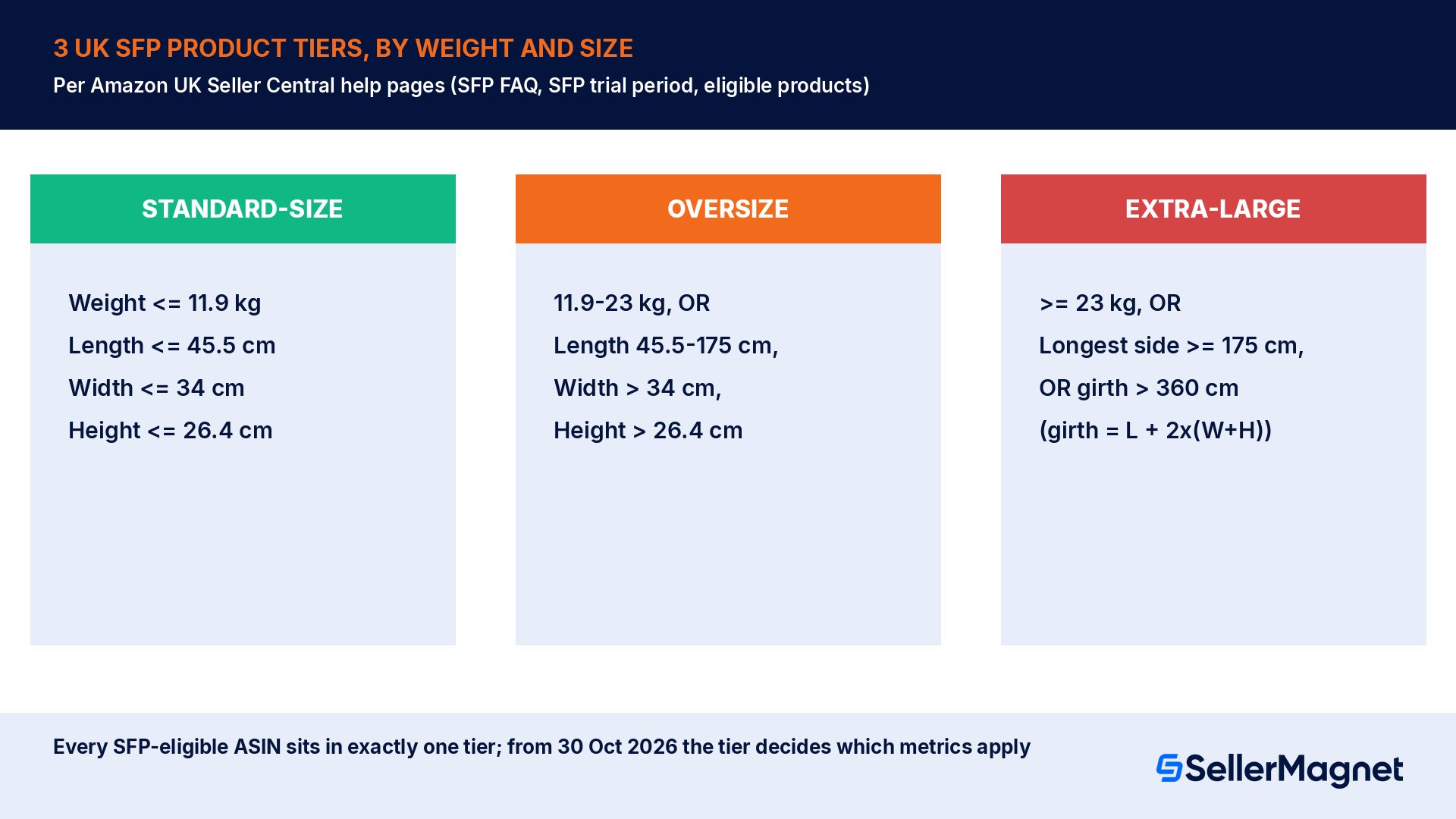
Amazon's UK Seller Central help pages publish the weight and dimension limits of the 3 tiers below (the SFP FAQ and the UK policy also name price as a factor, but the published table only lists weight and dimensions). Every seller shipping SFP orders needs to know which tier each ASIN falls into: the tier decides which requirements apply.
Tier
Weight
Dimensions
Standard-size
<= 11.9 kg
Length <= 45.5 cm, Width <= 34 cm, Height <= 26.4 cm
Oversize
> 11.9 kg and < 23 kg
Length > 45.5 cm and < 175 cm, Width > 34 cm, Height > 26.4 cm
Extra-large
>= 23 kg
Longest side >= 175 cm, or Girth > 360 cm (girth = length + 2 x (width + height))
UK store only
This change is published by Amazon's UK seller forum and UK Seller Central help pages, and applies to the UK store (sellercentral.amazon.co.uk). It does not automatically apply to other EU marketplaces; check each store's own SFP help pages before assuming the same tier rules there.
When does a tier get scored, and what happens in each phase?
For sellers in the SFP trial, Amazon's SFP FAQ (G202188870) and the trial period page (G202037700) list a minimum volume before evaluation starts: 25 packages for standard-size, 10 for oversize and 5 for extra-large, after at least 2 weeks in the trial. For sellers already enrolled, the UK maintain-enrolment policy says the requirements "are measured on a weekly basis, by product tier" and names no minimum. Amazon is also running the rollout in 2 explicit phases rather than switching everything on at once.
Phase
From
What happens
Phase 1
30 October 2026
SFP dashboard splits performance by tier; existing metrics (shipping method, on-time shipment, Buy Shipping/Easy Ship usage, cancellation rate) start being enforced per tier instead of blended; the 2 new metrics appear for monitoring only
Phase 2
6 January 2027
The notification-only period ends; 1-day delivery speed (standard-size) and non-Buy-Shipping on-time delivery (extra-large) now count toward eligibility; first warnings possible from 13 January 2027
What do Buy Shipping and Easy Ship mean for each tier?
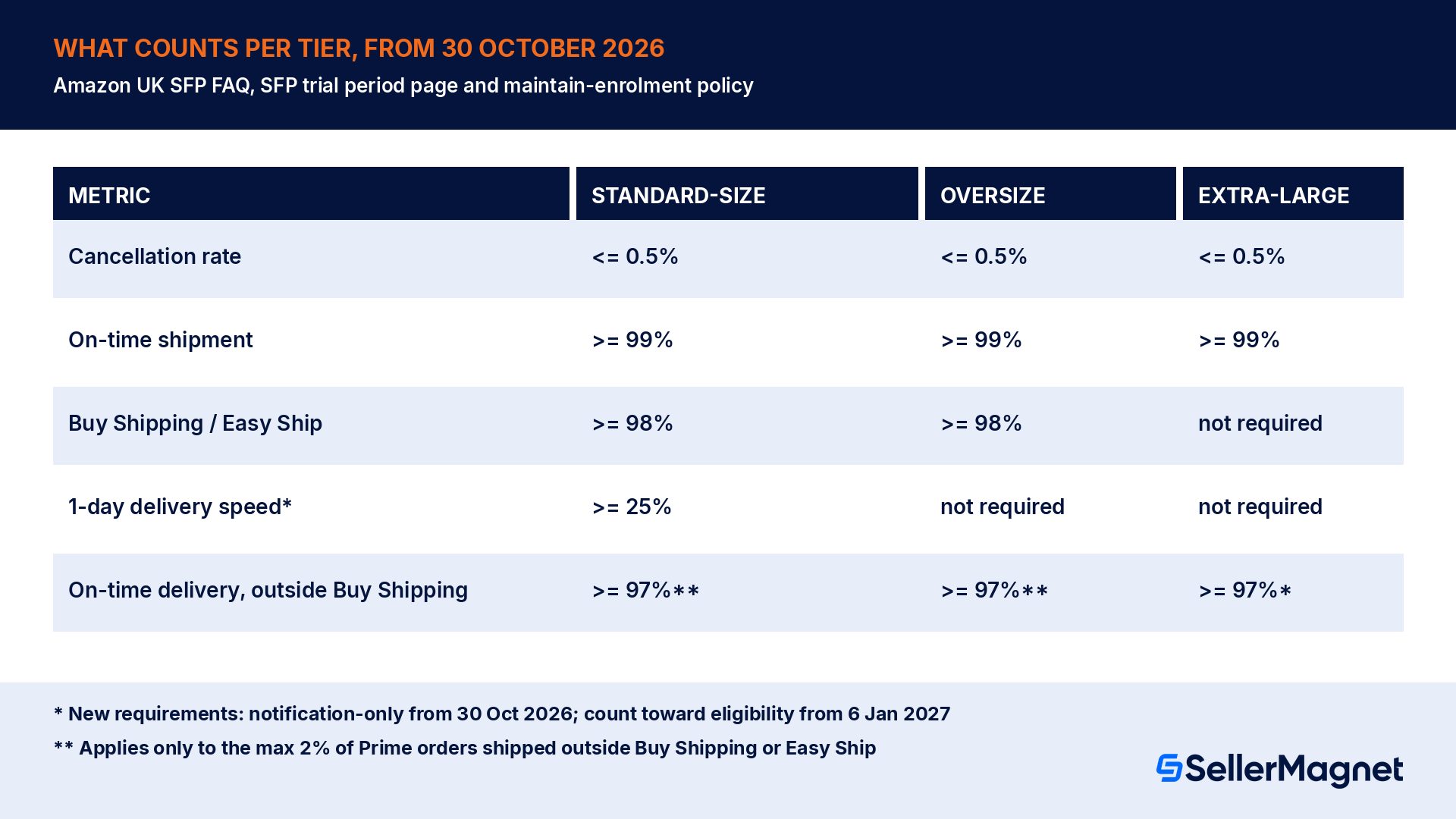
Amazon's UK maintain-enrolment policy gives standard-size and oversize 2 ways to fulfil Prime orders: buy labels for at least 98% of Prime orders from the supported Prime carriers (currently Royal Mail, DPD, Amazon Shipping and EVRi) through Buy Shipping services or the Merchant Fulfilment API, or use Easy Ship, where Amazon manages fulfilment on your behalf. The SFP FAQ adds that, in exceptional circumstances, a non-Prime-approved carrier may deliver no more than 2% of your total Prime orders. Extra-large does not carry the 98% requirement, and the FAQ states the reason itself: there is currently no Buy Shipping (MSS) integration for this tier in the UK, so all extra-large shipments are fulfilled outside it. Instead, Amazon accepts any logistics provider for which it receives a valid carrier tracking number, as long as those orders keep an on-time delivery rate of at least 97%.
Which requirements count toward your Prime badge in each tier?
Amazon's SFP FAQ, its help page on the SFP trial period (G202037700) and the UK maintain-enrolment policy lay out a different requirement bundle for each tier. Standard-size carries the most requirements of the 3 tiers. Oversize has no delivery-speed requirement. Extra-large has no Buy Shipping usage requirement; its orders shipped through any other carrier are held to the 97% on-time delivery rate instead. The trial period page and the policy list that 97% rate under all 3 tiers; for standard-size and oversize it only covers the small share of Prime orders shipped outside Buy Shipping or Easy Ship. All 3 tiers also keep the existing requirement to use a shipping method that supports weekend operations.
Metric
Standard-size
Oversize
Extra-large
Cancellation rate
<= 0.5%
<= 0.5%
<= 0.5%
On-time shipment rate
>= 99%
>= 99%
>= 99%
Buy Shipping / Easy Ship usage
>= 98%
>= 98%
not required
1-day delivery speed
>= 25% (grace until 6 Jan 2027)
not required
not required
On-time delivery, orders outside Buy Shipping
>= 97% (max 2% of orders)
>= 97% (max 2% of orders)
>= 97% (grace until 6 Jan 2027)
3 dates to keep apart
From 30 October 2026, the 4 existing requirements are measured and enforced per tier, so a weak tier shows on its own. The 2 new requirements, the 25% 1-day delivery speed for standard-size and the 97% on-time delivery rate for extra-large orders shipped outside Buy Shipping or Easy Ship, are notification-only until 6 January 2027: they appear on your dashboard and you may get notification emails, but they do not count toward eligibility yet. From 6 January 2027 they count, and Amazon's SFP FAQ adds: "If you're below any requirement, notifications become warnings. Your first warning can be issued no earlier than 13 January 2027."
Worked example: a seller across all 3 tiers
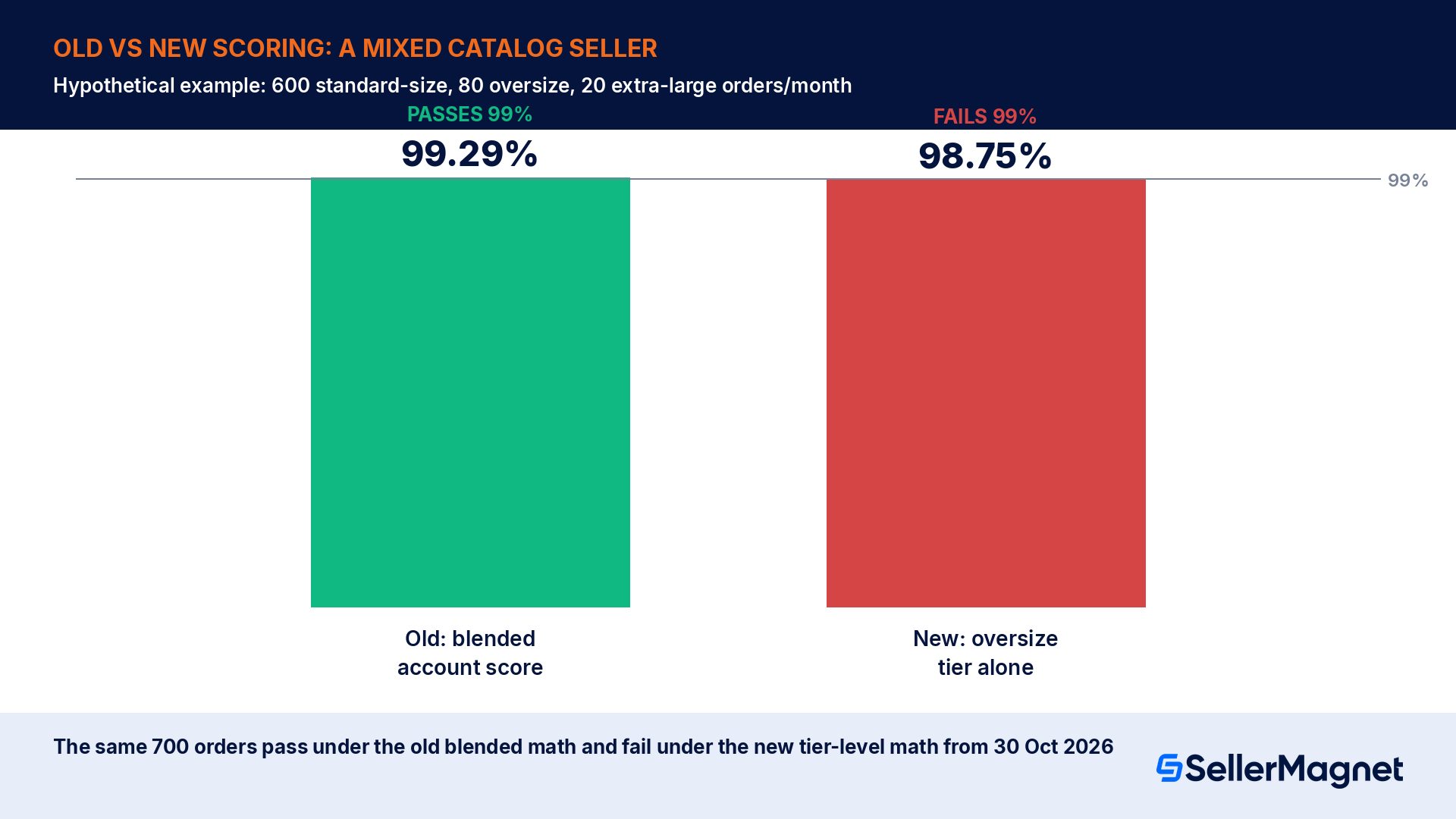
The figures below are a hypothetical example, not real seller data, built from the thresholds above to show how tier-level scoring plays out. A seller runs 600 standard-size SFP orders, 80 oversize and 20 extra-large in a typical month. On standard-size, 596 of 600 ship on time (99.33%, passes the 99% bar) and Buy Shipping covers 594 of 600 (99%, passes the 98% bar), but only 20% of its standard-size customer page views show a delivery date within one day, below the 25% bar that starts counting on 6 January 2027. On oversize, 79 of 80 ship on time (98.75%, fails the 99% bar) and Buy Shipping covers 79 of 80 (98.75%, passes). On extra-large, all 20 ship through a regional pallet carrier outside Buy Shipping, all 20 ship on time (100%, the on-time SHIPMENT metric, which has no grace period), but only 19 of 20 arrive on time with the carrier, 95% on-time DELIVERY, below the 97% bar that starts counting on 6 January 2027.
Under the old account-level math, this seller's blended on-time shipment rate across all 700 orders would be (596+79+20) / 700 = 99.29%, comfortably over 99% and invisible as a problem. Under the tier-level math that applies from 30 October, the oversize tier fails its 99% on-time shipment bar on its own, and 2 more requirements, standard-size 1-day delivery speed and the extra-large on-time delivery rate outside Buy Shipping, are already tracked and will start counting toward eligibility on 6 January 2027 unless this seller raises them before then. That is 3 separate items to fix, and none of them shows up in the blended 99.29%.
Turning the worked example into a fix plan
For the seller in the worked example, the order of operations matters. The oversize on-time shipment failure applies from 30 October and needs the fastest fix: check which carrier or warehouse process causes the 1 late oversize shipment in 80, since that is the metric with no grace period. The standard-size 1-day delivery share and the extra-large on-time delivery rate have real runway, 30 October to 6 January 2027, so the right move is to start tracking both on the SFP dashboard now and re-check them every week, not to treat them as urgent on day 1. A seller who fixes only the oversize issue and ignores the 2 tracked-but-not-yet-counted requirements until December is choosing to compress a 10-week improvement window into the final weeks before it counts.
Mistakes sellers make with the tier change
Assuming the 1-day and non-Buy-Shipping requirements already count. They only start affecting eligibility on 6 January 2027; treat the time until then as a free diagnostic window, not as a deadline to panic over.
Checking only the account-level SFP summary. From 30 October, the per-tier breakdown is the real picture; an account that looks healthy overall can still be failing one tier outright.
Not knowing which tier an ASIN sits in. A product near a boundary (11.9 kg, 45.5 cm) can tip into oversize with a small packaging change; check Amazon's own tier table for every SFP-eligible ASIN, not an estimate.
Using a non-Buy-Shipping carrier for extra-large without checking its on-time record. The 97% bar applies to the carrier's on-time delivery on your orders, so a carrier you have never audited for tracking reliability is a real eligibility risk from 6 January 2027.
Ignoring the UK scope. This announcement and its tier rules are UK-specific; do not assume another EU store runs the same thresholds without checking that store's own help pages.
Assuming a small tier is exempt. The 25/10/5 minimums are published for the trial; for enrolled sellers each tier is measured weekly, so check even a low-volume extra-large tier from 30 October.
Reading unchanged threshold numbers as unchanged requirements. The number does not change, but the denominator does: in a tier with only 25 orders, a single late shipment already means 96%, below the 99% on-time shipment bar.
Checklist to stay Prime-eligible under the new tiers
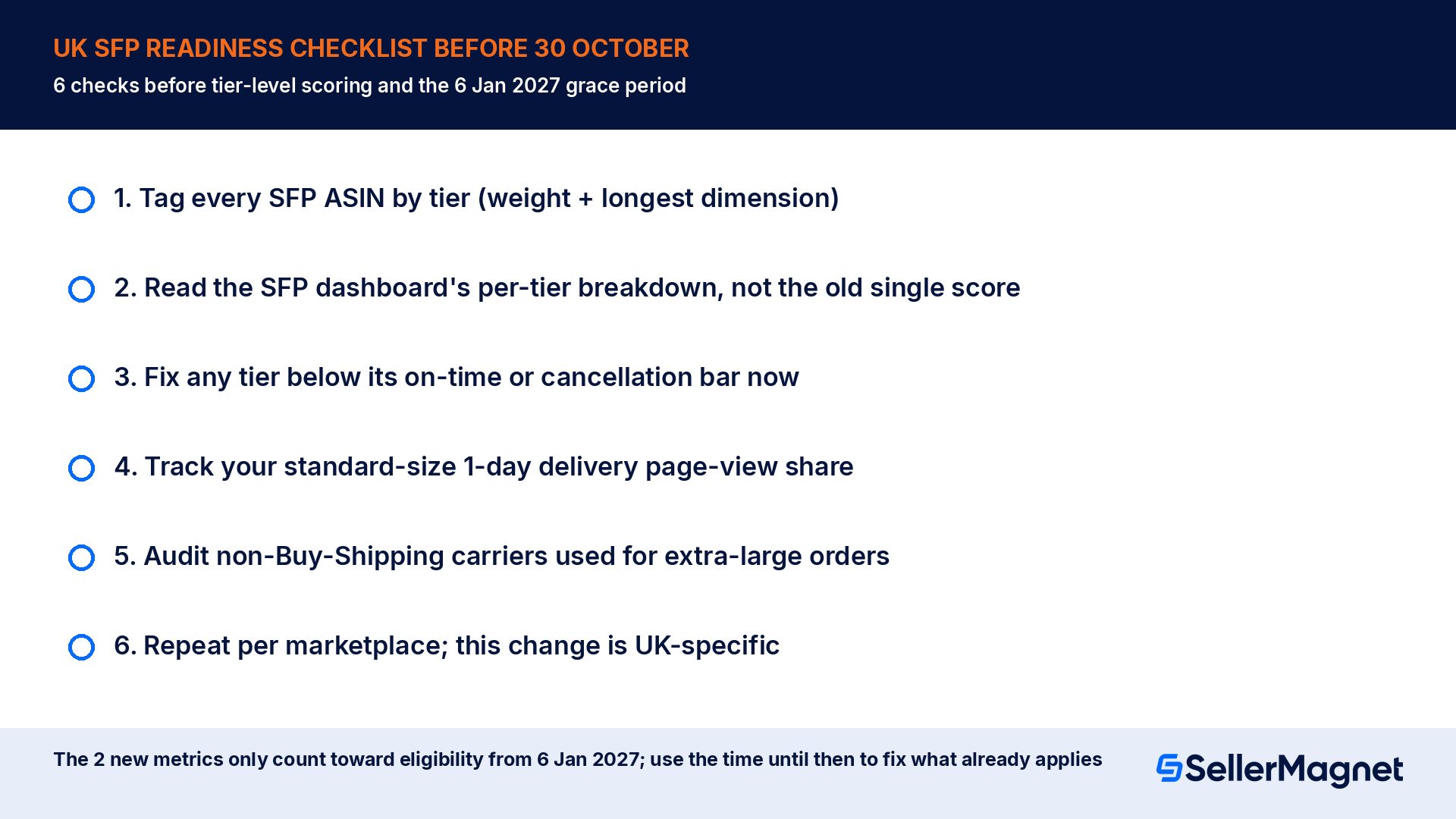
How to prepare for the UK SFP tier-level eligibility change
Tag every SFP ASIN by tier - Check Amazon's weight and dimension table for each SFP-eligible ASIN and record its tier now.
Pull your SFP dashboard's per-tier breakdown - From 30 October, read the dashboard split by tier rather than the old single account score.
Fix any tier below its on-time or cancellation bar now - On-time shipment and cancellation rate already apply per tier from 30 October; these are not in the grace period.
Check your standard-size 1-day delivery speed - Monitor it on the SFP dashboard now so you are at or above 25% well before it counts on 6 January 2027.
Audit non-Buy-Shipping carriers used for extra-large - Confirm their tracking numbers reach Amazon and their on-time delivery rate is at or above 97% before 6 January 2027.
Repeat per marketplace - If you also use SFP in other Amazon stores, check each store's own help pages; this change is UK-specific.
Where SellerMagnet fits next to the SFP dashboard
Amazon's own SFP dashboard is where you read the Prime requirements described above. SellerMagnet covers the profit and listing side next to it. The Analytics Dashboard shows net profit per order, product and marketplace after Amazon fees, COGS, shipping, VAT, refunds and your own expenses. Offer Watch checks your whole connected catalogue automatically for new sellers, Buy Box losses, undercuts and suppressed listings; its base check runs once a day, so treat it as a daily signal, not an instant alert.
Cancellation rate is one of the 4 existing requirements that Amazon measures separately from 30 October. If you want to see a stockout coming before it happens, SellerMagnet's inventory forecast shows days of stock left, expected stockout date and units to send, based on your real sales velocity (lookback 7 to 365 days). It is included from the Growth plan.
Does this change apply outside the UK?
No. Amazon's announcement and these tier rules are published specifically for the UK store (sellercentral.amazon.co.uk). Other EU stores have their own SFP help pages, which may or may not run the same thresholds; check each store directly rather than assuming.
What are the 3 SFP product tiers based on?
Amazon's published table uses weight and dimensions (the FAQ and UK policy also name price). Standard-size is at or under 11.9 kg and 45.5 x 34 x 26.4 cm; oversize sits above that and under 23 kg or 175 cm; extra-large is 23 kg or more, 175 cm or more on the longest side, or a girth over 360 cm.
When do the new 1-day and non-Buy-Shipping requirements actually start affecting my eligibility?
Not until 6 January 2027. From 30 October 2026 they are notification-only: they appear on your dashboard and may trigger notification emails, but do not count toward eligibility. From 6 January 2027, Amazon's SFP FAQ says being below any requirement turns notifications into warnings, with the first warning no earlier than 13 January 2027.
Can my account pass overall but fail one tier?
Yes, and that is the entire point of the change. From 30 October, each tier is scored on its own shipments, so a weak extra-large or oversize tier can fail its own requirements while your account as a whole looks healthy. Amazon's SFP FAQ also lists suspension as per tier: failing one tier does not remove the others.
Do I need to do anything on 30 October itself?
No single action is required that day; the measurement method changes automatically. The useful action is to check your per-tier breakdown on the SFP dashboard shortly after 30 October and fix anything already below bar on the existing requirements, since those are not covered by the grace period.
Is there a minimum package volume before a tier is scored?
Amazon's SFP FAQ (G202188870) and the trial period page (G202037700) list a minimum before evaluation starts during the trial: 25 packages for standard-size, 10 for oversize and 5 for extra-large, reached after at least 2 weeks in the trial. For sellers already enrolled, the UK maintain-enrolment policy measures the requirements weekly, by product tier, and names no minimum.
Is this the same as the general Seller Fulfilled Prime program requirements?
No. The general SFP registration requirements (UK mainland warehouse, professional plan, minimum shipping volume with an approved carrier) are unchanged and listed on Amazon's help page "Seller eligibility for Seller Fulfilled Prime" (G202188520); our general SFP guide covers the programme basics. This post covers only the 30 October 2026 change to how ongoing eligibility is measured, which is tier-level, not account-level.
Stop Juggling Tools. SellerMagnet Combines Everything You Need.