Amazon Lithium Battery Air Shipment Rule 2026: The 30% State-of-Charge Requirement
R
RenéFreelance Amazon Editor
|
15 min read
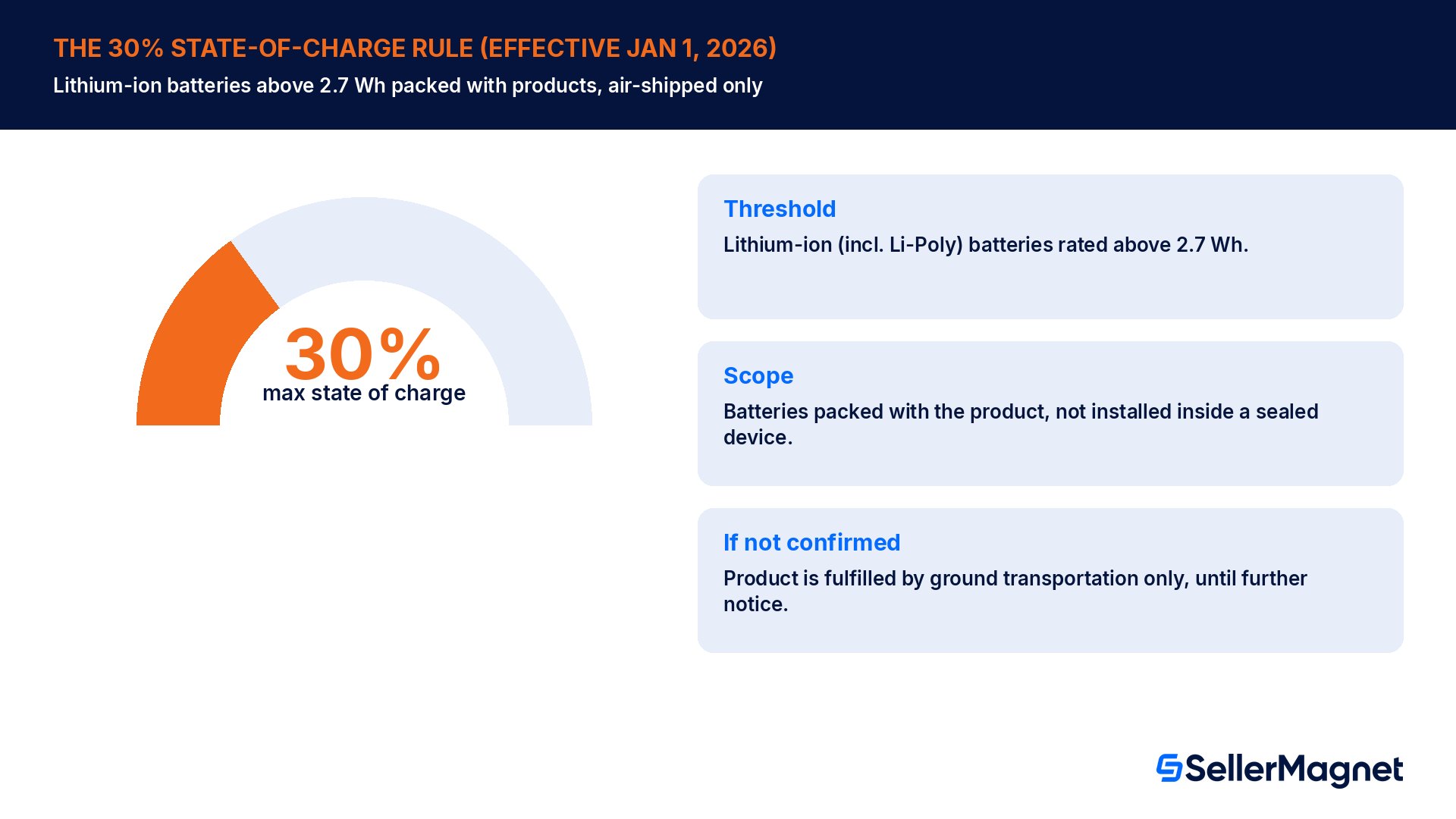
A product that has shipped by air without issue for years can lose that option overnight if nobody answers one new listing question correctly. Effective January 1, 2026, Amazon updated its requirements for products packaged with lithium-ion batteries to comply with International Civil Aviation Organization (ICAO) rules on air transportation safety. The headline number is simple: a lithium-ion battery rated above 2.7 Wh that ships packed with equipment must be at 30% state of charge or less, and if Amazon cannot confirm that, the product is fulfilled by ground transportation only, until further notice. This guide works through where that number comes from, the battery compliance questions every FBA listing with a battery now has to answer, the separate energy-content table that can block a battery from Amazon's network entirely regardless of charge state, and the practical steps to confirm a listing is actually compliant before it gets flagged.
Effective January 1, 2026, Amazon requires lithium-ion batteries rated above 2.7 watt-hours that ship packed with equipment to be at 30% state of charge or less, to comply with International Civil Aviation Organization air transportation safety rules. Sellers had to supply the requested battery compliance information by December 31, 2025. If Amazon cannot confirm a product meets this requirement, that product is fulfilled by ground transportation only until further notice. This sits alongside a separate, older rule that rejects lithium-ion cells and batteries outright above fixed watt-hour thresholds in many regions, and every FBA listing with a battery still has to answer the standard dangerous goods battery questions during listing or re-listing.
Where does the 30% number actually come from?
Amazon's forum announcement states the rule directly: "Specifically, lithium-ion batteries with a Watt-hour rating exceeding 2.7 Wh packed with products must have a 30% or less state of charge. If we're unable to confirm whether your product complies with the state of charge requirement, your product will only be fulfilled by ground transportation until further notice." The announcement frames this as an ICAO compliance update rather than an Amazon-specific policy choice: batteries carried on passenger and cargo aircraft are a known fire-risk category in international air transport regulation, and a lower charge state reduces the stored energy available to feed a thermal event if a cell is damaged in transit. The 2.7 Wh threshold is the dividing line. A battery at or below it is not covered by this specific state-of-charge requirement; a battery above it, packed with the product rather than installed inside it, is.
"Packed with" versus "installed in" matters here
The forum wording is specific to batteries packed with products. A battery installed inside a sealed device, where the device itself is the unit being shipped, is handled under the device's own dangerous-goods classification rather than this exact packed-with-product phrasing; a seller unsure which category their listing falls into should check the product's hazmat classification on the Look up an ASIN tool rather than assume.
Source: the forum announcement and Requirements for lithium batteries and products powered by lithium batteries. The help page does not publish a self-service way to prove a specific unit's exact charge percentage; it points sellers who need to confirm classification toward the compliance questions asked at listing, and toward contacting the manufacturer or supplier for the product's own documentation when the printed composition or rating is unclear.
The compliance deadline sellers already had to meet
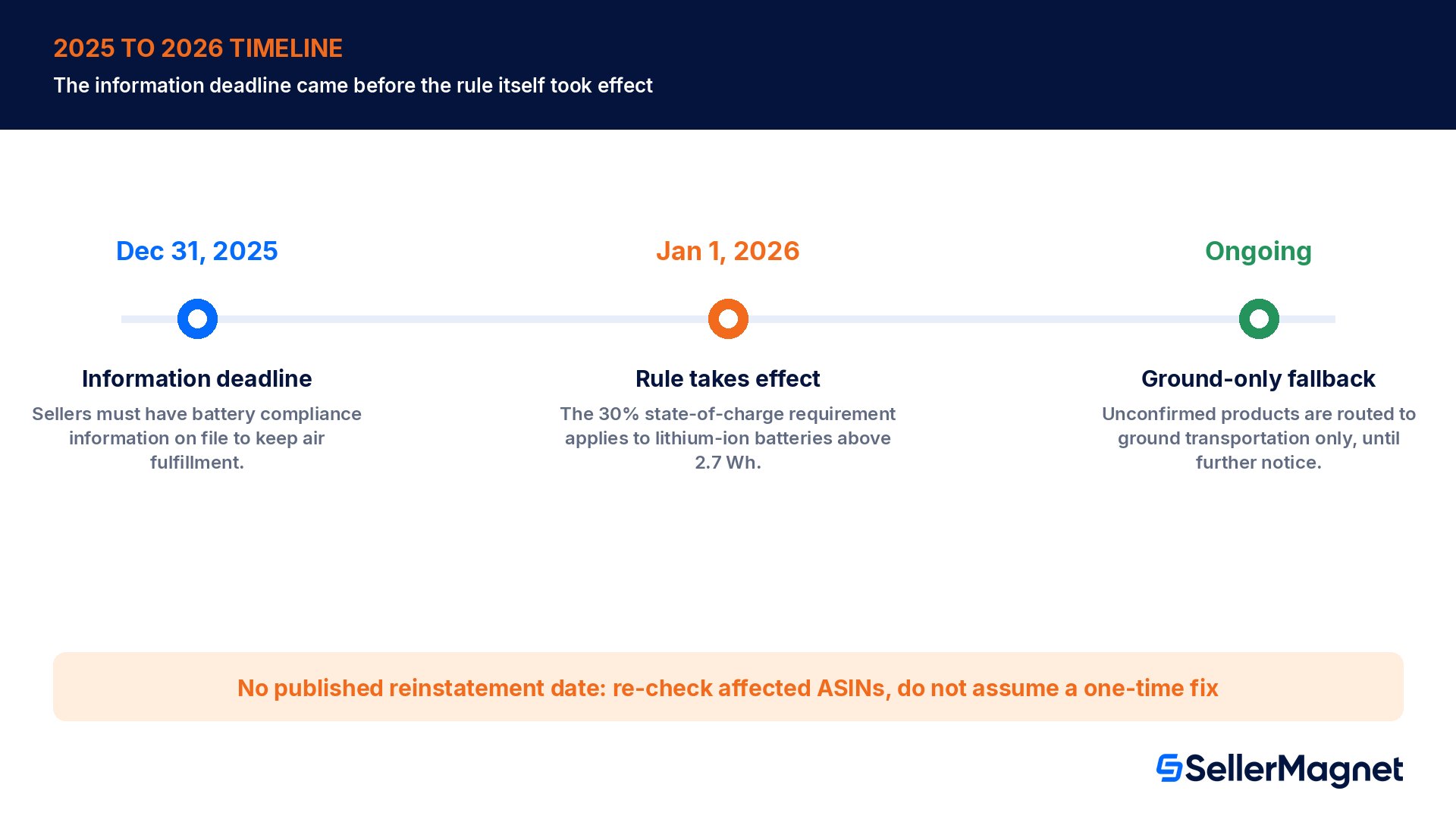
The forum post sets two dates, not one. "If you sell products that ship with a lithium-ion battery, you must provide the requested battery compliance information by December 31, 2025 to ensure your products can continue to be fulfilled by air." The information itself is collected through the standard battery compliance questions asked when a seller lists or re-lists a product for Fulfillment by Amazon; there is no separate standalone form outside that listing workflow. A seller who listed an affected product before this policy existed and has not touched that listing since does not get a free pass: Amazon's wording ties continued air fulfillment to the information being on file, not to when the listing was originally created.
January 1, 2026: the state-of-charge requirement itself takes effect for lithium-ion batteries above 2.7 Wh packed with products.
December 31, 2025: the deadline Amazon set for sellers to have battery compliance information on file to keep air fulfillment.
No fixed end date on the ground-only fallback: Amazon's own wording is "until further notice", not a temporary grace period with a known expiry.
What does "ground transportation only" actually cost a listing?
Amazon does not describe the ground-only fallback as a minor inconvenience; it is a routing change that can affect both delivery speed and network reach. Air legs are what let FBA inventory move quickly between distant fulfillment centers and reach customers in regions a ground network serves more slowly, including island and remote-territory addresses that depend on air for practical transit times at all. A product pushed to ground-only fulfillment can see slower cross-country replenishment between warehouses, longer delivery promises in regions where air was the only fast option, and reduced placement flexibility if Amazon's placement algorithm weighs air-eligible inventory differently when deciding which fulfillment centers to stock. None of Amazon's public pages publish an exact delivery-speed delta for ground-only lithium-ion inventory, so the practical way to judge the impact on a specific catalog is to compare delivery promises on an affected ASIN before and after the compliance information is confirmed on file, rather than to assume a fixed number of extra days.
"Until further notice" means check again, not check once
Because Amazon has not published a reinstatement date for products already pushed to ground-only fulfillment, confirming compliance information once and never checking again is a real risk. Re-verify affected ASINs through the Look up an ASIN tool periodically, especially after any change to the listing's battery attributes, rather than treating a single successful submission as permanent.
The compliance questions behind the number
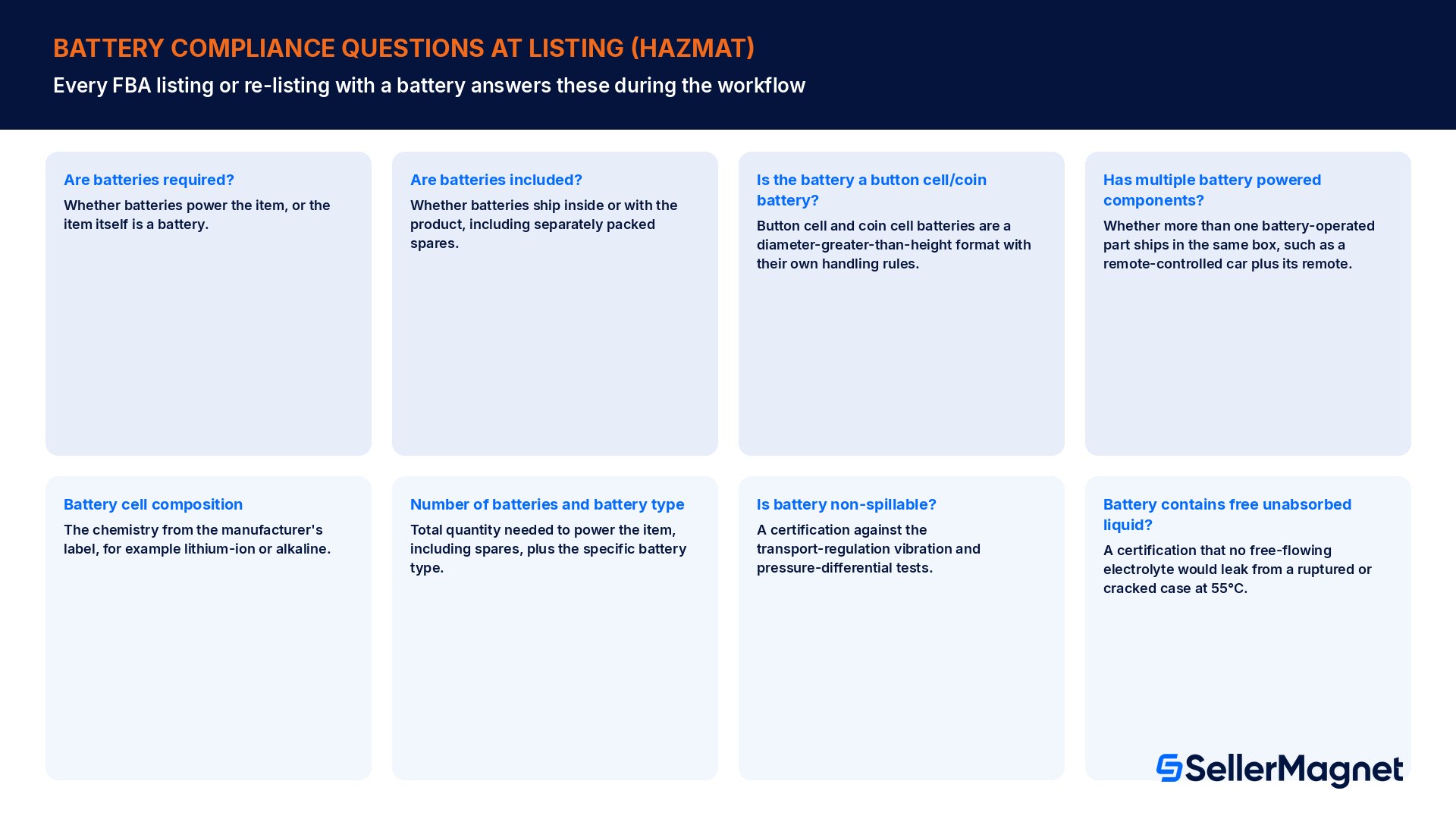
The state-of-charge figure sits on top of the standard dangerous goods (hazmat) battery questions every FBA listing with a battery has to answer, whether or not the 2.7 Wh threshold applies to it. Amazon's hazmat help page is explicit about the stakes: "You must provide all battery-related information for your product when creating a listing or converting a listing to FBA. If the battery information that you provide is incomplete, inaccurate, or otherwise conflicting, your product may be blocked for sale through FBA." That blocking risk is independent of the state-of-charge rule; a listing can be blocked purely for incomplete battery attributes even on a battery well under 2.7 Wh.
Question
What it asks
Are batteries required?
Whether batteries power the item, or the item itself is a battery.
Are batteries included?
Whether batteries ship inside or with the product, including separately packed spares.
Is the battery a button cell/coin battery?
Button cell and coin cell batteries are a diameter-greater-than-height format with their own handling rules.
Has multiple battery powered components?
Whether more than one battery-operated part ships in the same box, such as a remote-controlled car plus its remote.
Battery cell composition
The chemistry from the manufacturer's label, for example lithium-ion or alkaline.
Number of batteries and battery type
Total quantity needed to power the item, including spares, plus the specific battery type.
Is battery non-spillable?
A certification against the transport-regulation vibration and pressure-differential tests.
Battery contains free unabsorbed liquid?
A certification that no free-flowing electrolyte would leak from a ruptured or cracked case at 55°C.
Battery weight and unit
The net weight of the standalone batteries only, not the device or packaging.
Lithium battery packaging
Whether the battery ships installed, packed with the equipment, or packed separately from it.
Source: Dangerous goods required information and documentation (hazmat). Two fields are the ones sellers most often get wrong according to the help page's own clarifications. First, lithium content should come from the manufacturer whenever available; when it is not, an equivalent figure can be calculated from the amp-hour (Ah) rating per cell rather than left blank or guessed. Second, "batteries included" covers more than an obvious case like a device with a built-in battery: it also applies when batteries are packed separately with the equipment, such as remote-control batteries bundled in the same box as the device they operate.
A missing battery attribute is a free fix, unlike a failed lab test. SellerMagnet's Listing Optimizer checks a connected catalog's listing data for gaps like these before Amazon's own compliance review does, so a blank battery-weight field or an unanswered button-cell question gets caught during a routine review instead of surfacing as a blocked listing. The Dangerous Goods Compliance Questions 2026 guide walks through the full hazmat workflow beyond batteries, including aerosols and other dangerous-goods categories.
The separate rule that can reject a battery outright
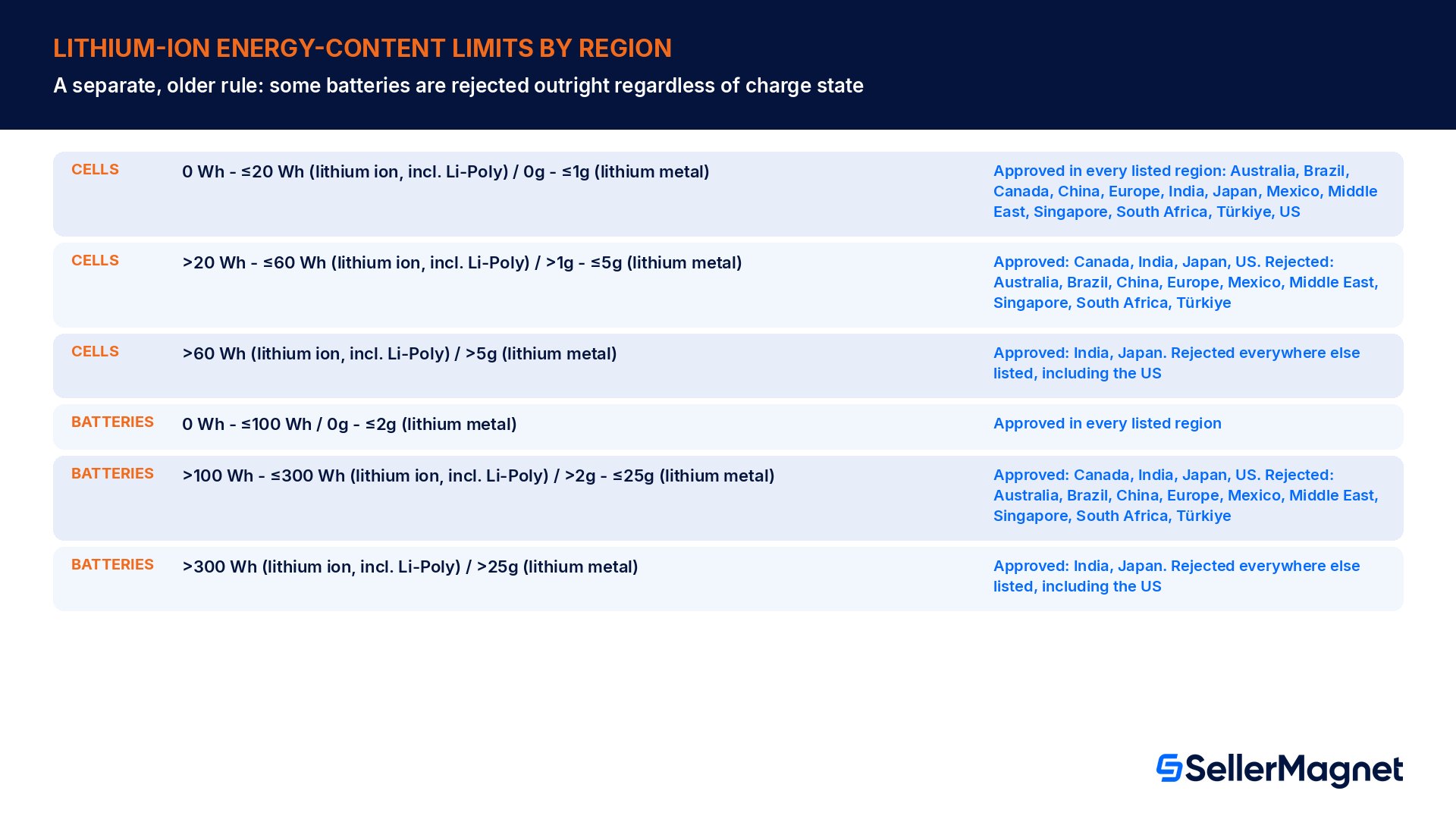
State of charge is not the only lithium-ion limit sellers have to plan around. A longer-standing Amazon table sets hard energy-content ceilings by region, independent of charge state, shipping mode, or anything else: some batteries are simply not approved for sale on certain stores at all, regardless of how they are packed or shipped. For single cells, including single-cell batteries:
Approved: India, Japan. Rejected everywhere else listed, including the US
Source: Requirements for lithium batteries and products powered by lithium batteries. Watt-hour rating is normally printed on the battery, its packaging, or in manufacturer documentation; when it is not, it can be calculated from the battery's voltage (V) and amp-hour (Ah) rating, both of which are also commonly printed in the same places. A seller sourcing a new SKU with an unusually large built-in battery, a power bank or an e-bike battery pack, for example, should check this table before listing rather than after a rejection, since a battery above the relevant threshold is rejected in the destination region regardless of how well the state-of-charge and hazmat paperwork is otherwise completed.
Which products does this actually touch?
Amazon's lithium page notes that products rarely carry an obvious sticker or symbol announcing a lithium battery inside. The two reliable ways to confirm it are reading the battery's own printed composition, when the battery itself is accessible or documented, or checking manufacturer documentation such as the product manual, with the supplier as a fallback source when neither is available. The same page distinguishes three lithium chemistries sellers should not treat interchangeably: lithium-ion batteries (rechargeable, used in phones, laptops, tablets, cameras), lithium metal batteries (generally non-rechargeable, used in watches, calculators, flashlights), and lithium-ion polymer batteries, a rechargeable variant that falls under the broader lithium-ion family for policy purposes. Only lithium-ion chemistries, including lithium-ion polymer, are named in the state-of-charge rule; a primary lithium metal cell is governed by the separate weight-based thresholds in the table above instead.
A practical pre-listing checklist
Confirm the battery chemistry from the manufacturer's label or documentation before assuming which rule applies: lithium-ion/Li-Poly for the state-of-charge rule, or the separate weight-based table for lithium metal.
If the battery ships packed with the product and is rated above 2.7 Wh, confirm with the manufacturer or supplier that units ship at 30% state of charge or less.
Answer every battery compliance question at listing or re-listing: required, included, button cell, multiple components, composition, quantity, weight, non-spillable, free liquid.
Calculate watt-hours from voltage and amp-hour rating when it is not printed directly, and check the result against the region approval table before listing in a new store.
Upload a battery exemption sheet through Manage dangerous goods classification when the product qualifies for one, instead of leaving the hazmat fields incomplete.
Use the Look up an ASIN tool to check an existing FBA ASIN's current classification status rather than assuming a listing created before this policy is still fully compliant.
Re-check affected ASINs periodically, since Amazon has not published a reinstatement date for products already moved to ground-only fulfillment.
Where this fits with Amazon's other battery and hazmat programs
This state-of-charge rule is narrower than it might first appear: it governs how a battery is shipped by air, not whether a product category needs third-party testing at all. Amazon's separate TIC (testing, inspection, certification) requirement for lithium battery powered smart home devices and consumer electronics is a different program with its own scope, standards and Account Health Dashboard notification schedule; a seller can clear one of these programs and still need to satisfy the other, since they check different things. The Amazon Lithium Battery TIC Compliance 2026 guide covers that program in full, and the FBA Prep and Labeling Requirements 2026 guide covers the separate labeling rules that interact with both.
A ground-only reroute shows up as a delivery-speed change before it shows up as a support ticket. SellerMagnet's Alerts lets a seller track Account Health notifications and listing status changes on battery-containing ASINs in one feed, so a routing change surfaces the same week it happens rather than only once a buyer complains about a slower delivery promise. The Account Health Rating 2026 guide covers how a flagged ASIN can affect the account-level score beyond this one listing.
What mistakes do sellers make with this rule?
Assuming the state-of-charge rule applies to every battery, when it specifically names lithium-ion batteries above 2.7 Wh packed with products, not every battery chemistry or every energy level.
Confusing this rule with the separate lithium battery TIC program for smart home devices; the two check different things and a pass on one does not cover the other.
Leaving the manufacturer's charge-state documentation unconfirmed and assuming Amazon will not notice, when the fallback is a ground-only routing change rather than a warning.
Treating a successful compliance submission as permanent, when Amazon has not published a reinstatement timeline for products already on ground-only fulfillment.
Skipping the hazmat battery questions on a low-threshold battery on the assumption that only large batteries need them; incomplete battery information can block any listing regardless of size.
Guessing a watt-hour rating instead of calculating it from voltage and amp-hour when it is not printed, which risks misjudging the region approval table for the wrong tier.
Not re-checking an older listing created before this policy existed, when continued air fulfillment is tied to the information being on file now, not to the listing's original creation date.
International stores and the air-network angle
The forum announcement is addressed to the US store, but the underlying driver, ICAO air transportation safety rules, is not a US-only regulatory framework; it governs how dangerous goods move on aircraft across international aviation routes in general. A seller running the same ASIN across multiple Amazon stores should not assume a state-of-charge submission accepted on one store automatically carries over to another, since each store's help documentation and Account Health systems are separately maintained even when the underlying ICAO requirement is shared. The safer approach for a multi-marketplace catalog is to treat each store's battery compliance questions as its own submission, confirm the information independently in each one, and keep a single internal record, such as a tracking sheet with a per-store status column, so a renewal or product change in one marketplace does not quietly leave another one unconfirmed.
The air-network angle also matters for sellers using Amazon's cross-border inventory placement services, where a single SKU's stock can be redistributed between fulfillment centers in different regions as part of normal replenishment. A product moved to ground-only fulfillment can lose access to the fastest of those redistribution paths, which in turn can show up as slower restocking in a region far from where the inventory currently sits, even if the seller never explicitly chose to ship that unit internationally themselves. That knock-on effect is one more reason the practical test for "is this actually affecting me" is comparing delivery promises and restock timing on the specific ASIN, not just checking whether Account Health shows an open notification.
When did Amazon's lithium-ion battery air shipment rule take effect?
January 1, 2026, for products shipped by air. Amazon set December 31, 2025 as the deadline for sellers to provide the requested battery compliance information through the standard listing workflow, specifically to keep affected lithium-ion battery products eligible for continued air fulfillment going into the new year.
Which batteries does the 30% state-of-charge rule cover?
Lithium-ion batteries, including the lithium-ion polymer variant, rated above 2.7 watt-hours that ship packed with the product rather than installed permanently inside a sealed device. Batteries at or below that 2.7 Wh threshold, and batteries installed rather than packed with the product, are not covered by this specific state-of-charge rule.
What happens if Amazon cannot confirm compliance?
The affected product is fulfilled by ground transportation only, until further notice, instead of by air. Amazon has not published a fixed reinstatement date or automatic review cycle for this status, so periodically re-checking the listing and its compliance information is the only reliable way to know whether anything has changed.
Is this the same as Amazon's lithium battery TIC testing requirement?
No, they are two separate programs. The TIC program requires third-party testing for specific smart home device and consumer electronics categories regardless of how they ship. This state-of-charge rule instead governs how any qualifying lithium-ion battery is shipped by air, and a product can need to satisfy either program, both, or neither, depending on its category and battery.
Can a battery be rejected even if the charge state is fine?
Yes. A separate, older energy-content table rejects lithium-ion cells and multi-cell batteries outright above fixed watt-hour thresholds in a number of regions, including above 60 Wh for a single cell in several stores, and this rejection applies regardless of charge state, packaging, or how carefully the hazmat questions were answered.
Does this rule apply to batteries installed inside a sealed device?
The forum wording specifically names batteries packed with products, not batteries installed inside them. A battery built into a sealed device is instead handled under that finished device's own dangerous-goods classification, so checking the product's existing classification on the Look up an ASIN tool is the safer first step before assuming either rule applies.
Stop Juggling Tools. SellerMagnet Combines Everything You Need.