FBA Certified Dimensions 2026: UK, France, Italy, Spain Fee Change
R
RenéFreelance Amazon Editor
|
12 min read
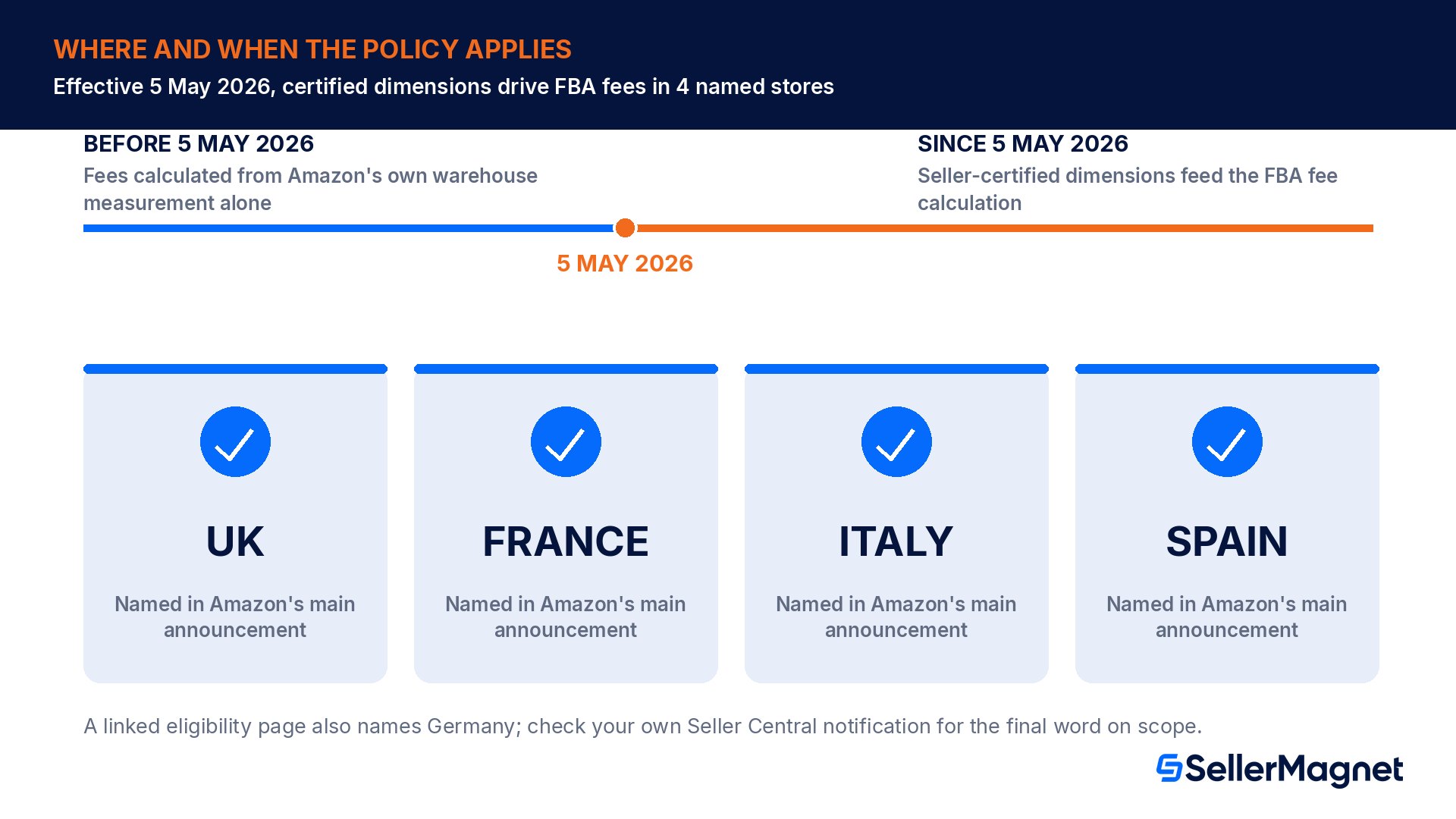
Since 5 May 2026, Amazon has calculated Fulfilment by Amazon (FBA) fulfilment fees for products listed on the UK, France, Italy and Spain stores using certified dimensions instead of Amazon's own warehouse measurement alone. The change is documented across several Seller Central help pages (reference GQHQGBTD7XB7EECN and the linked FBA item parcel dimensions certification policy), and it shifts part of the fee calculation onto the dimensions you yourself verify or submit, measured with a device that meets the EU Measuring Instruments Directive, such as a tape measure. If you have not verified your item parcel dimensions in these four stores since the policy went live, Amazon has already defaulted your existing dimensions to "certified" on your behalf, which means an unmeasured box could be quietly over- or under-charging you every month without a single alert in your account. This guide lays out exactly what changed, which stores and listings it covers, how the verification and appeal process works, and how to check whether your own catalogue is affected.
Since 5 May 2026, Amazon has used certified item parcel dimensions, measured by eligible sellers themselves, to calculate FBA fulfilment fees for active and new listings on the UK, France, Italy and Spain stores. Sellers get at least 60 days to verify existing dimensions; unverified listings default to the dimensions already on file. Amazon validates submissions in about 30 days and reimburses automatically when a correction lowers fees.
What exactly changed, in Amazon's own words
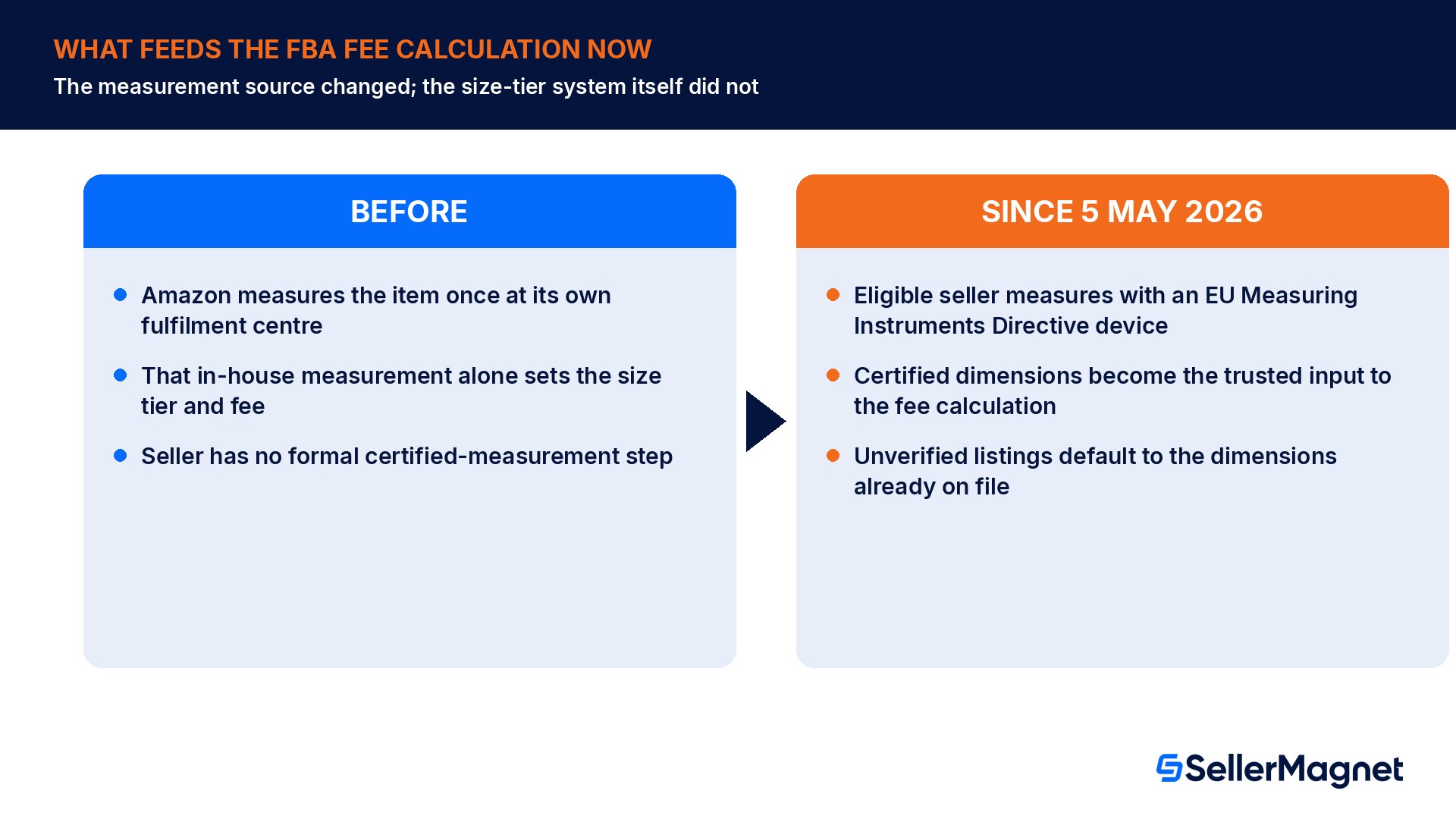
Amazon's Seller Central help page on changes to programme policies states it directly: "Starting on 5 May 2026, we'll update the way we collect Fulfilment by Amazon (FBA) item parcel dimensions for products listed on the UK, France, Italy and Spain stores. With this change, we'll use the certified dimensions that eligible sellers provide to calculate FBA fees for items with an active or new FBA listing in our UK, France, Italy and Spain stores." The linked FBA item parcel dimensions certification policy adds the technical definition: dimensions are "certified" when they are taken with a device that complies with the EU Measuring Instruments Directive, the same regulation that governs commercial tape measures and scales sold in the EU. In practice, this moves part of the fee-calculation input from a measurement Amazon takes once at its own fulfilment centre to a measurement the seller is responsible for providing and keeping accurate.
Who this affects: stores, listing status and item type
Three conditions decide whether a given listing is in scope. First, the store: Amazon's core announcement names the UK, France, Italy and Spain stores; a separate linked policy page additionally lists Germany among "eligible sellers," so Amazon's own pages are not perfectly consistent on this point, and the company states it will "notify you in advance once the policy applies in additional European stores" -- treat your own in-account notification as the deciding signal for any store beyond the four named everywhere. Second, listing status: the policy applies to all active FBA listings and to any new FBA listing you create in a covered store; it is not limited to a particular size tier or category. Third, item type: parcel and envelope items are explicitly excluded from the verification process for now, per Amazon's own wording, which means the policy currently targets standard carton-packed inventory rather than Amazon's smallest, flattest formats.
Amazon's own pages don't fully agree on the store list
The main changes-to-policies announcement names the UK, France, Italy and Spain. A linked eligibility page also mentions Germany. Rather than guess, check your own Seller Central account: if a listing is in scope, you'll see a 'Verify dimensions' link in FBA Inventory and/or a notification email, regardless of what a help page says generically.
Certification policy at a glance
The table below summarises the policy's key mechanics as published across Amazon's own Seller Central help pages.
Item
Rule
Effective date
5 May 2026
Stores named in the main announcement
UK, France, Italy, Spain (one linked eligibility page also names Germany)
What is measured
Item parcel dimensions as packaged: length, width, height in centimetres
Measuring device
Must comply with the EU Measuring Instruments Directive (e.g. a tape measure)
Verification window
At least 60 days from Amazon's notification, for flagged existing listings
New listings
Certified dimensions required from the start, no separate grace period
If you never verify
Existing on-file dimensions are assumed certified by default
Validation time after submission
About 30 days (longer in November/December)
Disagreement process
Remeasure FBA products and confirm fees widget, subject to monthly limits
Reimbursement if fees drop
Automatic, last 90 days, on amazon.co.uk/.fr/.it/.es
Items currently excluded
Parcel and envelope items
How certification actually works: notification, verification, deadline
If a listing is eligible, Amazon sends an email asking you to verify whether its existing item parcel dimensions are certified or, if not, to provide updated certified ones. You get at least 60 days from that notice to act. Inside Seller Central, go to the Inventory menu and open FBA Inventory; listings that need attention show a "Verify dimensions" link in the Estimated fee per unit sold column (you can also filter by "Certify dimensions for FBA fees" in the FBA fees drop-down). For a single item, click Verify dimensions, review the pop-up panel, and either confirm the dimensions are certified or choose Update dimensions and enter new ones measured length (longest side), then width (second-longest), then height (shortest), in centimetres. For many items at once, use the Bulk verify link at the bottom of that panel: download the item parcel dimensions spreadsheet, fill in the Seller Item Parcel Length/Width/Height columns (leave a row blank to keep the existing figure as certified), mark the confirmation column, and upload it via Submit for verification.
Doing nothing is itself a decision
Amazon's own wording: "If you don't verify that your current item parcel dimensions have been certified by the deadline or provide updated certified dimensions, we will assume that your existing dimensions are certified dimensions." An inaccurate but unverified box dimension becomes the new official number Amazon's fee calculation trusts, with no warning and no pause on the listing.
After you submit: validation, status labels and disagreements
Once you submit certified dimensions, Amazon validates them against the item as currently stored in its fulfilment centres, typically within about 30 days (longer during the November/December peak). The Estimated fee per unit sold column then updates away from "Dimensions in review" to one of three outcomes: Dimensions verified (your certified dimensions match and fees are unchanged), FBA fees increased, or FBA fees decreased. If Amazon's own measurement disagrees with what you submitted, it uses its own certified figure instead, and if you disagree with that outcome, you can file a remeasurement request at any time through the Remeasure FBA products and confirm fees widget (searchable in Seller Central by typing "remeasure"), subject to published monthly limits. When a remeasurement lowers your fees, the difference for the prior 90 days is reimbursed automatically for sales on amazon.co.uk, amazon.fr, amazon.it and amazon.es; other stores go through the general FBA fees reimbursement policy for weight and dimensions instead.
Worked example: a 1 cm rounding gap moves a listing up a fee band
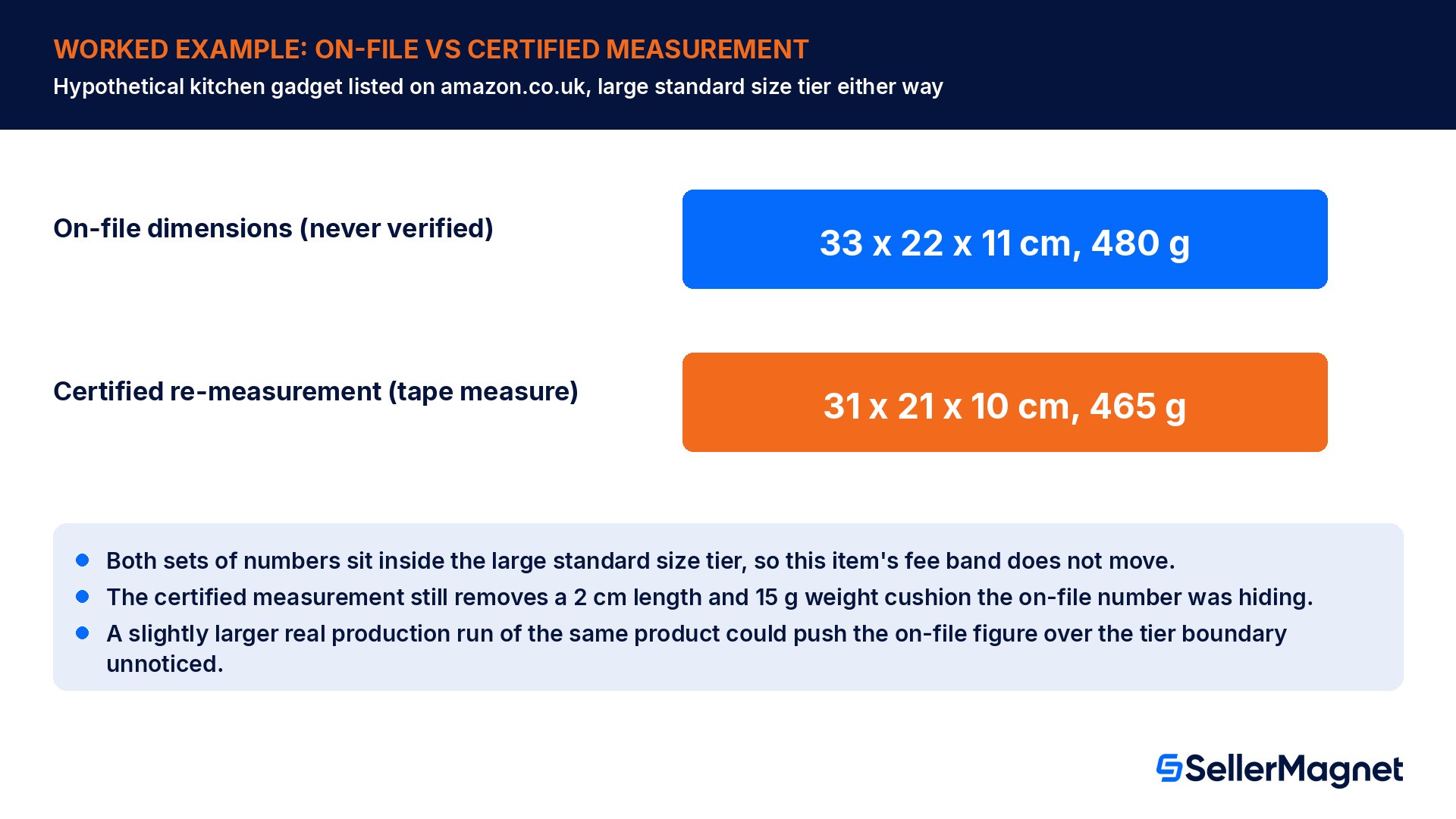
The figures below are a hypothetical example built to show the mechanics, not a real seller's data. A seller lists a kitchen gadget on amazon.co.uk with on-file dimensions of 33 cm x 22 cm x 11 cm, packaged weight 480 g, which Amazon's published size-tier bands place in the large standard size tier (over 30 cm on the longest side). The seller never received or acted on a verify-dimensions notification, so under the policy's own default rule those on-file numbers are now the certified dimensions driving the fee. The seller re-measures the item with a certified tape measure and gets 31 cm x 21 cm x 10 cm, packaged weight 465 g: still inside large standard, but materially smaller on every side.
Because the two sets of numbers sit in the same size tier here, submitting the corrected, smaller dimensions does not change this particular item's fee band, but it removes a 2 cm length cushion and a 15 g weight cushion that a slightly larger real production run of the same product could otherwise push over the large standard threshold into the next tier up at Amazon's next size check. The seller who never verifies carries that risk forward silently; the seller who certifies the real measurement at least knows exactly how close the item sits to the next fee band, and has Amazon's own dimension on file as evidence if a future remeasurement run moves the item to a higher tier incorrectly.
Mistakes sellers make with this change
Assuming no notification means no exposure. Amazon states it will notify eligible sellers by email, but a missed or filtered email leaves the deadline running unnoticed; checking the FBA Inventory 'Verify dimensions' column directly is the more reliable signal.
Treating the default as harmless. 'We will assume your existing dimensions are certified' is not a pause button; it locks in whatever number is on file, accurate or not, as the input to your ongoing fee calculation.
Measuring with an ordinary ruler or a phone app instead of a certified device. The policy specifically requires a device compliant with the EU Measuring Instruments Directive, such as a tape measure; an uncertified tool can get disputed at validation.
Measuring the bare product instead of the item as it is packaged and stored. Amazon's own instructions are to measure the item as it will be stored in the fulfilment centre, which includes its retail or protective packaging, not the unboxed product.
Assuming the policy covers every item type. Parcel and envelope items are excluded from this verification process for now, so don't spend time certifying dimensions Amazon is not currently asking for on those formats.
Filing a remeasurement request without checking the monthly limit. Remeasurement requests are subject to published monthly caps, so batching your highest-impact SKUs first gets more value out of a limited number of requests.
Letting the deadline run out for high-volume SKUs first. Prioritise verification by sales velocity: an unverified box dimension on a slow mover costs little, the same gap on a top seller compounds every month.
Checklist before the next fee cycle in these stores
How to verify your FBA item parcel dimensions in the UK, France, Italy and Spain stores
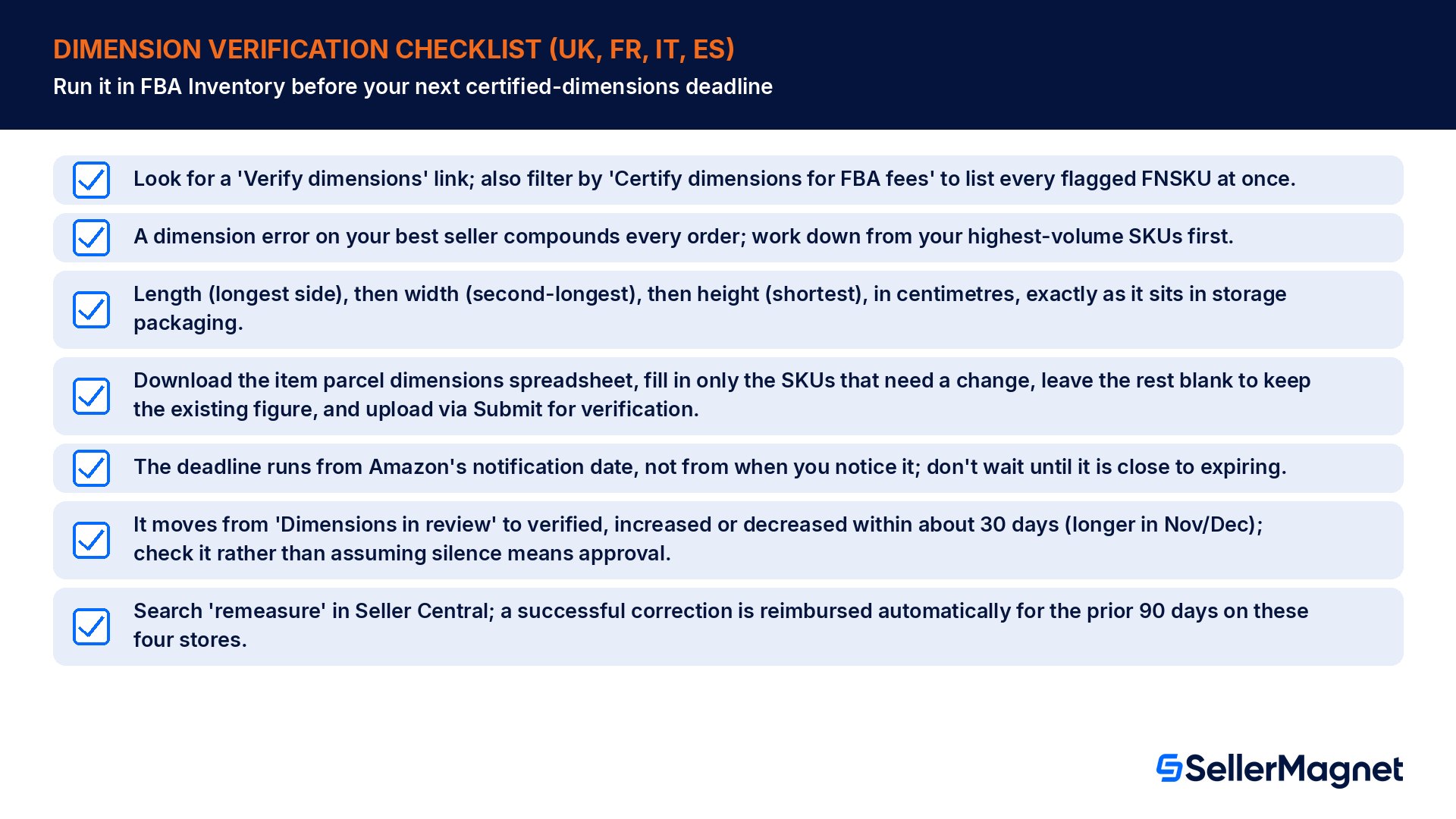
Open FBA Inventory and sort by the Estimated fee per unit sold column - Look for a 'Verify dimensions' link; also filter by 'Certify dimensions for FBA fees' to list every flagged FNSKU at once.
Prioritise by sales velocity, not alphabetically - A dimension error on your best seller compounds every order; work down from your highest-volume SKUs first.
Measure each item as packaged, with a certified device - Length (longest side), then width (second-longest), then height (shortest), in centimetres, exactly as it sits in storage packaging.
Use bulk verify for large catalogues - Download the item parcel dimensions spreadsheet, fill in only the SKUs that need a change, leave the rest blank to keep the existing figure, and upload via Submit for verification.
Track your 60-day window per SKU - The deadline runs from Amazon's notification date, not from when you notice it; don't wait until it is close to expiring.
Watch the status column after submitting - It moves from 'Dimensions in review' to verified, increased or decreased within about 30 days (longer in Nov/Dec); check it rather than assuming silence means approval.
Use the Remeasure widget if you disagree with the outcome - Search 'remeasure' in Seller Central; a successful correction is reimbursed automatically for the prior 90 days on these four stores.
Where SellerMagnet fits next to a certification pass
SellerMagnet's Fee Calculator compares FBA and FBM fees, referral fee, profit and ROI for any ASIN against Amazon's own public fee schedule, with 5 free lookups a day and no signup; running an ASIN through it before and after you update a dimension is a quick way to see whether a certification change actually moves the fee band before you submit it in Seller Central.
A dimension that Amazon's validation disputes, or a remeasurement that changes a fee retroactively, both show up as entries that are easy to lose track of across dozens or hundreds of SKUs. SellerMagnet's Fee Audit checks flagged fees against Amazon's own published rates and only marks a row claimable when it can verify the overcharge, so a certified-dimensions correction that should have lowered your fees but didn't is something you can actually catch and act on, rather than one more line buried in a monthly Amazon statement. SellerMagnet's Analytics Dashboard then shows that corrected fee against the rest of your margin by product, order and marketplace, so a certification-driven fee swing is visible, not just assumed fixed.
Does this policy apply to my store?
The main announcement names the UK, France, Italy and Spain stores; a separate linked eligibility page also mentions Germany, so the pages are not fully consistent. The decisive signal is your own Seller Central account: a 'Verify dimensions' link in FBA Inventory means a specific listing is in scope, regardless of what a general help page states.
What happens if I never verify a flagged listing?
Amazon's own wording is explicit: if you don't verify or update by the deadline, it assumes your existing on-file dimensions are the certified dimensions and keeps using them to calculate fees. The listing is not paused and nothing is blocked; the existing number simply becomes the number of record.
What counts as a 'certified' measurement?
A measurement taken with a device that complies with the EU Measuring Instruments Directive, such as a tape measure, measured on the item as it is packaged and stored in the fulfilment centre, recorded as length (longest side), width (second-longest) and height (shortest) in centimetres.
How long do I have to verify or update my dimensions?
At least 60 days from Amazon's notification for existing listings that are flagged. New FBA listings in these stores need certified dimensions submitted from the start, with no separate grace period.
What if I disagree with Amazon's validated dimensions?
Submit a remeasurement request at any time through the Remeasure FBA products and confirm fees widget (search 'remeasure' in Seller Central), subject to published monthly limits. If the correction lowers your fees, the difference for the prior 90 days is reimbursed automatically on amazon.co.uk, amazon.fr, amazon.it and amazon.es.
Does this change the FBA size tiers themselves?
No. This policy changes which dimensions Amazon trusts as the input to a fee calculation, moving part of that input to seller-provided, certified measurements. The size-tier bands (small standard, large standard, oversize, and so on) and their boundaries are a separate system that this policy does not redefine.
Are parcel and envelope items included?
Not currently. Amazon's own wording excludes parcel and envelope items from this verification process for now, and states it will notify sellers in advance if that scope changes.
Stop Juggling Tools. SellerMagnet Combines Everything You Need.