Amazon FBA Box Requirements 2026: Size, Weight and Labels
R
RenéFreelance Amazon Editor
|
20 min read
Amazon FBA box requirements decide whether your inventory is checked in within days or stuck at the dock. In the US store, a box that holds more than one unit may measure at most 36 x 25 x 25 inches and weigh at most 50 lb. On the UK and European help pages, the ceiling is 63.5 cm per side and 23 kg, and every box over 15 kg needs heavy-package labels on the top and sides. Every box also needs its own FBA box ID label, and Amazon expects box content information for each box or it charges a manual processing fee per unit. This guide collects the rules from Amazon's own help pages in one place, with a worked packing example, a cost table and a checklist to run before the carrier collects your boxes.
Amazon's FBA box requirements limit size, weight and labeling. In the US, a box with more than one unit must not exceed 36 x 25 x 25 inches or 50 lb, and jewelry or watch boxes stop at 40 lb. In the UK and Europe, the limit is 63.5 cm per side and 23 kg, with a Heavy Package label on any box over 15 kg. Every box needs its own FBA box ID label, packing must use approved materials such as bubble wrap or kraft paper, and box content information must be provided, or Amazon charges a manual processing fee per unit.
What are Amazon's FBA box requirements in 2026?
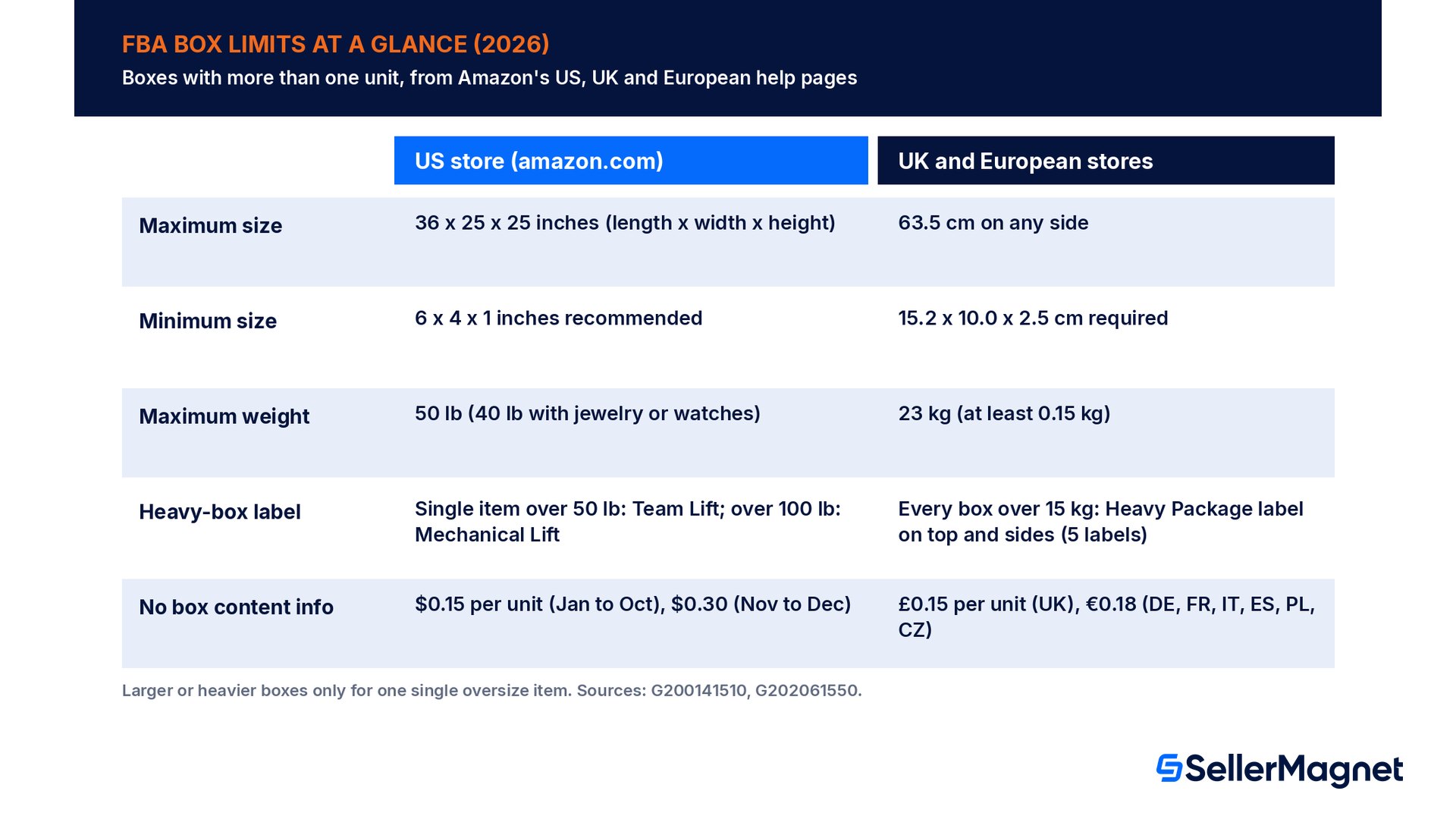
Amazon publishes the box rules on its Shipping and routing requirements help page, and each store has its own version. The core idea is the same everywhere: a box must be rigid, six-sided and within the size and weight limits, and every box must be identifiable by its own label. The numbers differ between the US and Europe, so the table below shows the limits side by side. All values come from the store's own help page, fetched in October 2026.
Rule
US store (amazon.com)
UK and European stores
Maximum size, box with more than one unit
36 inches long, 25 inches wide, 25 inches high
63.5 cm on any side
Minimum size
At least 6 x 4 x 1 inches and 1 lb recommended (reduces receiving delays)
At least 15.2 x 10.0 x 2.5 cm (required)
Maximum weight, box with more than one unit
50 lb (40 lb for jewelry or watches)
23 kg (minimum 0.15 kg)
Heavy-box labels
Team Lift on top and sides for a single item over 50 lb; Mechanical Lift for a single item over 100 lb
Heavy Package label on top and sides of every box between 15 kg and 23 kg (5 labels)
Larger or heavier box
Only for a single oversize item
Only for a single oversize item
Pallet-sized boxes
Not allowed ("gaylords")
Allowed if they meet the pallet acceptance criteria
Manual processing fee (no box content information)
$0.15 per unit (January to October), $0.30 (November and December)
£0.15 per unit (UK), €0.18 per unit (Germany, France, Italy, Spain, Poland, Czech Republic)
Sources: Shipping and routing requirements, US, UK and Germany, all official Amazon Seller Central help pages. The same European limits appear on the amazon.fr, amazon.it, amazon.pl and amazon.se versions of the page. Each store's page also lists extra rules for a box that holds one single oversize item, and those details differ slightly between stores, so read your own store's page before shipping a bulky product.
The US length limit is now 36 inches, not 25
Many guides, and some of Amazon's older shipment checklists, still say that a box with standard-size units must not exceed 25 inches on any side. The current US page allows a length of up to 36 inches, while width and height stay capped at 25 inches. The 63.5 cm limit in Europe applies to every side, so a box that is legal in the US can still be too long for a UK or German fulfillment center.
How do you measure a box the way Amazon does?
Measure the outside of the closed box and round up. In the US, the longest side may reach 36.0 inches and the two shorter sides 25.0 inches each; Amazon calls bigger boxes non-compliant and warns that sending oversize boxes may lead to blocked future shipments. In the UK and European stores, no side may exceed 63.5 cm, and the box must be at least 15.2 x 10.0 x 2.5 cm, so tiny mailer boxes are out as well.
The only way past these limits is a box that holds one single oversize unit, such as a piece of furniture that is longer than the standard limit. In that case the box must contain only that one item and must not be significantly larger than the item itself. Amazon warns that boxes that are excessively large relative to the oversize unit may lead to restricted shipping privileges, additional fees or refusal at the fulfillment center. A box with two or more units never qualifies for the oversize exception, even if each unit is large.
US, more than one unit: length up to 36.0 inches, width and height up to 25.0 inches each.
UK and Europe, standard-size units: no side over 63.5 cm, no box smaller than 15.2 x 10.0 x 2.5 cm.
One single oversize unit: the box may exceed the standard size, but only by as much as the item needs.
What is the FBA box weight limit, and when do you need heavy-box labels?
Weight is the limit that is easiest to miss, because a box that looks fine can still be far too heavy once a supplier fills it. In the US store, a box must not exceed the standard limit of 50 lb unless it contains one single item that weighs more than 50 lb. A box holding jewelry or watches must stay at or below 40 lb. When a single item weighs more than 50 lb, the box needs a label that clearly says Team Lift on the top and sides, and above 100 lb the label must say Mechanical Lift. Amazon also notes that UPS allowances for larger boxes do not apply to boxes that hold several standard-size items.
On the UK and European pages, a box with standard-size units must weigh between 0.15 kg and 23 kg. The rule that is easy to overlook is the label threshold: any box between 15 kg and 23 kg must carry a Heavy Package label (amazon.co.uk calls it Heavy Parcel) that can be read from the top and the sides, five labels per box in total. A box may only exceed 23 kg if it holds one single oversize item, and the UK and German pages cap that at 30 kg; heavier single items need enrollment in the FBA Heavy and Bulky program. Amazon does not supply these safety labels, so you print them yourself, in the language of the destination country.
Weight rule
US store
UK and European stores
Standard limit, box with more than one unit
50 lb (40 lb for boxes with jewelry or watches)
23 kg, and at least 0.15 kg
Safety label required
Team Lift on top and sides for a single item over 50 lb; Mechanical Lift for a single item over 100 lb
Heavy Package on top and sides of every box between 15 kg and 23 kg (5 labels)
Heavier box allowed
Only with one single item over 50 lb
Only with one single oversize item (UK and Germany: up to 30 kg, above that only via FBA Heavy and Bulky)
Weigh the packed box, not the product
Your listing weight is the weight of one unit. The box weight is every unit plus the box, inserts and tape. Amazon asks for accurate box weights and dimensions for every shipment, even if you skip box content information or do not use an Amazon partnered carrier, so a kitchen scale reading taken before the supplier added the last layer is not good enough.
Which boxes and packing materials does Amazon accept?
Amazon asks for a rigid, six-sided box with all flaps intact. The US page names the standard it accepts: a regular slotted carton (RSC), B flute, ECT-32 (edge crush test) and a burst strength of 200 lb per square inch, and the European pages list the same four specifications. Use strong shipping tape, wrap items separately and leave 2 inches of cushioning between your items and the walls of the box. If your items ship in the manufacturer's case pack, that 2-inch cushion is not needed. When you are done, shake the box gently: nothing inside should move.
Use these packing materials
Do not use these
Bubble wrap
Packing peanuts of any kind, including biodegradable or corn starch ones
Full sheets of paper (heavy kraft paper, at least 60 lb basis weight)
Foam strips and crinkle wrap
Inflatable air pillows
Shredded paper
Polyethylene foam sheeting
Thermocol chips and Styrofoam
The outside of the box matters too. The US page rules out point-of-sale containers (the retail box of a single product), open display boxes, pallet-sized boxes, string, straps, over-wrap and bundled boxes. The UK and European pages add that boxes must not be bagged or stretch-wrapped, covered in packing tape, closed with metal staples or plastic corner protectors, made of wood or metal, or strapped together. In Europe, however, pallet-sized boxes are allowed if they meet the pallet acceptance criteria.
Where do the FBA box ID label and the carrier label go?
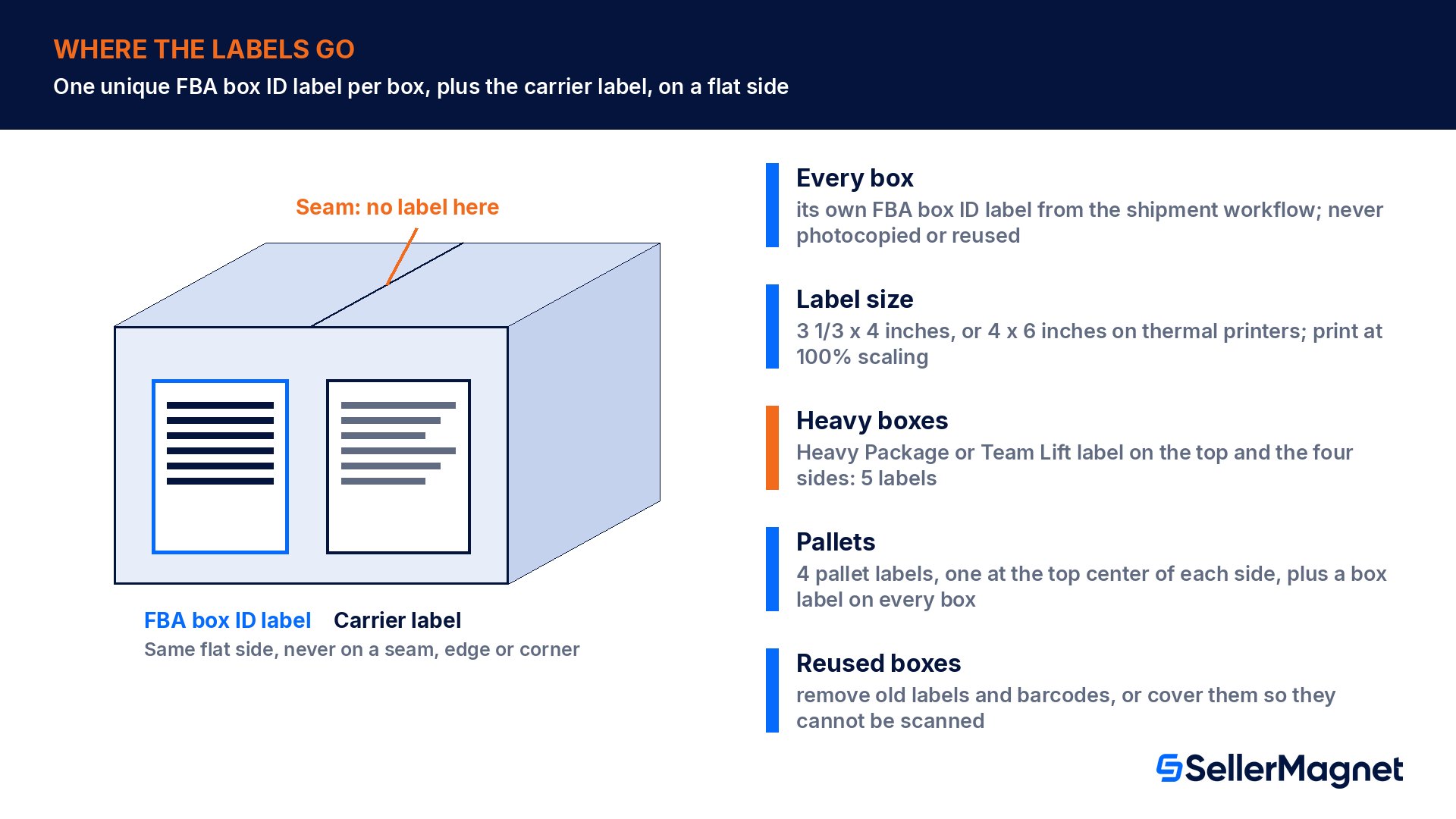
Each box in an FBA shipment must have its own unique FBA box ID label, printed from your shipment workflow, in addition to the carrier label. Because each label identifies one specific box, Amazon's label page says to print the full set and never photocopy, reuse or modify a label for another box. The label format is 3 1/3 x 4 inches (8.47 x 10.16 cm), and thermal printers can print it directly on 4 x 6 inch (10 x 15 cm) labels. Amazon's tools are optimized for thermal printers, laser printers also work, and ink jet printers should not be used. Print at a scaling of 100% so the barcode keeps its size.
Put the FBA box ID label and the carrier label on a flat side of the box, so neither barcode folds over an edge or corner.
Never place a label on a seam or on the opening of the box, where it tears when the box is opened.
Keep both labels uncovered so they stay scannable and readable.
If you reuse a box, remove every old shipping label, barcode and marking, or cover old barcodes with opaque tape or cross them out with a black marker.
If you ship several case packs inside one larger box, label only the larger box; the case packs inside need no box label of their own (more on case packs in our case packs and pallets guide).
Each pallet needs four pallet labels, one at the top center of each side, and every box on the pallet still needs its own box label.
Source: Shipping label requirements, an official Amazon Seller Central help page for the US store. Amazon states that failure to label boxes with the required FBA box ID label may lead to blocked future shipments, and that 2D barcodes do not replace the box ID label: if you use 2D barcodes for box content, you still need a box ID label on every box.
What is box content information, and what does skipping it cost?
Box content information tells the fulfillment center which SKUs and how many units sit in each box, plus each box's weight, dimensions and, where relevant, expiration dates. Without it, Amazon processes your boxes manually. Amazon's box content information page says this information lets the fulfillment center receive a shipment more quickly and make the inventory available for sale sooner, and the label page warns that inaccurate box content information may lead to blocked future shipments.
In the US, the packing step of the shipment workflow asks how the shipment is packed. For a single box you usually enter only its weight and dimensions. With one SKU per box, or mixed boxes in a shipment of 15 boxes or fewer and 25 SKUs or fewer, you can use the web form, upload an Excel or tab-delimited pack list, or use 2D barcodes; above 15 boxes or 25 SKUs with mixed boxes, only a file upload or 2D barcodes work. The Selling Partner API is a further option. A SKU can have only one expiration date per box.
Store
Manual processing fee if you skip box content information
When it is charged
US
$0.15 per unit (January to October), $0.30 per unit (November and December), based on when the first unit is received
14 days after the first unit is received
UK fulfillment centers
£0.15 per unit, plus VAT where applicable
The earlier of 14 days after the first unit is received or the end of that month
Fulfillment centers in Germany, France, Italy, Spain, Poland, Czech Republic
€0.18 per unit, plus VAT where applicable
The earlier of 14 days after the first unit is received or the end of that month
Sources: FBA manual processing fee, US, FBA manual processing fee, Germany and Box content information for FBA shipments, UK. Note the timing trap in the US: the rate depends on when the first unit arrives, not when you create the shipment. A shipment created in October whose first unit is received in November pays the $0.30 rate on every unit. The UK page adds a second trap: if a shipment has several boxes and you provide box content information for only some of them, the fee applies to all units in the shipment.
What happens when a box breaks the rules?
Amazon lists the consequences on the same Shipping and routing requirements page: inventory can be refused at the fulfillment center, disposed of or returned, and future shipments to the fulfillment center can be blocked. The US page adds inbound defect fees for the extra cost of redirecting, receiving and processing a shipment, while the European pages mention charges for preparation or noncompliance at the fulfillment center. Refused or damaged shipments can also come back to you at your own expense.
The US inbound defect fee itself applies to a specific set of shipment problems: shipments sent to a different fulfillment center than the one in your shipping plan (misrouted), and shipments that are deleted, canceled after approval, incomplete or not delivered in time (domestic shipments within 45 days of creation, international ones within 75 days). For shipments created on or after January 15, 2026, the fee is charged per unit by size tier, for example $0.38 for a Large standard item of 12 oz or less and $0.46 for one between 12 oz and 1.5 lb. If you believe a fee is wrong, you can request an investigation within 90 days of the shipment problem notification (source: Inbound defect fees, US). For the related placement charge, see our inbound placement service fee guide.
A shipment block costs more than any fee
Amazon repeats one warning on its size, weight and label rules: sending oversize or overweight boxes, or boxes without the required box ID labels, may lead to blocking of future shipments. A block can stop your replenishment, so treat the box rules as a hard limit, not as a fee you can choose to pay.
Worked example: packing 600 units three ways
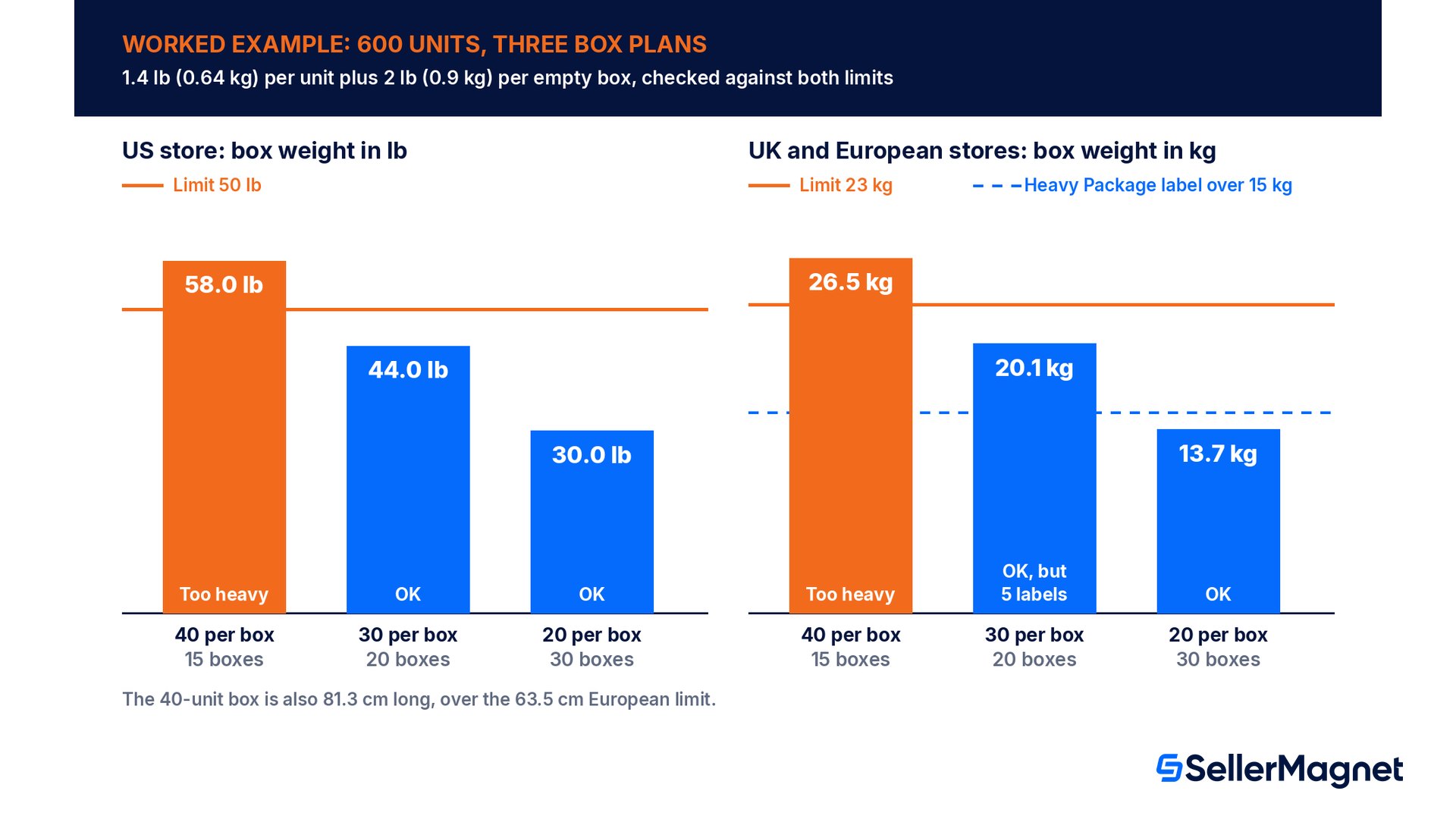
Take one product with a shipping weight of 1.4 lb (about 0.64 kg) per unit in a retail package of 8 x 6 x 3 inches. You plan to send 600 units, and your supplier proposes to pack 40 units per box. Each empty box with inserts weighs about 2 lb (0.9 kg). The table compares the supplier's box with two alternatives, checked against the US and the UK and European limits.
Units per box
Box size
Box weight
Boxes for 600 units
US store
UK and European stores
40
32 x 12 x 15 in (81.3 x 30.5 x 38.1 cm)
58.0 lb / 26.5 kg
15
Too heavy (over 50 lb)
Too heavy (over 23 kg) and too long (over 63.5 cm)
30
24 x 12 x 15 in (61.0 x 30.5 x 38.1 cm)
44.0 lb / 20.1 kg
20
Compliant
Compliant, but over 15 kg: Heavy Package labels needed
20
16 x 12 x 15 in (40.6 x 30.5 x 38.1 cm)
30.0 lb / 13.7 kg
30
Compliant
Compliant, no heavy-package label
The 40-unit box fails everywhere: 40 x 1.4 lb plus 2 lb is 58.0 lb, above the US 50 lb limit for a box with more than one unit, and 40 x 0.64 kg plus 0.9 kg is 26.5 kg, above the 23 kg European limit. Its 32-inch length would pass in the US, where the longest side may reach 36 inches, but it is 81.3 cm long and breaks the 63.5 cm limit in Europe. Lift labels do not rescue it, because the over-50-lb exception is only for a box with one single item.
The 30-unit box works in both regions: 44.0 lb in the US and 20.1 kg in Europe, with a longest side of 24 inches (61.0 cm). For a European fulfillment center, though, 20.1 kg is above the 15 kg threshold, so each of the 20 boxes needs five Heavy Package labels, 100 labels for the shipment. The 20-unit box (30.0 lb, 13.7 kg) needs no heavy-package label but means 30 box ID labels and 30 boxes to handle instead of 20. For a US-only shipment, 30 units per box is the efficient choice; for a shipment to Germany or the UK, 20 units per box keeps every box under 15 kg and avoids the heavy-package labels.
Now add the cost of skipping box content information for these 600 units. In the US, the manual processing fee would be 600 x $0.15 = $90.00 if the first unit is received between January and October, and 600 x $0.30 = $180.00 if it arrives in November or December. At a UK fulfillment center it would be 600 x £0.15 = £90.00, and at a German, French, Italian, Spanish, Polish or Czech one 600 x €0.18 = €108.00, plus VAT where applicable. If the same US shipment went to the wrong fulfillment center, the inbound defect fee for a Large standard item between 12 oz and 1.5 lb would be 600 x $0.46 = $276.00. Entering the box contents in the web form takes a few minutes, which makes it the cheapest item in this comparison. For every other per-unit cost of FBA, see our FBA fees table and our guide on how to reduce Amazon FBA fees.
How do you prepare an FBA box shipment, step by step?
Prepare compliant boxes for an FBA shipment
Choose the box for the destination - US box with more than one unit: 36 x 25 x 25 inches and 50 lb. UK and European stores: 63.5 cm per side and 23 kg, or 15 kg if you want to avoid heavy-package labels.
Pack with approved materials - Use a rigid six-sided RSC box, wrap items separately, fill gaps with bubble wrap, kraft paper, air pillows or foam sheeting, and shake the box to check that nothing moves.
Weigh and measure every packed box - Measure the outside of the closed box and weigh it with all units, inserts and tape, and note the values per box.
Enter box content information - In the packing step of the shipment workflow, enter the units per box with the web form, a pack list file or 2D barcodes, so no manual processing fee applies.
Print and apply the labels - Print the full set of FBA box ID labels at 100% scaling, put one unique label and the carrier label on a flat side of each box, and add heavy-box labels where required.
Check the shipment before pickup - Confirm that each box holds inventory from one shipment ID only and goes to the fulfillment center named in your shipping plan.
Common box mistakes that delay check-in
Accepting the supplier's box without weighing it. Factory boxes are often packed for freight, not for FBA, and a 58 lb box breaks the US limit just as a 26.5 kg one breaks the European limit.
Using the US length rule for European shipments. A 32-inch box passes in the US but is 81.3 cm long, far over the 63.5 cm European limit.
Forgetting heavy-package labels between 15 kg and 23 kg. In Europe, a box can be within the weight limit and still need five labels.
Photocopying one box ID label for several boxes. Every label is unique to one box, and Amazon's label page says never to photocopy, reuse or modify one.
Reusing boxes with old barcodes. An old barcode can be scanned by mistake during receiving, so remove old labels or make them unscannable.
Mixing shipments in one box. Each box may only hold inventory from one shipment ID.
Skipping box content information in November or December. In the US, the fee doubles to $0.30 per unit, based on when the first unit arrives.
Pre-shipment box checklist
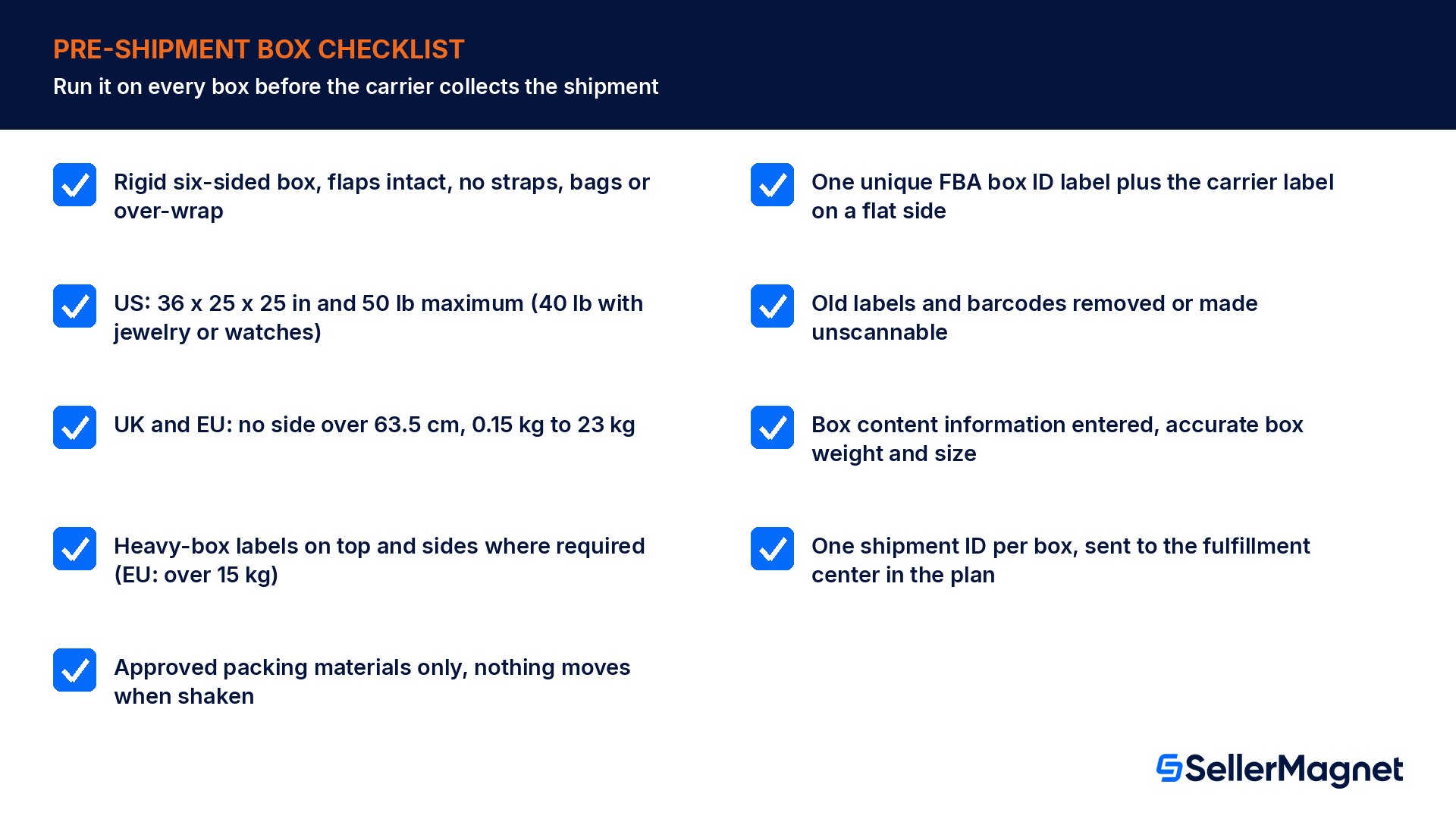
The box is rigid, six-sided, RSC, with flaps intact and no straps, bags or over-wrap.
US box with more than one unit: longest side 36 inches or less, the other two 25 inches or less, 50 lb or less (40 lb for jewelry or watches).
UK or European box with standard-size units: no side over 63.5 cm, at least 15.2 x 10.0 x 2.5 cm, 0.15 kg to 23 kg.
Heavy-box labels on the top and sides wherever required (Europe: every box over 15 kg; US: single items over 50 lb).
Only approved packing materials, 2 inches of cushioning, and nothing moves when you shake the box.
One unique FBA box ID label per box plus the carrier label, both on a flat side, not on a seam, uncovered.
Old labels and barcodes removed or made unscannable.
Box content information entered for every box in the shipment, with accurate box weights and dimensions.
Each box holds inventory from one shipment ID only and goes to the fulfillment center in your shipping plan.
Boxes that arrive short are money you can claim back. Even a perfectly packed shipment can be received with fewer units than you sent, or units can get lost or damaged later (our FBA reimbursements guide explains what you can claim). SellerMagnet's Lost & Found reimbursement service scans up to 2 years of Seller Central data for lost, damaged and unreturned inventory, prepares each claim with a template and evidence, and tracks each claim type's deadline for you; you review and file every claim yourself. To check what each unit still earns after FBA fees, the free Fee Calculator compares FBA and FBM fees, the referral fee, profit and ROI for any ASIN from Amazon's public fee schedule (5 free lookups per day). See pricing for current plans, with a 14-day free trial.
What is the maximum box size for Amazon FBA in 2026?
In the US store, a box with more than one unit may be up to 36 inches long and 25 inches wide and high. The UK and European help pages allow up to 63.5 cm on any side and require at least 15.2 x 10.0 x 2.5 cm. Larger boxes are allowed only for one single oversize item.
What is the weight limit for an FBA box?
In the US, a box may weigh up to 50 lb unless it holds one single item over 50 lb, and boxes with jewelry or watches stop at 40 lb. In the UK and European stores, boxes with standard-size units must weigh between 0.15 kg and 23 kg. Only a single oversize item may go heavier.
When does an FBA box need a Team Lift or Heavy Package label?
In the US, a box with one single item over 50 lb needs Team Lift labels on the top and sides, and over 100 lb Mechanical Lift labels. In the UK and Europe, every box between 15 kg and 23 kg needs Heavy Package labels on the top and sides, five in total. You print these labels yourself.
Does every box need its own FBA box ID label?
Yes. Each box needs its own unique FBA box ID label from your shipment workflow, in addition to the carrier label. Never photocopy, reuse or modify a label for another box. 2D barcodes do not replace the box ID label, and Amazon warns that boxes without the required label may lead to blocked future shipments.
What happens if I skip box content information?
Amazon then processes your boxes manually at the fulfillment center and charges a manual processing fee per unit: in the US $0.15 from January to October and $0.30 in November and December, in the UK £0.15 and €0.18 in Germany, France, Italy, Spain, Poland and the Czech Republic. Manually processed shipments can also be received more slowly.
Can I reuse old boxes for an FBA shipment?
Yes, as long as the box is still rigid, six-sided and has intact flaps. Remove every old shipping label, barcode and marking, or cover old barcodes with opaque tape or cross them out with a black marker, so the scanner cannot read them. A reused retail product box without an outer shipping box is not suitable.
Which packing materials does Amazon not allow?
Amazon's US and European pages list the same banned materials: packing peanuts of every kind, including biodegradable or corn starch ones, foam strips, crinkle wrap, shredded paper, Thermocol chips and Styrofoam. Use bubble wrap, full sheets of heavy kraft paper, inflatable air pillows or polyethylene foam sheeting instead, with 2 inches of cushioning around the items.
What happens if my FBA box is too big or too heavy?
Amazon may refuse the inventory at the fulfillment center, dispose of it or return it, and it may block your future shipments. Refused shipments can come back to you at your own expense. Weigh and measure every packed box before you print labels, because repacking at home is cheaper than a blocked shipment.
Stop Juggling Tools. SellerMagnet Combines Everything You Need.