Amazon's Fair Pricing Policy does not cap what you may charge; it polices the gap between your price and "other prices available to our customers" on and off Amazon, and it reads per-unit math and shipping fees the same way it reads a sticker price. A seller who never changed a single listing price can still trip the policy by packaging three units into a multipack, or by quoting a shipping fee the carrier invoice does not support. This guide works through Amazon's US help page for the Fair Pricing Policy, the related price limits and pricing definitions page, two worked examples with real numbers, and the enforcement ladder from a removed Featured Offer to a suspended account, plus how this standing policy differs from a Buy Box suppression or an automated High Pricing Error.
Amazon's Fair Pricing Policy says sellers set their own prices, but Amazon monitors those prices, including shipping costs, against other prices available to customers on and off Amazon. Pricing practices that harm customer trust include a misleading reference price, a price significantly higher than recent prices, charging more per unit in a multipack than for a single unit, and an excessive shipping fee. Amazon can remove the Featured Offer, remove the offer, suspend the ship option, or in serious or repeated cases suspend or terminate selling privileges.
What the Fair Pricing Policy actually says
The policy opens with a responsibility statement, not a price table: "Sellers are responsible for setting their own prices on Amazon stores." The enforcement power sits in the next sentence: "Amazon regularly monitors the prices of items on our stores, including shipping costs, and compares them with other prices available to our customers." That comparison set is not limited to Amazon; a lower price on your own site or a competing marketplace counts too. When a store offer's pricing "harms customer trust", Amazon's page lists four practices by name, and none of them require you to have changed a sticker price at all.
Pricing practice named in the policy
What it means in practice
Setting a reference price that misleads customers
A "was" or "list" price shown next to your price must be real and recent, not inflated to make a discount look bigger
Setting a price significantly higher than recent prices offered on or off Amazon
Amazon compares against recent prices anywhere customers can see them, not only against other Amazon sellers
Selling multiple units for more per unit than a single unit of the same product
A multipack's per-unit price must not exceed the single unit's price
Setting an excessive shipping fee
Checked against current public carrier rates, reasonable handling charges, and buyer perception
Source: Amazon Marketplace Fair Pricing Policy, Amazon Seller Central help for the US store. The page adds that Amazon's Seller Assistant can help with the topic and, in most language settings, connect you directly to Selling Partner Support.
The list is not exhaustive
Amazon introduces its four examples with "include, but are not limited to", so a pricing pattern that is not on the list can still be flagged if it harms customer trust in Amazon's view.
The "significantly higher" practice is the one sellers most often run into without planning to. It usually shows up after a short supply crunch: a competing offer disappears, your offer becomes the only one in stock, and raising the price to match demand can look identical to the pattern the policy targets, a price set well above the recent norm rather than one shaped by genuine scarcity. Amazon's monitoring does not distinguish intent; it compares the resulting number against recent prices on and off Amazon. The safer response to a real supply crunch is a gradual, bounded increase tied to your own cost and demand data, kept inside a maximum you set yourself, rather than a single large jump the moment competition drops out.
Price limits and pricing definitions (separate from Fair Pricing)
A second help page, "Price your item", sets the ceilings your price must also respect, independent of the Fair Pricing checks above. "You may list items at any price you feel is fair, regardless of the Amazon price or list price, within the limits set by Amazon, and so long as your price adheres to the Amazon Marketplace Fair Pricing Policy and Amazon Policy on Reference Prices." The price caps: Individual sellers may not list above $10,000, Professional sellers may not list above $300,000, and both caps are waived for Collectibles listings.
Term (Amazon's definition)
What it includes
Item price
The amount payable by a customer, excluding shipping and handling, as listed
Total price
Item price plus shipping and handling, discounts, rebates and promotions you offer, shipping method, and low-price guarantees
Excluded from total price
Discounts, sales, rebates or promotions you try to offer through Amazon that Amazon does not honor or support
Source: Price your item. The total-price definition matters for the shipping-fee check below: Amazon's fair pricing comparison is not limited to the item price line, it looks at what the customer actually pays in total.
Worked example 1: a multipack that violates the per-unit rule
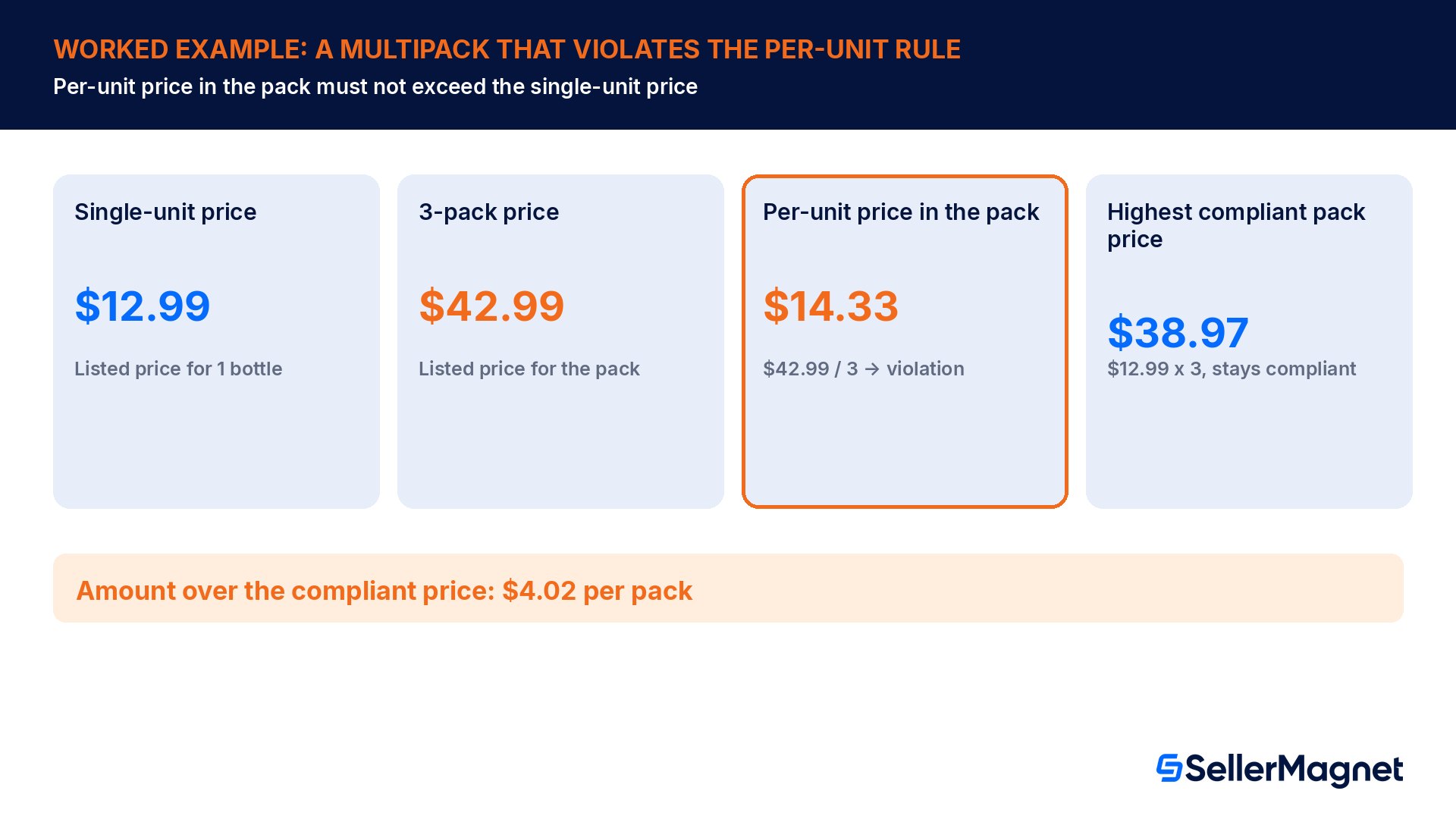
A seller lists a single bottle of a supplement at $12.99. The same seller also lists a 3-pack at $42.99. Dividing the pack price by the unit count gives a per-unit price of $14.33, which is higher than the $12.99 charged for one bottle on its own. That is the exact pattern the policy names: "Selling multiple units of a product for more per unit than that of a single unit of the same product." The multipack listing can be flagged even though the single-unit listing never changed.
Check
Calculation
Result
Single-unit price
Listed price
$12.99
3-pack price
Listed price
$42.99
Per-unit price inside the pack
$42.99 / 3
$14.33
Policy check
$14.33 vs single-unit $12.99
Violation: per-unit price is higher
Highest compliant pack price
$12.99 x 3
$38.97
Amount the pack is over
$42.99 minus $38.97
$4.02
The fix in this example costs the seller $4.02 of margin on the pack, not a rewrite of the listing: price the 3-pack at $38.97 or below so the per-unit price never exceeds the single unit's price, or raise the single-unit price first if the economics require it there too.
Worked example 2: an excessive shipping fee
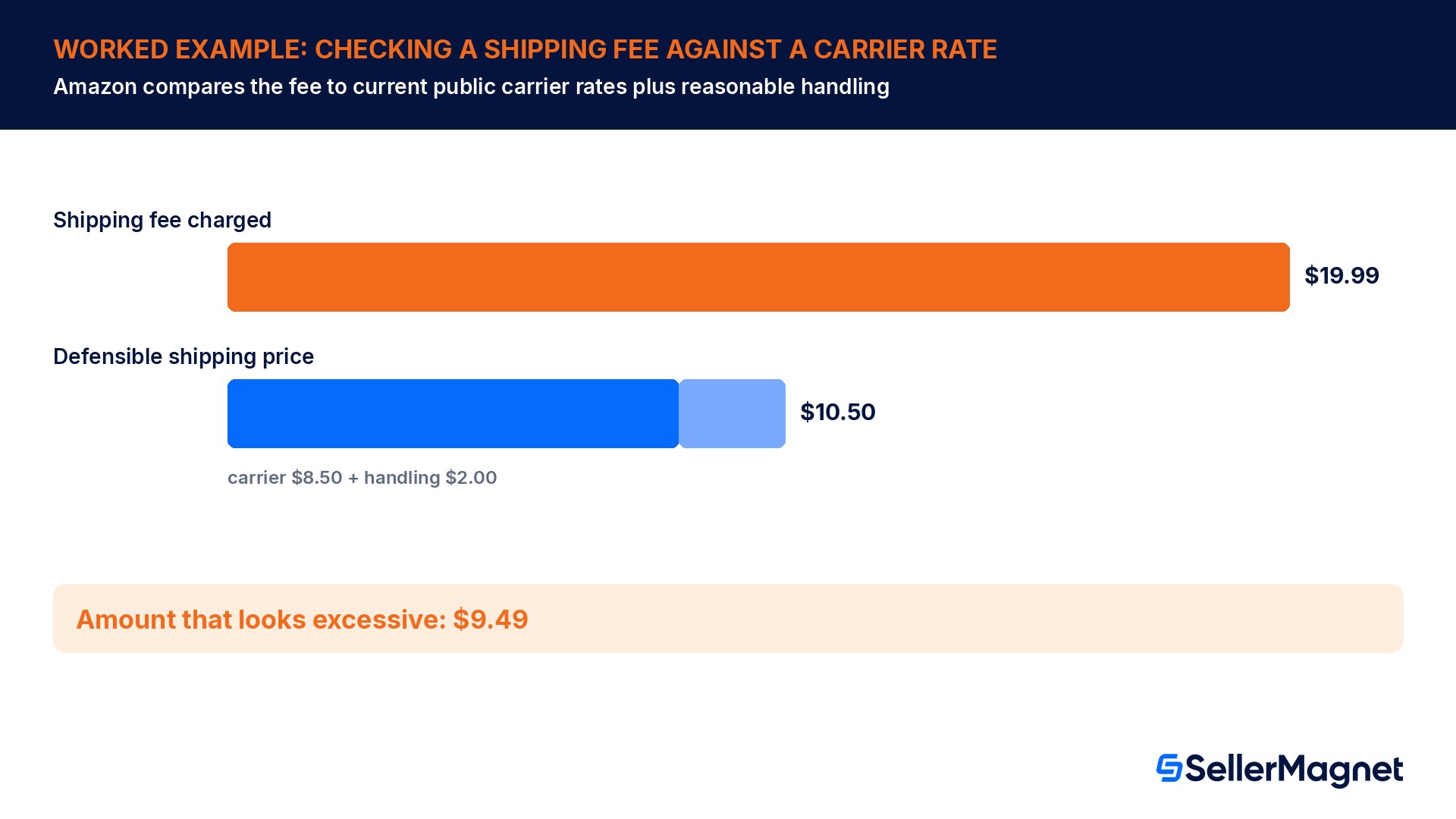
A second seller lists an item at $9.99 with a $19.99 shipping fee, for a total price of $29.98. The policy states that Amazon "considers current public carrier rates, reasonable handling charges, as well as buyer perception when determining whether a shipping price violated our fair pricing policy." The seller's own recent carrier invoice for the same weight and zone shows a public rate of $8.50; adding a reasonable handling charge of $2.00 gives a defensible shipping price of $10.50, which is $9.49 below what is actually charged.
Check
Calculation
Result
Item price
Listed
$9.99
Shipping fee charged
Listed
$19.99
Total price to the customer
$9.99 + $19.99
$29.98
Public carrier rate (same weight/zone)
From a recent carrier invoice
$8.50
Reasonable handling charge
Seller's own fulfillment cost estimate
$2.00
Defensible shipping price
$8.50 + $2.00
$10.50
Amount that looks excessive
$19.99 minus $10.50
$9.49
Buyer perception is part of the test too
Amazon's page names buyer perception alongside carrier rates and handling costs. A shipping fee that is technically defensible on cost can still read as a way to hide a discount from the item price, so keep the item price and shipping fee each realistic on their own, not only in total.
Reference prices: the "was" price trap
The first practice on Amazon's list is a reference price that misleads customers, and it is easy to trip without ever touching the actual selling price. A reference price is any "was", "list" or "compare at" figure shown next to your current price to signal a discount. Amazon's related Policy on Reference Prices (linked from the Fair Pricing page) expects that figure to reflect a price the item genuinely sold at recently, not a number invented to make today's discount look larger. A seller who raises a listed "was" price without a matching sales history behind it is building the exact mismatch the policy targets, even while the actual checkout price stays unchanged.
The practical test is the same one Amazon runs for the significantly-higher-price check: look at what the product has actually sold for recently, on Amazon and elsewhere, and keep the reference price inside that range. A reference price pulled from a one-off list price that was never charged, or from a stale promotion that ended months ago, fails that test regardless of how the current selling price compares.
Keep a record, not just a number
If a reference price is challenged, the defense is evidence: a dated price history for the ASIN, not an explanation of how the number was chosen. Keep a simple log of when each list price or "was" price was last genuinely charged, the same way you would track a sale's start and end date.
Fair Pricing versus a Buy Box suppression or a High Pricing Error
Three different Seller Central symptoms can look identical from the outside, a lost Featured Offer, but trace back to different causes, and mixing them up wastes time chasing the wrong fix. A Buy Box suppression with a "No Featured Offers Available" message is usually an eligibility problem unrelated to pricing policy, such as account health or fulfillment metrics. A High Pricing Error is Amazon's automated price-ceiling check, which deactivates an offer the moment it crosses a dynamically calculated line versus other current offers. The Fair Pricing Policy covered in this guide is broader and slower-moving: it is a standing policy enforced on reference prices, per-unit multipack pricing and shipping fees, not only on the headline item price in real time.
Symptom
Usual cause
Where to look first
No Featured Offers Available
Eligibility, account health or fulfillment metrics
Account Health dashboard, listing eligibility status
Offer deactivated as a pricing error
Automated price-ceiling check versus current offers
Featured Offer removed, offer removed or ship option suspended
Fair Pricing Policy: reference price, per-unit pricing or shipping fee
This guide's four named practices
Checking the notification text Amazon sends with the action is the fastest way to tell these apart: a Fair Pricing action names the policy directly, while a pricing-error deactivation names the price ceiling instead.
How enforcement escalates
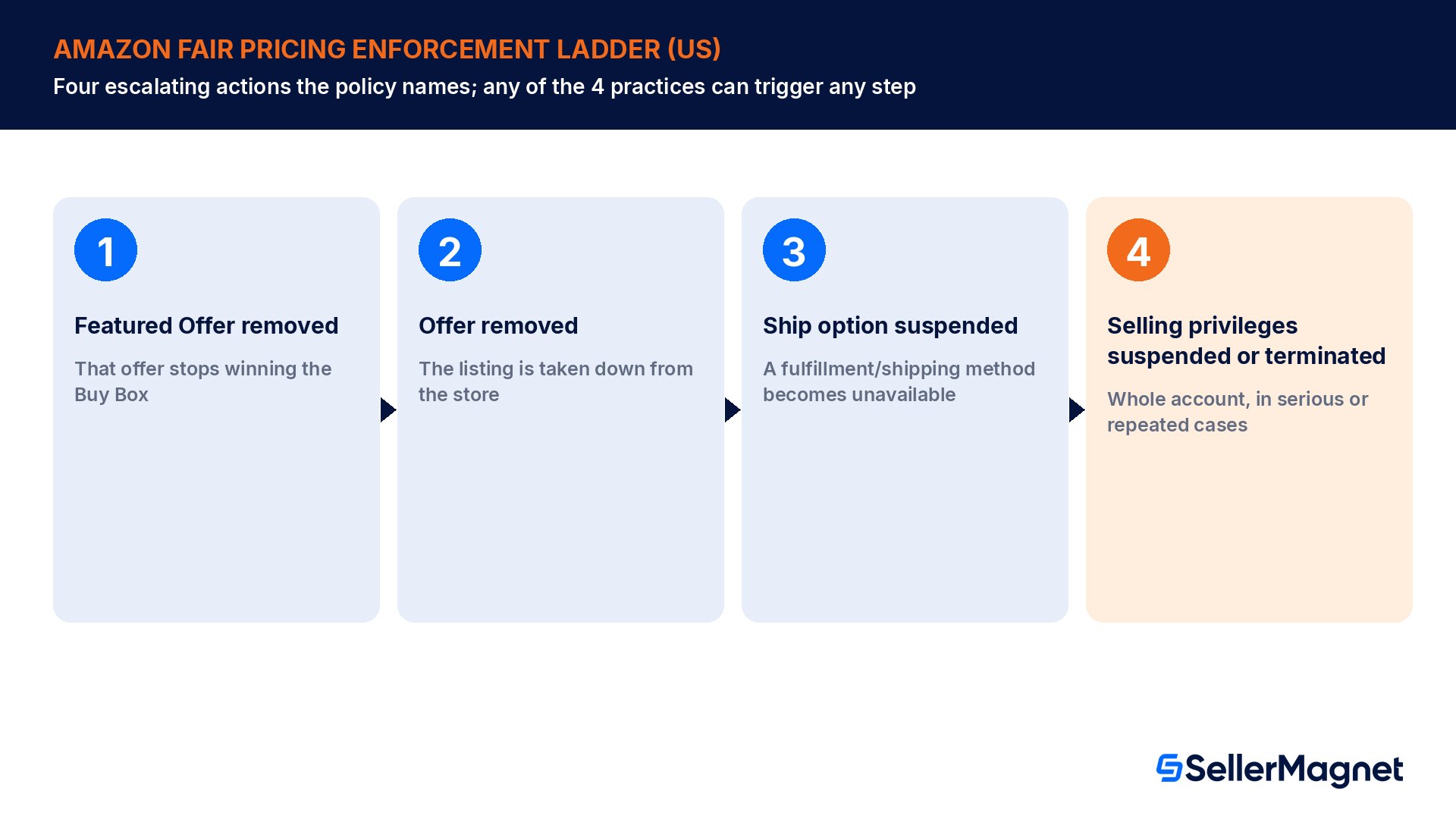
The policy names a specific sequence of actions, not a single penalty: "Amazon can remove the Featured Offer, remove the offer, suspend the ship option, or in serious or repeated cases suspend or terminate selling privileges." Reading it as a ladder helps explain why two sellers with a similar violation can see different outcomes: a first, isolated case is more likely to cost the Featured Offer or the single offer, while a pattern across many listings or a repeat after a warning moves toward the ship-option or account-level actions.
Step
What it affects
Typical trigger
Featured Offer removed
That offer stops winning the Buy Box, even if otherwise eligible
A first or isolated pricing concern on one offer
Offer removed
The listing itself is taken down from the store
The pricing issue persists or affects customer trust directly
Ship option suspended
A fulfillment or shipping method becomes unavailable on the account
A pattern tied to shipping-fee pricing specifically
Selling privileges suspended or terminated
The whole account, in serious or repeated cases
Multiple violations or no correction after earlier action
Source: Amazon Marketplace Fair Pricing Policy. Amazon's page does not publish fixed thresholds for which step applies when, so the safest reading is that every one of the four named pricing practices is a path onto this ladder, not only the most obvious one.
Where Automate Pricing fits in
Amazon's own repricing tool, Automate Pricing, references the Fair Pricing Policy directly. Its help page states that when a seller sets a minimum price but no maximum, "Automate Pricing will protect customer trust on your behalf by ensuring that your offers are not priced significantly higher than recent prices so that your offers remain eligible to become the Featured Offer." That is Amazon admitting the significantly-higher-price check is enforced inside its own repricing logic, not only after the fact by a policy team.
Source: Automate Pricing. The same page also covers business pricing rules for Amazon Business sellers and notes that pausing a listing (setting it Inactive) pauses any pricing rule attached to it until the listing is reactivated.
A repricer that never leaves your own floor and ceiling. SellerMagnet's Repricer never sets a price outside the minimum and maximum you define, and every price change is logged with its reason, so you can audit why a price moved before a customer, or Amazon, sees it as significantly higher or lower than recent prices. Fee Audit checks flagged fees, including shipping-related settlement entries, against Amazon's own published rates and only marks a row claimable when it can verify the overcharge, which is the same kind of carrier-rate check the Fair Pricing Policy itself runs on your shipping fee.
Common Fair Pricing mistakes
Pricing a multipack per piece without checking it against the single-unit price for the same product.
Treating the Fair Pricing Policy as a one-time listing check instead of something Amazon monitors continuously against prices on and off Amazon.
Setting a reference or "was" price that is not a real, recent price the item actually sold at.
Pricing shipping to offset a lowered item price, without a carrier invoice or handling estimate to support the fee.
Assuming a Featured Offer removal is unrelated to pricing, instead of checking the four named practices first.
Running a repricer with no maximum price and no review of whether the resulting price reads as significantly higher than recent prices elsewhere.
Ignoring the separate Individual ($10,000) and Professional ($300,000) price limits because a listing already passes the Fair Pricing checks.
How to check a listing against the Fair Pricing Policy
Review a listing for Fair Pricing Policy risk
Compare per-unit prices - If the same product sells as a single unit and in a multipack, divide the multipack price by its unit count and confirm it does not exceed the single-unit price.
Check the reference price - Confirm any "was" or "list" price shown is a real, recent price, not inflated to make the current price look like a bigger discount.
Benchmark against recent prices - Look at recent prices for the same product on and off Amazon, not only at other Amazon offers, before setting a price that stands out as significantly higher.
Cost the shipping fee - Add a current public carrier rate for the item's weight and zone to a reasonable handling charge, and compare that to the shipping fee actually charged.
Confirm the price limits - Check the listing against the $10,000 Individual or $300,000 Professional price cap, unless the item is in the Collectibles category.
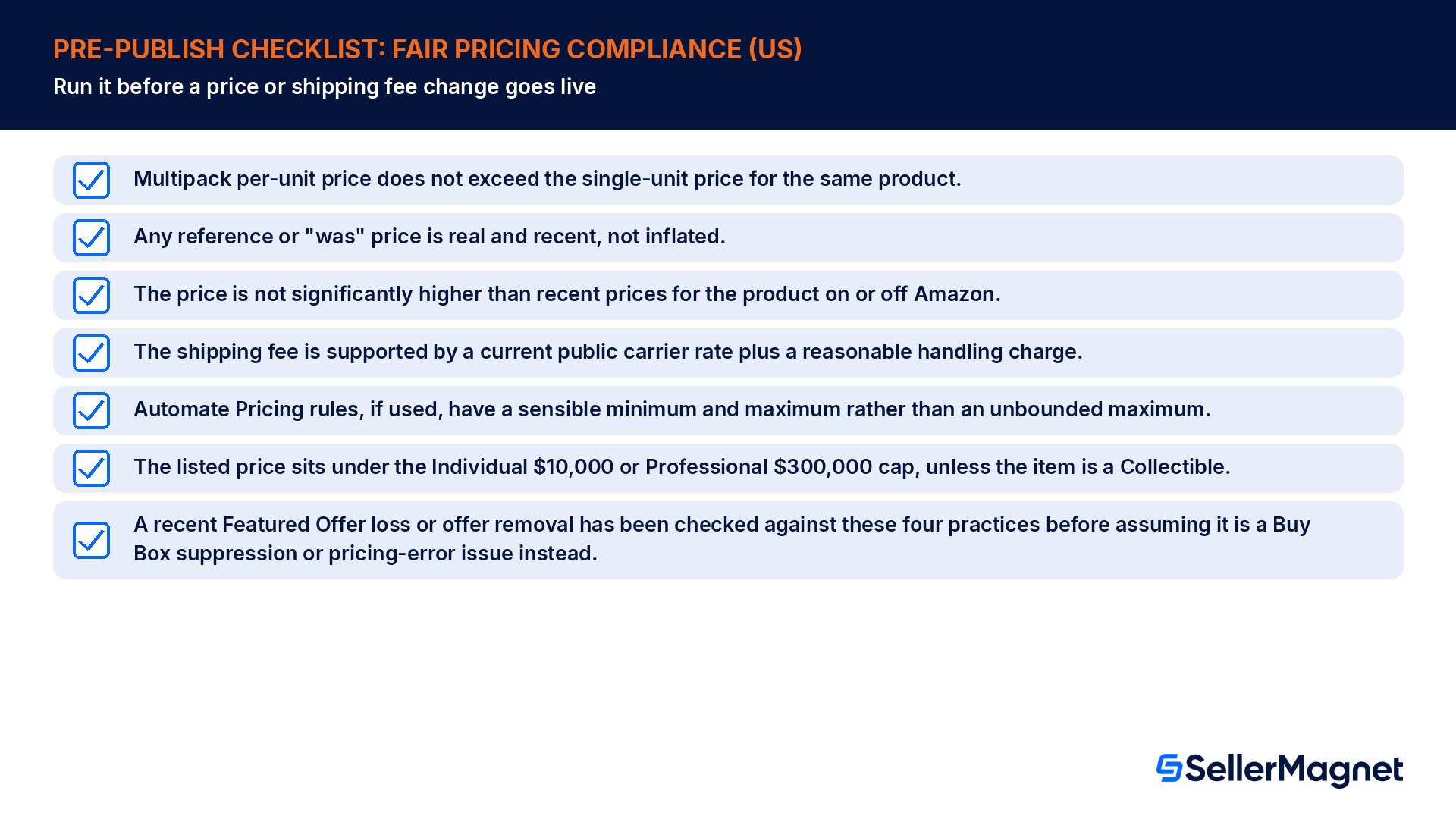
Pre-publish checklist for pricing compliance
Multipack per-unit price does not exceed the single-unit price for the same product.
Any reference or "was" price is real and recent, not inflated.
The price is not significantly higher than recent prices for the product on or off Amazon.
The shipping fee is supported by a current public carrier rate plus a reasonable handling charge.
Automate Pricing rules, if used, have a sensible minimum and maximum rather than an unbounded maximum.
The listed price sits under the Individual $10,000 or Professional $300,000 cap, unless the item is a Collectible.
A recent Featured Offer loss or offer removal has been checked against these four practices before assuming it is a Buy Box suppression or pricing-error issue instead.
What exactly does Amazon's Fair Pricing Policy monitor?
Amazon monitors prices on its stores, including shipping costs, and compares them with other prices available to customers on and off Amazon. The policy names four practices that harm customer trust: a misleading reference price, a significantly higher price, a higher per-unit multipack price than a single unit, and an excessive shipping fee.
Can a multipack violate the policy if the single-unit price is fine?
Yes. The policy separately names selling multiple units for more per unit than a single unit of the same product. A 3-pack priced above three times the single-unit price can be flagged on its own, even though the single-unit listing never changed, passes every other check, and sits well under Amazon's $300,000 Professional price cap.
How does Amazon decide if a shipping fee is excessive?
Amazon's page says it considers current public carrier rates, reasonable handling charges, and buyer perception. There is no published fixed dollar ceiling; a fee is compared against what a real carrier would charge for that weight and zone plus a defensible handling cost, so keep a recent carrier invoice on hand to justify the number.
What can Amazon do if a listing violates the policy?
Amazon names an escalating sequence: remove the Featured Offer, remove the offer, suspend the ship option, or in serious or repeated cases suspend or terminate selling privileges. The page does not state fixed thresholds for which step applies, so any of the four named pricing practices can trigger any step on a first or repeat violation.
Are there separate price limits besides Fair Pricing?
Yes, on the Price your item page. Individual sellers may not list an item above $10,000, and Professional sellers may not list above $300,000. Collectibles listings are exempt from both limits, and these caps apply regardless of whether the listing also passes every Fair Pricing check.
Does Amazon's own repricer protect against a Fair Pricing violation?
Partly. Amazon's Automate Pricing tool states that when a seller sets a minimum price but no maximum, it keeps offers from being priced significantly higher than recent prices so they remain eligible for the Featured Offer. That addresses only one of the four named practices, not multipack pricing or an excessive shipping fee.
Does the Fair Pricing Policy only apply at listing creation?
No. Amazon's page describes regular, ongoing monitoring of prices against other prices available to customers, so a listing that passed the check when created can still be flagged later if prices elsewhere change, or a multipack or shipping fee drifts out of line over time without the seller noticing.
Is a Featured Offer removal always a Fair Pricing issue?
No. A lost Featured Offer can also come from an eligibility-based Buy Box suppression or an automated High Pricing Error deactivation, both unrelated to the standing Fair Pricing Policy. Reading the exact notification Amazon sends is the fastest way to tell which of the three causes actually applies to a given offer.
Stop Juggling Tools. SellerMagnet Combines Everything You Need.