Amazon's standard return window is 30 days from delivery. For the 2026 holiday season it is not: anything a customer buys between November 1 and December 31, 2026 can come back to you until January 31, 2027, a full month after most of those orders would have aged out of a normal return window. Amazon's own forum post calls the change simple ("no action is required from you"), and for the mechanics of processing any single return, that is true. What it quietly does is stretch the open-liability tail of your entire November-December sales volume well into February, on top of whatever refund-processing delay your customers' payment method adds on its own. This guide works through the exact dates, what still applies the normal way, and where the extra weeks actually show up in your numbers.
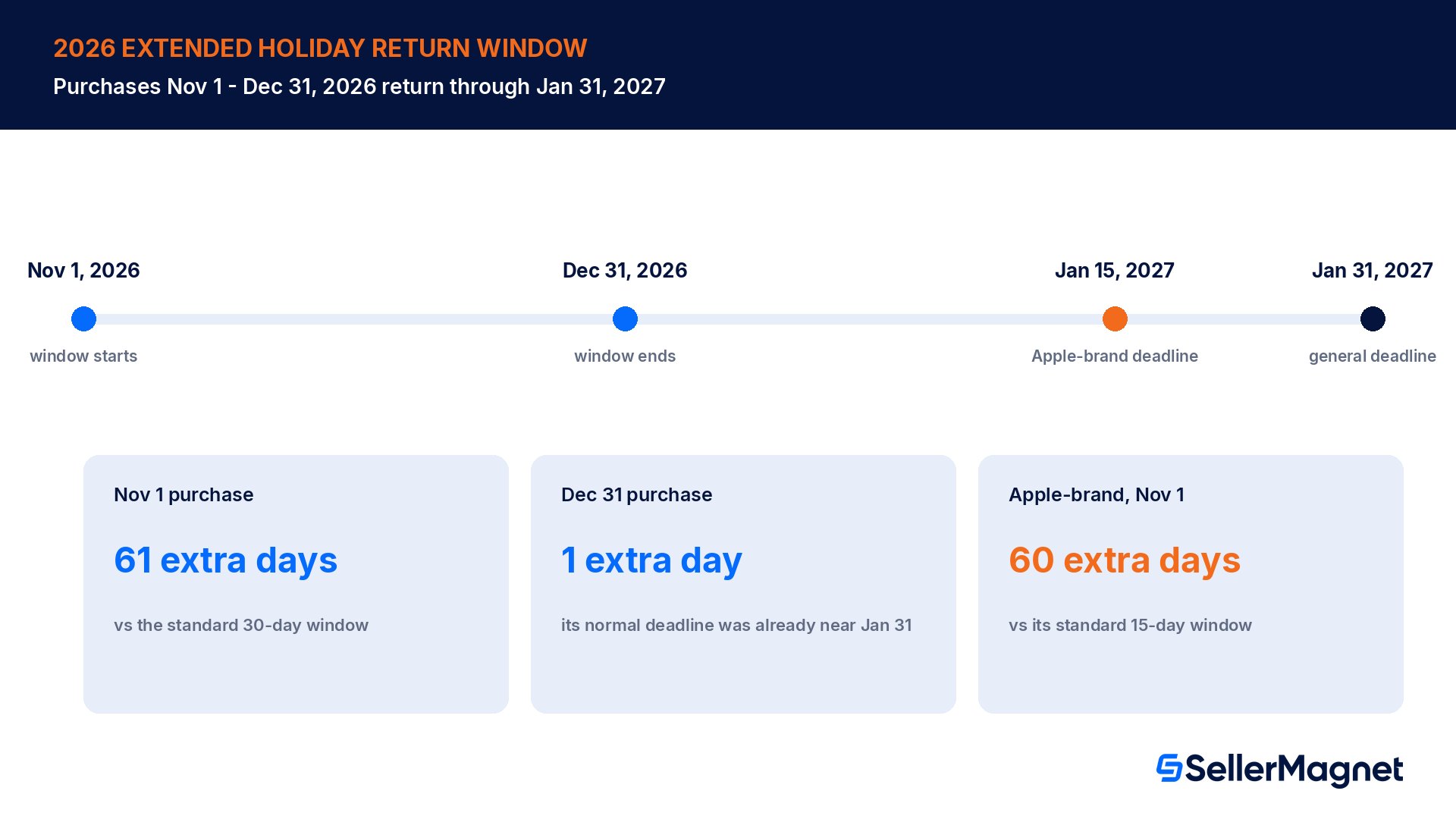
For the 2026 holiday season, Amazon extends its standard 30-day return window: items bought between November 1 and December 31, 2026 can be returned through January 31, 2027. Apple-brand products purchased in that same window follow their own shorter deadline, January 15, 2027. The extension applies automatically to every item on Amazon.com, whether it is FBA or FBM, and needs no action from the seller; all other return and refund conditions stay the same.
What are the exact dates, and who is covered?
Amazon's forum announcement is specific about scope: "Our 2026 extended holiday returns policy requires that items that are purchased by your customers between November 1, 2026 and December 31, 2026 can be returned until January 31, 2027, except for Apple brand products which can be returned until January 15, 2027. This extended window automatically applies to all items that you sell on Amazon.com, regardless of whether you use Fulfillment by Amazon (FBA) or Merchant (FBM). No action is required from you, and existing return and refund conditions remain unchanged." The customer-facing Return Policy page confirms the same wording under its own "2026 Holiday Season Extended Return Window" heading, and adds one framing detail the forum post does not: "This policy will apply every year," positioned as a standing seasonal rule rather than a 2026-specific favor.
Purchase date range
Normal return deadline would be
2026 extended deadline
Extra days gained
November 1, 2026 (most items)
December 1, 2026 (+30 days)
January 31, 2027
61 days
December 31, 2026 (most items)
January 30, 2027 (+30 days)
January 31, 2027
1 day
November 1, 2026 (Apple-brand)
November 16, 2026 (+15 days)
January 15, 2027
60 days
This is a store-specific policy, not a global one
The announcement, the Return Policy page and the exact dates above are published for the Amazon.com store. A seller running listings across multiple Amazon stores should check that store's own help pages for a holiday extension of its own rather than assuming the same January 31, 2027 (or January 15, 2027 for Apple-brand) deadline carries over automatically to amazon.de, amazon.co.uk, amazon.fr or any other store; return-window rules, including holiday extensions, are set per store, and a seller active on several of them can easily end up tracking more than one deadline for the same holiday season.
Why aren't the extra days spread evenly across your sales?
The policy sets one fixed calendar deadline, January 31, 2027, that every qualifying purchase shares, rather than adding a flat number of days to each order's own return window. That mechanic means the earliest holiday sales carry by far the longest extra tail: an order placed on November 1 would normally age out of returns on December 1, so the extension adds 61 extra days beyond what a customer buying the exact same item in October would get. An order placed on December 31 would normally still be returnable until January 30 anyway, so its extension is effectively 1 day. If you run any kind of pre-Black-Friday promotion, those early-November sales are the ones sitting open the longest, not your Cyber Monday or last-week-of-December volume.
Apple-brand items get a shorter, separate deadline
Apple-brand (and Boost Infinite-brand) products keep their own standard 15-day return window year-round, and the holiday extension gives them a shorter extended deadline too, January 15, 2027, instead of January 31. A seller carrying both Apple-brand and general merchandise needs to track two different deadlines for the same November-December sales period, not one blanket date; mixing the two up means closing a return case two and a half weeks before you actually had to, or worse, telling a customer their item is out of the window when it is not.
What Amazon's refund-timeline table adds on top of the return window
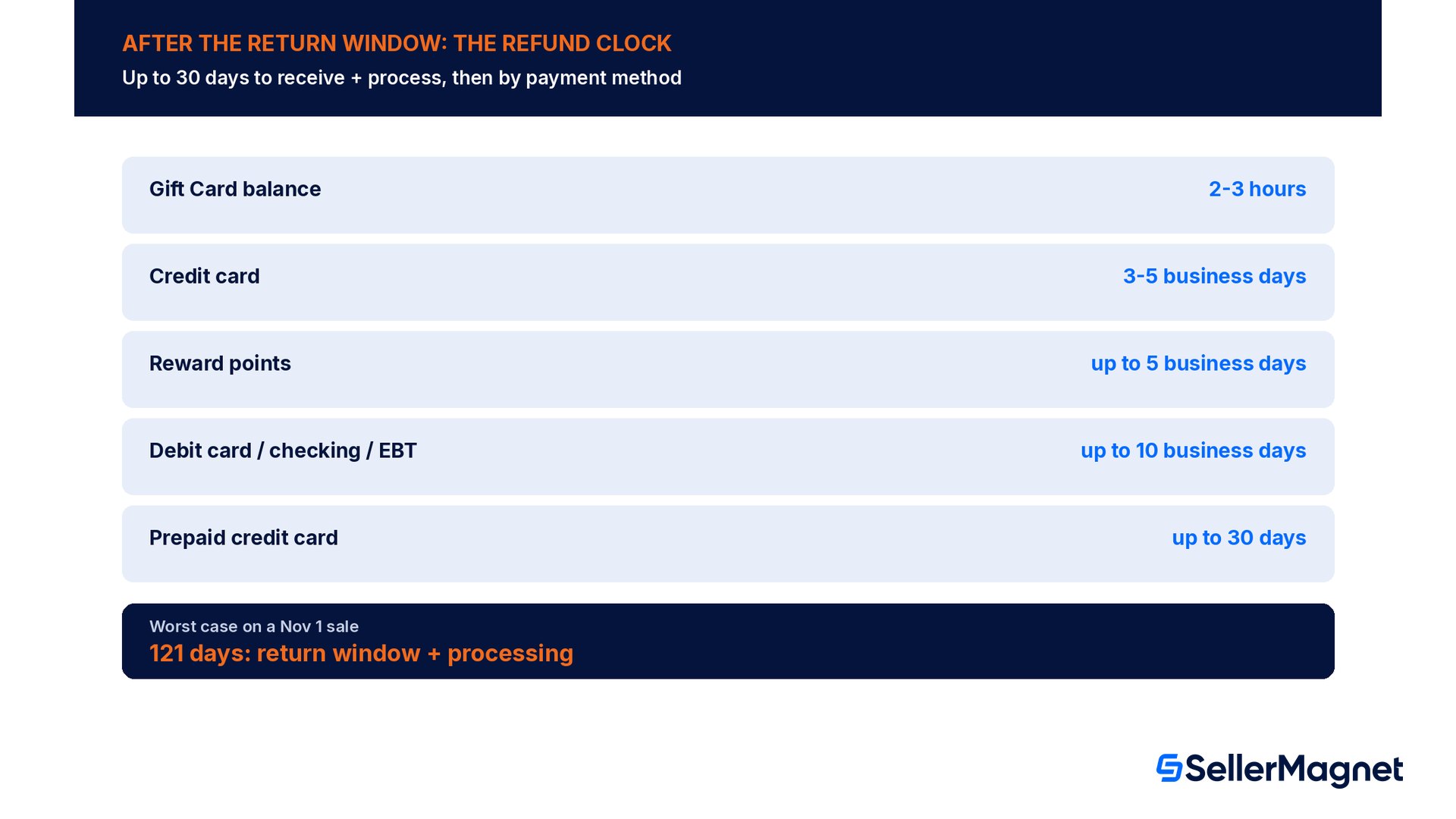
The return window governs when a customer is allowed to send an item back, not when the refund itself clears. Amazon's own Return Policy page states plainly: "It can take up to 30 days for us to receive and process your return. In certain circumstances refund timeframes may be longer." Once a refund is actually issued, the same page's Refund Timelines table adds a second, payment-method-specific delay before the money reaches the buyer, which matters to you mainly because it is also roughly how long the transaction sits as a pending adjustment rather than a closed one in your own payout reporting.
Refund method
Time after Amazon issues the refund
Amazon.com Gift Card or Gift Card balance
2-3 hours
Credit card
3-5 business days
Shop with Reward Points
Up to 5 business days
Debit card, checking account or EBT card
Up to 10 business days
Prepaid credit card
Up to 30 days, depending on the issuer
Stack the two delays on a worst-case November 1 order and the real gap between the original sale and a fully cleared refund is the 91-day return window itself plus the 30 days Amazon allows to receive and process the return, 121 days in total before you can be certain that sale is fully settled, not just within its return deadline. That is the number worth planning cash flow and inventory decisions against, not the headline January 31 date alone.
What stays exactly the same?
The announcement is explicit that this is an extension of the deadline only: "existing return and refund conditions remain unchanged." The customer-facing Return Policy page's own exceptions table keeps running on its normal clock underneath the holiday extension: 7 days for Kindle Store digital purchases and unread digital textbooks, 15 days for Apple/Boost Infinite brand items and Amazon Haul items over $3 (Haul items under $3 stay non-returnable and non-refundable), and 90 days for select Amazon Renewed products and most nonperishable baby products. None of those category-specific windows got a holiday extension of their own, so a seller carrying Renewed inventory, for example, is already inside a longer window than this policy grants everyone else, while a seller of Kindle Store digital add-ons sees no benefit from the holiday policy at all.
Track the extended tail without guessing which orders qualify.Analytics flags every order inside the Nov 1-Dec 31 purchase window so you can see at a glance how much of this season's revenue is still inside an open return liability, instead of assuming every order is clear once the normal 30 days pass. Amazon Alerts surfaces a return the moment it posts, including the ones that land in January or February on an order you may have already closed out internally, so a late holiday return never shows up as a surprise chargeback-style discrepancy weeks after the fact.
Why does Amazon run this every year?
The forum post frames the motive directly: "To provide a better shopping experience, we'll extend our standard 30-day return window during the year-end holiday shopping season... This change is part of our effort to strengthen customer traffic during the year-end shopping season." The practical reasoning is straightforward from a shopper's side: a gift bought in late November for a December holiday, or a self-purchase made before a trip, often is not opened, tried on or evaluated until well past a normal 30-day window. A shopper who worries a gift might be unreturnable by the time it is unwrapped buys less, or buys elsewhere; a published, calendar-fixed deadline removes that hesitation across the entire holiday catalog at once, which is also why the policy applies uniformly rather than per-category.
For sellers, the trade is the one this guide is built around: the same mechanic that removes a shopper's hesitation extends your own return-risk window on exactly the inventory you sold the most of. The forum thread's own reader replies push back on the idea that an open-ended deadline is costless (one points out Amazon did not commit to treating January 31 itself as a hard cutoff), which is a fair caution: plan around the published dates, but do not assume a return filed right at the deadline is the latest one you will ever see processed against this season's sales.
The extended return window runs alongside, not instead of, the separate holiday fulfillment-fee surcharges already in effect this season; see Amazon's holiday peak fulfillment fees for how those stack on the same November-December order volume.
FBA inventory and removal timing during the extended window
The forum announcement's FBA/FBM line matters most for inventory planning, not customer service. A returned FBA unit goes through Amazon's own grading process before it is either restocked as sellable, flagged for removal, or disposed of under your existing unfulfillable-inventory settings, and that grading cannot start until the item physically comes back, which under this policy can now happen as late as the end of January instead of early December. A seller who times a Q1 removal order or a liquidation decision around "anything from the holiday season should be back and graded by now" is working from the old, shorter window; this year, a meaningful share of November's units can still be in transit back to a fulfillment center when that removal order goes out. The practical adjustment is to push any holiday-stock removal or disposal decision at least a few weeks past January 31, not right up to it, so the last wave of extended-window returns has time to actually arrive and get graded first. This stacks directly on top of the existing EU unfulfillable-inventory disposal timeline, which already runs on its own 14-day clock once a unit is graded as unsellable.
Worked example: the same $42 order, two different closing dates
A seller ships a $42 item on November 1, 2026. Under the standard 30-day policy that order would be fully clear of return risk by December 1, 2026, and the seller could safely count that revenue as final for year-end planning purposes well before the books closed. Under the 2026 extended policy, the same order stays open to a return until January 31, 2027, 61 extra days, and if the customer does return it near that deadline and pays by a prepaid card, the refund itself might not finish clearing until 30 days after that, into early March 2027. A seller who assumed "holiday sales are safe once December ends" would close out 2026 showing that $42 as settled revenue, only to issue a refund against it roughly four months later, in a different fiscal year than the sale itself.
The practical fix is not to hold every November-December dollar in limbo for four months. It is to separate the two numbers you actually care about: cash received, which Amazon pays out on its normal schedule regardless of this policy, and return-risk-adjusted revenue, which should reflect that any order from this window can still reverse until January 31 (or February into early March once refund processing is added). A seller who tracks a running return-reserve estimate against November-December sales, instead of treating the whole quarter as closed on January 1, catches this gap before an accountant or a year-over-year comparison does.
The tax-year straddle: why this matters more than a normal return window
A standard 30-day return window almost never crosses a tax year: an order placed in early December is normally settled, one way or another, well before December 31. The 2026 extended window breaks that pattern on purpose, by design, for the entire November-December sales period: a return filed on January 30, 2027 against a November sale lands its refund, and its reduction to your gross payout, inside the 2027 reporting year, not 2026. That split matters directly for the number that shows up on a 1099-K: Amazon reports gross payment volume for the calendar year the payment settles in, so a refund that cycles through in January or February 2027 adjusts your 2027 gross figure, even though the original sale and the revenue you may have already recognized happened in 2026. A 1099-K's gross-sales figure already diverges from net profit before this policy is even considered; the extended return window is one more reason the two years' totals will not reconcile cleanly against a simple month-by-month sales export.
Common mistakes with the extended window
Assuming the extension adds a flat number of extra days to every order; it sets one fixed January 31 deadline, so early-November purchases gain far more extra time than late-December ones.
Applying the general January 31 deadline to Apple-brand or Boost Infinite-brand orders, which keep a separate, shorter extended deadline of January 15, 2027.
Treating the return window as the full settlement timeline and ignoring the separate "up to 30 days to receive and process" delay plus the payment-method refund timeline on top of it.
Assuming FBA inventory is exempt because Amazon handles the logistics; the forum announcement states the extension applies "regardless of whether you use Fulfillment by Amazon (FBA) or Merchant (FBM)."
Closing 2026 financial records as if every holiday-season sale is final; a sale from this window can still generate a return, and a refund, well into the 2027 calendar year.
Forgetting that the other return exceptions (7-day digital, 90-day Renewed/baby) are untouched by this policy and keep running on their own separate clock inside the same holiday season.
Assuming the same January 31, 2027 deadline applies to every Amazon store a seller lists on; the extension and its dates are published for Amazon.com specifically, and a seller also active on amazon.de, amazon.co.uk or another store needs to check that store's own holiday return policy rather than copying the US dates across.
How to plan around the extended window
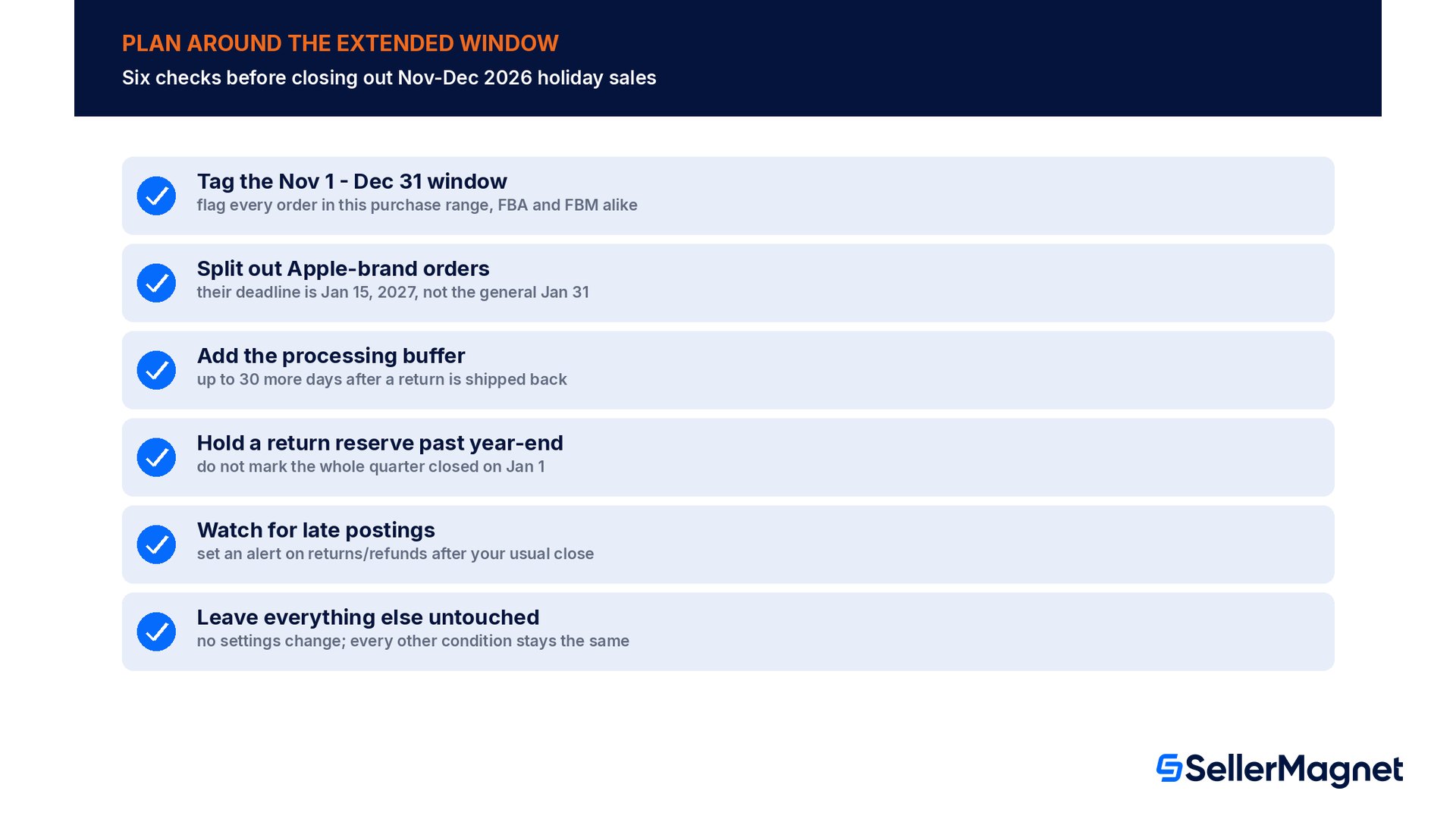
Account for the 2026 extended holiday return window
Tag the purchase window - Flag every order with a purchase date from November 1 through December 31, 2026 as inside the extended-return period, across both FBA and FBM.
Split Apple-brand orders out - Give Apple-brand (and Boost Infinite-brand) orders their own shorter deadline, January 15, 2027, instead of the general January 31 date.
Add the processing buffer - Plan against the full worst case, the return window plus up to 30 more days for Amazon to receive and process a return, rather than the return deadline alone.
Hold a return reserve past year-end - Keep a return-risk estimate against this window's revenue instead of marking the whole quarter closed on January 1, since a refund can still land in February or March 2027.
Watch for late postings - Set an alert on returns and refunds that post after your usual month-end close, so a January or February return against a November sale is caught instead of discovered during reconciliation.
Leave the rest of your process untouched - No listing, settings or Seller Central configuration change is required; the extension is automatic, and every other return condition and exception stays exactly as published.
What is Amazon's 2026 extended holiday return window?
Items purchased on Amazon.com between November 1 and December 31, 2026 can be returned through January 31, 2027, instead of the standard 30-day window. Apple-brand products purchased in the same period follow their own shorter deadline, January 15, 2027. Amazon states the extension applies automatically to every item, FBA or FBM, with no seller action required.
Does the extended window apply to FBA orders, FBM orders, or both?
Both. The announcement is explicit: the extension "automatically applies to all items that you sell on Amazon.com, regardless of whether you use Fulfillment by Amazon (FBA) or Merchant (FBM)." There is no separate opt-in or setting for either fulfillment method, and a mixed catalog does not need to treat the two groups differently.
Does every order purchased in November get the same number of extra days?
No. The deadline itself is fixed at January 31, 2027 for most items, so the extra time depends on when the order was placed. A November 1 purchase gains roughly 61 extra days beyond its normal deadline, while a December 31 purchase gains only about 1 day, since its normal 30-day deadline would already fall close to January 31.
Why do Apple products have a different deadline?
Apple-brand (and Boost Infinite-brand) products already follow a separate, shorter 15-day standard return window year-round rather than the general 30-day window. The 2026 holiday extension keeps that distinction: Apple-brand purchases from the same November 1-December 31 period get their own shorter extended deadline, January 15, 2027, rather than the general January 31 date.
Does the return window include the time it takes to get my refund?
No, they are two separate clocks. The return window only governs the deadline for sending an item back. Amazon states a return can take up to 30 days to be received and processed, and the refund then follows its own payment-method timeline on top, from 2-3 hours for a gift card up to 30 days for a prepaid card.
Do I need to change any settings to apply this policy?
No. Amazon states the extension applies automatically with no action required from sellers. There is nothing to enable in Seller Central, no shipping-template field, and no listing-level setting that changes the deadline; every eligible order from the November-December window is covered the same way regardless of your account configuration.
Are there items excluded from the normal return rules that this policy does not change?
Yes. The announcement states existing return and refund conditions remain otherwise unchanged, so the standard exceptions table still applies underneath the holiday extension: 7 days for certain Kindle Store digital purchases, 15 days for Apple/Boost Infinite-brand items and Amazon Haul items over $3, and 90 days for select Amazon Renewed products and most nonperishable baby products.
Is this a one-time 2026 policy or a recurring one?
Amazon's customer-facing Return Policy page states directly, "This policy will apply every year," framing the holiday extension as a standing seasonal rule rather than a one-off exception created for 2026 alone. The exact purchase window and deadline dates shift slightly each year to match that year's calendar, so check the published dates each November instead of reusing this year's.
Stop Juggling Tools. SellerMagnet Combines Everything You Need.