Buy with Prime Pricing 2026: The New $0.30 Minimum Fee, Explained
R
RenéFreelance Amazon Editor
|
12 min read
Last updated: Nov 02, 2026
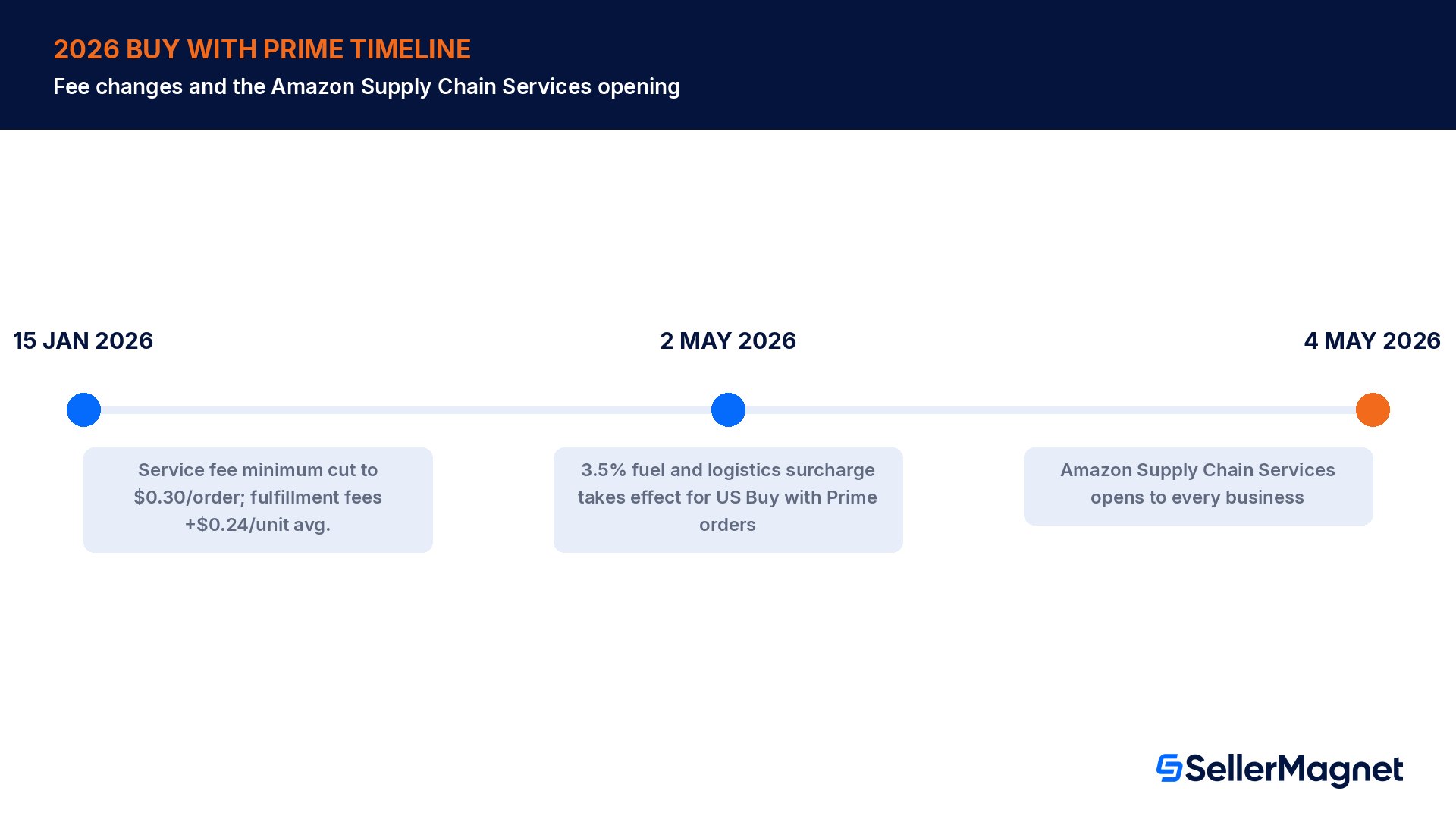
Buy with Prime's pricing changed twice in 2026, and the two changes point in opposite directions on a small order. On 15 Jan 2026 Amazon cut the Prime service fee's per-order minimum from $1.00 to $0.30, which lowers the fee on every order under $33.33, while fulfillment fees rose by an average of $0.24 per unit the same day. Then, on 4 May 2026, Amazon launched Amazon Supply Chain Services, the logistics business Buy with Prime is now part of, and opened it to every business, including ones that have never listed a single product on Amazon.com; Buy with Prime itself still needs a US-based entity. This guide works through Amazon's own Buy with Prime pricing page and the Seller Central fee-changes summary, walks five worked examples on exactly where the new $0.30 minimum helps and by how much, and lays out what a brand needs, and does not need, to qualify now.
Amazon cut the Buy with Prime service fee's per-order minimum from $1.00 to $0.30 on 15 January 2026, which lowers the fee on every order under $33.33. The same day, fulfillment fees rose by an average of $0.24 per unit. On 4 May 2026, Amazon launched Amazon Supply Chain Services, the logistics business Buy with Prime is now part of, and opened it to every business, including ones that have never sold on Amazon.com, though Buy with Prime itself still needs a US-based entity, an MCF account, a Professional Seller Central account and Amazon Pay.
What changed in Buy with Prime pricing on 15 January 2026?
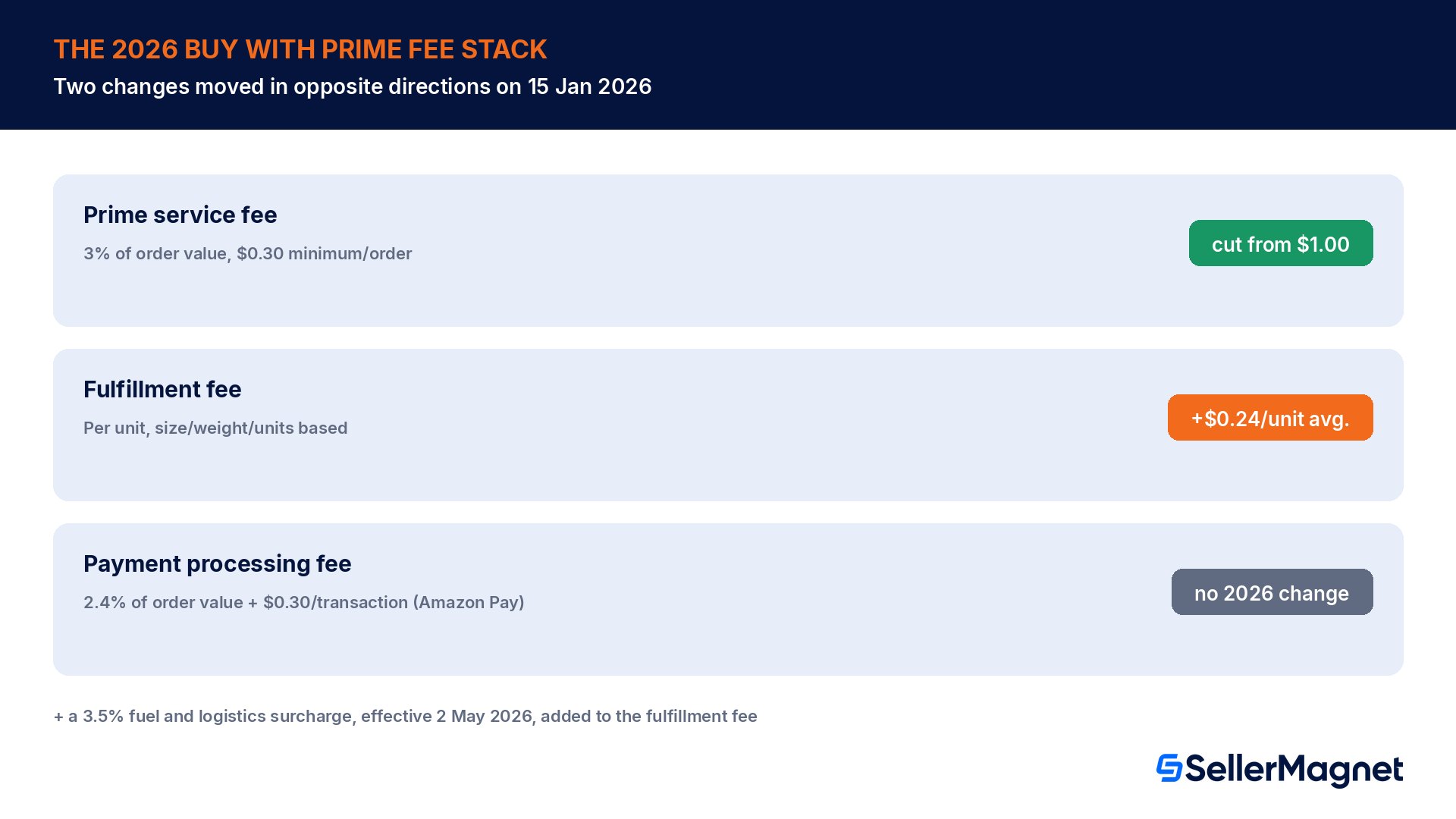
Buy with Prime's pricing has three parts: a Prime service fee, a per-unit fulfillment fee, and a payment processing fee. Amazon's pricing page states the service fee as 3% of each order's value, excluding taxes, with a minimum of $0.30 per order. That $0.30 figure is new. Before 15 Jan 2026 the minimum was $1.00 per order; the Seller Central 2026 US Referral and FBA fee changes summary and Buy with Prime's own pricing FAQ both confirm the cut, effective 15 Jan 2026 alongside the broader 2026 FBA fee update.
Fee component
What it covers
2026 change
Prime service fee
3% of order value (excluding tax), charged per order
Minimum cut from $1.00 to $0.30 per order, effective 15 Jan 2026
Fulfillment fee
Per-unit pick, pack, ship and returns cost, varies by size, weight and units per order
Increased by an average of $0.24 per unit, effective 15 Jan 2026; unchanged for orders of 3+ units in small and large standard-size categories
Payment processing fee
2.4% of order value plus $0.30 per transaction with Amazon Pay, or the ecommerce platform's own processor
No 2026 change reported on Amazon's pricing page
Source: Buy with Prime pricing and 2026 US Referral and FBA fee changes summary. A 3.5% fuel and logistics surcharge on fulfillment fees took effect for US Buy with Prime orders on 2 May 2026, per Amazon's fuel and logistics surcharge notice; the Buy with Prime pricing FAQ calls it a temporary surcharge on fulfillment fees, so it raises the fulfillment fee itself and is not a new line item on top of the service fee.
Two 2026 changes moved in opposite directions on a small order
The $1.00 to $0.30 minimum cut lowers the service fee on low-value orders, but the average $0.24 per-unit fulfillment fee increase went into effect the same day. On a single-unit order, the two partly offset each other rather than simply adding up to a win or a loss; the worked examples below size both sides together.
How much does the $0.30 minimum actually save, and at what order size?
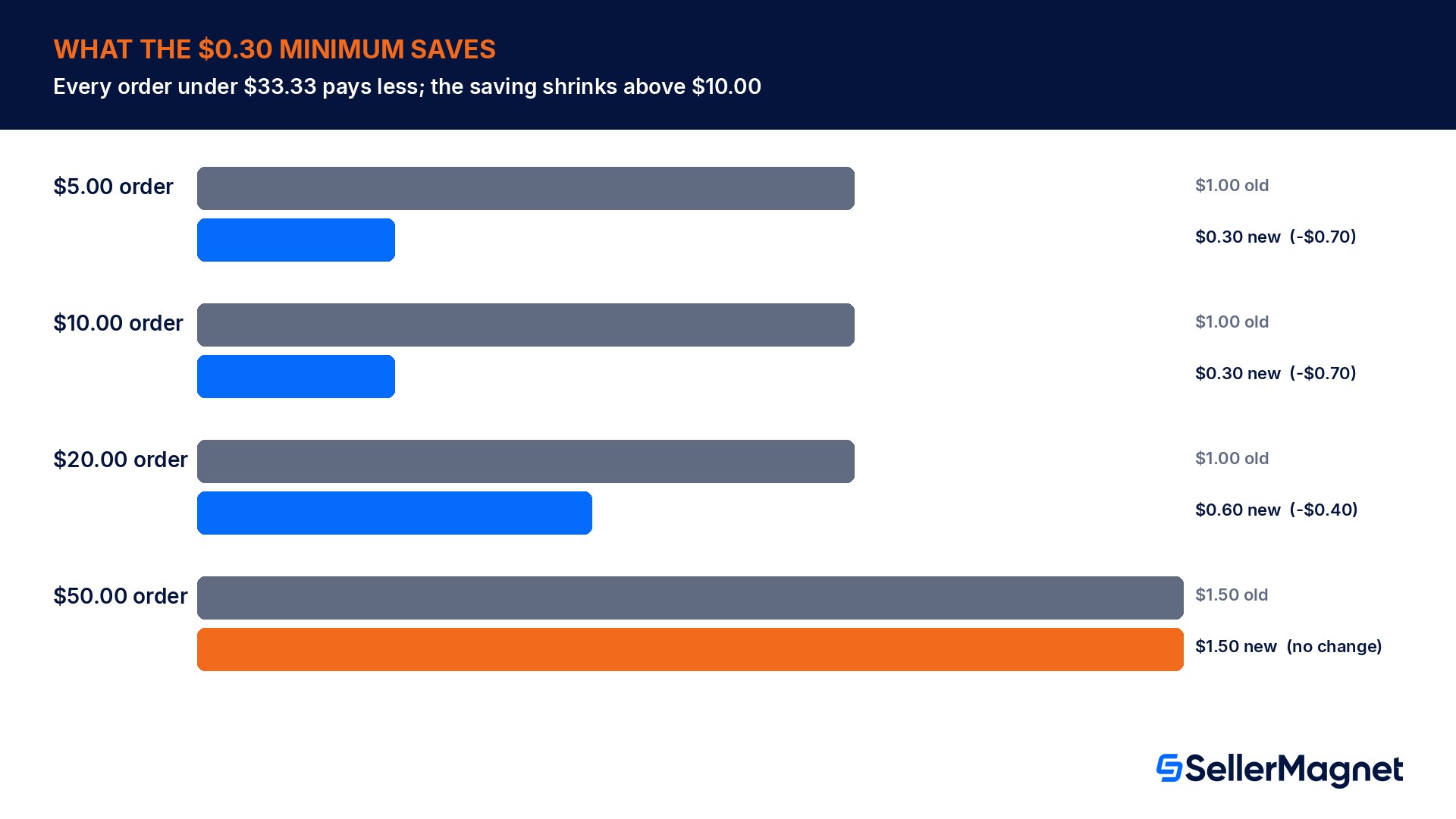
The service fee is always the greater of the 3% calculation or the applicable minimum. Under the old $1.00 minimum, any order under $33.33 (the break-even where 3% of the order equals $1.00) paid a flat $1.00, regardless of whether it was a $1.00 order or a $30.00 order. Under the new $0.30 minimum, that flat floor only holds up to $10.00; above that, the order pays the real 3% rate, which is less than $1.00 all the way up to $33.33. The result: every order under $33.33 pays less than before, the saving is a constant $0.70 for any order at or below $10.00, and it shrinks steadily to $0 as the order approaches $33.33.
Order value
3% calculation
Old service fee (at $1.00 min.)
New service fee (at $0.30 min.)
Saving
$5.00
$0.15
$1.00
$0.30
$0.70
$10.00
$0.30
$1.00
$0.30
$0.70
$20.00
$0.60
$1.00
$0.60
$0.40
$50.00
$1.50
$1.50
$1.50
$0.00
The pattern: every order at or above $50.00 already sat above the old $33.33 break-even, so the 3% calculation was always the binding number and the minimum cut changes nothing for it. Every order under $33.33 pays less: the full $0.70 saving up to $10.00 (worked example 3's $5.00 order included), then a shrinking saving as the order rises toward $33.33, exactly as the $10.00 and $20.00 rows above show.
Worked example: the fulfillment fee increase can offset the service fee saving
The $0.24 per-unit fulfillment fee increase landed on the same date as the service fee cut, so a single-unit order's net change is the two added together, not the service fee saving alone. On a $15.00 order, the service fee drops from $1.00 to $0.45, a $0.55 saving, but the average $0.24 fulfillment fee increase eats almost half of that, leaving a net saving of only $0.31 on the order, not the full $0.55.
Line
Amount
Order value
$15.00
Service fee saving (old $1.00 min. vs. new $0.30 min.)
+ $0.55
Average fulfillment fee increase, 1-2 unit order
- $0.24
Net change on this order
+ $0.31
Amazon's own FAQ notes fulfillment fees "will remain unchanged for orders containing 3 or more units in small and large standard-size categories," so a multi-item order sidesteps the fulfillment fee increase entirely while still getting the full service fee saving; a single-unit order gets both effects, partly cancelling out. Running both sides of the fee stack together, not just the headline minimum cut, is what gives an accurate landed-cost number. FBA Fees 2026 covers the equivalent fulfillment-fee changes for standard FBA orders sold on Amazon.com, for a seller comparing both channels side by side. These are the 2026 Peak Rate Card figures, in effect from 15 Oct 2026 to 14 Jan 2027; a post dated 2 Nov 2026 sits inside that peak window, so the numbers above are the ones that apply right now, not a separate off-peak rate.
Who can use Buy with Prime now, and what changed on 4 May 2026?
Buy with Prime's requirements page answers "Can I offer Buy with Prime for my products exclusively on my ecommerce site, without having to sell them on Amazon?" with a direct "Yes": a brand does not need active Amazon.com listings to run Buy with Prime on its own site. What changed on 4 May 2026 is the business behind it: Amazon launched Amazon Supply Chain Services (ASCS), the logistics business Buy with Prime is now part of, and opened it to every business, not only companies that were already selling on the Amazon marketplace. Buy with Prime itself still requires a US-based entity; that rule did not change.
Requirement
Still required in 2026?
Notes
Active Amazon.com listings
No
A brand can sell exclusively on its own site; Amazon.com presence is optional
US-based business entity
Yes
Buy with Prime remains available only to businesses with a United States-based entity authorized to do business, unchanged by the 4 May 2026 ASCS opening
Professional Seller Central account
Yes
Needed to import the product catalog into the Buy with Prime catalog, even with no live Amazon.com listings
MCF (Multi-Channel Fulfillment) account
Yes
Inventory must sit in Amazon fulfillment centers; MCF fulfills the off-Amazon orders
Amazon Pay account
Yes
Shoppers check out using their stored Amazon shipping and payment details through Amazon Pay
Source: Requirements to set up Buy with Prime checkout and Amazon's Amazon Supply Chain Services launch. The practical effect of the 4 May 2026 change is scale, not a new rule: a company that has never touched the Amazon marketplace can now go through the same ASCS onboarding path as an existing FBA seller, open an MCF account, send inventory to Amazon's fulfillment centers, connect Amazon Pay, and launch Buy with Prime checkout on its own ecommerce site, without ever listing a product on Amazon.com, as long as its business entity is US-based. A seller who only wants the Prime delivery badge, not the full checkout and returns handoff, has a cheaper option since 24 Sep 2026: MCF merchants can add Prime delivery as a shipping option on their own site at no additional cost, while keeping their existing checkout, payments and customer service.
"No Amazon.com listings" does not mean "no Amazon account"
A brand that skips Amazon.com entirely still creates a Professional Seller Central account, because that is how the product catalog gets imported into Buy with Prime and linked to Amazon's fulfillment network. Reading only the "you don't need to sell on Amazon" answer and skipping Seller Central setup is the most common onboarding mistake for a brand new to the ASCS ecosystem.
Compare the Amazon.com side of the same product before assuming the new fee stack is a win. To see the same product's Amazon.com economics next to it, SellerMagnet's Fee Calculator shows its FBA vs FBM fees, referral fee, profit and ROI for any ASIN with 5 free lookups a day, and Analytics shows every Amazon fee from your settlements next to your profit per order, so a fee change like this one shows up in the numbers instead of being guessed at.
What mistakes do sellers make with the 2026 Buy with Prime pricing change?
Thinking the $1.00 to $0.30 minimum cut only helps orders between $10.00 and $33.33, when every order under $33.33 pays less, including the full $0.70 saving on anything at or below $10.00.
Counting the service fee saving without netting it against the same-day average $0.24 per-unit fulfillment fee increase, which can erase almost half the saving on a single-unit order.
Assuming a brand with no Amazon.com listings needs no Amazon account at all; a Professional Seller Central account, an MCF account and Amazon Pay are still required even with zero Amazon.com presence.
Confusing the 4 May 2026 Amazon Supply Chain Services opening with a pricing change, or assuming it dropped the US-entity requirement; it widened who can qualify, the fee stack and the US-entity rule stayed the same.
Treating the 3.5% fuel and logistics surcharge that started 2 May 2026 as a separate fourth line item; it is added directly to the fulfillment fee, not a new charge stacked on top of the whole fee stack.
Forgetting that multi-unit orders (3 or more units in small and large standard-size categories) kept their 2025 fulfillment fee, so a bundled or multi-item order can avoid the fulfillment fee increase entirely while still getting the service fee saving.
How to check the current Buy with Prime fee stack for your own orders
Check the 2026 Buy with Prime fee stack
Calculate the 3% service fee on the real order value - Multiply the order value (excluding tax) by 3%; compare it to the $0.30 minimum and charge whichever is greater.
Check the per-unit fulfillment fee for the product's size tier and units per order - Look up the current fulfillment fee on the rate card; orders of 3 or more units in small and large standard-size categories kept their pre-2026 rate.
Add the 3.5% fuel and logistics surcharge where it applies - This surcharge, effective 2 May 2026, is added to the fulfillment fee itself, not charged as a separate line on the service fee.
Confirm eligibility against the current requirements, not an old note - A US-based entity, a Professional Seller Central account, an MCF account with inventory in Amazon's fulfillment centers, and Amazon Pay; active Amazon.com listings are not required.
What is the new Buy with Prime service fee minimum?
The Prime service fee minimum dropped from $1.00 to $0.30 per order on 15 Jan 2026. The service fee itself stayed at 3% of the order value excluding tax; only the floor beneath it changed, so every order under $33.33 now pays less than before.
Did Buy with Prime fulfillment fees go up or down in 2026?
Up, on average: fulfillment fees rose by an average of $0.24 per unit on 15 Jan 2026, the same day the service fee minimum was cut. Fulfillment fees stayed unchanged for orders of 3 or more units in the small and large standard-size categories.
Can I use Buy with Prime without selling on Amazon.com?
Yes. A brand can offer Buy with Prime exclusively on its own ecommerce site with no active Amazon.com listings. It still needs a Professional Seller Central account to import its catalog, an MCF account with inventory in Amazon's fulfillment centers, and an Amazon Pay account; only the Amazon.com listing itself is optional.
What changed on 4 May 2026 for Buy with Prime eligibility?
Amazon launched Amazon Supply Chain Services (ASCS), the logistics business Buy with Prime is now part of, and opened it to every business, not only existing Amazon sellers. It widened eligibility for the required MCF account and fulfillment-center inventory; it did not drop the US-entity requirement or the "no Amazon.com listings needed" rule, both unchanged.
Is the 3.5% fuel surcharge part of the Prime service fee?
No. The fuel and logistics surcharge, effective 2 May 2026 for US Buy with Prime orders, is added to the fulfillment fee itself, not the 3% Prime service fee.
Does the lower minimum help every order?
It helps every order under $33.33, though by different amounts: the full $0.70 saving on any order at or below $10.00, a shrinking saving between $10.00 and $33.33, and no change at $33.33 or above, where the 3% calculation was already higher than either minimum.
Stop Juggling Tools. SellerMagnet Combines Everything You Need.