Amazon 1099-K Tax Reporting 2026: What Actually Applies
R
RenéFreelance Amazon Editor
|
15 min read
For three straight years, every Amazon seller tax thread repeated the same warning: starting next year, you will get a 1099-K for anything over $600. It never actually happened at the federal level. In July 2025, the One, Big, Beautiful Bill Act (OBBBA) retroactively killed the $600 phase-in and restored the original $20,000-and-200-transaction threshold, backdated to the 2022 tax year. So heading into the 2026 filing season, most small and mid-size Amazon sellers will not receive a Form 1099-K from Amazon at all, and that is the correct, current rule, not a loophole. This guide walks through exactly how Amazon calculates the threshold, where to find the form if you do cross it, why the number on it almost never matches your bank deposits, which states still require a 1099-K at a much lower bar, and what triggers the one real trap in this whole system: 24% backup withholding on every payout.
Amazon is required to send you a Form 1099-K only if your unadjusted gross sales exceed $20,000 and you had more than 200 transactions in the calendar year; both conditions must be true. The One Big Beautiful Bill Act restored this threshold in July 2025, cancelling the lower $600 phase-in that media coverage had widely announced for 2026. The amount reported is your unadjusted gross sales (what buyers paid, including tax and shipping, before fees and refunds), not your bank deposit or your profit. Some states, such as Massachusetts and Illinois, require a 1099-K at a lower state-only threshold regardless of the federal rule.
Will I get a 1099-K? The threshold that actually applies
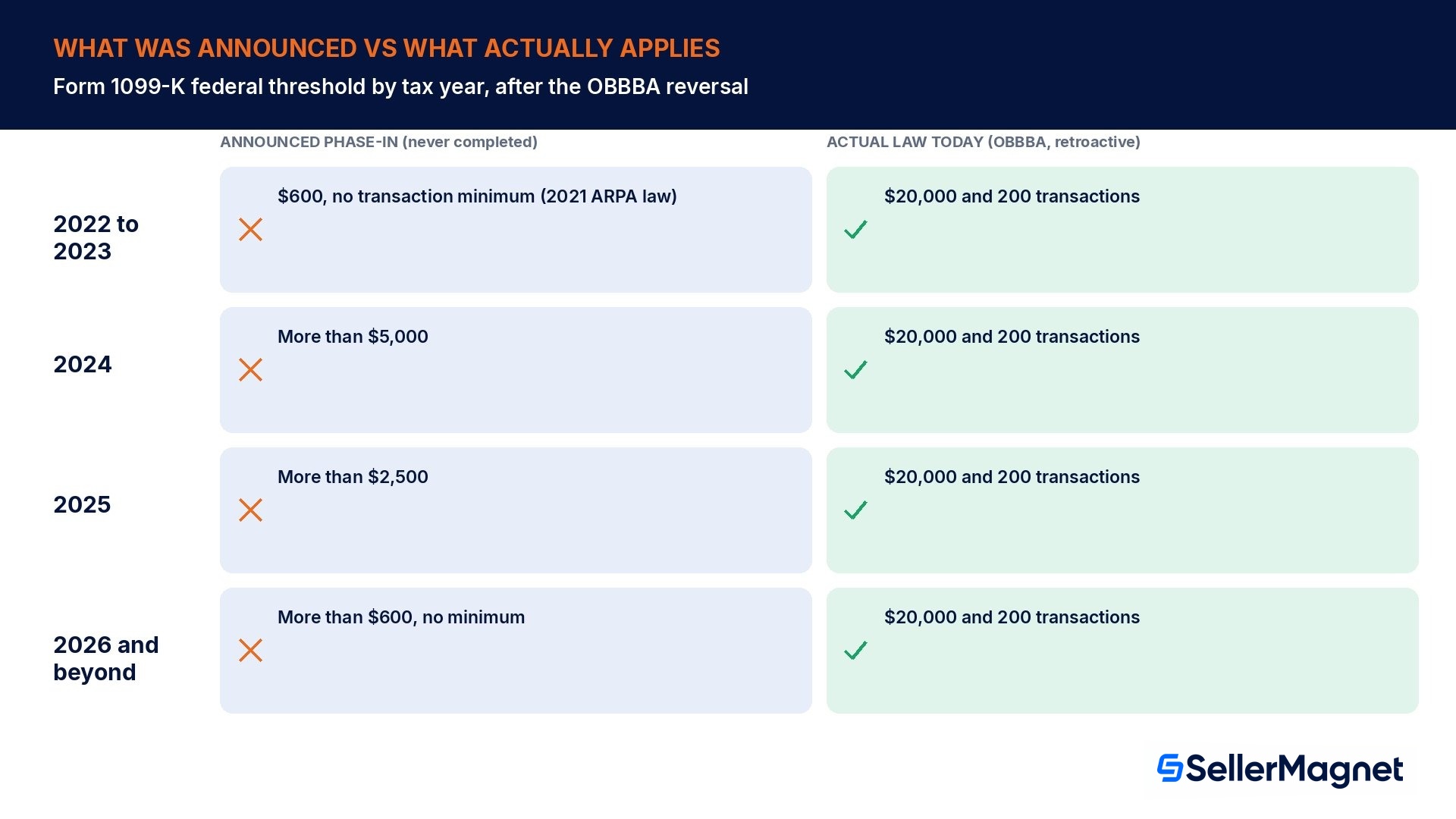
Form 1099-K has existed since 2011 at a stable $20,000-and-200-transaction threshold. In 2021, the American Rescue Plan Act (ARPA) scrapped that threshold entirely and set it at a flat $600 with no transaction minimum, intended to take effect for the 2022 tax year. The IRS delayed that change twice, then in November 2024 announced a phased-in compromise: more than $5,000 for 2024, more than $2,500 for 2025, and more than $600 for 2026 and every year after. Every seller tax guide published between 2022 and mid-2025 repeats some version of that phase-in table, and most of it is now wrong.
On July 4, 2025, the One, Big, Beautiful Bill Act became law. Section 70432 repealed the ARPA change outright and reinstated the original $20,000-and-200-transaction threshold, applied "as if included in" the original 2021 law, which the IRS confirmed in Fact Sheet 2025-08 (October 23, 2025) makes the reversal retroactive to the 2022 tax year. In practice, this means the $5,000-for-2024 and $2,500-for-2025 phase-in steps never actually took effect in the way sellers were told to expect, and the $600-for-2026 step that countless articles still describe as current law was cancelled before a single tax year ever used it.
Tax year
What the 2024 phase-in announcement said
What actually applies after OBBBA
2022 and 2023
$600, no transaction minimum (per the original 2021 ARPA law)
$20,000 and more than 200 transactions (OBBBA, retroactive)
2024
More than $5,000
$20,000 and more than 200 transactions
2025
More than $2,500
$20,000 and more than 200 transactions
2026 and beyond
More than $600, no transaction minimum
$20,000 and more than 200 transactions, not adjusted for inflation
Both tests have to be met, not just one
The IRS instructions for Form 1099-K spell out an AND, not an OR: a third-party settlement organization must report "if, in a calendar year, both of the following are met: 1. Over $20,000 in total amount of payments. 2. Over 200 in total number of transactions." A seller with $45,000 in gross sales across 60 orders does not cross the threshold. A seller with $8,000 in gross sales across 260 small orders does not cross it either. Amazon can still choose to send a form at lower amounts, but it is not required to.
What does Amazon actually count? Unadjusted gross sales
The number that matters for the threshold, and the number that lands in Box 1a if you do get a form, is unadjusted gross sales. Amazon's own tax FAQ defines it exactly: "the total sales, unadjusted for fees or refunds... the amount the buyer paid for an order even if the order is later refunded," and separately, "Unadjusted gross sales equal the amount the buyer paid for the order and includes sales proceeds, sales tax, and gift-wrap and shipping charges." The IRS instructions for Form 1099-K use almost identical language for Box 1a: "the total dollar amount of total reportable payment transactions for each participating payee without regard to any adjustments for credits, cash equivalents, discount amounts, fees, refunded amounts, shipping amounts, or any other amounts."
That one definition explains most of the confusion sellers have about this form. It is not your revenue in the accounting sense, and it is not close to your bank deposit. Four categories of money a seller never actually keeps are baked into the gross figure: sales tax Amazon collected and remitted on the buyer's behalf, gift-wrap charges, shipping charges the buyer paid, and the full sale price of every order that was later refunded. None of those are subtracted before the threshold test runs or before the number prints on the form.
Where do I find my 1099-K in Seller Central?
If you cross the threshold, Amazon makes the form available on or before January 31 of the following year, both by mail to the address on file in your tax interview and electronically if you consented to electronic delivery. To pull it yourself: sign in to Seller Central as the primary account user (only the primary user can access the Tax Document Library), open the Reports menu (see our guide to where every tool moved in the new Seller Central if the menu looks unfamiliar), select Tax Document Library, choose the relevant tax year, then select Form 1099-K and Download PDF. The PDF download is password protected; Amazon's help pages confirm the password format separately in the same help flow. If you manage multiple selling accounts, note that Amazon aggregates unadjusted gross sales and transaction counts across accounts under the same tax identity, not per individual Seller Central login, so a group of small accounts under one EIN can combine to cross the threshold even if no single account does alone.
No form does not mean no reporting obligation
The IRS says this plainly in its own consumer guidance: "No matter the amount of reported payments, if you receive payments for selling goods or services, you must report all income on your tax return," and separately, "Whether or not you receive a Form 1099-K, you must still report any income on your tax return." Form 1099-K is an information return that helps the IRS cross-check reported income; it was never the legal basis for owing tax on that income in the first place.
The gross-to-deposit gap: a worked reconciliation
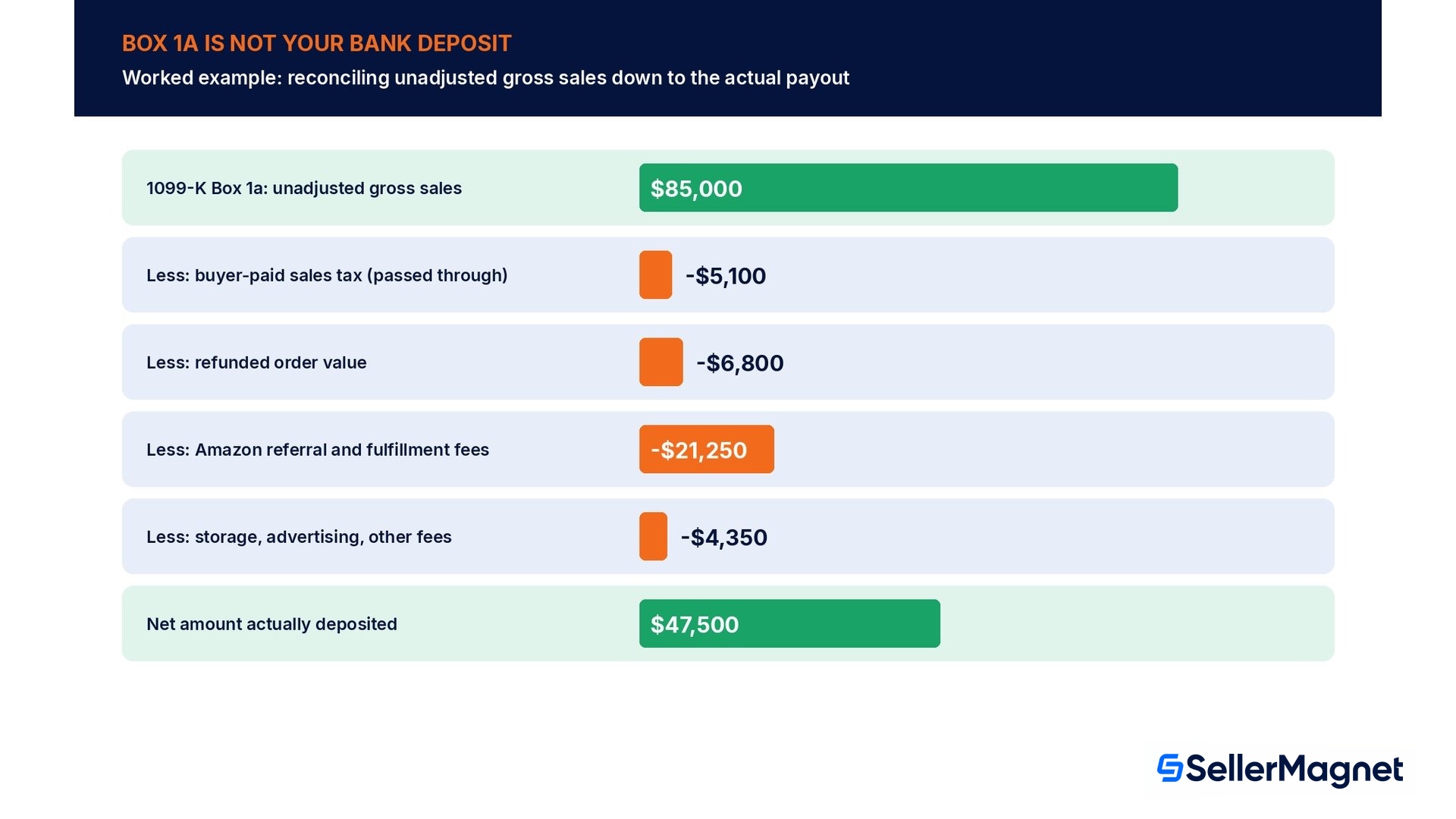
Picture a seller whose Box 1a for the year reads $85,000. That number is the full unadjusted gross sales figure: every order's buyer-paid total, tax and shipping included, with no subtraction for refunds, fees or anything Amazon deducted before paying out. Walking from that figure down to what actually hit the seller's bank account over the same period looks nothing like a flat percentage cut.
Line item
Amount
Why it is not in the bank deposit
1099-K Box 1a: unadjusted gross sales
$85,000.00
Full buyer-paid amount on every order, refunded or not
Less: buyer-paid sales tax (collected and remitted by Amazon)
-$5,100.00
Never belonged to the seller; passes through to the state
Less: refunded order value (full price of returned/cancelled orders)
-$6,800.00
Buyer paid it, then got it back; Box 1a never adjusts for this
Less: Amazon referral and FBA fulfillment fees
-$21,250.00
Deducted before payout, never touches the seller's bank account
Less: FBA storage, advertising and other seller-paid charges
-$4,350.00
Also deducted inside the settlement, before the deposit
Net amount actually deposited for the year
$47,500.00
This is the figure that should match the seller's own books
The $85,000 on the form is correct, and the $47,500 the seller actually banked is also correct; they are simply answering two different questions. The 1099-K answers "how much did buyers pay through this platform," which is the number the IRS uses to cross-check reported gross receipts. A seller's own profit-and-loss statement, the same kind of reconciliation behind our FBA profit margin calculator, answers "how much did I actually keep," after the seller's bookkeeping correctly removes pass-through sales tax, nets out refunds, and deducts every Amazon fee as a business expense. Handing a bookkeeper or a tax preparer the 1099-K number alone, without that reconciliation, is how sellers end up reporting gross sales as if it were taxable income and overpaying.
Could your state's threshold be lower than the federal one?
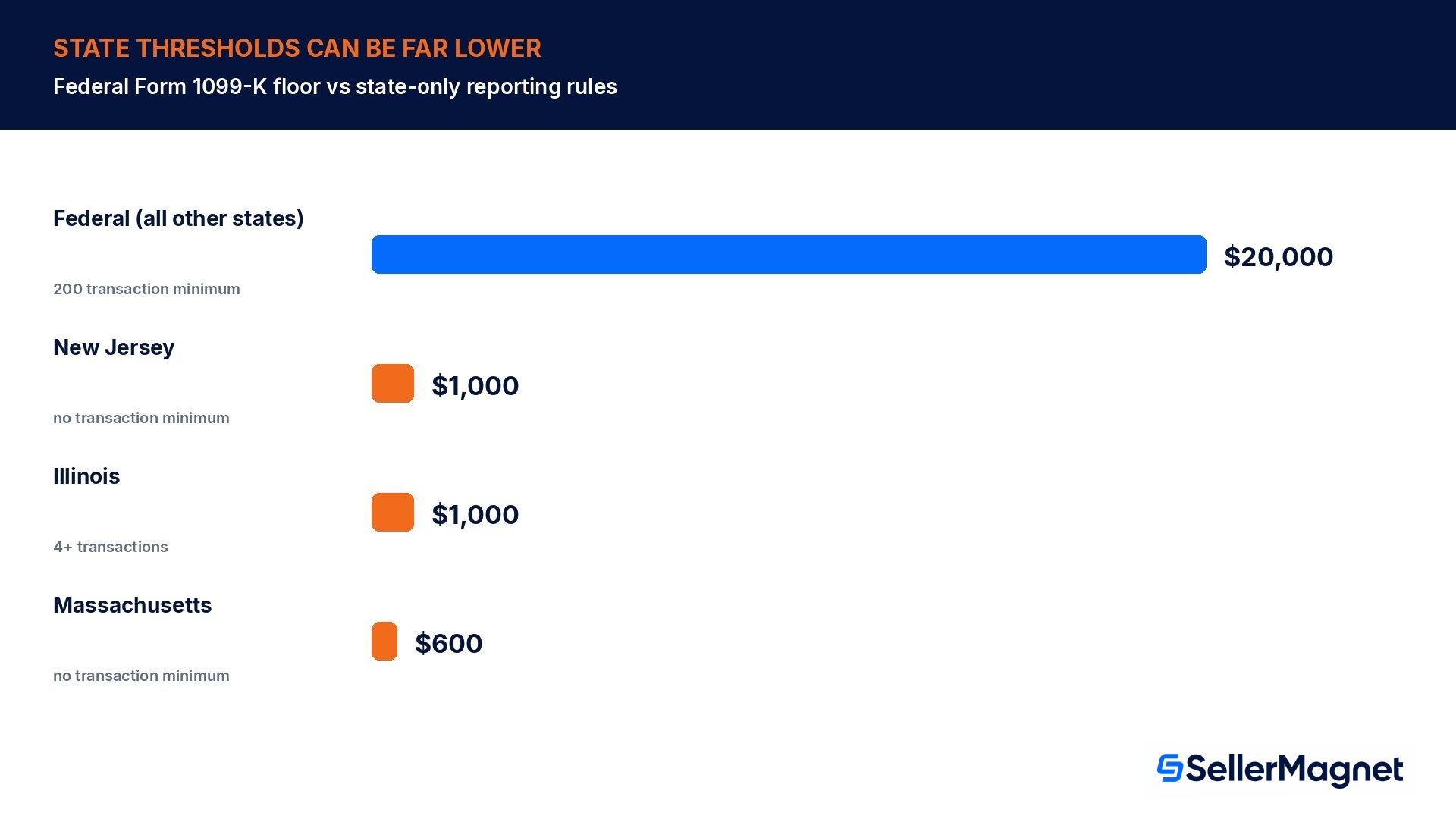
The federal $20,000-and-200-transaction rule only sets the floor for when a TPSO like Amazon must send a 1099-K under federal law. States are free to set their own, separate threshold for state information reporting, and several have done so at levels far below the federal bar. The IRS's own October 2025 fact sheet acknowledges this directly: "Your state may have a lower reporting threshold for TPSOs, which could result in you receiving a Form 1099-K, even if the total gross payments and transactions did not exceed the federal reporting threshold."
State
State-only 1099-K threshold
Transaction minimum
Massachusetts
$600
None
Illinois
more than $1,000
4 or more transactions
New Jersey
$1,000 or more (general Form 1099 filing rule)
None
All other states
Follow the federal threshold
$20,000 and 200 transactions
Check your own state before assuming you are exempt
This table covers the clearest, most consistently documented cases; several other states have lower or legally ambiguous thresholds that are being actively reinterpreted as other federal reporting dollar amounts change, so treat any number you read online, including the ones in this table, as a starting point and confirm the current figure on your own state's department of revenue website before you decide a 1099-K will not apply to you.
Why would Amazon withhold 24% of my payout?
Separately from whether you cross the reporting threshold, every seller account has to pass Amazon's tax identity interview: a legal name, entity classification and Taxpayer Identification Number (EIN, SSN or ITIN) that match IRS records exactly. Amazon's own tax identity FAQ is explicit about the consequence of getting this wrong: "If your tax identity information came back invalid, you have 30 days from the date of the email from Amazon to correct it. If you don't provide corrected information within 30 days, your Amazon account privileges will be suspended." A mismatch commonly comes from a misspelled legal name, a name that does not match the EIN exactly as the IRS issued it, or a status shown as REGISTRATION_INCOMPLETE because the TIN and legal name combination failed IRS validation.
The IRS side of the same problem is backup withholding, governed by IRC section 3406. When a payer like Amazon does not have a valid TIN on file, or the IRS flags the TIN it has as incorrect, the payer is required to withhold 24% of every reportable payment and remit it to the IRS, starting immediately and continuing until the payee supplies a correct, certified TIN. This is not a penalty charged after the fact; it is cash held back from a seller's own payout, every single disbursement, for as long as the mismatch is unresolved. The IRS's guidance on stopping it is equally direct: correct withholding generally stops within 30 calendar days of the payer receiving a valid, certified Form W-9 or TIN validation.
Reconciling Box 1a against real deposits is exactly the kind of settlement-report math that is easy to get wrong by hand.Analytics pulls directly from Amazon's own Settlement and Payments reports, so sales tax, refunds and every Amazon fee are already broken out and netted against gross sales before you hand anything to a bookkeeper, instead of reconciling a 1099-K's single gross figure against bank deposits line by line.
Worked example: does this seller cross the threshold?
A seller runs two Amazon storefronts under the same EIN: a US store with $18,400 in unadjusted gross sales across 340 orders for the year, and a UK store that converts to roughly $9,100 in unadjusted gross sales across 85 orders. Looked at individually, neither store appears to cross $20,000. But Amazon aggregates unadjusted gross sales and transaction counts by tax identity, not by individual Seller Central account, so the combined total is $27,500 in gross sales across 425 transactions. Both federal thresholds are exceeded (over $20,000 and over 200 transactions), so Amazon is required to issue one Form 1099-K reflecting the combined gross sales figure, not two separate forms under each store. If that same seller's registered address happened to be in Massachusetts, the $600 state threshold with no transaction minimum would have made a form mandatory anyway, long before the federal totals from either store individually mattered at all.
Common mistakes sellers make with this form
Assuming the $600 threshold that was announced for 2026 is still current law; it was repealed by the OBBBA in July 2025 before it ever applied to a real tax year.
Treating Box 1a as taxable income or profit, instead of the unadjusted gross sales figure it actually is, which still includes sales tax, shipping, gift-wrap charges and refunded orders.
Checking only one Seller Central account's totals against the threshold when multiple accounts share the same tax identity; Amazon aggregates across accounts under one EIN or SSN.
Assuming no 1099-K means no reporting obligation; every dollar of business income is reportable on your tax return regardless of whether a form was issued.
Ignoring a REGISTRATION_INCOMPLETE or rejected tax interview notice past the 30-day window, which risks both account suspension and 24% backup withholding starting on every payout.
Skipping the state-threshold check; a seller based in Massachusetts, Illinois or New Jersey can be legally required to receive and report a 1099-K at a fraction of the federal dollar amount.
Pre-filing checklist for 2026
Pull your unadjusted gross sales and transaction count for the year from Seller Central's Tax Document Library or Date Range Reports, across every account under your tax identity, not just one storefront.
Check it against $20,000 and 200 transactions; both conditions have to be true for the federal threshold to apply.
Check your state's own 1099-K threshold separately; do not assume the federal number is the only one that matters.
If you expect or receive a 1099-K, reconcile Box 1a down to your actual bank deposits before reporting anything, removing sales tax, refunds and every Amazon fee.
Confirm your tax interview status shows no pending or rejected flag; a mismatch risks both account suspension and 24% backup withholding.
Report all business income on your tax return regardless of whether a 1099-K arrives; the form is a cross-check tool for the IRS, not the source of the filing requirement.
How to check your own 1099-K status before year-end
Check whether you will cross the 1099-K threshold and reconcile the figure if you do
Pull your gross sales total - In Seller Central, go to Reports, then Tax Document Library (or Date Range Reports for a custom period), and total your unadjusted gross sales and transaction count for the calendar year across every account under your tax identity.
Apply both federal tests - Confirm whether the total exceeds $20,000 AND whether transactions exceed 200; a form is only federally required when both are true.
Check your state threshold - Look up your own state's current 1099-K dollar threshold; several states, including Massachusetts and Illinois, set the bar far lower than the federal rule.
Confirm your tax interview status - In Settings, Account Info, Business Information, Legal Entity, verify your legal name and TIN show no pending or rejected validation status.
Reconcile Box 1a if a form arrives - Subtract buyer-paid sales tax, refunded order value, and every Amazon fee from the gross figure to arrive at the deposit total your own books should show.
Report income either way - File your business income on your tax return whether or not a Form 1099-K was issued; the reporting obligation does not depend on receiving the form.
Will I get a 1099-K from Amazon if I sell under $600 a year?
Under the federal rule now in effect after the OBBBA, no. The federal threshold is $20,000 in unadjusted gross sales AND more than 200 transactions; both have to be exceeded. The $600 figure was a never-completed phase-in step that the OBBBA repealed in July 2025. A lower state threshold could still apply depending on where you are registered.
Does the 1099-K amount equal my taxable profit?
No. Box 1a is unadjusted gross sales, the full amount buyers paid including sales tax, gift-wrap and shipping, with no subtraction for refunds or Amazon fees. Your actual taxable profit comes from your own books after netting out those amounts and every legitimate business expense.
If I have two Amazon accounts, does Amazon check the threshold separately for each one?
No. Amazon aggregates unadjusted gross sales and transaction counts across every account tied to the same tax identity (EIN, SSN or ITIN), so combined totals across accounts can cross the threshold even when no single account does alone.
What happens if I do not receive a 1099-K at all?
Nothing changes about your tax filing obligation. The IRS requires you to report all business income on your tax return whether or not a Form 1099-K was issued; the form exists to help the IRS cross-check reported income, not to create the underlying reporting requirement.
What is backup withholding and why would Amazon withhold 24% of my payout?
Backup withholding applies when a payer does not have a valid, IRS-matching TIN on file for a payee. Amazon must withhold 24% of every reportable payment and send it to the IRS until a correct, certified TIN is provided, generally stopping within 30 calendar days of receiving the correction.
My state has a lower 1099-K threshold than the federal one. Does that mean I owe federal tax I did not owe before?
No. A state-only 1099-K threshold only affects whether a form is issued and reported at the state level; it does not change your underlying federal tax liability, which was already based on your actual income regardless of any form.
Where exactly do I download my 1099-K in Seller Central?
Sign in as the primary account user, open Reports, select Tax Document Library, choose the tax year, then select Form 1099-K and Download PDF. Only the primary user can access the Tax Document Library.
Is the $20,000-and-200-transaction threshold adjusted for inflation each year?
No. Per the IRS's 2026 Publication 1099, the Form 1099-K threshold is fixed at $20,000 and 200 transactions and is not subject to the annual inflation adjustment that applies to several other information-return thresholds.
Stop Juggling Tools. SellerMagnet Combines Everything You Need.