Amazon Posts 2026: The Free Brand Feed, Specs and Placement Explained
R
RenéFreelance Amazon Editor
|
11 min read
Amazon Posts is one of the Brand Registry benefits Amazon lists directly on its own brand-registry page: a way to "post engaging content at no cost in organic shopping feeds across the Amazon store." No campaign budget, no bidding, and no separate ad placement to buy; a brand simply needs to be enrolled in Brand Registry and follow a short list of image and content rules. That simplicity is also why it gets overlooked: a feature with zero cost and zero targeting knobs does not show up in a PPC dashboard, so many brand owners who qualify for it never check whether it is switched on. This guide works from Amazon's own Brand Registry page and its Posts ad policy page to lay out exactly who is eligible, the two image specs that actually matter (profile logo versus post image), where a published Post can surface across the Amazon store, the content rules that get a Post rejected, and what a brand owner should realistically expect it to do, since it is a discovery feature, not a performance-ad replacement.
Amazon Posts lets a Brand Registry-enrolled seller publish free, image-based content into shoppable feeds across the Amazon store, with no media cost and no bidding. A profile logo needs to be 1:1 at 640x640px minimum, and each post image needs an aspect ratio between 1:2 and 2:1 at 640x320px minimum, both JPG or PNG. Posts cannot contain review quotes, star ratings, requests for off-Amazon contact, pricing or promotional language, or a generic caption CTA like "Click Here"; a brand's own social handle and a clear, specific caption CTA are both allowed.
What Amazon Posts actually is, and what it costs
Amazon's own Brand Registry page lists Posts as one of several benefits unlocked once a brand is enrolled, described in Amazon's own words as the ability to "post engaging content at no cost in organic shopping feeds across the Amazon store." Amazon's separate Posts ad policy page frames the feature the same way: "Posts is a browse and discovery experience on Amazon focused on brand-shopping," built to help shoppers discover new products and see what's new from brands by browsing feeds of brand-curated content. Every Post links back to a product detail page, which is what makes each one shoppable, and every Post carries category tags so a shopper who taps one can keep browsing related Posts from other brands in the same category. None of this requires a campaign, an ad group or a daily budget; the cost is the time it takes to produce an image and a short caption that follow Amazon's rules.
Who is eligible: the Brand Registry prerequisite
Posts sits behind the same gate as A+ Content and several other brand-side benefits: Amazon's Brand Registry enrollment page states a brand needs a logo with the brand name permanently affixed to its products or packaging, plus a pending or registered trademark for that brand name or logo issued by a country with a matching Amazon store (see Amazon Brand Registry requirements for the full enrollment process). There is no separate application for Posts beyond Brand Registry itself; once a brand is approved, Posts becomes one of the benefits available to use, alongside A+ Content and Amazon's automated counterfeit and IP-violation protections. A seller who is not brand-registered, including most resellers and many private-label sellers still waiting on a trademark, cannot publish a Post at all; it is a brand-only surface, not a general seller tool.
The two image specs that actually matter
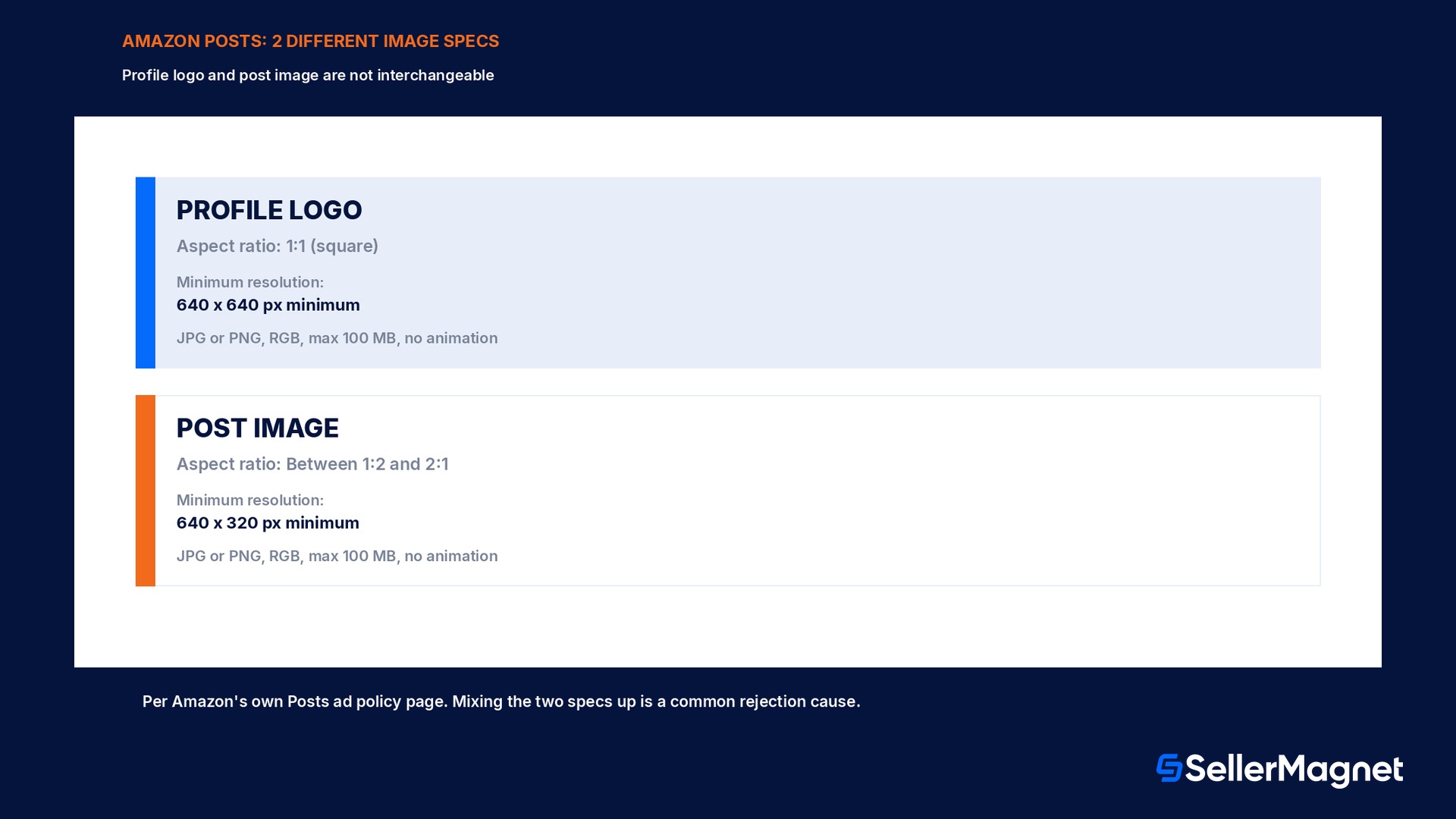
Amazon's Posts ad policy separates the creative into two distinct assets with two different specs, and mixing them up is one of the most common rejection causes reported by brand owners using the feature. The profile logo is fixed at a 1:1 aspect ratio; the post image itself has a much wider allowed range, between 1:2 and 2:1, which covers everything from a tall portrait crop to a wide landscape banner. Minimum resolution differs too: the logo needs at least 640x640 pixels, while the post image only needs 640x320 pixels or larger. Both assets accept JPG or PNG in RGB color format, cap out at 100 MB, and explicitly disallow any animation, so an animated GIF or a looping clip will not pass review in either slot.
Asset
Aspect ratio
Minimum resolution
Format
Profile logo
1:1 (square)
640 x 640 px or larger
JPG or PNG, RGB, max 100 MB, no animation
Post image
Between 1:2 and 2:1
640 x 320 px or larger
JPG or PNG, RGB, max 100 MB, no animation
Where a published Post actually shows up
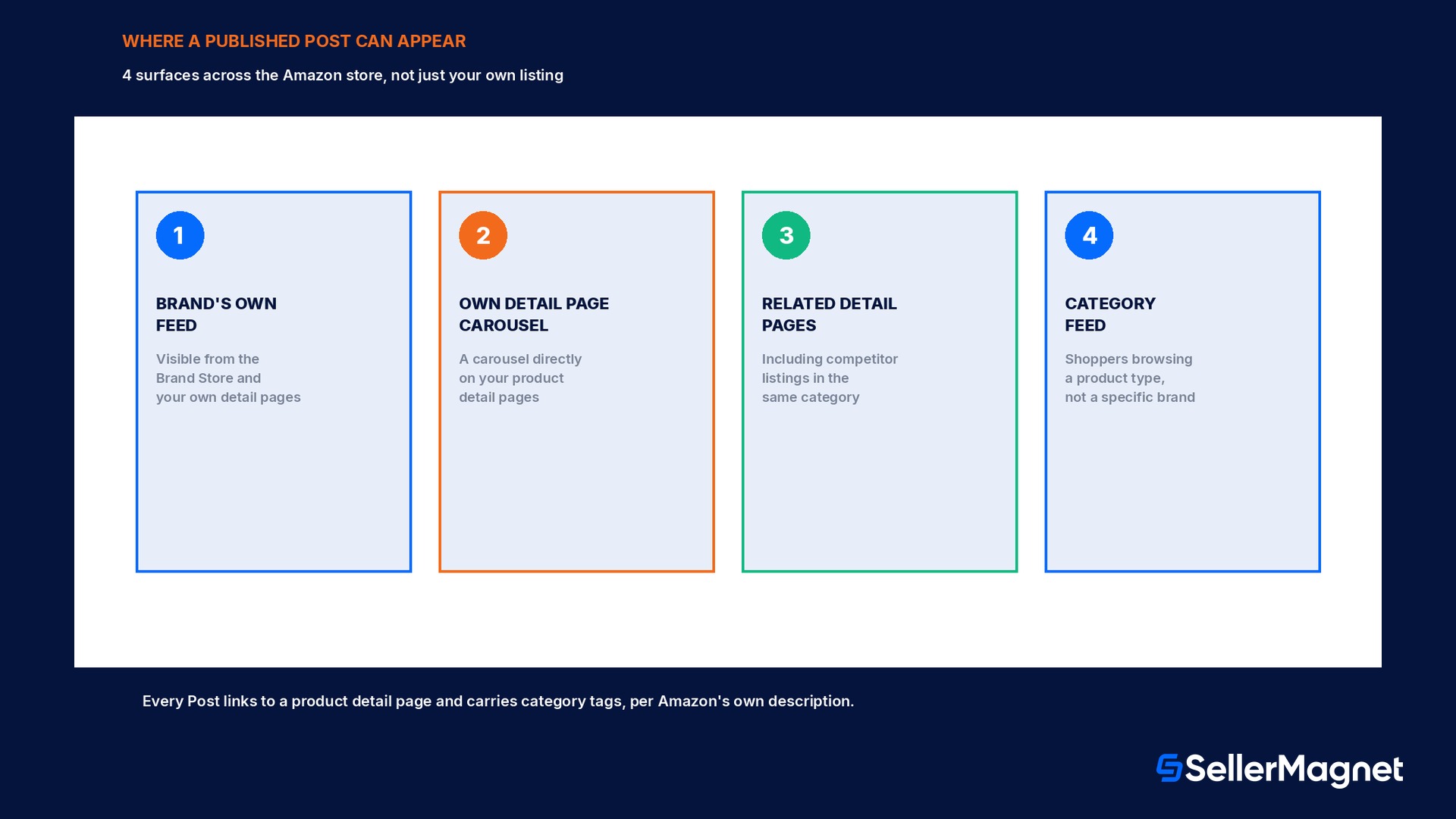
A Post is not confined to a brand's own storefront. Amazon's own description states that Posts link to product detail pages and carry category tags specifically so shoppers can keep exploring Posts in related categories, which is Amazon's own confirmation that a Post's reach extends beyond the page it was tagged from. In practice that means four distinct surfaces: the brand's own Posts feed, visible from its Brand Store and from its own detail pages; a carousel directly on the brand's own product detail pages; a feed on related or similar products' detail pages, including competitors in the same category; and a browsable category feed that shoppers reach by exploring a product type rather than a specific brand. A brand that only checks its own detail page for a Post is seeing one of four places it can appear.
The content rules that get a Post rejected
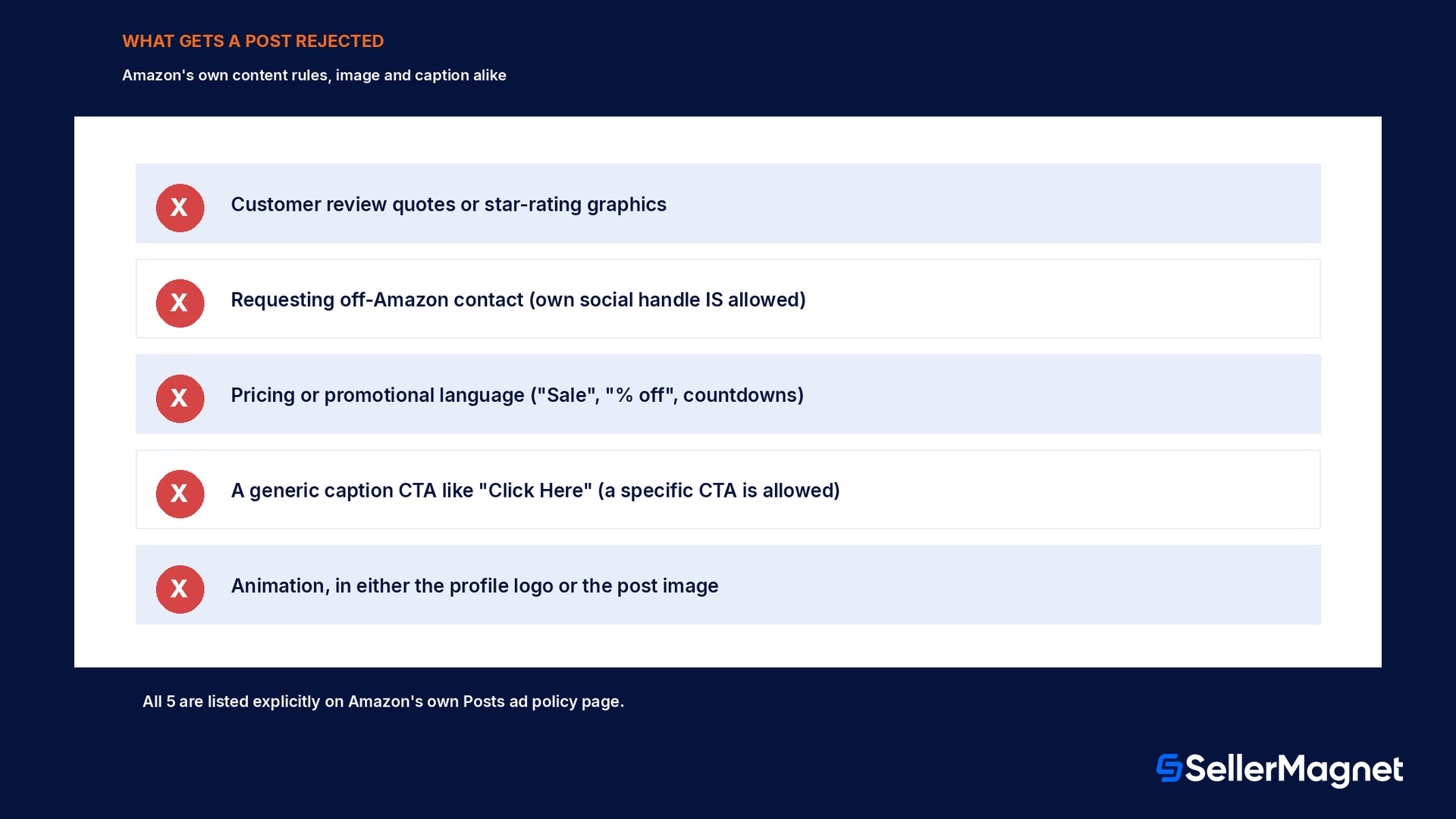
Amazon's Posts ad policy is explicit about what cannot appear in either the image or the caption, and two of the rules are narrower than brands often assume: a caption CTA is not banned outright, and a brand's own social handle is explicitly allowed.
No customer review quotes or star-rating graphics in the image or caption.
No requesting off-Amazon contact (email, social media handles, other methods); showing your own brand's social handle is permitted.
No pricing, percentage-off or promotional language ("Sale", "% off", countdowns).
No generic, non-specific caption CTAs like "Click Here"; a clear, specific caption CTA is allowed. A "Buy Now"-style CTA baked into the image itself is not.
No animation in either the profile logo or the post image.
How visibility actually works: no budget, no bidding
Posts has no bid, no daily budget and no auction, which is the point: it is positioned as a discovery surface, not a paid placement. Amazon does not publish the exact ranking formula behind which Posts surface more often in a brand's own feed, a category feed or a related-product feed. Independent trackers of the feature that monitor it closely consistently describe engagement, taps, clicks and follows, and recency as the signals that move a Post's visibility, which lines up with Amazon's own framing of Posts as an engagement-driven discovery feed rather than a reach-buying tool. A brand should treat posting consistency and genuinely tappable imagery as the realistic levers, not a bigger budget, since there is no budget to raise.
Mistakes that keep brands from using Posts well
Submitting the same image for both the profile logo and the post image. The two specs are different (1:1 at 640x640px vs. 1:2-to-2:1 at 640x320px); a logo-shaped square crammed into a wide post slot, or vice versa, looks wrong even if it technically clears review.
Treating Posts as a place to repeat the product listing's sales copy. The content rules exclude pricing and promotional language outright; a caption built the same way as a listing bullet point risks rejection, not just weak performance.
Assuming every CTA is banned and leaving the caption vague instead. Amazon's policy only blocks generic, non-specific CTAs like "Click Here"; a clear, specific caption CTA is allowed, it is the image itself that cannot carry a "Buy Now"-style CTA.
Removing the brand's own handle from a caption out of caution. Amazon's policy explicitly permits a brand's own social handle; what it actually bans is using a Post to request off-Amazon contact.
Assuming a Post will outperform because the brand has a big ad budget elsewhere. Posts has no bidding and no budget tier at all; spending more on Sponsored Brands or Sponsored Products does nothing to a Post's own visibility.
Posting once and never checking the four placement surfaces. A brand that only looks at its own product detail page is checking one of four places a Post can appear.
Using a review quote or a star-rating graphic for social proof. Both are explicitly listed as prohibited content on Amazon's own Posts ad policy page.
Assuming a non-brand-registered seller account can publish Posts. It cannot; the feature sits entirely behind Brand Registry enrollment.
Who should actually spend time on this
Posts is not a universal recommendation; it fits some seller situations far better than others.
A brand-registered seller with an already-tidy catalog of product photography. Reusing existing lifestyle or detail shots costs nothing extra to repurpose into a Post.
A multi-SKU brand that wants cross-sell visibility inside its own category. The category-feed and related-detail-page placements put a brand in front of shoppers browsing competitors, at no media cost.
A brand actively building a Brand Store and relying on its detail-page carousel for storytelling. Posts feed directly into the same brand-presence surfaces Amazon already gives Brand Registry members.
A seller without Brand Registry. Posts simply is not available; the realistic next step is pursuing Brand Registry eligibility itself, not trying to work around the gate.
A brand expecting Posts to replace a Sponsored Brands or Sponsored Products budget. It will not; Posts has no targeting, no bidding and no guaranteed placement, so it supplements a paid strategy rather than substituting for one.
Checklist before publishing a Post
How to prepare a compliant Amazon Post
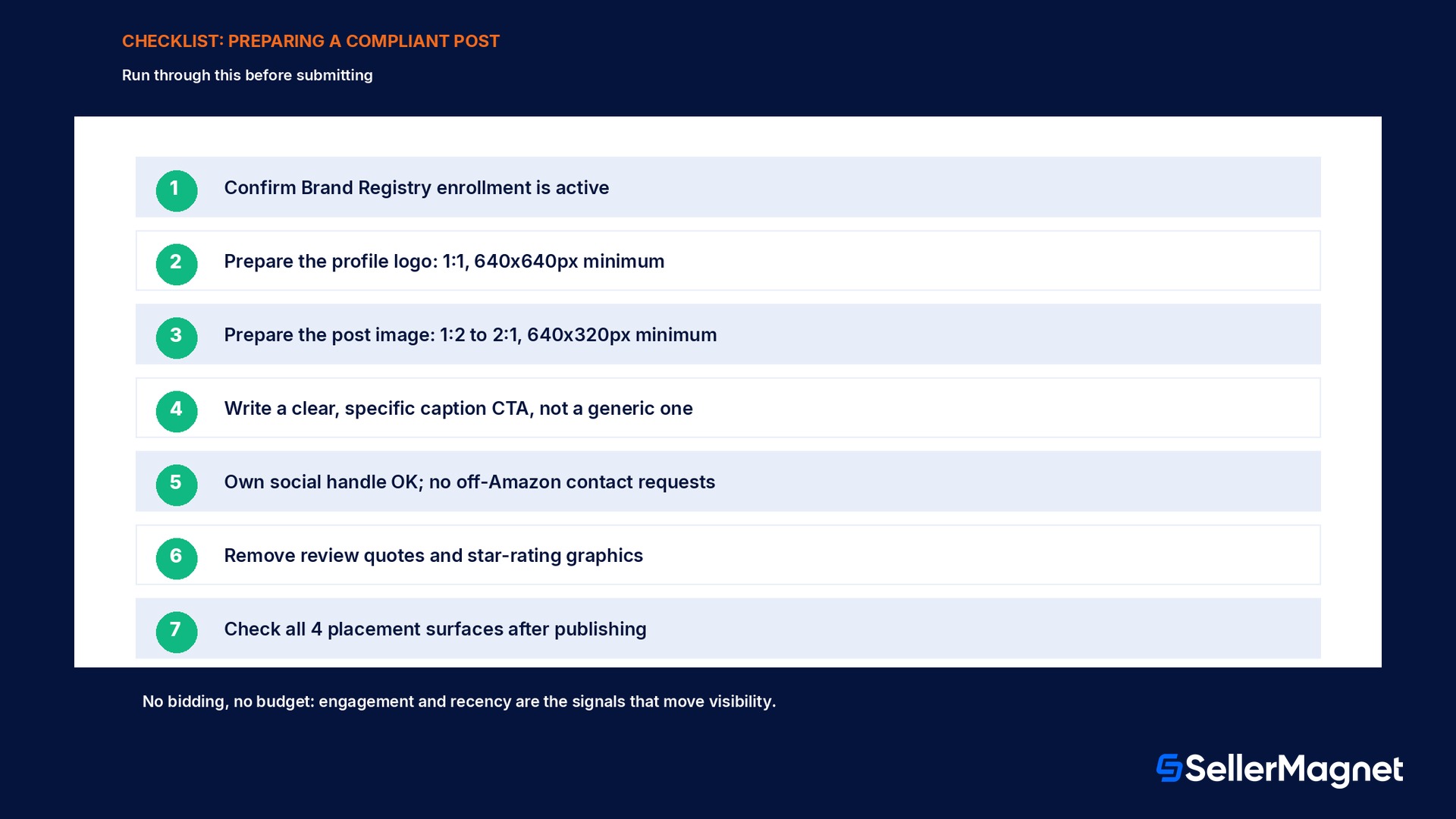
Confirm Brand Registry enrollment is active - Posts only becomes available once a brand's trademark-backed enrollment is approved; there is no separate Posts application.
Prepare the profile logo at 1:1, 640x640px minimum - JPG or PNG, RGB, under 100 MB, no animation.
Prepare the post image between 1:2 and 2:1, 640x320px minimum - A different aspect-ratio range and a lower minimum resolution than the logo; do not reuse the logo crop for this slot.
Write a caption with a clear, specific CTA, not a generic one - "Click Here" is prohibited; a clear, specific CTA is allowed, and pricing or promotional language is excluded regardless.
Keep the brand's own social handle if relevant, but no off-Amazon contact requests - Amazon's policy permits a brand's own handle; it bans asking shoppers to contact the brand via social media, email or other methods.
Remove any review quote or star-rating graphic from the image - Both are explicitly listed as prohibited content.
Publish and check all four placement surfaces, not just the brand's own detail page - Brand feed, own detail-page carousel, related detail pages and category feeds each show Posts differently.
Post consistently rather than once - With no bidding or budget available, engagement and recency are the signals independent trackers associate with visibility.
What SellerMagnet can and cannot do about this
Posts is created and published entirely inside Amazon's own seller and advertising tools; no third-party platform, including SellerMagnet, submits a Post on a brand's behalf. Where SellerMagnet does sit alongside the same Brand Registry prerequisite is on the adjacent brand-content surface A+ Content: the Listing Optimizer lets a Brand Registry-enrolled seller edit existing A+ Content modules and submit them to Amazon from inside SellerMagnet, which is the same underlying eligibility gate Posts sits behind, just a different content surface on the detail page itself.
A brand actively relying on Posts and A+ Content for brand presence is also, almost by definition, exposed to the two risks that come with visible brand real estate on Amazon: a competitor's listing changes or a counterfeit appearing nearby. Amazon Alerts is built for monitoring that side of the account, not for publishing Posts itself.
Do I need Amazon Brand Registry to use Amazon Posts?
Yes. Posts is listed by Amazon as a Brand Registry benefit; a brand needs an approved trademark enrolled in Brand Registry before it can publish Posts.
Does Amazon charge for Posts?
No. Amazon's own Brand Registry page describes Posts as content published "at no cost" in organic shopping feeds; there is no media spend or bidding involved in publishing a Post itself.
What is the minimum image size for a Post?
640 x 320 pixels or larger for the post image, and 640 x 640 pixels or larger for the profile logo, both JPG or PNG, per Amazon's Posts ad policy page.
Can a Post include a call to action?
In the caption, yes, as long as it is clear and specific; Amazon's policy only blocks generic, non-specific CTAs like "Click Here". A "Buy Now"-style CTA baked directly into the image itself is not allowed, and pricing or promotional language is excluded either way.
Can a Post show my brand's social media handle?
Yes. Amazon's policy specifically permits including your own brand's social media handle; what it prohibits is using a Post to request contact via social handles, email or other off-Amazon methods.
Where do shoppers actually see a Post?
On the brand's own feed, in carousels on the brand's product detail pages, and, depending on Amazon's placement logic, on related detail pages and in category-browsing feeds, per Amazon's own Posts description.
Does posting more often guarantee more reach?
Amazon does not publish a ranking formula; third-party analyses consistently describe engagement and recency as the signals that move a Post's visibility, not posting volume alone, so treat frequency as one input, not a guarantee.
Does SellerMagnet publish Amazon Posts for me?
No. Posts are created and published inside Amazon's own seller tools. SellerMagnet's Listing Optimizer works alongside the same Brand Registry prerequisite, for example editing and submitting A+ Content modules, not Posts itself.
Stop Juggling Tools. SellerMagnet Combines Everything You Need.