Got a Design Patent Infringement Claim on Amazon? What to Do Next
R
RenéFreelance Amazon Editor
|
14 min read
A design patent complaint is not something an Amazon algorithm raises on its own. A rights owner files it, through Brand Registry's Report a Violation tool or Amazon's Report Infringement form, and Amazon reviews the notice before acting on it. That review is not a court ruling on infringement, though: once a notice is accepted, Amazon removes the reported content, and it is up to you to reply. A design patent protects how a product looks, not how it works, so these disputes turn on silhouettes, proportions, seam lines and surface details rather than on function or materials. This guide covers what the claim actually means, the three checks worth running on the patent before anything else, which reply Amazon asks for, and how to write a specific reply that gives the reviewer something to check. It is not legal advice: Amazon's own IP policy pages recommend a lawyer for specific questions about IP rights, and so do we.
A design patent infringement claim on Amazon means a rights owner has reported your listing for copying the look of their patented design, not its function. Check the patent first: whether it is still in force and whether it is registered for that marketplace. Then reply to the notification with specific reasons why the designs differ, backed by side-by-side photos and measurements, or ask the rights owner for a retraction if you hold a license.
What does a design patent complaint actually claim?
Amazon's patents page for sellers draws the line in two sentences: utility patents 'generally protect the structure and functions of a product rather than how it looks', while design patents 'may be granted for the unique look of a product, but do not cover the structure or functions of a product'. A design patent complaint is therefore always an argument about appearance. In US law the yardstick is the 'ordinary observer' test, which the USPTO's examination manual (MPEP 1504) quotes from the Supreme Court's 1871 Gorham decision: a patented design is infringed when, 'in the eye of an ordinary observer, giving such attention as a purchaser usually gives', the two designs are 'substantially the same'. The same manual adds that the ordinary observer is deemed to compare the designs in the context of the prior art, meaning earlier similar designs, that the design is considered as a whole, and that when a patented design sits close to the prior art, small differences are likely to matter. Two practical consequences follow for your reply: explaining that your product works differently or uses other materials does not answer a design claim, and the comparison has to cover the overall look, not one detail in isolation.
Claim type
What it protects
How rights owners report it on Amazon
Utility patent
How a product works: its structure and functions
Report a Violation in Brand Registry (registered US utility patents can also apply for APEX) or the Report Infringement form
Design patent
How a product looks: its unique visual appearance
Report a Violation in Brand Registry or the Report Infringement form; not eligible for APEX
Trademark
A word, symbol or design that identifies whose goods they are
Report a Violation in Brand Registry or the Report Infringement form
Who can file a design patent complaint, and what happens to your listing
A notice has to come from the rights owner or from a registered agent acting for them. Amazon's page for rights owners says that to report an IP infringement you must be a Brand Registry user with the Rights Owner or the Registered Agent role. Enrolled brands can report through Brand Registry's Report a Violation tool (our Brand Registry guide covers enrolment); a rights owner whose brand is not enrolled can use the Report Infringement form, which is available to all selling partners, while logged in to an Amazon account. The notice must identify the IP, including its registration number, say where the infringement appears (on the product, its packaging, a detail page image or detail page text) and list the ASINs and URLs. The reporter then picks all sellers on the ASIN or specific sellers only, and Amazon tells rights owners to name the specific sellers 'to safeguard against the entire ASIN being affected' when only some offers are the problem. That choice decides whether only your offer or the whole detail page comes down. When a notice is valid, Amazon informs the responsible sellers and shares the rights owner's contact details with them; when it is accepted, Amazon removes the reported content and takes action against the responsible parties. Notices add up: Amazon's IP policy says it acts even when a seller infringes without knowing it, that an account can receive a warning or be suspended, and that it terminates repeat infringers in appropriate circumstances. The rights owner carries a risk too, since multiple submissions of inaccurate or inauthentic notices could lead to the removal of their submission privileges.
Check the patent itself before you reply
Three facts about the patent are worth a few minutes before you write a word, because each one can change the whole reply. First, is the patent still in force? Under 35 U.S.C. 173, as the USPTO's MPEP 1505 explains, a US design patent from an application filed on or after 13 May 2015 lasts 15 years from the date of grant, and one from an application filed before that date lasts 14 years from grant. The filing and grant dates are printed on the patent, and the USPTO's free Patent Public Search finds it by the number in the notice. A notice built on an expired patent has no current right behind it, so cite the expiry date in your reply. Second, is the patent registered for the marketplace where your listing was removed? Amazon's guidance for rights owners says a registered patent must be registered in the country where the infringement is reported, and that it will likely reject a notice based on a right from another country; its own example is a trademark registered in Italy used against a listing on Amazon.com. Third, does the number fit the claim? Amazon notes that US design patent numbers begin with the letter D, so a design patent notice that cites a number in another format, or that mixes up claim types, is worth pointing out.
Check
Where to verify it
If it fails
Patent still in force
Patent Public Search: the filing date and grant date on the patent
Cite the expiry: 15 years from grant if filed on or after 13 May 2015, 14 years if filed earlier
Registered for this marketplace
The issuing office on the patent, for example the USPTO for a US patent
Point out the mismatch: Amazon says it will likely reject a notice based on another country's right
Number fits a design patent
The notice itself: US design patent numbers begin with D
Flag a number or claim type that does not match a design patent
Respond to a design patent infringement complaint
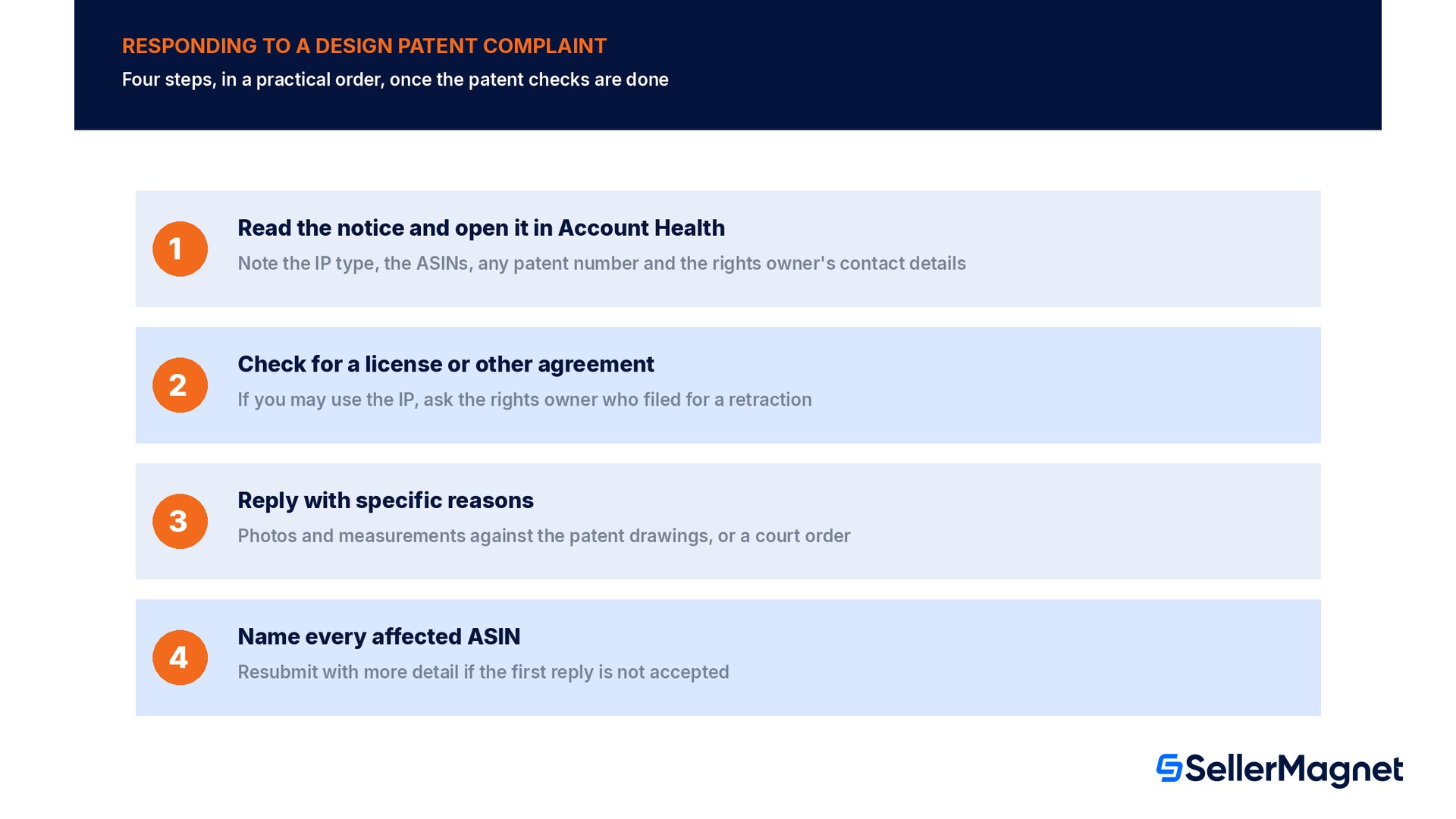
Read the notice and open the violation in Account Health. - Note the IP type, the ASINs, any patent number and the rights owner's contact details that Amazon shares with you. Amazon's IP pages send sellers to the Account Health page, where each violation has its own 'submit appeal' option and its own guidance on what to provide.
Check whether you are allowed to use the design. - If you hold a license or other agreement that allows you to use the IP named in the notice, contact the rights owner who submitted the complaint and request a retraction. Amazon says your content may be reinstated if it receives a retraction from the rights owner.
Reply with specific reasons, not a general denial. - For a patent notice, Amazon asks you to reply to the notification with specific reasons why you believe a mistake was made, and you may add a court order showing that your product does not infringe or that the patent is invalid or unenforceable. Side-by-side photos and measurements against the patent drawings make your reasons concrete. Invoices and Order IDs belong to counterfeit and trademark notices, which follow a different route.
Name every affected ASIN, and go again if needed. - List each affected ASIN, including child variants, so nothing is missed. If your first reply is not accepted, a second, more specific reply with a closer side-by-side comparison is a reasonable next step.
Never listed the reported product?
Then no design comparison is needed. Amazon's IP policy says that for a product you never listed, you reply to the notification you received and let Amazon know that you have never listed the reported product; Amazon then investigates to determine whether an error occurred. Keep that reply short and factual, and name the ASIN exactly as the notice does.
Which reply fits which notice?
Amazon's IP policy lists a different reply for each kind of notice, and sending the wrong one wastes a round. A design patent notice is a patent notice, so the patent row applies. If the same listing also draws a trademark or counterfeit complaint, that one arrives as a separate notice, because rights owners must file one IP type per notice, and it gets its own reply.
Situation
What Amazon asks for
Where
Patent infringement (design or utility)
Specific reasons why you believe a mistake was made; optionally a court order showing non-infringement or an invalid or unenforceable patent
Reply to the notification
You never listed the reported product
A note that you never listed it; Amazon investigates whether an error occurred
Reply to the notification
You hold a license or other agreement
A retraction from the rights owner who filed; your content may then be reinstated
Contact the rights owner
Trademark or counterfeit claim on the product or packaging
An invoice or Order ID that demonstrates authenticity
Account Health Dashboard
Several IP warnings on your account
A list of the affected ASINs plus invoices, Order IDs, an authorization letter from the rights owner or a court order
Appeal via Seller Central
What does a specific appeal actually read like?
Specificity matters more than length. A general appeal says the product is different without saying how; a specific one names what is being compared and states a conclusion for each point. A workable structure, adapted to your product and the patent in front of you: open with the ASIN and the exact patent number from the notice; state that you are disputing the design comparison, which is neither an acknowledgment nor a retraction request; describe the overall impression of your product next to the patent drawings; then walk through three to five concrete features that create the difference, such as the silhouette, a seam or panel line, the proportion between two parts or a surface pattern; attach the side-by-side photos the text refers to, with measurements where they help; and close by listing every attachment. Because the legal test looks at the design as a whole, a list of tiny differences without the overall view is weaker than it looks. A point-by-point comparison is also easier to review, and it gives you a clean base if a second, more detailed reply is needed. When the stakes are high or the rights owner has gone to court, have a patent attorney assess the comparison; Amazon accepts a court order as evidence.
If a separate notice alleges counterfeiting
Rights owners must file one IP type per notice, so a counterfeit or trademark complaint against the same listing comes as its own notice and needs its own answer. For a counterfeit or trademark claim about the product or its packaging, Amazon asks for an invoice or Order ID that demonstrates the product's authenticity, submitted through the Account Health Dashboard; a design comparison does not answer it. Spotting takedowns early helps with both: Offer Watch checks your own catalogue for suppressed listings once a day (hourly as a paid option), so a takedown shows up at the next check.
Why are these complaints hard to fully prevent?
A design patent complaint comes from a private party, not from an Amazon scan of your catalogue, so there is no setting that stops one from being filed. What you control is the groundwork and your reaction time: know where each design came from (your own design, or a license from the rights owner), keep your supplier records, and search active US design patents in Patent Public Search before launching a product that resembles a well-known one. Amazon's patents page is plain about it: the manufacturer or distributor of a product might be able to help with patent questions, and if you are unsure whether a product violates someone else's patent, consult a lawyer before listing. Market signals help too: a competing listing that suddenly goes inactive, or near-copies of a popular design appearing in your category, are reasons to look closer at the patents around that product. If the real problem is an unauthorized reseller riding your own listing rather than a copied design, that is a different fix; SellerMagnet's brand-owner guidance covers it, since repricing alone cannot remove an unauthorized seller. And because an IP notice lands on your Account Health page, it is worth knowing how violations there affect your Account Health Rating.
Where SellerMagnet fits.Competitor Tracker follows any ASIN you add, including ones you do not sell, for Buy Box owner, price, rank, stock and listing edits, so when a product you compete with goes out of stock or its listing changes, you see it at the next daily check. It does not file, defend or predict an IP complaint; it shows market changes earlier, so you know when to take a closer look.
Common mistakes when handling a design patent complaint
Arguing function instead of appearance. A design patent covers how a product looks; explaining that your product works differently or uses other materials does not answer the claim.
Sending a general denial. A reply without specifics gives the reviewer nothing to check. Name the ASINs, the patent number and the visual differences, and attach the comparison photos.
Answering the wrong claim type. Rights owners must file one IP type per notice, so check which type the notice actually names (patent, trademark or copyright) and send the reply Amazon lists for that type.
Expecting APEX to decide a design patent dispute. APEX covers registered US utility patents only; a design patent dispute runs through the notice, your reply and, if it comes to that, the courts.
Skipping the patent check and the license check. An expired patent, a right registered for another country or an existing license can settle the matter faster than a long evidence file, so check those first.
What is a design patent infringement claim on Amazon?
It is a notice from a design patent's rights owner, filed through Brand Registry's Report a Violation tool or Amazon's Report Infringement form, alleging that your product looks substantially the same as their patented design. It concerns appearance only, never function. If Amazon accepts the notice, it removes the reported content and informs the responsible sellers.
Can a design patent complaint go through APEX?
No. APEX, the Amazon Patent Evaluation Express, is only available for registered US utility patents; Amazon states that design patents, non-US patents and expired patents are not eligible. A design patent notice goes through the standard notice process instead, and you answer it by replying to the notification with specific reasons why you believe a mistake was made.
How do I appeal a design patent takedown on Amazon?
Open the violation on your Account Health page and reply to the notification with specific reasons why you believe a mistake was made: side-by-side photos, measurements and a comparison of the overall look with the patent drawings, listing every affected ASIN. You may also provide a court order showing non-infringement or an invalid or unenforceable patent.
Can the rights owner retract a design patent complaint?
Yes. Amazon's page for rights owners says they may submit a retraction if circumstances change after filing. If you hold a license or other agreement that allows you to use the IP, contact the rights owner who filed and ask for one; Amazon says your content may be reinstated if it receives that retraction.
Does a design patent complaint affect only my offer, or the whole listing?
It depends on how the rights owner filed it. A notice against all sellers on an ASIN can affect the entire detail page, while a notice against specific sellers' offers is meant to leave the page live for others. Amazon asks rights owners to name specific sellers when only some offers infringe, so check which applies to you.
Can an expired design patent still support a takedown?
It should not. Under 35 U.S.C. 173, a US design patent from an application filed on or after 13 May 2015 lasts 15 years from grant; one filed earlier lasts 14 years from grant. Look up both dates in the USPTO's Patent Public Search, and if the term has run out, cite the expiry date in your reply.
Does a US design patent cover my listing on other Amazon marketplaces?
Not automatically. Amazon's guidance for rights owners says a registered patent must be registered in the country where the infringement is reported, and that Amazon will likely reject a notice based on another country's right. A US design patent is a US right, so on other marketplaces, check which right the notice cites and where it is registered.
What happens if I receive several IP complaints?
After multiple warnings, if you believe your products do not infringe, Amazon's IP policy says to appeal via Seller Central with the affected ASINs and at least one of: invoices, Order IDs, an authorization letter from the rights owner (not a forwarded email) or a court order. Amazon terminates repeat infringers' accounts in appropriate circumstances.
Stop Juggling Tools. SellerMagnet Combines Everything You Need.