An email arrives from Amazon with a subject line about DAC7, and the seller's first reaction is usually to assume it is another Account Health notice and set it aside. It is not: DAC7 is an EU directive that requires Amazon, as the marketplace, to collect tax identification details from eligible sellers, verify them against the relevant authority's own database, and report the results, along with a quarterly breakdown of what that seller earned, straight to EU tax authorities. Miss the window Amazon gives to complete it and the consequence is not a warning letter; it is a suspended account and withheld payouts, triggered automatically once a fixed deadline passes with no separate notice that it has actually happened. This guide works through what information DAC7 actually requires, who is in scope (the 30-transaction and 2,000-euro threshold most sellers have never read closely), the exact 60-day clock and what happens at each reminder point, how Amazon's own consideration-amount formula turns a sale price into the number reported to tax authorities, and the specific, documented mismatches that most often stall a submission that looked complete.
DAC7 is an EU directive (Council Directive 2021/514) that requires Amazon to collect tax identification numbers, business details, and permanent establishment information from sellers whose primary address is in the EU, verify that information against tax authority records, and report it, together with the seller's quarterly sales, fees, and taxes, to EU tax authorities. Only sellers with at least 30 transactions or 2,000 euros in reportable consideration per year are in scope. Amazon gives 60 days from the first notification to submit the required information in the DAC7 portal inside Seller Central; missing that deadline suspends the account's listings and withholds its disbursements until the information is submitted and verified.
What does DAC7 actually require Amazon to collect and report?
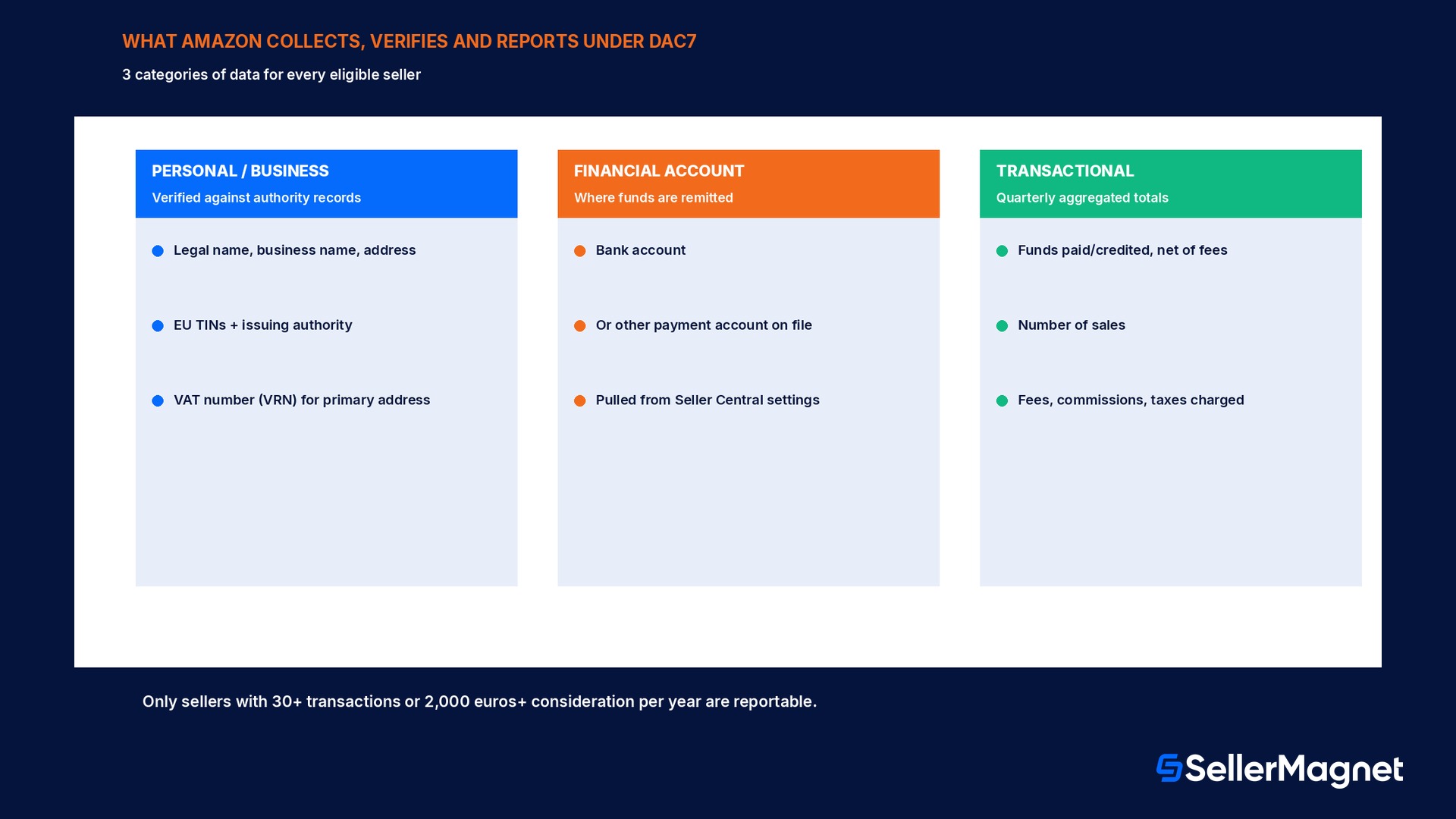
DAC7, formally the Directive on Administrative Cooperation's 7th amendment, is an EU directive that treats an online marketplace facilitating sales for EU-based sellers as a reporting intermediary for tax purposes, the same role a bank already plays for interest income. For every seller it determines is in scope, Amazon has to do three distinct things, each a separate compliance step rather than a single form: collect additional information such as Tax Identification Numbers (TINs), company registration numbers, and a list of permanent establishments in the EU; verify that information, which includes checking it against the issuing authority's own records rather than taking the seller's word for it; and report the seller's data, consideration earned, fees charged, and relevant banking details to the competent tax authorities. None of this is optional on Amazon's side once a seller crosses the threshold: the directive obliges Amazon to deactivate a non-compliant account if the required information is not provided and verified within 60 days of the first notification, which is why DAC7 shows up as an account-level deadline rather than a quiet background process.
Category
What Amazon reports
Where it comes from
Personal / business
Legal name or business name, address, all EU TINs with issuing authority, VAT registration number (VRN) for the primary address, date of birth where applicable
Seller Central account and tax settings, verified against authority records
Financial account
Bank account or other payment account funds are remitted to
Seller Central payment settings
Transactional
Quarterly total of funds paid or credited (net of fees), number of sales, fees/commissions/taxes charged
Amazon's own transaction records for the account
Who is actually in scope: the 30-transaction and 2,000-euro threshold
Not every EU seller gets reported under DAC7, and the cutoff is specific rather than a blanket rule applied to every account: Amazon's own guidance states that only sellers with a minimum of 30 transactions or a total consideration amount of 2,000 euros or more in a calendar year are eligible for reporting. A seller under both numbers, few transactions and a small total consideration, does not get reported for that year, and Amazon states this plainly rather than leaving it to inference. That does not necessarily mean the DAC7 portal disappears from Seller Central; a below-threshold seller may still see it, and completing it proactively is explicitly optional for that seller unless something changes, a new address, a business type switch, a tax number update, or the periodic 36-month reconfirmation window, that re-triggers the requirement regardless of transaction volume. The practical read for most small or seasonal EU sellers is to check both numbers for the calendar year rather than assume a quiet account is automatically exempt, since the threshold is evaluated per year, not permanently.
Below the threshold does not mean DAC7 never applies again
A seller who stayed under 30 transactions and 2,000 euros this year is not reported this year, but the same account is re-evaluated against both numbers every year. A quieter year followed by a busier one can move the same account back into scope with no separate warning beyond the normal DAC7 notification.
What is the 60-day deadline, and what happens if it is missed?
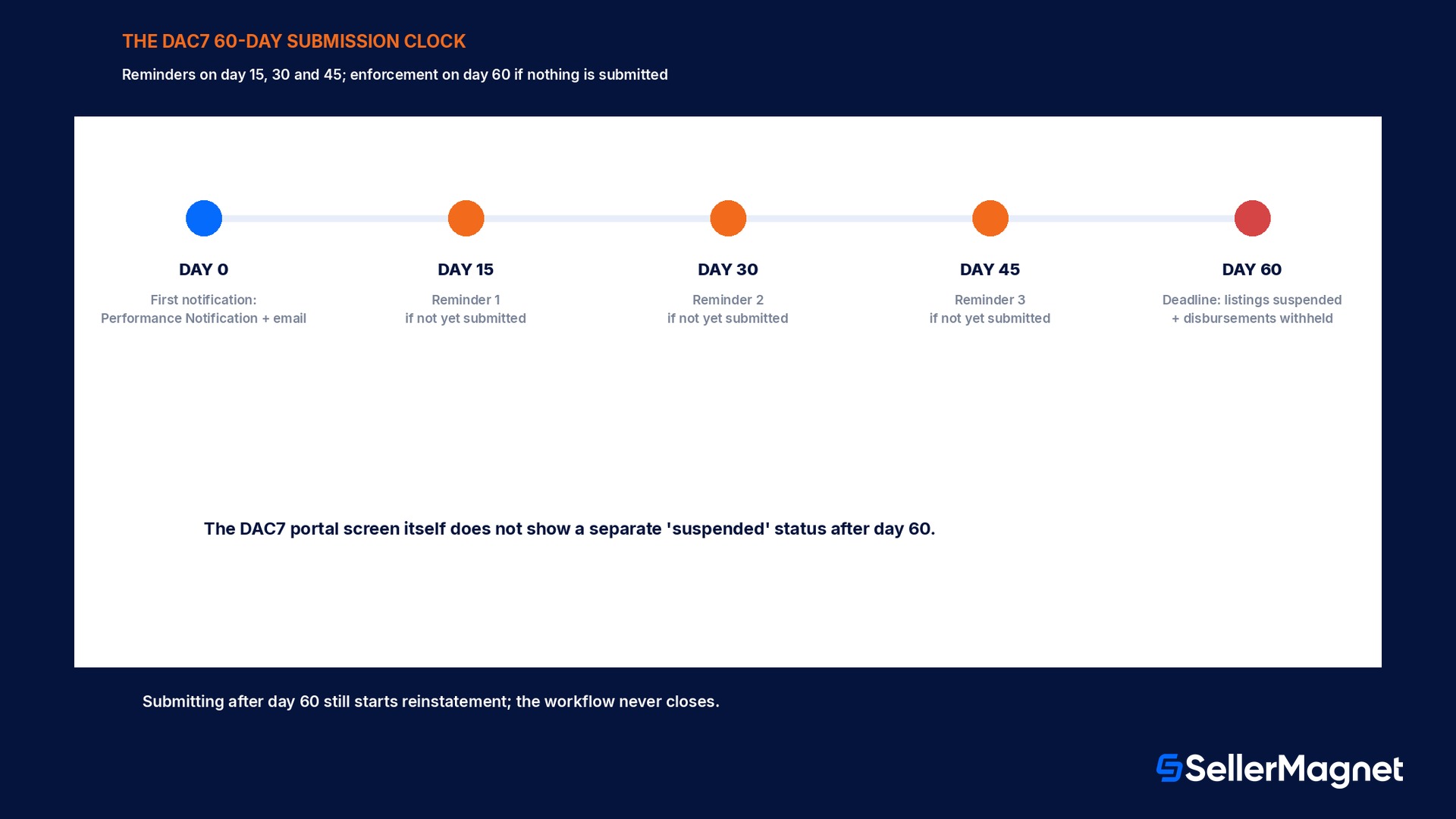
Amazon's own DAC7 timeline runs on a fixed clock rather than a soft target. Day 0 is the first notification, delivered as both a Performance Notification on the Account Health page and an email; from that date, the seller has 60 days to complete the DAC7 portal's full workflow and have the submission verified. Amazon does not wait silently in between: reminder notifications go out on day 15, day 30, and day 45, with a final reminder shortly before the day 60 cutoff. If day 60 arrives with no successful submission, Amazon takes two enforcement actions on the account at once, not one: listings are suspended, so the account cannot sell, and disbursements are withheld, so existing funds are held rather than paid out. There is a detail in Amazon's own guidance worth taking literally: the portal itself does not display a separate suspended status; the DAC7 status simply remains at risk and the workflow stays open, which means a seller checking only the DAC7 screen for a visible red flag can miss that the listings and payout holds have already taken effect elsewhere in the account. Completing the submission after day 60 still starts the reinstatement process, since the workflow never closes, but the suspension and the withheld funds are the state the account sits in until that happens.
Day
What happens
Day 0
First DAC7 notification: Performance Notification + email
Day 15
Reminder notification if not yet submitted
Day 30
Reminder notification if not yet submitted
Day 45
Reminder notification if not yet submitted
Shortly before day 60
Final reminder
Day 60
Deadline: listings suspended + disbursements withheld if not submitted and verified
How is the reported consideration amount actually calculated?
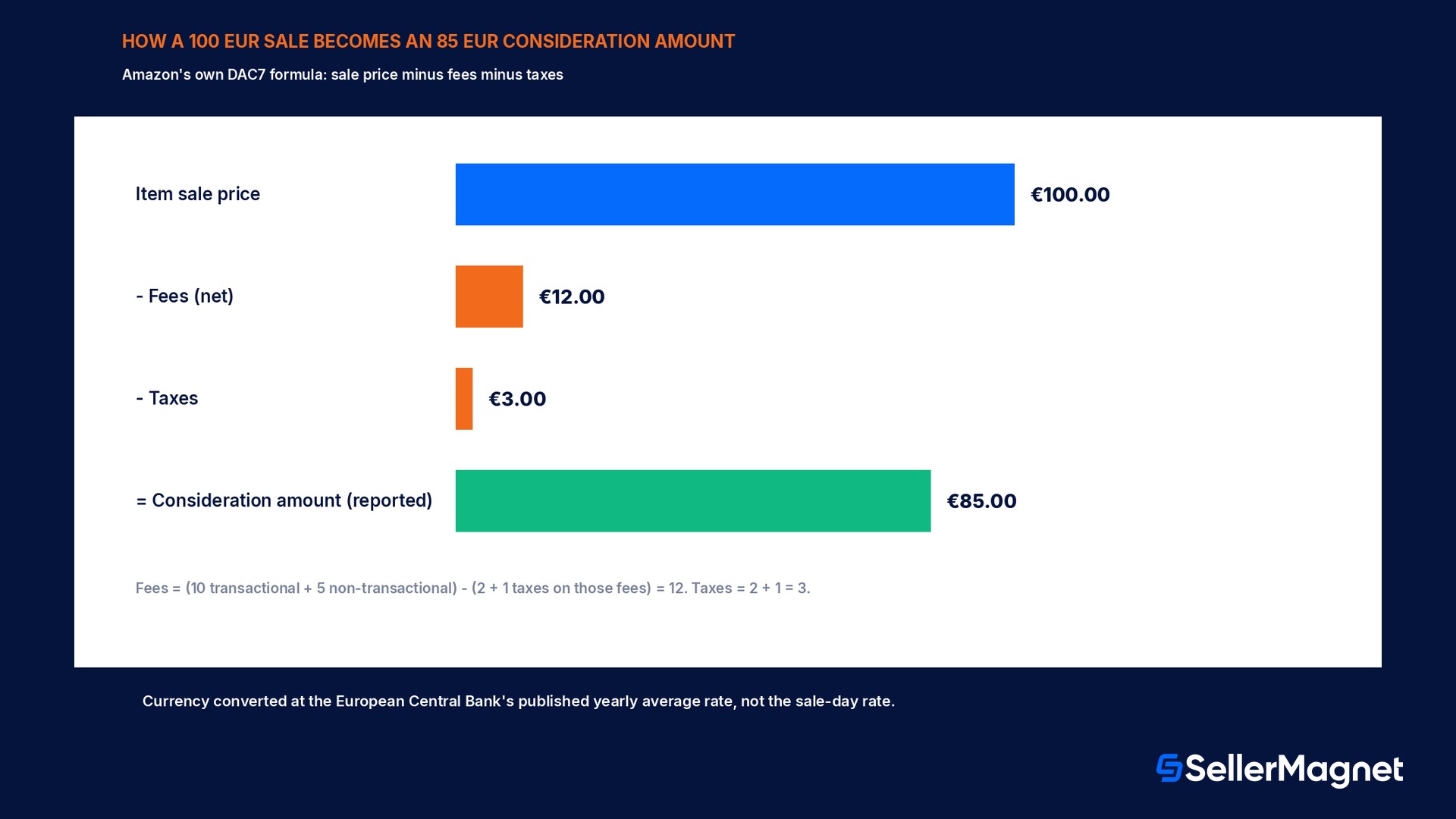
The number DAC7 reports to a tax authority is not the headline sale price a buyer paid; it is a consideration amount computed with a specific formula that nets out fees and taxes on two separate tracks. Amazon's own published calculation is: consideration amount equals the item sale price minus fees minus taxes, where fees equals the sum of transactional and non-transactional fees minus the sum of transactional and non-transactional taxes on those fees, and taxes equals the transactional taxes plus the non-transactional taxes. Running an actual sale through that formula makes the two-step netting clear rather than abstract. Take an item sale price of 100 euros, with transactional fees (including taxes on those fees) of 10 euros and the tax portion of that figure, 2 euros, broken out separately, plus non-transactional fees (including taxes on those fees) of 5 euros with 1 euro of that being tax. Fees in the DAC7 sense come out to 15 euros of combined fees minus 3 euros of combined fees-tax, for a net 12 euros; taxes come out to 2 euros plus 1 euro, for 3 euros; and the consideration amount reported is 100 minus 12 minus 3, which is 85 euros. A seller reconciling their own records against the DAC7 report, or against SellerMagnet's own margin figures, has to use this same consideration amount, not the raw sale price, or the two numbers will never match. For sales made in a currency other than euros, Amazon converts using the European Central Bank's published yearly average exchange rates, not the rate on the day of the individual sale.
Selling in multiple EU stores, and outside the EU
DAC7 is built on top of an already existing EU framework, the OECD's wider model rules for digital platforms that several non-EU jurisdictions have adopted in similar form, which is part of why a seller active across several marketplaces at once sees broadly comparable requests from more than one store rather than a single EU-only quirk. A seller running listings across several EU marketplaces, Germany, France, Italy, Spain, the Netherlands, Sweden, Poland, Belgium, and Ireland, does not complete DAC7 separately in each one. Amazon's guidance is explicit that the EU counts as a single store for DAC7 purposes: the 30-transaction and 2,000-euro threshold is assessed on the combined total across every EU marketplace, and the seller completes the submission once, in any one EU Seller Central account of their choosing, to cover all of them. That consolidation stops at the EU's own border. A seller who also meets the threshold in a non-EU store, the United States, Canada, Mexico, or Brazil among others, has a separate compliance obligation in each of those stores' own portals, assessed only on that store's own transactions; completing the EU submission does nothing for those accounts, and a seller active in several non-EU marketplaces may need to repeat the process more than once outside the EU even after the single EU submission is done. The VAT detail inside the portal is narrower than sellers sometimes expect: the DAC7 portal only displays the VAT registration number tied to the seller's primary address country, even when the seller holds additional EU VAT numbers registered elsewhere; those other numbers stay stored in Seller Central's tax settings and simply do not surface on the DAC7 screen. A seller with no EU VAT number at all still has to declare that explicitly inside the portal rather than leaving the field blank, since an empty field is not treated as equivalent to a deliberate 'no VAT number' declaration.
Change of circumstances and the 36-month reconfirmation
A completed DAC7 submission is not a one-time filing that never gets revisited. Four specific triggers reopen the verification workflow on an account that has already submitted successfully. An address change, updating the primary address inside Seller Central, restarts verification against the new address's tax authority. A business type change only works one direction for this purpose: switching from an individual seller account to a registered business entity (a sole proprietor incorporating, for instance) retriggers DAC7, while switching the other way, from an entity back to an individual, is explicitly not supported by the workflow and needs a different path. A tax number change, adding, removing, or editing a TIN or VAT number, also reopens verification, since the previously verified record no longer matches what the account now states. Separate from any of those, Amazon requires every seller to reconfirm their DAC7 declaration every 36 months regardless of whether anything changed at all, treating a stale but technically still-accurate filing the same as one that genuinely needs an update. None of these four triggers is optional to skip: a seller who updates an address or a tax number in Seller Central without completing the resulting DAC7 re-verification is, functionally, back in the same unverified state as a seller who never submitted in the first place, with the same 60-day clock and the same suspension and withheld-funds consequence if it lapses.
The notification email, and what Amazon actually does with the data
A seller who completes DAC7 successfully does not simply stop hearing about it afterward. Amazon's own guidance describes sending a separate notification email ahead of the actual report going to tax authorities, containing the specific data about to be shared, so the seller can review it and exercise whatever rights apply under the relevant data protection law before the report goes out. The underlying personal and financial information itself is pulled from what the seller has entered in Seller Central as of a fixed year-end date, December 31, with the aggregated transactional totals coming from Amazon's own transaction records rather than anything the seller submits separately for reporting purposes. A change made before that December 31 cutoff lands in the current year's report; a change made after it carries forward into the following reporting period instead, which matters for a seller who updates an address or a tax number late in the year and expects it to show up immediately. Amazon's guidance is also direct that DAC7's specific requirements can change over time as the underlying EU directive is amended again, and that sellers will be informed of any change that affects them, rather than the current rules being treated as permanently fixed.
The specific mismatches that stall a DAC7 submission
A name or address that does not match exactly. Amazon's own troubleshooting guidance names this as the most common verification failure: the legal business name and primary address in Seller Central must match the tax authority's record exactly, including punctuation, abbreviations, and special characters, not just in substance.
Treating identity verification (KYC) and DAC7 as the same requirement. They are separate, independent systems that both have to be satisfied for an account to be fully active; a seller who fixes their DAC7 submission while an unrelated KYC issue is still open will not see the account clear.
Leaving the 'no EU VAT number' field blank instead of declaring it. A seller genuinely without an EU VAT number still has to state that explicitly in the portal; an empty field is not read as a deliberate declaration and can stall verification.
Assuming a completed EU submission covers a non-EU store. A seller who meets the threshold in the US or another non-EU store still needs a separate submission in that store's own compliance portal; the EU-wide consolidation does not extend past the EU.
Not completing the resulting re-verification after an address, entity, or tax-number change. Updating the underlying Seller Central field is not the same action as completing the DAC7 workflow that change retriggers; the account can sit unverified until that second step happens.
Checking only the DAC7 portal screen for a sign of trouble. The portal does not display a separate suspended status after day 60; the listings-suspended and disbursements-withheld state can already be in effect elsewhere in the account while the DAC7 screen itself still just reads 'at risk'.
What SellerMagnet can and cannot do about this
Completing and verifying a DAC7 submission happens entirely inside Seller Central's own compliance portal, directly between the seller and Amazon; no third-party tool, including SellerMagnet, submits tax information on a seller's behalf or has any role in Amazon's verification of it. Where SellerMagnet's Fee Calculator and Analytics help is in reconciling the numbers once a DAC7 report exists: the fee calculator breaks a sale down into the same referral-fee and FBA-fee components that feed Amazon's own fees figure in the consideration formula above, and analytics gives a seller their own running total of transactions and net proceeds to sanity-check against the 30-transaction/2,000-euro threshold well before year end, rather than finding out where the count landed only when Amazon's own notification arrives.
DAC7 covers EU sellers' tax data reported to EU authorities; US sellers, or EU sellers who also sell into the US store, face a separate reporting mechanic covered in SellerMagnet's 1099-K tax reporting guide, which explains the US threshold and form instead. The two are run by different tax authorities under different rules and are not interchangeable.
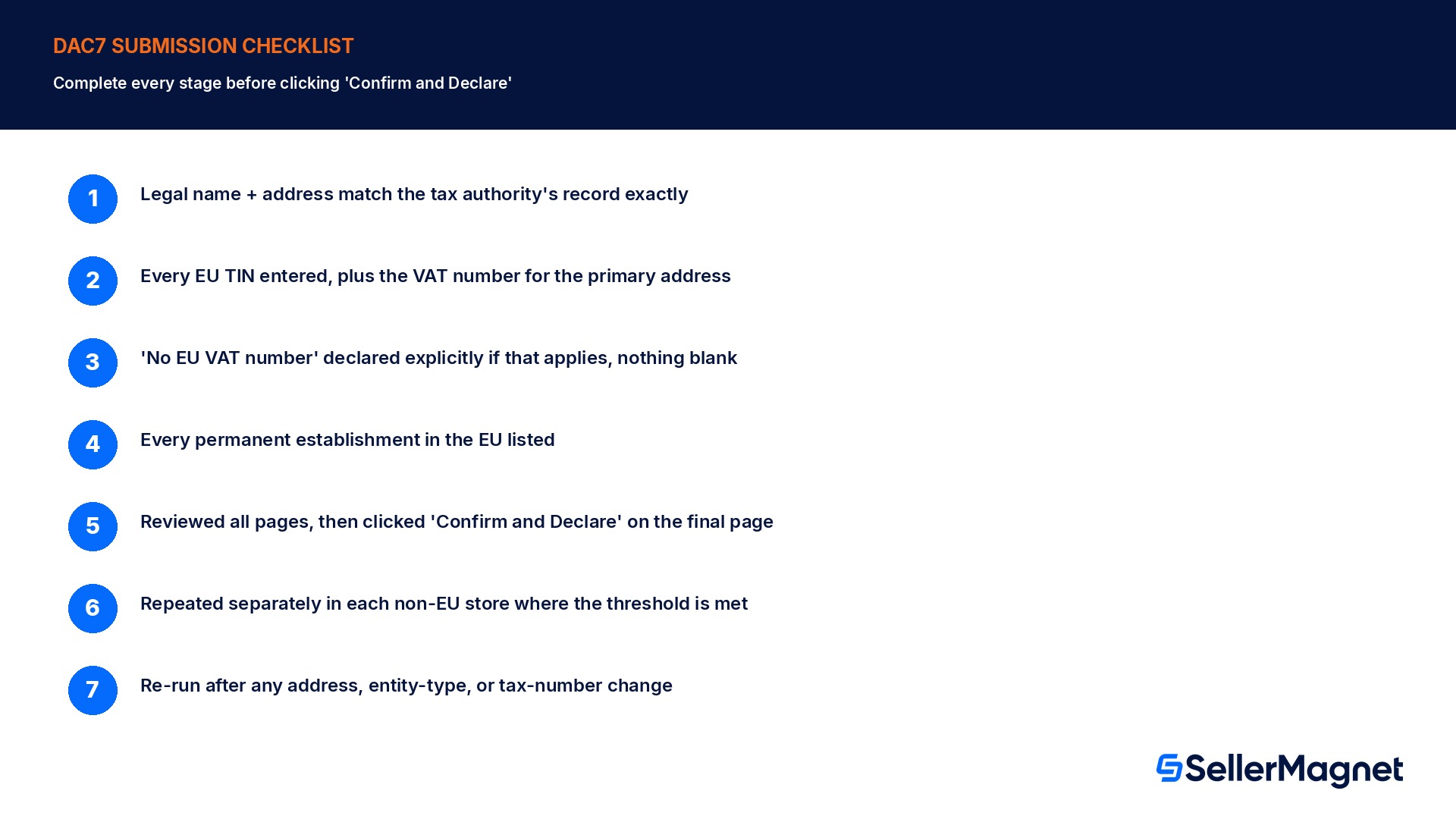
Checklist before the DAC7 clock runs out
How to clear a DAC7 notification before the 60-day deadline
Confirm the legal name and address match the tax authority's record exactly - Including punctuation, abbreviations, and special characters, not just the same information worded differently.
Enter every EU TIN and the VAT number for the primary address - The portal only displays the VRN tied to the primary address; other EU VAT numbers stay in Seller Central's tax settings.
Declare explicitly if there is no EU VAT number at all - Leave nothing blank; an empty field is not read as a deliberate 'no VAT number' declaration.
List every permanent establishment in the EU - Required before the final confirmation step, not optional detail.
Review every page, then click 'Confirm and Declare' on the final page - Saving progress on individual pages does not count as a submission; only the final declaration does.
Repeat separately in each non-EU store where the threshold is met - The EU submission covers every EU marketplace at once, but it does not cover the US, Canada, Mexico, Brazil, or other non-EU stores.
Re-run the workflow after any address, entity, or tax-number change - Updating the Seller Central field alone does not complete the re-verification that change retriggers.
What is DAC7, in plain terms?
DAC7 is an EU directive (Council Directive 2021/514) requiring Amazon, as the marketplace, to collect, verify, and report EU-based sellers' tax identification and quarterly sales data to EU tax authorities. It is Amazon's compliance obligation, triggered by a seller crossing a reporting threshold.
Who actually gets reported under DAC7?
Only sellers with at least 30 transactions or 2,000 euros or more in total consideration per calendar year. Sellers under both numbers are not reported for that year, though the DAC7 portal may still be visible.
What happens if I miss the 60-day DAC7 deadline?
Amazon suspends the account's listings (no selling) and withholds disbursements (funds held) until the required information is submitted and verified. The DAC7 portal itself does not show a separate suspended status.
Is the consideration amount DAC7 reports the same as my sale price?
No. It is the sale price minus fees minus taxes, using Amazon's own formula that nets transactional and non-transactional fees and taxes separately. A 100-euro sale with the fees and taxes in Amazon's own worked example reports as an 85-euro consideration amount.
Do I need to complete DAC7 separately for each EU country I sell in?
No. The EU counts as one single store for DAC7: completing it once in any EU Seller Central account covers all EU marketplaces. Non-EU stores each require their own separate submission in that store's own compliance portal.
I already completed DAC7. Why am I being asked again?
An address change, switching from an individual account to a business entity, a tax number change, or the mandatory 36-month reconfirmation all retrigger the verification workflow, even if the original submission was accepted.
Are DAC7 and Amazon's seller identity verification (KYC) the same thing?
No, they are separate, independent requirements. Both have to be satisfied for an account to be fully active; resolving one does not resolve the other.
Stop Juggling Tools. SellerMagnet Combines Everything You Need.